Introduction
In recent years, India and other developing countries have experienced a rapid acceleration in the epidemic of type 2 diabetes (T2D).Reference Shaw, Sicree and Zimmet1, Reference Yajnik2 T2D has a multifactorial aetiology, which includes risk factors such as obesity,Reference Jayawardena, Ranasinghe, Byrne, Soares, Katulanda and Hills3 malnutrition,Reference Misra and Khurana4 physical inactivity,Reference LaMonte, Blair and Church5, Reference Sieverdes, Sui and Lee6 rising life expectancy,Reference Shaw, Sicree and Zimmet1, Reference Wild, Roglic, Green, Sicree and King7 genetic predisposition,Reference DeFronzo8 ethnicity,Reference Seshiah, Balaji, Balaji, Paneerselvam and Kapur9 an adverse intrauterine environment and rapid ‘catch-up’ growth.Reference Yajnik2, Reference Yajnik10, Reference Hales, Barker and Clark11
In addition to the increasing prevalence of T2D in India, Indians are characterized by having an increased total fat mass (FM) and a lower fat-free mass (FFM), including muscle mass, when compared with Caucasians with the same body mass index (BMI).Reference Liew, Seah, Yeo, Lee and Wise12–Reference Chandalia, Lin and Seenivasan14 Furthermore, Asian Indians are characterized by an inappropriate distribution of the total FM, with more fat located centrally, including visceral and subcutaneous abdominal fat, and less fat on the lower extremities in addition to an increased prevalence of insulin resistance.Reference Banerji, Faridi, Atluri, Chaiken and Lebovitz13–Reference Chandalia, Abate, Garg, Stray-Gundersen and Grundy15
In India, nearly 30% of newborns are conceived with low birth weight (LBW), and according to the thrifty phenotype hypothesis these infants have an increased risk for developing T2D in their adult life.Reference Desai and Hales16–Reference Phillips, Barker, Hales, Hirst and Osmond22 Previous studies in Caucasians have shown that LBW leads to an increase in hepatic insulin resistance, and when overfed a high fat diet LBW individuals furthermore exhibit peripheral insulin resistance as compared with NBW individuals.Reference Brøns, Jacobsen and Hiscock19 In a recent study,Reference Thomas, Grunnet and Poulsen20 we have shown that young South Indian Dravidians born with LBW compared with controls born with a normal birth weight (NBW) are characterized by being shorter, lighter and having a lower lean body mass, as well as a marginal increase in diastolic blood pressure and in the incidence of glucose intolerance. However, we did not detect any significant difference in insulin sensitivity between the rural Indian LBW and NBW groups.
Physical activity has many beneficial effects, which include the improvement of insulin sensitivity and protection from insulin hyper-secretion in both healthyReference Borghouts and Keizer23, Reference Nishida, Higaki and Tokuyama24 and obese, as well as pre-diabetic individuals and overt T2D patients.Reference Krotkiewski, Lönnroth and Mandroukas25, Reference Dela and Stallknecht26 It is well established that body composition may be modified by physical exercise training,Reference Poehlman, Denino and Beckett27, Reference Lo, Lin, Yao and Ma28 and studies in Caucasians have supported the idea that physical exercise training protects LBW individuals from the development of overt glucose intolerance and insulin resistance.Reference Ortega, Ruiz and Hurtig-Wennlöf29–Reference Laaksonen, Lakka and Lynch31 In contrast, a study has shown no evidence with regard to physical activity or aerobic fitness being able to moderate the association between LBW and insulin resistanceReference Ridgway, Brage and Sharp32. Some studies have suggested that LBW subjects perform disproportionately less leisure-time physical activityReference Kaseva, Wehkalampi and Strang-Karlsson33–Reference Andersen, Angquist and Gamborg36, whereas others have reported no association between birth weight and total physical activityReference Ridgway, Brage and Sharp32 or aerobic capacityReference Clemm, Røksund, Thorsen, Eide, Markestad and Halvorsen37. Thus, whether subjects born with LBW have an altered capacity with regards to performing physical exercise training remains unclear.
The aim of this study was to assess the effect of a 6-week free-living outdoor bicycle intervention on body composition, insulin sensitivity and insulin secretion in young rural Indian men born with LBW compared with NBW controls.
Subjects, materials and methods
All participants gave their informed written consent in the local language after the protocol was approved by the local ethics committee.
The individuals were all part of an ongoing study programme to determine the impact of the prenatal environment on physiological mechanisms involved in the development of T2D and body composition in rural Indian men, wherein baseline data have recently been published.Reference Thomas, Grunnet and Poulsen20
A total of 117 young healthy men between 18 and 22 years of age were enrolled. All participating individuals had a complete physical examination, with genital staging, and only men who had attained puberty were included in the study. Individuals who had performed strenuous exercise [organized physical activity (sports) several times a week], those with a BMI>30 kg/m2 or those who were on any medication known to interfere with glucose homoeostasis were excluded from the study.
In addition, individuals with any chronic infection, metabolic disorders, major organ diseases, who smoked more than 10 cigarettes/day and/or consumed alcohol in excess of six pegs a week (one peg is equal to 30 ml of 42.8% of alcohol) were excluded from the study.
The participants were selected according to their birth weight from the birth registry at the Community Health Department of Christian Medical College, Vellore, India, as has been previously reported.Reference Thomas, Grunnet and Poulsen20 The 10th, 70th and 90th percentiles for birth weights in this cohort were 2450, 3100 and 3500 g, respectively. Birth with LBW was defined as birth weight <10th percentile and NBW as birth weight within the 70th–90th percentile. A total of 13,172 males born between 1986 and 1992 in 82 villages were included in the study. Of the 13,172 men, 5,892 were included from 23 randomly selected villages. Thus, 7,280 men from 59 villages were not selected. Out of the 5,892 men, only 4.842 had recorded birth weights, which resulted in the exclusion of another 1,050 men. A total of 1,624 out of 3,208 of the recorded birth weights met the birth weight criteria for the study. A total of 285 men were approached before the desirable number of 60 LBW and 60 NBW was reached. However, another three men were excluded due to ambiguous recordings of birth weight. Thus, 61 men with LBW and 56 with NBW participated in the study. The main reasons for non-participation were migration out of the district, holding a job elsewhere in the district or state and unwillingness to participate.
Study design
The study design is displayed in Fig. 1. After an overnight fast, the individuals were escorted from their homes by a local social worker to the hospital for baseline and follow-up measurements. They underwent a two-day thorough physical examination that included anthropometric measurements and collection of blood samples. Furthermore, a hyperinsulinaemic-euglycaemic clamp test was performed to determine peripheral insulin sensitivity, and an oral glucose tolerance test was carried out to determine the glucose tolerance status.Reference Thomas, Grunnet and Poulsen20 In order to estimate the participants’ regular level of physical activity, the individuals were asked to answer the short form of the International Physical Activity Questionnaire (IPAQ) before the intervention and the individuals were categorized into groups of low, moderate or high level of physical activity,Reference Craig, Marshall and Sjöström38 and objective measures of activity were obtained in the beginning and at the end of the intervention period.
An overview of the study design. Solid circles indicate examinations that are performed both before and after the intervention. OGTT, glucose tolerance test; HEC, hyperinsulinaemic-euglycaemic clamp; IPAQ, International Physical Activity Questionnaire; DEXA, dual-energy X-ray absorptiometry scanning; BP, blood pressure; BIA, bioimpedance analysis; IVGTT, intravenous glucose tolerance test.

Body composition
The body composition before and after the intervention was assessed by bioimpedance analysis (BIA) (Bodystat®1500; Bodystat Ltd, Isle of Man, UK), giving estimates of total FM, FFM and fat percentage. The procedure was performed with the participants fasting and lying in the supine position. The electrodes were placed on the participants’ hand and foot unilaterally and a 50 kHz of electric current was transmitted through the electrodes.
Fasting blood samples
Fasting blood samples were obtained before and after the intervention. Three fasting blood samples for the determination of insulin and C-peptide levels and two samples for testing glucose level were obtained each time. Glucose level was measured by the glucose oxidase–peroxidase method using reagents supplied by Roche, on Roche Modular P 800 system (% CV 3.6). Insulin and C-peptide concentrations were measured by chemiluminescence immunoassay, using kits for the Immulite 2000 system (Siemens healthcare Diagnostic products Ltd, Llanberis, Gwynedd, UK). Chemistry and immunoassay controls supplied by Bio-Rad were used as internal precision controls (% CV 10.2 for insulin and 3.7 for C-peptide).
Intravenous glucose tolerance test (IVGTT)
To determine the insulin secretion (β-cell function), a 30 min IVGTT was performed. A 20% glucose bolus of 0.3 g/kg body weight was infused over 1 min. Blood samples for determining glucose, insulin and C-peptide levels were collected at 0, 2, 4, 6, 8, 10 and 30 min. The IVGTT was performed before the clamp test at baseline and again after the bicycle intervention.
Calculations from the IVGTT and fasting blood samples
From the IVGTT, the area under the curve for insulin, glucose and C-peptide during the first 10 min of the IVGTT was calculated using the trapezoidal rule (AUC 0–10). First-phase insulin secretion (FPIR) during the IVGTT refers to the incremental area AUC0-10 and represents the average acute insulin response to the infusion of glucose in the first phase. To adjust for any baseline differences in basal insulin, FPIR was calculated as FPIR=[AUC insulin 0–10 (pmol/l)–AUC basal−insulin×10 min (pmol/l)]. PHI1 was calculated as a measurement of insulin secretion in relation to the glucose level as PHI1=[AUC insulin 0–10 (pmol/l)/AUC glucose 0–10 (mmol/l)].Reference DeFronzo8 To obtain the relationship between the insulin sensitivity and insulin secretion, the disposition index (DI) was calculated. An approximately hyperbolic relationship between the two measures exists, so that the product is constant for individuals with the same degree of glucose tolerance. DI was calculated as DI=[FPIR×(1/HOMA-IR)].Reference Faerch, Brøns, Alibegovic and Vaag39, Reference Kahn, Prigeon and McCulloch40
From the fasting blood samples, the homoeostasis model assessments (HOMA) of insulin resistance (HOMA-IR) and insulin secretion (HOMA-IS) were calculated as HOMA-IR=[(basal plasma−insulin×0.144)×(basal plasma−glucose)/22.5] and HOMA-IS=[(basal plasma−insulin×0.144×20)/(basal plasma−glucose−3.5)].Reference Wallace, Levy and Matthews41
Exercise capacity test
A sub-maximal bike test was performed before and after the intervention to provide an indication of physical fitness, as well as serve as an individual calibration of heart rate (HR) to energy expenditure for objective measures of habitual physical activity. The protocol included a 5-min warm-up at 10 Ws, after which the load was increased to 50 and by 30 W every minute thereafter. The physiological energy expenditure of each workload was estimated as 10.8 ml O2/min/W (ACSM equation), which was divided by body weight and regressed against the measured HR. The HR–VO2 relationship was extrapolated to age-predicted maximal HRReference Tanaka, Monahan and Seals42 to yield an estimate of VO2 max in milliliters O2/min/kg.
Intervention
All the participants were provided with a bicycle after having completed the baseline examination. The participants were instructed to exercise for at least 45 min a day for a 6-week period. The 45-min period of exercise was not required to be continuous in one bout but needed to be accumulated in bouts of at least 10-min duration. Participants were asked to keep a diary for recording their cycling sessions; this was checked on a daily basis by field workers as best as possible. Among the 117 individuals who participated in the exercise programme, 57 of them were monitored on a weekly basis in the field (two field workers had examined the diary maintained by the individuals). The remaining 60 participants were monitored twice a week through telephonic monitoring by social workers, as the participants were not at home owing to their agrarian occupation.
Objective assessment of physical activity
The participants’ total physical activity level during the intervention period was estimated using combined accelerometry and HR monitoring (Actiheart®; MiniMitter, Philips-Respironics, USA), as described elsewhere.Reference Brage, Brage, Franks, Ekelund and Wareham43 The monitor was placed on the participants’ chest wall and was worn for a total duration of 3 days in the beginning and for another 3 days and nights at the end of the bicycle intervention. These data also provide measures of sleeping HR, which can be used as a proxy indicator of cardiorespiratory fitness. Data were collected during free-living in a 15 s epoch resolution and pre-processed before further analysis.Reference Stegle, Fallert, MacKay and Brage44, Reference Ryberg, Sandberg and Mellberg45 Individual calibration of HR was performed using data from the incremental cycle ergometer exercise test described above and the parameter derivation as described elsewhere,Reference Brage, Ekelund and Brage46 from which physical activity intensity was estimated using a branched equation framework.Reference Brage, Brage and Franks47
Physical activity energy expenditure (PAEE) was calculated by integrating intensity time-series excluding non-wear periods and minimizing diurnal information bias; data were included for observations with more than 24 h of monitoring.
Statistical analyses
The parameters were tested for normal distribution by Kolmogorov–Smirnov test and histograms. In order to examine the impact of the intervention in the LBW and NBW group, Wilcoxon signed rank test (non-normally distributed) or the paired Student’s t-tests (normal distributed) was performed. When comparing the two birth weight groups, before and after the intervention, Wilcoxon two-sample test (non-normally distributed data) or the unpaired Student’s t-test (normally distributed data) was performed. In order to compare the differential effect of the intervention by birth weight, delta values were compared between groups. The normally distributed variables are reported as mean and 95% confidence interval, and the non-normally distributed variables are reported as median and interquartile range for the 25th and 75th percentile. P-values ⩽0.05 were considered statistically significant.
The reported data from the insulin and C-peptide fasting blood sample measurements were examined, and values with greater than two-fold deviation between successive measurements were excluded. The mean values for the remaining data for the fasting samples were used in the analysis. No participants were excluded; only single values were excluded from the analysis.
Due to a variation in the number of days between the measurements of the participants before and after the intervention, we performed a sub-analysis including only participants who were measured at baseline and 4–8 weeks thereafter (n=42 LBW and 36 NBW). In addition, sub-analyses were performed on those who had maintained their dairies on a daily basis, cycled for an average of 45 min/day and had a 4- to 8-week gap between their two examination days.
SAS Enterprise guide version 4.3 (SAS®; SAS Institute Inc., USA) was used for all statistical analyses.
Dropouts
At the time of follow-up, 14 participants had dropped out – nine from the LBW group and five from the NBW group. Post-intervention results are, therefore, based on 103 participants in total (LBW: n=52 and NBW: n=51). The reasons for dropping out included the following: being apprehensive of the previous clamp procedure and hence reluctant to return (n=6), having moved out of the district (n=4), parents preventing study completion (n=2), varicella infection that prevented return (n=1) and claustrophobia due to study-related procedures (n=1).
Results
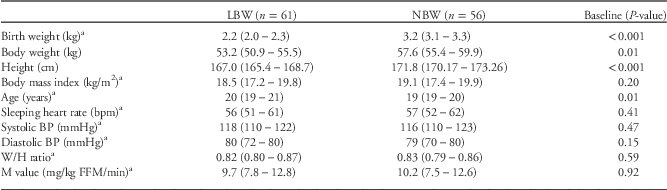
The clinical characteristics of the study participants have been previously publishedReference Thomas, Grunnet and Poulsen20 and are summarized in Table 1. The LBW individuals were 1 kg lighter at birth compared with the NBW group (P<0.001). The LBW participants were slightly older (P=0.01), lighter (P=0.01) and significantly shorter (P<0.001) than the NBW participants. No significant difference was observed between the LBW and NBW groups at baseline with regard to BMI and the peripheral insulin action (M value). Similarly, LBW and NBW individuals were equally distributed according to their self-reported physical activity level before the intervention, as estimated from the IPAQ; the majority was classified in the moderate or high activity level groups (LBW group: low physical activity n=11, moderate n=10 and high physical activity n=33; and NBW group: low physical activity n=14, moderate n=9 and high physical activity n=27).
Baseline clinical characteristics by birth weight groups
BPM, beats per minute; BP, blood pressure; W/H ratio, waist/hip ratio; FFM, fat-free mass.
Means and 95% confidence intervals for normal distributed data.
a Median and 25th and 75th interquartile intervals for non-normally distributed data.
A total of 63 participants had maintained an exercise diary on a regular basis. A total of 45 participants maintained the diary on a daily basis. A total of 40 participants maintained the diary daily and also cycled for 45 min a day. Out of these 40 participants, 26 had a 4- to 8-week gap between their two clinical examinations.
Total physical activity at beginning and end of intervention
No significant difference was observed in the LBW and NBW group with regard to PAEE (ml/kg/min); LBW at the beginning of the intervention was 76 (61−104) and at the end was 79 (56−102) (P=0.91), and NBW at the beginning of the intervention was 81 (64−98) and at the end was 75 (60−93) P=0.68. In addition, no difference in PAEE was observed during the first 3 days of the intervention between LBW and NBW groups (P=0.85).
Intervention effects on fitness indicators
Adequate data in relation to both the beginning and the end of the intervention were available for 70 participants (LBW group n=28 and NBW group n=42). No difference in the estimated VO2 max between birth weight groups was observed either before (LBW: 55.0 (52.0−58.0) v. NBW: 57.0 (53.8−59.8), P=0.39) or after the intervention (LBW: 58.0 (54.4−60.5) v. NBW: 55.3 (51.7−58.8), P=0.25). However, the intervention resulted in improving the estimated VO2 max for the LBW group (P=0.05), whereas no significant intervention effect was observed for the fitness test result in the NBW group (P=0.75); the time×group interaction was not significant (P=0.22). There was, however, a significant decrease in sleeping HR in the NBW group, from 57 (52−62) to 54 (51−60) bpm (beats per minute) (P=0.01), and a similar trend in the LBW group, from 56 (51−61) to 54 (49−60) bpm (P=0.09), suggesting an increase in physical fitness.
Intervention effects on body composition
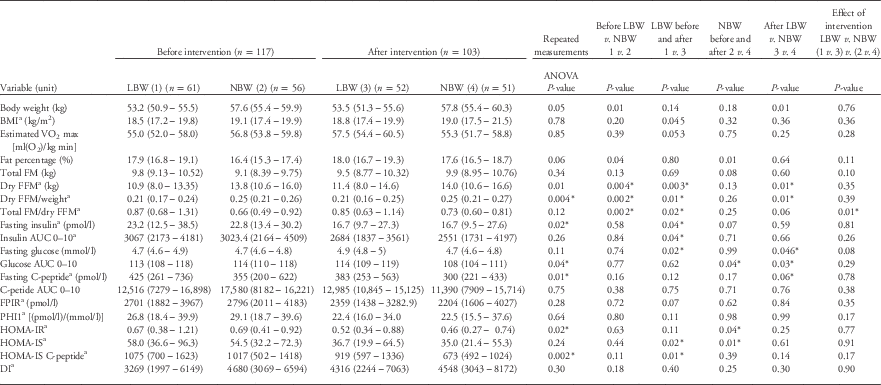
Before the intervention, the LBW group had a significantly higher fat percentage (P=0.04) and FM/FFM ratio (P=0.002) and a significant lower FFM (P=0.004) and FFM/body weight ratio (P=0.002) when compared with the NBW group as measured with the BIA (Table 2).
Anthropometry, body composition and biochemical characteristics before and after intervention
FPIR, first-phase insulin response 0–10 min; PHI 1, insulin AUC 0–10/glucose AUC 0–10; DI, disposition index; LBW, low birth weight group; NBW, normal birth weight group; BMI, body mass index; FM, fat mass; FFM, fat-free mass; HOMA, homoeostasis model assessments; HOMA-IR, homoeostasis model assessments of insulin resistance; HOMA-IS, homoeostasis model assessments of insulin secretion.
Means and 95% confidence intervals for normal distributed data.
a Median and 25th and 75th interquartile intervals for non-normally distributed data.
*P is statistically significant.
When comparing the impact of the intervention between the two birth weight groups, we were able to detect a significant difference in the ratio of total FM/FFM (P=0.01) (Table 2).
Following intervention, the LBW group had a significant increase in FFM (P=0.003), a significant decrease in FFM/body weight (P=0.01) and a significant decrease in total FM/FFM (P=0.02) (Table 2). In the NBW group, we found a small but significant increase in total fat percentage (P=0.01) following the intervention. In addition, we also established a trend towards an increase in total FM (P=0.08), whereas no significant change was seen in FFM in the NBW group (Table 2).
Intervention effects on insulin sensitivity and insulin secretion
Plasma levels of glucose, insulin and C-peptide in the two birth weight groups before and after the intervention are shown in Fig. 2. The two outliers in the C-peptide values represent a single subject.
Fasting glucose, C-peptide and insulin levels for the low birth weight group (LBW) and the normal birth weight group (NBW) before the intervention (visit 1) and after the intervention (visit 2). Data are presented as mean.
Before the intervention, no significant difference in either fasting plasma glucose or insulin levels was observed between the LBW and NBW groups (Table 2).
Fasting plasma glucose level was significantly increased in the LBW group after the intervention, whereas no change was observed for the NBW group. Fasting insulin level was significantly decreased in the LBW group after the intervention (P=0.04), and a trend towards reduction in fasting insulin level in the NBW group (P=0.07) was seen. The decrease in insulin secretion after the intervention is also associated with a significant decrease in HOMA-IS in the LBW and NBW groups, P=0.02 and P=0.01, respectively, and a trend towards a decrease in FPIR (P=0.07) and PHI1 (P=0.11) in the LBW group.
We found a significant decrease in the HOMA-IR in the NBW group (P=0.04) and a trend towards a decrease in HOMA-IR in the LBW group (P=0.11) (Fig. 3). Improved insulin sensitivity along with decreased insulin secretion is also reflected by no significant changes in any birth weight group in the DI.
Values for homoeostasis model assessments (HOMA) of insulin resistance (HOMA-IR) and insulin secretion (HOMA-IS) are shown for each individual in the low birth weight group and the normal birth weight group. P-values are shown for comparisons before and after the intervention.
In order to examine whether there was any association between improved insulin secretion and sensitivity and total fat percentages, lean body mass or VO2 max after the intervention, simple correlation analyses were carried out. However, no significant association was observed.
When sub-analyses were carried out, including those who had 4–8 weeks between their baseline clinical examination and their second clinical examination, the LBW group had still gained FFM during the intervention and both birth weight groups had a lower insulin secretion measured by HOMA-IS. Insulin resistance measured by HOMA-IR was not significantly different when comparing baseline data with the data after the intervention in the LBW group (P=0.27) or in the NBW group (P=0.11). In addition, the NBW individuals did not show an increase in FM or fat percentages after the intervention. However, when a sub-analyses were carried out, including all those participants who had maintained their dairy daily, cycled for an average of 45 min/day and had a 4–8 weeks between their baseline and second clinical examination, the only significant impact of the intervention was a reduced HOMA-IS in the NBW group after the intervention (P=0.04). This may be due to the low power associated with the study sample, as these results are based on the analysis of 26 individuals.
As 13 LBW and 3 NBW participants were born pre-term, we had adjusted our analyses for gestational age. However, the adjustment did not lead to an alteration in any of our results.
Discussion
Previous studies have shown conflicting results as to whether LBW individuals have a different/adverse response to exercise as compared with NBW individuals, and therefore we examined the effect of a 6-week free-living outdoor bicycle intervention on body composition, insulin sensitivity and insulin secretion in young rural Indian men born with LBW compared with NBW controls.
Body composition
In the present study, we showed that the LBW group had a significant increase in FFM and a significant decrease in total FM/FFM after the intervention, which was not observed in the NBW group. However, the NBW group still had a significantly greater total FFM and FFM/body weight after the intervention compared with the LBW group. This indicates that the LBW group displayed a greater relative response to the exercise intervention compared with the NBW group. The extent to which the relative improvement in body composition may be a consequence of the lower FFM in the LBW group before the intervention (i.e. regression towards the mean) is unknown. Regardless, our finding of a differential benefit in body composition after the intervention supports the relevance of implementing exercise training programmes in LBW individuals who are at an increased risk for developing several different cardiometabolic diseases including T2D. In other words, previous reports of lower leisure-time physical activity in LBW individualsReference Kaseva, Wehkalampi and Strang-Karlsson33–Reference Kajantie, Strang-Karlsson and Hovi35 may not only be a result of an underlying biologically determined reduced capability to perform and to benefit from exercise training. The NBW individuals did unexpectedly increase their whole body fat percentages (BFPs) during the intervention. This is, however, in contrast with another study where FM and total fat percentages decreased after an exercise intervention in both LBW and NBW participants.Reference Mortensen, Hingst and Frederiksen48 However, in the latter study, body composition was measured by dual-energy X-ray absorptiometry (DEXA) and the exercise intervention lasted 12 weeks with close monitoring by HR monitors. In addition, our observed increase in total fat percentages could suggest that the bicycle intervention may have been less physically demanding when compared with their normal daily physical activities, or alternatively that the individuals could have changed their diet during the intervention.
The increment in BFP and FM in the NBW group was measured by BIA and not by DEXA, and this may have introduced some deviations in the measurements, as BIA is not as accurate in the assessment of short-term changes in body composition compared with the DEXA scan. In addition, as there was no increase in either BFP or FM, which was observed when including only individuals with 4–8 weeks between their two examination days, it may also be assumed that it was due to lack of bicycling in the last period before the second examination.
Insulin sensitivity and insulin secretion
The exercise training intervention resulted in improvements in HOMA-IS and HOMA-IR, irrespective of the birth weight group, but only with a trend towards lowering of HOMA-IR in the LBW group. This presumably reflects an improvement in the hepatic insulin resistance in the two groups after the intervention; however, hepatic resistance per se has not been measured in this study. In addition, there was a tendency towards a reduced FPIR in the LBW group accompanied by no difference in DI, indicating that the decreased insulin secretion is a response of improved insulin sensitivity after the exercise intervention. As the muscle is a major site for insulin-stimulated glucose uptake, the improvement in insulin sensitivity in the LBW individuals after the intervention may potentially reflect their increase in FFM. However, we were not able to find any significant correlations between improved insulin sensitivity and FFM.
Fasting plasma insulin levels decreased after the intervention in both the groups. This change may reflect improved pancreatic β cell function, and could therefore be seen as a beneficial effect with respect to the prevention of T2D later in life. However, the intervention was not sufficient to lower the fasting plasma glucose levels. In contrast, a small unexpected and paradoxical increase in the fasting plasma glucose level was observed in the LBW group only. Although the magnitude of this increase in fasting glucose per se in the LBW individuals may be of no immediate clinical importance, it may explain as to why the improvement in HOMA-IR was not significant after the intervention. However, the finding of subtle elevations of fasting plasma glucose levels in LBW compared with NBW individuals is consistent with previous studies.Reference Jensen, Storgaard, Dela, Holst, Madsbad and Vaag49
To our knowledge, there are no previous studies that have shown improvements in HOMA-IR and HOMA-IS in healthy individuals, in relation to a non-supervised outdoor bicycle training intervention. This is important given that exercise training has to be implemented in a sustainable manner in people’s own environment, and the intervention should optimally work even without intensive supervision. Indeed, it has previously been shown that a 6-week treadmill intervention had an effect on insulin sensitivity and basal glucose levels in healthy young menReference Nishida, Higaki and Tokuyama24 studied during supervision in a laboratory.
Many of the previous studies regarding the association between birth weight and exercise adaptability have been of epidemiological origin. However, one recent intervention study investigated the impact of 12 weeks of exercise training on skeletal muscle AMP-activated protein kinase (AMPK) in LBW and NBW individuals. AMPK orchestrates many metabolic adaptations during and following exercise and a normal regulation of AMPK expression and activity in response to exercise was reported in both birth weight groups.Reference Mortensen, Hingst and Frederiksen48
Physical activity
We did not find any difference in the estimated VO2 max between the two birth weight groups, neither before nor after the intervention, but the LBW group had a significantly increased VO2 max after the intervention. The finding of no difference in VO2 max both before and after the intervention between the LBW and NBW individuals is supported by a recent study where LBW and NBW individuals underwent 12 weeks of monitored ergometer cycle training. There was an overall effect of training on the maximal HR, but this effect was independent of the birth weight groups. No significant impact of training was seen on the resting HR, HR corresponding to 65% of VO2 peak and respiratory exchange ratio in both the birth weight groups.Reference Mortensen, Hingst and Frederiksen48 In addition, it has been shown that with an incremental treadmill test no alteration in VO2 max was observed in pre-term LBW individuals.Reference Clemm, Røksund, Thorsen, Eide, Markestad and Halvorsen37
We did not find any difference in levels of objectively measured physical activity between the first and the last 3 days of the intervention, nor did we find any difference in physical activity at any point during the intervention between the two birth weight groups. This may be due to a relatively high level of habitual daily physical activity at baseline. The 4–8 weeks of bicycle training did not change their activity level significantly even when associated with daily chores. Alternatively, what may have happened is that the participants might have substituted parts of their activities before the intervention with bicycling. Although there was no evidence of any definite increase in physical activity during the intervention, we did find a significant reduction in sleeping HR in the NBW group and a trend towards a decrease in the LBW group. These findings support the notion that study participants most likely did increase their physical activity level during the intervention period and that these levels were maintained.
The extent to which LBW individuals may be less physically active than NBW individuals remains controversial. Our results showing no difference in activity level between LBW and NBW individuals have been supported by a recent accelerometry-based study.Reference Ridgway, Brage and Sharp32 In contrast, other groups have previously found that adults born with LBW undertake less leisure-time physical activity than adults born with NBW.Reference Kaseva, Wehkalampi and Strang-Karlsson33–Reference Andersen, Angquist and Gamborg36 However, in these studies, physical activity estimates were based on questionnaires, and the subjects were often born pre-term or with very LBW (<1500 g), which may explain the differences when compared with our study. However, a recent study has shown that those born pre-term and small for gestational age may exhibit lower exercise capacity.Reference Svedenkrans, Henckel, Kowalski, Norman and Bohlin50 Therefore, the impact of LBW in relation to exercise capacity is still open for debate.
Limitations
In this study, the bicycle intervention was monitored exclusively by diary records and not in an objective manner. The diary record was incomplete, and it is, therefore, possible that some individuals were not exposed to the prescribed intervention. Second, no objective measures of physical activity at baseline were obtained, thereby precluding any inference on the intervention effect on habitual activity levels. The pre- and post-exercise comparisons of body composition were carried out using BIA, which is less precise than DEXA. Some individuals had more than 8 weeks between their first and second clinical examination – a period of unknown exercise performance – which may have influenced our results on body composition and HOMA-IR. Finally, fluctuations in sleep and feeding patterns may also have influenced results on fasting plasma glucose and insulin levels.
Conclusion
In summary, a free-living bicycle-based intervention can improve insulin sensitivity and lower plasma insulin levels in young Indian men with low or NBW. Body composition was differentially influenced by the intervention in a more beneficial manner for the LBW individuals. The measured level of daily physical activity was similar before the intervention in both the birth weight groups, and the capability to perform and to increase the level of physical activity were also independent of birth weight. Further studies are required to assess whether long-term exercise training may eventually lead to a normalization of muscle mass and body composition in LBW individuals, and whether this may translate into an effective primary prevention of T2D in LBW individuals.
Acknowledgements
Authors acknowledge the social workers of the Community Health Department of Christian Medical College, Vellore, India, inclusive of Mr Aaron and Mr Ratnadas. The authors thank Ms Banu and Dr Isaac for their inputs on the manuscript.
Financial Support
This work was supported by The Danish Strategic Research Council and Biocampus, University of Copenhagen and Steno Diabetes Centre, Gentofte, Denmark.
Conflicts of Interest
None.
Ethical Standards
The protocol was approved by the local ethics committee: the Institutional Review Board of Christian Medical College, Vellore, India (Institutional Review Board, Minute Number: 5879, 2006). The authors assert that all procedures contributing to this work comply with the ethical standards of the relevant National Guidelines on Human Experimentation (Indian Council of Medical Research) and with the Helsinki Declaration of 1975, as revised in 2008, and has been approved by the institutional committees, Institutional Review Board of Christian Medical College, Vellore, India (Institutional Review Board, Minute Number: 5879, 2006).