


Introduction
In Britain we have the remarkable phenomenon that large numbers of quite severely disordered people who require considerable therapeutic effort are deemed ‘untreatable’.
[Gunn, quoted in Breaking the Cycle of Rejection: The Personality Disorder Capabilities Frame-work. National Institute for Mental Health in England (NIMHE), 2003a, p. 15p.
Those whose presentations meet diagnostic criteria for personality disorders have a range of problems which are complex and long term. The identification and labelling of this group is problematic for practical and ethical reasons. New CBT therapies and guidelines for helping people with personality disorder are promising, but are unlikely to be used unless there are ways of accurately identifying personality disorder and overcoming its negative connotations. This could leave many people with severe and complex problems without appropriate support.
Definition
Personality disorder is defined in DSM-IV (APA, 1994) as: ‘an enduring pattern of inner experience and behaviour that deviates markedly from the expectations of the individual's culture, is pervasive and inflexible, has an onset in adolescence or early adulthood, is stable over time, and leads to distress or impairment’. Ten types of personality disorder are described, which include paranoid, schizoid, schizotypal, narcissistic, histrionic, borderline, anti-social, obsessive-compulsive, avoidant, and dependent. It is recognized that problems surround the labelling of personality disorder, which may reflect the medical model and may be associated with negative perceptions such as ‘untreatability’ among professionals and serious criminal behaviour among the public and in the media.
Prevalence
The prevalence of personality disorder reported in the literature varies widely. This is probably because of differences in samples, diagnostic criteria, and assessment measures (Moran, 2002). Prevalence rates of 10–13% of adults have been reported in the community (de Girolamo & Dotto, Reference de Girolamo, Dotto, Gelder, Lopez-Ibor and Andreasen2000). In in-patient services reported prevalence rates range from 36% to 67% (NIMHE, 2003b; Hayward et al. Reference Hayward, Slade and Moran2006).
Problems associated with personality disorder
People with a diagnosis of personality disorder are more likely to have other mental health problems such as depression (Corruble et al. Reference Corruble, Ginestet and Guelfi1996), anxiety disorders (Sanderson et al. Reference Sanderson, Wetzler, Beck and Betz1994), substance misuse/dependence (Robins, Reference Robins1998) and eating disorders (e.g. Braun et al. Reference Braun, Sunday and Halmi1994). Ten percent of people with personality disorder complete suicide (Paris, Reference Paris1993). Cheng et al. (Reference Cheng, Mann and Chan1997) and Lesage et al. (Reference Lesage, Boyer, Grunberg, Vanier, Morissette, Menard-Buteau and Loyer1994) concluded that 47–77% of suicide cases studied retrospectively would have met criteria for at least one personality disorder.
Use of health-care services is high. In secondary care, this is particularly the case for people with borderline, histrionic, narcissistic, and antisocial personality disorder (Perry et al. Reference Perry, Lavori and Hoke1987; Narrow et al. Reference Narrow, Regier, Rae, Manderscheid and Locke1993). Bender et al. (Reference Bender, Dolan, Skodol, Sanislow, Dyck, McGlashan, Shea, Zanarini, Oldham and Gunderson2001) found people with personality disorder were hospitalized more often than those with depressive disorder; and used more psychiatric medication. A diagnosis of personality disorder predicts multiple psychiatric hospital admissions (Saarento et al. Reference Saarento, Hakko and Joukamaa1998).
Personality disorder predicts worse outcome for mental health problems such as depression, anxiety (Reich & Green, Reference Reich and Green1991) and schizophrenia (Tyrer & Seivewright, Reference Tyrer, Seivewright and Tyrer2000). Mental health services in the UK have not viewed personality disorder as part of their ‘core business’ (NIMHE, 2003b). In a recent survey study 28% of the health-care trusts in England who responded provided no identified adult mental health services to people with personality disorder (Fahy, 2002).
A proposed revision of the Mental Health Act provides a broader definition of mental illness, which will encourage the assessment and treatment of personality disorder as a legitimate role for mental health services (NIMHE, 2003b).
Psychiatric services in the UK have focused primarily on psychotic illnesses (Fahy, 2002), which have a prevalence of just 1–3% in the general population. People with personality disorder given another diagnosis such as depression or psychotic disorder may gain entry to mental health services but they are often ill-equipped to help.
Negative attitudes towards people with personality disorder are common in mental health services (NIMHE, 2003). This may be related to the view that personality disorder is not a ‘mental illness’, and an assumption that people with personality disorder can control their behaviour. Motives such as faking illness or seeking attention may be attributed, therefore they may be blamed for their problems.
Behaviours like self-harm and suicidal behaviour create anxiety for carers. Professionals can feel hopeless about the possibility of improvement and believe they have little to offer this client group.
Identifying personality disorder
The process of labelling people's behaviour, thoughts and feelings as consistent with personality disorder is a highly contentious action. Concerns about stigma may motivate professionals to avoid using the label. They may focus on co-occurring problems, such as depression or eating disorders. They may target only these problems, a potential cause of failure in intervention or repeat admissions (NIMHE, 2003a). In our experience, people given the label often react by associating it with media reports and crime novels involving individuals who commit serious crime. They may reject the label or feel very distressed by it.
Historically, dissatisfaction with specific DSM Axis II personality disorder categories (e.g. dependent, borderline, etc.) has been another controversy in accurate identification (Moran, 2002). These categories have poor discriminant validity, so that most presentations which meet criteria for one personality disorder also meet criteria for others (Moran, 2002). The DSM-IV addresses this problem by clustering personality disorders which typically overlap. The three clusters have good discriminant validity (Moran, 2002).
The demands of evidence-based practice, however, require some system of grouping people with similar problems. Moran (2002) proposed using DSM-IV or ICD-10 (WHO, 1992) definitions of personality disorders because they have been agreed by international bodies and are supported by a large evidence base. Once the definition is agreed there remain the problems of accurate assignation of the label and overcoming its negative connotations.
In addition to the facilitation of research and the development of specific interventions, identifying personality disorder should lead to the use of best practice guidelines and interventions. These include the guidelines published by the NIMHE (2003b) and by the National Institute for Clinical Excellence (NICE 2008a, b), which advocate general principles for working with people with a diagnosis of personality disorder [e.g. the use of specialist multi-disciplinary teams (MDT), the gradual tapering off of care, etc.p.
The present study argues for the greater labelling of patterns of thoughts, feelings, behaviour and physiological responses which are currently termed personality disorder. It does not argue for greater medicalization of the problems. Indeed we consider this would be most unhelpful. There may be a case for CBT theorists to redefine the presentations in a non-medical way, for example as Linehan et al. (Reference Linehan1993) do with borderline personality disorder in the context of dialectical behaviour therapy (DBT) formulation, or as Arntz has formalized the concepts into a standardized assessment for borderline personality disorder, namely the Borderline Personality Disorder Severity Index. (Arntz et al. Reference Arntz, Van Den Hoorn, Cornelis, Verheul, Van Den Bosch and de Bie2003). The Structured Clinical Interview for DSM-III-R Personality Disorders (SCID-II) also formalizes the identification of personality disorder using a structured interview format. None of these identification processes necessitate the use of the medical term ‘diagnosis’, except that the SCID-II uses it in the title.
In our practice efforts are made to overcome negative connotations by frankly exploring these with the client, stressing that the label is in effect a list of behaviours in which the client currently engages and which can be changed as these behaviours change.
The reason the paper argues for clearer identification of these patterns is to facilitate thoughtful, effective and non-damaging interventions on the part of CBT therapists and others.
Interventions for personality disorder
Recently the development of specialized therapies for personality disorder has accelerated. Within the CBT tradition these include DBT (Linehan et al. Reference Linehan, Heard and Armstrong1993), schema-focused therapy (Young, Reference Young1990) and CBT for borderline personality disorder (Tyrer et al. Reference Tyrer, Thompson, Schmidt, Jones, Knapp, Davidson, Knapp, Davidson, Catalan, Airlie, Baxter, Byford, Byrne, Cameron, Caplan, Cooper, Ferguson, Freeman, Frost, Godley, Greenshields, Henderson, Holden, Keech, Kim, Logan, Manley, Macleod, Murphy, Patience, Ramsay, De Munroz, Scott, Seivewright, Sivakumar, Tata, Thornton, Ukoumunne and Wessely2003). Psychoanalytically oriented partial hospitalization (Bateman & Fonagy, Reference Bateman and Fonagy1999) and transferencefocused therapy (Giesen-Bloo et al. Reference Giesen-Bloo, van Dyck, Spinhoven, van Tilburg, Dirksen, van Asselt, Kremers, Nadort and Arntz2006) have also been shown to improve symptoms of personality disorder. Ryle's Cognitive Analytic Therapy (CAT) (Reference Ryle and Ryle1995) is also recommended by NIMHE (2003).
It is worth noting that the majority of these interventions target borderline personality disorder. The use of evidence-based interventions can reduce service use and increase client satisfaction (e.g. Kennedy & Thomas, Reference Kennedy and Thomas2007).
Identification of personality disorder in an in-patient clinical psychology service
The present study was initiated due to concern that personality disorder may be under-identified in clients using local acute psychiatric in-patient services. A significant number of clients have multiple and lengthy admissions, with interventions appearing ineffective. The high prevalence of personality disorder in in-patient services indicated in the above-mentioned studies suggests that many of this group may meet criteria for a personality disorder. However, our clinical experience is that the label of personality disorder is not often given. In-patients are often given labels for Axis I problems, and treated only for these problems.
In conversations with service providers, some psychiatrists have expressed a reluctance to diagnose personality disorder due to the stigma attached to the diagnosis. They worry that the individual may be denied resources or treated differently by staff that hold more negative attitudes towards people with a diagnosis of personality disorder. While this stems from a caring response to clients, the interventions offered may be inappropriate or inadequate. This in turn may be a factor contributing to their multiple and lengthy admissions.
The aim of the present study was to compare the use of a diagnostic approach to identifying personality disorder with the use of a psychometric screening measure, the Millon Clinical Multiaxial Inventory – 3rd edition (MCMI-III; Millon, Reference Millon1997), and to explore the implications of any differences for CBT therapists working in this setting.
Method
Design
A survey design was used as the data was already routinely collected and no variables were manipulated in the study.
Participants
Participants were 122 in-patients in an acute psychiatric in-patient unit who were referred to the in-patient clinical psychology service between 2003 and 2005. There were 50 males and 72 females aged between 17 and 65 years, with a mean age of 34.5 years.
Referrals to the in-patient clinical psychology service were made for a full range of problems (e.g. depression, psychosis, anxiety disorders, personality disorders, etc.). Staff tended to refer in-patients to the psychology service after other interventions (e.g. medication, nursing support) were tried without success. This suggests that compared to the wider in-patient population, this group of people may have had more complex problems.
Measures
Diagnosis using ICD-10
The usual diagnostic procedure on the two in-patient wards locally was assessment by observation by the nursing team and by psychiatric interview. No standardized structured interviews were used. No psychometric screening was used unless the client was referred to a psychologist. The ICD-10 (WHO, 1992) was used to aid diagnosis. Disagreements were resolved by consultant's opinion taking priority.
MCMI-III
The MCMI-III is a 175-item self-administered true/false questionnaire. It measures two sets of problems: personality traits which are consistent with DSM-IV Axis II (personality) disorders, and clinical (Axis I) syndromes. The present study focused solely on the personality trait subscales, which were developed according to Millon's theory of personality. In the most recent version of the MCMI, items have been brought in line with the DSM-IV criteria for personality disorders. The three subscales which measure Millon's ‘passive aggressive’, ‘self-defeating’, and ‘aggressive’ personality traits were not used in this study as these are not represented in DSM-IV.
Internal consistency (Cronbach's α) of the personality subscales is reported as 0.67–0.90 (Millon, Reference Millon1997). Items have high criterion validity, but convergent validity with other measures is sometimes a weakness (Craig, Reference Craig and Strack2002).
The MCMI-III has a tendency towards Type II errors, or false positives. In order to minimize false positives, the higher of the two suggested cut-off scores was used (75 indicates ‘presence’ of a personality trait or syndrome, 85 indicates ‘prominence’ (Millon, Reference Millon1997), a cut-off of 85 was chosen). Test–retest reliability is reported as 0.84–0.96 (Millon, Reference Millon1997). Compared to clinical interview using DSM-IV, the MCMI-III has much higher reliability (Craig, Reference Craig and Strack2002).
MCMI-III norms were established with a sample of 998 psychiatric patients from the USA and Canada. The sample represents a wide range demographically, but underrepresents minority groups. The clinical psychology service was located in a predominantly white area. Despite the lack of UK norms, the MCMI-III is used widely in clinical practice and research in the UK (Craig, Reference Craig and Strack2002).
Procedure
After admission, an assessment period of 1 day to 1 week occurred during which the patient was given medication according to any pre-existing diagnosis, observed by nursing staff and interviewed if possible in a ward round setting. The nursing team gathered information from others involved such as social workers. In the case of sectioned patients a provisional diagnosis may have been made during the sectioning process.
Assignment of Axis I and Axis II diagnosis was made by a psychiatrist taking into account the opinions and observations of the MDT, usually nurses and social workers. The psychologist was occasionally involved with the MDT but could not cover all four ward rounds. Diagnosis was assigned by a range of psychiatrists at consultant and specialist registrar grades. Four consultant psychiatrist posts existed during the study period, but there was extensive use of locum psychiatrists because of difficulties in recruitment. In total, six consultants and four specialist registrars were involved in assigning diagnoses.
The nursing team usually decided who to refer to the psychologist with approval from the psychiatrist. Psychiatrists often referred directly to the psychologist.
In-patients completed the MCMI-III before attending their first session with the clinical psychologist. They were given the MCMI-III, along with three other routine assessment tools, by staff nurses. Normally in-patients completed the form independently, but in some cases staff nurses provided assistance if they had difficulties (e.g. due to poor literacy or very high anxiety).
Approval for the study was given by the Isle of Wight Healthcare NHS Trust in which the study was conducted and by the University of Southampton ethics board. All data were collected as part of normal clinical practice and anonymized. In-patients gave consent for their data to be used for clinical audit and research, with the option of revoking consent at any time. Twenty in-patients declined to give this consent and were therefore not included in this study. Examination of the demographic and diagnostic profiles of those who refused showed no differences from those included.
Electronic and paper psychology files were examined to obtain participant data, including age, gender, diagnoses, and results on MCMI-III personality trait subscales. The conservative cut-off of 85 on one or more of the Axis II subscales was taken as indicative of personality disorder.
Data management
The data were analysed using SPSS version 14.0 (SPSS Inc., Chicago IL, USA). Frequencies were calculated for participants with MCMI-III identified personality problems (scores of at least 85) and a diagnosis of personality disorder. χ 2 could not be performed as groups were very uneven and one group had <5 participants.
Results
Eighty-five percent of participants scored above the clinical cut-off score of 85 on at least one personality subscale of MCMI-III (see Table 1).
Frequency of identification of personality disorder (n = 122)

MCMI-III, Millon Clinical Multiaxial Inventory – third edition.
Sixteen per cent of participants had a diagnosis of personality disorder when they were referred to the in-patient psychology service. Of the 19 participants with a diagnosis of personality disorder, 11 had a diagnosis of borderline personality disorder, one had a diagnosis of psychopathic personality disorder, one had a diagnosis of dependent personality disorder, and six had a personality disorder diagnosis that was not specified.
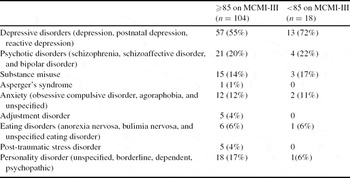
Diagnoses included mood disorders, anxiety disorders, psychotic disorders, adjustment disorder, eating disorders, personality disorders, and some diagnoses were pending further assessment. Table 2 contains the frequencies of these diagnoses grouped according to MCMI-III personality scores. Of note, 16% of the participants who had MCMI-III scores above the cut-off also had a diagnosis of a psychotic disorder (schizophrenia, schizoaffective disorder, or bipolar disorder).
Participants' diagnoses grouped according to MCMI-III scores

MCMI-III, Millon Clinical Multiaxial Inventory – third edition.
Of the 104 participants who scored above the cut-off on at least one of the Millon subscales, 16 participants met the cut-off on one subscale, 35 on two subscales, and 53 on three or more subscales.
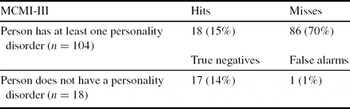
Using a signal detection theory approach, clinical assessment failed to detect personality disorder 70% of the time it was present as identified by MCMI-III (see Table 3, ‘misses’). In 17 out of 18 times that personality disorder was not present according to MCMI-III, no clinical personality diagnosis was given (Table 3, ‘false alarms’).
Accuracy of detection of personality disorder through clinical interview based on MCMI-III scores

MCMI-III, Millon Clinical Multiaxial Inventory – third edition.
Discussion
Using a psychometric instrument, the results show a high rate of personality disorder in the in-patient referrals group. The 85% rate of personality disorder indicated by MCMI-III is higher than the range of previously reported prevalence rates (36–67%). This may be due to the selected nature of the present sample (chosen for referral to the psychologist). The participants were people who had not been adequately helped by other interventions offered in the in-patient unit (e.g. medication, nursing support). As personality disorder is associated with poorer response to treatment, it is not surprising that this sample has a high rate of personality disorder.
Seventy per cent ‘misses’ shows serious under-detection of personality disorder as indicated by MCMI-III scores. Personality disorder is largely not being detected. It is only being identified diagnostically 15% of the time the MCMI-III suggests its presence. There is a need to investigate further the reasons for such under-identification. Professional beliefs and attitudes and/or insensitivity of professionals' clinical interviews to personality disorder may be two reasons. The lack of widely available interventions for personality problems may also be a factor.
Given that those making the diagnoses were using only clinical interview, it may be that this process was unreliable not only for Axis II personality disorder diagnoses but also for Axis I problems. It may be that reliability could be improved by the use of structured interviews and self-report measures.
Under-detection of this kind is likely to be happening in mental health services outside of the in-patient mileu. Axis I mental health problems may be the focus of intervention from primary through secondary and tertiary services, while personality disorder goes undetected and unaddressed. If services do not view personality disorder as their core business, adequate training in assessing for and treating personality disorder will not be prioritized. This may be another obstacle to accurate detection, contributing throughout services to the ‘revolving door’ phenomenon (NIMHE, 2003).
There is a need for cultural change across services, as the NIMHE (2003b) has identified. One important change is for CBT therapists and trainers to improve practices to increase the likelihood of identification of personality disorder. This should include increased use of assessment tools which screen for personality disorder, such as MCMI-III and SCID-II. CBT therapists should receive more training in assessing and treating personality disorder.
This study also raises specific concerns about the identification of personality disorder in people with a diagnosis of schizophrenia or other severe mental illness. A high proportion (21/25) of the participants with a diagnosis of a psychotic disorder met the cut-off indicative of personality disorder on the MCMI-III. Because mental health services, especially in-patient services, tend to provide interventions mainly for the psychotic element of the person's problems, these interventions may be temporary in their benefit. Applying a stress diathesis model of psychosis (Zubin & Spring, Reference Zubin and Spring1977), the stress caused by the interaction of personality disorder-related behavioural patterns and the environment may be one cause of relapse in this group. If the personality disorder was treated as well as the psychosis, people with both disorders may experience fewer relapses. CBT approaches for psychosis (e.g. Turkington et al. Reference Turkington, Kingdon and Chadwick2003, Reference Turkington, Dudley, Warman and Beck2004) are beginning to be viewed as a specialism within CBT, taking thinking further away from the co-existence of personality disorder and psychosis. Dialogue between CBT academics and practitioners around the implications of this comorbidity could be most productive. Integrating assessments and treatments may reduce client distress and increase effectiveness of interventions.
This study has implications for CBT therapists working in in-patient units. They might expect to work with people with unidentified personality disorder, including those referred with psychosis as the diagnosed disorder. In-patient services tend to use traditional interventions, primarily medication, to help people with psychotic disorders and other Axis I mental health problems. Those who do not respond to this treatment may be more likely to have presentations consistent with personality disorder and also more likely to be referred to therapists, who are usually in short supply and so receive a selected subset of in-patients as referrals.
CBT therapists are well equipped to contribute psychological thinking to the milieu of in-patient units and across the whole care pathway. Once personality disorder patterns are identified, these can be included in formulations of psychological distress and shared with the mental health teams providing care (e.g. Kennedy, Reference Kennedy, Clarke and Wilson2008). CBT, DBT and CAT formulations and brief interventions may be appropriately delivered in in-patient settings or as part of discharge planning (e.g. Swenson et al. Reference Swenson, Sanderson, Dulit and Linehan2001; McGowan, Reference McGowan, Clarke and Wilson2008). This can help de-medicalize approaches and provide alternative explanations to judgemental or hopeless thinking about people with personality disorders.
Most specific therapies until now have developed to address borderline personality disorder. In-patient units and secondary care in general also contain many people with histrionic, narcissistic, and antisocial personality disorder. More specific (non-forensic) approaches are needed for these presentations
The higher cut-off point of 85 was chosen to reduce possible over-estimation of personality disorder which can occur using the MCMI-III because of Type I error. The finding that personality disorder is under-identified is supported by the fact that the identification rate was very low compared to prevalence rates reported in other studies. The lack of UK norms for MCMI-III is also a concern. An improvement would be to use SCID-II to assess for personality disorder. Future research would benefit from samples including all in-patients rather than only those referred to psychological services and from data from other localities to improve the generalizability of the results. Qualitative research could help to uncover the reasons why personality disorder is being under-identified. Future studies might assess whether accurate diagnosis leads to improved patient services such as better tailored interventions, better outcome and fewer or briefer hospital admissions.
Summary
There is preliminary evidence that personality disorder is being under-identified in in-patient psychiatric units in routine clinical assessment by medical teams. CBT therapists working in and outside such units should expect to work with people with undiagnosed personality problems. There may be significant comorbidity with psychosis. Treating Axis II problems with Axis I interventions may be one cause of negative outcome. Careful attention should be paid to assessment and identification of personality disorder patterns before commencing intervention.
Declaration of Interest
None.
Learning objectives
(1) Awareness of clinical needs among in-patient groups.
(2) Awareness of assessment issues and methods.
(3) Awareness of potential reasons for negative outcome in CBT treatment on in-patient wards.




Comments
No Comments have been published for this article.