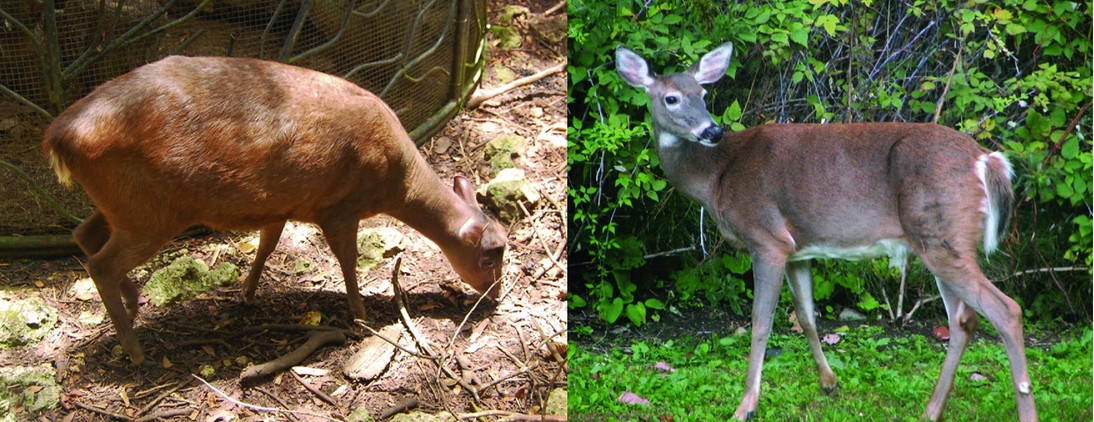


When Amerindians colonized the West Indies beginning 6,000–8,000 years ago, they encountered a terrestrial fauna rich in endemic species but poor in large-bodied taxa. Unsurprisingly, they sought to “stock the larder” by introducing a suite of non-native mammals from the continental Americas, including the dog (Canis lupus familiaris), agouti (Dasyprocta sp.), opossum (Didelphis marsupialis), and domestic guinea pig (Cavia porcellus), among others (Giovas Reference Giovas2017; Giovas et al. Reference Giovas, LeFebvre and Fitzpatrick2012; Grouard Reference Grouard2002, Reference Grouard, Goñalons, Arroyo-Cabrales, Polaco and Aguilar2010; Kimura et al. Reference Kimura, LeFebvre, deFrance, Knodel, Turner, Fitzsimmons, Fitzpatrick and Mulligan2016; LeFebvre and deFrance Reference LeFebvre and deFrance2014; Masseti Reference Masseti2011; Stahl Reference Stahl2009; Wing Reference Wing, Margaret Scarry and Scudder2008; see also de la Mata and Antúnez Reference de la Mata, Antúnez, Borroto-Paéz, Woods and Sergile2012 and Stahl Reference Stahl2013 for discussion of native canid interaction with Amerindians and possible admixture with dogs). Most species introductions occurred during the Ceramic Age (ca. 500 BC–AD 1500) when an influx of Saladoid migrants associated with pottery and crop cultivation moved into the islands from northern South America (Wilson Reference Wilson2007). While often considered a historic introduction (e.g., Baker et al. Reference Baker, Perdikaris, Grouard and Sykes2015; Heffelfinger Reference Heffelfinger and Hewitt2011; Long Reference Long2003), deer (family Cervidae) are among the exotic taxa appearing in the West Indian archaeological record of this period. Their skeletal remains are typically attributed to white-tailed (Odocoileus virginianus) and brocket (Mazama spp.) deer, which are native to Central America and northern lowland South America, raising questions about their origins, mode of introduction, and the cultural stimulus for their anthropogenic dispersal (Figure 1). Comprehensive reconstruction of prehistoric insular deer distribution has been complicated by underreporting and incomplete publication of finds, thwarting broader syntheses that could advance understanding of the economic and socio-symbolic significance of deer in the region's prehistory. By comparison, in lowland South America and the lower Orinoco interaction sphere—the ultimate source of the Saladoid diaspora—indigenous peoples’ engagement with deer is known to have been multifaceted. In these areas, deer are a source of prey and industrial raw material but also mythological actors, allegorical figures, and, as iegue, persons in their own right, tamed, adopted, and socially assimilated into communities (Cormier Reference Cormier2003; Erikson Reference Erikson, Podberscek, Paul and Serpell2000; Fausto Reference Fausto2007; Norton Reference Norton2015; Olsen Reference Olsen2013; Viveiros de Castro Reference Viveiros de Castro, Surrallés and García Hierro2005). A critical question for the West Indies is whether this ontological framework accompanied deer transported from the continent into the islands and, more fundamentally, whether we can even be certain that live deer, as opposed to body parts, were introduced. Were Amerindians moving large-bodied game across significant water gaps? Were they engaging in the exchange of products derived from deer bone and antler? Or were they perhaps doing both?
Left, red brocket deer (Mazama americana), Barbados Wildlife Reserve (photo courtesy of the author); and right, female white-tailed deer (Odocoileus virginianus; photo courtesy of Creative Commons).

The issue of live introduction versus the import of parts arises wherever exotic animal remains appear in the archaeological record, particularly when associated relative abundances are low, the range of skeletal elements is restricted, specimens show modification consistent with being exchange items, or written records are lacking (e.g., Giovas Reference Giovas2017; Giovas et al. Reference Giovas, Kamenov, Fitzpatrick and Krigbaum2016; Laffoon et al. Reference Laffoon, Ramos, Baik, Storde, Lopez, Davies and Hofman2014, Reference Laffoon, Sonnemann, Antczak and Antczak2016; Miller et al. Reference Miller, Carden, Evans, Lamb, Madgwick, Osborne, Symmons and Sykes2016; Pluskowski Reference Pluskowski2004; Sykes et al. Reference Sykes, White, Hayes and Palmer2006, Reference Sykes, Baker, Carden, Higham, Hoelzel and Stevens2011). Here, I review known prehistoric deer records for the West Indies and present the first full report in publication of four new records for cervid specimens from the Sabazan and Grand Bay sites on Carriacou and Pearls site on Grenada. I discuss the taxonomic attribution of these new specimens, evidence for manufacturing techniques, and their utilitarian and possible symbolic importance. These finds are contextualized within a synthesis of available records that reveals patterning in relative abundances of worked bone, element diversity, and skeletal part representation that may be used to distinguish the introduction of live deer from carcass products. Overall results advance our understanding of the distribution and cultural significance of this artifact class and the potential for introductions of live deer.
Biogeographic and Archaeological Background
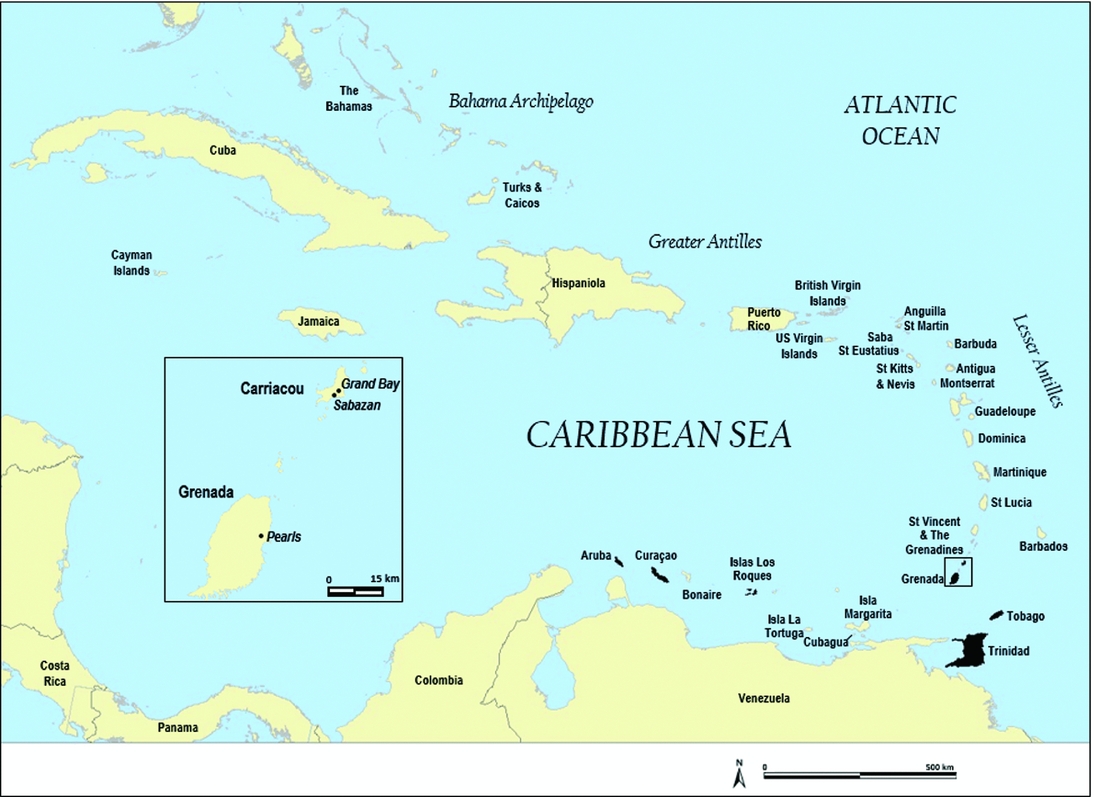
The West Indies (here used synonymously with the Caribbean) comprise the Greater Antilles, Lesser Antilles, Bahamas, and Turks and Caicos archipelagos, along with Trinidad and Tobago, Aruba, Bonaire, Curaçao, and the Los Roques group (a cluster of ~350 small cays) lying off of the Venezuelan coast (Figure 2). Due to Pleistocene connection with South America, Trinidadian faunal communities are continental and are excluded from the biogeographic Caribbean (Ricklefs and Bermingham Reference Ricklefs and Bermingham2008). Red brocket deer (Mazama americana) occur naturally on Trinidad and are listed as historically extirpated for Tobago (Kenny Reference Kenny2008; Murphy Reference Murphy2004), where the natural versus anthropogenic origin of their presence is unclear (Steadman and Stokes Reference Steadman and Stokes2002). They do not have a native distribution in the Antilles.Footnote 1 A subspecies of white-tailed deer (O. v. margaritae, sometimes elevated to species status, O. margaritae) is considered endemic to Isla Margarita, which once joined Venezuela via land bridge (Eisenberg Reference Eisenberg1989; Molina and Molinari Reference Molina and Molinari1999; Rodríguez and Rojas-Suárez Reference Rodríguez and Rojas-Suárez1995). White-tailed deer are noted as a precolumbian introduction on Curaçao (Heffelfinger Reference Heffelfinger and Hewitt2011), where they also occur today (Eisenberg Reference Eisenberg1989), and on Cubagua (Reitz Reference Reitz1992), but these determinations are problematic.Footnote 2 This study focuses on the cultural groups of the precolumbian West Indies. Eastern Central American islands are therefore excluded.
Map showing distribution of known precolumbian deer specimens in the West Indies; islands are in black.

The West Indies was first settled around 6200 BC with the arrival of people to Trinidad, probably from Venezuela (Boomert Reference Boomert, Keegan, Hofman and Rodríguez Ramos2013). Cuba, Hispaniola, and Puerto Rico were colonized in the 5th and 4th millennia BC, and most remaining islands were subsequently settled in a series of complex, asynchronous events possibly originating from multiple mainland sources (Giovas and Fitzpatrick Reference Giovas and Fitzpatrick2014; Keegan and Hofman Reference Keegan and Hofman2017). Exotic mammal translocations postdate 500 BC and the onset of the Ceramic Age, a catchall cultural chronological unit that extends up to European contact (Giovas Reference Giovas2016, Reference Giovas2017; Giovas et al. Reference Giovas, LeFebvre and Fitzpatrick2012; Grouard Reference Grouard2002, Reference Grouard, Goñalons, Arroyo-Cabrales, Polaco and Aguilar2010; Grouard et al. Reference Grouard, Perdikaris and Debue2013; Kimura et al. Reference Kimura, LeFebvre, deFrance, Knodel, Turner, Fitzsimmons, Fitzpatrick and Mulligan2016; LeFebvre and deFrance Reference LeFebvre and deFrance2014; Newsom and Wing Reference Newsom and Wing2004; Stahl Reference Stahl2009; Wing Reference Wing, Margaret Scarry and Scudder2008). A review of Ceramic Age cultural diversity (see Keegan et al. Reference Keegan, Hofman and Rodríguez Ramos2013; Wilson Reference Wilson2007) is beyond the scope of this article, but it may be noted that most island peoples were forager-horticulturalists who produced fine ceramics (Petersen et al. Reference Petersen, Hofman, Curet, Delpuech and Hofman2004); cultivated crops like manioc (Manihot escuelenta), sweet potato (Ipomoea batatas), and maize (Zea mays; Berman and Pearsall Reference Berman and Pearsall2008; Mickleburgh and Pagán-Jiménez Reference Mickleburgh and Pagán-Jiménez2012); and exploited a range of marine and terrestrial resources (Newsom and Wing Reference Newsom and Wing2004). Stylistic and provenance studies of artifacts (Fitzpatrick et al. Reference Fitzpatrick, Kaye, Feathers, Pavia and Marsaglia2009b; García-Casco et al. Reference García-Casco, Knippenberg, Ramos, Harlow, Hofman, Pomo and Blanco-Quintero2013; Hofman et al. Reference Hofman, Bright, Boomert and Knippenberg2007, Reference Hofman, Bright, Hoogland and Keegan2008; Pavia et al. Reference Pavia, Marsaglia and Fitzpatrick2013; Rodríguez Ramos Reference Rodríguez Ramos, Keegan, Hofman and Rodríguez Ramos2013), zooarchaeological research (e.g., Antczak Reference Antczak1995; Giovas Reference Giovas2016; Giovas et al. Reference Giovas, LeFebvre and Fitzpatrick2012; Grouard Reference Grouard, Goñalons, Arroyo-Cabrales, Polaco and Aguilar2010; Grouard et al. Reference Grouard, Perdikaris and Debue2013; LeFebvre and deFrance Reference LeFebvre and deFrance2014; Stahl Reference Stahl2009; Wing Reference Wing, Margaret Scarry and Scudder2008), and isotopic (Giovas et al. Reference Giovas, Kamenov, Fitzpatrick and Krigbaum2016; Laffoon et al. Reference Laffoon, Ramos, Baik, Storde, Lopez, Davies and Hofman2014, Reference Laffoon, Plomp, Davies, Hoogland and Hofman2015, Reference Laffoon, Sonnemann, Antczak and Antczak2016) and biomolecular (Kimura et al. Reference Kimura, LeFebvre, deFrance, Knodel, Turner, Fitzsimmons, Fitzpatrick and Mulligan2016) analyses of animal remains point to ongoing and geographically diverse exchange contacts within the islands and with the mainland at this time.
Methods
I performed an extensive—primarily English, French, and Spanish language—literature review to compile all possible prehistoric and protohistoric Amerindian records of deer remains from the West Indies. Selected databases and museum collections were also consulted. Full details of the literature search and analytic methods are provided in Supplemental File S1. I cannot claim to have identified all records as there are undoubtedly instances where these were missed due to under-publication and accessibility issues. Supplemental Table S2 compiles records for previously reported specimens, representing a total of 27 sites on six islands, and includes data from a review of Elizabeth Wing's zooarchaeological analysis cards for multiple sites on Trinidad and Curaçao, archived by the Environmental Archaeology Program, Florida Museum of Natural History (FLMNH; see Supplemental File S1 for additional details). These data were used with Wing's kind permission (cited here as “unpublished data”); any errors in their rendition are my own. Supplemental Table S2 lists the number of identified specimens (NISP) and minimum number of individuals (MNI), where available; unknown or ambiguous quantitative information is indicated as “data deficient.” Reported specimens include instances of worked bone, defined as any skeletal element exhibiting modification consistent with intentional subtraction of bone that occurs secondary to carcass butchery (i.e., initial butchery cutmarks are not considered “working”), including formal artifacts, preforms, and production waste.
Four new records from Carriacou and Grenada and a fifth unpublished Grenadian record (Stokes Reference Stokes1990) are presented here (Supplemental Table S2). These five records are the sole instances of which I am aware for the occurrence of deer specimens in the prehistoric Lesser Antilles. Identification protocols for these specimens considered morphology, size, current problems in Neotropical deer phylogeny, and possible conflation with historically introduced sheep (Ovis aries) and goats (Capra hircus; Supplemental File S1). Size differences may be used to tentatively distinguish between two candidate deer taxa: the generally smaller Mazama spp. and larger O. virginianus (Figure 1). Neotropical O. virginianus (30–50 kg) tend to be more gracile than their North American counterparts, however, overlapping in body mass with the larger brockets, especially the red brocket, M. americana (24–48 kg, up to 65 kg; Emmons and Feer Reference Emmons and Feer1997); thus attributions based on size are given with a confer designation. For previously published specimens, I maintain the original taxonomic attributions given (Supplemental Table S2) but caution against placing undue confidence in these, especially at the species or subspecies level.
New Records of Cervid Specimens in the West Indies
Grenada
The Ceramic Age site of Pearls, on Grenada's Atlantic coast, provides two new deer records originating from excavations conducted by William Keegan and Ann Cody in 1989 (Keegan Reference Keegan1991; Figure 2). Radiocarbon assays date the site to about 230 BC–AD 400 (Haviser Reference Haviser and Wilson1997; Keegan Reference Keegan1991), although recent critical appraisal of these dates suggests they may be several centuries too old (Hanna Reference Hanna2017). Artifacts such as ceramic wares and greenstone pendants exhibit stylistic affinities with Early Ceramic Age sites elsewhere in the Lesser Antilles, as well as Puerto Rico and South America (Keegan Reference Keegan1991). Disturbance from development, cultivation, and looting has affected the Pearls site since its initial excavation by Bullen (Reference Bullen1964) in 1962, necessitating cautious consideration of deer specimen context and provenance, discussed below. Direct dating of specimens was precluded by their small size and rarity. Vague reports of historic white-tailed deer introduction exist for Grenada (Lever Reference Lever1985; Long Reference Long2003) but without any evidence for establishment in the wild. No deer are present on the island today (Heffelfinger Reference Heffelfinger and Hewitt2011).
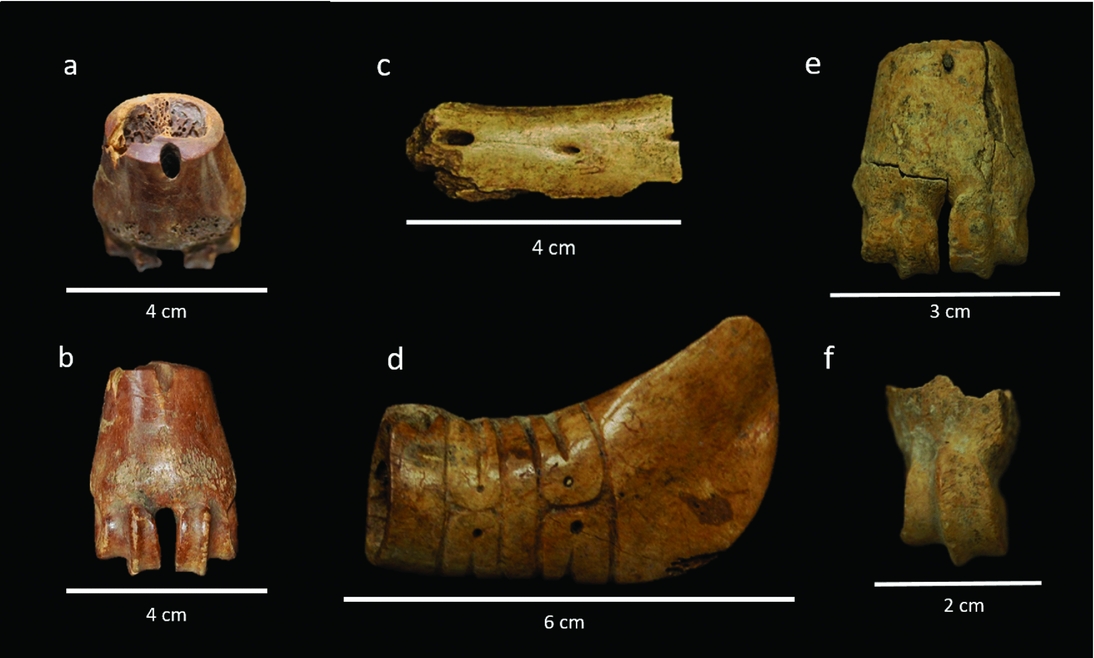
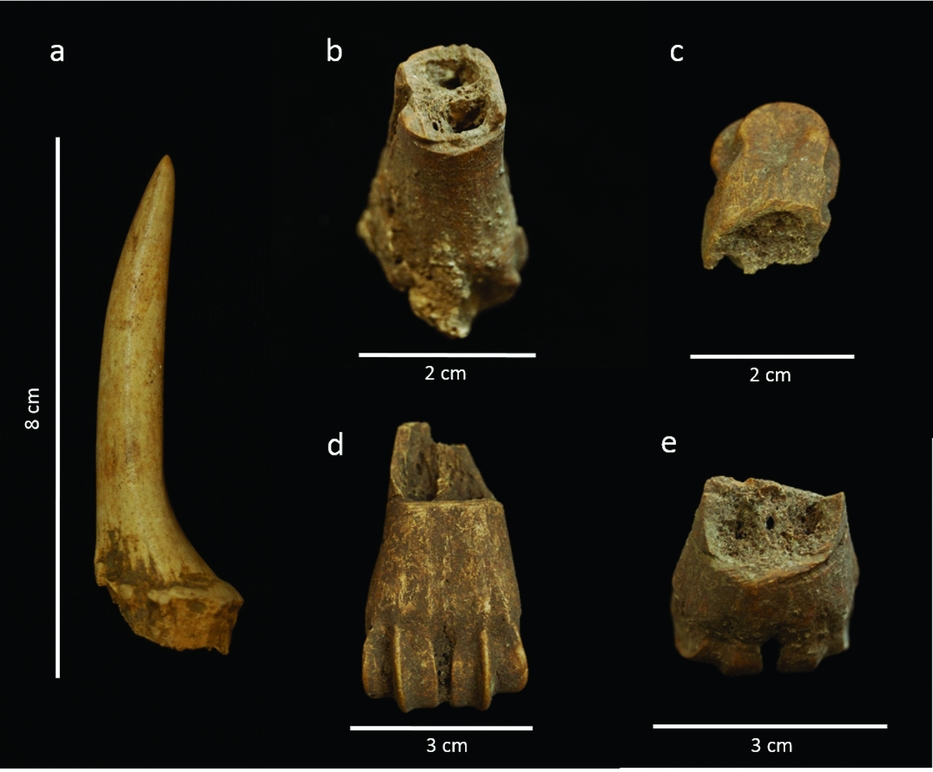
The first cervid specimen from Pearls is a worked, distal metatarsal identified by the author to cf. Odocoileus sp. based on larger size (Figure 3a–b and Supplemental Figure S3; Supplemental Table S2). The “confer” designation reflects the potential for size overlap with Mazama spp., while attribution only to genus reflects current uncertainty about the number of species within Neotropical Odocoileus. Keegan received the metatarsal from a local individual who reported recovering it from the site (William Keegan, personal communication 2015). It shows a groove-and-snap technique for separation of the distal articular end from the shaft. The transverse cut, located where the proximal end of the artifact would have joined the shaft, exhibits a beveled edge. Modified epiphyses of this type are common initial waste products in the manufacture of long bone shafts into tubes and blanks intended for further refinement into beads, pins, needles, and perforators/awls (Choyke and Tóth Reference Choyke, Tóth, Anders and Kulcsár2013; Emery Reference Emery2008; Lyman Reference Lyman2015; Stahl and Athens Reference Stahl and Athens2001). The metatarsal has been burnished to a high luster, however, with the beveled edge finely finished, suggesting this object could have been the desired final product. It may have been a pendant, with the anterior foramen employed for suspension, although no macroscopic signs of wear are evident along the foramen margin. Alternatively, the polish and finished edge could be modifications added later by the collector. The worked metatarsal is virtually identical in form and manufacturing technique to a specimen from a secure archaeological context on Carriacou described below. It is also similar to worked long bone specimens illustrated by Wing for the Quinam site on Trinidad (Wing, unpublished data) and nearly identical to worked metapodials from the St. John and Quinam collections held by the Yale Peabody Museum (Figure 4). This consistency with finds elsewhere in the region suggests that despite missing provenience, this object may well be of prehistoric Grenadian origin.
a) cf. Odocoileus sp. distal metatarsal, Pearls, Grenada, anterosuperior aspect with beveled edge formed by groove-and-snap method, and b) anterior aspect; c) cf. Odocoileus sp. mandibular fragment, Pearls, Grenada, lateral aspect; d) cf. Mazama sp. incised mandible, Sabazan, Carriacou (Find 08CSZ000158), lateral aspect; e) cf. Mazama sp. distal metacarpal, Grand Bay, Carriacou (Find. 08CGB001468BOA), anterior aspect; f) cf. Odocoileus sp. distal metatarsal condyle, Grand Bay, Carriacou (Find 11CGB001868BOA), anterior aspect. See also Supplemental Figures S3–S7.

Modified deer elements from Trinidad archaeological sites, collections of the Yale Peabody Museum: a) antler specimen exhibiting possible smoothing of the burr and polish, Quinam (ANT-181567); b) profile view of a distal metatarsal exhibiting transverse groove and snap, St. John (ANT-189221); c) anterior aspect of a metapodial trochlear condyle exhibiting transverse cut, St. John (ANT-189221); d) posterior aspect of distal metatarsal with partly failed, transverse groove and snap, St. John (ANT-189387); e) anterosuperior aspect of a distal metapodial exhibiting groove and snap, St. John (ANT-189221).

The second Pearls specimen, previously described in an unpublished faunal report (Stokes Reference Stokes1990), is the diastema portion of a left mandible securely identified to Artiodactyla with a “confer” designation to O. virginianus that reflects the specimen's fragmentary nature (“confer” was subsequently omitted in Stokes's [Reference Stokes1990] report; Figure 3c and Supplemental Figure S4; Supplemental Table S2). Exclusion of ovicaprids is possible based on the relatively smaller size and more sharply defined anterior margin of the mental foramen in Mazama sp. and O. virginianus compared to O. aries and C. hircus, as well as gracility of the diastema (length relative to breadth), which tends to be thicker and stockier in ovicaprids. The “cf. O. virginianus” attribution was confirmed by the author based on FLMNH Environmental Archaeology reference collections; the specimen was considered too incomplete to securely assign to genus. No modification other than fragmentation is evident. Regarding context, Stokes (Reference Stokes1990:6) noted the absence of signs for recent cultivation in the excavated area but, due to concerns over looting, chose to analyze faunal samples solely “from deep levels which appear to be pristine.” The mandibular specimen derives from these “pristine” samples recovered from the 4 mm screen fraction of sediments excavated 120–130 cm below datum.
Carriacou
Cervid finds from Carriacou, 27 km north of Grenada, come from the contemporaneous Late Ceramic Age village sites of Sabazan and Grand Bay (ca. AD 400–1400; Fitzpatrick and Giovas Reference Fitzpatrick and Giovas2011; Giovas Reference Giovas2013, Reference Giovas2016; Figure 2). Excavations at the Sabazan site were led by the author between 2005 and 2014 (Giovas Reference Giovas2013, Reference Giovas2016) and at Grand Bay by Scott Fitzpatrick, Quetta Kaye, and Michiel Kappers between 2003 and 2014 (Fitzpatrick et al. Reference Fitzpatrick, Kappers, Kaye, Giovas, LeFebvre, Harris, Burnett, Pavia, Marsaglia and Feathers2009a, Reference Fitzpatrick, Kaye, Kappers and Giovas2014) and indicate significant interaction with both the northern and southern Caribbean.
The Sabazan specimen (Find 08CSZ000158) is the most elaborately worked of the new finds described here and was recovered in situ at a depth of 105 cm below datum from stratigraphically intact deposits. An associated AMS assay provides a date of AD 890–990 (OS-71464, 1100 ± 20 BP; Giovas Reference Giovas2013, Reference Giovas2016). The specimen is a left mandible with the anterior body, coronoid process, condyle, and superior portion of the ramus removed (Figure 3d and Supplemental Figure S5; Supplemental Table S2). The lateral (buccal) surface has been incised with curvilinear designs reminiscent of pottery motifs in the region, while the medial (lingual) aspect has three triangularly arranged, drilled holes recalling similar tri-pointed and chevron patterns seen in Caribbean artifacts of shell, stone, and other media (Bercht et al. Reference Bercht, Brodsky, Farmer and Taylor1997; Mol Reference Mol2006:107; Petersen et al. Reference Petersen, Hofman, Curet, Delpuech and Hofman2004). Function is unknown, but perforations suggest ornamental suspension or attachment to another object. Perforation margins show no macroscopic signs of wear, however. Like the Pearls metatarsal, the mandible has been burnished to a high luster. Teeth are absent, but a single remaining root fragment indicates these may have been purposefully extracted in the manufacturing process. Taxonomic assignation to cf. Mazama sp. reflects the specimen's comparatively small size and uncertainty surrounding Mazama systematics (Supplemental File S1).
The Grand Bay specimens comprise two distal metapodials (Table Supplemental S2). The first is an adult metacarpal (Find 08GB001468BOA) recovered from the 6.4 mm screened fraction excavated from intact deposits 70–80 cm below surface and dated by association to AD 650–900. The specimen exhibits the same groove-an-snap manufacturing technique seen in the Pearls metatarsal (Figure 3e and Supplemental Figure S6). Like that specimen, it may have been a pendant but does not show any signs of polish or attrition along the foramen margin. This specimen has not been burnished, however, and the worked (proximal) edge is slightly ragged. One distal condyle was broken off but recovered from the same find bag and refit; no further modification is evident. Based on smaller size, the specimen has been assigned to cf. Mazama sp. but not attributed to species.
The remaining find from Grand Bay is an unmodified, unfused condylar epiphysis of a distal metapodial, probably a metatarsal (Find 11CGB001868BOA; Figure 3f and Supplemental Figure S7; Supplemental Table S2). The specimen was recovered in the 6.4 mm mesh screen fraction from stratigraphically intact deposits 110–120 cm deep and is dated by association to AD 400–650. The considerable size (nearly two to three times that of the condyle of the adult metacarpal) and juvenile status indicate a larger cervid, probably Odocoileus, to which it has been assigned with a confer designation.
Review: Distribution and Nature of Precolumbian West Indian Cervid Specimens
Including the new records, deer specimens are recorded for a total of 29 sites from seven West Indian islands: Trinidad, Tobago, Aruba, Curaçao, Islas Los Roques, Grenada, and Carriacou (Supplemental Table S2). Excluding Trinidad and Tobago, the record for West Indian deer specimens comprises 11 known sites on five islands lying outside the natural range of cervids. It remains possible that deer skeletal material is more widely distributed in the prehistoric Caribbean than appears based on this summary. Under-publication (gray literature) of deer records, fragmentation or modification that impedes taxonomic attribution of skeletal specimens, and lack of systematic screening of sediments in older excavations may have all contributed to missed specimens and distributional bias.
Notwithstanding these issues, some general patterns emerge. Insular records for deer specimens are confined to the southern Caribbean, particularly the islands along the Venezuelan coast (Figure 2). At least two genera, Mazama and Odocoileus, appear to have been introduced to non-native contexts, with Carriacou, Islas Los Roques, and Curaçao possessing records for both. As discussed below, collective records also suggests cervid specimens are assignable to one of three categories: 1) unmodified specimens consistent with food remains; 2) worked specimens, including formal artifacts; and 3) worked specimens with possible ritual or socio-symbolic significance. Available quantitative data indicate the distribution of these specimen types is not uniform across islands.
Unmodified Cervid Specimens
Larger cervid assemblages composed primarily of unmodified specimens with occasional traces of burning and cutmarks, such as those from Cedros (NISP = 73), Erin (NISP ≥ 238), Manzanilla (NISP = 169), Palo Seco (NISP = 936), Quinam (NISP = 626), St. Catherines (NISP = 76), and possibly St. John (NISP unknown, MNI = 24), all on Trinidad, are consistent with subsistence-focused exploitation of deer (see Supplemental Table S2 and references therein). The human behavioral implications of assemblages with very low (NISP ≤ 2) counts of unmodified bone are less clear. Such low counts are seen at Tanki Flip, Aruba; Pearls, Grenada; Grand Bay, Carriacou; and Dos Mosquises and Domusky Norte, Islas Los Roques—all non-native contexts—and may relate to artifact production, a consideration to which I return below.
Worked Cervid Specimens
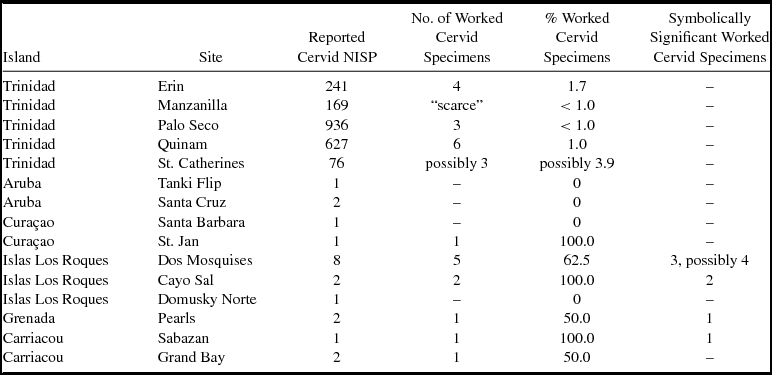
Worked deer bones, including formal artifacts, comprise at least 26 and possibly 38 or more specimens, with no evident bias toward taxon (Table 1 and Supplemental Table S2). Across all islands, worked metapodials, like those recorded for Curaçao, Carriacou, Grenada, and Trinidad, are a common form (n = 10). On Trinidad, transversely and longitudinally split long bone shaft fragments, frequently derived from metapodials (n = 7) and tibiae (n = 3), occur with comparative regularity, as do modified antlers (Figure 4; Supplemental Table S2). Harris (Reference Harris1973:121, Figure 3k), for example, reports “splinters of deer bone of varying length” from the Trinidadian Banwari Trace site, the size and shape of which suggest intentional splitting to provide raw material for the manufacture of objects, such as the 48 bone projectile points also recovered there. Modified antler from Erin (n = 1) and Quinam (n = 1; Figure 4) and “suspiciously smooth deer horn tips” (Harris Reference Harris1973:121, sic) from Banwari Trace (n = 4) and St. John (n = 2), all on Trinidad, may represent awls, tattooing implements, antler punches, or knapping tools (Boomert Reference Boomert2000). The Banwari Trace and St. John assemblages also contain worked bone in the form of pins, needles, and possible nose or ear ornaments, but the source for these is uncertain and potentially attributable to other large Trinidadian mammals, such as peccaries.
NISP, Worked, and Symbolically Significant Deer Bone Specimen Counts for Sites with Available Quantitative Data on Islands Where Deer Are Native (Trinidad) and Where They Are Non-Native (All Others).

Note: Counts have been aggregated at the family level (Cervidae) for each site.
Symbolically Significant Cervid Specimens
The final specimen category comprises deer bone specimens inferred to have ritual or socio-symbolic meaning and includes objects of personal adornment that might signify identity or rank. Beyond the problem of taxonomic recognition presented by highly modified bone (e.g., von Holstein et al. Reference von Holstein, Ashby, van Doorn, Sachs, Buckley, Meiri, Barnes, Brundle and Collins2014), the subjectiveness of this category makes quantification difficult. For example, a perforated, worked vertebra from Dos Mosquises, Los Roques (Antczak and Antczak Reference Antczak and Antczak2006:Figure 412), and the Pearls burnished metatarsal (Figure 3a–b) are included here as possible pendants/ornaments, but not the Grand Bay metacarpal (Figure 3e), which, while similar in form to the Pearls metatarsal, lacks “finishing” and is more consistent with debitage resulting from bone tool production (Emery Reference Emery2008; Stahl and Athens Reference Stahl and Athens2001). Likewise, antler fragments from a burial urn at the Savaneta site, Aruba (van Heerkeren Reference van Heerkeren1960), are excluded because although a mortuary association is evident, the ritual significance is uncertain.
At most, seven or eight symbolically significant specimens from four sites on three islands are recorded (Table 1; due to small sample size, relative frequencies are not considered). Foremost among these is the incised mandible from Sabazan. While precise function is unknown, its fine workmanship, iconographic consistency with the wider region, and lustrous surface—an aesthetic property prized by Caribbean Amerindians (Oliver Reference Oliver and McEwan2000)—point to socio-symbolic status correlates, which the object may have served to reify. The remaining symbolically charged objects consist of five Mazama and Odocoileus bone aerophones (wind instruments) from Dos Mosquises and Cayo Sal, Los Roques, recovered from contexts radiocarbon dated between about AD 1200 and European contact (Antczak Reference Antczak1995; Antczak and Antczak Reference Antczak and Antczak2006:Figure 408). They are made from deer radii and possess three or four perforations on one side, with a single perforation near the area of mouth placement on the opposing side. One specimen shows traces of red paint (Antczak Reference Antczak1995). Aerophone use is ethnographically widespread among South American indigenous peoples (e.g., Stahl and Athens Reference Stahl and Athens2001), including in Venezuela, which lies 130 km south of Islas Los Roques. Among the Warao of northeastern Venezuela, for instance, men today construct muhusemoituma “flutes” from the tibia of deer obtained by hunting (Olsen Reference Olsen2013). Because of physical variation in the deer and the instrument maker/player, no two aerophones are the same, and each possesses a unique tonal property that blends with others when played together at festivals and other special events (Olsen Reference Olsen2013). Curiously, all five aerophones and all unmodified appendicular elements reported for Dos Mosquises and Cayo Sal are left-sided (NISP = 8; Antczak Reference Antczak1995). The selective retention of animal parts from one side of a carcass for specific use in ceremonial rites has previously been recorded in Amerindian societies (e.g., Ingraham et al. Reference Ingraham, Robinson, Sobolik and Heller2015). Laterality in the Los Roques deer assemblages may thus reflect adherence to ritual prescriptions. Alternatively, this pattern could represent a functional constraint of aerophone use or, taking into account the small sample size, simply the chance result of carcass handling decisions. Interestingly, the Sabazan incised mandible is also left-sided, although the unmodified mandible from Domusky Norte, also in the Los Roques islands, is right.
Synthesis: Patterning in the Precolumbian West Indian Cervid Record
While prehistoric West Indian cervid records are relatively few, the available data signal three trends in cervid distribution for the region. First, the proportion of worked to unworked bone tends to be much greater on islands where deer are exotic. Second, the range of skeletal elements present in exotic contexts is low and generally limited to a similar restricted set of bones (e.g., radii, metapodials, mandibles, podials). This contrasts with the high element diversity for locations where deer are native. Finally, unmodified skeletal elements recovered from islands where deer are exotic tend to correspond to the same elements used in the production of formal artifacts (e.g., radii, mandibles) or are consistent with bone debitage or waste products anticipated in the manufacture of such objects or bone blanks (e.g., metapodial and mandibular fragments, podials).
Quantitative data show increased relative frequencies of worked to unworked bone for sites on islands where deer are not native (50–100%: Curaçao, Islas Los Roques, Grenada, and Carriacou; Aruba excluded) compared to Trinidad (< 4%), where live deer occurred prehistorically (Table 1). The former cases include sites, such as Sabazan and Cayo Sal, where deer bones occur exclusively as formal artifacts. While assemblage size for non-native contexts is small, this in itself may be meaningful: when deer occur in exotic locales, their skeletal remains tend to be worked in some fashion and are introduced in limited quantities. That absolute numbers of worked bone are actually similar across sites (n = 1 to 6 specimens) irrespective of whether they occur on native or non-native islands reinforces this interpretation and gives the impression that assemblages from the latter settings have been expunged of unmodified specimens constituting subsistence remains. Notably, there is no a priori reason to expect that non-native animals consumed for food will necessarily be rare in the record. The fragmented remains of introduced agouti and opossum, for instance, occur throughout the Lesser Antilles in much larger quantities than deer, typically in middens and with cutmarks and burning that substantiate their dietary contribution (Giovas Reference Giovas2013, Reference Giovas2016; Grouard Reference Grouard2001, Reference Grouard2002, Reference Grouard, Goñalons, Arroyo-Cabrales, Polaco and Aguilar2010; Newsom and Wing Reference Newsom and Wing2004). The absence of subsistence-correlated cervid specimens for non-native islands suggests deer were not regularly consumed in these places.
Element diversity offers additional evidence. Delsol and Grouard's (Reference Delsol and Grouard2016; see also Delsol et al. Reference Delsol, Zorro and Grouard2015) analysis of element representation for M. americana at the Manzanilla site (ca. AD 400–1400) on Trinidad (Boomert Reference Boomert2000) provides quantitative data supporting the association between a diversity of deer elements present and assemblages representing dietary remains in a context where live deer are available for exploitation. In the Manzanilla cervid assemblage (NISP = 169), femora, pelvic elements, scapula, humeri, radii, and tibiae exhibit the highest incidences of occurrence (> 10% NISP each), while metatarsals, tarsals, and vertebral elements are lower (< 6% NISP each; Delsol and Grouard Reference Delsol and Grouard2016; Delsol et al. Reference Delsol, Zorro and Grouard2015). Based on a similarly broad range of elements, Stahl and Athens (Reference Stahl and Athens2001) inferred the introduction of whole deer carcasses for consumption at the La Chimba site (700 BC–AD 250) in the Andean highlands of Ecuador. While not quantified, Wing's (unpublished data) zooarchaeological data likewise reveal a full complement of M. americana axial and appendicular elements at Quinam, Palo Seco, and Erin on Trinidad.
The Trinidadian data can be contrasted with element representation at the 11 sites on five islands where deer are not native (Aruba, Curaçao, Los Roques, Grenada, and Carriacou). Here, most of the elements seen at sites like Manzanilla are absent. Among the 21 specimens present, radii are the most common (n = 7), followed by metapodials (n = 4), mandibles (n = 3), tarsals (n = 2), vertebrae (n = 2), and a single example each of a femur, frontal, and antler fragment (excluding the unquantified Savaneta antlers). There is a lack of element diversity and a heavy emphasis on cortically dense, relatively straight bones (radii, metapodials, and the single femur), which are often favored for artifact manufacture (Choyke and Tóth Reference Choyke, Tóth, Anders and Kulcsár2013; Emery Reference Emery2008; Lyman Reference Lyman2015). Indeed, most, though not all, of these specimens have been worked. The sample is small, but this pattern suggests that bones entered sites as raw material for artifact manufacture or as finished objects rather than live animals or semi-whole carcasses. This seemingly low-utility element pattern is not the product of carcass scavenging by Amerindians (e.g., Binford Reference Binford1984; Blumenschine Reference Blumenschine1986), since scavenging opportunities can only exist where animals are viably established in the wild. High skeletal element diversity at Manzanilla and the other Trinidadian sites indicates good preservation for the region, suggesting that the observed patterning is also not driven by density-mediated bone attrition (Grayson Reference Grayson1989; Lyman Reference Lyman and Hudson1993), although additional confirmation is needed. A similar pattern of selective element representation with increased distance from native source has been observed for Iron Age fallow deer (Dama dama) remains in northern Europe, where it is suggested that the disproportionate presence of antler and metapodials relates to their import from the Mediterranean for magico-religious and medicinal use (Miller et al. Reference Miller, Carden, Evans, Lamb, Madgwick, Osborne, Symmons and Sykes2016; Sykes et al. Reference Sykes, White, Hayes and Palmer2006, Reference Sykes, Baker, Carden, Higham, Hoelzel and Stevens2011).
A final trend for non-native islands involves a correspondence between the elements occurring as unmodified/minimally worked specimens and those occurring as finished artifacts or as anticipated waste products in their manufacture. This correlation suggests the restricted introduction of skeletal parts associated with craft production. The radii aerophones (Cayo Sal and Dos Mosquises, Los Roques), the worked metatarsals (St. Jan, Curaçao; Pearls, Grenada), and the worked mandible (Sabazan, Carriacou), for instance, have counterparts in the unmodified radii (Cayo Sal, Los Roques), distal metapodials (Grand Bay, Carriacou), and unworked mandibular specimens (Pearls, Grenada; Domusky Norte, Las Roques). The presence of deer tarsals at Tanki Flip, Aruba, and Dos Mosquises could be explained as riders associated with metatarsals targeted for bone tool production.
At the Dos Pilas site in the Maya lowlands of Guatemala, Emery (Reference Emery2008) has documented a manufacturing sequence for specialized production of blanks and finished bone tools that begins with the removal of debitage (typically long bone epiphyses), moves to core (bone tube) production, and is followed by reduction to blanks and further refinement into finished objects. These sequential stages are associated with characteristic modified forms and debris, some of which are seen in the West Indian cervid assemblages. Stage 1 transversely cut epiphyses (waste), Stage 2 cores, and Stage 3 and 4 blanks are recorded at Palo Seco and Quinam, Trinidad, for example (Supplemental Table S2). Fewer of these forms occur on islands where deer are exotic, however. When formal artifacts in these latter contexts are excluded from consideration, the remaining specimens correspond to bone debris generated in the early stage of the production sequence, with evidence for Stages 2 through 4 lacking. This curious pattern for initial and terminal stage materials absent intervening products could be driven by sample size or bias against the recovery and identification of fragmentary remains—the Los Roques assemblages, for example, include taxonomically unidentified bone splinters attributed to manufacturing debris (Antczak Reference Antczak1995; Laffoon et al. Reference Laffoon, Sonnemann, Antczak and Antczak2016). Alternatively, formal artifacts may not have been manufactured at most sites, as suggested by the absence of certain production-favored elements like tibiae (Emery Reference Emery2008). Strong evidence for waste products (e.g., Grand Bay distal metapodials), however, suggests local manufacture, albeit perhaps on a limited scale that makes recovery of evidence for the full production sequence unlikely. Either way, the close correlation between elements present in worked and unworked categories is not apparent in Trinidadian sites because of their greater diversity in unmodified elements.
The overall pattern for non-native contexts to exhibit a restricted set of select elements with bias toward worked bone implies that whole deer are not reaching these islands. Apparently, bones and not bodies are being introduced into insular Caribbean sites. This does not preclude the live introduction of deer into the precolumbian West Indies per se but does imply this scenario is less parsimonious. Recent multi-isotope analysis of one of the deer specimens considered here, the Domusky Norte mandible from the Las Roques group, indicates a continental origin, most likely northern Venezuela, but does not provide evidence for or against live introduction (Laffoon et al. Reference Laffoon, Sonnemann, Antczak and Antczak2016).
Discussion and Conclusion
Contemporary West Indian ethnozoogeography is the cumulative product of long-term interaction between diverse peoples and an ever-changing landscape. The place of deer in the deeper antiquity of this narrative has remained elusive. This investigation has sought to redress our limited understanding of the material and socio-symbolic significance of deer among Amerindian groups in the insular Caribbean. Data synthesis is complicated by underreporting of finds and limited quantitative information, but some conclusions about the record and interpretation of its patterning are possible.
Insular cervid specimens are restricted to the extreme southern Caribbean, with the newly reported Carriacou and Grenada finds representing the first known instances of deer in the precolumbian Lesser Antilles. These new records extend the distribution of deer skeletal remains northward, beyond continental offshore islands, where deer would have been easier to acquire given shorter overwater distances to the mainland. Transport of animals or their parts to Carriacou and Grenada from South America, Trinidad, Margarita, or Tobago would have entailed crossing a sea gap of 130–180 km. Wider Antillean dispersal of cervids is possible given the high degree of interaction across the region during the Ceramic Age (García-Casco et al. Reference García-Casco, Knippenberg, Ramos, Harlow, Hofman, Pomo and Blanco-Quintero2013; Hofman et al. Reference Hofman, Bright, Boomert and Knippenberg2007, Reference Hofman, Bright, Hoogland and Keegan2008; Pavia et al. Reference Pavia, Marsaglia and Fitzpatrick2013; Rodríguez Ramos Reference Rodríguez Ramos, Keegan, Hofman and Rodríguez Ramos2013) and far-flung distribution of other exotic animals, including peccaries (Tayassu/Pecari), jaguars (Panthera onca), armadillos (Dasypus novemcinctus), and guinea pigs, which occur both as worked specimens and subsistence refuse (Giovas Reference Giovas2017; Giovas et al. Reference Giovas, LeFebvre and Fitzpatrick2012; Grouard Reference Grouard2002, Reference Grouard, Goñalons, Arroyo-Cabrales, Polaco and Aguilar2010; Laffoon et al. Reference Laffoon, Ramos, Baik, Storde, Lopez, Davies and Hofman2014; LeFebvre and deFrance Reference LeFebvre and deFrance2014; Newsom and Wing Reference Newsom and Wing2004).
In the South American lowlands, households often tame and keep brocket deer as pets or adoptive “children” (Antczak Reference Antczak1995; Cormier Reference Cormier2003; Erikson Reference Erikson, Podberscek, Paul and Serpell2000; Norton Reference Norton2015), a reminder that potential transport of tamed deer into the insular Caribbean should not be entirely discounted. Yet, available evidence does not support prehistoric live deer introductions. Instead, the data 1) indicate an increase in the proportion of worked bone and formal artifacts to unworked or minimally modified bone on islands where deer are not native; 2) demonstrate a contraction in the range of elements represented in these contexts, with a bias toward elements often favored for industrial use, such as radii and metapodials; and 3) in these same contexts, show a correlation between the skeletal parts present in the worked and unworked bone assemblages. These patterns are not evident on Trinidad, where live deer were established and where assemblage characteristics indicate subsistence-focused use of deer. Small sample size must temper firm conclusions, but taken together, these trends indicate that deer parts and artifacts made from these—not live animals—were being imported into the islands.
This determination is significant for the West Indies, where well-developed Amerindian interaction networks facilitated the dispersal of more than a dozen exotic animals (Giovas Reference Giovas2017; Giovas et al. Reference Giovas, LeFebvre and Fitzpatrick2012, Reference Giovas, Kamenov, Fitzpatrick and Krigbaum2016; Kimura et al. Reference Kimura, LeFebvre, deFrance, Knodel, Turner, Fitzsimmons, Fitzpatrick and Mulligan2016; Laffoon et al. Reference Laffoon, Ramos, Baik, Storde, Lopez, Davies and Hofman2014, Reference Laffoon, Plomp, Davies, Hoogland and Hofman2015; LeFebvre and deFrance Reference LeFebvre and deFrance2014; Masseti Reference Masseti2011; Newsom and Wing Reference Newsom and Wing2004; Wing Reference Wing, Margaret Scarry and Scudder2008). Their archaeological remains occur with varying abundance and degrees of modification but without established methods for distinguishing the introduction of animal parts from living animals. The trends enumerated here may be used as criteria for discriminating live translocation from the import of body parts. This approach, which may serve as a model for other settings, provides a foundation for parsing the differing sociocultural traditions and beliefs that may have characterized the two practices (Giovas Reference Giovas2017).
It now becomes appropriate to ask questions about the trade networks through which deer parts passed and the cultural context of their use in artifact production in the prehistoric Caribbean. How were these objects viewed, and what significance did they hold to warrant transport across the open ocean? This study suggests deer bone and antler served a utilitarian purpose, used possibly in the production of awls, punches, pins, and projectile points. Other deer bone objects functioned in a symbolic capacity linked to Amerindian ritual and ideology, as attested by their associations with music, personal adornment, and iconographic expression, as well as possible affiliation with the dead. The luster exhibited by the polished mandible and metatarsal from Carriacou and Grenada accord with ethnohistoric accounts of Caribbean Amerindian esteem for objects with shiny, reflective properties, such as shell, iridescent feathers, and guanín (a gold-copper alloy imported from South America), and the bodily display of such objects by culture heroes and caciques (chiefs) to epitomize numinous power (Oliver Reference Oliver and McEwan2000). Such symbolic associations nest within the larger pan-Amerindian ‘aesthetic of brilliance’ in which light and shimmering objects—understood as the solid embodiments of light—bestow vitality and fertility and mark high status (Saunders Reference Saunders2005). Oliver (Reference Oliver and McEwan2000:203) has argued with respect to guanín that its value in the West Indies may have been “measured in terms of real as well as symbolic distance from its source of origin and by it being thoroughly exotic.” A similar calculus of valuation may have held for deer bone objects. I suggest that it was the socio-symbolic rather than strictly the material significance of deer remains/artifacts that underwrote their worth and drove their dispersal northward into the islands during the precolumbian era.
Moving forward it will be incumbent upon Caribbeanists to not only recognize but also appropriately document the archaeological occurrence of deer in the islands. This process may entail questioning assumptions about the taxa represented by fragmentary mammal bones or reconsideration of taxonomic attributions for highly modified artifacts. Collagen fingerprinting (Cooke et al. Reference Cooke, Wake, Martínez-Polanco, Jiménez-Acosta, Bustamante, Holst, Lara-Kraudy, Martín and Redwood2016; von Holstein et al. Reference von Holstein, Ashby, van Doorn, Sachs, Buckley, Meiri, Barnes, Brundle and Collins2014) may help in this respect as a low-cost, high-throughput alternative to aDNA analysis in a tropical region where DNA preservation is poor. In this way, we may begin to integrate deer bone as an artifact class into a larger framework of evidence documenting the ways in which precolumbian peoples across the circum-Caribbean were dynamically linked by the movement of material goods, animals, and ideology.
Acknowledgments
I thank Kitty Emery, Verity Mathis, and Irvy Quitmyer (Florida Museum of Natural History), Roger Colten and Maureen DaRos White (Yale Peabody Museum of Natural History), and Sue McLaren (Carnegie Museum of Natural History) for collections assistance; Scott Fitzpatrick and Bill Keegan for access to the Grand Bay and Pearls specimens; and Michelle LeFebvre and Naomi Sykes for help along the way. I am especially indebted to Liz Wing for her kind permission to use her unpublished analytic data. I thank the peer reviewers whose comments improved this manuscript. This research was conducted in part while a visiting scholar at the Center for Comparative Archaeology, University of Pittsburgh.
Data Availability Statement
Materials are held by the institutions indicated in Supplemental File S1 and Supplemental Table S2, except Carriacou specimens and Grenada metatarsal, which are curated in the Zooarchaeology Laboratory of the author's home institution.
Supplemental Materials
Supplemental materials are linked to the online version of the manuscript, accessible via the SAA member login at https://doi.org/10.1017/laq.2017.57.
Supplemental File S1. Methods.
Supplemental Table S2. Records of Deer Remains in the West Indies.
Supplemental Figure S3. Worked, polished distal metatarsal from Pearls, Grenada, attributed to cf. Odocoileus sp.
Supplemental Figure S4. Left mandibular diastema fragment from Pearls, Grenada, attributed to cf. Odocoileus sp.
Supplemental Figure S5. Worked, left mandible from the Sabazan site, Carriacou, attributed to cf. Mazama sp.
Supplemental Figure S6. Distal metacarpal from the Grand Bay site, Carriacou, attributed to cf. Mazama sp.
Supplemental Figure S7. Distal metatarsal condyle from the Grand Bay site, Carriacou, attributed to cf. Odocoileus sp., side indeterminate.