Introduction
There is limited research surrounding friendship or socialisation post TBI, yet it is known that the presence of quality friendships in one’s life is positively associated with life satisfaction (Amati, Meggiolaro, Rivellini & Zaccarin, Reference Amati, Meggiolaro, Rivellini and Zaccarin2018). Despite the positive impact of friendships on our lives, studies show that social networks often diminish and decline after injury. This is evidenced in a study conducted by Finset, Dyrnes, Krogstad & Berstad, (Reference Finset, Dyrnes, Krogstad and Berstad1995). After interviewing 77 participants with TBI, 57% of participants reported that their social networks declined post TBI and 50% did not feel like they had enough interaction with friends. To the authors knowledge there are no other quantitative studies that have asked people with TBI about their social networks beyond 1995. The findings of Finset et al., (Reference Finset, Dyrnes, Krogstad and Berstad1995) study is further reinforced in qualitative studies. Di, Godfrey, Soo, Catroppa & Anderson, (Reference Di, Godfrey, Soo, Catroppa and Anderson2014) found that people with TBI noticed social discrepancies between their pre and post injury lives, after conducting semi-structured interviews. Further, Shorland & Douglas, (Reference Shorland and Douglas2010) found social discrepancies between what their friends were able to do and what the person with TBI was able to do and this affected the friendship. More specifically, it was perceived that friends were able to continue to participate in activities such as attending university or going out independently, while the person with TBI was no longer able to. Given the known positive impact of friendships on life satisfaction, in addition to the research which highlights the poor outcomes of friendships following a TBI, friendship is an important area of research. That is, if friendships can be established and maintained following a TBI, then life satisfaction can also be enhanced.
Almost entirely, studies regarding friendship following TBI have focused on the perceptions of the person with TBI and/or their family members and the perspective of friends has been lacking. Given that friendships are reciprocal and differ from the relationship between family members, it is important to understand the perspective of friends. Their perspective may be valuable in understanding why some friendships succeed following a TBI and others do not. In this study the aim was to understand processes involved in the maintenance and development of friendships from the perspective of friends.
To date, no study has comprehensively considered the processes involved in the maintenance of friendships post injury. The International Classification of Functioning (ICF) framework provides some explanation for the possible contributing factors that disrupt the ability to maintain social contact post TBI (WHO, 2001). TBI results in changes to body functions (Laxe, et al., Reference Laxe, Zasler, Selb, Tate, Tormos and Bernabeu2013; WHO, 2001). As the severity of these impairments increase, the more difficulty people with TBI may have with socialisation (Finset et al., Reference Finset, Dyrnes, Krogstad and Berstad1995; Oddy & Humphrey, Reference Oddy and Humphrey1980; Oddy, Humphrey & Uttley, Reference Oddy, Humphrey and Uttley1978). For example, it is well documented that changes to social communication is one impairment that has significant implications for maintenance and development of friendship following TBI. These impairments to body functions and structures can lead to changes in the ability to perform activities and participate in life roles (WHO, 2001). Particular activities and participation in life roles have been identified as contributing to negative changes in friendship post TBI, from the perspective of TBI survivors (Nichols & Kosciulek, Reference Nichols and Kosciulek2014; Shorland & Douglas, Reference Shorland and Douglas2010). The inability to participate in activities is a barrier to maintaining contact with friends. Environmental factors also influence friendships. In particular, factors related to the individual friend will have implications for whether a friendship is maintained. Allan (Reference Allan1989) discussed friendships in light of a crisis or change in a person’s life. Individuals within the friendship will respond to crisis and change differently. People possess a variety of skills, some of which may be more helpful during a particular crisis than others. The extent to which a friend can contribute during a crisis will also be related to the length of time that the help is required. In general, friendships are better suited to providing short-term assistance, rather than long-term assistance. Given that recovery from TBI can take many months, this prolonged time period may provide another reason friendships decline post TBI. While the studies discussed provide some insights into the impact that TBI may have on friendships, it is difficult to draw firm conclusions about the range of effects TBI may have on friendship. This limitation is especially the case because the perspective of friends is, for the most part, absent.
Qualitative studies are required to explore the experiences of friends, in addition to determining processes which are involved in the maintenance and development of friendships post TBI. This information cannot be ascertained through quantitative research.
A qualitative approach was chosen for the study because it is well suited to exploring the understanding that individuals attribute to an experience (Creswell, Reference Creswell2014). It is also considered to be an excellent approach when the topic for inquiry is complex and dynamic and where there is minimal existing knowledge (Creswell, Reference Creswell2007; Liamputtong & Ezzy, Reference Liamputtong and Ezzy1999). Given that the personal experience of friendship is both complex and dynamic, and in the context of TBI has been minimally investigated, a qualitative approach was considered a good fit for the research question. The research question in this study sought to gain an understanding of the process whereby some friendships succeed post TBI.
Method
Methodology
To achieve the aim of this research, the researcher adopted a constructivist grounded theory approach. Grounded theory can be used to investigate areas that have not been extensively researched. It enables the discovery of concepts grounded in the data that are relevant to the specific research area, rather than attempting to test a specific hypothesis or verify an existing theory (Glaser & Strauss, Reference Glaser and Strauss1968). The intent of grounded theory is to move beyond simple description of the experience for a group of individuals to generation of a proposed theory that is representative of processes captured in the experience of the group of individuals (Creswell, Reference Creswell2007). Through the use of grounded theory, a process could be developed from the bottom up. That is, the process would be grounded in the social experiences that friends shared with the researcher. Grounding insights firmly within the experiential data of friends was particularly important, given the limited existing understanding of friendships post TBI.
Participants
Four participants with TBI were recruited to the study. These participants were past or current clients with the Mid Western Brain Injury Rehabilitation Program (MWBIRP), located in a regional city in New South Wales (NSW), Australia. This program is part of NSW Health and is attached to a major regional hospital. The program provides outpatient multidisciplinary care to people with TBI. Inclusion criteria for participants with TBI were:
-
1. Have sustained a moderate-to-severe TBI as defined by a period of post traumatic amnesia (PTA) of at least 1 to 24 h or more and/or a Glasgow Coma Scale (GCS) of 12 or less;
-
2. Have sustained the TBI at least 6 months prior to recruitment;
-
3. Have been discharged from hospital;
-
4. Have documented social communication impairments as identified in an initial discourse sample analyzed using the Prutting Pragmatic Protocol (Prutting & Kirchner, Reference Prutting and Kirchner1987). This was important because it is well documented that changes to social communication is one impairment that has significant implications for maintenance and development of friendship following TBI;
-
5. Be able to identify friends (nonfamily) to participate; and
-
6. Have sufficient English proficiency to engage in conversation in English.
The exclusion criteria for participants with TBI were:
-
1. Aphasia which impacts on the ability to participate equally in conversation;
-
2. Dysarthria of a severity which would impact on an unfamiliar listener’s ability to understand output;
-
3. Current drug or alcohol addiction or active psychosis determined through a file audit and discussion with their clinical team; and
-
4. Current diagnoses of clinical depression, determined through a file audit and discussion with their clinical team.
These criteria were chosen, as it was believed that their presence may have influenced the results. All of these diagnoses would have significant effects on communication abilities, different to the effects of social communication impairments. It was important to exclude these diagnosis to assist with developing saturation in the data, due to experiences being more similar among participants.
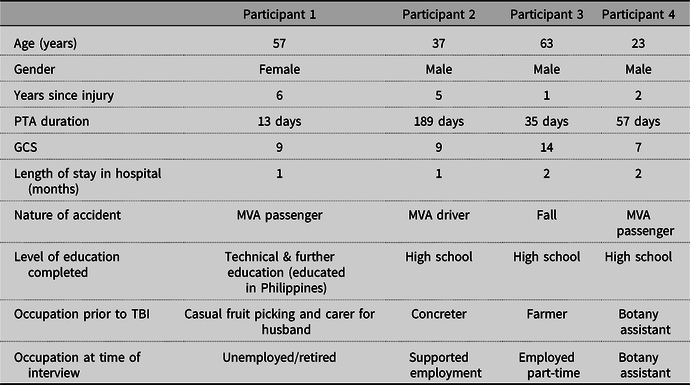
The demographics of these participants are outlined in Table 1. None of the participants were currently engaged in rehabilitation programs, but all continued to have contact with case managers.
Demographics of participants with TBI

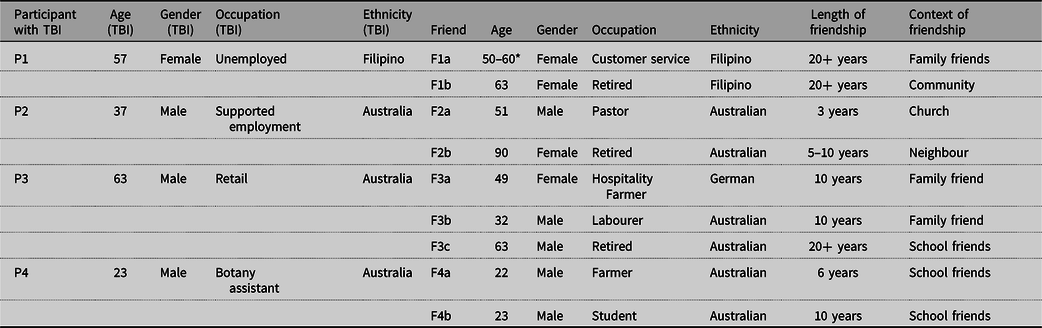
These four participants identified one-to-two friends each. Nine friends participated in the study. The friendship dyads are described in Table 2.
Demographics of participants with TBI and their friends, plus friendship characteristics

* Age range only provided.
The eligibility criteria for friends were for them to:
-
Be selected by the person with TBI;
-
Not be a family member of the person with TBI; and
-
Be able to participate in an interview.
Recruitment and sampling
In this study the participants are the friends of people with TBI. However, the person with TBI needed to be included to enable the recruitment of friends. Rehabilitation coordinators provided information about the study to people with TBI and sought their consent to be contacted by the researcher. The researcher contacted and visited those who had indicated a willingness to participate and completed the informed consent procedures. The person with TBI nominated friends who they thought may be willing to participate in the study. The person with TBI provided the contact details of the friends. The friends were then contacted by the researcher. Friends were told that their contact details had been provided by the person with TBI. Interviews were completed with those who agreed to participate. Once one friend had been interviewed, a second or third friend was contacted and the process was repeated. There was one occasion when the person with TBI provided the contact details of two friends and both friends chose not to participate. This person with TBI was excluded from the study.
The researcher commenced by recruiting from a group of participants who were considered to have expertise or experience surrounding the subject matter. In this study, this broad group comprised friends of participants who had sustained a TBI. Later in the research process, sampling was guided by theoretical sampling. Through the constant comparison of the data, characteristics that might play a role in shaping the friendship became apparent. These characteristics included the duration of the friendship, the age of friends, and whether friendships commenced prior to the injury being sustained or after the injury was sustained. Theoretical sampling was used to guide further recruitment of participants that allowed each of the characteristics to be represented in the study. This procedure provided the researcher with opportunities to explore whether codes developed from the data were specifically related to particular friendships characteristics (Coyne, Reference Coyne1997).
To assist with determining when to cease recruitment, saturation in relation to grounded theory was considered. While repetition did become evident within much of the data analysis, true theoretical saturation could not be reached due to the limitations imposed by the time constraints of postgraduate study.
Data collection
Semi-structured interviews, memos, and client files were used to collect data.
The first author conducted the interviews. Initially, a broad interview protocol was developed based on existing literature discussing friendships following acquired brain injury. Interviews began with an open invitation to share information: I’m interested to hear about your friendship with xx, whatever comes to mind, how long you’ve know each other, the things you like to do together, and the things that you enjoy about xx and even the things that might frustrate you or get on your nerves …… When participants responded to this opening segment the researchers considered the unfolding story and paid attention to the information that was provided, so that relevant follow-up questions could be asked (Galletta, Reference Galletta2013).
Constant comparison occurred between each interview. Hence, supplementary ideas were added to the protocol that was grounded in the data provided by previously interviewed participants. These ideas pertained to:
-
How friends supported each other;
-
Talking together;
-
The accident;
-
The hospital stay;
-
Stages of recovery;
-
Effects of the accident or TBI on the friend;
-
How did the friend get information about the accident;
-
Thoughts about the right thing to do in relation to the accident;
-
Anything friends chose not to include themselves in, in regards to the accident;
-
Changes in relation to communication and how the friend managed these changes;
-
What would have helped the friend;
-
Who helped the friend; and
-
Any experiences that the friend drew on that helped manage the changes that occurred as a result of the accident.
The interviews in this study lasted between 50 and 90 min. All interviews were audio and video recorded. Interviews were conducted face-to-face with eight participants, at a convenient location for the participant. One participant lived interstate to the researcher. This interview was conducted over the phone and audio recorded. All interviews were transcribed in full and uploaded to NVivo software (Castleberry, Reference Castleberry2014). Transcription was conducted according to the guidelines used by Hines (Reference Hines2009).
Throughout data collection constant comparison was used to examine data provided by the same participant. When conducting initial coding the researcher noted ideas and topics that were raised by the participants and these were added to the interview protocol. In this way, the second participant was asked about these ideas or topics raised by the first participant. This process continued throughout the course of all nine interviews. While saturation was apparent in most categories, it should be noted that negative case sampling was not used to confirm that this was the case for all categories.
Data analysis
All the interviews were transcribed and read independently by two researchers. Initial coding was conducted on the data provided by the first participant. On most occasions each sentence or utterance was coded individually; however, narratives were coded in their entirety to avoid altering the intended meaning.
Following this, focused coding was completed. This involved using codes that occurred more frequently among initial codes or had greater significance. At this stage the researcher considered what the initial codes implied as well as what they initially revealed (Charmaz, Reference Charmaz2014). That is, some participants may have been explicit about the same idea that other participants implicitly acknowledged.
Finally, theoretical coding was completed. Three theories were referenced at this stage of coding. Social network theory, a theory of how people interact with others inside their network (Kadushin, Reference Kadushin2012). Social exchange theory, describing the way that social relationships are based on exchanges (Uehara, Reference Uehara1990). Finally, symbolic interactionism, a theoretical perspective that views the individual and the context in which the individual exists as inseparable (Charon, Reference Charon2007). Each of these theories were used when engaging in constant comparison to enhance the proposed theory at this level of coding.
Establishing trustworthiness and rigor
Several strategies were used to enhance the trustworthiness and rigor of this research. Member checking was used with all but one participant, who could not be contacted. After initial coding, the researcher produced a written summary of the information that the participant had provided, including any interpretation that had been made to achieve the initial coding. This summary was sent to participants. Participants were then contacted, providing an opportunity to further discuss the summary, and for participants to highlight any areas where they felt the information may have been misinterpreted. There were no occasions of participants highlighting information that had been misconstrued.
Given that the first author worked clinically for an extensive period of time with people who had sustained a TBI, memo writing was important to establish reflexivity. The memos included assumptions made by the researcher about factors that may have contributed to social isolation, the impact of family members on friendships, ways that clinicians could engage with friends, and possible ways to assist with the development and maintenance of friendships. This information did not come directly from participants, therefore it was important to capture this, acknowledging how these findings emerged and therefore establishing reflexivity.
A methodological journal was also kept. This journal captured topics such as previous experiences, assumptions, and hypotheses that the researcher held, identifying gaps in the data (which assisted with theoretical sampling), defining preliminary codes, highlighting subtle differences between initial codes and thoughts and perceptions surrounding the experience of conducting semi-structured interviews.
Results
The overall conceptualisation that emerged from the data described the process of friends actively placing themselves within the friendship with the person with TBI. Two major processes were evident, that enabled friends to actively place themselves within the friendship: making sense of the TBI and the consequences and maintaining normality in the friendship.
Making sense of the TBI
Friends in this study made sense of the TBI by being there, thinking about the TBI and its consequences, connecting with others, and finding out about changes. Friends found their place in the friendship, enabling it to continue by establishing ways that they could be with the person with TBI. In the early stages of recovery, it was difficult to do the usual activities they did, such as exercise together, chat, have a coffee, or share a meal together. During this stage friends identified two ways to continue to be there and part of the friendship. Firstly to update others and keep updated themselves. This is exemplified by the following quote. ‘When I went to the Philippines last December I went to visit and see [person with TBI’s family] so that they will know how [she] is going here and tell them how she is’ (F1a). Secondly to visit and provide company. As time progressed and the person with TBI improved, they were able to engage in activities that friends would usually do together. For example, participant F1a and her friend returned to playing marjong together, ‘I said yeah, we’ll just have to go … together and play marjong’.
Participants appeared to utilize a variety of thought processes to guide their thinking about the TBI and its consequences. These thought processes included making assumptions (‘I think what worried him was that he didn’t know what the outcome was going to be’ F3b), comparing the past with the present (‘There’s no crap with him … He’s always been like it’ F3c), using personal experiences as a guide (e.g., participant F2b likened the person with TBI to her grandchildren, discussing how she would like people to treat her grandchildren if they were in a similar situation to her friend with TBI.), creating justifications (‘it was just natural that he was going to change a little bit when he was so down and depressed and that sort of thing’ F3b), forming opinions (‘He isn’t a lunatic. I won’t have that he is…certainly he’s got brain damage. But he is not a lunatic’ F2b), contemplating the future (‘the fact that he’d even want to get back into it [car racing] after the crash has happened’ F4b) and reflecting on the situation (‘Sort of like scruffing his hair the other night… but it was good to still have him here’ F4b). The experiences that they were exposed to while being with the person with TBI were then processed using these ways of thinking and were also mapped on to already existing schemas, beliefs and values.
Participants discussed connections that they shared with family members, as well as paid carers to enable them to make sense of the TBI and its consequences. The connections between friends and family and friends and paid carers were different. In regards to the involvement of family members, all participants and their friends had a relationship with one another’s families. There were instances when friends acknowledged the presence of the family of the person with TBI in the situation, as well as the role that their own family played. The following quotations provide evidence of the way that the participants identified different roles that both the family of the person with TBI, as well as their own family, played. ‘One day his sister comes down…and brings her boys to the pool here…[person with TBI] could go to the pool to be with his sister’ (F2b) and ‘I keep on talking to [my daughter], you know how’s your Tita [person with TBI]. She said she’s ok now mum, don’t worry’ (F1a).
In relation to paid carers, there was one person with TBI who had paid carers providing support and the two participating friends of this person focused strongly on the influence that paid carers had on making sense of the TBI and its consequences. Paid carers influenced participants’ making sense of the TBI by providing different perceptions about the person with TBI and sharing their knowledge with the participants. Participants identified discrepancies between their perceptions of the person with TBI and the paid carers’ perceptions, for example: ‘they say sometimes he can … socially struggle … we haven’t seen too much of that’ (F2a). Friends also received knowledge about the consequences of the TBI from paid carers.
Participants observed numerous changes in their friend as a result of the TBI. Changes surrounding behavior, cognition, communication, health, mood, and physical abilities were noticed. They specifically indicated that they observed these changes or the person with TBI or their family shared information about these changes. These included changes that were perceived as both positive and negative.
Maintaining normality
Participants in this study indicated their friendships continued beyond the TBI, exhibiting common elements of friendship, including: participating in activities, sharing, providing advice, socialising, helping one another, and using strategies to manage change. They identified a range of activities that they participated in with their friend including catching up for a coffee or drink, going shopping, specific recreation activities such as playing mah-jong or car racing, watching the football together, attending events together such as church activities, and sharing a meal.
Some participants did not highlight any post injury changes that had occurred to the activities they shared with their friends, while others did. For example, the following excerpt demonstrates changes Participant F3c: ‘before his accident, yeah we used to always go out and have a beer together and yeah’.
Interviewer: ‘and have those things that you enjoyed doing together changed since he had the accident’?
Participant F3c: ‘yeah because [person with TBI] can’t do it’. Participants tended to accommodate these changes.
Problems, concerns, as well physical items were reciprocally shared. For example, participant F1a provided examples of sharing concerns after her husband’s passing – ‘ … if there’s someone who’s going to marry you, are you still going to marry? and then she said I don’t know. I’m scared. You know I’m scared that we might not find … a person that’s … like our husbands … ’ Participants tended to provide advice to the person with TBI on most occasions, rather than the person with TBI providing advice to their friend. The content of advice varied between participants.
In addition to participating in activities, participants and their friends made contact with one another to socialise. Participant F1b commented that, ‘we keep on talking we just trying to mingle and socialise with each other that’s what we’re doing’. When socialising, participants and their friends spoke about a variety of topics. Friends also maintained normality by helping one another. Participants and their friend with TBI were both the providers and receivers of help. Different types of help were provided and received, including emotional help or support, physical support, and a combination of both. For example, participant F2a indicated that their friend provided emotional help through the following quote, ‘I saw him a week later or a couple of weeks later he would ask how is your dad’. While participant F2b indicated that their friend also provided physical help, ‘He’ll put the bin out, or he’ll put the bin in, whichever day it is’.
To be able to continue to maintain normality in the friendship, participants had developed particular strategies to manage changes that occurred as a result of the TBI. The strategies tended to be contextual and dependent on particular behaviors of the person with TBI. Examples of strategies included setting boundaries, (‘[If] she ask me to drive … her and I can’t really drive her I have to tell her no I can’t’) (F1a), prompting (‘Sometimes he not talk, but I push him to talk’) (F3a), provision of feedback (‘well I don’t understand what you’re telling me’) (F2b), providing reassurance (‘and then he’ll come back and I’ll just say ‘you had the shits old fella’ and we’ll have a bit of a laugh oh yeah yeah and things are alright’) (F3c), and modification of their own [the friends’] behavior (‘you had to learn to talk to him again, instead of just talking to whoever else was in the room about him’) (F4a).
Discussion
It is well known that people with TBI are more susceptible to social isolation (Douglas & Spellacy, Reference Douglas and Spellacy2000). The impairments that they present with can have negative implications on their ability to socialise and therefore develop and maintain friendships (Finset et al., Reference Finset, Dyrnes, Krogstad and Berstad1995; Shorland & Douglas, Reference Shorland and Douglas2010; Struchen, Pappadis, Sander, Burrows & Myszka, Reference Struchen, Pappadis, Sander, Burrows and Myszka2011). However, this study showed that diverse friendships have the potential to be maintained and developed post TBI. This finding draws parallels with Aristotle’s Nichmachean Ethics. Aristotle describes three types of friendship. Those of utility, pleasure or good, and virtue. He theorizes that friendships of good and virtue are perfect friendships. They are less likely to break down because the people in them are ‘good’ people and they wish one another well. It may be possible that the friendships explored in this study are those of good and virtue. Hence they have been maintained. While this study identified processes that assist with the maintenance of friendships, perhaps these friends were able to actively place themselves in the friendship because they were friendships of good and virtue (Thomson, Reference Thomson1955). In particular, friendships of good and virtue were more likely to be able to maintain normality in the friendship, as the friendship was not reliant upon finding pleasure or usefulness in the other’s company, as would be the case with friendships of pleasure and utility. Further investigation would be required to determine if this theory applies to the population of people with TBI and their friends.
Other clinical studies have shown that particular factors appear to influence friendships. For example, Shorland & Douglas, (Reference Shorland and Douglas2010) demonstrated that changes to communication impacted upon the ability to interact with friends. Each of the people with TBI in this study were identified as experiencing communication impairment and yet their friendships were maintained. Therefore, while communication appears to be another factor that could affect the ability to maintain a friendship, it appears that this can be compensated for. This may demonstrate that there are a multitude of factors that could affect the maintenance and development of a friendship post TBI, rather than one singular factor.
Clinical implications
The results indicate that friendships can be developed and maintained following a TBI. It appears that friends who are able to make sense of the TBI and its consequences and maintain normality still continue to be friends. Further research would be required to determine whether clinicians could intervene with friends to develop these behaviors. Alternatively, this study has also demonstrated that friends can be instrumental in maintaining and developing friendships without intervention. This finding is synonymous with Bogart, Togher, Power & Docking, (Reference Bogart, Togher, Power and Docking2012), who also showed that friends are able to empower the person with TBI in the context of conversations. When nine participants and their friends’ conversations were compared to the conversations of matched controls, it was found that friends were able to compensate for the communication impairments demonstrated by the person with TBI. Again, it may be possible that friendships of good and virtue, as per Aristotle’s Nichmachean Ethics, do not require intervention. Perhaps other types of friendships could benefit from training to assist with maintenance.
There are already some intervention approaches that exist that could assist with guiding health professionals’ work with friends. Togher, Power, Rietdijk, McDonald & Tate, (Reference Togher, Power, Rietdijk, McDonald and Tate2012) developed communication partner training which encouraged communication partners to put the person with TBI on a level playing field during communicative interactions. This was achieved through the use of strategies to empower the person with TBI to participate in the conversation. This intervention approach encourages the maintenance of normality in the context of conversation. This is aligned with findings from this research, where it appears that friends who are able to maintain normality through the use of strategies are able to maintain a friendship with a person with TBI.
Given that Togher et al., (Reference Togher, Power, Rietdijk, McDonald and Tate2012) have demonstrated that training communication partners can be effective in improving the quality of conversation, this may provide evidence that friends could also be trained to use some of the strategies that the participants in this study used to maintain their friendships. That is, friends could be trained to assist the person with TBI to participate in activities, provide advice, socialise with the person with TBI, encourage reciprocal helping of one another, and use strategies to manage change such as prompting.
Future directions
The results demonstrated that friends were able to make sense of the TBI and its consequences and maintain normality through the use of a variety of pathways. Further research could be conducted to clarify whether these processes were utilized in friendships that did not last post TBI. This may provide more conclusive evidence to determine whether these processes are essential in the maintenance of successful friendship post TBI. Research could also focus on possible interventions that could assist the person with TBI and their friend to develop skills to enable them to engage in the processes of actively placing themselves in the friendship.
Limitations
While qualitative research methodology was an appropriate methodological choice to achieve the proposed research aims, there are limitations. The results from this study are the lived experiences of these particular participants; however, other’s experiences may differ from those of this group, depending on their context and environment (Creswell, Reference Creswell2007). For example, the majority of these friends were over the age of 30. Therefore, these findings may not reflect the experience of younger friends.
As previously mentioned, theoretical saturation was not achieved across all the categories. While repetition of ideas was seen and it was possible that some focused codes did reach theoretical saturation, time constraints did not enable the establishment of a systematic approach to determine whether all categories reached a point where no new properties or dimensions could be established (Birks & Mills, Reference Birks and Mills2015).
It is well documented that TBI is more frequently sustained by youths, young adults, and people over the age of 60 (Helps, Henley & Harrison, Reference Helps, Henley and Harrison2008). Unfortunately, in this sample only one participant with TBI was a young adult. Hence the sample was not necessarily representative of the usual demographic that would be likely to sustain a TBI. Other participants under the age of 20 were invited to participate. Two chose not to be involved due to concerns that it may affect the friendships that they had, they did not feel it was a priority for their friend or they were unable to identify a friend to participate. This will continue to be a limitation that will have implications for future research.
For many people with TBI, friendships deteriorate prior to 6 months post injury. This study only considered participants who had sustained their injury beyond 6 months. It is possible that people with TBI and their friends could be experiencing different concerns during the inpatient phase of rehabilitation. It is not possible to determine whether the information discussed in the clinical implications section would be relevant to this cohort.
Conclusion
The aim of this study was to investigate the experiences of friends of people with TBI. Nine friends were interviewed, using a semi-structured interview. Data were analyzed using a grounded theory approach. The results showed that friends are able to actively place themselves in the friendship following a TBI by engaging in two processes, making sense of the TBI and its consequences and maintaining normality in the friendship. The findings reinforce that while friendships do change after TBI, there are occasions when friendships can succeed. Some friends are able to find a place in the friendship and make headway, enabling the friendship to continue and grow.
Financial Support
This research received no specific grant from any funding agency, commercial or not-for-profit sectors.
Conflict of Interest
Tennille Bertram has no conflicts of interest to disclose. Professor Leanne Togher has no conflicts of interest to disclose. Doctor Emma Power has no conflicts of interest to disclose. Professor Jacinta Douglas has no conflicts of interest to disclose.
Ethical Standards
The authors assert that all procedures contributing to this work comply with the ethical standards of the relevant national and institutional committees on human experimentation and with the Helsinki Declaration of 1975, as revised in 2008.