Introduction
During the hot season in northern Thailand I videotaped a group of school-aged boys and their younger siblings playing indoors after school as they engaged in a series of riddles, puns and language games that are typical of young children across cultures. One of these – particularly popular among Thai children – involved a series of statement/question pairs ending with a humorous twist, pun, or play on words. Typically one child (the expert) initiates the game by prompting another child (the novice) to utter the first question in the series, as in the following typical example:
(1) Expert: Say, ‘what hole?’
Novice: what hole?
Expert: crab hole.
Novice: what crab?
Expert: field crab.
Novice: what field?
Expert: rice field.
And so on. After having twice performed one version of this game with his fellow eight-year-olds, Eck turned to his five-year-old younger brother, Song, to perform it with him. What Song did not know, however, was that he was being targeted for a humorous insult at the end of the sequence. As Eck prompted Song to ask the first question, the other children gathered around in excitement to watch the game unfold. How would Eck and Song perform in front of their friends? We will see below (Segment 3) that, while Song lacks the prowess of the older boys at performing these language games, he does manage to fleetingly turn the tables on the older kids through his own creative improvisations.
Children’s humorous play is a cultural activity with its own particular aesthetic – an aesthetic in which highly creative, incongruent, and unexpected speech and action are valorized, appreciated, and rewarded (Gossen Reference Gossen, Bauman and Sherzer1974, McDowell Reference McDowell1979). Successful performance within this aesthetic requires being able to capitalize on fleeting opportunities by utilizing complex contextual and pragmatic knowledge about the cultural frameworks and expectations that are in play in a particular interaction. As children’s play becomes ever more linguistically and pragmatically complex through childhood, it also supports and reflects children’s developing language proficiency and literacy, whether in a first or a second language (Cazden Reference Cazden, Bruner, Jolly and Sylva1976, Pellegrini Reference Pellegrini1981, Gombert Reference Gombert1992, Poveda, Cano & Palomares-Valera Reference Poveda, Cano and Palomares-Valera2005). In this article I show how the repetition and scripted structures that are characteristic of play serve as crucial resources for enhancing children’s participation in the humorous play activities of older or more proficient children. Just as jazz musicians rely on the harmonic, rhythmic, and melodic structures of a standard tune on which to build their creative improvisations, and just as they tweak a tune’s style or mood to create novel versions, children make use of the structure, repetitiveness, and predictability that are typical of play as jumping-off points for the creative improvisations and playful adaptations that are highly valued within their social worlds. Drawing on Bauman’s (Reference Bauman2004) concept that speakers calibrate their utterances to fit new contexts, and that differing ideologies of performance underlie these calibrations, I argue that an aesthetic of decalibration is at work in children’s metalinguistic and metapragmatic language play, in which children revel in the humorous breaching of expectations made possible by linguistic and pragmatic ambiguity.
Play is sometimes the serious business of childhood: Song and Eck’s performance in this “child’s play” may have important social consequences. Like adults, children’s standing within their social world is constituted, in part, through their performance in the activities and skills that are highly valued among their peers in play (Haas Reference Haas1957, Labov Reference Labov1972, Abrahams Reference Abrahams, Bauman and Sherzer1974, Corsaro Reference Corsaro1985, Goodwin Reference Goodwin1990, Gaskins, Miller & Corsaro Reference Gaskins, Miller and Corsaro1992, Maybin Reference Maybin2006). Recently, scholars of childhood across disciplines have argued that children’s worlds are neither completely autonomous from adult endeavors, nor fully dependent on them (Corsaro Reference Corsaro1985, Reference Corsaro2005; Corsaro & Eder Reference Corsaro and Eder1990; Gaskins et al. Reference Gaskins, Miller and Corsaro1992; Bucholtz Reference Bucholtz2002). Children are theorized not as progressively acquiring a stable and pre-existent adult culture, but rather as taking an active part in cultural production across time scales, from small-scale interactions (micro-genetic), to individual development (ontogenetic), to generational and historical processes (cultural-historical), to evolutionary change (phylogenetic) (Rogoff Reference Rogoff2003), both within and beyond their peer groups. In creatively producing their childhood cultures, children appropriate and adapt symbolic and material resources from the “adult” world to the purposes of their childhood worlds, activities and endeavors (Corsaro Reference Corsaro1985, Bucholtz Reference Bucholtz2002): Children develop within a childhood world that is itself embedded in the larger symbolic, social, and material structures of the adult world. This essay articulates with recent research that explores not only how children structure and participate in play, but also their socialization into play and peer cultures across the stages of childhood (Goodwin & Kyratzis Reference Goodwin and Kyratzis2007), examining how young children like Song are socialized into the highly valued and complex humorous play activities of older children through peripheral participation in a mixed-age play group.
Repetition in the (re)production of language and culture
Practices of repetition by both novices and experts pervade a wide range of socializing encounters in children’s early linguistic and social development, facilitating the accurate acquisition of canonical linguistic and cultural practices by children and novices. Any detailed investigation of repetition in human discourse complicates a view of repetition as simple mimicry or replication: Repetition provides the very texture of our discursive practice, weaving together instances of discourse across temporalities, and marking the social reference points and alignments that bind us together with other human actors (Keenan & Schieffelin 1976; Keenan Reference Keenan, Ervin-Tripp and Mitchell-Kernan1977; Pennycook Reference Pennycook1996; Silverstein & Urban Reference Silverstein and Urban1996; Agha Reference Agha2005, Reference Agha2007; Wortham Reference Wortham2006; Tannen Reference Tannen2007). While “synchronic repetition” (Tannen Reference Tannen2007) – the recurrence of forms within a conversation or text – creates texture and coherence at a local level, “diachronic repetition” – repetition creating “a connection to previously experienced discourse”(Tannen Reference Tannen2007:9) – ties local encounters to broader social, cultural, and historical undercurrents. Synchronic repetition in the language spoken around children facilitates learning not only by making linguistic and cultural objects memorable through sheer frequency, but also by making their canonical form more salient (Brown Reference Brown1998, Reference Brown and Duranti2001). The “dialogic repetition” that pervades Tzeltal conversational exchanges, for example, “amounts to a systematic exposure to paradigmatic contrasts of a crucial sort” (such as verb forms) in children’s early language acquisition (Brown Reference Brown1998). Various types of synchronic repetition constitute useful resources for language learners of all ages, making language forms and texts accessible and providing learners with the minimal means of participating in classroom activities (Merritt Reference Merritt1982, Duff Reference Duff, Kelly Hall and Verplaetse2000, Cekaite & Aronsson Reference Cekaite and Aronsson2004, Moore 2006b), in play activities (McDowell Reference McDowell1979, Blum-Kulka, Huck-Taglicht & Avni Reference Blum-Kulka, Huck-Taglicht and Avni2004), and in conversation (Tannen Reference Tannen2007). In the classroom, teachers use repetition to provide “participatory rhythm” and “catch-up time,” which makes students’ involvement in classroom activities possible (Merritt Reference Merritt and Johnstone1994). Teachers’ self-repetition as they negotiate meaning with their second-language learners makes the talk more comprehensible to these students, which may facilitate both language acquisition and content learning (Chaudron Reference Chaudron1983, Pica, Young & Doughty Reference Pica, Young and Doughty1987).
Repetition also plays a key role in the (re)production of culture. Cultural rituals and routines instantiate, in more or less explicit ways, important cultural categories, identities, ideologies, norms, and values, contributing to children’s developing understanding of these phenomena through their diachronically repeated performance in a range of contexts (Schieffelin & Ochs Reference Schieffelin and Ochs1986, Schieffelin Reference Schieffelin1990). Canonical and authoritative texts that are poetically styled through synchronic repetition, parallelism, and other rhetorical devices are particularly potent means of transmitting and reproducing dominant and powerful discourses (Bauman & Briggs Reference Bauman and Briggs1990, Silverstein & Urban Reference Silverstein and Urban1996). McDowell (Reference McDowell1979), for example, pointed out that the formal and semantic redundancy of children’s folklore constitutes “an accessible rhetoric” that is ripe for repeated performance by children. Moreover, across multiple social encounters, emerging discourses and identities may become stabilized and gelled through such processes of repetition and circulation (Bauman & Briggs Reference Bauman and Briggs1990, Agha Reference Agha2005, Wortham Reference Wortham2006). Repetition, therefore, serves as a discursive resource across time scales for producing, maintaining, and/or transforming the social and cultural fabric that serves as the basis for intersubjectivity.
One of the key ways by which cultural objects make their way through the world rather than simply disappearing into the ether of past social encounters is through their iterative performance as genres in recurrent or novel contexts. As an important type of diachronic repetition, genres create type-level interdiscursive associations that reference broader norms of conduct (Silverstein Reference Silverstein2005). The performance of a genre structures participants’ expectations for how to talk, who should talk, and when they should do so (Bakhtin Reference Bakhtin, Emerson and Holquist1986[1979], Hanks Reference Hanks1996) invoking, for example, expectations about genre-specific texts (such as poems or songs), ways of speaking (the styles, registers, and language) (Kulick Reference Kulick1992, Garrett Reference Garrett2005), and ways of participating (participation structures, forms of participation such as embodiment and role-specific contributions, and participant roles) (Bauman & Briggs Reference Bauman and Briggs1990, Goodwin & Goodwin Reference Goodwin, Goodwin and Duranti2004). Genre is hence “a means … for the expressive enactment of subjectivity”(Bauman Reference Bauman2004:6). While the diachronic performance of genres can evoke broader social and cultural fabrics underlying the current discourse, the poetic styling of genres through repetition and parallelism makes these textures and social fabrics salient and accessible for playful (or serious) tweaking and transformation.
Repetition in children’s play and humor
Repetition not only fosters the enhanced participation of novices in socializing contexts, but it also constitutes the very fabric of play itself. Anyone who has ever spent time with a small child quickly learns that young children enjoy reading the same book, hearing the same song, or playing the same game over and over “again!” There is simply something comforting, pleasurable, and accessible about repetition, which comes with a certain rhythm and predictability: Children’s playful “artistic verbal performances are savored in their own right as appealing kinds of linguistic concoctions” (McDowell Reference McDowell1979:12). Perhaps because so much of life seems confusing, unpredictable, and beyond the control of young children they are particularly drawn to the pleasures of repetitive experiences. In humorous play, children provide these experiences for each other through synchronic repetition such as parallelism, rhythmic patterns, and games played in rounds (Garvey Reference Garvey1974, Gossen Reference Gossen, Bauman and Sherzer1974, McDowell Reference McDowell1979, Cook-Gumperz Reference Cook-Gumperz, Hall and Bucholtz1995, Cook Reference Cook2000) and format tying (Goodwin & Goodwin Reference Goodwin, Goodwin, Philips, Steele and Tanz1988, Corsaro & Maynard Reference Corsaro, Maynard, Slobin, Gerhardt and Kyratzis1996). Children’s repetitions of others’ speech accomplish a range of complex pragmatic functions, as they do in adult discourse (Keenan Reference Keenan, Ervin-Tripp and Mitchell-Kernan1977, de León Reference de León2007), such as agreeing with, commenting on, or establishing the shared nature of prior propositions.
Children also frequently engage in diachronic repetition as they perform familiar tidbits of children’s folklore, literature, or fragments of popular culture (Opie & Opie Reference Opie and Opie1967, McDowell Reference McDowell, Sutton-Smith, Mechling, Johnson and McMahon1995, Moore Reference Moore, Newman and Hyman2006a). Through dramatic reenactment (e.g., Gordon Reference Gordon2002, Paugh Reference Paugh2005) and parody (Basso Reference Bauman and Briggs1979, Cekaite & Aronsson Reference Cekaite and Aronsson2004, Rampton Reference Rampton2006) children are able to review aspects of experience that may have been confusing the first time around. These forms of diachronic repetition allow children to work out how they feel about previous experiences, and to display those feelings to others. Such intertextual ties often subvert social hierarchies or break children out of adult constraints, such as the way in which children’s naughty versions of the Popeye ditty “radically altered (the ditty) to produce a message subversive of adult-imposed decorum” (McDowell Reference McDowell, Sutton-Smith, Mechling, Johnson and McMahon1995:55). Children also seem to notice, remember, and relish recycling splices of discourse that are affectively salient for some reason, creating a dynamic repertoire of borrowed words that become locally significant. This was the case with the humorous and teasing variant of a greeting described by Reynolds Reference Reynolds2007, ‘buenos días/ ((military salute))’, that first emerged as an improvised insult within a sibling conflict and later circulated humorously among other children in that group. Familiar routines typically associated with hierarchical participation structures, such as greetings, are also ripe for playful distortion by children, and are used to subvert the social order through play. De León Reference de León2007, for example, reported how Tzotzil siblings subverted age hierarchies within the family through humorous language play that altered the highly predictable interactional routines of exchanging greetings and conveying adults’ messages.
Children’s uses of repetition in play change over the course of their early development. During the preschool years, much of children’s available playtime is spent in pretend routines and recurrent games (Evaldsson & Corsaro Reference Evaldsson and Corsaro1998, Blum-Kulka et al. Reference Blum-Kulka, Huck-Taglicht and Avni2004). For school-aged children, language play, such as poetic play or playful uses of language, metapragmatic or metalinguistic play, mocking/subversive play, and play with ritualistic interchanges, increases and becomes more sophisticated (Sawyer Reference Sawyer1995, Blum-Kulka et al. Reference Blum-Kulka, Huck-Taglicht and Avni2004). Younger children and less proficient second-language learners are able to engage more fully in play with peers by using frequent synchronic repetition of simple and conventionalized language from their own or others’ prior talk (Rydland & Aukrust Reference Rydland and Aukrust2005), while repetition in older or more proficient children’s language play decreases and draws more subtly on the style, manner, and timing of speech, displaying the children’s enhanced awareness of the social and pragmatic uses of language (Blum-Kulka et al. Reference Blum-Kulka, Huck-Taglicht and Avni2004, Bell Reference Bell2005). Rydland and Aukrust Reference Rydland and Aukrust2005 demonstrated that less proficient second-language-learning children used self-repetition frequently to facilitate their participation in play with peers, while more proficient second-language-learning children used repetition for more complex functions such as displaying understanding and building on other children’s talk. More complex uses of repetition in play have been, in turn, associated with higher proficiency in early literacy and academic uses of language (Pellegrini Reference Pellegrini1981, Snow, Barnes, Chandler, Goodman & Hemphill Reference Snow, Barnes, Chandler, Goodman and Hemphill1991, Rydland & Aukrust Reference Rydland and Aukrust2005).
Repetition both structures children’s humorous play and makes it interpretable as humorous. Tannen (Reference Tannen2007:71) points out that humor is an important function of repetition with slight variation, such as when one speaker said, “Rover is being so good,” and another replied, “He’s being hungry.” Repetition and parallelism set up a frame within which certain aspects of a familiar structure can be varied to humorous effect (Jakobson Reference Jakobson and Sebeok1960, Johnstone Reference Johnstone1991, Tannen Reference Tannen2007). A parallel structure, for example, presents two or more parallel items within a shared frame. This process highlights the two elements that vary, and “evokes the paradigm of which they are both (or all) members” (Johnstone Reference Johnstone1991:33). When the variation within a frame is humorous, this parallel or repetitive structure highlights the strange, tweaked, incongruous nature of the humorous item (Kyratzis Reference Kyratzis2004). The paradigm evoked in Tannen’s example above, for example, is that of the dog’s comportment – different ways the dog could “be” in the current situation. The frame for both items is “(he) is being x,” and the differing items contrast “being good” with “being hungry.” Yet, while “being good” is a common expression, “being hungry” is strange because verbs describing a state of being are rarely found in a present progressive frame (they already imply an ongoing time frame), so this parallelism heightens the humor of the contrast.
The role of variation within a frame for constructing humor is also evident at the broader level of cultural models, genres, and interactional routines. Children’s worlds are constructed, in part, through the appropriation of cultural materials. This “stretching or plying the frame” of the adult cultural model “gives the children more control over it and allows them to move it in directions in line with the values and concerns of peer culture” (Evaldsson & Corsaro Reference Evaldsson and Corsaro1998:386) and provides experiences that are “both continuous and discontinuous with everyday life” (Evaldsson & Corsaro Reference Evaldsson and Corsaro1998:389). Cekaite & Aronsson Reference Cekaite and Aronsson2004 found that young, bilingual school-aged children produced “playful recyclings” to humorous effect in the classroom in metapragmatic play that breached generic expectations about who should produce which types of discourses in which contexts. These included both intertextual play – diachronic repetition that brings elements of incongruent discourses (e.g., songs, personal names, other classroom routines) into the classroom dialog – and role appropriations, segments of child discourse that are inappropriate to the child’s role, such as when a child repeats or parodies a teacher’s utterances. In communicative foreign language classrooms, university-level language learners engage in playful uses of language in ways that “destabilize institutionally sanctioned assumptions about what counts as meaningful language” (Pomerantz & Bell Reference Pomerantz and Bell2007:556). In the playful and silly greetings exchange described by de León (Reference de León2007:415), children “untie the inherently tied greeting format” by recycling and progressively unhinging its A-B format over several rounds, and through semantic counterpointing of increasingly unconventional vocatives. The familiar greeting exchange provided a structure against which new contributions could be compared for the humorous ways they were distorted or changed.
In this article, I examine how children draw on genre as a frame for producing humorous alterations in their play. As genres are diachronically “repeated” across time and space, their significance changes as social actors adjust them to the current activity expectations and understandings. While some genre performances such as ritual activities are strictly regimented by genre expectations, others such as comedy performances creatively depart from expectations (Keenan Reference Keenan1973, Bauman & Briggs Reference Bauman and Briggs1990, Bauman Reference Bauman2004). A genre may be invoked humorously within an incongruent context, for example, or through its invocation may radically change the nature of the current situation. McDowell (Reference McDowell, Sutton-Smith, Mechling, Johnson and McMahon1995:59) points to this contrast in children’s play, demonstrating that while some children’s folklore performances may be evaluated in terms of their fidelity to a traditional item, “in other genres, such as riddling, the juvenile peer group may attach… as much or more importance on the ability to formulate spontaneous improvisations.” He refers to this “capacity to formulate appropriate folkloristic items” (McDowell Reference McDowell, Sutton-Smith, Mechling, Johnson and McMahon1995:60) within a folkloric tradition as traditional competence. To capture this, I draw on Bauman’s (Reference Bauman2004) notion that performers make minute “calibrations” in their genre performances to align these with new contexts by tweaking form, function, or theme. Some genres or performance contexts are associated with particular “ideologies of performance,” involving “expectations and values bearing on the degree to which individual performances should conform with or depart from what is taken to be normative for the genre” (Bauman Reference Bauman2004:9–10).
In children’s humorous play, an important ideology of performance is to produce utterances that are incongruent with aspects of the current context. Cekaite & Aronsson (Reference Cekaite and Aronsson2004:374), for example, argue that children’s humor is “based on an inversion of normative expectations” by playing with (i) how (e.g., parody/mocking), (ii) when (e.g., incongruent intertextual connections), or (iii) by whom (e.g., role appropriation) something is said. What matters in a child’s construction of humor is the way that a genre is placed and performed within play activities, and the practices of engagement that children forge for themselves within its performance. Children’s play, then, seems to aim at what I would call the decalibrationof utterances: Children draw on generic resources that invert the current social situation, perform genres that are incongruent with the current context of speaking with no alignment or adjustment, or participate in a genre in ways that breach expectations. By decalibrating their contributions from normative constraints, children are able to break in and spin out of those play activities in creative and valued ways, engaging in the inversion and mutation of social expectations, while showing off their skills or their comrades’ lack thereof. I argue that the very repetition and predictability typical of play genres, then, may actually foster creativity, making space within fleeting social encounters for children to break in or spin out of a genre’s constraints.
The Study and its Setting
The study
The data for this paper are taken from a broader ethnographic, discourse analytic study of children’s language socialization at home, in school, and in play groups, conducted in Pong Noi, a Muang village near Chiang Mai, northern Thailand, in 2000–2001, where children speak the regional vernacular at home and with peers, but learn the national standard variety of Thai at school. At regular intervals over 10 months, I observed and videotaped four 5- and 6-year-old children and their 7- to 9-year-old siblings (using radio microphones) in their everyday activities at home, at school, and in their play groups. Extensive logs (detailed records of the activities occurring on these recordings) were created and annotated with additional cultural, historical, social, and linguistic information in consultation with my Muang assistants. Based on field notes, video logs, and interviews with community members, relevant areas for detailed investigation were identified, and particular segments were collaboratively transcribed and translated with the help of my assistants. This article focuses on the children’s play activities at home after school with siblings and neighboring children of different age groups. Although the data fragments presented here came from a single play session, they were chosen to clearly illustrate the dynamics and processes of play that occurred across the peer groups. During this play session at 5.5-year-old Song’s home on a school-day afternoon, he is watching a movie with his older brother (Eck, age 7.5), his older cousin (Cue, age 8, visiting from out of town), and two neighbor children (Boy, 8, and Girl, 4).Footnote 2
Language games in the Muang community
For the most part, children living in close proximity to each other in Pong Noi would gather to play at one of their family compounds where adults were present. The location and composition of these play groups shifted from day to day depending on a number of factors, and group dynamics and leadership shifted accordingly. The gender and age composition of the groups was usually mixed, with one gender/age predominating. Activities included pretend play (especially among same-age preschoolers), watching movies on video, physical outdoor activities (biking, rolling tires, exploring the woodlands, playing with animals), scripted games (e.g., drop the handkerchief, clapping games), collecting/exchanging mass-mediated character paraphernalia (e.g., cards and disks depicting characters), drawing, and other activities. Language play such as riddles, jokes, and other poetic/playful uses of language – plays on words, puns, mocking or subversive play with language, playing with the pragmatic aspects of language, and ritualistic interchanges – occurred occasionally in all of the play groups studied, but with more frequency in the predominantly male groups.
Language games, including punning, riddles, plays on words, and other forms of play with language are salient cultural activities in Thailand. Being a skilled performer of language games and being a good sport within language play activities are valued skills for fostering intimate friendships. For example, language games have been described as a central resource in Muang courtship rituals (J. Potter Reference Potter1976, S. H. Potter Reference Potter1977), and Haas Reference Haas1957 describes how language games are competitive activities in which participants adopt different positions that can be negotiated and reversed as players target other players, retaliate, or simply show off their skills. The structure of language games makes salient the aspects of language structure and meaning, such as the double meaning of a word. In turn, the interactive organization of the play activity, including laughter in appreciation of a good joke, format tying, and the repetition of laughable items, highlights particular language structures as relevant to successful participation in the game.
Breaking in and Spinning Out in Language Play Performances
Spinning out: Contrapuntal decalibration in expert humor
I begin by presenting an example that illustrates the decalibrating aesthetic of children’s complex language games, showing how they creatively tweak and transform the very participation structure of their activities, often breaking away from formulaic texts and regimented game structures by drawing on the multiple language resources of their community, creating new puns, riddles, or similar plays on words that fit with this aesthetic. Even the very boundaries between codes (such as the local vernacular Kam Muang and Standard Thai) become fair game as objects of language play.
Just before this segment, my young research assistant, fearing that I wasn’t getting enough “data” about the children’s proficiency in Kam Muang, had been asking the boys a series of teacher-like questions in the vernacular. Her questions took up the topic of Cue’s recent birthday party, where the children had eaten pizza rather than cake. As this segment begins, Song (age 5.5) becomes the target of an impromptu riddle from his older cousin Cue (age 8) after he compares pizza to ‘the rotten barf of foreigners’. This is perhaps a playful (and somewhat subversive) reference to the foreigner behind the camera (me) – indeed, Song glances at me as he says it. Being preoccupied with filming (and perhaps also socially inept in this setting), I failed to join in by countering his teasing. Im and Cue, however, did not miss the opportunity to respond by directing a jab back at Song.Footnote 3
(Song 5/03/01 #1: p. 17; 16:15-21:10)
Im: research assistant. (Muang is in plain text, Standard Thai is in italics).
1. Im lɛ́ɛw dâj kĭn khéek kɔ̀ɔ kháp and you got to eat cake too, or not?
2. Song bà kĭn kháp no we didn’t eat any.
3. Cue bà kĭn kháp jaŋ [ khanŏm bà dâj kĭn we didn’t eat any. [ cake we didn’t eat.
4. Song [ phítsâa pĕn khéek kháp [ pizza IS cake.
5. Im ʔaaw: : oh: :
6. Song [tham maa càak hâak phít fa`lăŋ ] [it’s made of the rotten barf of foreigners]
7. Cue [ ʔeek ʔeek ʔeek ʔeek ʔeek ] ʔeek nʉ́k wâa ha [ Eck Eck Eck Eck Eck ] Eck, he thinks, hah
8. phítsâa tham maa c(h)àak hh hâak fàl(h)àŋ ŋà pizza is made o(h):f hh the barf of foreig(h)ners
9. Im lá lam kɔ̀ɔ and is it delicious?
10. Song la:m deli:cious.
11. (0.5)
12. Im ʔɔɔ: : aw: :
Segment 1a: Lam
In line 6, Song’s statement that ‘pizza is made of the rotten barf of foreigners’ keys a play frame, in part by denigrating things foreign in the presence of an elder foreigner. This statement is treated as funny and repeatable by Cue, who reanimates Song’s answer for the benefit of Eck, with lots of laugh tokens evaluating it as funny (‘Eck, he thinks hah that pizza is made o(h):f hh the rotten barf of for(h)eigners!’, lines 7–8). Im directs the jab back at Song by asking if pizza is delicious (line 9), and he answers that it is (line 10). At this point, Cue challenges Song’s answer with an implicit evaluation that it’s strange to claim it was delicious given that he did not finish his portion (‘If it’s delicious, why didn’t you eat it all?’, line 13). Without allowing Song to answer, Cue quickly shoots off a second question, embodying Im’s teacher-like questioning. His question involves a play on the sound form lam, which has different meanings in Standard Thai and Kam Muang: ram [lam] (Standard Thai: usu. pronounced lam) ‘to dance’, vs. lam (Kam Muang) ‘to be delicious’.
13. Cue lam dĭaw thama kĭn bà sĩaŋ = if it’s delicious why didn’t you eat it all
14. Cue =.hh sɔ̌ɔŋ kĭn phítsâa lam kɔ̀ɔ
1. = .hh Song, is eating pizza delicious?
2. = .hh Song, (you) eat pizza, do (you) dance?
15. (0.5)
16. Song lam it’s delicious
17. Cue paj lam kăaŋ thànŏn púun kà go dance in the middle of the street there.
18. Childre ((laughing, 4.0))
Segment 1b: Lam
Cue’s question in line 14 is ambiguous: It could be interpreted in two ways, depending on one’s syntactic parsing of the utterance: ‘Song, is eating pizza delicious?’; or, ‘Song (you) eat pizza. Do (you) dance?’ Given that the preceding topic was pizza, a question directed at Song to clarify whether he thinks pizza is delicious is more relevant than a question about dancing. The fact that Cue’s entire utterance is spoken in Kam Muang while ram is a Standard Thai word also favors interpreting this sound form as Kam Muang lam ‘to be delicious.’ It would be incongruent with the current context to interpret Cue’s question as the Thai version, about dancing. When Song answers in the affirmative (‘(it’s) delicious,’ line 16), Cue’s punch line makes his joke public (‘go dance in the street over there!’ line 17) by placing lam/[lam] in a sentence frame in which its meaning is ‘dance’ (note that the rest of Cue’s utterance is still in Kam Muang). This positions Song as the target of the joke and reveals his inferior skill at wordplay, while also showcasing Cue’s dexterity in seizing the opportunity to land a zinger. Cue’s joke is appreciated by all of the children present as they laugh heartily (line 18), showing that the children (including Song) acknowledge his wit and verbal acumen.
Cue’s pun-dependent question sequence humorously decalibrates his utterance from the current context by breaching expectations about both the how (the variety of language used, Thai) and the what (the content of the question, being about dancing rather than taste) of his utterance. Furthermore, Cue unravels the Initiation-Response-Evaluation participation structure set up by Im’s enactment of a canonical classroom genre, appropriating the “teacher” role by voicing teacher-like questions (‘If it’s delicious why didn’t you eat it all? = ·hh Song, is eating pizza delicious?’ lines 13–14). While Song cooperates with this participation structure by responding in a student-like manner, the “teacher” evaluation slot that would be relevant next is instead used by Cue to give a directive (‘go dance in the street over there!’, line 17), a move that retrospectively reframes the previous question as a pre-directive (seeking information relevant to the directive before performing it). Cue, then, was also able to invert expectations about who says what to whom by first seeming to appropriate a teacher’s role in the performance of a classroom “display question” genre, then retrospectively reframing the sequential positioning of the utterance.
Making the joke public, Cue’s punch line metalinguistically cues that a playful/poetic performance mode is in progress, inviting playful contributions by other participants. What follows demonstrates how the conventions of a genre – in this case the expectation that a joke’s punch line will receive appreciation – can be appropriated to forge new forms of participation that “multiple participants build in concert with each other” (Goodwin & Goodwin Reference Goodwin, Goodwin and Duranti2004:37) in the fleeting moments of interactive play. Eck (Song’s older brother), in particular, laughs heartily, savoring the punch line by repeating the focal punned word several times and embodying its incongruent meaning as he dances around the room. This appreciation sequence evolves into an activity that I call spinning out, a series of moves in which participants playfully spin new and increasingly complex language play by recycling and building upon each other’s contributions. Similar to the tweaked greetings described by de León Reference de León2007, in which children progressively decalibrate their greeting utterances from expectations over multiple turns, these children progressively ramp up their contributions and break out of constraints over several rounds of counterpointing.
((Throughout this segment: Eck and Cue run back and forth in the room on all fours, Song sits in a chair.))
19. Eck lám lám lam lam dance dance dance dance
20. Song (jáak dó piap sii) eh hnn hnn hnn .hh (yak do piap see) eh hnn hnn hnn .hh
21. Eck lamkháa:n paj lam I’m annoyed, go dance
22. Song lamkhaan ñăŋ annoyed at what?
23. (2.5)
24. Cue paj lam (neew/lɛ́ɛw) maa khaan hɛ̆ɛm go dance (then) come crawl again.
25. Song [khaj [who?
26. Cue [paj lam (0.4) lam sèt (0.4) lam (ma/lɛ́) [ go dance (0.4) when you finish dancing (0.4) dance then
27. law dəən khaan hɛ̆ɛm ( ) we crawl-walk again ( )
28. Eck eh heh huh huh eh heh huh huh
29. Cue [( ) [( )
30. Song [hʉ̂ʉ hʉ́ʉ ʔaw paj khaan [huh huh ah go crawl
31. (1.0)
32. Song khaan kɔ̀ jan nà kà crawl and then kick.
Segment 1c: Lam
Starting in line 19 with Eck’s repetition of the punch line as appreciation of the joke, the boys spin out into a series of plays on words involving partial repetitions of fragments of previous utterances, slightly tweaking these utterances to move progressively further from the meaning of the word lam ‘delicious’. First, Eck uses the syllable lam within a different word lamkhaan ‘to be annoyed’ in line 21 (‘I’m anno:yed, go dance!’). This invites further spinning out as Cue continues to play on combinations of lam ‘dance’ and khaan ‘crawl’, uttered within new sentence frames along the theme of walking/dancing/crawling in lines 22 (‘go dance (then) come crawl again’) and lines 24–25 (‘... dance (then) we crawl-walk again’). The boys also break free of the preceding spatial formations and face-to-face alignment, spinning out embodiments of dancing, walking on all fours, and kicking as they move back and forth across the room. Here, children decalibrated their contributions from the preceding adult-led activity, as they moved progressively further from the original meaning of the word lam ‘delicious’ and from the classroom-like participation structure of the adult questions. This was achieved not only by “plying the frame” of the classroom genre (Evaldsson & Corsaro Reference Evaldsson and Corsaro1998), but also by the repeating “with slight variation” (Jakobson Reference Jakobson and Sebeok1960, Tannen Reference Tannen2007). Rather than holding the frame steady and varying items within it, though, children held steady the animal theme, and repeated sound forms in new syntactic frames, infusing them with new meaning.
While the older boys fly around the room, Song – less skilled than the older boys – stays seated in his chair, but remains engaged through simple format tying (synchronic repetition of elements of the other boys’ prior utterances, without varying their meaning) in line 22 (‘Annoyed at what?’), line 28 (‘huh huh ah go crawl’), and line 30 (‘crawl and then kick’). In this last line (30), he attempts to make a humorous contribution through an intertextual tie (a diachronic repetition) to a joke from earlier in the day (see Segment 2) involving the word jan ‘kick’. Though unable to engage more centrally in this highly creative and humorous wordplay, he joined in the appreciative aftermath of the joke’s telling by simple synchronic and diachronic repetition. In the next two segments, we’ll see how Song more successfully uses repetition as a resource in creating humor with his elder playmates.
Intertextual decalibration: Diachronic repetition as a resource in novice humor
In the following segment, Song uses diachronic repetition of a riddle textFootnote 4 to forge a more expert role vis-à-vis his playmates. In this riddle, a pun is used to play on the ambiguity between Thai homophones pronounced jan Footnote 5: jan[1] ‘a string consecrated by a monk and tied around the wrist for protection from evil spirits or curses’; jan[2] ‘to support, to push, to touch’. When jan[2] is combined with a word for ‘foot/pedestal’, tiin, it means ‘to push with the foot’: tiin ‘foot, pedestal, stand’; jan tiin ‘a push-kick with the foot, kick’. The person initiating this riddle would typically ask the dupe whether, when encountering a ghost, she or he would want a jan or a visit with a monk. Because the question refers to the topic of ghosts, the most likely interpretation would be that jan[1] ‘consecrated string’ is the intended meaning. Song displays both his skill in performing a riddle and his knowledge of a repertoire of scripted riddles by addressing this well-known riddle to his older neighbor, Boy, who is not familiar with it. By answering that he ‘wants a jan (‘consecrated string’/ ‘kick),’ Boy sets himself up to get kicked:
(bivalent words and Kam Muang: plain; Standard Thai: italics; bold for emphasis)
1. Song phĭi maa: (.5) ʔaw janlʉ̌ʉ wâa (.2) paj hăa phá If a ghost ca:me (0.5) would you take a consecrated stringor (0.2) go visit a monk?
2. Boy ʔaw jan I would take the string.
3. (0.5)
4. Eck [jan ká [the string?
5. Children [((laughing))
6. Song uh heh hah ʔə́ə: ((kicks Boy)) heh heh jan tĭin há haa haa uh heh hah u:nh ((kicks Boy)) heh heh a foot-shove ha haa haa
Segment 2: A pun-riddle
Song’s question at line 1 (‘If a ghost came, would you take a jan or go visit a monk?’) targets Boy as the dupe. His subsequent words and actions in line 6 (‘enh ((kick)) heh heh a foot shove!’) together reveal that this riddle was a play on the ambiguity of two homophones, and that the least expected meaning was the correct one. By setting himself up to get kicked, Boy’s lack of knowledge of riddles has been publicly exposed, a fault that has led to his becoming the object of laughter as well as the recipient of an actual kick.Footnote 6
This example illustrates how synchronic repetition not only facilitates novices’ skillful participation in new or difficult tasks, but also makes complex aspects of linguistic structure, form, and meaning more transparent. The fact that the word jan is repeated in every turn at talk highlights it as a central focus of the riddle. Much like the dialogic repetition in Tzeltal conversation (Brown Reference Brown1998), this riddle activity makes language structure, meaning, and form explicit by segmenting words into their component parts (e.g., jan and tiin), contrasting the multiple meanings of a given sound form (e.g., jan[1] vs. jan[2]), and repeating the relevant language forms in different syntactic frames. Jan is also made affectively salient through the interactive structure of the riddling performance, including Eck’s request for confirmation (line 4 : jan ka? ‘the jan?’) and the children’s laughter (in lines 5 and 6), both of which mark Boy’s answer as repeatable and laughable. Although this utterance is not decalibrated in the metapragmatic sense described by Cekaite & Aronsson Reference Cekaite and Aronsson2004 and found in Segment 1 above, it is decalibrated metalinguistically: The least expected meaning of the sound-form jan is the operative one. The utterance is made interpretable as humorous through these textual and interactional devices that highlight the metalinguistic focus of the ambiguity and contrast.
As much previous work has shown, children fluidly adopt local, context-dependent, game-specific roles (e.g., questioner, answerer, and audience) in play that are consequential for their participation in the game and even quite possibly their standing within the peer group. Song’s diachronic repetition of this simple riddle text, with its ready-made expert role and its formulaic means for instantiating that role, provided this novice an important resource for enhancing his participation and displaying his skill to other children. The text itself provided the decalibration that is so aesthetically pleasing in children’s humor, allowing Song to produce a humorous riddle based on lexical ambiguity as well as a nice instance of the foot-based humor popular in Thailand. Both synchronic repetition and diachronic repetition allowed Song to accomplish more than he could in more spontaneous and fast-flowing interactions such as Segment 1. In the next segment, we’ll see that the predictability and repetition within another riddle genre provides Song an interactional opening to land a zinger of his own.
Breaking in: The decalibration of genre as resource in novice humor
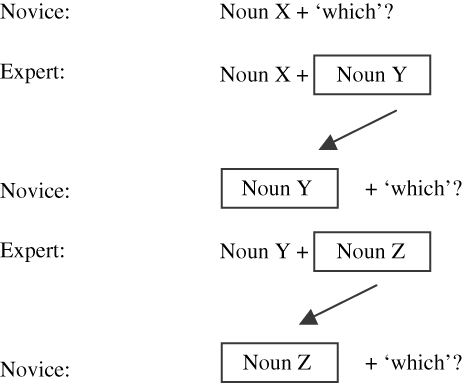
In this section, I return to the scripted riddle that was mentioned in the introduction to show how Song breaks into the script and into the older boys’ social group by strategically manipulating a structural opportunity provided by the genre’s organization to invert the subordinate role expected of him. Before the start of Segment 3, the older boys in the play group had twice performed this same language game while Song had been paying attention to watching the movie. This riddle genre conventionally starts off with the expert telling the novice which question to ask first; the expert responds, and the novice formulates the next question based on the expert’s responses. This folkloric text is illustrated in Figure 1, showing the structure of the riddle questions in the original language:
Parallel Structure
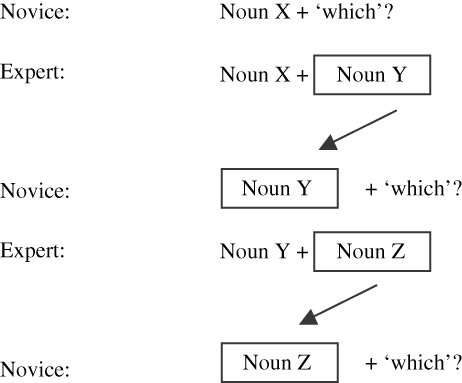
In this type of riddle, performers display the traditional competence described by McDowell Reference McDowell, Sutton-Smith, Mechling, Johnson and McMahon1995, as children are continuously creating new versions and circulating well-known versions. It is a scripted genre in the sense that it is composed of a particular text to which only the “expert” has access. Thus the role of the expert is to provide the input for the novice’s subsequent question. The role of the novice is to isolate the new noun – the last noun of the compound – in the expert’s utterance and repeat it in a question frame. The expert (re)produces a riddle text, while the novice displays his or her skill in these procedures of format tying. Segment 3 shows how this inverted riddle performance actually unfolds.
(Song 05/03/01 #1: 29:15-30:30) (Muang is in plain text, Standard Thai is in italics).
1. Eck Sɔ̌ɔŋ thăam wâa ( ) luu: ʔàlaj ʔîi ʔɛ̂ɛ Song ask that ( ) what ho:le, like that.
2. Song luu ʔàlaj what hole?
3. Eck luu puu crab hole.
4. Eck puu (0.4) ʔàlaj ʔîi lɛ̂ɛ what (0.4) crab, like that.
5. Song puu ʔàlaj what crab?
6. Eck puu naa field crab.
7. (0.4)
8. Song puu naa field crab
9. (0.4)
10. Eck naa ʔàlaj ʔîi lɛ̂ɛ=what field, like that =
11. Song =naa ʔàlaj =what field?
12. Eck [naa khâw ʔà kà ] [ It’s rice field. ]
13.Cue[ naa khâw ] [ rice field]
14. Song naa khâw rice field.
15. (0.8)
Segment 3a: Turnip Head
Eck prompts Song to say the first two questions in line 1 (‘Song, ask that ( ) what ho:le?, like that’) and line 4 (‘what (0.4) crab?, like that’). These questions are faithfully replicated by Song in lines 2 and 5 respectively, and Eck produces the responses. But after his second response utterance in lines 6 (‘field crab’), Eck briefly pauses (line 7) for Song to produce the next question. Instead, Song repeats the response that Eck had just produced.
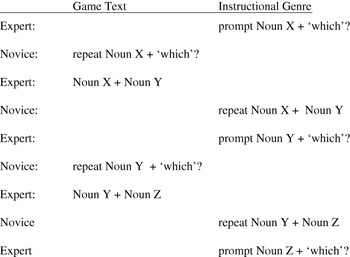
Another genre comes into play in this performance of the game, then, because Song does not produce these statement-to-question transformations, but rather repeats both the questions and the responses uttered by Eck. In order to keep the game moving toward its punch line, therefore, Eck must continue to provide each new question for Song to repeat, so that an instructional prompting genre is laminated (Goffman Reference Goffman1981, Gordon Reference Gordon2002) over the riddle genre (see Figure 2).
Lamination of an instructional genre
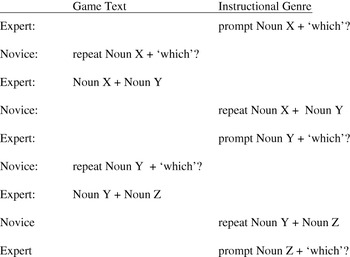
In this second, laminated participation framework, Song places himself in the role of someone learning the text, rather than a novice displaying his skill at deducing the new question. Although this game positions Song as the unknowing target or patsy of an eventual insult, he finds a way to break out of these generic constraints by positioning himself as a learner of the whole text, allowing him to take on the role of an apprentice to the expert’s position, rather than just the patsy. He has now broken in to these genres, forging for himself an unexpected – and more prestigious – form of participation. As the prompting and riddle genre continue, this provides a wedge for engaging in highly valued forms of humorous play and eliciting the appreciation of the other children. The action continues in Segment 3b:
16. Cue khâw ʔàlaj khá- cá- [khâw châw ] what rice? ri- ste- [ steamed rice ]
17. Eck [thăam ʔâaj lɛ̂ɛ ] khâw ʔàlaj [ask big brother ] what rice?
18. Song [khâw ʔàlaj [ what rice?
19. Eck [( ) [( )
20. (0.8)
21. Eck [ khâw cá ] khâwcâaw [ steamed ri- ] steamed rice
22. Song [ khâw câaw ] [steamed rice]
23. Eck [[ caâw ʔàlaj]]thăam lɛ̂ɛ [[ what steam? ]], ask.
24. Boy [[ câaw ʔàlaj ]] [[ what steam? ]]
25. Song câaw khàlaj kh- what steam?
26. (0.4)
27. Eck câaw jùu hŭa person be. located head the king.
28. Song câaw jùu hŭa the king.
29. Boy [hwaʔàlaj] [what head? ]
30. Eck [hŭahŭa ] hŭaʔàlaj[ head head] what head?
31. Song câa- (.) phá câw jùu hŭa: ki- (.) the ki::ng!
Segment 3b: Turnip Head
The instructional genre described above continues apace here, but this rhythm begins to fall apart when Eck produces a response that differs structurally from the others in line 27 (caw juu hua ‘the king’): instead of being a true noun compound, it is an expression used to refer to the king of Thailand, (phra)caw juu hua (lit. ‘the (royal) master above our heads’), which contains a homophone of the noun (caw ‘steam’) from the previous question. This incongruity wedges open a space for playful participation. Instead of repeating the next prompted question, Song repeats that previous response in line 31 (ca- (.) pracaw juu hua! ‘mas- (.) the ki::ng!’) to savor the humor (Tannen Reference Tannen2007). By doing this, Song displays appreciation for Eck’s humorous play on words, even interrupting himself to give the full version of the word (pracaw juu hua rather than caw juu hua). This utterance also reveals that Song possesses enough knowledge of language to get the meaning of the joke and to produce the full version of the expression. The older boys desperately want Song to repeat the next question that will set him up to get insulted: They have already prompted him several times (hua alaj ‘which head?’, lines 29–30), and they continue to pursue his compliance with mounting excitement in the segment below. Yet this very frustration will open up an opportunity for Song to land a zinger himself.
32. Boy [hŭa wâa ʔàlaj ] [what is the head? ]
33. Cue [ hŭa ʔàlaj ] [ what head? ]
34. Eck hŭa ʔàlaj what head?
35. (1.0)
36. Eck [ hŭa ʔàlaj ] [what head?]
37. Song [ hŭa phàk- ] hŭa phàkkàad hih hih hunh [turnip he-] a turnip head hih hih hunh
38. Children ((laughing heartily))
Segment 3c: Turnip Head
In this segment, Song has successfully broken in to the riddle genre to steal a position of playful prestige. No longer the patsy, he takes advantage of the older boys’ repeated voicing of the next question as they urge him to repeat it. Their mounting frustration shows in their increasing volume and in their overlapping talk in these turns as they urge Song to repeat the question. The boys’ prompts in line 32 (‘what is the head?’), and lines 33, 34, and 36 (‘what head?’) are ambiguous: They simply voice the question without framing it with a verb of saying, such as ‘say’, or marking it as imperative. Song takes advantage of this ambiguity to temporarily seize the expert role by actually answering the question in line 37 (‘turnip hea- a turnip head! hih hih hunh’), reframing their utterances as questions rather than prompts. His response is a clever play on words: It repeats an element of Eck’s prior utterance (hua ‘head’) in a new multisyllable noun (hua pakkad ‘turnip head’). Like ‘the king’ a few lines earlier, this utterance inverts expectations about the structure of responses – normally noun compounds – by instead uttering a polysyllabic noun that contains the same sound form. Song’s contribution, then, is decalibrated from the current context by inverting the expectations about the who (which participant provides responses to the questions), and the what (what Song’s next contribution is scripted to be in this text, and the form of response utterances in this game). It is also decalibrated in its content by moving from a line about ‘his royal highness’ to an utterance that uses hua ‘head’ in a very different sense: that of a vegetable, an irreverent juxtaposition. Song’s humor is roundly savored by all of the children present, who break into hearty laughter, showing appreciation for his prowess at plays on words (line 38). Song has broken into the genre, forging a momentary role for himself as the riddle’s expert, into the older boys’ playgroup by landing a zinger of a play on words in a highly unexpected place in the game.Footnote 7 The structure, repetition and predictability of this familiar genre facilitated Song’s participation by opening up an opportunity space that was accessible and salient, yet this also required his own devilish wit and sheer will to breach the gap.
Conclusion
Children’s language play is a performance mode in which humor is constituted by the inversion of expectations and norms both metalinguistically and metapragmatically. The more incongruent a child’s contribution is with the current contextual expectations, the more humorous it seems to be. Yet even comedic play relies for its interpretation on the expectations and knowledge of the audience, even if that means completely upturning those expectations to humorous effect. As orienting frameworks that structure expectations about the form, function, and theme of speech/text/action, speech genres constitute an important type of knowledge that children draw upon to formulate maximally humorous contributions. As much as speakers calibrate, or align to some degree, their performance of a given genre to new contexts, children’s humorous play activities instead decalibrate utterances from the current context by abruptly inserting incongruous elements into fast-moving speech and action. Metalinguistic play pushes the boundaries of sound–meaning correspondence (as when jan was used ambiguously to mean ‘kick’ instead of ‘consecrated string’), of words (as when lamkhaan was broken into two syllables, each of which was the homophone of other words, and when the boys used polysyllable nouns instead of compound nouns), and of distinct language codes (as when lam was used ambiguously to mean ‘delicious’ in Kam Muang or ‘dance’ in Standard Thai). Metapragmatic play, on the other hand, breaches expectations about who says what, to whom, how they say it and, I would add, when they say it. This occurs in Segment 2 when Song capitalizes on the ambiguity between imperative and interrogative caused by the lack of an imperative frame in the older boys’ prompting utterances (‘what head?’), and in Segment 1, which plays on the ambiguity between a teacher-like question sequence versus a pre-directive between friends (‘Song, is eating pizza delicious?’).
As a preschool child among a group of second-graders, Song has a peripheral and subordinate position within this play group, and he often stays on the sidelines of the older boys’ language play. He is, however, able momentarily to inhabit more valued, central, and expert roles within this play activity by using both synchronic and diachronic repetition as resources. In Segment 1, although he had been targeted as the patsy of Cue’s joke, he was able to join the other boys’ spinning out sequence through format tying, if only peripherally. While the older, school-aged boys created new puns and wordplay on the fly, Song was able to participate skillfully in this highly valued form of play through his performance of a scripted riddle genre (diachronic repetition) in Segment 2. Finally, he was also able to break out of his subordinate position within Eck’s riddle (Segment 3) by inverting expectations about the nature of his participation, and by playing with the ambiguity of prompted questions to land a zinger of his own. The decalibration of generic expectations also occurs at the corporeal level in children’s play, as when Eck and Cue physically broke out of an instructional questioning genre to perform an active embodiment of the words and phrases they were inventing (dancing, crawling). The audience evaluation of a genre’s performance has as much to do with how it conveys a particular mood, style, attitude, or emotion as it does with a binary judgment of cold skills, or of the text’s fidelity. Participation goes well beyond the assignment of simple speaker/hearer roles, to the very constitution of the social fabric through our embodied forms of engagement with the world.
The language play examined here has clear value for children’s phonological, metalinguistic, and metapragmatic awareness. Skillful participation in language games requires sophisticated parsing of language and grammatical structure, including knowledge of word meanings, co-occurrence restrictions, homophony, and the differentiation of linguistic codes. These play activities also require knowledge of the ways that talk constitutes and is constrained by social life, such as the assignment of genre-specific roles or age-grade hierarchies in the play group, in order to invert them humorously. At 5 years old, Song was on the cusp of a new stage of life, but his participation in multi-age play groups at home provided a training ground in which he could develop the traditional competence valued by older children, making initial stabs at the kinds of decalibration that are so well appreciated by them. Children’s play is primarily aimed not at the attainment of some adult-valued skills (such as literacy), but rather at the moment-by-moment constitution of their identities and relationships within their peer groups, at taking advantage of any opportunity to display impressive skills within this improvisational aesthetic, and at providing for each other the pleasures of repetition and humor that make up children’s worlds.