I. INTRODUCTION
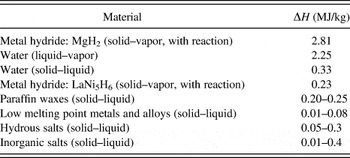
The development of new and efficient thermal energy storage (TES) materials remains a major challenge in addressing needs in a variety of areas from intermittent solar energy harvesting to thermal management of transient, high-flux heat loads. Conceivable TES application temperatures could range from near room temperature (for cooling electronics, for example) to moderate temperatures commensurate with “temperature lift” heat pumping cycles and waste heat recovery from power generation cycles. The latter temperatures could fall in the range of several hundred degrees Celsius. A variety of passive materials have been developed and used for TES including paraffin waxes, water tanks, and low-capacity reversible metal hydrides, among others. Paraffin wax has been used as a TES medium for decades.Reference Cai, Wei, Huang, Lin, Chen and Gao1–Reference Zhang, Fisher, Ramachandran, Gore and Mudawar4 The current state-of-the-art packaging technology for containing and conducting heat to paraffin wax reduces its effective heat storage density at the system level appreciably. Other material systems of possible interest are summarized in Table I; notably, paraffins, salts, and liquid metals have impractically low inherent enthalpies of phase change when normalized by mass. In fact, the only two example materials that exceed 1 MJ/kg are water (liquid–vapor) and a metal hydride. Regarding water, the slow kinetics of boiling/evaporation, limited largely by the nucleation, ebullition, and departure time of ∼10 ms for each bubble,Reference Carey5 and the requirement for handling large quantities of vapor make it less practical.
Inherent material enthalpy of phase change and/or reaction for candidate thermal storage materials at temperatures between 100 and 400 K.

Metal hydrides offer a potential materials solution, enabled by the uniquely high formation enthalpy of hydrogen gas, as well as other advantages such as on-demand cooling, fast thermal response, and system designs that are compact and lightweight.Reference Park, Tang, Kim, Gottschlich and Leland6 However, they also offer significant challenges to be overcome. First, we note that not all metal hydrides have high-energy storage capacities (cf., LaNi5H6 as shown in Table I). In fact, some well-known intermetallic metal hydrides have been studied recently for reversible and reasonably fast thermal storage,Reference Park, Tang, Kim, Gottschlich and Leland6 but the low thermal energy density of such “classical” hydrides renders them poorly suited for high-density thermal storage. However, some metal hydrides do offer exceptionally high TES density. For instance, a reaction of Mg and H2 can be used to store thermal energy, and a theoretical energy density of 2.81 MJ/kg is possible.Reference Reiser, Bogdanovic and Schlichte7 Magnesium hydride (MgH2) is a well-studied example,Reference Tanniru, Tien and Ebrahimi8–Reference Varin, Czujko and Wronski11 but the high temperatures required for hydrogen release and sluggish kinetics make it impractical for highly peaked input rate TES applications. The broader metal hydride research community has been very active recently in developing new hydrides for hydrogen storage for fuel cell operations, but in that application low reaction enthalpies are desired because high reaction enthalpies decrease overall efficiency and create severe cooling problems upon hydrogenation (i.e., fueling).Reference Varin, Czujko and Wronski11 Because of the emphasis on hydrogen storage for fuel cell vehicles, pure metal hydrides with high heats of reaction have been largely neglected in recent research compared to those with moderate-to-low reaction heats. Conversely, our work focuses on metal hydrides that offer extraordinarily high inherent thermal storage capacity, while also exploring new routes for controllable kinetics enhancement and high effective thermal conductivity. However, accessing this large thermal density under rapid heating conditions required for projected applications, efficient heat flow, reduced desorption temperatures, and fast chemical kinetics of candidate hydrides like MgH2 are required; therefore, new material enhancement through improved catalysis are required.
Hydrogen gas produced from a metal hydride offers exceptionally good thermal transport properties. For example, the electrical power generation industry uses hydrogen extensively (often produced by on-site electrolysis) to provide high-rate cooling of turbine generator windings.Reference Nagano, Kitajima, Yoshida, Kazao, Kabata, Murata and Nagakura12 The use of hydrogen for such massive-scale cooling is in concert with its high thermal properties, viz, thermal conductivity, κ th = 0.18 W/mK; specific heat, C p = 14.21 kJ/kg·K; and specific gas constant, R = 4.12 kJ/kg·K. The typical thermophysical properties of hydrogen are an order of magnitude superior to those of other common reactive gases such as NH3, CO2, steam (H2O), and air. Only inert He gas approaches the thermal performance of hydrogen. Furthermore, hydrogen’s high specific gas constant makes it uniquely suitable for rapid isothermal gas expansion cooling, which suggests additional utility beyond TES.
Motivated by the overall benefits of generating H2 from metal hydrides for polymer electrolyte membrane fuel cells, many research efforts have focused on substantially improving the hydrogen storage properties of metal hydrides using different approaches such as mechanical ball milling, doping with catalysts, confinement in nanoporous scaffolds, and reactions with metals, nonmetals, or metal hydrides.Reference Varin, Czujko and Wronski11, Reference Croston, Grant and Walker13–Reference Varin, Czujko and Wronski16 In general, nanostructuring via mechanical ball millingReference Varin, Czujko and Wronski16 or wet chemistry methodsReference Kalidindi and Jagirdar17 and the use of suitably tailored catalysts as dopantsReference Grochala and Edwards18 have shown the most promise. A variety of transition metal and metal oxide catalytic additives (Ni, Nb, TiO2, Cu, Co, Fe, etc) have been investigated under various conditions.Reference Varin, Czujko, Wasmund and Wronski19–Reference Mao, Guo, Yu, Liu, Wu and Ni22 In summarizing the available literature, we note that nickel-catalyzed MgH2 reactions have shown better dehydrogenation properties in comparison to other transition metal catalystsReference Varin, Czujko and Wronski11, Reference Yang, Shang and Guo23, Reference Xie, Liu, Zhang, Qu, Wang and Li24; the high catalytic activity of Ni is attributed to its efficiency in the cleavage of hydrogen bonds during hydrogenation and recombination of hydrogen atoms during dehydrogenation.Reference Varin, Czujko and Wronski11 The reactivity of any given catalyst can be substantially altered by alloying. Although mechanically milled MgH2–LaNi5Reference Liang, Huot, Boily, Van Neste and Schulz25, Reference Spassov, Delchev, Madjarov, Spassova and Himitliiska26 and MgH2–ZrxNiyReference Dehouche, Peretti, Hamoudi, Yoo and Belkacemi27 composites have been studied separately, a comprehensive comparative study of the hydrogen storage properties of milled MgH2–LaNi5, MgH2–ZrxNiy, and MgH2–Ni composites under similar conditions is still lacking, given that all the aforementioned samples were modified differently and dehydrogenation reactions performed at different vacuum levels. As pointed out by Varin et al.,Reference Varin, Czujko and Wronski11 desorption tests of MgH2 with additives conducted in vacuum are of very limited value because the use of vacuum systems in practical applications of hydrides will greatly complicate the whole design. Therefore, we present herein a comprehensive comparison of the dehydrogenation properties of MgH2 milled with Ni and Ni alloys. This work also provides further insights into the role of the active catalyst during the dehydrogenation reaction of MgH2.
II. EXPERIMENTAL SECTION
A. Sample preparation
MgH2, LaNi5, and Zr2Ni5 powders (hydrogen-storage grade) were purchased from Sigma-Aldrich (St. Louis, MO), whereas Ni metal nanopowder (≤100 nm in size and 99.9% in purity) was purchased from American Elements (Los Angeles, CA). The as-received hydrides and catalyst–hydride mixtures were ball milled in a SPEX SamplePrep 8000M Mixer/Mill [high-energy shaker (vibratory) mill], which combines strong shearing and impact forces to mix, blend, and reduce particle size. The clamp movement of the mill is 5.9 cm back-and-forth and 2.5 cm side-to-side, whereas the clamp speed is 1060 cycles per minute. The hydrides were milled in a 65-cm3 stainless steel vial using 15 stainless steel grinding balls (0.7 cm in diameter) under Ar environment. The ball-to-powder weight ratio was 13:1, which falls at the lower end of the recommended range of 10–100.Reference Varin, Czujko and Wronski11 The milling time of the as-received hydrides were 1, 2, 5, and 10 h, whereas the catalyst compositions investigated were 2, 5, and 10 wt% and were milled for 2 h except where otherwise stated. Samples were handled in an Ar glove box with the amount of oxygen and water vapor present being less than 10 and 0.1 ppm, respectively, to reduce oxidation and/or hydroxide formation.
B. Differential scanning calorimetry and thermogravimetry (DSC/TGA)
DSC/TGA measurements were performed using a Simultaneous DSC–TGA instrument (SDT 2960 TA Instruments, New Castle, DE). All measurements were carried out with 5–10 mg of sample at atmospheric pressure and repeated to ensure reproducibility. The temperature was linearly increased from room temperature (∼25 °C) to 500 °C at a rate of 5 °C/min in a stream of Ar (∼50 sccm) to reduce oxidation. The apparent activation energy, E A, of the dehydrogenation reactions was determined using the Kissinger method. The Kissinger equationReference Kissinger28 given in Eq. (1) is used to obtain information about the kinetics and the reaction order of simple decomposition reactions by analyzing the sensitivity of the decomposition temperature (T dec) to the heating rate (β):

where R represents the gas constant; E A is determined from a linear plot of  versus
 .
The heating rates used for this analysis were 5, 10, and 20 °C/min. Detailed description and assumptions inherent in the Kissinger method are reported in Ref. Reference Kissinger28 The TA Universal Analysis software was used to determine the onset temperature (T onset) and T dec after each experiment.
C. Structural transformation and microstructure
Phase identity and purity were characterized by x-ray diffraction (XRD) using a Rigaku D-5000 (Rigaku, Tokyo, Japan) with Cu Kα radiation (λ = 0.15418 nm) operated at 40 kV and 150 mA at room temperature. The scan range was from 2-theta = 20–90°, and the scan rate was 3°/min at a step size of 0.05°. The microstructure of the samples was studied using an FEI Quanta environmental field emission scanning electron microscope (FESEM, FEI, Hillsboro, OR). All images were captured under high vacuum with an accelerating voltage of 20 kV. Backscatter electron imaging allowed differentiation between relatively high atomic mass catalysts and low atomic mass MgH2. This distinction was confirmed by energy-dispersive spectroscopy, which correlated high backscatter (i.e., bright) regions with high catalyst concentrations.
D. X-ray photoelectron spectroscopy (XPS)
The role of Ni catalyst during the dehydrogenation of MgH2 was studied via XPS using a Kratos Ultra XPS system (Kratos, Kanagawa, Japan) with a monochromatic Al Kα source (hυ = 1486.6 eV) operated at 12 kV and 10 mA. Samples were loaded on the holders in the glove box and transported in sealed bags to reduce contamination from oxygen and water vapor. The Kratos XPS is equipped with a heating stage in the outer sample treatment chamber (STC) (vacuum level ∼2.0 × 10⁻⁷ Torr during heating). Samples were placed in the STC and heated to 250 °C at a rate of ∼50 °C/min and maintained at this temperature while H2 desorption was monitored using a residual gas analyzer. After dehydrogenation, the sample was transferred under vacuum to the analysis chamber for spectral acquisition. All samples were analyzed before and after the dehydrogenation process. The C 1s peak (binding energy = 284.8 eV) was used as charge reference for energy calibration. Spectral analysis was performed using CasaXPS software. Least square fitting of the spectra was performed using mixed Gaussian–Lorentzian peaks in the quantification process.
III. RESULTS AND DISCUSSION
A. Optimization of the high-energy ball milling process
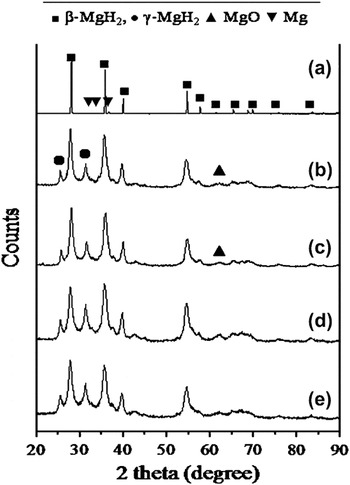
The XRD patterns of the MgH2 in the as-received condition and after ball milling for 1, 2, 5, and 10 h are presented in Fig. 1. The observed reflections of the as-received MgH2 correspond to tetragonal β-MgH2 and some retained Mg. After milling for 1 h, there is a structural transformation of the β-MgH2 to the (metastable) orthorhombic γ-MgH2 and the formation of MgO. Detailed explanations for the formation of the metastable polymorph and MgO after milling have been provided by Huot et al.Reference Huot, Liang, Boily, Van Neste and Schulz29 All the milled samples exhibit broad peaks—suggesting the formation of nanograins—and prolonged milling up to 10 h did not change the composition of the polymorphs significantly compared to 1-h milling. These XRD observations are generally consistent with previous workReference Varin, Czujko and Wronski11, Reference Varin, Czujko and Wronski16 except that in our work the β–γ transformation occurred after 1 h. In previous studies such as that by Varin et al.,Reference Varin, Czujko and Wronski16 milling for 10 h or longer was required to transform β-MgH2 to γ-MgH2. Thus, the high-energy milling process used in the current study appears to be more efficient in generating the metastable γ phase even with a lower-than-typical ball-to-powder weight ratio of 13:1.
X-ray diffraction (XRD) patterns showing the microstructural evolution during high-energy milling: (a) as-received MgH2, (b) 1-h milling, (c) 2-h milling, (d) 5-h milling, and (e) 10-h milling. Phase assignments are made on the basis of comparisons with PDF data.

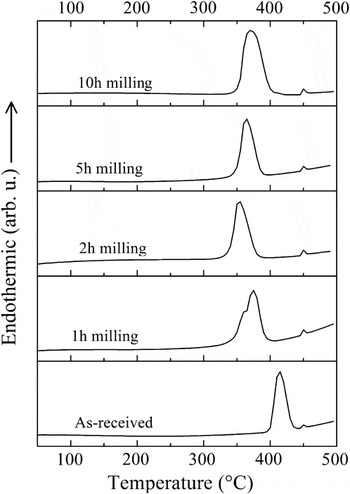
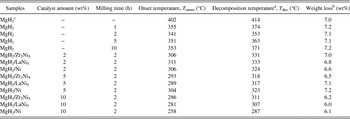
The effect of high-energy milling for different durations on the T dec of MgH2 was studied to optimize the milling conditions. As shown in Fig. 2, the DSC profiles are characterized by a single endothermic peak, which corresponds to the decomposition of the hydride. The T dec (peak maximum temperature) of the as-received MgH2 sample occurs at 414 °C, whereas the T dec for samples milled for 1, 2, 5, and 10 h are 374, 353, 363, and 371 °C, respectively. A summary of the desorption properties of MgH2 modified with the different catalysts is presented in Table II. It is believed that the small endothermic peak at 450 °C is an experimental artifact. The reduction of T dec by ∼62 °C while maintaining about the same DSC peak area or hydrogen storage capacity implies that the optimum milling time under these conditions is 2 h. Other workers have reported that a reduction in T dec by up to 60 °C typically requires prolonged milling. For instance, Varin et al.Reference Varin, Czujko and Wronski16 reported a reduction in T dec in the range of 40–60 °C for the as-received MgH2 after milling for 10–100 h. The decrease in T dec after milling is generally attributed to the formation of nanograins, introduction of lattice strains, and phase transformation of tetragonal β-MgH2 to orthorhombic γ-MgH2 as confirmed by XRD (Fig. 1).Reference Varin, Czujko and Wronski11, Reference Varin, Czujko and Wronski16, Reference Huot, Liang, Boily, Van Neste and Schulz29 The FESEM data (not shown) revealed that the as-received MgH2 has a grain size of ∼10 μm, and fine grains are formed with increasing milling time. It is thought that the motion of the balls in the high-energy vibratory mill combines strong shearing and impact forces in various proportions to increase the free energy of the system by increasing surface area and creating lattice defects.Reference Huot, Liang, Boily, Van Neste and Schulz29 No Fe contamination was observed (0.1 at.% detection limit) during XPS analysis of the milled samples suggesting that the reduction in T dec observed is completely due to the milling of the hydride, not from the leaching of Fe from the stainless steel vial or milling tools as observed by Ares et al.Reference Ares, Aguey-Zinsou, Klassen and Bormann30
Differential scanning calorimetry (DSC) profiles of as-received MgH2 as a function of ball milling duration (heating rate 5 °C/min).

Summary of the dehydrogenation properties of all the catalysts studied.

a Data obtained from differential scanning calorimetry profiles.
b Data obtained from thermogravimetry profiles.
c As-received MgH2.
B. Influence of Ni-based catalysts
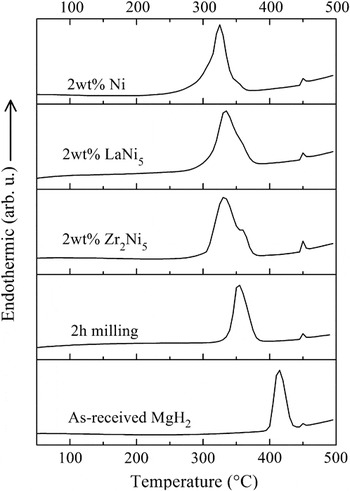
Further, we examined the dehydrogenation reaction of MgH2 milled with 2 and 5 wt% of Ni alloys for 2 h. Figure 3 shows the DSC results of the as-received MgH2, milled MgH2, and MgH2 doped with 2 wt% Zr2Ni5, LaNi5, and Ni catalysts. The onset temperature (T onset) and T dec for the various samples are summarized in Table II. The T onset represents the point at which the onset tangent line intersects with the baseline of the DSC peak. The DSC results reveal a reduction in T dec due to the catalytic effect of Ni and the Ni alloys, compared to the T dec of MgH2 milled for 2 h without catalyst. These results are consistent with a similar shift in T dec observed in the TGA profile. The catalytic effect of Ni appears to be marginally higher than for Zr2Ni5 or LaNi5 because T dec for the former is 324 °C, whereas the latter are 331 and 333 °C, respectively. Also, the DSC results for MgH2 milled with Zr2Ni5 and LaNi5 exhibit a shoulder near 350 °C, which corresponds to the T dec of MgH2 milled in the absence of a catalyst. This suggests that unlike pure Ni, the Ni alloys do not seem to catalyze the dehydrogenation reaction completely. Hanada et al.Reference Hanada, Ichikawa and Fujii31 showed that the hydrogen desorption properties of Nb2O5-catalyzed MgH2 are improved with increasing milling time in contrast to that of Ni-catalyzed MgH2. In our case, the shoulder observed at 350 °C did not disappear with longer milling time (5 h). It should be noted that the T dec values reported here are higher than those obtained from studies performed in vacuum such as that by Hanada et al.Reference Hanada, Ichikawa and Fujii31
DSC profiles for the as-received MgH2, milled MgH2 (2 h), and MgH2 milled with 2 wt% Zr2Ni5, LaNi5, and Ni catalysts for 2 h (heating rate 5 °C/min).

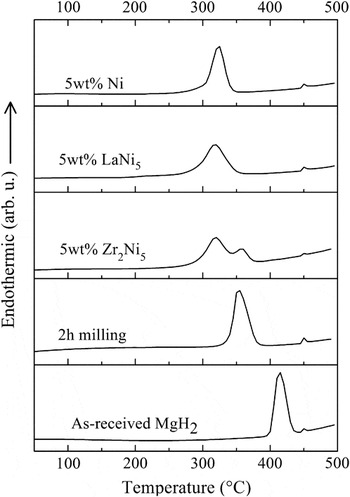
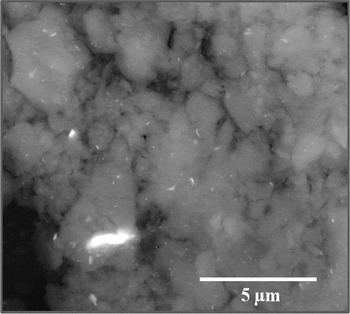
The influence on milling MgH2 with higher amounts of Ni-based catalysts (5 wt%) was also studied. Figure 4 shows the DSC profiles of the as-received MgH2, milled MgH2, and MgH2 doped with 5 wt% Zr2Ni5, LaNi5, and Ni catalysts. The DSC profile of MgH2 samples milled with Zr2Ni5 shows a double desorption peak at ∼319 and ∼350 °C suggesting that Zr2Ni5 does not catalyze the entire reaction. As shown in Fig. 4, the maximum of the endothermic peak is further reduced by ∼10 °C upon increasing the catalyst amount from 2 to 5 wt%. High-energy milling of the as-received MgH2 with 5wt% Ni or Zr2Ni5 has therefore resulted in ∼100 °C decrease in T dec. Generally, longer milling time (>2 h) did not result in better desorption properties for MgH2 milled with catalysts. FESEM studies revealed that the large as-received MgH2 particles were transformed into small grains with sizes ranging from 0.3 to 1 μm, and that the catalyst particles are fairly well-dispersed on the surface of MgH2 after 2 h of milling as shown by the representative FESEM image in Fig. 5. The catalytic enhancement of hydrides has been widely demonstratedReference Varin, Czujko and Wronski11; however, most studies involve several hours of ball milling. For example, Yonkeu et al.Reference Yonkeu, Swainson, Dufour and Huot32 showed that 80 h of ball milling was needed to decrease the T dec of MgH2 from 429.2 to 368.3 °C using 2 mol% of the body-centered cubic alloy TiV1.1Mn0.9 as catalyst. We should note that for studies performed in vacuum, T dec of modified MgH2 in the range of 200–280 °C with a good rate is common while at 0.1 Mpa H2, no desorption occurs below 325 °C.Reference Varin, Czujko and Wronski11 Although the T dec achieved at the current stage of our work is still higher than the desired range for TES, the substantial decrease in T dec achieved after only 2 h of milling is noteworthy. Further downshift of T dec may be obtained by improving catalyst dispersion, catalyst–hydride interaction via high-energy wet chemical milling process.
DSC profiles for the as-received MgH2, milled MgH2 (2 h), and MgH2 milled with 5 wt% Zr2Ni5, LaNi5, and Ni catalysts for 2 h each (heating rate 5 °C/min).

Backscattered electron micrograph of MgH2 modified with 5 wt% Ni catalyst. Dispersed lighter areas correspond to Ni-rich phases.

The effect of Ni-based catalysts on the dehydrogenation kinetics of MgH2 was also investigated. The apparent activation energies, E A, were determined using the Kissinger method as previously discussed (Fig. 6). The apparent E A for the as-received MgH2 is ∼169 kJ/mol, which is in agreement with E A obtained from the Arrhenius plot (E A = ∼168 kJ/mol) for MgH2 powder purchased from ABCR GmbH & Co. (Karlsruhe, Germany).Reference Varin, Czujko and Wronski11 The apparent E A for the dehydrogenation reactions of MgH2 catalyzed by Zr2Ni5, LaNi5, and Ni are 79, 122, and 81 kJ/mol, respectively. From the E A values, it is clear that modifying MgH2 with Zr2Ni5 or Ni catalysts via high-energy milling improves the kinetics significantly; the E A is reduced by half. It has been shown that milling MgH2 with nano-Ni particles for 15 min and 20 h reduces the desorption temperature at atmospheric pressure from 418 to 243 and 302 °C, respectively.Reference Varin, Czujko and Wronski11 The apparent E A of desorption of MgH2 milled with nanosized Ni for 15 min and micrometer-sized Ni particles for 20 h were 92 and 105 kJ/mol, respectively. The E A values obtained in our work using Ni and Zr2Ni5 particles are comparable to these values.
Kissinger plots for dehydrogenation of as-received MgH2, MgH2 milled with 5 wt% Zr2Ni5, LaNi5, and Ni catalysts for 2 h each. The heating rates used were 5, 10, and 20 °C/min.

Based on the positive effect of the catalysts on T dec and E A, higher amounts of catalysts were also milled with the as-received MgH2 for 2 h. The DSC profiles of MgH2 milled with 10 wt% Zr2Ni5, LaNi5, and Ni are shown in Fig. 7. The T dec for MgH2 milled with 10 wt% Zr2Ni5, LaNi5, and Ni were 311, 307, and 287 °C, whereas their T onset were 286, 281, and 258 °C, respectively. Further decrease in T dec was observed after milling with 10 wt% catalyst. In comparison to the as-received MgH2, the total decrease in T dec was greater than 100 °C for all the samples. The apparent E A obtained from the Kissinger method for MgH2 milled with 10 wt% Zr2Ni5, LaNi5, and Ni are 85, 97, and 87 kJ/mol, respectively. The apparent E A does not seem to change significantly with higher catalyst amount except in the case of LaNi5. As the catalyst amount milled with the hydride increases, the H2 weight penalty during dehydrogenation of the hydride increases, and this does not seem to be severe as evidenced by their respective TGA data (Table II). The weight loss analysis was restricted to the temperature range where MgH2 undergoes its enthalpy change (>250 °C).
DSC profiles for MgH2 milled with 10 wt% (a) Zr2Ni5, (b) LaNi5, and (c) Ni catalysts for 2 h each (heating rate 5 °C/min).

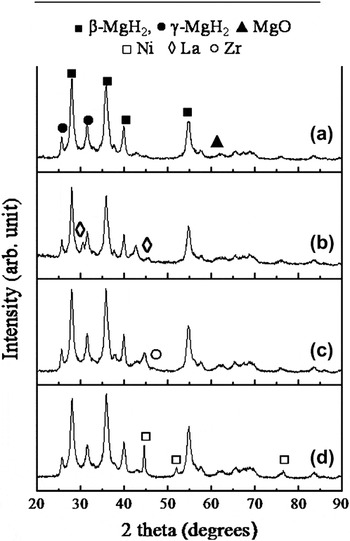
To explore possible structural change due to the increased amount of catalyst, XRD patterns of MgH2 + 10 wt% catalyst composites were acquired and the results are shown in Fig. 8. It is clear from the observed reflections that the samples are composed of mixtures of the two main polymorphs (β-MgH2 and γ-MgH2) and the various catalyst components. In comparison to the XRD pattern of the as-received MgH2 (Fig. 1), the diffraction peaks of these composites (Fig. 8) are considerably broadened indicating the formation of nanocrystallites or residual strain. The absence of MgH2Ni, a common alloy formed when a high amount of Ni is milled with MgH2 indicates that solid state reactions between the catalyst and MgH2 may not have occurred.
Powder XRD of (a) milled MgH2 for 2 h and MgH2 milled with 10 wt% (b) LaNi5, (c) Zr2Ni5 and (d) Ni for 2 h.

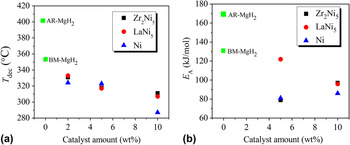
A summary of the effects of milling and the amounts of Ni, LaNi5, and Zr2Ni5 catalysts on T dec and apparent E A is presented in Figs. 9(a) and 9(b). It is clear from this result that ball milling may have both thermodynamic and kinetic effects—it decreases the T dec from 414 to 353 °C and the E A from 169 to 131 kJ/mol. The effect of the catalysts on T dec appears to be the same for MgH2 samples milled with 2 and 5 wt% catalysts; however, Ni catalyst clearly shows the highest downshift of T dec for MgH2 samples milled with higher catalyst amount (10 wt%). As mentioned earlier, milling MgH2 with 5 wt% Ni and Zr2Ni5 results in improved kinetics, corresponding to ∼50% decrease in E A compared to the as-received MgH2. Interestingly, increasing the catalyst amount to 10 wt% does not result in a corresponding increase in the dehydrogenation kinetics of MgH2 samples milled with Ni and Zr2Ni5; on the other hand, improved kinetics is observed for MgH2 milled with 10 wt% LaNi5 possibly due to the increasing active Ni component in the sample.
Effect of milling and the amount of the various catalysts on the decomposition temperature (T dec) and apparent activation energy (E A) during the dehydrogenation of MgH2. For comparison, data for as-received MgH2 (AR-MgH2) and MgH2 milled for 2 h (BM-MgH2) are also included.

C. XPS analysis of the role of catalyst
To obtain further insight into the role of the active catalyst (Ni) during the dehydrogenation of MgH2, XPS analysis was carried out on MgH2 in the as-received and dehydrogenated states and for MgH2 + 5 wt% Ni and MgH2 + 10 wt% Ni in the milled and dehydrogenated states. The XPS spectra of O 1s and Mg 2p regions for the various samples are presented in Fig. 10. The Ni 2p spectra of MgH2 + 5 wt% Ni exhibited poor signal-to-noise due to the low concentration of Ni. However, the Ni 2p spectra of MgH2 + 10 wt% Ni showed improved signal-to-noise (not shown), and the binding energies of the 2p3/2 and 2p1/2 for the milled hydride state were centered at 852.3 and 869.5 eV and for the dehydrogenated state at 852.1 and 869.5 eV, respectively. The Ni 2p3/2 and 2p1/2 peak positions and line shapes are characteristic of metallic Ni,Reference Wagner, Naukim, Kraut-Vass, Allison, Powell and Rumble33 and the peak positions for the milled and dehydrogenated states are somewhat similar indicating that Ni remains in the metallic state during the dehydrogenation of MgH2. The Mg 2p peaks for all the milled and dehydrogenated states were centered ∼50 eV [Figs. 10(a) and 10(b)], consistent with the core level binding energy of Mg in hydrides.Reference He and Pong34 The addition of Ni catalyst does not seem to affect the shape and peak position of the Mg 2p peaks. On the other hand, all the O 1s spectra showed doublets indicating that oxygen atoms are present in two different chemical environments [Figs. 10(c) and 10(d)]. The low-binding energy peak is ascribed to O2− or lattice MgO oxygen atoms, whereas the high binding energy (HBE) peak is still unclear but widely associated with hydroxide, hydroxyl, oxygen containing species acting as precursors to support oxide growth or catalytic poison.Reference Splinter, Mclntyre, Lennard, Griffiths and Palumbo35, Reference Ershova, Dobrovolsky, Solonin, Khyzhun and Koval36 In fact, prior work has shown that the presence of these oxygen species with HBE peak on Ti-based alloy surfaces can block catalytically active sites and prevent H2 dissociation.Reference Dobrovolsky, Yendrzheevskaya, Sinelnichenko, Skorokhod and Khyzhun37 Curve fitting of the O 1s spectra using a mixture of Gaussian (50%) and Lorentzian (50%) line shapes to achieve the best fit allowed for the quantification of the oxide and hydroxide components. The ratio of the hydroxyl : oxide (OH−/O2−) decreases significantly after milling MgH2 with 5 wt% Ni catalyst suggesting that the presence of Ni decreases the hydroxide component. It should be noted that milling with higher catalyst amount (10 wt%Ni) did not result in further decrease of the OH−/O2− ratio. Based on the analysis of the O 1s spectra for the different samples and their corresponding E A data, we hypothesize that there is a strong correlation between the type of oxygen species adsorbed on Ni-modified MgH2 and the reaction kinetics of the dehydrogenation reaction. Lower OH−/O2− ratios generally have lower E A values and vice versa.
X-ray photoelectron spectroscopic spectra of as-received MgH2 and MgH2 milled with 5 and 10 wt% Ni catalysts: (a) Mg 2p region before reaction, (b) Mg 2p region after reaction, (c) O 1s region before reaction, and (d) O 1s region after reaction. R = OH−/O2− ratio.

IV. CONCLUSIONS
This work has shown that the presence of Ni and Ni alloys in MgH2 decreases the energy barrier of MgH2 dehydrogenation, and catalytic activity follows the following order: Ni ≈ Zr2Ni5 > LaNi5. Using a combination of a high-energy vibrating mill and Ni-based catalysts, we have successfully reduced the T dec of MgH2 by over 120 °C, from ∼414 to ∼287 °C. MgH2 milled for 2 h with Ni (5 wt%) and Zr2Ni5 (5 wt%) showed an E A of 81 and 79 kJ/mol, respectively, corresponding to a ∼50% decrease in E A. These improvements were achieved after only 2 h of milling indicating the efficiency of our high-energy milling procedure. In particular, the XPS data indicate that the milling of MgH2 with Ni catalyst decreases the amount of oxygen atoms in defective positions that are associated with poisoning of the catalytically active centers, thereby enhancing the dehydrogenation process. This insight into the role of Ni catalyst during the dehydrogenation of MgH2 would benefit current efforts aimed at improving the hydrogen and heat storage properties of hydrides. Although these results are promising, significant reductions in T dec are desired for many thermal storage applications; therefore, additional ways of improving the surface area density of the hydride grains, catalyst dispersion, and catalyst–hydride interaction are being explored.
ACKNOWLEDGMENTS
Support from the Air Force Research Laboratory and the Air Force Office of Scientific Research are gratefully acknowledged. The authors are grateful to Dr. Karla L. Strong for valuable discussions.