In June 2021, the severe acute respiratory coronavirus virus 2 (SARS-CoV-2) B.1.617.2 (δ or delta) variant emerged as the predominant SARS-CoV-2 variant in the United States. Its emergence coincided with an increase in infections among vaccinated persons, possibly attributable to enhanced viral transmission compared with previous variants, viral immune evasion, and waning vaccine-derived immunity. Reference Dougherty, Mannell, Naqvi, Matson and Stone1,Reference Tartof, Slezak and Fischer2 Nursing home (NH) populations comprise predominately older adults, who are disproportionately affected by coronavirus disease 2019 (COVID-19) and are susceptible to declining vaccine-derived immunity. Reference Bialek, Boundy and Bowen3,Reference Bajema, Dahl and Prill4 Between July 26 and November 30, 2021, the Centers for Disease Control and Prevention (CDC) partnered with US public health jurisdictions to perform prospective surveillance of outbreaks involving residents who were at least fully vaccinated with a primary COVID-19 vaccine series to describe outbreak characteristics, and the risk of infection and disease severity by vaccination status.
Methods
Participating health departments collected outbreak, facility, and resident information from NHs with eligible outbreaks, defined as those including 3 or more infections within a 14-day period in residents who were at least fully vaccinated. Participating jurisdictions were recruited via an informational e-mail to state epidemiologists followed by a call hosted by the CDC field support team for interested jurisdictions. Infection in a fully vaccinated resident was defined as a positive SARS-CoV-2 viral nucleic acid amplification or antigen test from a respiratory specimen in a resident who had completed a primary COVID-19 vaccination series at least 14 days earlier. A primary COVID-19 vaccination series is defined as 2 doses of an mRNA COVID-19 vaccine (Pfizer-BioNTech or Moderna) or 1 dose of Johnson and Johnson (Janssen).
At the onset of the outbreak, the following facility-level information was collected once: resident census stratified by vaccination status (fully vaccinated with a primary series plus an additional dose (booster or third vaccine dose), fully vaccinated with a primary series, partially vaccinated with a primary series, or unvaccinated). The following outbreak information was also collected: onset date (collection date of first positive SARS-CoV-2 specimen among residents or staff), completion date (14 days after last identified SARS-CoV-2 infection in a resident or staff), and whether the initial infection was detected in a staff member or resident. The information collected on infected residents included their presence in the facility at outbreak onset, vaccination status, presence or absence of COVID-19 symptoms, all-cause hospitalization, all-cause death, and SARS-CoV-2 variant type. Detection of symptoms and hospitalization were reported through outbreak completion; mortality was reported through 14 days after outbreak completion. Outbreak duration was the number of days from outbreak onset until outbreak completion.
Infection attack rates and risk ratios were estimated for residents present at outbreak onset using Poisson generalized estimating equation models with log links accounting for facility-level clustering. The risk for selected outcomes among infected residents was compared by vaccination status using generalized estimating equation binomial regression models with log links. Analyses were conducted using SAS version 9.4 software (SAS Institute, Cary, NC) using α = 0.05 and limited to completed outbreaks ending on or before November 30, 2021. This activity underwent ethical review at CDC and was conducted consistent with applicable federal law and CDC policy (45 CFR part 46.102(l)(2), 21 CFR part 56; 42 USC Sect 241(d); 5 USC Sect 552a; 44 USC Sect 3501 et seq).
Results
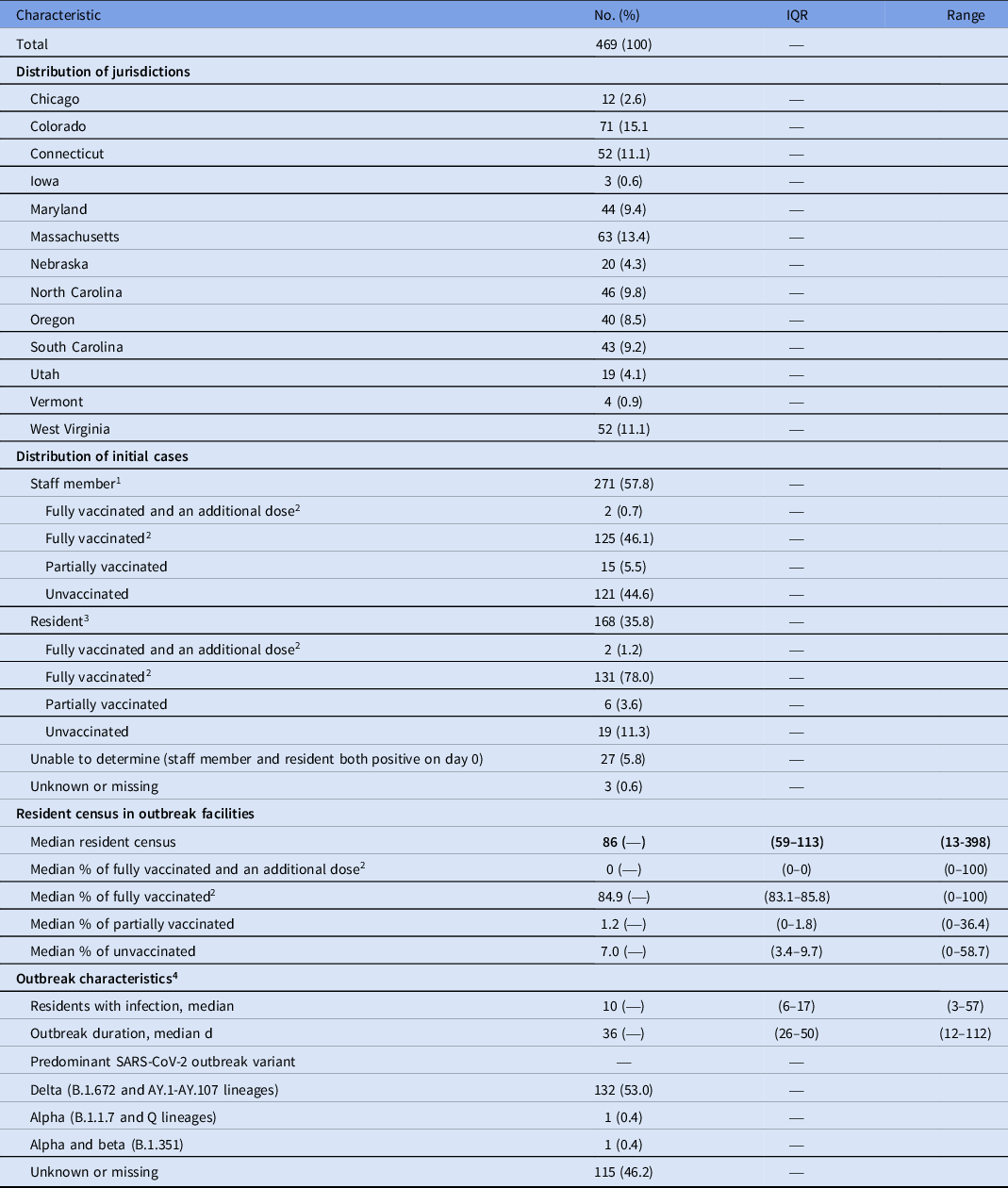
From July 26 to November 30, 2021, 469 outbreaks meeting surveillance criteria were reported in 433 (18.4%) of 2,348 NHs represented in the surveillance catchment area of the 13 participating US jurisdictions (Table 1). The surveillance catchment constituted 85% of the 2,762 licensed NHs within participating jurisdictions and 15.1% of 15,600 NHs nationwide. Reference Harris-Kojetin, Sengupta, Lendon, Rome, Valverde and Caffrey5 Among 469 initial cases, 271 (57.8%) occurred in a staff member, 121 (44.6%) of whom were unvaccinated. The median numbers of resident cases were similar when the initial outbreak case was a staff member (median, 11 cases) compared with a resident (median, 9 cases; Wilcoxon rank-sum P = .104).
Characteristics of Nursing Home Outbreaks Involving Three or More SARS-CoV-2 Infections in Residents Who Were at Least Fully Vaccinated—13 US Jurisdictions, July–November 2021

Note. IQR, interquartile range.
1 8 (3%) staff members had missing or unknown vaccination status.
2 Fully vaccinated with a primary series of COVID-19 vaccine (≥14 d after receipt of 1 dose of Johnson and Johnson [Janssen] or after 2 doses of an mRNA COVID-19 vaccine).
3 10 (6%) resident initial cases had missing or unknown vaccination status.
4 Data were restricted to completed outbreaks with full resident data (n = 249).
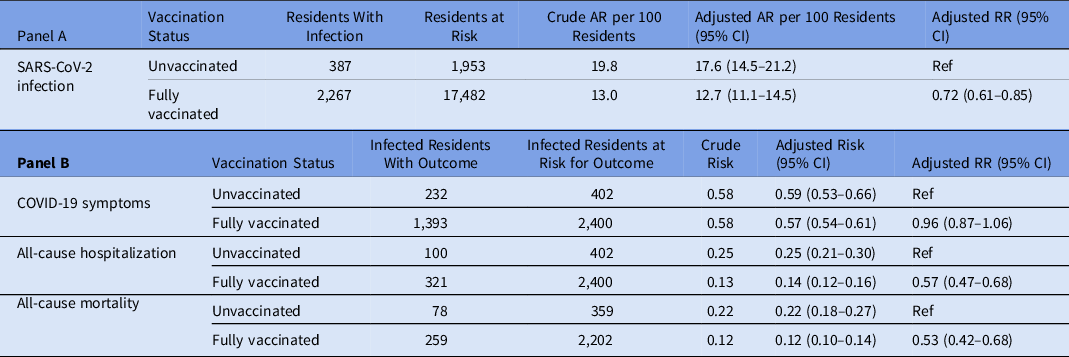
Among the 249 completed outbreaks with full resident data, 134 (53.8%) had viral sequences reported for at least 1 infected resident. The SARS-CoV-2 δ (delta) variant was the predominant sequence identified in 132 (98.5%) outbreaks. The median outbreak duration was 36 days (IQR, 26–50 days). Estimated infection attack rates were lower among fully vaccinated residents (12.7 per 100 residents; 95% CI, 11.1–14.5) than among unvaccinated residents (17.6 per 100 residents; 95% CI, 14.5–21.2) who were present at outbreak onset (RR, 0.72; 95% CI, 0.61–0.85; P = .0001) (Table 2). The risk for developing COVID-19 symptoms was similar for fully vaccinated and unvaccinated infected residents (RR, 0.96; 95% CI, 0.87–1.06). Among infected residents who were fully vaccinated, the risks for all-cause hospitalization (RR, 0.57; 95% CI, 0.47–0.68) and all-cause death (RR, 0.53; 95% CI, 0.42–0.68) were significantly lower than they were among unvaccinated infected residents (Table 2).
Crude and Adjusted 1 (Panel A) SARS-CoV-2 Infection Attack Rates per 100 Residents 2 (222 completed outbreaks) 3,4 and (Panel B) Outcome Risk Ratios for Symptomatic SARS-CoV-2 Infection, All-Cause Hospitalization and All-Cause Death 5 Among Infected Residents (249 completed outbreaks) by Vaccination Status 6 —13 US Jurisdictions, July–November 2021

Note. AR, attack rate; Ref, referent; RR, risk ratio; IQR, interquartile range; CI, confidence interval.
1 ARs and RRs are adjusted for facility level clustering using generalized estimating equation models.
2 Median days to infection was not significantly different for fully vaccinated residents (12 d; IQR, 6–21) compared with unvaccinated residents (12 d; IQR, 6–22) by Wilcoxon rank sum test (P = .234).
3 27 additional outbreaks were excluded as the number of cases exceeded the number of total residents (n=8) or if the facility did not have any unvaccinated residents (n=19).
4 Outbreaks were considered complete 14 days after last newly identified SARS-CoV-2 infection in a resident or staff member.
5 Death outcomes were not reported for cases in 22 outbreaks.
6 Residents who received an additional COVID-19 vaccine dose or who were partially vaccinated were not included.
Discussion
Among 433 NHs in 13 US jurisdictions, 469 SARS-CoV-2 outbreaks involving 3 or more infections among residents who had received at least primary COVID-19 vaccination began during July 26–November 30, 2021. These outbreaks predominantly involved the SARS-CoV-2 δ (delta) variant. The CDC National Healthcare Safety Network data demonstrated that vaccine effectiveness against SARS-CoV-2 infection declined among NH residents with an mRNA COVID-19 vaccination from 75% before the SARS-CoV-2 δ (delta) variant emerged to 53% during June–July 2021, when the δ (delta) variant emerged. Reference Nanduri, Pilishvili and Derado6 Because this finding occurred ∼6 months following the mid-December 2020 rollout of mRNA vaccines to NH populations, the extent to which waning of vaccine-induced immunity or enhanced virus transmission contributed to decreased vaccine effectiveness was unclear. Although this study did not specifically analyze the impact of waning immunity, it occurred during the 4 months following July 2021 and found that vaccination still provided protection against SARS-CoV-2 infection. Continued NH surveillance is important to understand newer variants with enhanced transmission potential, such as the SARS-CoV-2 ο (omicron) variant, 7 and how booster doses affect the risk for infection and severe outcomes.
This study had several limitations. Overall, 87% of US NH residents completed a primary COVID-19 vaccination series because of early efforts targeting populations in these settings. 8 Consequently, unvaccinated residents might differ by medical history, infection-induced immunity from prior SARS-CoV-2 infection, length of residence, or end-of-life care, potentially affecting infection and outcomes risk estimates that were unable to be further ascertained. Despite a standardized protocol, outbreak investigation and implementation of CDC-recommended testing practices likely varied between jurisdictions, which may have affected the number, size, and duration of outbreaks captured. 9 This outbreak investigation describes outbreaks with 3 or more infected residents who were at least fully vaccinated and assesses the risk of infection and disease severity by vaccination status in the context of these outbreaks. Thus, this study potentially overestimates attack rates among vaccinated residents outside of this context. Given the large number of facilities under surveillance and limited staff resources, resident census and vaccination reporting were restricted to one time at outbreak onset, and we could not account for changes to vaccination status during an outbreak. Furthermore, resident movements (eg, resident days in the facility) were not ascertained. Because of this, formal vaccine effectiveness estimates were not calculated. The outcome follow-up period was specific to the outbreak end date, which led to variation in follow-up times of individual infected residents. Although median days to infection was not different by vaccination status, adjusted estimates were unable to account for potential variations in time from infection to outcomes by vaccination status or outcomes occurring beyond the follow-up period. These data reflect outbreaks in 13 US jurisdictions, limiting a broader generalizability. Although 98% of sequenced isolates were identified as the SARS-CoV-2 δ (delta) variant, specimens with sequence results were only available for half of all completed outbreaks. Finally, we did not determine types of symptoms, symptom severity, or reasons for hospitalization and death among infected residents. This may have limited our ability to interpret differences in these outcomes by vaccination status. Reference Khoury, Cromer and Reynaldi10
In NH outbreaks involving infections among residents who had at least completed a primary COVID-19 vaccination series during the SARS-CoV-2 δ (delta) variant predominant phase of the pandemic, primary COVID-19 vaccination was protective against infection and, among infected residents, against all-cause hospitalization and death. NH residents and staff members should stay up to date with COVID-19 vaccination, including additional and booster doses, to protect against SARS-CoV-2 infection, severe illness, and death.
Acknowledgments
The authors acknowledge the CDC COVID-19 Response Laboratory TF Strain Surveillance and Emerging Variants team; Surveillance Branch National Healthcare Safety Network team, Prevention and Response Branch Long-Term Care Facility Team, Division of Healthcare Quality Promotion, CDC; Colorado Department of Health COVID-19 Infection Prevention Unit; Colorado Department of Health COVID-19 Regional Epidemiology Response Teams; Colorado Department of Health COVID-19 Residential Care Epidemiology Team; Brynn Berger, Meenalochani Ganesan, Jordan Gilbert, Kaitlin Greenberg, Shermalyn Greene, Massachusetts State Public Health Laboratory Molecular Diagnostic and Next Generation Sequencing; Erica Wilson, Justin Albertson, Oregon State Public Health Laboratory; Oregon COVID-19 Response and Recovery Unit; West Virginia Bureau of Public Health Outbreak Team; West Virginia Rapid Development Laboratory.
Financial support
No financial support was provided relevant to this article.
Conflicts of interest
Meghan Linder reports support for attending meetings or travel through the Council of State and Territorial Epidemiologists in the past 36 months. Dat Tran reports grants from an Epidemiology and Laboratory Capacity cooperative agreement and the State Health Information Exchange Cooperative Agreement Program in the past 36 months. Melissa Cumming reports holding a nonsalaried membership of the FDA Blood Products Advisory Committee in the past 36 months. M. Salman Ashraf reports grants from Merck and nonsalaried membership of the Society for Healthcare Associated Epidemiology (SHEA) and Infectious Disease Society of America (IDSA) in the past 36 months. Glen Gallagher reports support for attending the 2021 ASCP meeting in the past 36 months. Rebecca Pierce reports leadership role in SHEA Leadership in Epidemiology, Antimicrobial Stewardship and Public Health (LEAP) Steering Committee in the past 36 months.