The conventional and widely-accepted definition of the security dilemma (endeavours to achieve security result in more insecurity) is built upon certain theoretical assumptions. The first assumption is that actors survive and interact in an anarchic political structure characterised by uncertainty. In such a structure, each actor relies on its own capabilities to pursue security unilaterally. Second, it is assumed that each actor has a certain idea of security: security is a scarce resource and it can only be achieved for the self in competition with others. Hence, security is conceptualised as an ethnocentric value and/or commodity. Third, there is very limited opportunity (in such a political structure where security is scarce) for an actor to develop ideas and/or communication channels to understand ‘benign intentions’ of others. These theoretical assumptions are primarily the raison d'être of the conventional security dilemma. When scholars of the societal security dilemma adopted the conventional definition of the security dilemma,Footnote 1 these assumptions, along with the concept itself, were largely internalised by them. This generates the central problem that this study will focus on. Scholars belonging to this approach aim to analyse the actor responsibility in the eruption of intersocietal or ethnic conflicts. However, the three (neo-)realist theoretical assumptions of the security dilemma hinder these objectives.
This article will build analytical principles, derived from the Wendtian social constructivism, upon which a new societal security dilemma can be constructed in order to conduct the analysis of actor responsibility. The central argument is that actor responsibility in societal security dilemmas can be studied by analysing how actors understand security, how through their ideas and actions (re)construct anarchy and dichotomist identities/interests. This task, however, cannot be performed within the conceptual strictness and limitations of the conventional security dilemma framework. Limitations revolve around three concepts: anarchy as a determining structure, intentions of actors vis-à-vis others (malign and benign), and dichotomist societal identities. The problematisation of the conventional societal security dilemma theorising will be conducted in the first part of the article, which will be concluded by the Wendtian critique of the conventional societal security dilemma's analysis of the Yugoslav civil war.
In the second part, based on the recent reconceptualisation of the security dilemma,Footnote 2 it will be discussed how the conventional societal security dilemma can be rethought and improved to enhance its analytical power to study actor responsibility. With reference to the three concepts (anarchy, intention, identity), a new societal security dilemma framework can be built upon three principles: (1) a security dilemma results in violence depending on how the actors themselves interpret the political structure in which they interact with others (that is, not accepting anarchy as given); (2) differentiation of actors' intentions as malign or benign is inconsequential; what matters is how actors conceive security and which tools they choose to adopt to achieve security; and (3) identity is not exogenous to the politics of security (not fixing societal identities even for the sake of analysis). It will be argued that a new societal security dilemma adopting these principles can provide a more comprehensive, dynamic, political, and realistic analysis of actor responsibility in societal-level confrontations. In the last part, the dissolution of Yugoslavia will be reread based on the new principles of the societal security dilemma in order to show how political actors constructed anarchy and self/other dichotomies between societal groups in former Yugoslavia.
The three limitations of conventional societal security dilemma to study actor responsibility
Since its conceptualisation by John Herz in 1950, the security dilemma has been enriched, updated, and recently reconceptualised. In the last decade, while some scholars rejected the central role that conventional security dilemmas play in post-Cold War world politics by constructing related – but essentially different – dilemmas,Footnote 3 others continued to defend the explanatory power of the concept in relation to interstate confrontations and conflicts under the condition of anarchy.Footnote 4 Between these two poles, many scholars updated the concept through introducing new ideas flourished in International Relations (IR), but without challenging the state-centrism of the conventional security dilemma.Footnote 5 Among the attempts to enhance the concept through new ideas, widely-accepted works have been those which study intersocietal or interethnic group conflicts through the security dilemma.Footnote 6 Their key contribution was to replace states with societies having dichotomist identities as to the level of analysis. However, with an exception,Footnote 7 new approaches have not problematised the central assumptions of and concepts integral to the security dilemma.
Variants of the societal security dilemma analyse ‘actor responsibility’ implicitly or explicitly. Their analyses investigated how representatives of ethnic/religious societal groups (heads of states, political party leaders in power) through their words and actions contribute to the eruption of intersocietal conflicts. However, even in the works which claim to study actor responsibility as an objective of their analyses,Footnote 8 the analysis goes little beyond policymakers' manipulation of ancient and recent histories: actors play into the existing enmities and hostile societal identities. In contrast, this article argues that in societal security dilemmas, political actors actively (re)construct dichotomist societal identities. In order to analyse this construction process, (dominant) political actors' ideas of security and how their security policies construct anarchic political structure and dichotomist identities should be addressed. In addition, how they marginalise alternative ideas and policies of security and identity will also be included in the analytical scope. In the end, the anarchic political structure and dichotomist societal identities serve certain political interests.
The application of the security dilemma to intersocietal group confrontations was provoked by the intra-state unrests that emerged in some European countries in the post-Cold War era. The first attempt was Barry Posen's work. According to Posen,Footnote 9 the security dilemma between ethnic groups arises under the condition of anarchy-like political structure where the demise of the central authority increases the superiority of offence over defence paving a way for new windows of opportunity for ethnic groups. He integrates the dichotomist ethnic identities as a constitutive factor in the dilemma, especially when historical hostilities are manipulated by the elites.Footnote 10 In this way, Posen brings actor responsibility in societal security dilemmas.
Posen's work is the first integration of neo-realist thinking of the security dilemma into the study of societal level conflicts. By fully adopting Posen's approach, Chaim Kaufmann in his study of ethnic civil wars in relation to the security dilemma posits a central position to anarchy over other factors. He argues that ‘regardless of the origins of ethnic strife, once violence reaches the point that ethnic communities cannot rely on the state to protect them, each community must mobilize to take responsibility for its own security’.Footnote 11 The importance of anarchy as the political structure of the emerging security dilemmas is highlighted, and so far, not effectively challenged by the conventional societal security dilemma theorists. For example, Stuart Kaufman's main contribution is his categorisation of structural and perceptual security dilemmas.Footnote 12 The former refers to the security dilemma emerging when the anarchic political structure forces actors to self-help and worst-case forecasting. In contrast, the latter happens when the policymakers ‘fail to recognize the degree to which their security measures threaten other states’.Footnote 13
Therefore, Kaufman looks at two factors in societal security dilemmas: anarchy (structural) and benign intentions (mainly perceptual). Like Posen, he points at the elite responsibility to manipulate historical events that feed into dichotomist ethnic identities. Erik Melander also strongly focuses on actors with benign intentions.Footnote 14 He argues that the failure to convince others that the measures are defensive leads to the ethnic conflict. Unlike C. Kaufmann, S. Kaufman and Posen, Melander considers anarchy as a reason of the security dilemma to a lesser extent. Instead his focus is on the defensive (and therefore, benign) intentions that cannot be transmitted to others.
Paul Roe remains the sole scholar who systematically studies the security dilemma at a societal level and conceptualises the ‘societal security dilemma’.Footnote 15 Roe's conceptualisation differs from the previous works in three respects. First, Roe's categorisation of the societal security dilemmas reflects the centrality of the malign/benign intentions. For Roe, tight and regular security dilemmas occur when actors have benign intentions, while the loose security dilemmas are the products of actors with malign intentions. Although the character of intentions is also highlighted by others, with Roe, the type of intentions becomes a determiner of the type of societal security dilemma.
Second, unlike previous works, the dichotomist identities-security relationship is built upon the ‘societal security’ provided by the Copenhagen School. According to this school, societal security refers to ‘the ability of a society to persist in its essential character under changing conditions and possible or actual threats’.Footnote 16 The ‘essential character’ hereby means societal identity: its language, culture, religious, and national characteristics. When identity is under threat (or perceived so), the society reacts. Notwithstanding the problems discussed below, Roe does not just assume ‘different identities lead to insecurity’, but provides a theoretical explanation for why it can happen.
Third, Roe explicitly makes the study of the actor responsibility in intersocietal conflicts as one of the main objectives of his analysis. This results in shifting the central focus from the role of anarchy to the role of agents (such as actor responsibility). Roe justifies this theoretical shift as the following: ‘if the security dilemma is to “explain” conflict and not merely “re-describe it”, the first challenge, then, is to (re)formulate the concept in such a way that it can be profitably situated prior to state collapse’.Footnote 17 This significantly differentiates Roe's conceptualisation from his predecessors.
The societal security dilemma theorising has not been widely challenged in the literature. The most import criticism, however, comes from Shiping Tang.Footnote 18 According to Tang, in order to identify a process of spiralling as a security dilemma, three factors must coexist: anarchy, actors with benign intentions, and power accumulation. He criticises the works of Posen, S. Kaufman, and Roe in relation to lack of one or more factors in their conceptualisations. Tang argues that an integrative and dynamic theory of the security dilemma he builds explicitly shows the causal links in the process. In his own words, the causal relations operate as follows: ‘anarchy generates uncertainty; uncertainty leads to fear; fear then leads to power competition; power competition activates the (dormant) security dilemma; and the activated security dilemma leads to war through a spiral’.Footnote 19
The most striking difference of Tang's conceptualisation from others is the way he attempts to bring identity into the conceptualisation. According to Tang's approach, identity can act as a ‘psychological regulator’ which regulates ‘the severity of the security dilemma’. As a regulator, it operates somewhere between the dormant security dilemma and the activated security dilemma. In fact, Tang himself does not explicitly mention identity in his approach. However, he implies that fear, hatred, and resentment are psychological regulators and ‘fear of ethnic extinction’ can be integrated into his dynamic theory. However, he also warns the reader that this type of fear should not be confused with fear generated by anarchy. The latter is one of the reasons of the security dilemma; while the former is a regulator.Footnote 20 Although Tang's approach does not develop a societal security dilemma per se, he reformulates the security dilemma with explicit causal links from anarchy to the security dilemma by making references to societal dynamics.
To recapitulate, the conventional societal security dilemma has been conceptualised by recourse to invoke three central understandings by different scholars with varying degrees. Anarchy (Posen, Kaufman's structural security dilemma, and Tang) is generally accepted as the political structure of the societal security dilemma. Intentions are also essential for security dilemmas. While presence of malign and benign intentions lead to different types of security dilemma (Melander, Roe), lack of malign intention is also sine qua non condition for the security dilemma (Tang). Finally, identity difference has been integrated into the security dilemma either indirectly as a source of fear (Tang's psychological regulator) or directly as an explanatory factor for the emergence of societal security dilemmas. The remainder is the problematisation of these theoretical assertions in relation to the analysis of actor responsibility.
The problem of anarchy
Anarchy is first used by Herz in his conceptualisation of the security dilemma.Footnote 21 Similarly, scholars of the societal security dilemma integrated anarchy into their analyses as the collapse of the central authority or dissolution of empires and/or multiethnic states. According to this line of thinking, during the periods of dissolution, an anarchy-like political structure emerges that each actor (that is, ethnic/religious group) must take care of itself. In the absence of central authority, societies with different identities cannot develop the conditions of trust towards each other as different identities based on old historical enmities feed fear and the worst-case forecasting.
In such an anarchic structure, what can be the actor's responsibility? According to Posen, ‘the barriers to cooperation inherent in international politics provide clues to the problems that arise as central authority collapses in multi-ethnic empires’.Footnote 22 These barriers include relative security and power calculations, the necessity of self-help, and the worst-case forecasting. Similarly, Tang put anarchy as the primary reason for the security dilemma.Footnote 23 Stuart Kaufman, on the other hand, reversed the analysis and argued that in the case of Yugoslavia, the deliberate policies of Milosevic (perceptual security dilemma) led to the structural security dilemma stemming from anarchy.Footnote 24 However, for Kaufman, once the structural security dilemma is in effect, there is no way to stop it.
The question is that whether the elite would have acted differently if the conditions of anarchy are so determining and restrictive. Within an anarchic structure (that is, the central authority collapsed) where each societal group is responsible for its own security, what would be the other options? Fear, distrust, and the worst-case forecasting are accepted as essentials of the political structure. Therefore, the possibility of cooperation is already shut down. According to the societal security dilemma theorising, actors do what they must do in such a self-help system. Anarchy does not leave room for agency, or any type of actor responsibility. As a result, actor responsibility is reduced to the manipulation of fears in the society vis-à-vis the other mainly for getting political gains.
However, this thinking has been efficiently problematised in the discipline by scholars belonging to different approaches. According to these approaches, anarchy is not a timeless, monolithic, and determining structure. Its degrees and characteristics can change. They can be maturedFootnote 25 and governed;Footnote 26 anarchy can be transformed from Hobbesian to Lockean or Kantian; rather than a structure ‘out there’, it can be studied as ‘what states makes of it’.Footnote 27 However, under the theoretical determinacy of (neo-)realism, all these studies have escaped from the societal security dilemma literature. The alternative view argued in this article is that: the societal security dilemma emerges not because the political structure is anarchy, but because actors choose to act in a way that their actions construct an anarchic political structure eventually. When this structure is constructed, they reconstruct, rather than transform, it. This is because these political actors also have certain ideas about security and how security can be pursued. As a result, they prioritise particular security policies and exclude and marginalise alternative ways of acting that can promote common security with other societies.
The problem of malign/benign intentions
The root of this problem goes back to Herbert Butterfield's security dilemma understanding. He argues that all wars in history are tragedies. This is because actors who cannot be sure about benign intentions of others try to increase their power by provoking a similar response from others. As a result, this spiralling leads to war between actors who have originally benign intentions.Footnote 28 Intentions have been given a central role to study societal security dilemmas as well. Scholars, with the benefit of hindsight, pass judgements on what decision-makers were really trying to do, whether they were security-seekers or power-seekers, whether they really intended to harm others or not.
However, it is difficult to claim that they can agree on whether intentions of actors are benign or malign. Putting malign or benign intentions at the centre of his typology of tight, regular and loose societal security dilemmas, Roe cannot clearly categorise the societal security dilemma between Krajina Serbs and Croats.Footnote 29 In addition, although Roe defines the security dilemma as ‘an essentially objectivist concept’ through which analysts can tell the intentions of actors were benign or not with the benefit of hindsight,Footnote 30 Tang's criticism to Roe challenges this. Tang interpreted Franco Tudjman's intentions differently by looking at the same practices.Footnote 31 This indeterminacy and disagreement stems from the fact that what can be considered as ‘benign’ for one analyst can easily be identified as ‘malign’ by another. This is because what threatens societal survival can be a matter of disagreement among analysts. For example, the removal of Serbs from bureaucracies is a security-seeking policy, therefore, a manifestation of benign intentions by Roe.Footnote 32 The same practice is defined by Tang that ‘the Croats were threatening the Serbs, not only symbolically but physically’.Footnote 33 This is an inconsequential discussion as interpretation of an analyst about whether a political actor has benign or malign intentions would largely depend on which historical sources s/he uses, how s/he frames the historical case and the analysts' personal views about what ‘threatens’ societal identity.
This problem can be coped with shifting the analytical scope from ‘malign or benign intentions’ to what type of security understandings actors have and what type of tools they adopt to achieve security. This shift not only helps analysts avoid problematic discussions about goodness or evilness of actors. It also enables them to analyse the underlying security understandings of actors which led them to act as ‘benign security-seekers’ or ‘malign power-seekers’ or ‘expansionists’. In this way, studying the actor responsibility in triggering intersocietal conflicts can be freed from ‘malign vs. benign intentions’ discussions. After all, if there is ‘malignness’ in an actor's intentions (expansionism, destruction of others, etc.), it is a result of certain ideas about security and insecurity that actor possesses.
The problem of identity-security relationship
According to the (neo-)realist understanding of the security dilemma, fear, uncertainty, and distrust towards others are fundamental factors of anarchic political structure of world politics. As a result, states cannot and are not willing to construct common norms and interests or multilateral forums to build common security as in such a self-help system because these practices put survival at risk. In this point, scholars of the security dilemma bring a useful concept in order to replicate a similar analysis at societal level: identity.
In the societal security dilemma literature, different and inherently dichotomist identities are considered to be sources of fear and uncertainty between societies. The elite (for their political purposes) manipulate this identity difference and provoke ethnic conflict. Although during the early stage of the societal security dilemma theorising (Posen and S. Kaufman), the issue of identity difference between societies is not built upon a security theory (that is, identity is taken for granted as a security threat), for the first time, Roe analyses the identity-security relationship through integrating the Copenhagen School's securitisation theory.Footnote 34 His conceptual map goes as the following: different societies have different collective identities; policymakers ‘securitise’ the Other as a ‘threat’ to the Self either with benign or malign intentions; this leads to spiralling; the process results in ethnic conflict. The significant difference from the (early) Copenhagen School's approach he put clearly is that rhetoric is not enough to trigger security dilemmas, but ‘if rhetoric comes hand in hand with harmful policies, then collective consciousness, and with it group identity, may indeed be observed as ontologically insecure’.Footnote 35
Apart from this minor twist, Roe completely adopts the Copenhagen School's identity conceptualisation: although it is constructed, identity can be fixed (temporarily) for the sake of conducting an analysis. Interestingly, Roe acknowledges two major scholars who challenge the Copenhagen School's identity conceptualisation. First, he presents Bill McSweeney's ideas about how identity construction processes are affected by competition among different political actors and interest groups.Footnote 36 Second, Roe quotes Huysmans' significant criticism about the ‘objectified’ identity understanding of the Copenhagen School.Footnote 37 However, without explaining why, these criticisms are disregarded by Roe who continues with the apolitical and objectified identity conceptualisation.
For Roe's analytical purposes, this practice represents a controversy. At various parts of his analysis, he clearly states that the objective of the societal security dilemma is: (1) to bring identity into the security dilemma theorising; and (2) to study actor's responsibility in eruption of ethnic conflicts. In relation to the first objective, Roe's theory is not in fact different from the previous works.Footnote 38 Roe states that ‘they [identities] become objects around which security dynamics can take place’.Footnote 39 Putting it at the centre of security relations, as in previous works of Posen and Kaufman, Roe assumes a unidirectional relationship between identity and security: different (fixed, although temporarily) identities lead to insecurity. However, rather than bringing identity into the security dilemma theorising, this is replacing sovereignty of states with identities of societies. As will be discussed below, the relationship between identity and ideas and policies of security can better be grasped if the relationship is accepted as mutually constitutive.
Regarding the second objective, actor responsibility in Roe's analysis does not go beyond the manipulation of identity difference. However, actor responsibility cannot be reduced to this because political actors through their ideas about security can reconstruct dichotomist identities. In other words, McSweeney's and Huysmans' criticisms are important not only because the fixed identity conceptualisation is sociologically inaccurate. It is also because a fluid identity understanding opens new venues for security analysts to examine how political actors with different political interests construct and reconstruct particular identities by marginalising others. As a result, analysts will be able to examine why certain policymakers fail to transform the existing dichotomies. The contrary is an apolitical analysis of identity-security relationship which assumes ‘identity’ as a fixed factor exogenous to political processes:Footnote 40 identity is out there to be manipulated by the elite.
So far, the three limitations of the conventional societal security dilemma approach were discussed with reference to its understanding of anarchy, of actors' intentions and identities. In the following section, the reading of the dissolution of Yugoslavia by the conventional approach will be criticised based on the Wendtian social constructivism. Therefore, the need for an alternative security dilemma approach will be better situated on a theoretical foundation.
Wendtian critique of the conventional societal security dilemma in Yugoslavia
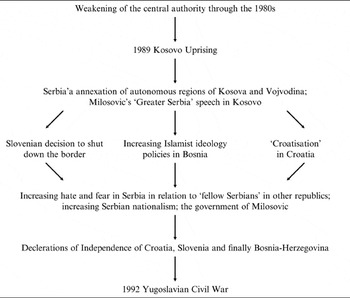
The scholars of conventional societal security dilemma read the dissolution of Yugoslavia as the following. The economic and political crises had weakened the federal government of Belgrade throughout the 1980s. The first unrest emerged in Kosovo in 1989. The leader of Serbian communists Milosevic paid a visit to the Serbian minority in Kosovo and made his infamous ‘Greater Serbia’ speech. Kosovo and Vojvodina were annexed by Serbia (see the third Section). Fearing of a similar intervention, Slovenia shut down its borders. Islamist ideology of Alia Izetbegovic in Bosnia and the Croatian nationalism of Franco Tudjman in Croatia were rising. Especially, the Croatization policies of Tudjman fed fear and hatred in Serbia towards the Croats. Meanwhile, nationalist leaders Tudjman and Milosevic were successfully manipulating the war-time atrocities. Milosevic came to power in the first general elections in Serbia. As a response, other republics declared independence. Consequently, the civil war started (see Table 1 below).
1989–1992 Societal security dilemma in former Yugoslavia

Wendt divides social actors in two elements: behaviours and properties.Footnote 41 Properties refer to actors' identities and interests, which are in a mutually constitutive relationship with behaviours. From the perspective of Wendtian social constructivism, the conventional societal security dilemma focuses on the behaviours of actors. In other words, the security dilemma is almost reduced to the action-reaction dynamic between political actors acting on behalf of groups. The conventional approach attempts to read intentions of political actors, and therefore, to explain the ethnic conflict partly based on ‘benignness’ or ‘malignness’ of actors. However, as discussed above, this has proven to be a problematic attempt in itself. Apart from intentions, the political structure (anarchy) and properties (identities and interests) of actors are taken for granted. As there is a limited, if any, analytical focus on how political actors themselves thought about the dissolution process, identities, and interests of their respective ethnic groups, the role of political actors is reduced to the manipulative agents who play into the assumedly already existing identity differences.
Wendtian social constructivism enables a more comprehensive and realistic approach to study actor responsibility in societal security dilemmas. The key is Wendt's conceptualisation of the mutually constitutive relationship between beliefs (ideas) and identities/interests. Actors have beliefs about what exists exogenously. However, according to Wendt, ‘beliefs are not merely about an external world. They also constitute a certain identity and its relationship to that world, which in turn motivates action in certain directions.’Footnote 42 This is not to argue that ideas cause identities/interests. Rather, the point is that ideas of actors contribute to the constitution of particular identities and interests, which in turn constitute beliefs. This mutually constitutive relationship results in particular behaviours. When behaviours produce interaction with others, this interaction affects beliefs, identities, and interests of actors. Interactions between actors construct micro-structures (for example, relationship between Serbs and Croats or between Serbs and Bosnians). These microstructures constitute a macrostructure (for example, an anarchic political structure), which affects microstructural relations.Footnote 43
Wendt's social constructivist approach not only analyses mutually constitutive relations (between ideas and identities/interests or between micro and macro structures) but also enables the exploration of constructed nature of structures and identities/interests rejecting the essentialist approaches to them. To put it simply, Wendtian approach enables the deconstruction of the factors, which are taken for granted by the conventional societal security dilemma. The latter's analysis reifies the properties of actors and structures in which they interact by prioritising behaviour. This approach ‘disempowers’ actors politically as they are generally treated as automated units in already existing structures (ethnic differences, anarchy, and so on).Footnote 44
In contrast, social constructivist approach to the security dilemma directs the analytical attention to the role of actors' ideas about themselves, others, and political structures under the condition of uncertainty and fear. The implications of it for the societal security dilemma theorising are thought-provoking. When actors experience insecurity in relation another, how do they think about themselves? How do they position themselves in relation to another? What do they think about the political structures? What kinds of solutions they envisage to the insecurity problem they face?
The crucial dimension for the objective of this discussion is that actors can be studied as deliberative political agents whose ideas about (in)security of themselves and others constitute political identities/interests, and eventually the political macrostructure. Therefore, their responsibility can be studied in a more comprehensive way, as their ideas partly constitute dichotomist identities and self-centric security interests. In order to conduct this analysis, a different security dilemma framework is needed: a security dilemma with ideational schemes, or the logics of insecurity.
Towards a new societal security dilemma to analyse actor responsibility: setting the parameters
Booth and Wheeler's security dilemma framework provides an alternative way in order to study the actor responsibility in intersocietal conflicts by rendering ideas a prominent role. When actors make choices about how to pursue security for themselves under the condition of uncertainty, they act in accordance with certain ideational schemes. Schemes include ideas about (in)security, the ways to pursue security, how to identify the Self in relation to ‘threatening’ others, and about self-interests, recalling Wendt's words, ‘we want what we want because of how we think about it’.Footnote 45 Ideas constitute identities/interests, which inform behaviours. Microstructural interactions then constitute the political macrostructure. In the security dilemma theorising, Booth and Wheeler define three types of ideational schemes in terms of three ‘logics of insecurity’.
The three logics of insecurity consist of three different understanding of security. Each logic (and therefore each conception of security) suggests alternative ways to deal with insecurity. The first logic of insecurity is fatalism, which assumes that anarchy is the political structure in which actors interact. Living in anarchic structure, actors feel Hobbesian fear towards each otherFootnote 46 as there is no way to be fully sure about others' intentions. The central assumption of fatalism is that under such uncertainty, when an actor faces insecurity in relation to another, it should assume and prepare itself for the worst. The actor pursues security through ethnocentric policies.Footnote 47 If the actor does not assume these ethnocentric security policies, it risks destruction. The logic of fatalism generally reflects the conventional security dilemma understanding, which inspired the societal security dilemma. However, this represents only one choice and one possibility in the security dilemma.
The second logic of insecurity is the logic of mitigator. According to the mitigator logic, policymakers can break the vicious cycle of security competition and war through constructing common norms, shared values, and common interests. They therefore build a cooperative political structure in which different units (states) can coexist together. As a result, the political structure evolves into Lockean or even Kantian anarchy. In other words, anarchy can be ‘matured’. If actors choose to act in this way, an order can be forged.Footnote 48 As actors interact in such a predictable structure, the insecurity in relation to others' intentions can decrease.
If actors choose to act in accordance with the fatalist logic, the security dilemma can result in mutual tension accompanied by arms racing at best, and conflict at worse. Actors choosing to act within the confines of the mitigator logic can break the vicious cycle of competition and war. They can mitigate, but not transcend the security dilemma. In order to transcend the security dilemma, actors have another choice: to construct a common we-feeling through trust-building at societal level. Actors adopting the transcender logic choose to act in a way that existing identities and interests are redefined in order to pursue common security. The fundamental difference from the mitigator logic is that in the transcender logic, a common we-feeling should be constructed at societal level. Trust-building at societal level is functional to construct this common identity.Footnote 49 This new conceptualisation along the logics of insecurity provides a fresh perspective to analyse actor responsibility in societal security dilemma processes, as the logics provide alternative ideas about security that actors adopt.
Actor responsibility in reconstructing anarchy
Either as a cause (Posen, Tang) or as a permissive structure (Roe), anarchy is attributed a central role by the scholars of the societal security dilemma. However, none of these approaches problematise the taken-for-granted characteristic of anarchy: they accept it as a reality out there that determines actors' actions. However, this understanding has long been challenged by various approaches including English School-inspired approaches,Footnote 50 by regime theorists,Footnote 51 by feminist approaches,Footnote 52 by the security community approach,Footnote 53 and by social constructivist approaches.Footnote 54 However, this broad and highly relevant discussion about how actors as agents construct structures has not been reflected in the societal security dilemma theorising.Footnote 55
Notwithstanding their significant differences, all these approaches reiterate that, rather than an all-encompassing and determining structure out there, anarchy can be reconstructed, reformed, or transformed (their answers to ‘how’ and ‘to what extent’ questions significantly differ) by the actors. This understanding asserts that actors enjoy some level of agency in varying degrees. The question here is whether actors choose to use this (limited or extended) agency to construct and reconstruct the anarchic political structure or to transform its parts or its whole. In other words, if scholars of the societal security dilemma conceive the political structures followed by the dissolution of multi-ethnic states or the collapse of the central authority as anarchy, this can be partly because dominant political actors construct and reconstruct this anarchic political structure, which feeds into mutual fear, hostility, and distrust. This, of course, certainly does not mean that political actors are autonomous from structural constraints. ‘Structures obviously (always) affect people's decisions, but they do not determine them. They are a necessary part of an explanation of behaviour, but they are not sufficient.’Footnote 56 If, as Buzan argues,Footnote 57 structures and units are always in a mutually constitutive relationship, another necessary explanatory factor in constructing anarchic structures is the actor's responsibility: the choices of actors about how to think and act.
The new security dilemma framework enables scholars to address this neglected point. By bringing the logics of insecurity into the security dilemma, which is reconceptualised as a ‘difficult choice of an actor between two alternatives’ or two logics, actor responsibility in eruption of ethnic conflicts gains a deeper dimension. Why did actors act according to the fatalist logic, other than the mitigator logic or why did they choose to adopt ethnocentric security policies instead of trust-building policies to construct a ‘we-feeling’ between societies? Political structures are hardly monolithic and oppressive to the extent that they disable all alternative ideas and policies, as will be seen below in the case of Yugoslavia. There are always different choices underlined by fatalism, mitigator, or transcender logics. Roe himself acknowledges this fact in relation to Croatia in 1990s and ‘as with Croats, security requirements were also subject to internal contestation’.Footnote 58 However, this contestation between different ideas about security and how some political actors marginalised alternatives and fatalistically took ethnocentric policies, and therefore, reconstructed anarchy have so far escaped from all conventional societal security dilemma approaches.
When societal conflicts are reanalysed through the prism provided by the new security dilemma, actor responsibility cannot be reduced to the manipulation of historic enmities for political purposes. Dominant political actors, by marginalising alternative actors and their ideas, fatalistically adopt ethnocentric security ideas and policies without considering how these policies are received by others. Through security policies underlined by fatalism, they reconstruct the anarchic political structure. In other words, Tudjman's Croatia's practices in 1992 to protect the Croatian national identity can be generated by fears and uncertainty stemming from the anarchy-like political structure following the dissolution of Yugoslavia. However, what is neglected in the conventional societal security dilemma literature is how the ideas and policies of Tudjman contributed to the reconstruction of this anarchic structure, rather than transforming, or at least mollifying, it.
From the malign/benign intentions to the logics of insecurity
The analytical focus on whether actors have malign or benign intentions largely originates from the conventional security dilemma theorising primarily structured in the Butterfieldian way. This approach misleads analysts in two senses. First, ‘malign’ and ‘benign’ are analytical, albeit problematic, labels created by analysts to describe actors' intentions. As to the reminder, if an actor does not aim to attack another and takes defensive measures for its own security, the intentions are described as benign. However, if s/he takes actions to attack another, the intentions are put as ‘malign’. The existence of ‘benign’ intentions becomes a criterion to determine what kind of societal security dilemma the case under investigation exemplifiesFootnote 59 or even the situation can be defined as a security dilemma.Footnote 60 Whether an actor had malign or benign intentions can only be known by analysts with the benefit of hindsight. However, the conventional societal security dilemma approaches are quick to accept these analytical labels as ontological realities: as if actors really had malign or benign intentions during the time of the crisis. However, it is highly unlikely that a political actor thinks his/her intentions are malign even if s/he intends to wage war on another (analytically, it must point at malign intentions) because war can serve a ‘good’ cause: self-security.Footnote 61
While investing too much attention in ‘malign’ and ‘benign’ intentions, what is neglected in the conventional thinking is the role of instrumental reason: the end justifies the means. Instrumental reason is one of the key components of the fatalist logic, which prompts policymakers to adopt policies that assumingly increase self-security without considering how these policies affect others negatively. In its worst case, ‘instrumental reason turns people into cogs into genocidal machines and policies without fully appreciating what is happening’.Footnote 62 Increasing security for the society they represent is a useful justification mechanism for policymakers. At the end of the day, Milosevic and Tudjman in 1992-4 were trying to increase security for their respective societies, even if their mutual policies led to the ethnic cleansing of other societal groups. For scholars, their intentions can be identified as malign with the benefit of hindsight. However, during the time of the crisis, were they really ‘malign’ or was instrumental rationality operational that even the most destructive ideas were considered by actors themselves as ‘benign’? And if actors themselves identified their intentions as ‘benign’, is it possible to talk about ‘malign’ intentions during the time of crises? ‘Malign’ and ‘benign’ are misleading labels that analysts use to identify intentions after the conflict.
Can actors be taken responsible during the time of crises for their actions if they thought that their security policies were serving a good cause? They still can be but not through engaging in inconsequential discussions about the malignness or benignness of intentions. What must be questioned here is what actors understood from security during the time of crises that activated instrumental reason. This leads us to the second point.
The second point about why the focus on intentions is not helpful to determine actor responsibility is that intentions are derived from ideas about security. Intentions are important not as a cause of the societal security dilemma, as in put by Tang, but as indicators. What they indicate is the security understandings of actors: what does security mean for me, how to pursue security for myself, are others threatening us, what kind of political structure in which I must interact with others. Fatalist, mitigator, and transcender logics result in different intentions. For example, a policymaker adopting the principles of the fatalist logic tends to suppress other ethnic identities for its security; another one with the mitigator logic tends to find alternative ways to coexist with the other, but as separate entities.
The analytical focus with the new security dilemma is directed to actors' conceptions of security: which conception or understanding an actor chooses to act on? In this way, actor responsibility can be studied better in intersocietal conflicts than inconsequential endeavours to determine whether actors had malign or benign intentions, even if this labelling cannot reflect the reality during the time of the crisis. The focus on security rationalities also frees the analysts from taking the benefit of hindsight about past conflicts. They can also pass judgements on actor responsibility in current societal confrontations by analysing actors' discourses and practices. Depending on the logic of insecurity adopted, analysts can make predictions about the likelihood of conflict.
Mutually constitutive identity-security relationship
The constitutive role of political actors in eruption of intersocietal conflicts can be studied in relation to identity. In order to analyse actor responsibility, identity (ethnic, religious, or societal in general) can be approached, first, as a linguistic construct, and second, as a sociological construct.
In relation to the former, identities are accepted as linguistic products of actors' narratives. Actors choose what to narrate and how to narrate about the past and through narration, they reconstruct reality.Footnote 63 Political actors can perform this in consideration with their political interests. However, the implication of the linguistic argument is greater than this. Through narratives, political actors do not only play into historical enmities, but they reconstruct ‘the threatened, victimized Self’ and ‘the threatening Other’.Footnote 64 In other words, identities are not settled foundations out there upon which actors play the game of politics, as the conventional societal security dilemma suggest. On the contrary, political actors tell stories of the past in a particular way that the Self-identity is constructed as opposed to the Other-identity. Hence, actor responsibility does not lie in the manipulation of the existing identity differences, but in constructing these identities in a dichotomist way.
However, identity construction processes still cannot be reduced only to linguistic processes. McSweeney in his sociological analysis of identity-security nexus argues that as identity is not ‘a thing’ but ‘a process of negotiation among people and interest groups’, identity construction processes cannot be thought of autonomous from competition about how the unit (state or society) can solve its insecurity problem.Footnote 65 He concludes that ‘the security problem is not there just because people have separate identities; it may well be the case that they have separate identities because of the security problem’.Footnote 66 This argument has an important implication for the purposes of this article: under the condition of uncertainty (such as the collapse of the central authority) societal groups feel insecurity and as a response, they can choose to adopt security ideas and policies that construct different identities as ‘the Others’ who can attack anytime and anywhere. In a similar manner, when insecurity is felt, they can also choose to deal with this by constructing a common identity with others.Footnote 67 Actor responsibility can be investigated in terms of how political actors construct dichotomist societal identities as a response to the insecurity problem. In order to perform this task, the scope again should be directed towards security understandings of actors.
Unfolding the dynamics of ‘co-constitution’ of identity and security paves the way for analysing identity ‘as a source of security’.Footnote 68 The new security dilemma framework enables analysts to integrate this idea into the societal security dilemma theorising. When actors choose to act in accordance with the principles of the fatalist logic, their security understanding directs them to adopt ethnocentric security policies without taking how others might be affected by these policies. These policies feed into ‘othering’ processes by constructing and reconstructing them as threats to societal self-identity in the making. This does not preclude of course the possibility that actors adopt the fatalist logic because they have dichotomist identities. The point here is that the relationship between identity and conceptions about security is not unidirectional, but mutually constitutive.
Even if societies are assumed to have dichotomist identities, security policies underlined by the mitigator logic have potential to transform this dichotomy. Actors have important responsibilities in these processes. Take Michael Barnett's analysis of the 1992 general elections in Israel between Yitzhak Shamir, who defended an ultranationalist Israeli identity, and Yitzhak Rabin, who campaigned for an Israeli identity integrated with the world and conciliation with ‘enemies’. As a result of the victory of Rabin, ‘a construction of an Israeli national identity and interests that were tied to a peace process that involved a territorial compromise with the Palestinians’, and the peace process was about ‘who it [Israel] was and who it was to become’.Footnote 69 Through the Oslo Process, the parties through their narratives and practices attempted to mitigate their security dilemma by deconstructing the dichotomist identities. However, these mitigation attempts remained at state-level and could not be nestled into the societal level, old hostilities erupted as a result of new dominant narratives and practices.Footnote 70
The security dilemma can be transcended if a common we-identity is constructed at societal level. The primary illustration for this is the construction of the security community in Europe. According to Booth and Wheeler, European states have been able to construct a common citizenship, a we-feeling among societies of Europe in order to break the cycle of fear, distrust, and insecurity characterised the European politics for centuries.Footnote 71 Through institutionalisation of multi-level social, cultural, and economic relations between societies, a common identity has been gradually constructing. Wæver also points to this process. He argues that ‘there is more and more a European flavour to being French, German, and so on … the national self contains a “narrative” with Europe as a required component’.Footnote 72 These authors' analyses of European integration lead us to the point that identity can become a source of security if the common identity construction process is shifted to societal level. Actor responsibility in societal security dilemmas lies here. An analyst of the societal security dilemma therefore, is enabled to ask the following questions: why did political actors not choose to construct a common identity, which would be an additional layer to ethno-religions identities? How did they opt out this choice? Which political actors were pushed to the fringes of political spectrum? Integration of identity as a source of security through the transcender logic enables analysts to study actor responsibility in relation to what actors failed to do as well.
In the last part of the analysis, the discussion so far will be illustrated through re-reading of the dissolution of Yugoslavia. The dissolution is surely a long and complex process. The aim is to illustrate the importance of new principles by operationalising them with reference to particular moments of the dissolution.
An illustration of the new societal security dilemma: different reading of Yugoslavia to study actor responsibility
Since its official inception in 1905 to 1945 Yugoslavia's politics was characterised by tension between different ethnic groups, massacres, and assassinations.Footnote 73 The foundation of Tito's Yugoslavia in 1945 put a halt to interethnic conflicts. However, as the events from 1970s onwards illustrated, the socialist regime largely failed to build trust at societal level between individuals belonging to different ethnic groups. Insecurity of ethnic groups in relation to others could not be dealt with effectively. The question of history repeating itself remained in policymakers' (and perhaps societies') understandings: ‘how can we know others do not want to what they did decades ago?’ This fed insecurity of societal groups further. Policymakers of the Yugoslav republics then were in a security dilemma: how can I interpret others' intentions of others and how can I respond to them?
Actor responsibility in the case of Yugoslavia primarily lies in the fact that policymakers chose to interpret others' intentions and respond to them according to the principles of the fatalist logic, rather than mitigator or transcender logics. Policymakers mainly assumed the worst about the intentions and adopted ethnocentric policies, which egoistically served security of their respective societies without considering how these policies affected others. These policies underlined by fatalism, as its name suggests, fatalistically assumed that the atrocities of the past can happen again so a societal group should ethnocentrically pursue security for itself. These fatalist policies' primary effect was the weakening of the federal government, which was the central authority in Yugoslavia. This alleviated uncertainty and insecurity further. Ethno-nationalist parties in the republics strengthened their foundations in such an uncertain political structure by providing a sense of security to electorates. For example, during the elections in 1990, Milosovic's party's slogan was intriguing: ‘With us there is no uncertainty!’ This was the uncertainty, or anarchy, which they contributed to constructing through ethnocentric policies.
If a dissolution date of Yugoslavia was to be determined, it would be the day when the Slovenian delegation walked out from the Extraordinary Congress of the League of Yugoslav Communists in January 1990. The on-going tension between Slovenian and Serbian representatives in regard to political reforms, pluralism, and the republics' federal rights reached the climax during the meeting. With the Slovenian delegation walked out, the League of Yugoslav Communists (renamed Communist Party in 1952) disintegrated into the republics' independent parties. Even after this strong blow to Yugoslavia, the federal government remained in power for a while, albeit with decreasing authority. Some scholars of the societal security dilemma identified the collapse of the federal government as the birth of anarchic structure in Yugoslavia where each ‘ethnic group’ had to compete for survival. However, what is missing in their analyses is the fact that ‘anarchy’ did not happen in former Yugoslavia, but was constructed by certain political actors.
Yugoslavia, as an example of socialism with liberal contours, proved to be a successful state until the early 1970s. The economic growth in all republics (but especially in Slovenia and Croatia), industrialisation, and increasing trade volume with both socialist and capitalist states created a period of peace and prosperity in the country.Footnote 74 However, the appearance of Croatian and Serbian nationalist groups in respective republics led to the formulation of 1974 Constitution. This constitution strengthened the equality of all republics (regardless of the size of population) by adopting the unanimity rule in federal decision-making. In spite of its benefits, the Constitution was inefficient because it failed to create a supranational legal mechanism to solve conflicts among republics except the office of presidency. The office of presidency itself was projected to be replaced by ‘the collective state presidency’ following Tito's death.Footnote 75 As a result, there was left no supranational arbiter to rebuild dialogue and trust between republics in the case of a crisis. During the process of construction of anarchy in Yugoslavia, the 1974 Constitution, which originally aimed to strengthen the federal government, in fact prepared the foundation of the dissolution by investing all power to the League of Yugoslav Communists.
Actor responsibility did not lie only in failing to envisage or propose a supranational mechanism with the fear of creating a strong presidency, but also in restraining the already subordinated and weakened federal government's efforts to address the problems of Yugoslavia. The incapacitation of the federal government by the republics to address the economic crisis during the 1980s was a useful example. During the 1980s, Yugoslav republics suffered a serious economic crisis. Drastic worsening of populations' economic situation led to the general strikes all around country. Only in 1987, 1,570 strikes took place with 360,000 participants.Footnote 76 In March 1989, Ante Markovic was appointed as a prime minister of the federal government. Markovic initiated new political and economic reforms in order to control hyperinflation and unemployment. However, the federal government's efforts were continuously hindered by republics' policymakers. Markovic himself complained that reforms had ‘either been stopped or slowed down’ at a regional level.Footnote 77 As the Markovic administration failed to solve the economic crisis, the support of Yugoslavians to the federal government declined further along with increasing economic insecurity.Footnote 78
The construction of anarchic political structure by weakening the federal government by the republics had another dimension: lack of a body to initiate trust-building between republics. One story, among many, is illustrative of this situation. In 1988, in Kosovo which was granted full autonomy by the 1974 Constitution, Albanian majority (around 90 per cent of the population) began riots against the Belgrade government, which resulted in Serbian minority's unrest. The leader of Serbia's League of Yugoslav Communists Milosevic made the Serbian Parliament to pass amendments to reintegrate Kosovo and Vojvodina into Serbia in April 1989.Footnote 79 This act was a direct violation of the 1974 Constitution, which granted full autonomy to both provinces. The inefficiency of the federal government to protect the Constitution increased fears of and distrust towards the Serbian government. Slovenian policymakers were ‘anxious to forestall the possibility that Belgrade decision-makers might one day wish to impose “standard solutions” on their republic’.Footnote 80 In 1989, following the Kosovo issue, the Slovenian Parliament passed a law stated that only in situations when the Slovenian Parliament invites it, the federal government has a right to intervene in Slovenia.
Relations between Serbia and Slovenia worsened more. In November 1989, Serbs in Slovenia organised a demonstration. Slovenian government prevented the Serbs from Serbia from attending to the demonstration by closing the border. The reaction of Serbia was fierce to terminate business links with Slovenia. As a result, the common market between Yugoslav republics became practically ineffective.
The brief examples from the dissolution process of Yugoslavia illustrate that political actors in Yugoslavia did not find themselves in the anarchic political structure. Rather, through their actions and inactions, they constructed it. These actions were informed by fatalist ideas political leaders held: ‘other ethnic groups cannot be trusted; so we need to pursue our own security without considering how our policies contributed others' insecurity. Acting otherwise risks annihilation.’ As a result, the federal government was weakened day-by-day due to self-centric security policies of the republics. In turn, fear and distrust characterised the political relations between republics further. The Slovenian Parliament's above mentioned ‘preventive’ legislation pointed at how decision-makers adopted the perception that they had to survive in an anarchy-like structure. Ethnocentric security policies followed. In short, paraphrasing Wendt's words, anarchy in former Yugoslavia was what Milosevic of Serbia, Tudjman of Croatia, and Kucan of Slovenia made of it.
In a nutshell, Yugoslavia during the 1980s was characterised largely (but not totally) the declining federal government and economic instability. Distrust among republics resulted in subsequent political crises (like the one discussed above) which increased the sense of anxiety and insecurity in the country. ‘The hurried quest for personal security and stable relationships during a period of socioeconomic turbulence and rapid political disorientation was undoubtedly important factor contributing to the proliferation of small ethno-national parties.’Footnote 81 To put it differently, in such an unstable political environment, ethno-national political parties claimed to provide security to their respective ethnic groups. Their policies underlined by fatalism designed to increase security for their societal groups as opposed to other societal groups' security concerns. These policies continuously reconstructed self/other dichotomy between societies. The idea that ‘homogenized ethnic community’ is the best possible solution to the insecurity of a societal group became a commonly accepted idea. This strengthened the dichotomist and exclusionary ethnic identities further by subordinating other individual and societal identities to the oppressive nature of ethno-nationalism. As stated by Gallagher:
Leaders who insisted that they were able to interpret and defend the popular will of the nation gained control. Their nationalism denied individualism and disempowered intermediate institutions which were designed to set limits on what the state could do to citizens and, instead, the nation came to be seen as the collective individual. Citizens hitherto defined by jobs, education, character, ideas as well as nationality, were increasingly reduced to one dimension as the climate of insecurity turned nationalism into a state religion.Footnote 82
Therefore, policies which were designed to serve security of the ethnic group were considered ‘benign’ as the instrumental reason began to dominate.
One of the fundamental features of the fatalist logic is the idea that what happened in the past is likely to repeat itself in the future. In parallel, the nationalist rhetoric constructing the self/other dichotomy was partly characterised by the narrative of victimhood (such as the one in Serbia reminding the society of atrocities in Croatia against Serbs during World War II).Footnote 83 As a way of preventing such an outcome again, ethno-nationalist political actors promoted national homogeneity, which is the idea that ‘statehood without minorities constituted political stability and offered the only genuine chance for peace’.Footnote 84 According to this thinking, ‘ethnic groups’ are essentially different so separation of them based on historic/cultural differences is a recipe for security and peace. For example, in an interview, Tudjman stated that ‘Croatians and Serbs do not only have different historic characteristics: they also belong to different cultures. Therefore any attempt to create a unitary Yugoslavia is doomed to fail.’Footnote 85
Tudjman's words pointed at an action more than a ‘manipulation of ethnic differences’. Like Tudjman, Milosevic's pan-Serbianism and, to a lesser extent, Bosnian leader Izetbegovic's Islamist narratives constructed ‘we vs. they’ dichotomy by arguing for essential cultural and historical differences between societies. Security was offered to individuals as long as they exclusively adopted their ‘essential’ ethnic identity. In contrast, through education and supporting interethnic marriages, the federal government had been able to create a sense of citizenship, albeit a fragile one, based on ‘Yugoslavism’ with a considerable level of popular support.Footnote 86 This common identity construction attempt was abandoned by mainstream political actors as this common identity was doomed to collapse because individuals essentially belonged to different ethnic groups. As a result, such as Tudjman's support of the Turkey-Greece population exchange in 1926 as, for him, through this exchange both states achieved internal stability and peace between them,Footnote 87 policies for ethnic homogenisation became widespread. ‘Ethnic cleansing’ as a policy of security was considered as ‘benign’ since it would assure survival of ‘the ethnic community’.
A question remains that whether political actors had choices other than adopting the fatalist logic. One of the strengths of the new societal security dilemma conceptualisation is that it enables analysts to explore alternative security ideas and policies. In addition to choosing fatalism-driven policies, actor responsibility also lies in not choosing and marginalising alternative political ideas. Even in dominantly ethno-nationalist political structures, there were alternative choices underlined by mitigator and even transcender logic. As examples of policies underlined by mitigator logic that aims to build an order in Yugoslavia that different societies coexist, in Serbia's political structure, the idea of ‘Yugoslav Commonwealth’ based on a common market and the formation of ‘Civic Alliance of Serbia’ against nationalist parties can be considered.Footnote 88 However, civil society activities and their ideas emphasised, to varying degrees, more on common identity that could be constructed between different ethnic groups in all parts of former Yugoslavia.Footnote 89 Especially women organisations were highly active in different Yugoslav republics.Footnote 90 Women organisations in Serbia continuously called for restraint to the Milosevic administration, although political actors chose not to hear their call.Footnote 91
The point here is that in Yugoslavia, even during the time of conflict, there were alternative ideas to ethnic homogenisation of exclusionary ethnic groups. This illustrates that identity is not necessarily a source of insecurity. If common identities, as supported by civil society movements in Yugoslavia, are constructed, identity can become a source of security as well (remember the federal government's attempts to construct Yugoslavism). However, these ideas were marginalised and pushed to the fringes of political spectrum. Moreover, as Devic rightly argues, scholars have so far had little, if any, attention to the alternative ideas of civil society movements.Footnote 92 In relation to the conventional societal security dilemma literature, this results in the discussion of politics in Yugoslavian republics as monolithic that only fatalism-driven ideas and policies existed. In contrast, looking at alternatives enables analysts to examine how political actors in Yugoslavia chose to act in a security dilemma. Therefore actor responsibility can be studied more comprehensively and realistically than performed in the conventional societal security dilemma literature.
Conclusion
This article has argued that a new societal security dilemma should examine alternative ideas about societal identity with their security implications by using the conceptual tools called ‘insecurity logics’. With the introduction of logics, analysts would be enabled to study political actors' ideas about what security means, and how security can be pursued. Actor responsibility, it was argued, can be investigated in relation to how actors (re)construct anarchy and dichotomist identities and also fail to adopt alternative courses of action. Four conclusions can be derived from the discussion. The first one is that students of IR cannot study cases without theories and/or particular analytical frameworks, which lead us what to study and how to study. However, this necessity should not result in imposition of theoretical and conceptual ideas on the cases under investigation. The conventional societal security dilemma suffers from this type of imposition. In contrast, the logics of insecurity in conjunction with the new security dilemma enables analysts to study actors ideas and practices without imposing theoretical assumptions on how actors must think and act.
Three other conclusions are related to how a new societal security dilemma can be rethought:
Synchronising the societal security dilemma with the discipline of IR: Although it was an innovative concept once, the societal security dilemma is now well behind various theoretical discussions in IR. This impasse hinders the concept's explanatory and analytical power to study intersocietal confrontations. This article has showed how some of these discussions can be integrated into the concept, maybe through transforming the concept itself. This integration can contribute to enhancing the concept's analytical power to discuss actor's constitutive roles in societal conflicts.
Politicising the societal security dilemma: A claim to study actor responsibility cannot be reduced to make assertions about whether actors had ‘malign’ or ‘benign’ intentions. Problematic these assertions are, they also neglect the political side of the discussion. ‘What is the political actor responsibility in inter-ethnic wars?’ is as political a question as it is analytical. If anarchy and dichotomist identities are reconstructed, this is because they serve particular political interests. In the construction processes, alternative actors and their ideas were marginalised and silenced. However, what is marginalised has not been included in the societal security dilemma. Through the logics, these actors and their conceptions of security can also be studied.
Not only the past, but predictions about the future: One of the most important contributions of a new security dilemma framework is that scholars would not have to rely on the benefit of hindsight to conduct an analysis. By focusing on security rationalities of actors, they can discuss the current societal confrontations with greater prediction ability.