Introduction
Strongyloides stercoralis infection affects between 10 and 40% of the population in many tropical and subtropical countries (Schär et al., Reference Schär, Trostdorf, Giardina, Khieu, Muth, Marti, Vounatsou and Odermatt2013). In Brazil, the prevalence of strongyloidiasis can vary according to different populations, regions and diagnostic methods evaluated (de Paula et al., Reference de Paula, de Castro, Gonçalves-Pires, Marçal, Campos and Costa-Cruz2000). The prevalence of S. stercoralis infection in alcoholic patients in Salvador, Brazil, was 23.5% (Silva et al., Reference Silva, Inês, Souza, Dias, Guimarães, Menezes, Barbosa, Alves, Teixeira and Soares2016). Strongyloidiasis is considered to be a neglected tropical disease and is probably underdiagnosed, due to its irregular parasitic load and uncertain clinical symptoms (Puthiyakunnon et al., Reference Puthiyakunnon, Boddu, Li, Zhou, Wang, Li and Chen2014). The parasite's capacity to cause autoinfection is responsible for the decade-long persistence of infection in untreated hosts (de Souza et al., Reference de Souza, Machado, Teixeira and Soares2014; Puthiyakunnon et al., Reference Puthiyakunnon, Boddu, Li, Zhou, Wang, Li and Chen2014) and facilitates the transmission of the disease, mainly in areas without adequate sanitation.
In clinical laboratories, the detection of larvae in stool samples is performed as a definitive diagnostic test. However, due to an irregular and small larval load in the faeces in the majority of patients with chronic infection, repeated stool examinations associated with different parasitological methods are necessary to establish an accurate diagnosis of Strongyloides infection (Dreyer et al., Reference Dreyer, Fernandes-Silva, Alves, Rocha, Albuquerque and Addiss1996; Uparanukraw et al., Reference Uparanukraw, Phongsri and Morakote1999; de Souza et al., Reference de Souza, Inês, Santiago, Teixeira and Soares2016). The parasitological methods that have been used include direct faecal smear, Baermann–Moraes method, spontaneous sedimentation, TF-Test®, formalin–ether concentration, filter-paper culture and agar plate culture (APC) (Arakaki et al., Reference Arakaki, Iwanaga, Kinjo, Saito, Asato and Ikeshiro1990; Kobayashi et al., Reference Kobayashi, Hasegawa, Soares, Toma, Dacal, Do, Brito, Yamanaka, Foli and Sato1996; Ericsson et al., Reference Ericsson, Steffen, Siddiqui and Berk2001). Agar plate culture, although rarely used, is the parasitological method that has the highest sensitivity for S. stercoralis diagnosis (Koga et al., Reference Koga, Kasuya and Ohtomo1992; de Kaminsky, Reference de Kaminsky1993; Blatt & Cantos, Reference Blatt and Cantos2003; Inês et al., Reference Inês, Souza, Santos, Souza, Santos, Silva, Silva, Teixeira and Soares2011). Moreover, the identification of parasites based on the different patterns of larval movement in APC, may increase the sensitivity of the method when larvae are not recovered from cultures, and may also reduce the risk of contamination (Inês et al., Reference Inês, Souza, Santos, Souza, Santos, Silva, Silva, Teixeira and Soares2011). Eosinophilia has been considered a potential marker in screening for chronic strongyloidiasis, particularly in asymptomatic individuals (Nutman et al., Reference Nutman, Ottesen, Leng, Samuels, Kimball, Lutkoski, Zierdt, Gam and Neva1987; Gill & Bailey, Reference Gill and Bailey1989). In addition, eosinophils perform an important role in host defence; they are not only directly involved in the innate immune response, but also in the adaptive immune response against helminth larvae (Padigel et al., Reference Padigel, Lee, Nolan, Schad and Abraham2006; Shin et al., Reference Shin, Lee and Min2009; Iriemenam et al., Reference Iriemenam, Sanyaolu, Oyibo and Fagbenro-Beyioku2010).
Chronic alcohol use has been associated with S. stercoralis infection (Oliveira et al., Reference Oliveira, Ribeiro, Mendes, Oliveira and Costa-Cruz2002; Marques et al., Reference Marques, Zago-Gomes, Gonçalves and Pereira2010) and a higher predisposition to hyperinfection and severe strongyloidiasis (Lashof et al., Reference Lashof, Lesterhuis, Wanten, Beckers and Keuter2007; Teixeira et al., Reference Teixeira, Inês, Pacheco, Silva, Mendes, Adorno, Lima and Soares2010). A reliable diagnosis is particularly important for alcoholic patients and other groups at risk of severe S. stercoralis infection. In the present study, we evaluated the efficacy of three different parasitological methods and number of stool samples for S. stercoralis diagnosis, as well as the presence of peripheral eosinophilia in alcoholic patients according to the parasite load.
Materials and methods
Patients and parasitological diagnosis
The present study was carried out from September 2012 to March 2014 in alcoholic patients seen at a public hospital in Salvador, Bahia, Brazil, which is supported by the National Health System. The diagnosis of chronic alcoholism was according to WHO criteria (F10.2, ICD 10, 2002). All alcoholic patients provided detailed information on daily alcohol intake and they were hospitalized voluntarily for treatment of alcoholism.
Initially, 330 patients were enrolled in this study. Informed consent for participation was obtained from each patient during delivery of clinical specimens. A total of 328 individuals delivered three faecal samples, which were examined by three different methods – spontaneous sedimentation, Baermann–Moraes method and agar plate culture (APC) – at the Clinical and Toxicological Laboratory of the College of Pharmacy at the Federal University of Bahia, Brazil. Two patients provided only one faecal sample and they were excluded from evaluation of the efficacy of parasitological methods. The sensitivities of each method were calculated according to the number of stool samples analysed and the parasite load. Larvae from approximately 1 g of faeces, obtained by the Baermann–Moraes method, were quantified under a microscope (at 400× magnification). The peripheral blood eosinophil count was measured in 330 alcoholic patients and eosinophilia was considered when the eosinophil count was greater than 600 cells/mm3.
Statistical analysis
Statistical analyses were performed using the statistical software GraphPad (San Diego, California, USA). The cumulative number of positive samples, and the comparison of efficacies of parasitological methods and frequency of eosinophilia according parasite load were performed using the chi-square test. Differences were considered to be statistically significant when P < 0.05.
The Kappa test was used to measure the concordance between the parasitological methods. The reference values are inferred as follows: <0, no agreement; 0–0.19, poor; 0.20–0.39. low; 0.40–0.59, moderate; 0.60–0.79, substantial and 0.80–1.00, excellent agreement (Landis & Koch, Reference Landis and Koch1977).
Results
Efficacy of parasitological methods
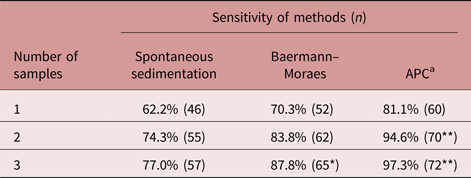
APC was the most sensitive parasitological method for the detection of S. stercoralis larvae (97.3%), when considering the results of three samples on alternate days, followed by the Baermann–Moraes and sedimentation methods, with a sensitivity of 87.8% and 77%, respectively. APC increased the number of S. stercoralis-positive samples detected, compared to Baermann–Moraes and spontaneous sedimentation methods, diagnosing an additional 7 and 15 cases, respectively (table 1). There was a statistically significant difference between the Strongyloides diagnosis performed by APC and spontaneous sedimentation methods (P < 0.05). The analysis of two or three samples by APC increased larval detection by 10 (13.5%) and 12 (16.2%) additional cases, respectively, when compared to a single sample (P < 0.05). The analysis of multiple samples increased the sensitivity of all three parasitological methods (table 1).
A comparison of three parasitological methods for Strongyloides stercoralis diagnosis according to the cumulative number of samples (n = 74).

*Comparison between the sensitivity of the Baermann–Moraes method with one and three stool samples (P < 0.05). **Comparison between the sensitivities of the APC with one and two or three samples (P < 0.05). aComparison of APC with spontaneous sedimentation to detect S. stercoralis larvae was statistically significant (P < 0.05), independent of the number of samples.
In this study, the three parasitological methods showed a high level of agreement (K > 0.8): APC with Baermann–Moraes (K = 0.899), APC with sedimentation (K = 0.837) and Baermann–Moraes with sedimentation (K = 0.859).
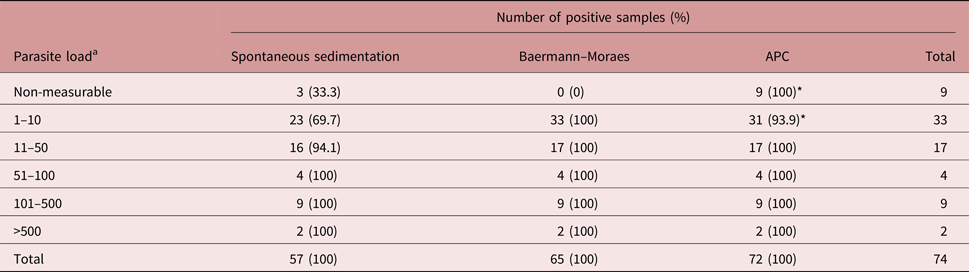
The sensitivities of the methods were influenced by the parasite load. In APC, the sensitivity reached 100% when the larval number was above 10, while spontaneous sedimentation reached 100% only when there were more than 50 larvae. The spontaneous sedimentation had the lowest sensitivity for the recovery of S. stercoralis larvae in positive stool samples having up to 10 larvae/g faeces (26/42; 61.9%) (table 2).
Number of positive samples for S. stercoralis larvae by different parasitological methods, according to the parasite load (n = 74).

aNumber of parasites/g faeces by the Baermann–Moraes method. *The APC method was more sensitive than the Baermann–Moraes and the spontaneous sedimentation method (non-measurable larval number/Baermann–Moraes negative results), and the spontaneous sedimentation method (1–10 larval output/g faeces) (chi-square test; P < 0.05).
The majority of alcoholic patients positive for S. stercoralis (42/74) presented within 10 larvae/g faeces (56.8%), nine of these patients (21.4%) were negative by the Baermann–Moraes method and were diagnosed by APC (9/9) and spontaneous sedimentation (3/9). Twenty-three per cent of alcoholic patients had a parasite load of 11–50 larvae/g faeces and 17.6% (13) with 51–500 larvae/g faeces (table 2). Two hyperinfected patients (2.7%) were diagnosed with more than 1000 larvae/g faeces (table 2).
Eosinophil levels in alcoholic patients
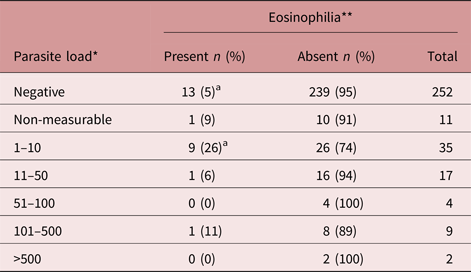
In the present study, 15.4% of alcoholic patients infected with S. stercoralis (12/78) had >600 eosinophils/mm3, while 5.2% of uninfected patients (13/252) had eosinophilia (P < 0.05). There was a significant difference between the mean eosinophil count in alcoholic patients infected (343/mm3 of blood) and those uninfected (247/mm3) with S. stercoralis (P < 0.05). Most of the S. stercoralis-infected patients who presented with an eosinophil count above 600/mm3 of blood had within 10 larvae/g faeces (83.3%; 10/12) and two hyperinfected patients presented a normal eosinophil count, below 600/mm3 (table 3).
Eosinophilia in S. stercoralis-infected (n = 78) and in uninfected alcoholic patients (n = 252) according to parasite load.

*Number of parasites/g faeces by the Baermann–Moraes method. ** >600 eosinophils/mm3 of blood. aSignificant occurrence of eosinophilia in S. stercoralis-infected patients with low parasite load, compared to non-infected patients (P < 0.05, chi-square test).
Discussion
Some studies in Brazil have indicated a high prevalence of S. stercoralis infection in alcoholic patients (Oliveira et al., Reference Oliveira, Ribeiro, Mendes, Oliveira and Costa-Cruz2002; Marques et al., Reference Marques, Zago-Gomes, Gonçalves and Pereira2010), despite the use of diagnostic methods having low sensitivity. In this study, the agar plate culture method was the most sensitive (97.3%) for detection of S. stercoralis larvae, when compared to both Baermann–Moraes (87.8%) and spontaneous sedimentation methods (77.0%). This confirms the results of a previous study undertaken in our laboratory (Inês et al., Reference Inês, Souza, Santos, Souza, Santos, Silva, Silva, Teixeira and Soares2011) and other studies (Arakaki et al., Reference Arakaki, Iwanaga, Kinjo, Saito, Asato and Ikeshiro1990; Koga et al., Reference Koga, Kasuya and Ohtomo1992; de Kaminsky, Reference de Kaminsky1993; Blatt & Cantos, Reference Blatt and Cantos2003). In addition, in the present study, the sensitivity of the parasitological methods tested changed according to the number of larvae excreted in faeces. APC had the highest sensitivity in patients excreting a low number of larvae – up to 10 parasites/g faeces (low parasite load) – when compared with both Baermann–Moraes and spontaneous sedimentation methods. In the normal routine of a clinical laboratory, the APC method is not commonly used, despite its high efficacy for S. stercoralis diagnosis (Inês et al., Reference Inês, Souza, Santos, Souza, Santos, Silva, Silva, Teixeira and Soares2011).
However, in infections with a parasite load greater than 10 larvae/g, the Baermann–Moraes method achieved a 100% sensitivity rate, as in the APC method. The sensitivity of the three parasitological methods reached 100% when there was high parasite load (above 50 larvae/g faeces). Other studies have also demonstrated increased parasitological sensitivity according the number of larvae identified in faeces (Intapan et al., Reference Intapan, Maleewong, Wongsaroj, Singthong and Morakote2005; Schär et al., Reference Schär, Hattendorf, Khieu, Muth, Char, Marti and Odermatt2014).
As the number of larvae increases in the faeces of alcoholic S. stercoralis-infected patients, the easier it is to establish the diagnosis (Silva et al., Reference Silva, Inês, Souza, Dias, Guimarães, Menezes, Barbosa, Alves, Teixeira and Soares2016), and even methods with low sensitivity, such as spontaneous sedimentation, can detect the presence of larvae. The high parasite load in alcoholic patients is probably due the increase of endogenous corticosteroid levels, due to excessive alcohol consumption, which in turn enhances the fecundity of parasite females and the transformation of rhabditiform into infective filariform larvae, mimicking the effect of worm ecdysteroids and leading to internal autoinfection (Concha et al., Reference Concha, Harrington and Rogers2005). Consequently, alcoholic patients are more susceptible to the development of hyperinfection and severe strongyloidiasis (Lashof et al., Reference Lashof, Lesterhuis, Wanten, Beckers and Keuter2007). Besides, the chronic consumption of alcohol has a toxic effect on the smooth muscle contractile proteins of the small intestine, reducing gastrointestinal peristalsis and enhancing the risk of autoinfection (Wegener et al., Reference Wegener, Schaffstein, Dilger, Coenen, Wedmann and Schmidt1991; Addolorato et al., Reference Addolorato, Capristo, Gasbarrini and Stefanini1997). The poor hygienic habits of alcoholic patients may also increase the risk of infection with soil-transmitted helminths.
The sensitivity of all parasitological methods increased according to the number of faecal samples examined. However, none of these methods achieved 100% sensitivity, which emphasizes the need for the use of different methods and repeated sample analysis. These findings are in agreement with the results obtained in other studies (Uparanukraw et al., Reference Uparanukraw, Phongsri and Morakote1999; Hirata et al., Reference Hirata, Nakamura, Kinjo, Hokama, Kinjo, Yamane and Fujita2007; Steinmann et al., Reference Steinmann, Zhou, Du, Jiang, Wang, Wang, Li, Marti and Utzinger2007; Knopp et al., Reference Knopp, Mohammed, Simba Khamis, Mgeni, Stothard, Rollinson, Marti and Utzinger2008). In the absence of a ‘gold standard’ method for the S. stercoralis diagnosis, the use of agar plate culture, due to its high sensitivity, associated with the Baermann–Moraes method is the most suitable approach, since none of the samples was diagnosed using the spontaneous sedimentation method alone. Although laborious and time consuming, APC is more efficient than other parasitological diagnostic methods for detection of larvae in stool samples (Sato et al., Reference Sato, Kobayashi and Shiroma1995; Jongwutiwes et al., Reference Jongwutiwes, Charoenkorn, Sitthichareonchai, Akaraborvorn and Putaporntip1999; Inês et al., Reference Inês, Souza, Santos, Souza, Santos, Silva, Silva, Teixeira and Soares2011).
Eosinophilia is a common finding in patients chronically infected with S. stercoralis and may aid in the diagnosis. However, it is often absent in hyperinfection and disseminated disease in patients under immunosuppressive therapy (Genta et al., Reference Genta, Douce and Walzer1986; Newberry et al., Reference Newberry, Williams, Stauffer, Boulware, Hendel-Paterson and Walker2005). Alcohol consumption has been shown to be associated with immune suppression and immune modulation (Teixeira et al., Reference Teixeira, Pacheco, Souza, Silva, Inês and Soares2016). Conversely, case reports showed increased eosinophilia in alcoholic patients with hyperinfection syndrome caused by S. stercoralis (Teixeira et al., Reference Teixeira, Inês, Pacheco, Silva, Mendes, Adorno, Lima and Soares2010; Zaidi et al., Reference Zaidi, Natarajan and Sharma2011). Our data revealed eosinophilia in 15.4% (12/78) of S. stercoralis-infected patients. However, an increased number of eosinophils was mostly observed (83.3%; 10/12) in infected patients excreting fewer than 10 larvae/g faeces. These results suggest that high parasite load may affect the production of eosinophils in alcoholic patients, which is probably due to the immune modulation of the host response induced by S. stercoralis infection, as all patients were alcoholics. Moreover, it is important to stress that the absence of eosinophilia should not be used to infer the absence of Strongyloides infection.
In conclusion, our data pointed out the need to obtain more than one faecal sample and to use several parasitological methods, including agar plate culture, for S. stercoralis diagnosis. Eosinophilia may guide the clinical suspicion of strongyloidiasis in alcoholic patients, but it may be absent in patients with high parasite loads.
Financial support
This work was supported by Ministério da Saúde/Fundacão de Amparo à Pesquisa do Estado da Bahia (PPSUS/FAPESB) and Conselho Nacional de Desenvolvimento Científico e Tecnológico (CNPq), Brazilian agencies.
Conflict of interest
None.
Ethical standards
This study was approved by the Committee of Ethics in Research of the Nursing School, Federal University of Bahia, Brazil.