Effective regulation of officials is a persistent challenge across political systems, because the success and stability of a regime depend significantly on the competence and loyalty of lower-level bureaucrats. Incompetent or disloyal bureaucrats can sabotage policy implementation, fuel social unrest, and even threaten regime survival (Egorov and Sonin Reference Egorov and Sonin2011; Landry Reference Landry2008; Reuter and Robertson Reference Reuter and Robertson2012). Existing research on bureaucratic oversight identifies mechanisms such as electoral accountability (Cox and Rosenbluth Reference Cox and Rosenbluth1996; Golden and Chang Reference Golden and Eric2001), reliance on personal connections (De Mesquita et al. Reference De Mesquita, Smith, Siverson and Morrow2005; Shih, Adolph, and Liu Reference Shih, Adolph and Liu2012), and performance-based evaluations (Landry, Lü, and Duan Reference Landry, Lü and Duan2018; Li and Zhou Reference Li and Zhou2005) but largely overlooks the role that media can play in bureaucratic oversight within authoritarian contexts.
This article addresses this gap by examining how local government propaganda in China functions as an instrument of bureaucratic management. Specifically, I propose that a significant portion of local state media reports serve primarily as public documentation of official activities. These reports create credible, publicly accessible records, thereby facilitating internal performance evaluations. Because the primary aim is administrative documentation, the content often appears formulaic and rigid. I refer to this type of output as “trace-management propaganda” (TM propaganda).
Using state media as a bureaucratic management tool has two notable advantages. First, the public nature of these records allows scrutiny by competing officials, increasing the risk and potential consequences of fabricating achievements. Second, the publication of records on state media platforms constrains officials’ ability to embellish or fabricate their contributions in subsequent internal reports, such as annual performance summaries or project evaluations.
These features enhance the credibility of internal evaluations, which is especially valuable when conventional oversight mechanisms, such as personal networks, are weak or unavailable. Leaders lacking reliable personal connections with subordinates depend increasingly on publicly documented and externally verifiable reports. Simultaneously, subordinates use these reports strategically to bolster the credibility of their performance claims.
To empirically assess this argument, I collected and analyzed all posts published by official propaganda accounts of Chinese prefectural-level city governments on WeChat, the most popular Chinese social media platform, between 2016 and 2019, including their readership data. Employing machine-learning content analysis, I demonstrate that local governments consistently generate substantial volumes of TM propaganda, which typically attract minimal public engagement. The frequency of such posts noticeably increases as official evaluation periods approach, indicating their direct role in performance appraisals.
Further analysis investigates how TM propaganda volume correlates with interpersonal ties between officials and their superiors. Findings reveal that when city leaders lose personal connections with provincial supervisors, TM propaganda emphasizing their achievements significantly increases. Additionally, cities with weaker interpersonal ties between their top leaders and local officials produce more TM propaganda overall compared to those with stronger internal relationships. A difference-in-differences analysis and an event study show that weaker personal ties increase TM propaganda. Robustness checks further show that these patterns are best explained by heightened incentives to document officials’ work, rather than by efforts to discipline the public or by increases in underlying governance activity.
This research contributes to the broader scholarship on bureaucratic management under authoritarianism, in which accurately verifying subordinate performance and loyalty is a persistent principal-agent challenge. The literature typically emphasizes personal networks and controlled political institutions, such as limited electoral processes (Gandhi and Lust-Okar Reference Gandhi and Lust-Okar2009; Gandhi and Przeworski Reference Gandhi and Przeworski2007; Reuter and Robertson Reference Reuter and Robertson2012; Shih, Adolph, and Liu Reference Shih, Adolph and Liu2012). However, these mechanisms are not universally accessible or dependable. TM propaganda thus emerges as an alternative administrative solution, creating transparent, tamper-resistant records of official behaviors and performance.
The study also advances research on state media in authoritarian regimes. Prior scholarship has emphasized propaganda’s expressive functions: mobilizing public support (Filho and Castro Lima Reference Filho and de Castro Lima2016; Stockmann and Gallagher Reference Stockmann and Gallagher2011), reinforcing political control (Carter and Carter Reference Carter and Carter2021; Yanagizawa-Drott Reference Yanagizawa-Drott2014), signaling loyalty (Chung-Hon Shih Reference Shih2008), and discrediting opponents (Guriev and Treisman Reference Guriev and Treisman2019). My findings redirect attention to media’s instrumental use as an administrative recording device. This perspective extends Altheide and Johnson’s (Reference Altheide and Johnson1980) notion of “bureaucratic propaganda,” which conceptualizes propaganda not as public persuasion but as a means of legitimizing institutional actions. I build on this logic to demonstrate that local government propaganda also plays a critical role in strengthening institutional regulation and bureaucratic oversight.
This research further explains the persistent prevalence of low-engagement propaganda in China. Despite being widely criticized as outdated, exaggerated, or ineffective in shaping a positive government image and often generating public resistance or ridicule (Havel Reference Havel2009; Huang and Cruz Reference Huang and Cruz2021), low-engagement propaganda is typically interpreted either as a display of regime strength and ideological discipline (Carter and Carter Reference Carter and Carter2021; Huang Reference Huang2015) or as an image-building strategy by ambitious officials (Chung-Hon Shih Reference Shih2008; Pan Reference Pan2019). I offer an additional explanation: this type of propaganda persists because it often serves an administrative documentation function, in addition to public persuasion and image building. Importantly, low-engagement propaganda can simultaneously perform multiple roles, including recordkeeping, political signaling, and image building. This multifaceted functionality highlights the complex nature of authoritarian communication.
Ultimately, this article advocates increased scholarly attention to trace management, a widespread bureaucratic oversight practice in China. Using state media to substantiate official performance claims is a distinct form of this approach. Despite frequent discussions of trace- management’s impact in Chinese media, academic research on this topic remains sparse. By exploring how this evaluation method influences bureaucratic and political behavior, I aim to stimulate further investigation into an understudied yet critical dimension of Chinese governance
Regulating Officials in Authoritarian Regimes
Principal-agent Problem in Authoritarian Regimes
Authoritarian regimes depend heavily on the competence and loyalty of subordinate officials to implement policy, distribute resources, and maintain social control. These officials form the backbone of the regime’s administrative and coercive apparatus. When subordinates are inept or disloyal, policy failure, unrest, and even regime collapse can result (Egorov and Sonin Reference Egorov and Sonin2011; Landry Reference Landry2008; Reuter and Robertson Reference Reuter and Robertson2012). Accordingly, authoritarian leaders face a central governance challenge: how to effectively monitor and regulate their agents to ensure both capability and commitment.
Unlike democratic regimes, in which electoral accountability and a free press help expose and discipline underperforming officials (Fearon Reference Fearon, Przeworski, Stokes and Manin1999; Ferejohn Reference Ferejohn1986), authoritarian systems often lack reliable channels for gathering independent information. Democratic leaders can monitor legislative voting records to identify defections (Cox and Rosenbluth Reference Cox and Rosenbluth1996; Golden and Chang Reference Golden and Eric2001), and media scrutiny provides additional oversight. In contrast, authoritarian leaders must typically rely on other insiders to assess a subordinate’s performance and loyalty. This creates opportunities for collusion and information distortion: Officials may shield each other from scrutiny as long as their collective underperformance does not trigger immediate regime-threatening crises (Iqbal and Zorn Reference Iqbal and Zorn2006; Wintrobe Reference Wintrobe2000). Even in times of serious instability, central leaders may be too weakened or too dependent on their subordinates to impose meaningful sanctions.
To address these regulatory challenges, authoritarian regimes often use three main strategies. First, leaders often leverage personal connections—shared hometowns, educational backgrounds, family ties, or long-standing patron-client relationships—to strengthen loyalty and enforce compliance (De Mesquita et al. Reference De Mesquita, Smith, Siverson and Morrow2005; Shih, Adolph, and Liu Reference Shih, Adolph and Liu2012). These informal bonds encourage subordinates to align their fates with that of their patron, fostering mutual dependence. Yet such relationships are inherently unstable: when the political winds shift or personal incentives change, subordinates may defect or betray their superiors (Boix and Svolik Reference Boix and Svolik2013; Svolik Reference Svolik2009).
Second, some regimes selectively adopt democratic institutions, including local elections and quasi-independent media, as tools for monitoring officials (Gandhi and Lust-Okar Reference Gandhi and Lust-Okar2009; Gandhi and Przeworski Reference Gandhi and Przeworski2007; Reuter and Robertson Reference Reuter and Robertson2012). Poor electoral performance or negative press coverage can signal incompetence or public discontent, prompting leaders to discipline local cadres. However, the effectiveness of these mechanisms depends on the extent of their openness. As electoral and media institutions become more democratic, they may also empower opposition movements and civil society, posing long-term risks to authoritarian stability (Miller Reference Miller2015; Wright and Escribà-Folch Reference Wright and Escribà-Folch2012).
Finally, many authoritarian regimes attempt to quantify their subordinates’ performance, often by focusing on economic outcomes (Landry, Lü, and Duan Reference Landry, Lü and Duan2018; Li and Zhou Reference Li and Zhou2005). Officials who excel at stimulating economic development are rewarded with promotions, whereas those who fail to meet targets risk dismissal. Yet this approach has notable limitations. Reliance on quantitative metrics can incentivize data manipulation, thereby undermining the accuracy of performance assessments (Wallace Reference Wallace2016). Moreover, not all dimensions of an official’s work can be meaningfully captured by numerical indicators, restricting the efficacy of such methods in comprehensively measuring a subordinate’s abilities.
Trace Management in China
In addition to the three official management methods just discussed, the Chinese government has increasingly adopted trace management (in Chinese, Henji Guanli) as a way of regulating officials. This system involves documenting, preserving, and analyzing the “traces” or records generated by officials during their work processes. These traces may include written documents, electronic records, photographs, videos, and other forms of evidence that capture the progress and outcomes of officials’ tasks. Instead of relying solely on a final work report, government projects are evaluated through a continuous chain of procedural records that document how the project unfolded and which officials participated at each stage.
For example, when Chinese officials convene a meeting to discuss economic policy, trace management requires them to record who attended, where the meeting was held, what topics were discussed, photographic evidence (showing all participants), and the final decisions made. These records then serve as key materials for monthly or yearly performance evaluations of officials and the final evaluation of the project that the meeting discussed. If the meeting is not classified, the records are aggregated into a news report and published. This practice is widespread across Chinese bureaucracies and has become a routine part of daily administrative operations. Figure 1 presents a screenshot of a trace-management record documenting an ideological study session of a Communist Party branch.
Screenshot of a Trace-Management Record

Figure 1 Long description
A screenshot of a web-based management interface.
At the top, a red header bar contains the title Party Organization and Party Member Management System in Chinese and English, alongside a yellow hammer and sickle emblem.
Below the header, the Activity Information section includes several input fields:
* Title: Party Member Training.
* Location: Blank field.
* Type: Theoretical Study is selected from a list of checkboxes.
* Associated Task: A text field with a button to the right.
* Start and End Time: Set for 2025-12-11 from 14:00 to 16:00.
* Host and Recorder: Blank fields.
* Theme: Party Member Training.
The middle section contains the Activity Record, featuring a large text box filled with Chinese characters and a corresponding English translation. The text describes a training session presided over by a President and Secretary regarding the Fourth Plenary Session of the 20th Central Committee, focusing on scientific self-reliance and national development. A word count indicates 201 out of 2000 characters. Below this is an Activity Images section with an upload placeholder and an Attachment Materials section with an upload button.
At the bottom, the Attendance section displays buttons for different member categories and statistics showing an On-site Attendance Rate of 93.3% and an Overall Attendance Rate of 100.0%.
However, the scope and intensity of trace management have sparked concerns regarding excessive recordkeeping.Footnote 1 Even Chinese President Xi Jinping has acknowledged that although trace management can be useful, it may also be excessively time-consuming and burdensome.Footnote 2 He has urged local governments to avoid an over-reliance on trace management for performance evaluations and instead simplify bureaucratic processes to allow grassroots officials to focus on substantive governance challenges.
Despite these criticisms, trace management has become an indispensable tool in the Chinese bureaucratic system. Its purpose is not to assess whether projects were completed efficiently or produced high-quality outcomes but to generate verifiable records that document whether officials followed required procedures, complied with rules, and fulfilled assigned responsibilities. By transforming administrative processes into traceable records, it makes responsibility attributable, divisible, and visible.
First, trace management produces an auditable archive of both successful and failed initiatives. These records enable policy makers to identify who approved, implemented, or neglected specific tasks; embed risk control into routine governance; and incentivize procedural diligence even when it does not improve substantive outcomes.
Second, trace management enables performance evaluation in domains in which results emerge slowly or are difficult to quantify, such as long-term infrastructure development or public diplomacy. By breaking long-term projects into a sequence of procedural records, it provides evidence of effort and compliance during each phase, allowing leaders to monitor performance before outcomes are observable.
Third, and most importantly, trace management serves as a credibility check on official reports. Although information about officials’ diligence and responsibility can be summarized in project reports or annual evaluations, these documents are vulnerable to manipulation.Footnote 3 By linking summary reports to a series of traceable records documenting each activity or task, trace management enables a more accurate assessment of an official’s overall performance. This additional layer of oversight strengthens bureaucratic accountability and supports more informed decision making. Trace records thus function as a credibility mechanism that supplements official reports and mitigates information manipulation, providing a more reliable basis for oversight and evaluation.
Propaganda as Trace Management
As discussed, trace management in China involves compiling and preserving records of bureaucratic activity. A significant portion of these records take the form of media reports published by government departments and state-affiliated outlets, which result in propaganda as trace management. A better understanding of this practice can deepen our understanding of propaganda in authoritarian regimes.
Propaganda
Propaganda is a widely used tool for sustaining authoritarian rule. Studies have shown that propaganda can effectively bolster regime support (Filho and Castro Lima Reference Filho and de Castro Lima2016; Stockmann and Gallagher Reference Stockmann and Gallagher2011), promote policy compliance (Adena et al. Reference Adena, Enikolopov, Petrova, Santarosa and Zhuravskaya2015; Bleck and Michelitch Reference Bleck and Michelitch2017; Pan, Shao, and Xu Reference Pan, Shao and Xu2020; Williamson and Malik Reference Williamson and Malik2021), and discourage antigovernment mobilization (Carter and Carter Reference Carter and Carter2021; Yanagizawa-Drott Reference Yanagizawa-Drott2014). Even in countries where skepticism of state media is high, such as Russia, audiences may still absorb its narratives (Szostek Reference Szostek2018).
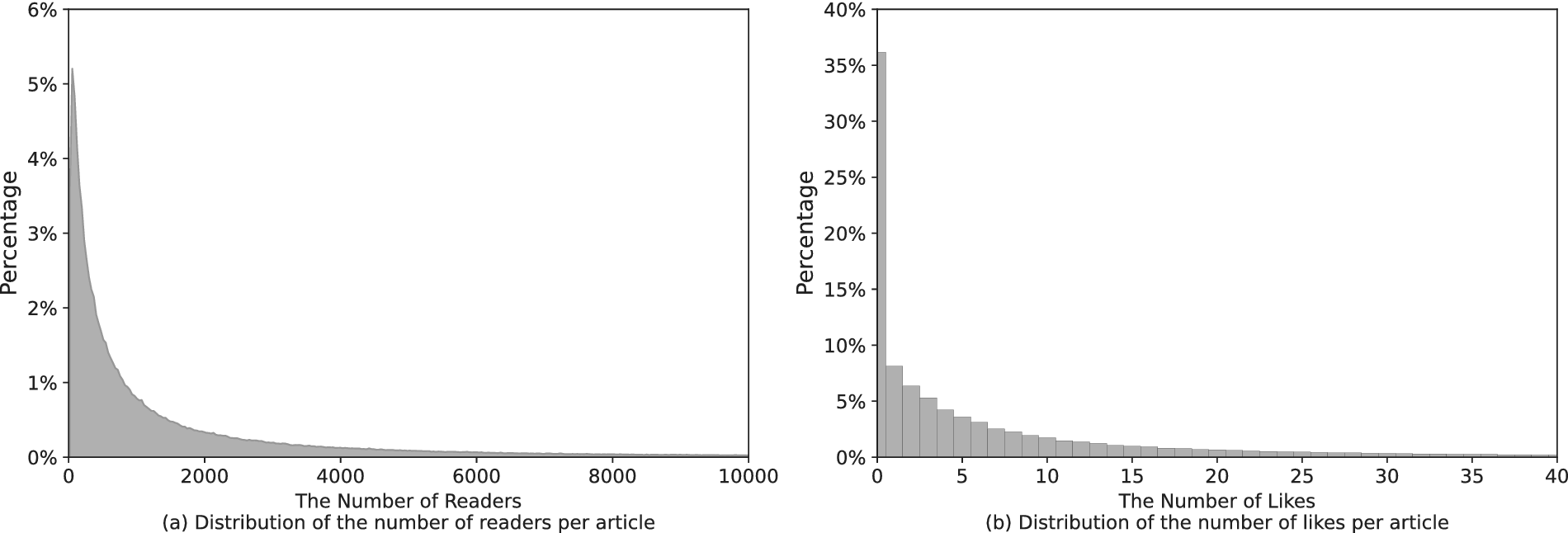
Yet, propaganda is not always effective in shaping beliefs. Research suggests that it can erode trust in government (Bush et al. Reference Bush, Erlich, Prather and Zeira2016; Chen and Shi Reference Chen and Shi2001; Huang Reference Huang2018; Mickiewicz Reference Mickiewicz2008; Tong Reference Tong2005) and is often ignored or dismissed (Havel Reference Havel2009). The rise of digital media has further exacerbated this trend, granting individuals greater autonomy in selecting their information sources (Chadwick Reference Chadwick2017; Dunaway and Graber Reference Dunaway and Graber2022; Fletcher and Nielsen Reference Fletcher and Nielsen2017; Webster and Ksiazek Reference Webster and Ksiazek2012). For instance, although the Chinese government requires local administrations to produce social media propaganda, these posts routinely fail to attract public attention. Figure 2 illustrates this pattern using data from more than three years of WeChat posts by city-level propaganda accounts. Despite the large populations of these cities, most posts receive only a few hundred views and minimal likes.
Lack of Engagement with Authoritarian Propaganda

Figure 2 Long description
Panel a, titled Distribution of the number of readers per article, is an area graph. The Y-axis is Percentage ranging from 0 percent to 6 percent. The X-axis is The Number of Readers ranging from 0 to 10,000. The data shows a steep asymptotic curve starting at over 5 percent for very low reader counts and dropping rapidly to near 0 percent as the number of readers exceeds 2,000.
Panel b, titled Distribution of the number of likes per article, is a bar histogram. The Y-axis is Percentage ranging from 0 percent to 40 percent. The X-axis is The Number of Likes ranging from 0 to 40. The first bar at 0 likes represents approximately 36 percent of articles. The subsequent bars show a sharp drop-off, with articles having 1 like at roughly 8 percent, and the frequency continuing to decrease in a long tail toward 40 likes.
Scholars have proposed various explanations for the functionality of low-engagement propaganda. Huang (Reference Huang2015) argues that its mere presence signals the strength of the authoritarian government and its perceived broad support, thereby increasing compliance and reducing protest activity, regardless of whether the public actively consumes or believes the content (Carter and Carter Reference Carter and Carter2021; Huang and Cruz Reference Huang and Cruz2021; Pearce and Kendzior Reference Pearce and Kendzior2012). Huang refers to this type of messaging as “hard propaganda.” From this perspective, the ability of hard propaganda to engage or persuade the public is secondary; what matters is that it visibly reinforces state authority and deters dissent.
Another perspective views low-engagement propaganda as a strategy of image building within authoritarian systems, in which lower-level officials use media not primarily to persuade citizens but to signal loyalty and competence to their superiors. Bureaucratic image building is common in authoritarian states where officials showcase their achievements and loyalty to their superiors (Cai Reference Cai2004; Yan and Yang Reference Yan and Yang2025). Propaganda can also be a tool for image building. Chung-Hon Shih (Reference Shih2008) argues that sycophantic officials who produce excessively flattering or “nauseating” propaganda incur social costs that credibly demonstrate loyalty to political patrons, and Zeng (Reference Yu2023) shows that local leaders who emphasize their administrative competence through mass media bear sunk and audience costs that enhance the credibility of their performance signals. Extending this logic, Pan (Reference Pan2019) finds that county executives strategically use government websites to embed self-promotional content that aligns with political promotion cycles. Such propaganda may appear monotonous or unappealing to ordinary citizens because it is not intended to engage the public but rather to impress supervisory audiences within the bureaucratic hierarchy.
Trace-management Propaganda
Although prior studies identify different target audiences and mechanisms of influence, they nevertheless regard low-engagement propaganda primarily as an expressive tool that still requires its intended viewers to notice and respond to it. In contrast, this research suggests that low-engagement propaganda can also be TM records of officials’ work that are used specifically as verification of that work. Whether propaganda attracts substantial attention at the time of publication is not necessary for its TM function; what matters is that it is transparent, public, resistant to manipulation, and easily retrievable when officials’ work needs further verification. Propaganda thus operates as a record or trace, in addition to shaping belief, signaling state authority, and serving image-building functions.
Importantly, TM propaganda is not designed to be continuously monitored, even during routine evaluations. Instead, it is retrieved selectively and contingently when verification is required. Such moments include promotion reviews, project audits, interdepartmental disputes, or challenges raised by rival officials. In these contexts, publicly available media reports function as external evidence that can be cross-checked against internal documentation and performance claims. Their value lies less in real-time consumption than in their durability, public accessibility, and resistance to ex post manipulation.
TM propaganda records the activities of various government branches and officials, including conferences, official visits, and routine bureaucratic work. Like other official media outputs, TM propaganda often exhibits an outdated and formulaic style, which can appear awkward or off-putting to the public. This style is commonly called “formulaic style” (Guanfang Baguwen), and it persists because propaganda departments have little incentive to adapt content for audience engagement. The value of these documents lies in their role as verifiable records for internal evaluations and interdepartmental comparisons. Officials prioritize ensuring that their contributions are accurately recorded over adapting them to evolving public tastes. Therefore, propaganda departments tend to follow the existing format and style and expend no extra effort to adapt to significant societal changes, evolving media landscapes, or shifting audience preferences.
TM propaganda is closely aligned with what Altheide and Johnson (Reference Altheide and Johnson1980) describe as bureaucratic propaganda. They argue that modern organizations, especially bureaucracies, often produce communication not primarily to inform or persuade the public but to legitimize their own operations, demonstrate activity, and sustain institutional authority. TM propaganda extends this logic by adding the function of regulation: instead of merely symbolizing that the bureaucracy is functioning, TM propaganda is also designed to regulate the functioning of the bureaucracy. It transforms symbolic communication into administrative evidence, allowing propaganda to function not only as an expressive act but also as a practical tool for evaluation, accountability, and supervision. In this way, TM propaganda shows that propaganda may not only reflect bureaucratic order but also actively constitute and sustain it through the continual production of verifiable records.
Trace-management Propaganda, Hard Propaganda, and Image Building
It is important to clarify how TM propaganda relates to the two main types of low-engagement propaganda discussed earlier: hard propaganda and image-building propaganda. These three functions are analytically distinct, but they are not mutually exclusive. A single piece of propaganda may simultaneously serve as a bureaucratic trace, a signal of state power, and a vehicle through which officials present loyalty or competence to their superiors.
TM propaganda first differs from hard propaganda in its primary audience and mechanism. Hard propaganda faces outward: it primarily targets citizens by signaling the regime’s strength, presence, and capacity. Its purpose is not necessarily to persuade citizens in a deep sense but to remind them of the visibility and authority of the state. TM propaganda, by contrast, derives its central bureaucratic value from creating a transparent, public, and durable record that can later be retrieved to verify officials’ work. Even when citizen attention is limited, such propaganda can still retain substantial value as an administrative trace. Importantly, however, this TM function does not preclude a hard propaganda effect. Although TM propaganda may not attract active public engagement, citizens may still encounter it repeatedly while consuming government-published information, such as public service announcements or other official notices. In such contexts, TM propaganda can also function as government signaling by reinforcing the visibility, activity, and authority of the state.
TM propaganda also differs from image-building propaganda, although the two are similar in that both treat low-engagement media as inward-facing bureaucratic tools. However, the two functions operate through different mechanisms. Image-building propaganda assumes a communicative process in which superiors must see, interpret, and reward media performances. Its effectiveness therefore depends on whether promotional content reaches and persuades upper-level evaluators. TM propaganda, by contrast, primarily functions as an archival system. Even when a report is not closely read at the time of publication, it can still be valuable later because it documents who participated in an activity, what was done, and how responsibilities were allocated.
This distinction helps resolve a long-standing puzzle in the literature on the effectiveness of image-building propaganda. Even when promotional reports reach higher-level officials, whether through routine monitoring, internal circulation, or deliberate forwarding, existing research finds little evidence that such media-based visibility materially influences promotion outcomes. Career trajectories in China depend far more on performance indicators, factional ties, and cadre evaluations than on media presence. If image-building propaganda rarely improves promotion prospects, its persistent production remains difficult to explain within a purely communicative framework. The TM perspective provides an additional explanation: even if self-promotional media content does not significantly affect promotion outcomes, it still fulfills a bureaucratic function as a verifiable record of activity. Publicity efforts are therefore not wasted even when their communicative effects are limited, because they also generate traces that can later be mobilized in evaluations, audits, and disputes.
At the same time, these distinctions should not be mistaken for categorical separations. A single propaganda item may simultaneously perform multiple functions. For instance, a city-level newspaper article highlighting a mayor’s diligence might function as hard propaganda by signaling the vitality and authority of local government, or as TM propaganda by documenting the official’s concrete activities; or, if reprinted or cited by higher-level outlets, as image-building propaganda by increasing that official’s visibility to superiors.
This multifunctionality explains why TM records take the form of traditional propaganda articles, rather than internal bureaucratic reports. The propaganda format enables a single document to retain bureaucratic utility while preserving its potential symbolic and persuasive functions. Publishing information as state media reports is therefore more versatile than relying solely on internal documentation.
Although individual pieces of low-engagement propaganda may simultaneously embody multiple functions, their dominant role often varies by media level and audience reach. In national or provincial outlets, low-engagement propaganda more commonly operates as signaling or image building, because these outlets are more visible to both higher officials and the public, making them effective platforms for projecting regime strength and individual competence. In addition, given the limited space in higher-level outlets and the large volume of submissions from lower-level officials, publication in national media is more difficult to secure. As a result, higher-level outlets are less suitable for routine trace management, especially when the primary goal is simply to create a verifiable record of official activity. In contrast, local-level propaganda, particularly that produced by city-, county-, or departmental-level media platforms, is more likely to perform a TM function. In the following sections, I further explain how and why state media reports are used for trace management and how the existence of TM propaganda can be empirically identified using local state media data.
How and Why Propaganda for Trace Management Works
Using State Media Reports for Trace Management
When state media reports are used to record or trace bureaucratic work, they function as propaganda for trace management. Bureaucrats are not expected to publicize every trivial or routine task, but any unclassified activity connected to a project, policy initiative, achievement, or other work relevant to performance evaluation must be reported publicly. Failing to document such work would make an official appear less productive or less diligent, because public reporting serves both as a transparency requirement emphasized by the central government and as a standard way of demonstrating workload. Field observations offer direct insight into the production process and the bureaucratic functions of such reports.
In late 2024, I participated in organizing a major political conference in City B that was co-hosted by multiple government departments and research institutions. This experience offered me firsthand exposure to how official news reports are generated for political events. Immediately following the conference, the primary organizer prepared a general media report, detailing key information such as the date, location, attendees, and activities. A central concern in drafting this template report was deciding which names and institutional affiliations to include and the order in which they should appear, as well as ensuring that no details breached political taboos.
After this master draft was prepared, each participating agency customized its own version of the report. These adaptations emphasized each department’s individual role while omitting references to others. Although factual accuracy was emphasized, nearly all reports conformed to the rigid and formulaic style. Editors frequently consulted their department leaders, tailoring content to reflect the leaders’ preferences: some preferred low-profile reporting, whereas others sought greater visibility. These customized reports were then published on departmental social media accounts and sometimes submitted to local or higher-level media platforms for broader dissemination. In many cases, the reports were also compiled into internal summaries for review by higher-level officials.
Interviews with government editors reinforce the bureaucratic function of these media reports. When asked whether they expected public interest or engagement, all interviewees responded negatively. They expressed no concern about readership metrics and emphasized that producing such reports was a mandatory administrative task. The goal was not primarily public persuasion but rather accurate documentation for internal accountability.
These observations highlight that while these media reports are disseminated through government social media and state-run news channels, their primary function is bureaucratic recordkeeping. Although they may incidentally contribute to the government’s image, their main purpose is to document events accurately and allocate credit or responsibility among different government entities. This aligns with previous interviews with Chinese official media editors, who prioritize factual accuracy and political correctness over audience engagement (Wang Reference Wang2024). As a result, much of what is labeled as propaganda does not primarily aim to shape public opinion but also functions as a bureaucratic trace of administrative activity. This explains why these reports often appear unengaging or even awkward: they are designed to document, not to persuade.
Where these reports are published depends largely on the importance of the activity. Routine events are typically recorded only on departmental websites; however, major projects must be documented in higher-level media, such as provincial and national state media, to reinforce the credibility of the activity and document the workload involved. Although Chinese authorities exercise strong control over state media and officials can readily secure publication in outlets under their direct authority, such as departmental social media accounts, publication in higher-level and more authoritative outlets is neither automatic nor guaranteed. Officials often need to negotiate with editors to obtain publication space; in many cases, they rely on personal connections or financial resources to ensure that their activities are recorded on these more authoritative platforms. These constraints make lower-level media outlets the primary sites of routine TM propaganda. Departmental, county-level, and city-level media are therefore more likely to carry TM propaganda, whereas publication in provincial or national outlets is generally reserved for more important activities and often serves additional signaling or image-building functions.
Appendix A provides three examples of news reports published by state media outlets regarding a major political conference held in Beijing. These examples further illustrate the function of these reports and how a general media report is modified to record the work of each department. It is important to note that even though these reports are crafted to highlight the contributions of the authoring department and are shaped by the preferences of department leaders, their content is not fabricated. Any fabrication in such media reports could lead to serious consequences, as I discuss in the following sections.
The Rationale for Using State Media in Trace Management
Using state media for trace management provides distinct advantages compared to the internal storage of bureaucratic records. The public nature of these TM records makes both the records themselves and related internal reports more credible, strengthening trace management’s role as a regulatory tool.
First, publication reduces the risk of TM fabrication by subjecting officials’ claims to external scrutiny. Once a report is published, it is visible not only to the leaders responsible for evaluating subordinates but also to rival officials, who often have a vested interest in exposing falsified achievements to damage their competitors’ reputations. This culture of scrutiny is further reinforced by the public notice period that accompanies most government promotions in China. During this period, the names of officials slated for promotion are publicly announced, and others are encouraged to report any misconduct or falsification linked to the promoted individual. In such cases, fabricated TM reports serve as prime evidence for accusations, potentially derailing an official’s career advancement. Even though TM propaganda is selective and self-promotional, its claims must remain accurate, because false or unverifiable statements increase the risk of external challenge and bureaucratic sanction. As a result, officials exercise extreme caution in ensuring the accuracy of the information they submit, which explains the strong emphasis on precision in publicly released records.
In addition, publishing records on state media platforms discourages officials from fabricating their work in later internal reports, such as annual project summaries or cadre evaluations. Like other news reports, TM propaganda will be stored across multiple platforms and accessed by various individuals; therefore, modifying it would require retrieving and altering every existing copy, a process that is both resource-intensive and virtually impossible to execute without detection. Because later internal reports must remain consistent with these public records, officials face constraints on fabricating their contributions ex post. Thus, even if higher-level leaders do not regularly monitor media reports, the existence of durable public traces enhances the credibility of internal evaluations.
Fieldwork illustrates how this process operates in practice. In a recent case at the research institution with which I was affiliated, our team published a media report for a collaborative project with a district government in City S. A leader from another district subsequently accused the report of “over-exaggeration,” prompting the city government to launch an internal investigation comparing the published claims with actual project activities and internal documentation. Such challenges are common in collaborative projects with Chinese governments, and they make both officials and partners extremely cautious about the accuracy of publicly released reports. This case demonstrates how TM propaganda functions as verifiable documentation: even if higher-level leaders never read the report, its public availability allows others to scrutinize it, and any inconsistency can trigger bureaucratic consequences.
Consequences of Using State Media for Trace Management
The use of state media for trace management results in the prevalence of TM propaganda. Many state media reports are produced primarily to document and verify the work of government officials, even though they may also serve persuasive, signaling, or image-building functions. This administrative focus shifts attention toward accuracy and accountability, resulting in content that often remains stylistically rigid and formulaic.
To empirically test whether state media is used for trace management, I examined patterns in local state media propaganda. I focused on local state media because the empirical implications of TM propaganda should be most pronounced at this level. As argued earlier, TM propaganda is more prevalent and more readily observable in lower-level outlets, where publication is easier to secure and routine bureaucratic activities are more regularly documented. Specifically, I propose two hypotheses.
First, if local state media reports are used for trace management, then we should expect a surge in TM propaganda in the months leading up to evaluations. Officials facing performance reviews have strong incentives to ensure their work is properly documented through visible, verifiable media reports. In China, these assessments typically take place at the end of the calendar year. Thus, if my argument holds, the volume of TM propaganda should increase during this period.
Annual Evaluation Hypothesis: There will be an observable increase in TM propaganda activities at the end of each year, coinciding with the period of annual evaluations.
Second, as previously noted, trace management offers an alternative means of regulating officials, and using media outlets for this purpose bolsters its credibility. Leaders who lack other methods of overseeing subordinates’ work are thus more likely to require that trace management be documented via local state media. In turn, local state media editors will devote more space to recording these traces of officials’ work. Likewise, subordinates who lack other ways of demonstrating loyalty and competence are more inclined to use media coverage to reinforce the credibility of their TM reports. They may invest additional resources into both posting their work records on departmental social media accounts and persuading local state media outlets to publish them. Consequently, TM propaganda should be more prevalent in settings where leaders do not have personal connections with local officials.
Personal Connection Hypothesis: TM propaganda should be more common in contexts where leaders do not have personal connections with local officials.
Research Design
Data
To test the argument that state media is used for trace management, I constructed a novel dataset comprising all posts published from January 2016 to December 2019 by the official WeChat accounts of Chinese prefecture-level city governments (Yu Reference Yu2026). By the end of 2019, 230 such governments, representing 78% of all prefecture-level cities, had launched WeChat propaganda accounts.Footnote 4 These accounts typically bear the name of the city followed by the word fabu, meaning “release.”
The dataset begins in January 2016, shortly after most accounts were created, and ends in December 2019 to avoid confounding effects from the COVID-19 outbreak. In total, it contains approximately 1.4 million posts, including metadata such as readership and “like” counts.Footnote 5 WeChat is China’s largest social media platform, combining features similar to those of Facebook with services like food ordering and utility bill payments. Its official accounts function much like Facebook pages, enabling certified users to publicly post text, videos, and images. Each post includes a cover image and a title that users must click to view the full content.
Chinese city-level governments started creating official government accounts in 2013 for various purposes, such as providing government services or broadcasting propaganda. In recent years, the Chinese central government has issued several documents emphasizing the importance of influencing public opinion through WeChat and requiring local governments to create their own WeChat accounts.Footnote 6 There are three ways for a post of an official account to reach WeChat users: automatic push to subscribers, sharing on private feeds, and sharing through chats or chat rooms (group chats).
These WeChat propaganda accounts are supervised by local official media outlets or the publicity departments of local governments. Their content largely mirrors material published in traditional state media, although titles are often modified to make them more appealing to social media users (Lu and Pan Reference Lu and Pan2021). The content primarily comes from three main channels: other state media (especially local official newspapers),Footnote 7 directives from local leaders, and submissions from local government officials.Footnote 8 Managers of these propaganda accounts may edit the collected content, but they seldom produce original reports themselves. Although content directives from local leaders always have high priority, material submitted by other officials might not.
Propaganda accounts on WeChat operate under a strict structural constraint: They can publish only a limited number of posts per day, typically around 10, and they are partially evaluated on audience engagement.Footnote 9 Editors therefore must balance two competing pressures (Lu and Pan Reference Lu and Pan2021). On one hand, because engagement metrics matter, they are incentivized to allocate this scarce posting space to high-engagement nonpolitical content such as local social news and public-service announcements. On the other hand, as official propaganda outlets, they are required to publish a baseline amount of political content, even though such posts draw minimal public interest. This structural tension implies that low-engagement political reports, including TM content, will be published only to satisfy mandatory requirements or when editors receive additional incentives to publish them.
This structural constraint makes WeChat official accounts a particularly suitable setting for testing the TM hypothesis. Critical evaluation periods often coincide with heightened administrative activity, raising the concern that increases in political reporting might simply reflect more events taking place. However, because official WeChat accounts cannot freely increase their daily output, and editors must protect engagement performance, they are unlikely to publish more political reports merely because there is increased administrative activity. Publishing additional political reports would reduce the space available for popular content and would harm account performance. Consequently, any increase in TM propaganda, particularly during evaluation periods, is more plausibly driven by bureaucratic incentives. Such incentives may include explicit instructions from leaders or heightened pressure from local officials who seek public documentation of their work.
Evidence from appendix A supports this interpretation. The third example in the appendix shows a TM article published nearly one month after the event occurred, which suggests that its timing was shaped by editorial negotiations and the availability of posting space, rather than by the timing or frequency of administrative activities.
This study focuses on social media rather than traditional media such as newspapers or television for two reasons. First, although traditional outlets may provide richer detail, many of their records are not digitized, making large-scale analysis difficult. Second, as traditional audiences decline, digital platforms, especially WeChat, have become central to propaganda dissemination. If trace management occurs on digital platforms with broader reach, it likely also exists in less-visible traditional outlets.
To understand the thematic content of these posts, I applied the BITERM topic model (BTM), a method optimized for short text (Yan et al. Reference Yan, Guo, Lan and Cheng2013). After evaluating models ranging from 5 to 200 topics, a 35-topic model was selected as optimal. I manually labeled each topic by reviewing the top 500 associated post titles and the most frequent keywords (figure 4). Appendix C outlines the topic modeling process, including model selection and keyword analysis.
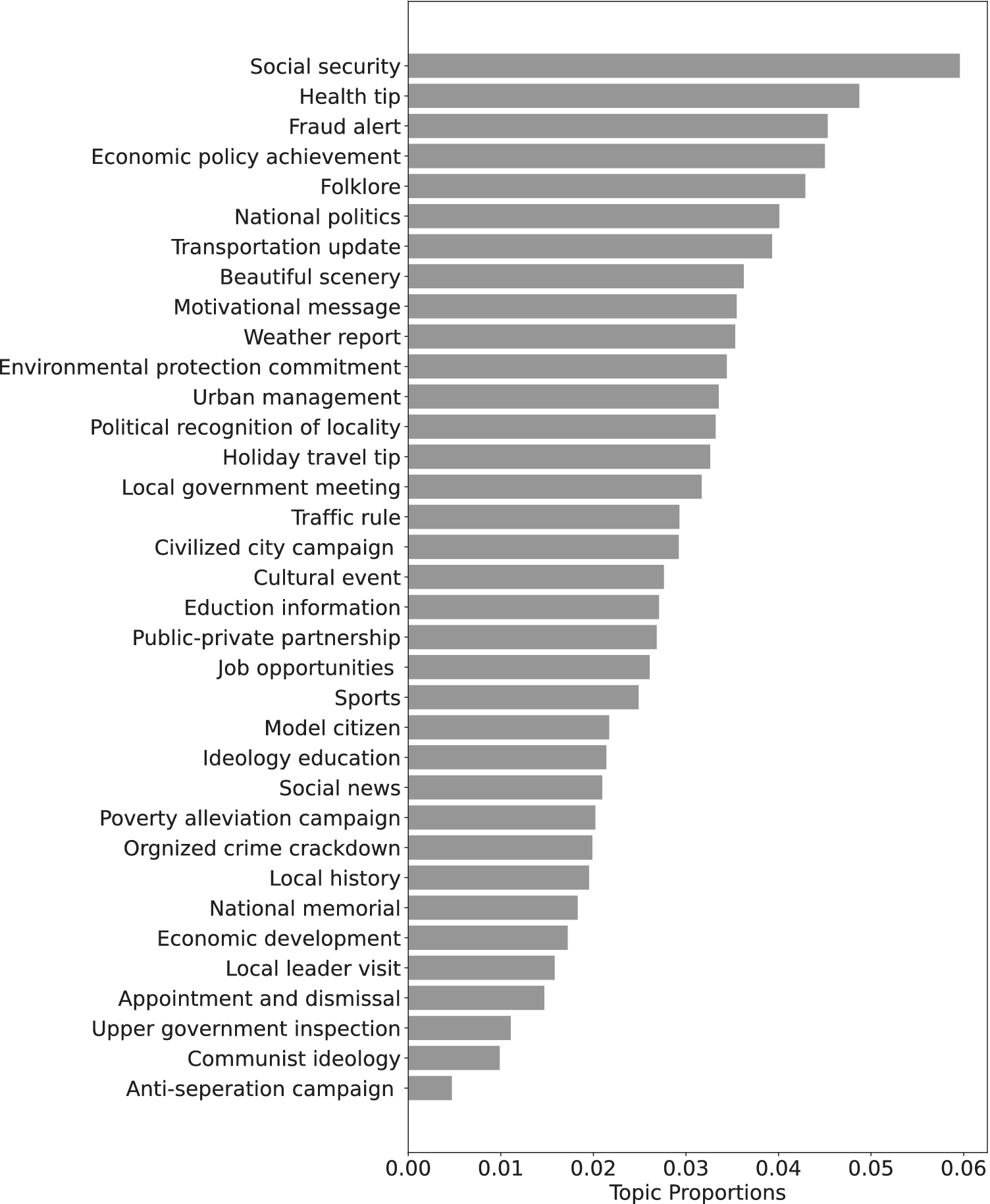
Figure 3 presents the distribution of the 35 topics, labeled by researchers using BTM-generated keywords, along with their corresponding proportions in the dataset. Several topics are clearly identifiable as TM propaganda, including those focused on the promotion of Communist Party ideology, local leader visiting, and local government meeting.
Topic Proportions of Local Governments’ WeChat Content

Figure 3 Long description
The X-axis is labeled Topic Proportions and ranges from 0.00 to 0.06 in increments of 0.01. The Y-axis lists 35 topics. The bars are arranged in descending order of proportion from top to bottom.
* Social security: approximately 0.059
* Health tip: 0.049
* Fraud alert: 0.045
* Economic policy achievement: 0.045
* Folklore: 0.043
* National politics: 0.040
* Transportation update: 0.039
* Beautiful scenery: 0.036
* Motivational message: 0.035
* Weather report: 0.035
* Environmental protection commitment: 0.034
* Urban management: 0.033
* Political recognition of locality: 0.033
* Holiday travel tip: 0.032
* Local government meeting: 0.031
* Traffic rule: 0.029
* Civilized city campaign: 0.029
* Cultural event: 0.027
* Eduction information: 0.027
* Public-private partnership: 0.027
* Job opportunities: 0.026
* Sports: 0.025
* Model citizen: 0.022
* Ideology education: 0.021
* Social news: 0.021
* Poverty alleviation campaign: 0.020
* Orgnized crime crackdown: 0.020
* Local history: 0.019
* National memorial: 0.018
* Economic development: 0.017
* Local leader visit: 0.016
* Appointment and dismissal: 0.015
* Upper government inspection: 0.011
* Communist ideology: 0.010
* Anti-seperation campaign: 0.005
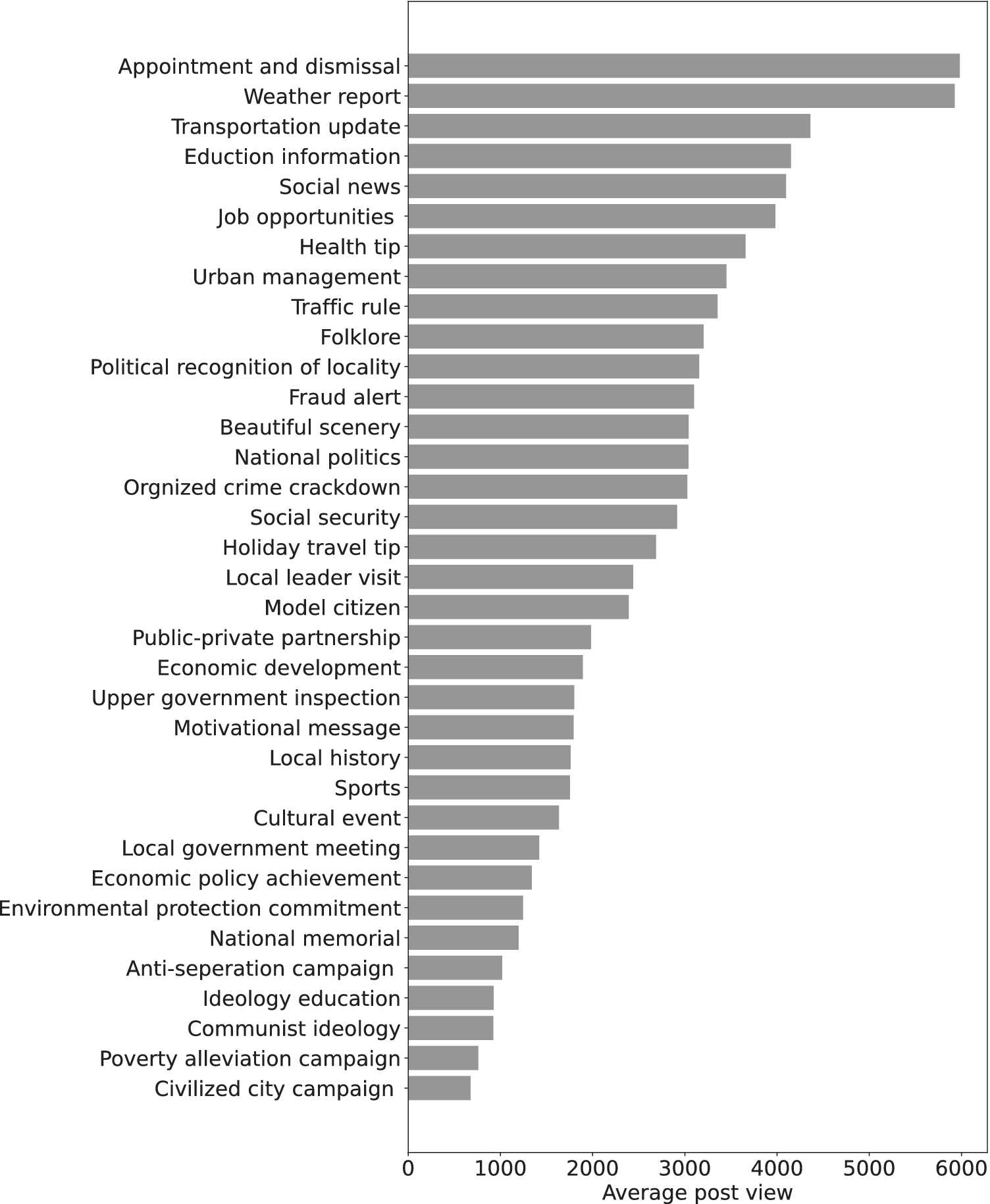
Figure 4 presents the average readership across different topic categories. The data show that topics related to TM propaganda consistently receive lower levels of public engagement than other types of posts. Notably, the 10 least-viewed topics are all related to TM propaganda. This pattern aligns with the definition of TM propaganda as having an outdated and exaggerated style, which often renders it unappealing or off-putting to the public.
Readership of Posts by Topic

Figure 4 Long description
The X-axis represents Average post view with numerical increments of 1000 from 0 to 6000. The Y-axis lists 36 topics. The data shows a clear downward trend from top to bottom.
* Appointment and dismissal: ~6000
* Weather report: ~5950
* Transportation update: ~4400
* Eduction information: ~4100
* Social news: ~4050
* Job opportunities: ~3950
* Health tip: ~3600
* Urban management: ~3400
* Traffic rule: ~3350
* Folklore: ~3150
* Political recognition of locality: ~3100
* Fraud alert: ~3050
* Beautiful scenery: ~3000
* National politics: ~3000
* Orgnized crime crackdown: ~3000
* Social security: ~2900
* Holiday travel tip: ~2650
* Local leader visit: ~2400
* Model citizen: ~2350
* Public-private partnership: ~1950
* Economic development: ~1900
* Upper government inspection: ~1800
* Motivational message: ~1750
* Local history: ~1750
* Sports: ~1750
* Cultural event: ~1600
* Local government meeting: ~1400
* Economic policy achievement: ~1350
* Environmental protection commitment: ~1250
* National memorial: ~1200
* Anti-seperation campaign: ~1050
* Ideology education: ~950
* Communist ideology: ~950
* Poverty alleviation campaign: ~800
* Civilized city campaign: ~700
Although the topics generated by the unsupervised topic model offer a useful way to broadly categorize government posts, the resulting classifications may not align precisely with this study’s definition of TM propaganda. To improve classification accuracy, I used a supervised approach in which two coders manually categorized 1,000 WeChat posts as either TM propaganda or other content. Coders were instructed to classify a post as TM propaganda if it emphasized government achievements, ideological education, or political activities, such as meetings, official visits, or routine bureaucratic work. Furthermore, government achievements were to be regarded as public-service information (useful information for the public), instead of TM propaganda, if they (1) referred to specific public goods, services, or administrative procedures and (2) provided concrete, actionable details, such as dates, locations, or contact channels. I then used this manually coded sample as a training set for fine-tuning a BERT (Bidirectional Encoder Representations from Transformers) model, which I applied to classify all propaganda posts based on their headlines and content. Appendix D provides further details on the manual coding procedure, the generation of the training set, and the fine-tuning process. The supervised classifier achieved an accuracy rate of 0.929.
In addition to media data, I compiled a dataset on the personal attributes of city-level party secretaries, the highest-ranking officials in each of the 230 prefecture-level cities included in this study. This dataset includes information on gender, age, education level, tenure duration, prior positions, and career trajectories. Additionally, I collected data on the start date of each party secretary’s term and the tenure of their superior, the provincial party secretary. These variables allow me to measure the strength of political connections between city-level leaders and their superiors.
Identification Strategies
To investigate whether local state media is used as a TM record, I proposed two key hypotheses. The following models are designed to empirically test these hypotheses.
Testing the Annual Evaluation Hypothesis
The first hypothesis proposes that the volume of TM propaganda increases at the end of each year, coinciding with annual performance evaluations. To test this, I specified the following model:
-
Model 1: $ T{M}_{ct}={\beta}_1 last{Q}_{ct}+{\beta}_2 Coun{t}_{ct}+{\mu}_c+{\nu}_t+{\epsilon}_{ct} $


Here,
$ {TM}_{ct} $
 is the number of TM propaganda posts published by city c in month t. The key explanatory variable,
$ last{Q}_{ct} $
 , is a binary indicator set to 1 for months within the final quarter of the year and 0 for all other months.
$ Coun{t}_{ct} $
 controls for the total number of WeChat posts in that month. City fixed effects (
$ {\mu}_c $
 ) and year fixed effects (
$ {\nu}_t $
 ) account for unobserved heterogeneity across time and locations. A significantly positive
$ {\beta}_1 $
 would support the annual evaluation hypothesis.
Testing the Personal Connection Hypothesis
The second hypothesis suggests that TM propaganda is more prevalent in cities where leaders lack personal ties with their subordinates. I tested it through two models.
Model 2: City–Province Connection. This model evaluates whether propaganda activity increases when a city party secretary is appointed by the current provincial party secretary—an indicator of closer political ties.
-
Model 2: $ \hskip-0.12em {\mathrm{SM}}_{pct}={\beta}_1 CityProvinc{e}_{pct}+{X}_{pct}\theta +{\rho}_p+{\nu}_t+{\epsilon}_{pct} $

The key explanatory variable,
$ CityProvinc{e}_{pct} $
 , is a binary indicator set to 1 if the city party secretary p in city c and month t was appointed during the term of the current provincial party secretary, and 0 otherwise. Provincial party secretaries have decisive authority over city-level leadership appointments; therefore, a city secretary selected under the incumbent provincial leader is generally understood to have a closer political connection to that provincial leader than a secretary whose appointment predates the incumbent’s term (Jiang Reference Jiang2018; Lei Reference Lei2023). Consequently, the connected city party secretary enjoys higher provincial trust and has less need to record competence.
The dependent variable,
$ {SM}_{pct} $
 , measures the number of propaganda posts mentioning the city party secretary p in city c and month t. A key control variable,
$ Ol{d}_{pct} $
 , is a binary indicator equal to 1 if the party secretary is 57 years or older, reflecting the typical retirement threshold beyond which further promotion is unlikely. I also control for the length of the party secretary’s tenure, because longer time in office may correspond to a greater number of activities worthy of publicity. Additional controls include the party secretary’s gender, age, and educational background, as well as the total number of WeChat posts published in each city-month. All control variables and their associated coefficients are denoted by
$ {X}_{pct}\theta $
 . To account for unobserved heterogeneity at the individual and temporal levels, I include city party secretary fixed effects (
$ {\rho}_p $
 ) and year-month fixed effects (
$ {\nu}_t $
 ).
Model 3: Local vs. External Appointed City Party Secretary. This model assesses whether externally appointed party secretaries—who lack local networks—rely more heavily on TM propaganda.
-
Model 3: $ {TM}_{ct}={\beta}_1 WithinCit{y}_{ct}+{X}_{ct}\theta +{\mu}_c+{\nu}_t+{\epsilon}_{ct} $

$ {TM}_{ct} $
 is the count of TM propaganda posts in city c and month t.
$ WithinCit{y}_{ct} $
 is a binary indicator equal to 1 if the current party secretary was promoted from within the same city (i.e., former mayor). It has a value of 0 if the secretary was appointed externally from another city or from a higher-level government post (EAS). An internally promoted secretary (IPS) typically possesses established personal networks and long-standing relationships with local officials, whereas EAS secretaries generally lack such local embeddedness.
This distinction reflects a long-standing institutional practice in China: External appointments are often used to disrupt entrenched local networks and to strengthen upper-level control, a pattern that extends back to imperial China (Watt Reference Watt1972) and continues in the contemporary era (Bulman and Jaros Reference Bulman and Jaros2021). As a result, EAS face greater information asymmetry and reduced informal oversight capacity when they first enter office. Consequently, they are expected to rely more heavily on formal, publicly verifiable TM materials to monitor subordinates, leading to a higher volume of TM propaganda.
In addition, both types of appointments go through the same provincial-level vetting and approval process and therefore require political connections and trust from provincial leaders. This prevents differences in superiors’ trust between EAS and IPS secretaries from influencing the propaganda behavior of city party secretaries and, in turn, the pattern of TM propaganda.
Controls (
$ {X}_{ct} $
 ) mirror those in model 2, and city fixed effects (
$ {\mu}_c $
 ) and year-month fixed effects (
$ {\nu}_t $
 ) are included to control for unobserved heterogeneity.
Difference-in-Differences (DID) Analysis
To establish causality, I exploited variation in city party secretary transitions and implemented a Difference-in-Differences (DID) framework.
I identified 206 party secretary transitions across 175 cities, of which 162 transitions had at least six months of pre- and post-transition data. I defined the treatment group as transitions where the incoming secretary was appointed externally and the control group as transitions where the incoming secretary was promoted internally. The DID model is specified as follows:
-
Model 4: $ T{M}_{\mathrm{zt}}=\delta Treatmen{t}_z+\gamma Pos{t}_t+\beta \left( Treatmen{t}_z\ast Pos{t}_t\right)+{X}_{zt}\theta +{\tau}_z+{\nu}_t+{\epsilon}_{zt} $

$ {TM}_{zt} $
 is the number of propaganda posts for transition z at time t. Post t equals 1 for post-transition months.
$ Treatmen{t}_z $
 equals 1 if the transition was external. The coefficient
$ \beta $
 estimates the causal effect of an external appointment on TM propaganda. Controls (
$ {X}_{zt} $
 , controlling the same group of variables as model 2 and model 3), transition fixed effects (
$ {\tau}_z $
 ), and year-month fixed effects (
$ {\nu}_t $
 ) are included.
Some scholars may worry that leadership transitions in one city could spill over to others, potentially violating the Stable Unit Treatment Value Assumption (SUTVA). However, such spillovers are highly unlikely in the Chinese context. City-level party secretary appointments are made by provincial authorities and are not intended to signal policy shifts to other jurisdictions. Moreover, local propaganda bureaus report exclusively to their own party secretary, not to peer cities. Consequently, a transition in one city has no plausible channel through which it would influence propaganda behavior elsewhere.
Robustness 1: Difference-in-Differences Event Study (DID-ES)
Although the initial DID analysis provides valuable insights, it deviates from a conventional DID setup because party secretary transitions occur at different time points, resulting in multiple pretreatment and posttreatment periods. To address this issue, I implement a Difference-in-Differences Event Study (DID-ES), also known as a two-way fixed-effects model, to further validate the finding from model 4.
This approach offers several advantages. First, it allows for a test of the parallel trends assumption, ensuring that treatment and control groups exhibit similar trends before the transition. Second, it enables an examination of treatment effects over time, rather than estimating a single posttreatment effect. Third, it uses the full dataset, incorporating cities that did not experience a leadership transition as additional control units.
The DID-ES model is specified as follows:
-
Model 5: $ T{M}_{ct}={\sum \limits}_{i=-24}^{-2}{\beta}_i{D}_i+{\sum \limits}_{i=0}^{24}{\beta}_i{D}_i+{X}_{ct}\theta +{\mu}_c+{\nu}_t+{\epsilon}_{ct} $

Di is a dummy equal to 1 if city c is i months from a secretary transition (or i months before if i is negative). The omitted category is
$ {D}_{-1} $
 , the month before the transition. The coefficients
$ {\beta}_i $
 trace the dynamic effect of the treatment over time. If the coefficient is significant before the treatment, it suggests a violation of the parallel trends assumption, and significant coefficients after the treatment reflect the dynamic effects of the treatment over time. Controls and fixed effects follow those in earlier models.
Robustness 2: Heterogeneous Treatment Effects (HTE)
Recent scholarship cautions that conventional DID-ES models may yield biased estimates when treatment effects vary across units (Chiu et al. Reference Chiu, Lan, Liu and Xu2023; De Chaisemartin and d’Haultfoeuille Reference De Chaisemartin and d’Haultfoeuille2023; Sun and Abraham Reference Sun and Abraham2021). To account for this, I adopt the HTE-robust method developed by Liu, Wang, and Xu (Reference Liu, Wang and Xu2024), also known as the Fect estimator, as an additional robustness check. This model accommodates treatment effect heterogeneity and confirms the reliability of the findings.
Robustness 3: Generalized Synthetic Control (GSC)
Although the DID and DID-ES analyses provide informative baseline estimates, both approaches hinge on the assumption that treated and control transitions would have followed parallel outcome trajectories in the absence of treatment. Given the heterogeneous political, economic, and institutional environments across Chinese cities and the possibility that these differences evolve over time, the parallel trends assumption may be imperfectly satisfied. Moreover, the staggered timing of party secretary transitions means that units enter treatment under varying conditions, raising additional concerns about conventional DID estimators. To address these issues and further strengthen causal identification, I employ the generalized synthetic control (GSC) method (Xu Reference Xu2017). GSC relaxes the conventional parallel trends requirement by modeling unobserved confounders as time-varying latent factors and by constructing unit-specific counterfactual paths based solely on pretreatment information. This interactive fixed-effects framework yields a more flexible and data-driven counterfactual, which is particularly well suited to settings with staggered adoption and evolving unobservables. Incorporating GSC as a complementary robustness check ensures that the estimated effects of EAS appointments are not artifacts of differential pretreatment trends or latent city-level heterogeneity, thereby enhancing the credibility of the causal findings.
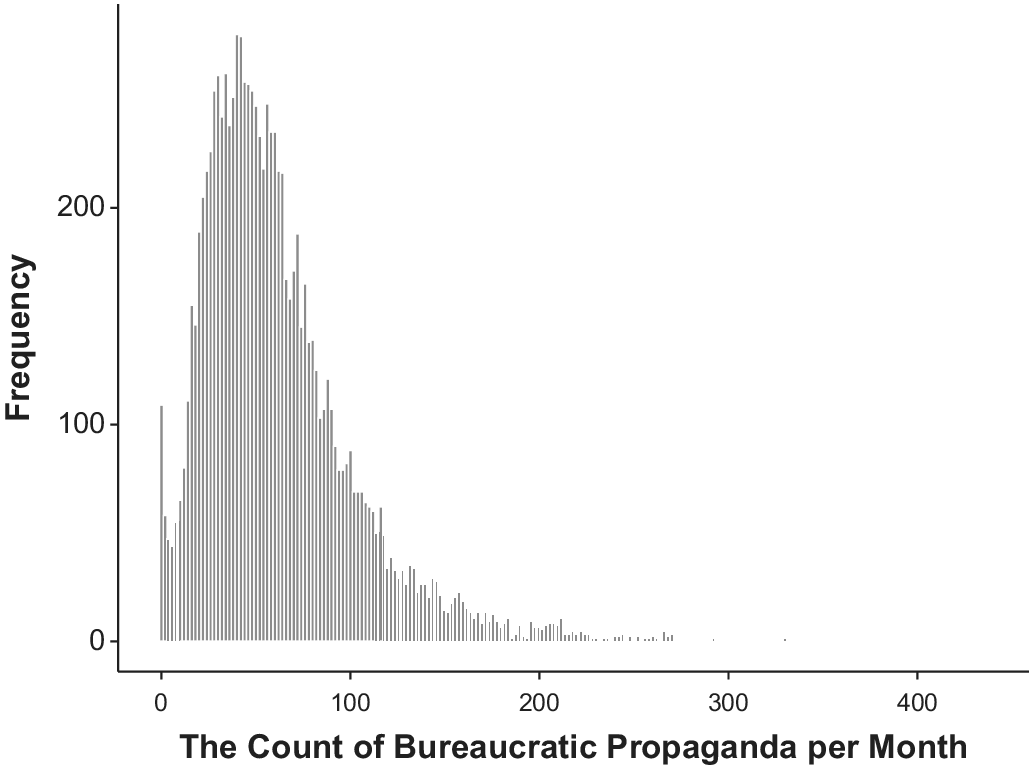
Finally, as shown in figure 5, the dependent variable—the number of TM propaganda posts—is approximately normally distributed and does not exhibit overdispersion. As such, Poisson regression is used across all models for consistency and robustness.
The Distribution of TM Propaganda

Figure 5 Long description
The vertical Y-axis is labeled Frequency with major tick marks at 0, 100, and 200. The horizontal X-axis is labeled The Count of Bureaucratic Propaganda per Month with tick marks every 100 units from 0 to 400.
* The data begins with a small spike at zero followed by a rapid increase.
* The distribution reaches its highest peak at a count of approximately 50, where the frequency exceeds 250.
* After the peak, there is a steady decline in frequency as the count increases.
* The distribution exhibits a long right tail, with very low frequencies extending toward a count of 300 and a few isolated data points near 400.
* The majority of the data is concentrated between the counts of 25 and 100.
Results
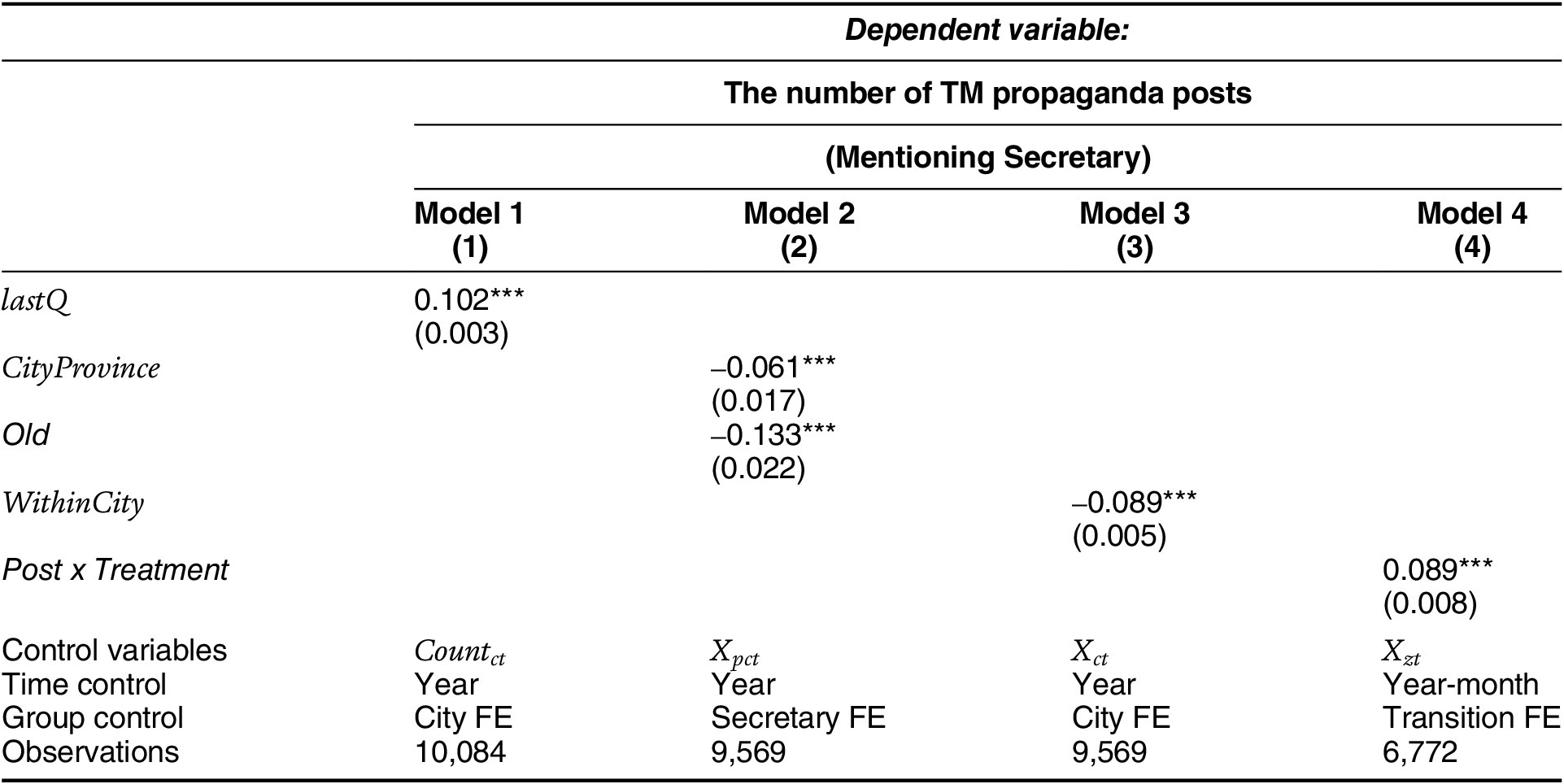
Table 1 presents the empirical findings of the study. Column 1 reports the effect of the end of the year on the volume of TM propaganda. The results indicate that, during the final quarter of the year, each city’s official WeChat propaganda account publishes an average of approximately six additional TM propaganda posts each month. This finding supports the annual evaluation hypothesis, suggesting that these extra reports are indeed produced to support officials’ annual evaluations.
Main Regression Result

Table 1 Long description
The table presents regression results for the dependent variable: The number of T M propaganda posts mentioning Secretary. It is divided into four columns representing Model 1, Model 2, Model 3, and Model 4.
* Row 1: last Q. Model 1 shows 0.102 with three asterisks. Standard error is 0.003.
* Row 2: City Province. Model 2 shows minus 0.061 with three asterisks. Standard error is 0.017.
* Row 3: Old. Model 2 shows minus 0.133 with three asterisks. Standard error is 0.022.
* Row 4: Within City. Model 3 shows minus 0.089 with three asterisks. Standard error is 0.005.
* Row 5: Post times Treatment. Model 4 shows 0.089 with three asterisks. Standard error is 0.008.
* Row 6: Control variables. Model 1 uses Count sub c t. Model 2 uses X sub p c t. Model 3 uses X sub c t. Model 4 uses X sub z t.
* Row 7: Time control. Models 1, 2, and 3 use Year. Model 4 uses Year-month.
* Row 8: Group control. Model 1 uses City F E. Model 2 uses Secretary F E. Model 3 uses City F E. Model 4 uses Transition F E.
* Row 9: Observations. Model 1 has 10,084. Model 2 has 9,569. Model 3 has 9,569. Model 4 has 6,772.
A note at the bottom indicates that three asterisks denote p less than 0.01.
Note.*p < 0.1; **p < 0.05; ***p < 0.01.
Columns 2 and 3 test the personal connection hypothesis, examining whether weaker political ties between leaders and subordinates correspond to greater volumes of TM propaganda. Model 2 focuses on the relationship between city and provincial party secretaries, assessing how shared tenure affects the frequency of posts featuring city secretaries. Model 3 evaluates whether city party secretaries appointed from outside the jurisdiction, who presumably lack local networks, are associated with higher overall levels of TM propaganda. In both cases, the coefficients on the key independent variables are negative and statistically significant, confirming that TM propaganda is more prevalent in contexts where leaders lack strong personal ties with subordinates.
Specifically, model 2 finds that when a city party secretary is not appointed by the current provincial party secretary, the number of propaganda posts highlighting that official’s activities increase by approximately 6% per month. This pattern supports the view that such posts serve a bureaucratic function, documenting achievements for internal evaluation purposes. Additionally, the coefficient for the Old variable is negative and significant, indicating that party secretaries nearing retirement, who are no longer eligible for promotion, are less likely to be featured in TM propaganda.
Crucially, this pattern is more consistent with trace documentation than with a purely elite-signaling interpretation. Because higher-level officials are unlikely to consume city-level social media content regularly, the increase in propaganda activity is better explained by the need for formal trace documentation, rather than elite audience targeting.
Model 3 provides further support for this interpretation. Cities with externally appointed party secretaries publish approximately 8% more TM propaganda posts per month than those where the party secretary was promoted internally. This suggests that TM propaganda functions as a tool for both hierarchical oversight and bureaucratic self-presentation. For top officials, these reports help monitor subordinates; for lower-level cadres, they bolster their credibility within the administrative system.
I used a DID approach to investigate whether the previous position of a new local leader causally affects posting patterns of TM propaganda. The last columns of table 1 summarize the results for model 4: Replacing a local secretary with one from outside the jurisdiction increases the number of TM propaganda posts by about 9%, compared to promoting a mayor to the secretary position within the same city. The DID analysis illustrates that the loss of personal connections between the secretary and local officials results in an increase in trace management through state media.
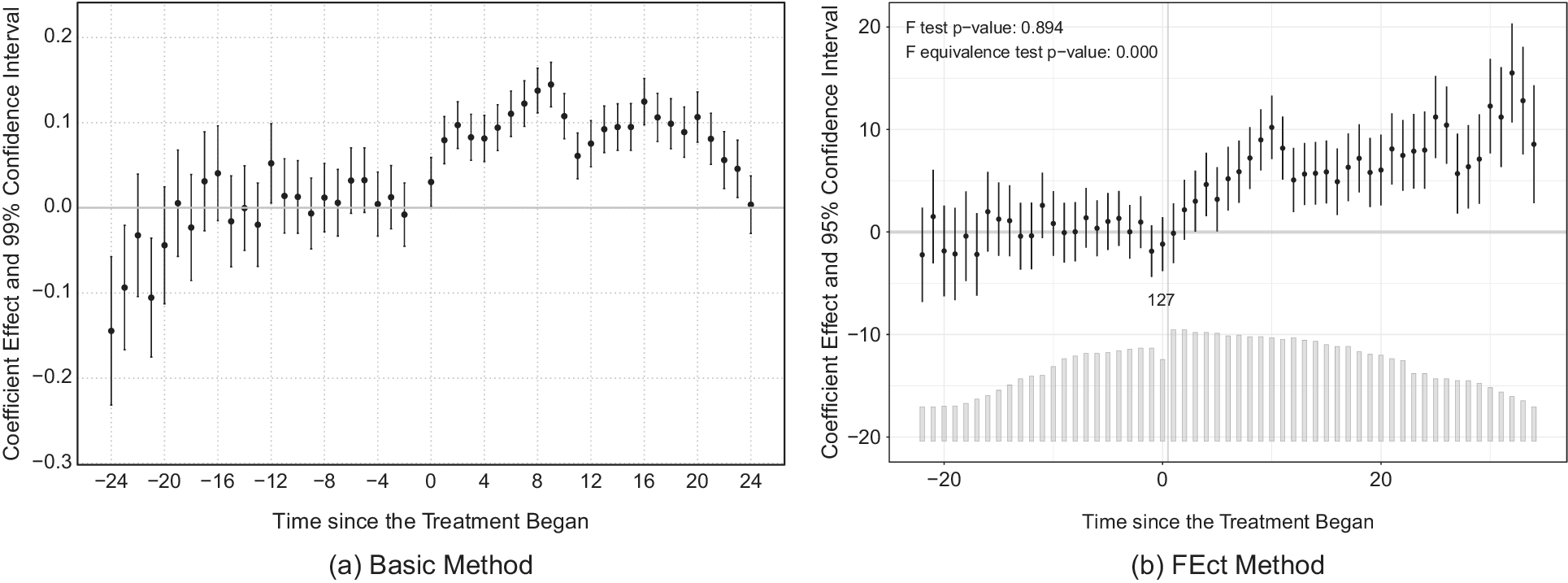
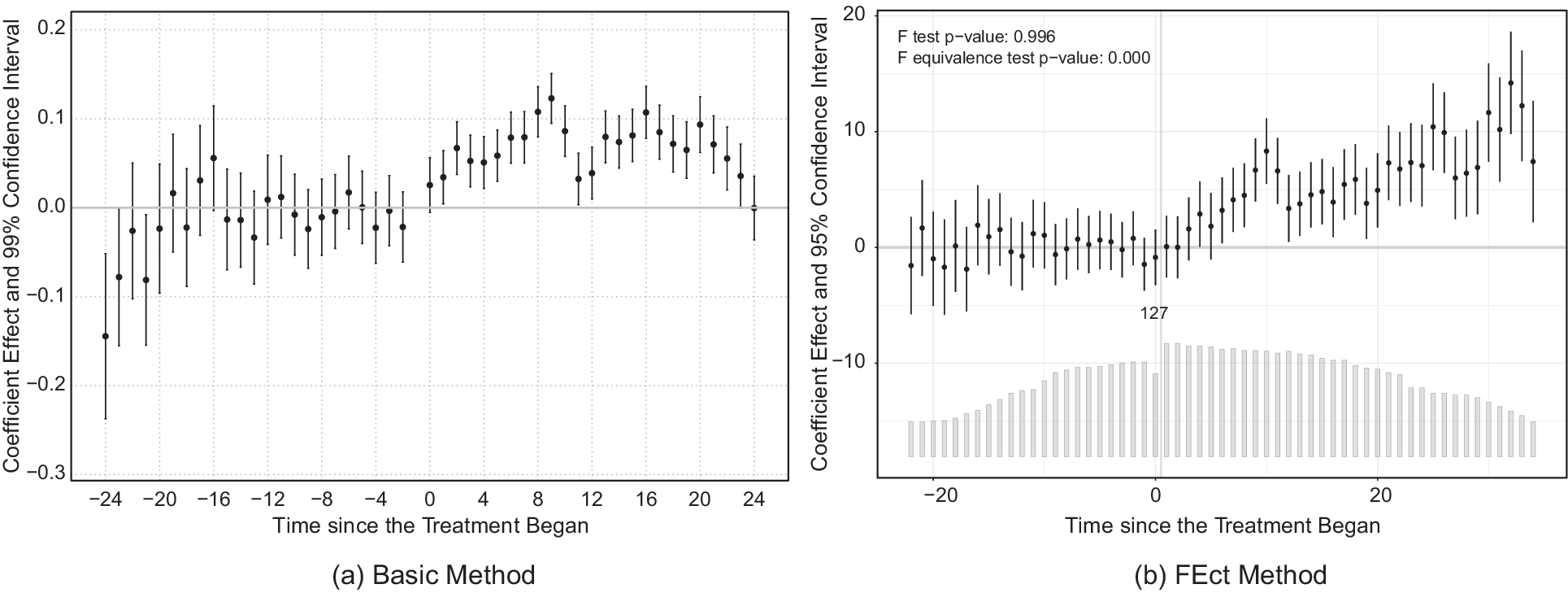
To validate these results and examine treatment dynamics over time, I implemented a Difference-in-Differences Event Study (DID-ES). Figure 6(a) plots the estimated monthly effects from model 5. The pretreatment period displays no systematic differences between treatment and control groups, with only 4 of the 24 pre-transition coefficients reaching significance; this indicates the parallel trends assumption is satisfied. In contrast, immediately after the external appointment, the treatment effect becomes positive and statistically significant in nearly every month, peaking within the first year and gradually declining thereafter. This suggests that as newly appointed secretaries build relationships with subordinates over time, their reliance on TM propaganda diminishes.
DID Event-study Analysis

Figure 6 Long description
A multi-panel figure with two side-by-side graphs labeled a and b. Both graphs share an X-axis titled Time since the Treatment Began.
Panel a, titled Basic Method, has a Y-axis titled Coefficient Effect and 99% Confidence Interval ranging from -0.3 to 0.2. The data points show a gradual upward trend starting from -0.15 at time -24, crossing the zero line around time -4, and peaking at approximately 0.15 at time 8 before declining back toward zero at time 24. Each point includes vertical error bars representing the confidence interval.
Panel b, titled F E ct Method, has a Y-axis titled Coefficient Effect and 95% Confidence Interval ranging from -20 to 20. In the top left corner, text indicates F test p-value 0.894 and F equivalence test p-value 0.000. The data points remain near zero until time 0, after which they show a steady linear increase reaching approximately 15 by time 30. Below the main data, a bar chart shows sample distribution, with a peak count of 127 centered at time 0.
Figure 6(b) plots the results of the HTE-robust DID event-history analysis. To further increase the confidence in this effect, I do not limit the Di to 24 months before and after the transition. The results remain consistent with the basic DID-ES findings, with an even clearer pattern: before treatment, the effect fluctuates around zero, whereas after treatment, a significant increase is observed and persists. The effect gradually diminishes after one year of the transition but remains significant. Notably, figure 6(b) reveals a dramatic increase in the effect of appointing a new secretary three years post-transition. This abnormal increase is likely due to the small number of cases, because the simulation may not have enough data to generate stable results. It is also evident that the confidence intervals widen significantly from 20 months after the transition.
In addition, I apply all four diagnostic tests for the DID assumptions as introduced by the FEct method. The results of the placebo test are presented in appendix e, figure E1(a), and the outcomes of the “no-pretrend” test are shown in figure 6(b). The findings indicate that the model satisfies all four diagnostic checks, providing strong evidence that the key assumptions underlying the DID analysis hold.
Moreover, the FEct method does not support the use of Poisson regression, and I acknowledge that results might differ depending on the simulation method used. To further validate my results, I apply the FEct method with different simulation approaches and with the log-transformed version of the dependent variable. As shown in appendix E, figures E1(b) and E2, the results remain substantively unchanged, although confidence intervals widen slightly.
Finally, figures E3(a) and E3(b) in appendix e present the results from the GSC method. Figure E3(a) shows the estimates using the full sample from model 4, whereas figure E3(b) restricts the analysis to treated units with at least 12 months of pretreatment observations. Both figures display a pattern consistent with the previous DID-based analyses: The estimated effects fluctuate around zero prior to treatment, indicating good pretreatment fit, and rise substantially after treatment. Although the post-treatment confidence intervals are wider than those obtained from the FEct and HTE methods, reflecting the greater uncertainty inherent in counterfactual prediction under GSC, the overall trajectory of the estimated effects is similar. These additional analyses reinforce the robustness of the main findings across alternative estimation strategies.
Robustness Tests
This section presents a series of robustness checks to validate the results obtained from the initial models. These additional analyses are crucial for confirming the reliability of the findings and addressing potential concerns related to external factors and alternative explanations.
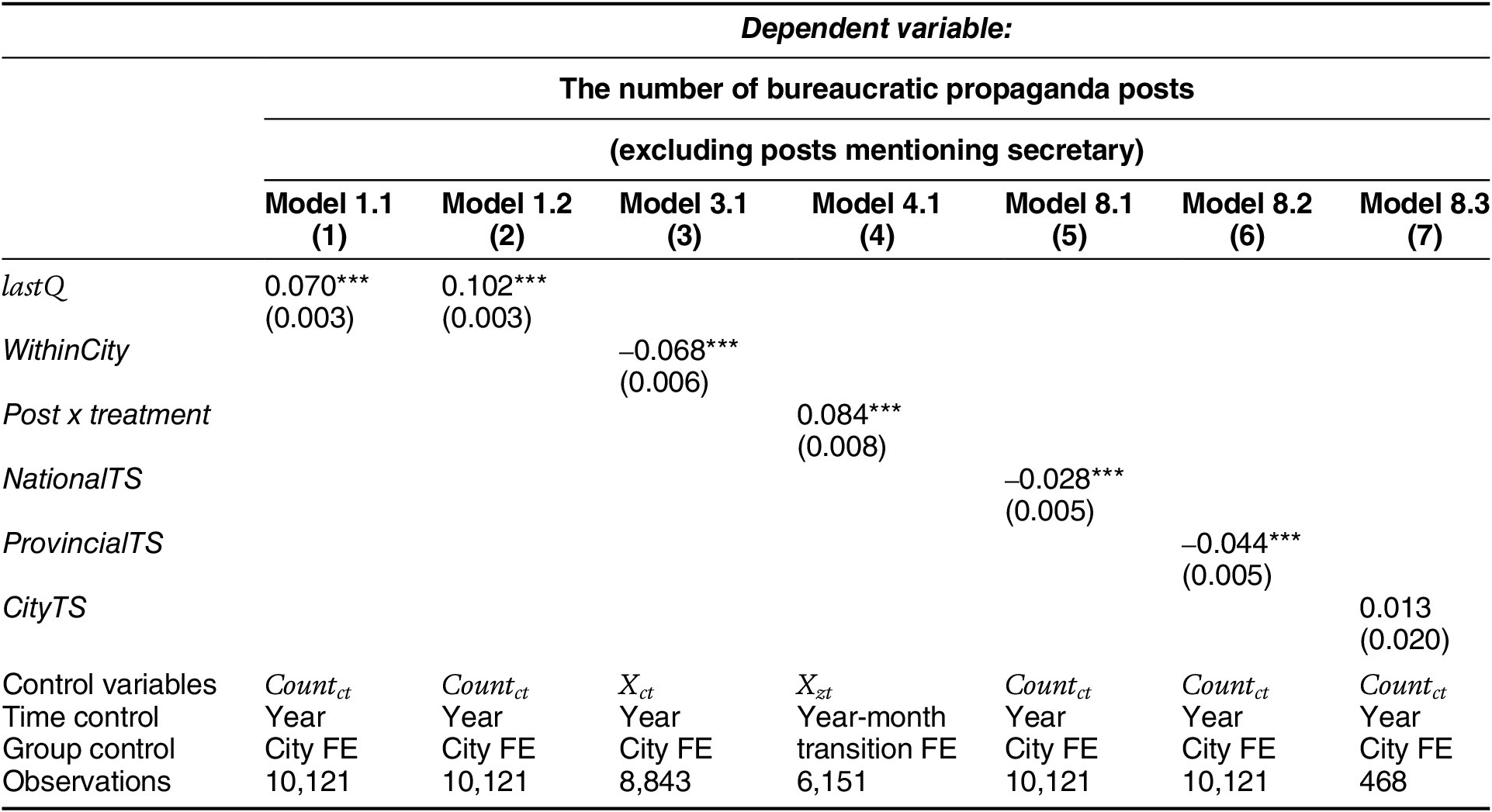
One key concern is the potential influence of China’s National Day in October, which could naturally lead to an increase in TM propaganda because of the national celebrations. If this were the case, the observed rise in TM propaganda posts during the last quarter of the year might not be driven by annual evaluations but rather by state-mandated propaganda surrounding National Day. To account for this, I reestimate model 1, modifying the explanatory variable lastQ so that it only marks the final two months of the year as 1, rather than the entire last quarter (model 1.1). The result, reported in column 1 of table 2, shows that the increase in TM propaganda posts remains statistically significant even when excluding October. This suggests that the observed effect is not solely driven by National Day celebrations but persists throughout the final months of the year, supporting my argument that these reports are linked to annual evaluations.
Robustness Check Regression Result

Table 2 Long description
The table presents regression results for the dependent variable: The number of bureaucratic propaganda posts (excluding posts mentioning secretary). It includes seven models labeled 1.1, 1.2, 3.1, 4.1, 8.1, 8.2, and 8.3.
* Model 1.1 and 1.2: last Q coefficients are 0.070 and 0.102 respectively, both significant at p < 0.01.
* Model 3.1: Within City coefficient is -0.068, significant at p < 0.01.
* Model 4.1: Post x treatment coefficient is 0.084, significant at p < 0.01.
* Model 8.1: National T S coefficient is -0.028, significant at p < 0.01.
* Model 8.2: Provincial T S coefficient is -0.044, significant at p < 0.01.
* Model 8.3: City T S coefficient is 0.013, which is not statistically significant.
Control variables for all models include Count sub t sub c t or X sub c t. Time controls are mostly Year, except for Model 4.1 which uses Year-month. Group controls are City F E, except for Model 4.1 which uses transition F E. Observation counts range from 468 in Model 8.3 to 10,121 in Models 1.1, 1.2, 8.1, and 8.2.
Note.*p < 0.1; **p < 0.05; ***p < 0.01.
Another possible explanation for the increase in TM propaganda following the appointment of a new secretary from another city or a higher-level government is that these newly appointed leaders may seek greater media coverage of themselves. This could serve two purposes: first, as a way to introduce themselves to local officials, and second, to highlight their activities to upper-level governments. If this were the case, the observed increase in TM propaganda might be driven more by the secretary’s self-promotion, rather than by local officials’ efforts to document their work for evaluation.
To address this concern, I remove all posts that mention the local party secretary and reestimate Models 1, 3, 4, and 5. The results are reported as model 1.2, model 3.1, and model 4.1 on table 2, and figure 7 presents the results for the reestimated model 5. Although the coefficients for the primary explanatory variables change in magnitude across all models, their direction remains the same, and they remain statistically significant. This suggests that although externally appointed secretaries may indeed demand more media coverage of themselves, this factor does not fully explain the increase in the volume of TM propaganda.
Robustness Check of DID Event-Study Analysis

Figure 7 Long description
A multi-panel figure with two side-by-side line graphs.
Panel a, titled Basic Method, has a y-axis labeled Coefficient Effect and 99% Confidence Interval ranging from -0.3 to 0.2. The x-axis is labeled Time since the Treatment Began ranging from -24 to 24. Data points with vertical error bars show a fluctuating trend around zero before time 0, followed by a sustained increase and stabilization above zero after time 0. A horizontal reference line is at y equals 0.
Panel b, titled F E ct Method, has a y-axis labeled Coefficient Effect and 95% Confidence Interval ranging from -10 to 20. The x-axis is labeled Time since the Treatment Began ranging from -20 to 30. Text in the top-left corner states F test p-value 0.996 and F equivalence test p-value 0.000. The data points show a flat trend near zero before time 0, followed by a gradual linear increase after time 0. Below the main data, a bar chart shows the distribution of observations, with a peak of 127 at time 0.
Although I argue that activity reports are unlikely to increase simply because officials conduct more activities, some may still worry that higher workloads mechanically generate more TM propaganda. To address this concern, I use the Two Sessions (TS) as a proxy for fluctuations in bureaucratic activity. The Two Sessions, the annual plenary sessions of the People’s Congress and the Committee of the Chinese People’s Political Consultative Conference, are among the most politically salient events in China’s administrative calendar. They require extensive preparation, including briefings, departmental consultations, warm-up meetings, and post-session summaries. Unlike party congresses or plenary sessions of party committees, the Two Sessions take place every year at predictable times, making them a reliable indicator of periods with unusually high administrative activity. I therefore examine whether TM propaganda increases around the national-, provincial-, and city-level Two Sessions. If TM reporting were driven by genuine rises in offline activity, we should observe clear spikes during these periods. However, as shown in the last three columns of table 2, no such increases appear at any level.Footnote 10
This finding also helps rule out two additional alternative explanations. First, one might argue that governments intensify propaganda during politically sensitive moments, such as year-end or leadership transitions, to reinforce social control. Yet the Two Sessions represent one of the most politically charged periods of the year, during which officials have strong incentives to ensure social stability. However, TM propaganda does not increase even then. This suggests that changes in TM propaganda are not driven by general efforts to discipline the public.
Second, increases in TM propaganda might reflect bureaucratic compliance with shifting propaganda quotas. If quotas were systematically adjusted, they would plausibly rise during major political meetings like the Two Sessions. But again, I do not observe any increase in TM posts during this period. In addition, if the TM propaganda quotas increase during evaluation periods, this would suggest that the propaganda is useful for evaluation as evidence of compliance and workload. In this sense, publication quotas are not an alternative to the TM logic but rather a formalized institutional mechanism through which trace management is implemented. The existence of reporting requirements therefore reinforces, rather than contradicts, the argument that media outputs are used to generate verifiable administrative records.
Together, these robustness checks examining the Two Session period reinforce that increases in TM propaganda are unlikely to be caused by activity inflation, social-control demands, or quota adjustments. Instead, they are best explained by heightened incentives to document officials’ work for evaluation.
In addition, some may be concerned that the coding scheme classifies posts about Communist Party ideology as TM propaganda, even though such content resembles standard hard propaganda. I include these posts because most of them document how local governments implement ideological work, for example, organizing meetings to study Xi Jinping Thought, thereby functioning not only as ideological dissemination but also as records of bureaucratic activity. I also conducted an additional robustness check to assess the influence of ideological content on the results. Specifically, I expanded the codebook to include a third rule that excludes all ideology-related posts from the TM category. I then modified the training dataset accordingly, retrained the BERT classifier, and reestimated all four main models using this revised measure. As shown in appendix G, the substantive results remain consistent in direction and statistical significance, indicating that the findings are not driven by the inclusion of ideological posts.
Finally, the last potential concern is that systematic differences may exist between cities with externally appointed secretaries and those with secretaries promoted from local mayoral positions. If such differences drive higher volumes of TM propaganda in cities with externally appointed secretaries, this would undermine my findings by introducing selection bias. Moreover, systematic differences between cities could also violate the parallel trends assumption in the DID framework, further challenging the causal interpretation of my results. To mitigate this concern, all models include city-level fixed effects, which control for city characteristics that might influence the volume of TM propaganda.
Discussion and Conclusion
This study investigates how local government propaganda in China can function as a tool for bureaucratic management. I argue that a substantial portion of what is traditionally considered propaganda serves an additional purpose: it acts as a formal record of officials’ work, facilitating oversight and evaluation. Drawing on fieldwork insights and an original dataset of more than 1.4 million WeChat posts from 230 cities, I show that the volume of TM propaganda increases significantly during the final quarter of the year—consistent with the annual evaluation cycle. Moreover, in contexts where political connections between leaders and subordinates are weak, reliance on local state media for trace management intensifies.
These findings contribute to the literature on authoritarian governance by highlighting an underexplored function of local propaganda: internal bureaucratic regulation. In environments where institutionalized mechanisms for oversight are limited or compromised, trace management via state media offers an alternative way to verify and monitor official behavior. Importantly, the analysis likely underestimates the full extent of this phenomenon, because the dataset primarily captures content from high-profile propaganda accounts. Many TM reports circulate through lower-level or internal media platforms that are more difficult to access systematically. As the AGSDM case in appendix A illustrates, even prominent departments face substantial barriers to publishing on major platforms such as Beijing Fabu. This suggests that bureaucratic documentation through local state media is even more widespread than the current analysis captures.
The findings also broaden our understanding of the role of official news within authoritarian systems. Specifically, I show that official news is not merely part of the state’s information dissemination strategy but also serves as a mechanism for bureaucratic control and the monitoring of local officials. With the dramatic increase in the volume of government news reports in the age of social media, it is important for researchers to recognize that not all this information primarily aims to influence public opinion.
Although TM propaganda enhances traceability and accountability, its broader implications for governance quality are more complex. On the one hand, publicly verifiable traces can reduce information manipulation and strengthen oversight. On the other hand, an excessive emphasis on procedural documentation may exacerbate China’s long-standing problem of “formalities for formalities’ sake” (formalism; xingshi zhuyi). Officials frequently devote substantial time to producing traces, rather than addressing substantive policy challenges. Because evaluations often prioritize whether procedures were followed rather than whether outcomes improved, bureaucratic effort may shift away from genuine problem solving. The net governance effect of trace management is therefore far from clear. Although it can enhance accountability in environments with weak monitoring capacity, it may also distort administrative behavior by rewarding visible compliance over substantive performance.
In recent years, the Chinese central government and Xi Jinping himself have repeatedly criticized formalism and issued directives aimed at reducing the burden of excessive documentation.Footnote 11 Yet despite these efforts, trace management remains deeply entrenched in everyday bureaucratic practice. This persistence may reflect a structural tension within authoritarian governance. Although leaders may rhetorically oppose formalism, they also rely heavily on procedural records to supervise a vast bureaucracy characterized by information asymmetries and limited independent auditing capacity. In policy domains where outcomes are hard to measure, slow to materialize, or prone to manipulation, publicly accessible traces provide one of the few verifiable sources of evidence about officials’ effort and compliance. Thus, rhetorical opposition to formalism coexists with practical dependence on trace management as a governance tool.
These uncertainties highlight the need for further research. Scholars should more systematically examine how trace management affects policy implementation, administrative responsiveness, and bureaucratic motivation. Despite being a pervasive and institutionalized component of China’s governance architecture, trace management has received remarkably little scholarly attention. Understanding its broader consequences is essential for evaluating both its regulatory value and its unintended distortions within the Chinese bureaucratic system.
Finally, TM propaganda is most prevalent at the local level, where it is easier to publish. If researchers were able to systematically collect content from lower-tier departmental media outlets, which are often more internally oriented, the patterns identified here would likely appear even more pronounced. At the same time, national-level media also publish substantial amounts of low-engagement propaganda. Whether this content primarily serves image building, regime signaling, or bureaucratic purposes remains an open question. Future research should explore whether the bureaucratic function observed in local propaganda also extends to higher-level outlets and, more broadly, how multifunctional propaganda operates across the vertical hierarchy of the Chinese state.
Supplementary material
To view supplementary material for this article, please visit http://doi.org/10.1017/S1537592726106069.
Data replication
Data replication sets are available in Harvard Dataverse at:https://doi.org/10.7910/DVN/U1A4AV
Acknowledgments
I am deeply grateful for the insightful suggestions and generous assistance provided by Eddy Chen, Rongbin Han, Haifeng Huang, Hai Liang, Dongshu Liu, Tianguang Meng, Rongxin Ouyang, Chaohong Pan, Margaret E. Roberts, Fred Solt, and Zijing Zhao. I also appreciate the helpful comments from participants in the 2022 MPSA conference and the 2023 APSA conference.