Introduction
The root-knot nematode (RKN) Meloidogyne spp. is an important pest of several Solanaceous crops, especially pepper, potato and tomato, causing roughly US$70 billion of crop losses annually (Khan & Haider, Reference Khan and Haider1991; Jones et al., Reference Jones, Haegeman, Danchin, Gaur, Heilder, Jones, Kikuchi, Manzanilla-Lopez, Palomaers-Rius, Wim, Esmael and Perry2013). The primary control method for RKN in watermelons, cucumbers, tomatoes and carrots has used soil fumigation with synthetic nematicides, such as methyl bromide, metam sodium and 1, 3-dichloropropene. The pressure to find viable alternatives to synthetic soil fumigants and methyl bromide, withdrawn in 2005 according to the Montreal Protocol on substances that deplete the Ozone Layer (Caboni et al., Reference Caboni, Ntalli, Aissani, Cavoski and Angioni2012a) and their effect on non-target organisms, has been intensified in recent years. Plant protection from RKN and soil-borne plant pathogens should therefore rely on alternative control strategies that are both economically sustainable and environmentally sound at the same time.
Plant secondary metabolites that have no apparent role in primary metabolism play an important role in controlling UV absorption (Li et al., Reference Li, Ou-Lee, Raba, Amundson and Last1993) and plant–insect interactions (Rice, Reference Rice1984). Such compounds, called allelochemicals, have nematicidal, insecticidal, hormonal, antifeedant against pests, and antimicrobial activities (Copp, Reference Copp2003; Isman, Reference Isman2006).
Recently, allelochemicals, belonging to the chemical groups of the α, β, γ, δ-unsaturated aldehydes, ketones, lactones, isothiocyanates and furanocoumarins, showed significant nematicidal activity against Meloidogyne species (Ntalli et al., Reference Ntalli, Manconi, Leonti, Maxia and Caboni2011; Caboni et al., Reference Caboni, Ntalli, Aissani, Cavoski and Angioni2012a, Reference Caboni, Sarais, Aissani, Tocco, Sasanelli, Liori and Angionib, Reference Caboni, Saba, Tocco, Casu, Murgia, Maxia, Menkissoglu-Spiroudi and Ntalli2013a, Reference Caboni, Aissani, Cabras, Falqui, Marotta, Liori, Ntalli, Sarais, Sasanelli and Toccob, Reference Caboni, Tronci, Liori, Tocco, Sasanelli and Diana2014, Reference Caboni, Saba, Oplos, Aissani, Maxia, Spiroudi, Casu and Ntalli2015; Aissani et al., Reference Aissani, Tedeschi, Maietti, Brandolini, Garau and Caboni2013). However, phenolics are compounds possessing one or more aromatic rings bearing one or more hydroxyl groups, with over 8000 structural variants. In general, they are known as phenolic acids and analogues, flavonoids, tannins, curcuminoids, coumarins, lignans, quinones and others, based not only on the number of phenolic rings but also on the structural elements that link these rings (Dillard & German, Reference Dillard and German2000; Fresco et al., Reference Fresco, Borges, Diniz and Marques2006). In this respect, many phenolic compounds have been reported to possess potent anti-oxidant activity and to have anticancer or anticarcinogenic/antimutagenic, anti-atherosclerotic, antibacterial, antiviral and anti-inflammatory activities (Veeriah et al., Reference Veeriah, Kautenburger, Habermann, Sauer, Dietrich, Will and Pool-Zobel2006; Baidez et al., Reference Baidez, Gomez, Del Rio and Ortuno2007; Han et al., Reference Han, Shen and Lou2007). In addition, phenolic compounds provide essential functions in plant reproduction and growth, and act as defence mechanisms against pathogens, parasites and predators (Aoudia et al., Reference Aoudia, Ntalli, Aissani, Yahiaoui-Zaidi and Caboni2012). Recently, we showed that phenolic acids from Melia azedarach are nematotoxic against Meloidogyne incognita (Aoudia et al., Reference Aoudia, Ntalli, Aissani, Yahiaoui-Zaidi and Caboni2012). Phenolic compounds with electron-donating substituents in general and chloro substituents in particular, as well as the corresponding substituted phenoxyacetic acid esters, show good nematicidal activity, while the hydrazides are largely inactive (Malik et al., Reference Malik, Pal, Sangwan, Singh Dhindsa, Verma and Bhatti1989). According to our literature survey, this is the first report of the nematicidal activity of phenol and nitrophenols against M. incognita.
In this scientific work, we report: (1) the in vitro paralysis experiment of selected phenolics against second-stage juveniles (J2) of M. incognita; (2) their preliminary structure–activity relationship analysis; and (3) the correlation between nematicidal activity and anti-oxidant power of the tested compounds.
Materials and methods
Chemicals
Standards of phenolic compounds of purity greater than 98%, fosthiazate, gallic acid, Tween 20 and dimethylsulphoxide were obtained from Sigma–Aldrich (Tunis, Tunisia). Methanol and water were of high performance liquid chromatography (HPLC) grade.
Helminth population
A population of M. incognita originally reared from tomato roots (Solanum lycopersicum L.) cv. Belladonna, a cultivar that is very susceptible to root-knot nematodes, was collected from a greenhouse in Cagliari (Italy). All plants were maintained in a growth chamber at 25–28°C, 60% relative humidity and 16-h photoperiod, in plastic pots (18 cm diameter). Plants used for inoculations were 7 weeks old, at the five-leaf stage. After 40 days, the plants were uprooted, and the roots were washed to be free of soil and cut into 2-cm pieces. Eggs were extracted according to the sodium hypochlorite procedure, and second-stage juveniles (J2) were allowed to hatch in modified Baermann funnels at 28°C. All J2 hatching in the first 3 days were discarded, and thereafter J2 collected, after 24 h, were used in the experiments (Aissani et al., Reference Aissani, Tedeschi, Maietti, Brandolini, Garau and Caboni2013).
Nematicidal assay
The nematicidal activity of phenolic compounds, was tested in terms of paralysis of nematode juveniles (J2), and the EC50 values were calculated. Stock solutions were prepared from phenolics by dilution with dimethyl sulphoxide, whereas working solutions were obtained by dilution with distilled water containing the polysorbate surfactant 20 (Tween-20). Final concentrations of dimethyl sulphoxide in each well never exceeded 2% v/v, because preliminary trials showed that paralysis of helminths exposed to those concentration levels was similar to paralysis of helminths maintained in distilled water (Aissani et al., Reference Aissani, Tedeschi, Maietti, Brandolini, Garau and Caboni2013). Distilled water, as well as a mixture of water with dimethyl sulphoxide and Tween-20 at concentrations equivalent to those in the treatment wells, served as negative controls, while fosthiazate served as a positive control. Twenty-five juveniles were used per treatment well in Cellstar 96-well plates (Greiner Bio-One, Milan, Italy). The plates were covered to prevent evaporation and were maintained in the dark at 28°C. Border wells containing plain water with nematodes were placed around the wells of each treatment to check the vapour drift among wells, which could possibly interfere with the efficacy results. Juveniles were observed with the aid of an inverted microscope (Zeiss, Oberkochen, Germany) at 40× magnification after 24 h and were ranked into two distinct categories: motile or paralysed. After the assessment, the helminths were transferred into plain water, after washing in tap water through a 20 μm pore screen to remove any excess of tested compounds, and they were observed again after 24 h for the re-assessment of motility.
Anti-oxidant assay
The anti-oxidant capacity of the tested compounds was performed using 2,2-diphenyl-1-picrylhydrazyl (DPPH) radical-scavenging activity, as described previously by Grzegorczyk et al. (Reference Grzegorczyk, Matkowski and Wysokinska2007). Briefly, various concentrations of phenols (0.3–200 μg/ml) were added to 1 ml of 0.1 mm methanol solution of DPPH and incubated at 27°C for 30 min. The optical density of the sample was quantified at 517 nm. DPPH radical scavenging activity (RSA), expressed as a percentage, was estimated utilizing the following formula:
 $${\rm RSA}\, \left( \% \right) = \left[ {A_{{\rm DPPH}} - \left( {A_{{\rm sample}} -A_{{\rm control}}} \right)/A_{{\rm DPPH}}} \right] \times 100$$
Ascorbic acid was used as a reference molecule in the same concentrations as the tested extract. All the analyses were carried out in triplicate. The efficacy concentration 50 (EC50) value was determined as the concentration of the compound required to scavenge 50% of the DPPH radicals.
Statistical analysis
Treatments of the paralysis experiments were replicated six times, and each experiment was performed twice. The percentages of paralysed J2 in the microwell assays were corrected by removal of the natural death/paralysis percentage in the water control, according to the Schneider Orelli formula, corrected (Puntener, Reference Puntener1981):
 $$\eqalign{\% & = \left[ \left( {\rm paralysis} \,\% \, \hbox{in treatment} - \hbox{paralysis} \,\% \, \hbox{in control} \right)/ \right. \cr & \left. \quad \left( 100 - \hbox{paralysis} \,\% \, \hbox{in control} \right) \right] \times 100}$$
and they were analysed (ANOVA) after being combined over time. Since ANOVA indicated no significant treatment by time interaction, means were averaged over experiments. Corrected percentages of paralysed J2 treated with test compounds were subjected to non-linear regression analysis using the log-logistic equation proposed by Seefeldt et al. (Reference Seefeldt, Jensen and Fuerst1995):
 $$y = C + \left( {D - C} \right)/\left\{ {1 + {\rm exp}\left[ {b\,\left( {{\rm log}\left( x \right) - {\rm log}\left( {{\rm EC}_{50}} \right)} \right)} \right]} \right\}$$
where C = the lower limit, D = the upper limit, b = the slope at the EC50, and EC50 = the test compound concentration required for 50% paralysed helminths after control elimination (natural death/paralysis). In the regression equation, the test compound concentration (% w/v) was the independent variable (x), and the paralysed J2 was the dependent variable (y). The mean value of the six replicates per compound concentration and immersion period was used to calculate the EC50 value.
Results
In vitro nematicidal assays
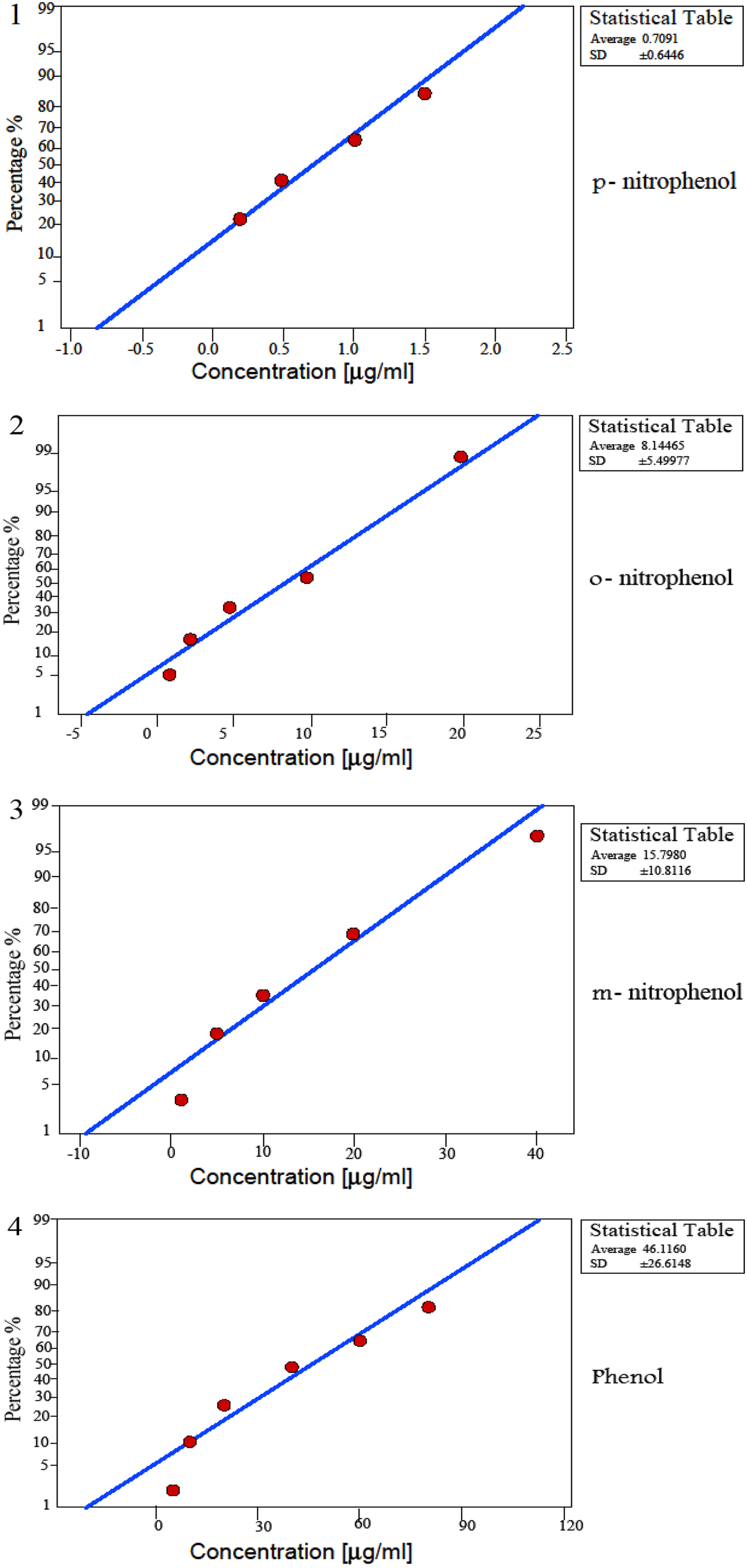
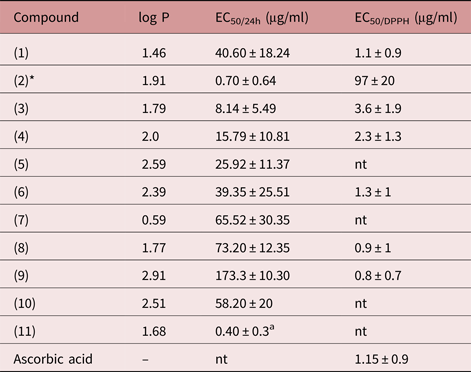
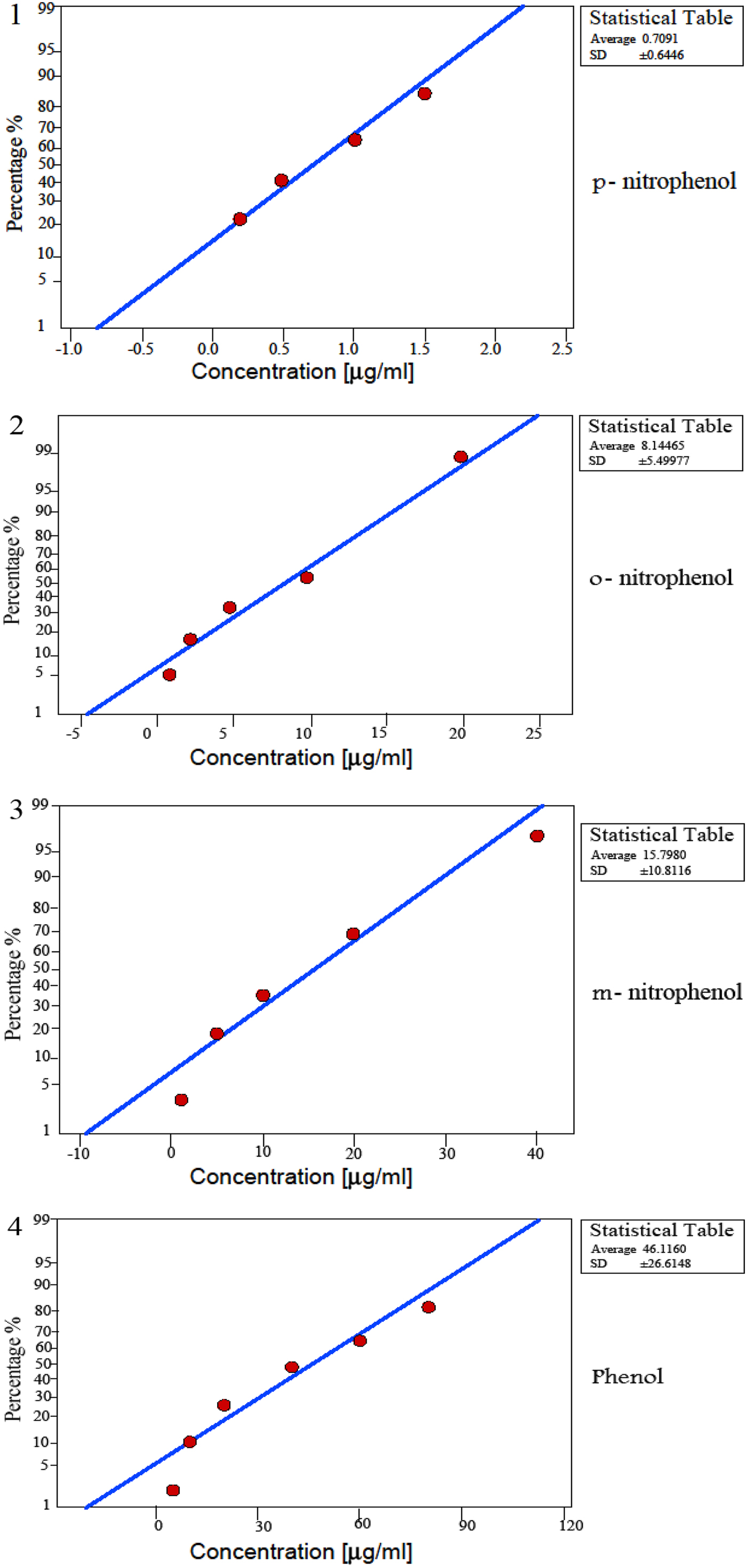
The highest nematicidal activity was recorded to p-nitrophenol (2) (R 2 = 0.999), with a fumigant activity, followed by o-nitrophenol (3) (R 2 = 0.998), m-nitrophenol (4) (R 2 = 0.997) and p-bromophenol (5) with an EC50 after 1 day of immersion of about 0.70 ± 0.64, 8.14 ± 5.49, 15.79 ± 10.81 and 25.92 ± 11.37 μg/ml, respectively (figs 1 and 2, table 1).
EC50/24h of phenolic compounds on M. incognita: p-nitrophenol (1), o-nitrophenol (2), m-nitrophenol (3) and phenol (4), n = 4.
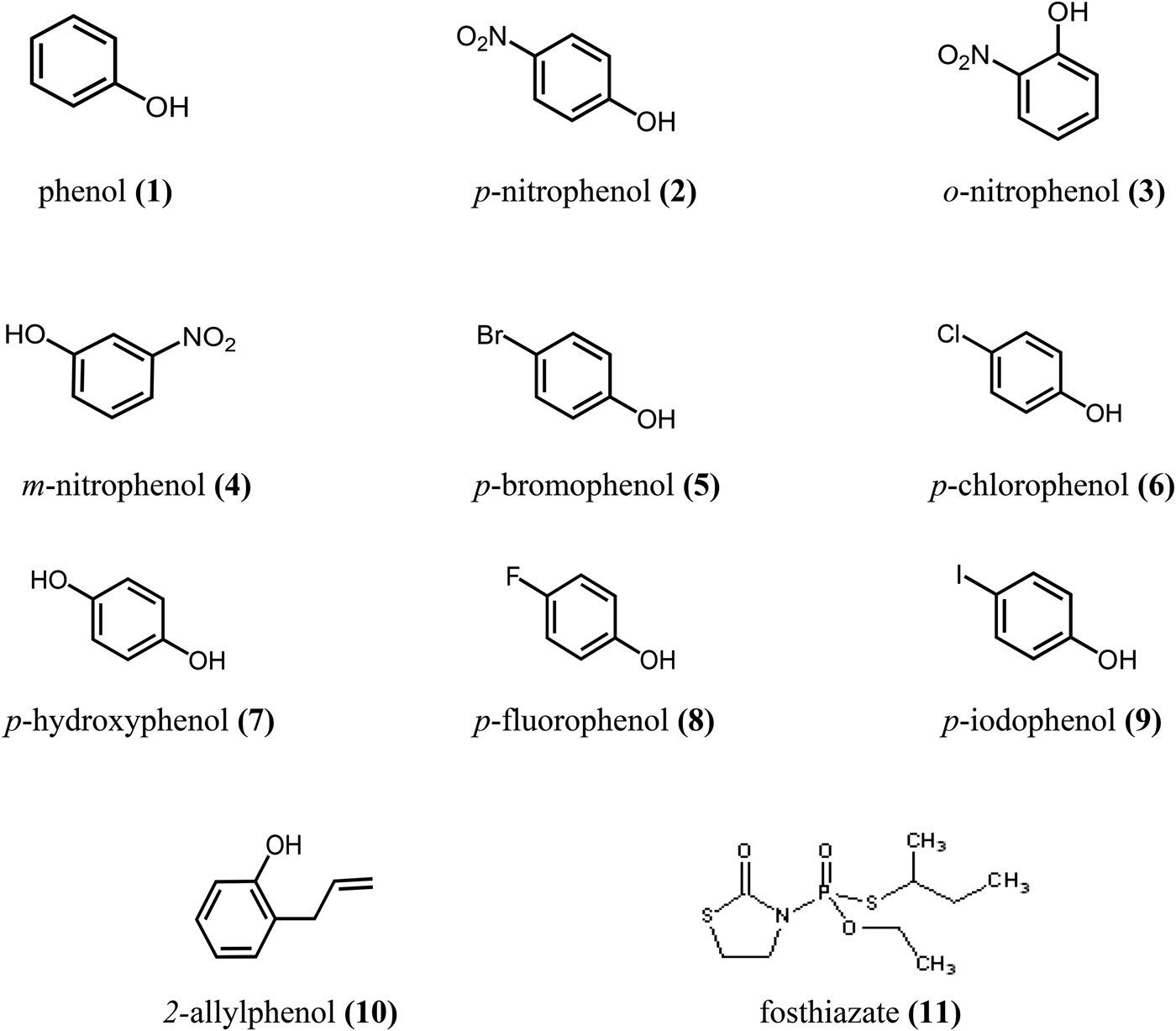
Chemical structure of the tested compounds.

Correlation between nematicidal and anti-oxidant activity of the tested compounds (n = 4).

aResult reported by Caboni et al. (Reference Caboni, Aissani, Cabras, Falqui, Marotta, Liori, Ntalli, Sarais, Sasanelli and Tocco2013b).
nt, Not tested.
*This compound has a fumigant activity.
Substitution of the nitro-group in the para-position by bromo- (5), chloro- (6), hydroxy- (7), fluoro- (8) and iodo- (9) groups decreased this activity significantly (fig. 1, table 1). The change on the ortho-position of the nitro-group (3) by the allyl group (10) decreased the nematicidal activity sevenfold, from 8.14 ± 5.49 to 58.20 ± 20 μg/ml after the same period of immersion (table 1).
Anti-oxidant assay
The DPPH radical-scavenging activity method showed that the most anti-oxidant compound was p-iodonitrophenol (9) followed by p-fluoronitrophenol (8), phenol (1) and p-chlorophenol (6), with EC50 values of 0.8 ± 0.7, 0.9 ± 1, 1.1 ± 0.9 and 1.3 ± 1 μg/ml, respectively. These phenolic derivatives presented a potent anti-oxidant activity, being close to the control ascorbic acid with EC50 of 1.15 ±0.9 μg/ml. The least anti-oxidant compound was p-nitrophenol (2) followed by o-nitrophenol (3) and m-nitrophenol (4), with EC50 values of 97 ± 20, 3.6 ± 1.9 and 2.3 ± 1.3 μg/ml, respectively (table 1).
Discussion
In the present investigation, the nematicidal activity of ten phenolic derivatives, starting from phenol, on M. incognita was assessed according to the fosthiazate control.
Results showed that position 4 of the nitro-group on the phenolic ring is very important for nematicidal power, conferring an activity close to the chemical control fosthiazate (EC50/24h = 0.70 ± 0.64 and 0.40 ± 0.3 μg/ml, respectively). Changes of the nitro-group to positions 2 and 3 decreased this activity 11 and 22 times, respectively. This is confirmed by the study of Caboni et al. (Reference Caboni, Saba, Oplos, Aissani, Maxia, Spiroudi, Casu and Ntalli2015) who showed that 4-nitroacetophenone and 4-iodoacetophenone are the most active acetophenones against the same helminth, M. incognita.
Phenols and nitrophenols are among the most widely used industrial organic compounds. They are frequently used as intermediates in the manufacture of pharmaceuticals, dyes, pesticides and explosives (Spain, Reference Spain1995). The resistance to biodegradation of the aromatic ring of these compounds is enhanced by the presence of more nitro-groups, such as trinitrophenol (Qureshi & Purohit, Reference Qureshi and Purohit2002). Nitro-aromatics are not found as natural compounds in the environment. Due to the pronounced electron-withdrawing character of the nitro-groups, they harbour an electron-deficient pi-electron system, generating a xenobiotic character. As a result, the electrophilic attack, which is usually considered as the first step in aromatic biodegradation, becomes more difficult (Qureshi et al., Reference Qureshi, Kapley and Purohit2012).
When substitutions of the nitro-group in the para-position were made, the nematicidal activity differed, based on the substitution pattern. In fact, bromo-, chloro-, hydroxy-, fluoro- and iodo-groups at this position decreased this activity 35, 60, 93, 104 and 247 times, respectively, according to the p-nitrophenol (table 1).
Substitution of the nitro-group in position 2 on the phenolic ring (2) by the allyl group (10) decreased the activity seven times, from 0.70 ± 0.64 to 58.20 ± 20 μg/ml.
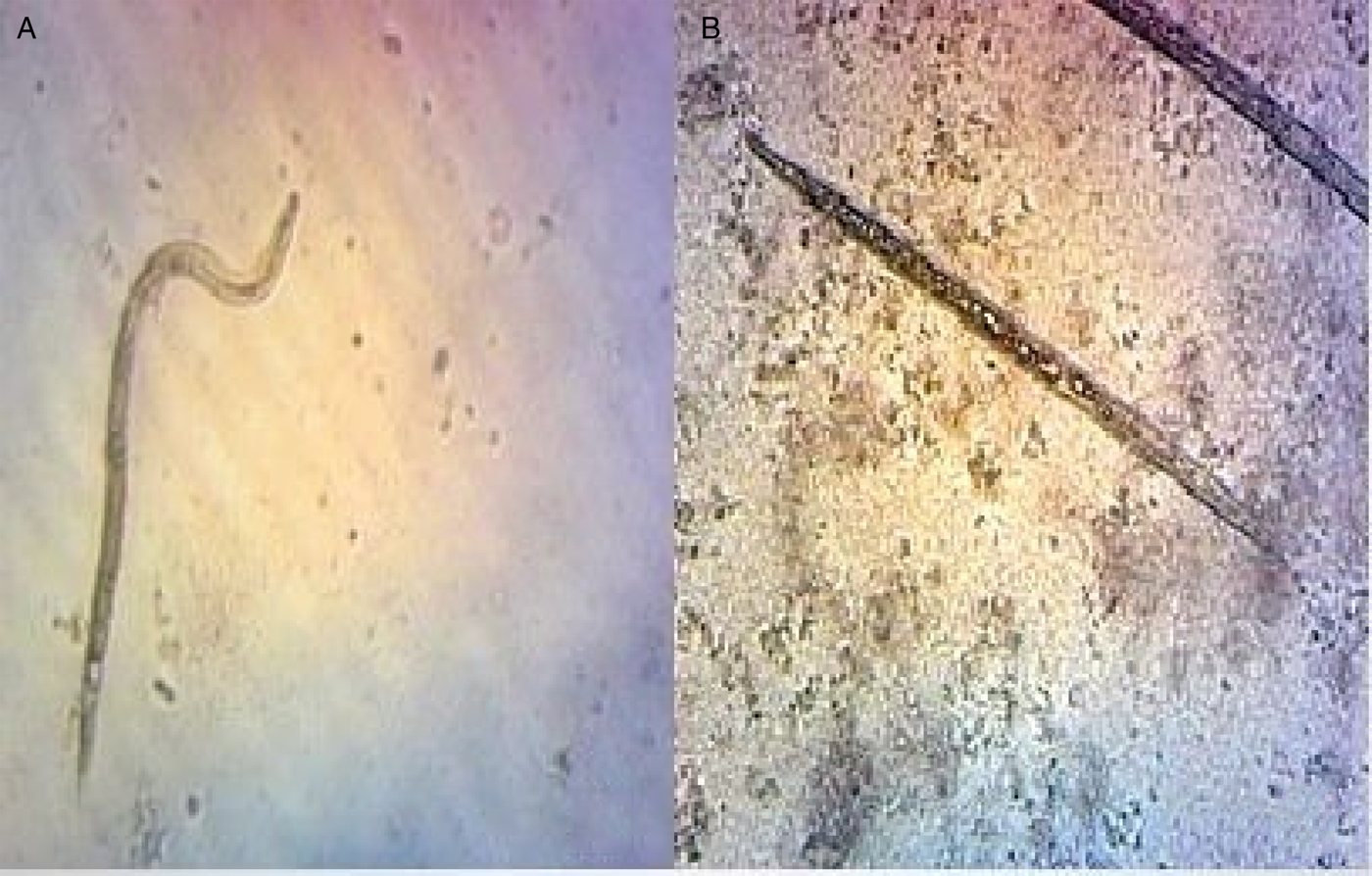
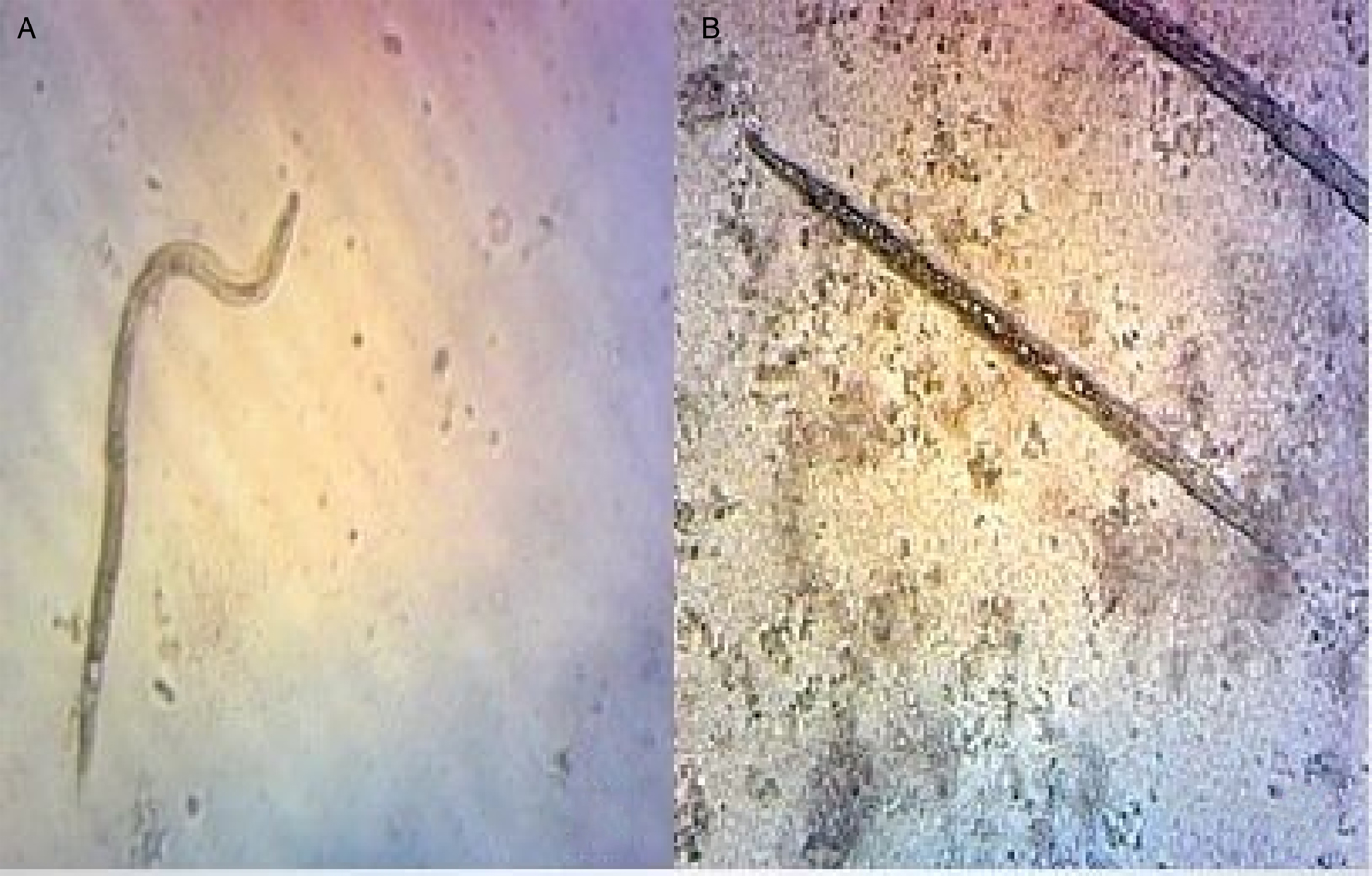
Remarkably, p-nitrophenol showed the highest nematicidal activity (0.70 ± 0.64 μg/ml) with the corresponding lowest anti-oxidant activity (about 97 ± 20 μg/ml) (table 1). The phenolic compounds are not able to scavenge free-radicals such as the superoxide anion (O2.) and hydroxyl radical (OH.), and their toxicity is revealed by the production of reactive oxygen species (ROS). The phenol treatments paralyse helminths, which appear straightened in shape with evident internal vacuolization (fig. 3).
Nematodes before (A) and after (B) 24 h of immersion in p-nitrophenol at 10 μg/ml. After treatment, nematodes were paralysed in a straight shape and internal vacuoles were evident.
Previous studies reported similar results when nematodes were treated with isothiocyanates and some vacuolar-type proton-translocating adenosine triphosphatase (ATPase), vacuolar-type H+-ATPase (V-ATPase) inhibitors, such as α, β, γ, δ-unsaturated aldehydes and pyocyanin (Caboni et al., Reference Caboni, Tronci, Liori, Tocco, Sasanelli and Diana2014; Aissani et al., Reference Aissani, Urgeghe, Oplos, Saba, Tocco, Petretto, Eloh, Menkissoglu-Spiroudi, Ntalli and Caboni2015).
In the same fashion, gossypol, a triterpenoid aldehyde isolated from cotton plants, was shown to inhibit mitochondrial electron transfer and stimulate generation of ROS (Arinbasarova et al., Reference Arinbasarova, Medentsev and Krupyanko2012). Thus, ROS produced by redox-active phenols may have a crucial role in the inhibition of V-ATPase and induction of lipid peroxidation, as well as depletion of anti-oxidant enzyme activities, such as superoxide dismutase, catalase and glutathione peroxidase.
In another study, when oxidative agents were applied to sakAΔ and mpkCΔ mitogen-activated protein kinase (MAPK) mutant strains of Aspergillus fumigatus, they became susceptible to antifungal agents because the mutated MAPK system was incapable of launching a fully operational oxidative stress response dealing with the mode action of the anti-oxidant system on the resistance to diverse biological activities including nematicidal activity (Kim et al., Reference Kim, Chan, Mahoney and Campbell2011).
Treatment of helminths with aryl hydrazones and maleimide derivatives altered their metabolic profile by changing fatty acids and rates of ammonia elimination (Eloh et al., Reference Eloh, Demurtas, Deplano, Ngoutane Mfopa, Murgia, Maxia, Onnis and Caboni2015, Reference Eloh, Demurtas, Mura, Deplano, Onnis, Sasanelli, Maxia and Caboni2016) giving insight into the mode of action of phenolic derivatives.
This study deals with the use of nitrophenols as potent nematicidals against M. incognita. The structure–activity relationship shows that slight structural differences among tested compounds conferred significantly different nematicidal effects. This suggests that the biological activity is not only a concentration-dependent function, but is also related to chemical characteristics. The nitro-group in the para-position of the phenolic ring is crucial for nematicidal activity. Our data suggest that phenolic derivatives could be integrated into the pest-management system.
Acknowledgements
Special thanks to Pr. Pierluigi Caboni from the University of Cagliari, Italy for providing tomato roots infested by nematodes.
Financial support
This study was funded by the Ministry of Higher Education and Scientific Research, Tunisia.
Conflict of interest
None.
Ethical standards
The authors assert that all procedures contributing to this study comply with the ethical standards of the relevant national guidelines on the care and use of laboratory animals and have been approved by the institutional committee of the Institut Pasteur, Tunis.