Introduction
The prevalence of childhood obesity is 16.9% in the United States according to the 2011–2012 National Health and Nutrition Examination Survey data.Reference Ogden, Carroll, Kit and Flegal 1 Weight gain, particularly in early infancyReference Taveras, Rifas-Shiman and Belfort 2 is strongly associated with the risk of obesity in childhood and later life as demonstrated in several studies and multiple systematic reviews.Reference Taveras, Rifas-Shiman and Belfort 2 – Reference Monteiro and Victora 5 Infants born small are more likely to gain weight quickly early in infancy as compared with those with higher birth weights, and this is associated with higher adiposity later in life.Reference Baird, Fisher and Lucas 3 Furthermore, rapid weight gain in the first year of life is associated with cardiovascular and metabolic dysregulation in adulthood,Reference Leunissen, Kerkhof, Stijnen and Hokken-Koelega 6 and may be observed as early as 3 years of age.Reference Belfort, Rifas-Shiman, Rich-Edwards, Kleinman and Gillman 7 Thus, growth in early infancy (<1 year) is an important influence on the future health of a child.
Nutrient exposure in utero influences infant growth after birth. Donahue et al. Reference Donahue, Rifas-Shiman and Gold 8 reported that high neonatal levels of the n-3 long chain polyunsaturated fatty acids (LCPUFA) docosahexanoate (DHA) and eicosapentanoate (EPA) predict a lower risk for obesity and adiposity at 3 years of age, as measured by skinfold thickness. Interestingly, maternal n-3 levels were not associated with infant adiposity.Reference Donahue, Rifas-Shiman and Gold 8 Furthermore, n-3 LCPUFA supplementation during pregnancy and lactation in a randomized controlled trial, did not affect adiposity at 1 year of age,Reference Hauner, Much and Vollhardt 9 suggesting that maternal fatty acid intake is not the primary determinant of infant adipose accumulation. The fetus – unlike the adult – has limited capacity to synthesize LCPUFA in adequate amounts to meet its developmental needs,Reference Salem, Wegher, Mena and Uauy 10 and thus depends upon both maternal supply and placental transport for acquiring LCPUFA.
In order to further investigate the association between the fatty acid profile in fetal blood and early infant adiposity, we utilized data from a cohort of women recruited during pregnancy and followed to term whereupon the placenta was collected and neonatal anthropometry were measured. Mother–infant pairs were followed to 6 months post-partum. We assessed the relationships between the change in body mass index z-score (BMI-z) in the first 6 months of life, and maternal and umbilical venous plasma fatty acid profiles. We hypothesized that infants with a greater positive change in BMI-z would be physiologically different from those that had a smaller, or negative change. We predicted that their fatty acid profiles at birth would be different as would their placental lipid transporter gene expression levels.
Subjects and methods
Subject recruitment and procedures
All aspects of this study were approved by the Oregon Health & Science University Institutional Review Board. Fifty women ⩾18 years of age in their third trimester (⩾26 weeks of pregnancy) who were patients at Cascades East Family Practice Center or Klamath Medical Clinic in Klamath Falls Oregon were recruited based upon screening at prenatal visits. Klamath Falls is a rural city of ∼20,000 people on the Oregon–California border. Exclusion criteria were: women carrying multiple fetuses; fetuses with chromosomal anomalies; non-English speaking women.
Potential study participants from Cascades East Family Practice Center or Klamath Medical Clinic were identified based upon screening at prenatal visits and were asked to sign a preconsent document by clinic staff allowing the research nurse to contact them. Women were then scheduled for an initial clinical visit, where the overall purpose of the study and expectations were explained and informed consent was obtained.
Data and tissue collection
At the initial clinic visit, study participants were interviewed about their birth history, physical measurements were taken and venous blood was collected. Study participants were given a 20$ gift certificate for participating in the study.
Placental tissue and umbilical venous blood was collected at delivery. Placental weight (untrimmed), major and minor axial dimensions and thickness were measured and recorded. Placental biopsies were collected from four different cotyledons, avoiding calcified and underperfused areas. Maternal decidua was removed. Samples were snap frozen in liquid nitrogen and stored at −80°C. Birth weight, gestational age at birth and fetal sex were recorded. Umbilical venous blood was collected into an ethylenediaminetetraacetic acid-treated tube and placed on ice until centrifuged at 1500 g for 10 min at 4°C to isolate the plasma. Plasma was stored at −20°C.
The morning after delivery, the study nurse obtained physical measurements of the infant including length (crown-rump and crown-heel), chest, abdominal, arm and head circumferences and skinfold thicknesses (triceps, subscapular, thigh). Each measurement was taken three times to ensure accuracy. After 6 months of delivery, subjects were asked to come back to the clinic with their baby for another visit. The study nurse obtained additional physical measurements of the infants including length (crown-rump and crown-heel), chest, abdominal, arm and head circumferences and skinfold thicknesses (triceps, biceps, suprailiac, subscapular, thigh). Each measurement was taken three times to ensure accuracy. Mothers were also asked at this time about breast or bottle-feeding practices.
We calculated age- and sex-specific weight-for-age z-score (WFA-z), length-for-age z-score (LFA-z), weight-for-length z-score (WFL-z) and BMI-z from the World Health Organization (WHO) 2006 growth chart data as recommended by the Center for Disease Control and Prevention for children in the U.S. ages 0–2 years (http://www.cdc.gov/growthcharts/who_charts.htm). Sum of skinfolds (triceps+subscapular+thigh) was calculated for neonates and infants at 6 months as an estimate of overall adiposity; from these data, growth of skinfolds in the first 6 months after birth was calculated. Arm muscle area (AMA)=[mid-upper arm circumference−(π×triceps skinfold)]2/[4 π] with measures in cm) was calculated for neonates and infants at 6 months as an estimate of muscle mass.Reference O’Tierney, Lewis and McWeeney 11
Quantitative plasma fatty acid analysis
Fatty acids were extracted and quantified by the method of Lagerstedt et al. Reference Lagerstedt, Hinrichs and Batt 12 as previously published.Reference O’Tierney-Ginn, Roberts and Gillingham 13 Deuterated free fatty acids were added to samples before extraction as internal standards. The fatty acid-pentafluorobenzyl esters were analyzed by gas chromatography mass spectophotometry on a Trace DSQ (Thermoelectron). Each fatty acid was matched to the deuterated internal standard closest in length and retention time. Peak area ratios of known amounts of standard fatty acids and the internal standards were used to generate calibration curves to quantify unknowns using Xcalibur software.
Placental molecular analyses
RNA was isolated using TriReagent (Sigma) following the manufacturer’s protocol. RNA was reverse transcribed to cDNA using MultiScribe Reverse Transcriptase (Applied Biosystems, Carlsbad, CA), and polymerase chain reaction (PCR) performed using the Stratagene Mx3005P Thermocycler (Agilent, Santa Clara, CA). PCR amplicons were detected by fluorescent detection of SYBR Green (Power SYBR Green Master Mix; Applied Biosystems). For each primer pair, standard curves, no template controls and unknowns were run in triplicate. Following cycling, the melt curve of the resulting amplicon was analyzed to ensure that a single product was detected. Quantification of mRNA was achieved using the respective standard curves with manufacturer’s software (MxPro QPCR; Agilent). Values were expressed as a ratio of the gene of interest:GAPDH control in each sample. Gene-specific primers, shown in the Supplementary Table S1, were designed for fatty acid transport proteins (FATP)-4, FATP-6; fatty acid translocase (CD36); fatty acid-binding proteins (FABP)-3, FABPpm, lipoprotein lipase (LPL) and endothelial lipase (EL). Placental gene expression data was log transformed to obtain normal distribution for group comparisons.
Statistical analysis
Spearman’s correlation (ρ) was used to examine the relationship between plasma lipids, placental gene expression and infant growth measures. Two sample t-statistics and corresponding descriptive methodology were used to examine differences in maternal, placental and neonatal measures and fatty acid concentrations between infants who were or were not followed-up at 6 months of age. A P-value of <0.05 was considered statistically significant.
Results
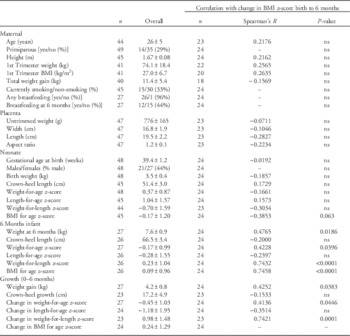
Participant characteristics are shown in Table 1; 6-month infant follow-up was performed on 55% of the initial cohort (n=27). Subjects included in the postnatal analyses were similar to those without postnatal assessments, except for maternal age at enrollment (Supplementary Table S2). None of the mothers in this cohort developed gestational diabetes, but six women were diagnosed with pre-eclampsia. All analyses were performed with and without these six women, and were not found to be affected, thus the women were retained in all analyses. At birth, neonates in this study were thinner compared to the WHO reference values with an average BMI-z of −0.17. At 6 months, (average BMI-z=0.09), these infants were similar to WHO reference values. Table 1 shows the relationships between participant characteristics and change in BMI-z score during infancy. Of the 12 women who were breastfeeding at 6 months, two reported exclusive breastfeeding; 24 out of 27 women reported introducing solids by 6 months. We did not detect significant associations between infant feeding practices and growth measures. We did not have sufficient numbers to thoroughly investigate sex differences.
Maternal and placental characteristics and growth measures of infants and relationship with changes in body mass index (BMI) z-score between 0 and 6 monthsFootnote a

a Data are mean±s.d. unless otherwise noted. Relationship between change of BMI-z and categorical variables assessed via Kruskal–Wallis rank t-test.
There was no association between maternal characteristics (parity, smoking status, breastfeeding practices) or body type (height, weight, weight gain during pregnancy) and change in BMI-z from 0 to 6 months. Placental measurements were not related to BMI-z changes in early infancy. BMI for age z-score at birth showed a trend (P=0.063) for a negative relationship with change in BMI-z during infancy, but other neonatal characteristics were not associated (e.g. neonatal skinfolds: r=0.2541; P=0.24). Infant weight at 6 months, WFA-z, WFL-z and BMI-z were strongly positively related to change in BMI-z from 0 to 6 months. A positive BMI-z change was associated with greater weight gain in the first 6 months of life and a greater change in WFA-z and WFL-z, but not with crown-heel growth.
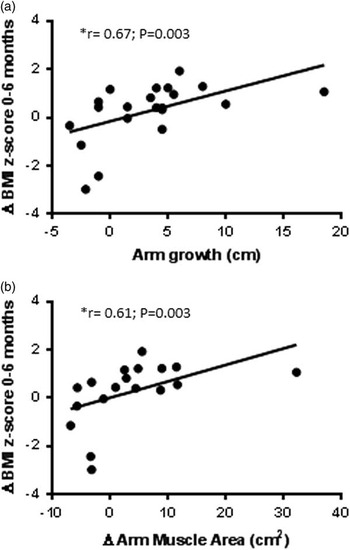
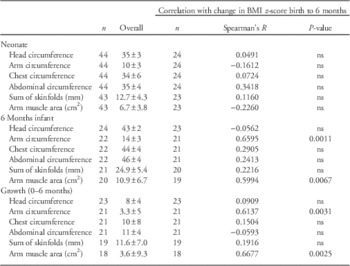
Neonatal and 6-month infant anthropometry values and their relationship to changes in BMI-z between 0 and 6 months are shown in Table 2. Head, arm, chest and abdominal circumference at birth were not correlated with change in BMI-z in early infancy. At 6 months of age, arm circumference and arm muscle area, an indicator of muscle mass, were larger in infants that had a greater positive change in BMI-z in early infancy. Growth of arm circumference and muscle area was also strongly positively related to change in BMI-z from birth to 6 months (Fig. 1). Skinfold thicknesses were not associated with BMI-z change, at any age.
Relationships between infant growth measures and adiposity over the first 6 months of life. A greater change in body mass index (BMI) z-score from birth to 6 months of age is correlated with a greater arm (a) and arm muscle area growth (b) (n=18). *Spearman’s correlation coefficient (ρ). No differences in relationships were noted between male and female fetuses.

Neonatal and infant anthropometry and growth of infants and relationship with changes in body mass index (BMI) z-score between 0 and 6 monthsFootnote a

a Measures are in cm unless otherwise noted. Data are mean±s.d.
Plasma fatty acid profiles at birth were associated with weight gain in infancy
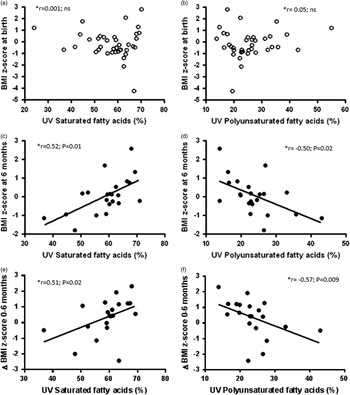
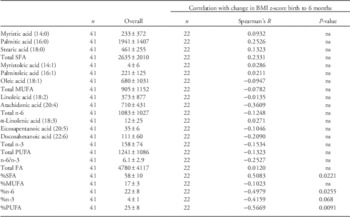
Umbilical venous plasma fatty acid profiles, and their relationship with BMI-z change in early infancy, are shown in Table 3. Infants with a positive change in BMI-z had a fatty acid profile at birth with a high proportion of saturated and low proportion of polyunsaturated fatty acids relative to infants with a small, or negative change in BMI-z (Fig. 2e and 2f). Figure 2 shows that BMI-z score at 6 months were positively correlated with the proportion of saturated fatty acids and negatively correlated with polyunsaturated fatty acids at birth. There was no correlation between fatty acid profiles at birth and neonatal growth measurements (Fig. 2a and 2b).
Relationship between umbilical venous fatty acid profiles and infant adiposity. Body mass index (BMI) z-score at birth is not associated with umbilical venous (UV) plasma fatty acid profiles (a and b). A high BMI z-score at 6 months of age, and greater change in BMI z-score from birth to 6 months of age, is associated with a high proportion of saturated fatty acids (c and e) and a low proportion of polyunsaturated fatty acids (d and f) in umbilical venous plasma at birth (n=22). *Spearman’s correlation coefficient (ρ). No differences in relationships were noted between male and female fetuses.

Umbilical venous fatty acid profiles of infants and relationship with changes in body mass index (BMI) z-score between 0 and 6 monthsFootnote a

SFA, saturated fatty acid; MUFA, monounsaturated fatty acids; PUFA, polyunsaturated fatty acid; FA, fatty acid.
a Data is µM unless otherwise noted. Data are mean±s.d.
Fatty acid profiles at birth were also associated with skinfold thickness at birth. The sum of skinfolds at birth (thigh+biceps+subscapular) was negatively correlated with umbilical venous total polyunsaturated fatty acid levels (r=−0.48, P=0.039), total n-6 PUFA (r=−0.47, P=0.041), total n-3 PUFA (r=−0.46, P=0.046) and the proportion of n-6 PUFA (r=−0.58, P=0.009) and total PUFA (r=−0.52, P=0.021) in plasma. Neonatal skinfold thickness was positively correlated with the proportion of saturated fatty acids at birth (r=0.49, P=0.034). We were unable to detect any associations between fatty acid profiles at birth and infant skinfolds or skinfold growth in the first 6 months of life. We did not detect any correlations between fatty acid profiles at birth and neonatal or infant arm muscle area or arm muscle area growth.
Maternal fatty acid profiles in mid-pregnancy were not associated with weight gain in early infancy or skinfold thickness at birth, 6 months or growth in early infancy.
Placental fatty acid transporter gene expression was associated with infant adiposity measures
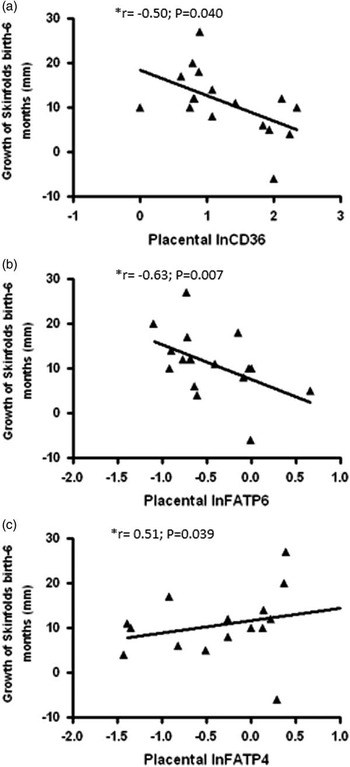
Quantitative PCR methodology was used to assess the association between placental fatty acid transporter gene expression and infant adiposity measures. Fatty acid transporter or lipase gene expression was not associated with changes in BMI-z. However several fatty acid transporters were correlated with skinfold thickness at 6 months of age and skinfold growth between birth and 6 months. Fatty acid transport protein (FATP)-4 mRNA levels were positively correlated with skinfold thickness at 6 months of age and the change in skinfold thickness from birth to 6 months (Fig. 3). The expression of FATP-6 and CD36 were negatively associated with skinfold thickness in early infancy. Placental plasma membrane fatty acid-binding protein (FABPpm) expression was positively correlated with 6-month skinfolds (r=0.51, P=0.04), but not with skinfold growth (r=0.46, P=0.06). Lipoprotein lipase mRNA expression was negatively associated with skinfold growth in the first 6 months of life (r=−0.50, P=0.04). We were unable to detect any statistically significant associations between placental fatty acid transporter/lipase gene expression and neonatal skinfolds, neonatal or infant arm muscle area, weight-for-length, BMI-z or umbilical cord fatty acid levels.
Relationships between placental fatty acid transporter mRNA levels and growth of skinfolds. Placental fatty acid translocase (FAT/CD36) and fatty acid transport protein (FATP)-6 were negatively correlated with skinfold growth in early infancy (a and b). Placental FATP-4 was positively correlated with skinfold growth (c) (n=17). *Spearman’s correlation coefficient (ρ). No differences in relationships were noted between male and female fetuses.

Discussion
A higher rate of weight gain in early infancy is associated with obesity in later life.Reference Baird, Fisher and Lucas 3 , Reference Ong and Loos 4 We studied infants with negative and positive changes in BMI-z within the first 6 months of life to better understand the nutritional factors associated with growth patterns representing slower and more rapid weight gain (and lower and higher risks for obesity), respectively. The main finding of our study was that a high proportion of saturated fatty acids and low DHA levels in umbilical vein plasma at term were associated with high skinfold thickness at birth, high infant BMI-z at 6 months of age and a positive change in BMI-z in early infancy. Placental fatty acid transporter expression was correlated with skinfold growth in early infancy, a marker of fat deposition. Thus, fatty acid profiles at birth may be predictive of early infant growth and risk for obesity later in life; this may be related to differences in lipid transport function in the placenta.
We found that infants with a greater positive change in BMI-z in the first 6 months of life had a high proportion of saturated and low proportion of polyunsaturated plasma fatty acids at birth compared with those with a smaller or negative change in BMI-z over this time period. Low levels of n-3 fatty acids (DHA+EPA) in cord blood were found to be associated with higher adiposity at 3 years of ageReference Donahue, Rifas-Shiman and Gold 8 and rapid growth in the first 6 months related to obesity at both 3 yearsReference Taveras, Rifas-Shiman and Belfort 2 and 6–11 yearsReference Koontz, Gunzler, Presley and Catalano 14 of age. We found a trend (P=0.068) for a lower proportion of n-3 LCPUFA in infants with greater BMI-z changes in the first 6 months. Together these findings suggest that low LCPUFA levels at birth may indicate a propensity for obesity later in life, perhaps through its association with higher rates of weight gain in early infancy.
Rapid growth within 6 months of birth may be related to increased fat deposition,Reference Koontz, Gunzler, Presley and Catalano 14 , Reference Holzhauer, Hokken Koelega and Ridder 15 which may continue to offer future obesity risk.Reference Taveras, Rifas-Shiman and Belfort 2 , Reference Koontz, Gunzler, Presley and Catalano 14 However, changes in BMI-z during early development are not an accurate measure of adiposity.Reference Andres, Hull and Shankar 16 Several authors have shown that early, even rapid, weight gain is positively associated with lean mass growthReference Brunner, Schmid and Huttinger 17 , Reference Chandler-Laney, Gower and Fields 18 challenging the notion that lean mass tracks directly from fetal life to childhood and beyond.Reference Baker, Workman and Bedrick 19 However, as neonates are likely born with their full complement of muscle fibers,Reference Rowe and Goldspink 20 we speculate that increases in lean mass are due to an increase in skeletal muscle fiber size, not number. Thus, early infancy may be a time when myocyte enlargement occurs at varying rates among individuals – whether or not these changes are permanent is unknown. We found that early rapid weight gain was associated with increased arm muscle area growth – a marker of increased lean mass – rather than skinfold thickness growth. Importantly, those infants with a negative change in BMI-z during the first 6 months of life lost arm muscle area, indicating a loss in lean mass relative to body size, but continued to gain fat mass (as assessed by skinfold thickness), which could have negative connotations for future metabolic health.Reference Joglekar, Fall and Deshpande 21 These findings highlight the importance of assessing body composition, in addition to standard weight and length measures, during early growth studies in order to better understand potential long-term consequences of differences in rate of growth.
Early rapid weight gain is often associated with low birth weight – known as ‘catch-up growth’.Reference Eriksson, Forsen and Tuomilehto 22 In our study, infants with a positive BMI-z change tended to have a low BMI-z at birth (P=0.06), suggesting they were thin at birth. However, consistent with the findings of Holzhauer et al.,Reference Holzhauer, Hokken Koelega and Ridder 15 we observed that these two growth patterns (negative v. positive changes in BMI-z) were not related to birth weight. Thus, neonatal body composition is likely a better predictor of early growth patterns than birth weight. Weight gain over the first 6 months was positively associated with change in BMI-z, but change in skinfold thickness was not. As skinfolds represent subcutaneous fat, it is possible that intraabdominal fat deposition or soft tissue growth was greater in infants that had a larger positive change in BMI-z. Though absolute crown-heel growth was not related to BMI-z changes, we noted that the change in LFA-z tended to be lower in infants who gained weight quickly (P=0.09). Less length growth (accounting for age and sex) and higher arm muscle area growth demonstrates a different pattern of lean mass distribution in infants that gain weight quickly. Future studies should assess the metabolic efficiency of lean mass in individuals with different distributions of fat and muscle. Thus, a high proportion of saturated fatty acids combined with low PUFA levels in cord plasma are associated with an early rapid weight gain, a positive change in BMI-z in the first 6 months, high BMI-z at 6 months and an overall greater lean mass.
Umbilical venous fatty acid profiles are affected by maternal fatty acid supply, placental delivery and fetal lipid metabolism. Consistent with previous findings,Reference Donahue, Rifas-Shiman and Gold 8 we did not see an association between maternal fatty acid profiles and neonatal or infant growth measures in this study. We found that gene expression levels of placental fatty acid transporters such as FAT/CD36, FATP-4 and FATP-6 were correlated with the growth of skinfolds from birth to 6 months of age, suggesting that early fat deposition and infant adiposity are related to placental lipid handling. As we only measured mRNA expression of these transporters, we cannot say whether the ability of the placenta to deliver fatty acids from mother to the fetus was related to early infant growth. However, umbilical venous, but not maternal, plasma fatty acid levels were correlated with infant BMI-z, supporting the notion that placental lipid handling pathways were altered. Maternal fatty acids were measured at mid-pregnancy rather than at birth, therefore they may not accurately represent the maternal fatty acid supply at term.
Changes in placental fatty acid transporter gene expression have previously been shown to be associated with alterations in placental fatty acid uptake and transport to the fetus.Reference O’Tierney-Ginn, Roberts and Gillingham 13 , Reference Xu, Agrawal, Cook and Knipp 23 – Reference Brass, Hanson and O’Tierney-Ginn 25 Interestingly, placental CD36 and FATP-6 levels were negatively related to infant adiposity while FATP-4 levels were positively correlated to skinfold growth. The specific roles of each type and isoform of fatty acid transporter in the placenta are not well-understood. Placental FATP-4 expression correlates with cord blood DHA levels,Reference Larque, Krauss-Etschmann and Campoy 26 while CD36 is thought to be a relatively non-specific transporter.Reference Duttaroy 27 Due to the cross-sectional nature of the gene expression data, we cannot speculate on whether the placental gene expression is representative of transporter activity at birth or reflects an upregulation/downregulation of expression in response to fetal fatty acid requirements and maternal supply.
Post-partum factors such as length of exclusive breastfeeding has been found to influence infant adiposity and risk of childhood obesity in a recent meta-analysisReference Yan, Liu, Zhu, Huang and Wang 28 but may not be protective long-term.Reference O’Tierney, Barker, Osmond, Kajantie and Eriksson 29 We did not observe any associations between length of breastfeeding and weight gain trajectories, though we did not measure volume of milk or solid intake, which may confound these relationships. Our study was limited by collecting non-fasting maternal blood samples, which introduces variability into the lipid data. Also, by nature, this pilot study included a small number of subjects and we were only able to follow-up with 55% for infant growth measures. This affected our capacity to control for confounding variables and so we used conservative Spearman’s correlation analysis rather than multiple linear regression. Despite this limitation, we found strong relationships, many of which were consistent with findings of larger cohort studies.
This study is the first to link placental fatty acid transporter expression along with neonatal fatty acid profiles at birth to infant growth measures and adiposity. Our findings suggest that early infancy weight gain is associated with poor plasma LCPUFA status at birth and that fat deposition in infancy is related to changes in placental lipid handling. We speculate that neonatal fatty acid profiles – established by placental transport and maternal nutrition – determine the trajectory for infant growth and fat and lean mass deposition.
Acknowledgments
None.
Financial Support
This research was supported by the NIH-NICHD (R00HD062841 to PFOG), Edwards Endowment (KLT), Northwest Health Foundation, Holtzman Foundation, Audrey Love Foundation and Eagles Trust Foundation.
Conflicts of Interest
None.
Ethical Standards
The authors assert that all procedures contributing to this work comply with the ethical standards of the U.S. Department of Health & Human Services Regulations for the Protection of Human Subjects, with the Helsinki Declaration of 1975, as revised in 2008, and have been approved by the Oregon Health & Science University Institutional Review Board.
Supplementary Material
To view supplementary material for this article, please visit https://doi.org/10.1017/S2040174417000150