Introduction
Tuberculosis (TB) is a contagious, infectious disease of chronic evolution. Histologically, it is characterised by the presence of granulomas and central caseous necrosis, caused by Mycobacterium tuberculosis. Transmission occurs predominantly by air and particularly affects the lungs, but TB can occur in any organ.
Following the appearance of acquired immunodeficiency syndrome, TB has grown in importance.Reference Agarwal and Bais1, Reference Kandiloros, Nikolopoulos, Ferekidis, Tsangaroulakis, Yiotakis and Davilis2 Human immunodeficiency virus infection has changed not only the epidemiological trends of TB but also its clinical presentation, with a rising incidence of extra-pulmonary forms.Reference Nasti, Tavio, Rizzardini, De Paoli, Morassut and Barzan3
Laryngeal TB is the most frequent granulomatous laryngeal disease.Reference Yencha, Linfesty and Blackmon4, Reference Pease, Hoasjoe and Stucker5 Usually as secondary to pulmonary TB, but stuides present up to 20 per cent of prevalence for primary laryngeal TBReference Porras, Martin, Perez and Avalos6, i.e. without pulmonary or any other form.
Two theories are accepted to explain the pathophysiology of laryngeal TB: bronchogenic and haematogenic. In the first, the laryngeal mucosa is contaminated by direct contact with bronchial secretions, explaining the preferential involvement of the vocal folds and the posterior commissure.Reference Rodriguez, Rodriguez, Vidal and Noguerado7 In the second, the larynx is infected by circulatory transmission via blood or lymph, compromising preferably the false vocal folds, epiglottis and aryepiglottic folds.Reference Rodriguez, Rodriguez, Vidal and Noguerado7, Reference Lim, Kim, Choi, Kim, Kim and Choi8
Tubercular lesions in the laryngeal mucosa may have various appearances, including granular, nodular, ulcerated, hyperaemic and/or oedematous.Reference Lim, Kim, Choi, Kim, Kim and Choi8 The locations of the lesions, in decreasing order of incidence, are the vocal folds, epiglottis, false vocal folds, aryepiglottic folds and the interarytenoid region.Reference Ozudogru, Cakli, Altuntas and Gurbuz9
Dysphonia is the main symptom of laryngeal TB, being present in 96.6 per cent of cases,Reference Lim, Kim, Choi, Kim, Kim and Choi8 followed by odynophagia, dysphagia, odynophonia and cough.Reference Porras, Martin, Perez and Avalos6, Reference Ozudogru, Cakli, Altuntas and Gurbuz9, Reference Lindell, Jing and Wallace10 After recovery from laryngeal TB, one would expect voice production to improve as the laryngeal inflammatory process resolved; however, we could find no reports addressing the evolution of dysphonia after laryngeal TB treatment.Reference Yelken, Guven, Topak, Gultekin and Turan11
The vocal folds are formed in layers from the superficial layer of the lamina propria, flexible and rich in elastic fibres, to the vocal muscle, more rigid and rich in collagen fibres. Any change in one or more of these layers may alter their function.Reference Hirano12–Reference Hirano, Bless, Massey, Hartig and Ford14 The fibrosis associated with mucosal healing causes stiffness, which interferes with vocal production.Reference Ozudogru, Cakli, Altuntas and Gurbuz9, Reference Woo, Casper, Colton and Brewer15, Reference Hansen and Thibeault16
This study aimed to evaluate the incidence, evolution and outcome of dysphonia in patients treated for laryngeal TB, as well as to assess the effect of speech therapy on patients' vocal quality.
Materials and methods
A prospective, longitudinal, cohort study was performed. Initially, we reviewed the medical records of patients with laryngeal TB treated at the Evandro Chagas Institute of Clinical Research, Oswaldo Cruz Foundation, from 2000 to 2008, in order to identify those who had been treated for laryngeal TB and had vocal disorders, but who had not received previous speech therapy. These patients were invited to participate in the study. Those who agreed, and who gave written, informed consent, were included in the cohort.
Otorhinolaryngological evaluation consisted of videolaryngoscopy using a rigid optic Karl Storz 70° laryngoscope (Karl Storz, Tuttlingen, Germany) to assess the presence or absence of laryngeal lesions and their location.
Speech evaluation was performed at the first consultation and then every three months.
Acoustic speech analysis was undertaken using Vox Metria software (CTS Informática, Pato Branco, Brazil).Reference Caporrino Neto, Cervantes, Jotz and Abrahão17 Patients' voices were recorded in a quiet room, in a digital computer file for best voice capture. A microphone was used (A-20 model; Plantronix, São Paulo, Brazil) with a mouth–microphone distance of 10 cm. The patient was asked to produce a sustained /e/ vowel in a normal fashion.
Acoustic analysis evaluated the following parameters: The indexes of disturbance related to the fundamental frequency are, jitter, and shimmer variability to semitones. The fundamental frequency is the number of cycles of vibration of the vocal folds per second, and its variability leads to oscillation of cycles; the fundamental frequency variability is considered abnormal when increased by more than two semitones. Jitter and shimmer supply information on the similarity of successive glottal cycles and the stability of the glottal source.Reference Yelken, Guven, Topak, Gultekin and Turan11 Jitter indicates the short-term variability of the fundamental frequency, and is considered abnormal when greater than 0.6 per cent. Shimmer indicates the short-term variability in the amplitude of the sound wave, and is considered abnormal when greater than 6.5 per cent. The glottal to noise excitation ratio calculates the acoustic noise in a series of pulses produced by the oscillation of the vocal folds; a value greater than 0.5 is considered to indicate an abnormal trend. The voice irregularity parameter represents the correlation between jitter and shimmer, and is regarded as abnormal if greater than 4.75.Reference Behlau13, Reference Carrillo and Ortiz18 The maximum phonation time was evaluated using a digital timer (model TI5G811; Timex, Manaus, Brazil), with the patient asked to sustain the vowel /e/; a time of less than 10 seconds was considered reduced. We also evaluated the ratio between the maximum phonation times of the voiceless fricative /S/ and the voiced fricative /Z/; a value greater than or equal to 1.2 was considered to indicate lack of glottal closure.Reference Behlau13, Reference Garcia, Garcia, Diaz and Canizo19
Data were processed as follows: arrangement of study protocol variables, data entry, data quality control, and data analysis using the Statistical Package for the Social Sciences version 11.0 software package.
During exploratory data analysis, the simple frequencies of categorical variables and summary measures (i.e. mean and standard deviation (SD)) of quantitative variables were described.
We applied the Student's t-test to compare the means of paired data (evaluation of voice quality before and after speech therapy), considering a significance level of 5 per cent.
This project was approved by the Research Ethics Committee of the Evandro Chagas Institute of Clinical Research, Oswaldo Cruz Foundation (protocol number 0043.0.009.000-07).
Results and analysis
We retrieved the clinical records of 23 patients with a confirmed diagnosis of TB and laryngeal lesions. These patients comprised five women and 18 men, with a mean age ± SD of 41.3 ± 13.9 years at the time of illness.
Dysphonia was present in 21 (91.3 per cent) of the 23 patients with laryngeal TB, and constituted the first symptom in 19 (82.6 per cent) of these 23. After treatment, dysphonia was completely resolved in 15.8 per cent of patients, reduced in 68.4 per cent and unchanged in 15.8 per cent.
Nine patients accepted the invitation to participate in the study. One had a normal voice at the time of first evaluation, and another left the study before commencement of speech therapy. Thus, seven patients (five men and two women) underwent longitudinal study involving voice assessment and speech therapy. All these patients participated in speech therapy, and were evaluated three times over a six month period.
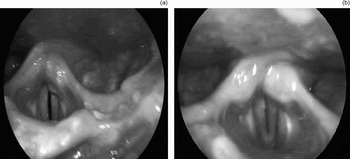
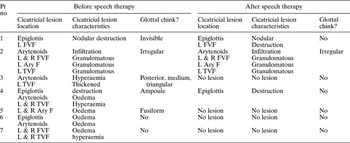
The results of videolaryngoscopic evaluation before and after speech therapy are presented in Table I. In patients one and two, biopsy was used to investigate possible associated disease. Videolaryngoscopic views for patient five, before and after speech therapy, are shown in Figure 1.
Videolaryngoscopic views for patient five: (a) fusiform chink seen before speech therapy, and (b) full glottal closure after three months of speech therapy.

Patients'* videolaryngoscopic findings before and after speech therapy

* Initial n = 9. Pt no = patient number; L = left; R = right; FVF = false vocal fold; TVF = true vocal fold; Ary F = aryepiglottic fold
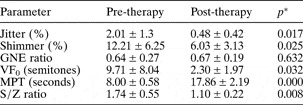
The parameters selected for evaluation of voice quality, and the results of statistical analysis, are shown in Table II.
Patients' voice parameters before and after speech therapy

Data represent means ± standard deviations unless otherwise specified. *Student's t-test for paired data. GNE = glottal to noise excitation; VF0 = fundamental frequency variability; S/Z = ratio between maximum phonation time for /S/ vs /Z/
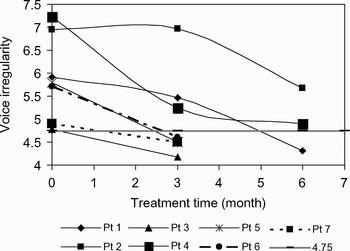
Figure 2 shows changes in patients' vocal quality, indicated by the voice irregularity parameter, over the treatment period. All patients experienced a reduction in voice irregularity, and five attained a degree of irregularity within the normal range (p = 0.002).
Change in patients' voice irregularity over the speech therapy treatment period. (A voice irregularity value of more than 4.75 was considered abnormal.)

Discussion
The residual dysphonia in patients treated for laryngeal TB has not attracted much interest in the literature. However, its high incidence (84.2 per cent) and its impact on quality of life prompted us to investigate the influence of speech therapy on its evolution. In this study, speech therapy significantly improved voice quality in all patients.
Consistent with other studies, we found a higher incidence of laryngeal TB in males,Reference Agarwal and Bais1, Reference Porras, Martin, Perez and Avalos6, Reference Lim, Kim, Choi, Kim, Kim and Choi8, Reference Yelken, Guven, Topak, Gultekin and Turan11 with an average patient age of approximately 40 years.Reference Kandiloros, Nikolopoulos, Ferekidis, Tsangaroulakis, Yiotakis and Davilis2, Reference Porras, Martin, Perez and Avalos6, Reference Lim, Kim, Choi, Kim, Kim and Choi8
As in other studies,Reference Agarwal and Bais1, Reference Kandiloros, Nikolopoulos, Ferekidis, Tsangaroulakis, Yiotakis and Davilis2, Reference Porras, Martin, Perez and Avalos6, Reference Lim, Kim, Choi, Kim, Kim and Choi8, Reference Lindell, Jing and Wallace10 laryngeal TB lesions were found most frequently on the vocal folds. This finding explains the fact that dysphonia is the primary symptom of laryngeal TB, caused by impairment of vibratory movement and glottal closure.Reference Pease, Hoasjoe and Stucker5, Reference Ozudogru, Cakli, Altuntas and Gurbuz9
The laryngeal pathology we observed after laryngeal TB treatment (and before speech therapy) can be explained by the inflammatory process of laryngeal TB and the compensatory mechanisms developed after treatment.Reference Hirano12 The cicatricial tissue observed is made up of dense collagen fibres which are more rigid than the normal vocal fold mucosa. The location of the scar may vary, affecting one or both vocal folds, and may create asymmetry. The scar is localised, so the associated stiffness is restricted to the portion affected, and compensatory mechanisms may facilitate the development of secondary disorders.Reference Pease, Hoasjoe and Stucker5, Reference Ozudogru, Cakli, Altuntas and Gurbuz9 We also observed glottal chinks, which may develop due to loss of vocal fold vibration (caused by laryngeal TB) preventing complete glottal closure. In these cases, an improvement in the amplitude of vibratory movement may occur after laryngeal TB treatment, although insufficient to allow complete glottal closure.Reference Ozudogru, Cakli, Altuntas and Gurbuz9
According to Yelken et al.,Reference Yelken, Guven, Topak, Gultekin and Turan11 the action of anti-TB drugs improves voice quality. Unlike the present study, these authors reported the absence of dysphonia after laryngeal TB treatment. However, other studies have noted the permanence of dysphonia after laryngeal TB treatment.Reference Pease, Hoasjoe and Stucker5, Reference Ozudogru, Cakli, Altuntas and Gurbuz9 This difference may be related to the location of lesions, and the time elapsed between infection and its diagnosis and treatment.
• Tuberculosis (TB) is an infectious disease of chronic evolution, histologically characterised by the presence of granulomas and central caseous necrosis, and caused by Mycobacterium tuberculosis
• Laryngeal TB is the most frequent granulomatous laryngeal disease
• This study evaluated dysphonia after laryngeal TB treatment, and the effect of subsequent speech therapy on vocal quality
• There is a high incidence of dysphonia after laryngeal TB treatment; such dysphonia can be improved by speech therapy
We could find no previous reports of speech therapy in patients with dysphonia after laryngeal TB treatment. The results of the current study indicated statistically significant improvements in jitter, shimmer, fundamental frequency, maximum phonation time and S/Z ratio. After speech therapy, all patients had complete glottal closure, except for one who had an associated vocal fold injury under ongoing investigation. The lack of statistically significant improvement of the glottal to noise excitation ratio, following speech therapy, was probably due to noise remaining in the voice because of an irreversible process associated with cicatrisation.Reference Pease, Hoasjoe and Stucker5, Reference Ozudogru, Cakli, Altuntas and Gurbuz9 Even when some degree of dysphonia remained, patients reported less vocal fatigue and more comfortable speech.
Conclusion
The permanence of dysphonia after the treatment of laryngeal TB leads us to conclude that affected patients need assistance in rehabilitating their damaged speech functions. In this study, speech therapy had a positive effect on vocal rehabilitation in such patients, and resulted in improved voice quality.
Acknowledgements
We acknowledge contributions to the study by Armando de Oliveira Schubach PhD, Ana Cristina da Costa Martins PhD, Raquel Vasconcellos MSc and Cleber do Carmo MSc.