1. Introduction
This article explains why there is important variation in the degree of concentration of legislative specialization across legislative parties. I define legislative specialization at the party level as the proportion of legislative effort parties make by each policy jurisdiction. For instance, if a legislative party spent more than half of its available resources (e.g. time, staff) on education and health, we could state that this party specializes relatively more on these two policy jurisdictions than on other areas. Greater concentration of legislative specialization implies that parties allocate their legislative efforts on a smaller set of policy jurisdictions. As I discuss below, party leaders often promote and coordinate such efforts.Footnote 1 As party leaders are able to coordinate legislative efforts, they might prefer increasing the concentration of legislative specialization to signal preferences, interest, or effort, and eventually either achieve electoral benefits due to issue voting in the short term or construct the party label in the long term.
Previous studies argue that delegation of legislative functions to specialized committees in charge of specific policy jurisdictions occurs for three reasons. First, under the informational perspective, legislative majorities delegate prerogatives to committees because they need expertise and greater information on certain policy jurisdictions (Gilligan and Krehbiel, Reference Gilligan and Krehbiel1987; Krehbiel, Reference Krehbiel1991; Hamm et al., Reference Hamm, Hedlund and Post2011). As members of these specialized committees share their policy expertise, legislatures accomplish collective benefits from specialization (Krehbiel, Reference Krehbiel1991). Second, under the distributional perspective, special privileges are granted to committees to solve the problem of majority rule instability and to facilitate log rolls (Weingast and Marshall, Reference Weingast and Marshall1988; Baron and Ferejohn, Reference Baron and Ferejohn1989). Third, partisan theories contend that delegation to committees occurs to strengthen the control of party leaders over the legislative agenda (Rohde, Reference Rohde1991; Cox and McCubbins, Reference Cox and McCubbins1993).
Although these approaches offer convincing explanations as to why legislative specialization occurs through the delegation of rights and prerogatives to committees, there is still scant research on how legislative parties allocate their policy initiatives across committees. The existence of differing electoral rewards across policy jurisdictions can justify why the distribution of efforts is uneven. In fact, party attention varies across policy jurisdictions, prioritizing salient policy jurisdictions that provide greater electoral rewards to parties. However, this study does not aim to inform which policy jurisdictions are preferred by parties. Instead, it explains why there is variation in the concentration of legislative specialization across parties. To answer this question, this article focuses on the key role of party size measured by the percentage of seats held in congress. This factor is hypothesized to alter the benefits and costs of the concentration of legislative specialization. By employing a unique database composed by 66,027 bill initiatives from 10 Latin American legislatures, I find that a U-shaped curve defines the relationship between party size and the degree of concentration of legislative specialization: niche parties and the largest parties tend to choose the highest degrees of concentration of legislative specialization.
Greater concentration of legislative specialization might bring parties either short-term or long-term benefits. In the short term, showing policy preferences in highly salient policy jurisdictions might help parties gain support, especially electoral advantages during campaigns (Rabinowitz et al., Reference Rabinowitz, Prothro and Jacoby1982; Budge and Farlie, Reference Budge and Farlie1983; Edwards et al., Reference Edwards, Mitchell and Welch1995; Fournier et al., Reference Fournier, Blais, Nadeau, Gidengil and Nevitte2003; Bélanger and Meguid, Reference Bélanger and Meguid2008; Walgrave et al., Reference Walgrave, Lefevere and Tresch2012; Klüver and Sagarzazu, Reference Klüver and Sagarzazu2016; Schröder and Stecker, Reference Schröder and Stecker2018). Some studies report that issue voting is gaining increasing importance when explaining citizens' voting decisions (Lefevere et al., Reference Lefevere, Tresch and Walgrave2015; Bos et al., Reference Bos, Lefevere, Thijssen and Sheets2016).Footnote 2 Further research is needed to determine to what extent greater concentration of legislative specialization helps parties achieve greater electoral support by targeting highly salient issues.
In the long term, as political parties consistently specialize in certain policy jurisdictions in the legislature, they constantly inform society about their policy preferences (Green-Pedersen, Reference Green-Pedersen2010; Green-Pedersen and Mortensen, Reference Green-Pedersen and Mortensen2015; Schröder and Stecker, Reference Schröder and Stecker2018). Over time, greater concentration of legislative specialization might help them construct a reputation as a competent party to deal with problems regarding a policy jurisdiction, and perhaps, such a reputation could facilitate an ownership claim on these policy issues. Walgrave et al. (Reference Walgrave, Lefevere and Tresch2012) state that issue ownership refers to ‘the fact that specific political parties are identified by the public at large with specific policy issues and are considered to be the most competent party to deal with those issues’. Parties take advantage of issue ownership to enhance the support of the electorate in future elections, since ownership indicates which problems the party will address (Budge and Farlie, Reference Budge and Farlie1983; Petrocik, Reference Petrocik1996; Nadeau et al., Reference Nadeau, Blais, Gidengil, Nevitte, Thorburn and Whitehorn2001; Aldrich and Griffin, Reference Aldrich, Griffin and Nelson2003; Petrocik et al., Reference Petrocik, Benoit and Hansen2003; Clarke et al., Reference Clarke, Sanders, Stewart and Whiteley2004; Damore, Reference Damore2004; Holian, Reference Holian2004; van der Brug, Reference van der Brug2004; Hayes, Reference Hayes2005; Green and Hobolt, Reference Green and Hobolt2008; Neundorf and Adams, Reference Neundorf and Adams2018; Green and Jennings, Reference Green and Jennings2019). Further research is needed to reveal to what extent greater concentration of legislative specialization helps parties acquire issue ownership or a reputation as the most competent party in specific policy jurisdictions.
Finally, greater concentration of legislative specialization in certain policy domains can provide voters with greater information on parties' preferences and goals; and it helps them distinguish parties based on policy domains. If voters can distinguish across political parties according to the policy domains voters believe parties prioritize, then these parties could enhance their ‘programmaticness’. Since programmaticness is one of the characteristics of ‘institutionalized’ parties and party systems (Mainwaring, Reference Mainwaring2018), greater concentration of legislative specialization might also contribute to the formation of institutionalized parties and party systems. Further research is also needed to verify this potential consequence.
The rest of this article is divided into four sections. Section 2 explains the hypothesis of this study. Section 3 discusses how other studies have characterized the role of party leaders in coordinating legislative actions in Latin American legislatures. Section 4 presents empirical evidence regarding the impact of party size on the degree of concentration of legislative specialization. Section 5 concludes and offers suggestions for further research.
2. Explaining the degree of concentration of legislative specialization
This section explains why parties choose greater or lesser degrees of concentration of legislative specialization. In this analysis, I treat the legislative party as the unit of analysis that makes decisions to maximize electoral support. I assume that legislative parties could win seats by either responding to the demands of local constituencies or of the population at large.
Moreover, for simplicity I assume that the number of bill initiatives serves as a good proxy of legislative effort. Bill initiation data can indicate the types of policies political parties target for legislative specialization. Bill initiatives do not represent the whole universe of legislative effort, and there are other legislative outputs that could serve as proxies of legislative effort. For instance, non-binding resolutions could signal concern for a particular policy jurisdiction. Nevertheless, bill initiatives are usually more costly in terms of both the time and staff resources needed to draft them. Furthermore, it is more likely that bill initiation becomes more salient and exposed by the media than non-binding resolutions. Moreover, at least a portion of bill initiatives expose the authors to the media (Callaghan and Schnell, Reference Callaghan and Schnell2010; Brunner, Reference Brunner2012). Considering these facts, I focus on the production of bill initiatives throughout this study as legislative parties or legislators employ them to publicize their preferences regardless of their approval or rejection. In fact, legislators or legislative parties could simply propose bills to signal policy preferences without much hope of having these bills passed.Footnote 3
2.1 Defining benefits
As stated above, parties could gain electoral support, at least in the short term, by targeting highly salient policies. Specifically, parties could seek to increase support from focusing on highly salient policy jurisdictions in congress that voters consider to be the most important areas for enhancing their welfare. In fact, previous studies find that issue saliency can have a relevant effect on voting behaviour (Rabinowitz et al., Reference Rabinowitz, Prothro and Jacoby1982; Budge and Farlie, Reference Budge and Farlie1983; Edwards et al., Reference Edwards, Mitchell and Welch1995; Fournier et al., Reference Fournier, Blais, Nadeau, Gidengil and Nevitte2003; Bélanger and Meguid, Reference Bélanger and Meguid2008; Walgrave et al., Reference Walgrave, Lefevere and Tresch2012; Lazarus, Reference Lazarus2013; Klüver and Sagarzazu, Reference Klüver and Sagarzazu2016).
Another possible strategy that could alter the expected future electoral benefits party leaders estimate is accomplishing a strong reputation in a salient policy jurisdiction. As mentioned above, legislative parties might attempt to construct a reputation or claim issue ownership in order to maximize electoral support in the long term. The pursuit of reputation as a competent party to deal with problems in a particular policy jurisdiction might lead a party to spend legislative resources on highlighting its interest in a policy area (Green-Pedersen, Reference Green-Pedersen2010; Schröder and Stecker, Reference Schröder and Stecker2018). This strategy could be conducive to increasing the degree of concentration of legislative specialization.
However, these short-term or long-term incentives might make parties within a party system adopt similar degrees of concentration of legislative specialization focusing on highly salient policy jurisdictions. Since all parties face the same potential benefits of legislative specialization, differences across parties in their levels of concentration of legislative specialization should depend on additional factors. Differences in informational advantages among parties – on which policy jurisdictions can provide greater electoral benefits – might help explain to some extent differences across parties in their concentration of legislative specialization. Nevertheless, as this study shows in the empirical section, the differences in the concentration of legislative specialization across parties are striking and can hardly be explained by only informational advantages, which might disappear fast as parties adjust their strategies. This leads to consideration of other types of incentives or constraints that might affect parties' structure of incentives of greater concentration of legislative specialization.
2.2 Defining marginal benefits and marginal costs
I assume that the marginal electoral benefits of greater concentration of legislative specialization for parties are positive but decrease as parties increase their concentration of legislative specialization. The heterogeneity in the voters' levels of satisfaction across policy jurisdictions helps explain why certain issues are preferred to be targeted by parties or legislators while others are discarded. As parties target the relatively more salient issues for short-term benefits (or maybe pursue ownership for long-term benefits), parties enhance electoral support. However, if parties persist in targeting a particular policy jurisdiction by proposing additional initiatives, the additional electoral rewards will still be positive, but lower. The assumption of diminishing marginal utility of individuals is commonly employed in neoclassical economics. Also called ‘law of diminishing marginal utility’, this law assumes that the first unit of consumption of a good or service yields more utility than the second and subsequent units (Nicholson, Reference Nicholson2002). Previous empirical studies show that this axiom describes individuals' structure of preferences well (Horowitz et al., Reference Horowitz, List and McConnell2004). In this case, voters will reward additional parties' efforts in a particular policy jurisdiction, but with a decreasing trend. Once parties satisfy voters' most important demands regarding a particular issue, meeting other mandates will become less rewarding for parties. As the marginal benefits of targeting another policy area exceeds those of the targeted policy jurisdiction, it is expected that the party switches its attention to this new most attractive policy jurisdiction. Party leaders are likely to do so if they expect greater marginal benefits from targeting another policy jurisdiction. In case a particular policy was not subject to the assumption of diminishing marginal utility, all parties would propose all bill initiatives within the realm of only that policy jurisdiction. Certainly, this scenario is never observable. Overall, the theoretical assumption of diminishing marginal utility seems to be not only compelling, but also empirically valid after discarding the existence of these alternative scenarios.
Furthermore, greater concentration of legislative specialization and its potential benefits are not exempt of costs. Opportunity costs are especially relevant as we consider the individual agenda of legislators. The opportunity costs include the votes that could have been gained under the best alternative strategy. For instance, a bill initiative could either respond to the immediate demands of the constituencies of a legislator, or contribute to highlighting interest in a highly salient issue. Although these two objectives – legislator's or party's agenda – might not be totally incompatible, it is almost certain that opportunity costs will arise when a bill initiative cannot contribute to these two objectives equally. Another potential opportunity cost includes all votes that could have been gained if the party would have targeted the second most attractive policy area to increase electoral support. These opportunity costs comprise the electoral support that parties lose as they ‘invest’ more time, technical, and administrative resources to increase their concentration of legislative efforts in salient policy jurisdictions. Specifically, as legislators spend more time and effort to propose new bills that follow party leaders' directives, they might risk losing seats in the legislature because of their diminished responsiveness to the demands of their local constituencies. Initiatives designed by leaders are more likely to favour the construction of reputation or short-term support for the party than to respond to specific demands of citizens residing in specific electoral districts. However, a potential trade-off between strategies strengthening the support for the party label and party responsiveness to the demands of specific electoral circumscriptions must be taken into account by party leaders in order to maximize electoral rewards for the party as a whole. This potential trade-off between legislators' goals and partisan electoral benefits poses an optimizing problem to party leaders.
As legislators stop responding to more relevant demands from their local constituencies (due to an additional initiative aiming to pursue ownership or short-term support for the party as a whole), the opportunity costs of this additional initiative grow. That's why I assume in my theory of legislative specialization the existence of positive and increasing marginal electoral costs. Total opportunity costs increase as the concentration of legislative specialization expands. If the marginal opportunity costs of greater concentration of legislative specialization were not positive and increasing, legislators would propose all bill initiatives following party leaders' directives. This type of scenario is not observable. Thus, this assumption is theoretically plausible after discarding the occurrence of the alternative scenario.Footnote 4
To sum up, greater concentration of legislative specialization (at the expense of reducing response to localized demands) will increase the marginal and total electoral opportunity costs for the party while the electoral benefits of these strategies still grow – but less than the contributions of previous legislative efforts enhancing the concentration of legislative specialization. The presence of both increasing marginal electoral costs and decreasing marginal electoral benefits might produce a maximizing state in which the marginal benefits of the degree of concentration of legislative specialization equal its marginal costs. Party leaders could push their members to increase the concentration of their legislative specialization until achieving this state. In sum, this condition determines parties' optimal degree of concentration of legislative specialization.
2.3 The role of party size
I hypothesize that the largest and the smallest parties select the highest concentration of legislative specialization. First of all, changes in the number of legislators modify the cost structure of the concentration of legislative specialization. For instance, a decrease in the number of parties automatically increases the number of legislators of the average party. If party leaders did not push their members for producing more bill initiatives, each legislator would have to sacrifice less time and effort in complying with party leaders' directives since party leaders now can delegate tasks to a greater number of legislators.
This condition is certainly advantageous for parties. For instance, as parties become larger, the drafting of a certain number of additional bill initiatives – designed to boost the concentration of legislative specialization – might not require that each legislator sacrificed bill initiatives targeting local constituencies to achieve reelection (assuming that each legislator requires certain number of bill initiatives to get reelected). Hence, such increases in the number of legislators should lead to reductions in the opportunity costs of enhancing the concentration of legislative specialization. The decline in marginal and average costs,Footnote 5 as party size enhances, produces a new maximizing state in which greater concentration of legislative specialization is required to maximize electoral support. Party leaders are then incentivized to push their members in the legislative body to further the concentration of legislative specialization until this is achieved.Footnote 6
The existence of declining average costs of the degree of concentration of legislative specialization as party size increases suggests the presence of informational scale economies. Under this scenario, the costs of constructing ownership of an issue or targeting a highly salient issue for the party might minimize when the number of legislators increases. If the number of legislators varies across parties, I should observe differences across parties in the optimal degree of concentration of legislative specialization since the structure of benefits and costs depends on the number of legislators. In sum, party size might matter for explaining differences in the concentration of legislative specialization across parties of different sizes, and consequently, across party systems with different degrees of fragmentation.
2.4 Becoming a niche party
The smallest parties – as measured by the number of their legislators – are likely to pursue ownership of a single issue; in addition, their small number of legislators might not be able to propose a sufficient number of bill initiatives to own more than a single policy jurisdiction. In this case, the concentration of legislative specialization might be relatively high for the smallest parties (e.g. niche parties). In fact, there is a considerable amount of literature on how beneficial it is for the smallest parties to become a ‘niche party’ by specializing on a single issue rather than trying to respond to citizens' demands in multiple policy jurisdictions (Meguid, Reference Meguid2005; Adams et al., Reference Adams, Clark, Ezrow and Glasgow2006, Reference Adams, Ezrow and Debra2012; Ezrow, Reference Ezrow2008; De Vries and Hobolt, Reference De Vries and Hobolt2012; Neundorf and Adams, Reference Neundorf and Adams2018). These studies find that niche parties' leaders and their supporters pay more attention to issue debates and become more policy oriented than those of other parties (Neundorf and Adams, Reference Neundorf and Adams2018). Overall, niche party's legislators might opt for concentrating most of their efforts on only one issue that could help define their party brand. Since the success of these parties may depend almost entirely on a single issue or a radical position on a topic, the relative value of creating a reputation in a single policy jurisdiction might increase considerably. As the marginal benefit of the issue that define the label of the niche party becomes relevant, the smallest parties are incentivized to increase their concentration of legislative specialization to secure these benefits and survival.Footnote 7
Hence, I contend that a U-shaped curve defines the relationship between party size and the degree of concentration of legislative specialization. As party size decreases, the degree of concentration of legislative specialization diminishes due to the increase in the marginal opportunity costs. However, as party size becomes relatively very small, the benefits of greater concentration of specialization grow substantially due to the increase in the marginal benefits. Party leaders then seek to increase the party's degree of concentration. In sum, I hypothesize that the degree of concentration becomes the highest for the smallest and the largest parties. When party sizes are extreme – relatively small or large – parties might decide to optimize by choosing relatively high levels of legislative concentration. Medium-sized parties might select lower levels of concentration of legislative specialization. The following section justifies the case chosen to test the hypothesis of this study.Footnote 8
3. The Latin American context
Party leaders play a decisive and important role in Latin American legislatures. John Carey describes this role as follows (Reference Carey2009: 25):
National party congresses invariably occur less frequently than legislative party group meetings, but national party executive committees generally have the authority to establish the party line… Many parties also retain disciplinary bodies, composed of national party leaders that are authorized to impose sanctions on legislators who break discipline on votes where a party line has been established.
Saiegh (Reference Saiegh2005: 23) notes that party leaders ‘usually set policy agendas, nominate candidatesFootnote 9 and monitor the work of elected representatives’ in party meetings. These activities frequently take place in regularly scheduled meetings, which usually occur once a week. It is in these meetings that party policy is established, strategies for passing legislation or publicizing important matters are developed, and party and legislative leaders are selected.Footnote 10
Latin American party leaders can strategically employ their prerogatives to reward obedient legislators or punish defiance. These instruments help party leaders influence legislators' behaviour, and consequently, help explain the relatively high levels of cohesion and party unity in the legislative arena.Footnote 11 For instance, Langston (Reference Langston2017) reports that party leaders in the legislature continued dominating decision-making in Mexico after the Partido Revolucionario Institucional's defeat in the 2000 presidential election. Similar accounts have been reported for Brazil – a country in which electoral rules, federalism, and the inability of party leaders to nominate candidates tend to favour individual legislators' agendas over party agendas. Limongi and Cheibub Figueiredo (Reference Limongi and Cheibub Figueiredo2007) and Figueiredo and Limongi (Reference Figueiredo and Limongi2000) argue that internal rules organize legislative work entirely around political parties, giving rise to highly centralized decision-making in the Brazilian congress. Although there is no clear consensus on the relative power of party leaders vis-a-vis that of legislators, there is general agreement that party leaders can exert a significant influence over legislators' actions in Latin America.
In sum, previous studies attribute an important and decisive role to party leaders in coordinating actions and strategies within their legislative groups in Latin American legislatures. Leaders contribute to solve effectively collective action problems within their parties (in the legislature). Based on these previous studies and the evidence from interviews with several legislators in the region,Footnote 12 it becomes reasonable to argue that party leaders are strong enough to influence legislators to propose some fraction of bill initiatives that could help parties develop reputations in specific policy jurisdictions.
In addition to the coordinating role that party leaders play in Latin American legislatures, I examine the effects of the determinants of the concentration of legislative specialization within the Latin American context because of several reasons. First, differences in party system fragmentationFootnote 13 produce significant variations in party size that make comparisons meaningful. Second, democratization and democratic consolidation are still recent phenomena in most countries of the region. During this period parties might be using selective legislative specialization to construct programmatic linkages with voters. Since the existence of strong programmatic bonds could encourage greater concentration of legislative specialization, analysing legislative specialization at the early stages of democratic consolidation helps minimize the potentially endogenous relationship between the concentration of legislative specialization and the existence of programmatic bonds between parties and citizens.
Third, Latin American countries share both common cultural roots and presidential systems,Footnote 14 which helps reduce the number of potential determinants explaining variation in parties' concentration of legislative specialization. Finally, data on bill initiatives are available for several countries, which makes feasible the testing of the hypothesis of this study. The following section tests the validity of the hypothesis within the Latin American context.
4. Data and empirical analyses
In order to test the effect of party size on the concentration of legislative specialization, I select 10 Latin American legislatures. The legislatures of these 10 countries – Brazil (2011–2014), Chile (1990–2014), Colombia (2010–2015), Dominican Republic (2002–2010), Guatemala (1996–2012), Mexico (2007–2012), Nicaragua (2006–2011), Paraguay (2003–2013), Peru (2001–2011), and Uruguay (1985–2010) – were strategically selected for several reasons. First, these countries register diverse scores of the concentration of legislative specialization and legislative fragmentation (see online Appendices D and E). Second, bill initiation data are available for these countries.Footnote 15 Third, the relative strength of party leaders varies across these countries, according to Jones's Index of Centralization of Power in the Political Parties (2005). For instance, while the Nicaraguan parties register one of the highest strength scores (13.5), the Chilean parties present one of the lowest scores in the region (it only reaches 9).
I employ bill initiation data for testing my hypothesis on the relationship between party size and the degree of concentration of legislative specialization.Footnote 16 Bill initiation data directly reveal which policy issues parties' legislators aim to emphasize. Another option might be the analysis of the composition of committee membership. Previous analyses of bill sponsorship show that committee membership constitutes the most important predictor of issue attention (Woon, Reference Woon2011). However, parties might seek to channel relatively more initiatives through salient committees in which their membership presence is relatively less important. Moreover, the mere presence of legislators in a committee does not imply automatically effort made by the party. Considering these potential distortions in the measurement of issue attention employing committee membership data, I choose employing bill initiation data that directly capture the efforts that were made.
The number of bill initiatives proposed by legislators and scrutinized in the overall analysis totals 66,027 for all legislatures. I acknowledge that this dataset does not include the universe of bill initiatives in the region. However, this representative sample allows me to incorporate in the empirical analysis substantial variation regarding key institutional traits for this study such as legislative fragmentation, legislative capabilities, electoral volatility, district magnitude, and the degree of parties' centralization of power. It is then unlikely that the incorporation of data from other legislatures, which present similar characteristics to those selected in this study, change significantly the findings reported herein.
To assess the degree of concentration of legislative specialization across parties and across party systems, I classify these bill initiatives according to 12 possible policy jurisdictions.Footnote 17 This classification offers two advantages. First, there are committees representing these policy jurisdictions in all the congresses of my sample. Thus, it becomes possible to make comparisons across countries. Second, this classification includes all the most salient policy areas that the literature on issue ownership identifies to be relevant for voters.
To measure the concentration of legislative specialization of each party, I employ two indicators: the Gini coefficient and the Herfindahl index. These indices have different properties with different influences on the tails of the distribution. The Gini coefficient is a widely used measure of inequalities across units (Creedy, Reference Creedy1998). It ranges from 0 in cases of perfect equality across all units to 1 in cases of complete inequality. As used in this study, the Gini coefficient assesses the extent to which a party specializes across policy jurisdictions. Thus, a Gini coefficient of 0 indicates that a party allocated the same share of bill initiatives in every policy jurisdiction. A Gini coefficient of 1 means that a party assigned 100 per cent of its bill initiatives in one policy jurisdiction and 0 per cent in all the rest.
The Herfindahl index is an indicator of concentration, which is usually employed to measure the concentration of income and market share concentration (Hirschman, Reference Hirschman1945; Herfindahl, Reference Herfindahl1950; Rhoades, Reference Rhoades1993). It is calculated by squaring the shares (percentage) of bill initiatives allocated in every policy jurisdiction, and then summing the squares (Hirschman, Reference Hirschman1945; Herfindahl, Reference Herfindahl1950; Rhoades, Reference Rhoades1993). Since the index gives heavier weight to policy jurisdictions with larger shares than to policy jurisdictions with small shares, higher values of the Herfindahl index indicate greater concentration of legislative specialization (Hirschman, Reference Hirschman1945; Herfindahl, Reference Herfindahl1950; Rhoades, Reference Rhoades1993).Footnote 18
To calculate these two measures, I first count how many bills legislators of a certain party presented. I exclude from this count all bill initiatives that legislators initiated to favour exclusively their constituencies in the electoral districts where they were elected. Legislators might employ these initiatives to respond to their constituencies' demands or to the push to build a favourable reputation of being competent to deal with particular issues in their districts.Footnote 19
After counting the number of bill initiatives proposed in each policy jurisdiction by each party during a given year, I calculated the percentage of bills proposed by each party in each policy jurisdiction. Then I calculated the Gini coefficient and the Herfindahl index for every party and for every year.Footnote 20
Considering that bounded dependent variables are not amenable to linear regression models, I fit a fractional response multilevel regression model with the automatic limits between 0 and 1 given the configuration of the Gini coefficient and the Herfindahl index. The fractional response regression model does not need specific data transformations at the corners and estimates the conditional expectation of the dependent variable given the predictors. The estimation of the parameters is based on a quasi-maximum-likelihood method that produces robust and relatively efficient estimates (Papke and Wooldridge, Reference Papke and Wooldridge1996). I take advantage of a multilevel regression employing a random intercept model for assessing the impact of the covariates on the dependent variables. In particular, I employ a multilevel model varying intercept to account for possible statistical dependence among observations belonging to the same legislature. Failure to cluster this type of data may result in underestimated standard errors and consequently to mistakes in the estimation of our inference analysis (Barcikowski, Reference Barcikowski1981; Steenbergen and Jones, Reference Steenbergen and Jones2002). To account for this, the use of multilevel modelling takes the hierarchical structure of the data into account by assuming random effects at each level of analysis. This provides a more conservative inference.
As the key independent variables to test my hypothesis regarding the effect of party size in congress, I employ two variables: the percentage of legislative seats and the square of the percentage of legislative seats each political party holds in congress. As the theory predicts, the results should indicate the presence of U-shaped relationship between party size and the concentration of legislative specialization: a negative coefficient for the percentage of legislative seats and a positive coefficient for the square of the percentage of legislative seats.
As control variables, I first employ a measure of electoral volatility. To measure electoral volatility, I employ the electoral volatility indicator taken from Jones (Reference Jones2005), which is calculated based on the Pedersen index (Pedersen, Reference Pedersen1979). Higher levels of this measure indicate higher levels of volatility. Greater electoral volatility might contribute to reducing the degree of concentration of legislative specialization. Expectations about a party's survival in the legislature might alter the expected electoral benefits of a reputation to deal with problems in a particular policy jurisdiction. For instance, in an electorally volatile context in which new parties emerge and old parties disappear, the expected electoral benefits of party reputation decrease. Therefore, parties might value these potential benefits relatively less. Since legislative parties expect to obtain electoral rewards from such reputations in the long term, they might be sensitive to changes in electoral volatility regarding their decisions on how many issues to highlight. As the expected electoral benefits of such reputation decrease,Footnote 21 political parties might become less willing to increase the concentration of legislative specialization. For instance, if party leaders observe increases in electoral volatility, they might proceed to recalculate the future electoral benefits of such a reputation and re-prioritize the regional or local agenda of their legislators. Under these conditions, the concentration of legislative specialization might shrink.
I also employ a measure of legislative capabilities. Legislators' experience and the quality of staff could affect the ability of legislators and party leaders to alter the concentration of legislative specialization. As noted above, legislative parties might benefit from greater legislative capabilities because they could produce bill initiatives to signal their policy preferences to their constituencies. The congress capabilities index (of legislative capabilities), which is constructed by Sebastián Saiegh and reported by Stein et al. (Reference Stein, Tommasi, Echebarría, Lora and Payne2006), presents an important advantage. It focuses only on Latin American legislatures, which probably improves its accuracy as it analyses fewer legislatures with more similar characteristics. The index compares legislatures according to eight indicators, five quantitative and three qualitative. The first two quantitative indicators measure the confidence of citizens and business people in the performance of congress. The third indicator reflects the average years of legislator experience, and the fourth, the percentage of legislators with university education. Finally, the fifth quantitative indicator assesses the average number of committee memberships per legislator. The qualitative indicators consider the strength of committees, whether the legislature is a good place to build a career, and technical expertise.
I also control for the relative power of party leaders within their organizations. If party leaders hold greater power within their organizations, they could reach more easily their optimal level of concentration of legislative specialization. Issue voting practices might lead empowered leaders to coordinate more successfully parties' strategies to increase the concentration of legislative specialization on fewer policy issues. Hence, this level of leaders' relative power might alter the selection of concentration of legislative specialization. For this purpose, I used Jones's Centralization of Power Index to account for these differences (2005). This index is based on five factors: leaders' right to select legislative candidates, design of the electoral system used for the election of legislative candidates, timing of presidential and legislative elections (whether or not these elections are concurrent), presence of autonomous regional leaders, and presidential primaries held.Footnote 22
I also add in a control variable that indicates whether or not the party is the ruling one or is part of the ruling coalition. Given that Latin American executives are repositories of bureaucratic expertise and possess informational advantages with respect to legislators (Alemán and Tsebelis, Reference Alemán and Tsebelis2016; Ponce, Reference Ponce, Alemán and Tsebelis2016), ruling parties might have access to these resources. These advantages over other legislative parties might affect the concentration of legislative specialization between those of the ruling parties and those of other parties. In fact, these advantages might make ruling parties optimize their concentration of legislative specialization under more favourable conditions. Finally, I include a measure of party system fragmentation to evaluate whether the effects of party size over the degree of concentration of legislative specialization hold, even after considering this indicator of competition. I rely on the Laakso-Taagepera index to construct this variable (Laakso and Taagepera, Reference Laakso and Taagepera1979).Footnote 23 The configuration of competition might help explain cross-country differences in how party leaders form their expectations about future gains and losses according to the competition they face.
For testing the theory regarding the existence of a U-shaped relationship between party size and the degree of concentration of legislative specialization, I employed four specifications (two fractional response models for the Gini coefficient and two additional one for the Herfindahl index). While the first model specification for each pair of model specifications does not include the party system fragmentation variable, the second one includes this additional covariate.
4.1. Results
I display results of the four model specifications in Table 1. The results confirm the existence of a U-shaped relationship between party size and the degree of concentration of specialization. All employed models provide evidence of this influence regardless of the employed measure of the degree of concentration of legislative specialization. Both the smallest and the largest parties tend to choose higher levels of concentration of legislative specialization. These types of parties embark more persistently in targeting fewer policy jurisdictions. Then, it is possible that these parties achieve ownership of policies more often, which might help them increase their electoral support. On the contrary, medium-sized parties seem to be more often inclined to concentrate less their legislative effort across policy jurisdictions; however, the policies targeted are likely to be salient and electorally profitable. The adoption of these different strategies might also produce divergent effects for internal politics. Party leaders might seek to accumulate greater power – and even achieve it – in the largest and smallest parties in order to facilitate the coordination of these optimizing strategies that involve greater concentration of legislative specialization. Further research shall provide information on the plausibility of these possible implications.
Explaining the concentration of legislative specialization at the party level

***Statistically significant at 1%; **statistically significant at 5%; *statistically significant at 10%.
Regarding the control variables, some of them seem to matter for explaining the concentration of legislative specialization. First, legislative capabilities seem to matter for explaining the concentration of legislative specialization, but it is not statistically significant in all models. Enhancements in legislative capabilities are correlated with increases in the concentration of legislative specialization.
Furthermore, the relative power of leaders (centralization index) also seems to be positively associated with increases in the concentration of legislative specialization, but such association does not appear to be robust. Finally, reductions in party system fragmentation boost the concentration of legislative specialization. This result is robust even if the party size variables are included in the model. Further research shall focus on how variations in competition dynamics can also alter the concentration of legislative specialization.
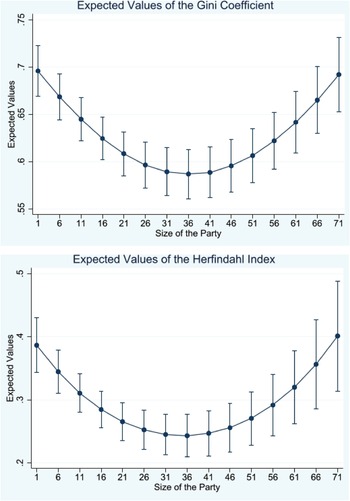
In order to obtain an indication of the substantive size of the effects of size of the party, I report the expected values of the Gini coefficient and the Herfindahl index in Figure 1, as the values of party size vary. The other variables take on their mean values. As shown, these effects are not only statistically significant, but also meaningful. The values of the Gini coefficient and the Herfindahl index diminish substantially as the size of the party approaches an intermediate value (around 36 per cent of seats). Figure 1 confirms that the smallest and largest parties concentrate relatively more their legislative specialization.Footnote 24
Expected values of the Gini coefficient and Herfindahl index as size of the party varies.

4.2. Robustness checks
These results are robust to any change in the specification of the estimation. I adopt several strategies to evaluate the robustness of the results reported in Table 1. First, I take advantage of a fractional response regression model that employs party-clustered standard errors to examine if the inference is altered. As in all the robustness checks, each pair of models evaluates the two dependent variables of this study: Gini and Herfindahl indexes. The results from similar models to those of Table 1 confirm the validity of the hypothesis of this study.Footnote 25 Second, I use (party, legislative period, and country) fixed effects to examine whether or not party, legislative period, or country characteristics distort the significant effects of the key variables measuring the size of the party and the square of the size of the party on legislative specialization. I find that the effect of these variables is robust to this model specification.Footnote 26
Third, I include a measure of district magnitude to evaluate whether or not this systemic trait of the electoral system alters the significant effects of party size on legislative specialization. District magnitude has been found to be a powerful predictor of party system fragmentation, being district magnitude and party system fragmentation positively related (Amorim Neto and Cox, Reference Amorim Neto and Cox1997; Roberts Clark and Golder, Reference Roberts Clark and Golder2006). Moreover, previous studies suggested that electoral systems, which are strongly determined by district magnitude, help explain why parties target a specific or broad range of voters (Cox, Reference Cox1990; Myerson, Reference Myerson1993). This tendency might also create distortions in the degree of concentration of legislative specialization. The results of the econometric analysis indicate that increases in district magnitude are associated with reductions in the concentration of legislative specialization resembling those of party system fragmentation. However, this effect does not appear to be statistically significant, suggesting that district magnitude could be related to the concentration of legislative specialization through other effects not captured by legislative fragmentation.Footnote 27
Fourth, I calculate a second Gini coefficient for every party by weighting every policy jurisdiction differently, employing the percentage of bill initiatives in every policy jurisdiction. This considers differences in the relevance of each policy jurisdiction in the legislative agenda to evaluate whether these variations could alter the validity of the hypothesis. The idea is to control for the biases that these variations might create for the estimations. For instance, some policy jurisdictions might be more important in some countries than in others (i.e. mining in Chile and Peru or security in Colombia). I rerun model 1 reported in Table 1 with this second type of Gini coefficient as the dependent variable. The results are very similar to those displayed in Table 1: both variables party size and party size square are statistically significant and present the expected sign.Footnote 28
Fifth, I employ all bill initiatives including those affecting only the interests of a single electoral circumscription.Footnote 29 The new results remain very similar to those displayed in Table 1. Sixth, I run two specifications in which I exclude the smallest parties (parties holding control of 1 per cent or less of seats). Legislators in these parties might not be able to choose among different policy jurisdictions as their capabilities are substantially reduced. When the smallest parties are excluded from the sample, the results still confirm the hypothesis of this study.Footnote 30 Seventh, I run panel data models with random effects to determine whether or not time series effects could distort the results. I lag the dependent variable and include it as an additional covariate to capture dynamic effects in the specifications.Footnote 31 The key results of this study are robust to this alternative specification. Finally, I run a post-stratification econometric model designed to adjust the sampling weights considering the unequal sampling across countries. This method decreases the bias due to underrepresented countries in the sample. The results of this econometric model once again confirm the results previously reported.Footnote 32
5. Conclusions
This study demonstrates that the smallest and largest parties (relatively) tend to choose higher degrees of concentration of legislative specialization in order to maximize support. In a similar manner, medium-sized parties also optimize by selecting lower levels of concentration of legislative specialization. The selection of these strategies can produce important effects on the types of linkages parties hold with voters. Previous studies already report that in relatively more fragmented party systems, parties own fewer issues (usually at most one or two issues) than in two-party systems, and most of the policy issues are not owned by any party (Petrocik, Reference Petrocik1996; Walgrave and De Swert, Reference Walgrave and De Swert2007; Bélanger and Meguid, Reference Bélanger and Meguid2008). My study sheds light on the causal mechanisms that could explain why this occurs. In particular, legislative fragmentation might help explain differences in the content of information that legislative bodies provide to voters. As the concentration of legislative specialization increases, voters might increasingly learn about programmatic differences among political parties. Under this scenario, credibility and generation of information are more likely to increase in a polity with programmatic parties; and this goal might become less costly under less fragmented party systems.
In particular, greater levels of concentration of legislative specialization could lead to a faster formation of programmatic linkages with voters. I recommend that further research be conducted to analyse whether this is the case. If further research confirmed this finding, and the formation of programmatic linkages was desirable, policymakers and politicians might evaluate the adoption of key institutional reforms to increase the degree of concentration of legislative specialization for achieving greater programmaticness. While niche parties – more commonly found in proportional systems – can survive, even grow, and respond to the specific demands of certain voters; the largest parties – more prevalent in majoritarian systems – could respond with greater emphasis to certain policy agendas. If the latter type of response was normatively preferable, reductions in district magnitude shall lead to make this outcome relatively more common. An important benefit of low levels of district magnitude is that the presence of the largest parties might boost responsiveness in the long term, in case the formation of programmatic linkages was confirmed. However, some degree of responsiveness to short-term demands might also be desirable, and those might be relatively lower for the largest parties as medium-sized parties might respond with greater emphasis to short-term and salient demands. These normative trade-offs deserve further analysis.
Supplementary material
The supplementary material for this article can be found at https://doi.org/10.1017/S1468109923000245 and https://dataverse.harvard.edu/dataset.xhtml?persistentId=doi:10.7910/DVN/BRZ5U7.
Acknowledgments
I thank Dr. Eduardo Alemán, Dr. Ernesto Calvo, Dr. Peter Kingstone, Dr. Susan Scarrow, and Dr. Jonathan Slapin as well as anonymous reviewers of the JJPS for their valuable comments on prior drafts of this article.
Competing interest
None.