INTRODUCTION
Neospora caninum is an intracellular protozoan parasite which causes the disease neosporosis. Neospora infection is primarily associated with abortions in cattle (Thilsted and Dubey, Reference Thilsted and Dubey1989) and hind limb paralysis in dogs (Dubey et al. Reference Dubey, Carpenter, Speer, Topper and Uggla1988; Barber and Trees, Reference Barber and Trees1996). It is estimated that worldwide economic losses attributed to N. caninum-induced abortions run into hundreds of millions of dollars per year (Dubey et al. Reference Dubey, Schares and Ortega-Mora2007). An efficacious vaccine is currently unavailable (Reichel and Ellis, Reference Reichel and Ellis2009). Domestic dogs (Dubey et al. Reference Dubey, Carpenter, Speer, Topper and Uggla1988), coyotes (Canis lupus dingo) (Gondim et al. Reference Gondim, McAllister, Pitt and Zemlicka2004a), wolves (Canis lupus) (Dubey et al. Reference Dubey, Jenkins, Rajendran, Miska, Ferreira, Martins, Kwok and Choudhary2011) and dingoes (Canis latrans) (King et al. Reference King, Slapeta, Jenkins, Al-Qassab, Ellis and Windsor2010) have been identified as definitive hosts to date, while many domestic and wild mammal species have been identified as intermediate hosts (Gondim, Reference Gondim2006). Intermediate hosts become infected either by ingesting oocysts shed in the feces of final hosts (De Marez et al. Reference De Marez, Liddell, Dubey, Jenkins and Gasbarre1999; Gondim et al. Reference Gondim, Gao and McAllister2002) or by hunting and scavenging tissues from infected hosts (Gondim et al. Reference Gondim, Gao and McAllister2002, Reference Gondim, McAllister, Pitt and Zemlicka2004a). Neospora infection can also be transmitted vertically, a common transmission route in cattle and dogs.
As carnivores are at the top of the food chain, measuring their prevalence of N. caninum can give an indication of the presence of N. caninum infections lower down the food chain (Jakubek et al. Reference Jakubek, Bröjer, Regnersen, Uggla, Schares and Björkman2001; Lindsay et al. Reference Lindsay, Weston and Little2001). However, there is evidence that the level of N. caninum infection acquired by a carnivore varies depending on the intermediate host consumed (Gondim et al. Reference Gondim, Gao and McAllister2002, Reference Gondim, McAllister, Mateus-Pinilla, Pitt, Mech and Nelson2004b; Dubey et al. Reference Dubey, Schares and Ortega-Mora2007). Levels of exposure to the disease in carnivores vary in different habitats also. For instance, dogs have been found to have higher seroprevalence in rural areas where they have more contact with infected bovine tissue (Basso et al. Reference Basso, Venturini, Venturini, Moore, Rambeau, Unzaga, Campero, Bacigalupe and Dubey2001; Antony and Williamson Reference Antony and Williamson2003; Lasri et al. Reference Lasri, De Meerschman, Rettigner, Focant and Losson2004). By investigating which aspects of a carnivore's ecology are associated with the variation of prevalence between and within different species, we can further improve our understanding of carnivores’ role in the epidemiology of bovine Neospora infection.
The wild mammal carnivores found in Ireland are red foxes (Vulpes vulpes), American mink (Mustela vison), European badger (Meles meles), Irish stoat (Mustela erminea hibernica), European otter (Lutra lutra), pine marten (Martes martes), feral ferret (Mustela putorius furo) and feral cats (Felis catus). The aim of this study was to investigate how common Neospora infection is in wild carnivore hosts in Ireland and to use this information in conjunction with the knowledge about the ecology of these animals to identify their role in the epidemiology of bovine neosporosis.
MATERIALS AND METHODS
Collection of samples
Cadavers were collected as road kill, donations by anonymous hunters or donations by other research and wildlife organizations. All samples collected except for red foxes were mustelids. Feral cats were not included in this study due to difficulty in distinguishing feral cats from domestic cats. In total, 109 foxes, 197 American mink, 41 stoats, 36 otters, 12 pine martens and 4 feral ferrets were collected throughout Ireland. Road kill was only collected if it occurred within the last 24 h. Animals from hunters were normally shot or trapped during the night and collected the following day. Wherever possible post-mortem and sampling were carried out immediately, otherwise the animal was stored at −20 °C until the post-mortem and sampling could take place. Blood, brain and fecal samples were made available from 52 badgers, sampled throughout Ireland as part of the tuberculosis testing programme. Fifty pine marten scats collected during a national pine marten census (O’ Mahony, Reference O'Mahony, O'Reilly and Turner2012) and 50 fox heads from throughout Northern Ireland, sampled for a study on rodenticide in non-target animals (Tosh et al. Reference Tosh, McDonald, Bearhop, Lllewellyn, Fee, Sharp, Barnett and Shore2011) were also made available.
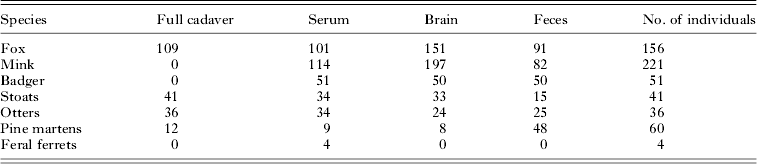
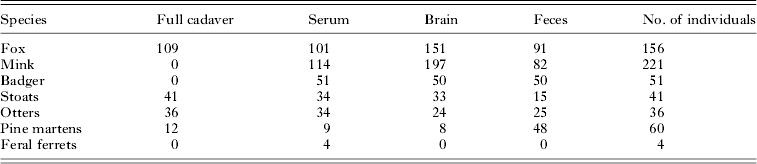
Due to the varying states of condition of the animals collected it was not always possible to retrieve all 3 types of samples required (Table 1). Blood was collected from the body cavities of animals and serum was separated by centrifugation. Fecal samples were extrudated from the rectum. Where it was not possible to obtain enough fecal matter from the rectum, material was extruded from higher up the digestive tract. Whole brain and serum samples were stored at −20 °C, fecal samples were stored at 4 °C until examination.
Number of samples collected for each species of animal
IFAT of serum samples
Serum samples were tested using a commercial indirect fluorescent antibody test (IFAT) according to the manufacturer's instructions (Neospora caninum FA Substrate Slide VMRD Inc, Washington, USA). Neospora caninum positive control – fox origin (VMRD Inc, Washington, USA) was used as a positive control and buffer contained within the kit was used as a negative control. FITC-labelled rabbit anti-fox IgG was used as secondary antibody in the fox assays and FITC-labelled goat anti-ferret IgG for all mustelid samples. Antibodies were used at a dilution of 1:80. All serum samples were first screened at a concentration of 1:20 and if found to be positive were repeated at 1:20 and 1:40. The status of all samples that showed fluorescence was confirmed by a second reader. Samples were only considered positive if fluorescence was observed at 1:40. Any positive serum samples were also analysed for the presence of Toxoplasma gondii antibodies using a latex agglutination test (LAT) (Toxoreagent, Mast Diagnostics, Bootle, UK) according to the manufacturer's recommendations.
PCR analysis of brain samples
Brains were allowed to defrost at room temperature and weighed. Where possible a 200 mg sample was taken from the mid-cerebrum and another 200 mg sample was taken from the corpora quadrigemina. If the brain was too damaged to confidently identify the mid-cerebrum or corpora quadrigemina 2 × 200 mg samples were taken from any tissue that could confidently be identified as brain tissue. This was the case in 30 out of the 151 fox brains, 91 out of 197 American mink brains, 32 of the 50 badger brains, 8 out of the 33 stoat brains, 13 out of the 24 otter brains and 5 out of the 8 pine marten brains.
Neospora caninum DNA was extracted from the tissue samples according to the methods described by Boom et al. (Reference Boom, Sol, Salimans, Jansen, Wertheim-Van Dillen and Van Der Noordaa1990) and McLauchlin et al. (Reference McLauchlin, Pedraza-Diaz, Amar-Hoetzeneder and Nichols1999). To avoid any cross-contamination, the utensils used were either disposable or sterilized by flame alcohol between samples. DNA extractions took place in a separate laboratory to the dissections, in a laminar airflow hood that was sterilized between extractions. Although, McLauchlin et al. (Reference McLauchlin, Pedraza-Diaz, Amar-Hoetzeneder and Nichols1999) used zirconia beads for oocyst disruption in feces, it was found that the beads also effectively homogenized the brain tissue and liberated the Neospora DNA. Detection of N. caninum DNA was carried out by a nested PCR following the method of Buxton et al. (Reference Buxton, Maley, Wright, Thomson, Rae and Innes1998). The targeted region for DNA amplification was the internal transcribed spacer (ITS1) gene region (which can be used to differentiate between N. caninum, Hammondia hammondi, Hammondia heydorni and Toxoplasma gondii, Dubey and Schares, Reference Dubey and Schares2006) using outer primers NN1 (5′-tca acc ttt gaa tcc caa-3′) and NN2 (5′-cga gcc aag aca tcc att-3′) to amplify an external 425 base pair region and inner primers NP1 (5′-tac tac tcc ctg tga gtt g-3′) and NP2 (5′-tct ctt ccc tca aac gct-3′) to amplify the internal 249 base pair region. DNA extracted from placental tissues from aborted calves (kindly provided by Dr Luis Miguel Ortega Mora) was used as the positive control; negative controls were performed in the absence of template DNA. Extractions and PCR on the positive control tissue yielded N. caninum DNA each time they were carried out.
The amplification was carried out in a thermal cycler with 50 μl of a reaction mixture consisting of 0·15 μ m of each primer, 0·2 mm of dNTP mixture, 1·5 mm MgCl2, 400 ng/μl BSA, 1X Buffer (GoTaq Flexi buffer, Promega), 2 units/50μl GoTaq DNA polymerase, Promega and 4 μl of DNA template for the external amplification. The reaction mixture was prepared in a cabinet that was sterilized between preparations with UV light to prevent contamination. For the internal amplification the concentration of the primers was increased to 0·2 μ m and the DNA template concentration reduced to 2 μl. Cycling conditions for the first amplification step consisted of an initial denaturation at 95 °C for 5 min followed by 45 cycles of denaturing at 94 °C for 1 min, annealing at 48 °C for 1 min and extension at 72 °C for 1 min. The second amplification step was identical except that both annealing and extension times were shortened by half. For both PCR assays the final extension was carried out at 72 °C for 5 min.
The presence of the N. caninum product was visualised by a 2% agarose electrophoresis gel using SYBR Safe DNA gel stain fluorescence (Invitrogen). PCR was repeated on all positive samples to ensure they were not a result of contamination. All positive samples were purified using a High Pure PCR product purification kit (Roche) and sent to be sequenced (GATC, Germany) for confirmation that they were N. caninum and not another cross-reactive species.
PCR analysis of fecal samples
The methods employed to test the fecal samples for N. caninum depended on the amount of fecal matter available. If less than 1·7 g of faecal material were present in the sample, DNA was extracted directly from 0·2 g of the feces. If over 1.7 g of faecal material were available, samples were first screened microscopically for the presence of N. caninum oocysts following concentration by flotation in Sheather's sugar solution (sp. gr. 1·18 at 4 °C). If oocyst-like structures were detected, DNA was extracted and screened using PCR. In the case of otter fecal samples, DNA was extracted directly from 0·2 g as its jelly-like consistency prevented reliable flotation of oocysts. The DNA extraction technique and PCR assay used were the same as that used to test the brain samples.
The association between the relative frequency of animals of different species being infected was examined using a Chi squared test.
RESULTS
IFAT of serum samples
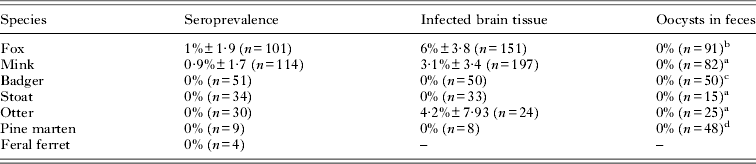
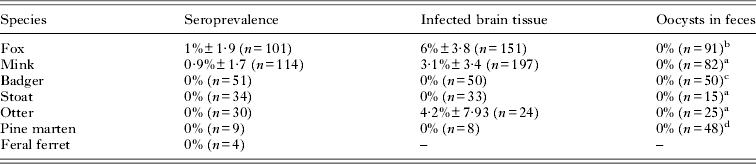
One (0·99%) of 101 red foxes and 1 (0·88%) of 114 American mink tested positive for antibodies against N. caninum using IFAT (Table 2). None of the other samples were positive. One badger serum sample that gave a positive signal at 1:20 but was negative at a 1:40 dilution was considered negative. The fox sample was T. gondii positive with a titre of 1:128, the mink sample tested negative for T. gondii antibody. Negative and positive controls never resulted in false positives or false negatives.
Prevalence of antibodies to Neospora caninum, brain tissue with detectable N. caninum DNA and oocysts in feces of Irish carnivores ± 95% CI
a DNA extracted directly from 200 mg of feces.
b All samples examined by microscopy, DNA extracted from concentrated oocysts from 13 samples.
c All samples examined by microscopy, DNA extracted from concentrated oocysts from 7 samples.
d All samples examined by microscopy, DNA extracted from concentrated oocysts from 2 samples and directly from 200 mg of feces in 6 samples.
PCR analysis of brain samples
Of the 151 fox brains tested N. caninum was detected in 9 (5·96%, Table 2). The majority of positive foxes came from Co. Galway where most of the fox samples (n = 70) originated. Of the 197 mink brains tested N. caninum was detected in 6 (3·05%, Table 2). Only 1 (4·16%) otter out of 24 was found to be positive (Table 2). This animal had been found as road kill on a coast road outside Dungarvan, Co. Waterford. Neospora caninum DNA was not detected in any of the other species sampled (Table 2). Neospora caninum DNA was not detected in the brains of the fox or mink from which antibodies against N. caninum were detected by IFAT. No significant association was detected between the species that tested positive and prevalence (χ 2 = 1·7651, 2 d.f; P > 0·05).
Out of all the 16 infected brains identified, 2 were positive at both the mid-cerebrum and the corpora quadrigemina (12·5%). In 6 (37·5%) only the corpora quadrigemina, but not the mid-cerebrum sample, were positive. While in 5 (31·25%) the mid-cerebrum, but not the corpora quadrigemina sample, was positive. The remaining 3 (18·75%) positive samples were too damaged to confidently identify the different parts. In 2 of these only 1 sample was positive. Negative and positive controls never resulted in false positives or false negatives.
PCR analysis of fecal samples
Neospora caninum DNA was not detected in any of the fecal samples tested (Table 2). Although oocysts, resembling N. caninum, were detected in 28 of the fecal samples this could not be confirmed by PCR. Negative and positive controls never resulted in false positives or false negatives.
DISCUSSION
Brain tissue was used in the present study because Ho et al. (Reference Ho, Barr, Rowe, Anderson, Sverlow, Packham, Marsh and Conrad1997) and Dubey and Schares (Reference Dubey and Schares2006) identified it as the most successful tissue to identify the presence of N. caninum in infected animals. In only 3 (18·75%) of the 16 positive brains could N. caninum DNA be detected in both regions, the corpora quadrigemina and the mid-cerebrum. Therefore, studies testing only 1 area of the brain could result in an underestimation of the prevalence of N. caninum. Hughes et al. (Reference Hughes, Thomasson, Craig, Georgin, Pickles and Hide2008) found these 2 parts of the brain to be most frequently positive in rabbits. The only other molecular study of N. caninum in the brains of Irish foxes, besides the present study, did not detect the presence of the parasite in 148 brains examined (Murphy et al. Reference Murphy, Walochnik, Hassl, Moriarty, Mooney, Toolan, Sanchez-Miguel, O'Loughlin and McAuliffe2007). The targeting of 2 specific regions of the brain in the present study may account for the identification of positive animals. De Marez et al. (Reference De Marez, Liddell, Dubey, Jenkins and Gasbarre1999) found that N. caninum did not have a uniform distribution in the tissue of its host. Ho et al. (Reference Ho, Barr, Rowe, Anderson, Sverlow, Packham, Marsh and Conrad1997) recommended that at least 3 samples of brain tissue from the 1 cow should undergo PCR amplification.
This is the first time that N. caninum has been identified in the tissue of a European otter. Five European otters previously tested for N. caninum antibodies (Sobrino et al. Reference Sobrino, Dubey, Pabón, Linarez, Kwok, Millán, Arnal, Luco, López-Gatius, Thulliez, Gortázar and Almería2008) and 1 tested by molecular methods (Hůrková and Modry, Reference Hurková and Modrý2006) were all found to be negative. The positive European otter in this study was found on a coastal road in Dungarvan, County Waterford. Attempts to ascertain the relative susceptibility of otters living on the coast to infection of N. caninum are difficult, as this was the only otter of the 33 tested that came from a coastal area. As the European otter is threatened internationally (Marnell et al. Reference Marnell, Kingston and Looney2009) a more thorough investigation of the possible exposure of the European otter to disease as a consequence of food and habitat choice is warranted.
That red foxes were found to be hosts of N. caninum in Ireland is not surprising as their most common prey items in Ireland, rabbits and other small mammals, have also been shown to be a host by molecular methods (Hughes et al. Reference Hughes, Williams, Morley, Cook, Terry, Murphy, Smith and Hide2006, Reference Hughes, Thomasson, Craig, Georgin, Pickles and Hide2008; Ferroglio et al. Reference Ferroglio, Pasino, Romano, Grande, Pregel and Trisciuoglio2007; Jenkins et al. Reference Jenkins, Parker, Hill, Pinckney, Dyer and Dubey2007; Thomasson et al. Reference Thomasson, Wright, Hughes, Dodd, Cox, Boyce, Gerwash, Abushahma, Lun, Murphy, Rogan and Hide2011). Carrion, which was also identified in the stomachs of foxes used in this study (Whelan, Reference Whelan2008), is a potential source of infection. Dogs have been observed to become infected after the ingestion of naturally infected bovine placenta (Dijkstra et al. Reference Dijkstra, Eysker, Schares, Conraths, Wouda and Barkema2001). As foxes are commonly observed to take afterbirths during calving (Sleeman et al. Reference Sleeman, Davenport and Fitzgerald2008) and exploit seasonally available food resources (Hewson, Reference Hewson1984), the placenta could be a very important source of infection for foxes.
Gondim et al. (Reference Gondim, Gao and McAllister2002) reported that dogs fed infected calf tissue produced significantly more oocysts that those fed infected mice, suggesting that calves are a more efficient intermediate host. Gondim et al. (Reference Gondim, McAllister, Mateus-Pinilla, Pitt, Mech and Nelson2004b) and Sobrino et al. (Reference Sobrino, Dubey, Pabón, Linarez, Kwok, Millán, Arnal, Luco, López-Gatius, Thulliez, Gortázar and Almería2008) found higher seroprevalence rates in wolves than smaller canids and speculated that this was related to the greater proportion of ungulates in the diet of wolves. Although experimentally infected mice have been shown to infect dogs that ingest them (McAllister et al. Reference McAllister, Dubey, Lindsay, Jolley, Wills and McGuire1998; Lindsay et al. Reference Lindsay, Dubey and Duncan1999), it may be that parasite burdens in naturally infected small mammals are too low to make them an efficient source of infection. The low prevalence of N. caninum observed in foxes in Ireland may be a result of small mammals making up a greater proportion of their diet, in comparison to scavenging from ungulates carcasses or placenta (Fairley, Reference Fairley2001).
This is the first time that N. caninum has been identified in the tissue of an American mink. As this species’ global range is still increasing (Ibarra et al. Reference Ibarra, Fasola, Macdonald, Rozzi and Bonacic2009), it could introduce Neospora infections into new areas and expose immunologically naive animals. The lack of any positive inland European otters in this or other studies (Hůrková and Modry, Reference Hurková and Modrý2006; Sobrino et al. Reference Sobrino, Dubey, Pabón, Linarez, Kwok, Millán, Arnal, Luco, López-Gatius, Thulliez, Gortázar and Almería2008) suggests that the mink may not be coming into contact with N. caninum when hunting in fresh water but, instead, they become infected when searching for food in terrestrial habitats.
Two of the 9 foxes and 1 of the 6 mink that were positive for the presence of N. caninum in their tissue were from the Boora Bog in County Offaly. In contrast, none of the 38 stoats sampled from that area were positive for N. caninum. However, this does not necessarily indicate that stoats are not susceptible to infection by N. caninum. Polecats and other mustelids have been found to be seropositive (Dubey et al. Reference Dubey, Schares and Ortega-Mora2007) and both otters and American mink have been shown to be hosts for N. caninum in this study.
Foxes and mink both generally have greater territory sizes than the stoat. On the other hand, the pooled territory size of the high number of stoats sampled from the area would be expected to compensate against this. Irish stoats primarily prey on small mammals (Sleeman, Reference Sleeman1992; Fairley, Reference Fairley2001). That a specialist predator on small mammals, from an area where N. caninum is known to occur, were not infected, further suggests that naturally-infected small mammals may be inefficient intermediate hosts, or not hosts at all.
Similarly, the lack of N. caninum infection observed in pine martens and badgers may be linked to their omnivorous diet in Ireland (Fairley, Reference Fairley1967; Boyle and Whelan, Reference Boyle and Whelan1990; Fairley Reference Fairley2001; Cleary et al. Reference Cleary, Corner, O'Keeffe and Marples2009), thus limiting their exposure to N. caninum (Melo et al. Reference Melo, Leite and Leite2002). Hůrkova and Modry (Reference Hurková and Modrý2006) also did not detect N. caninum DNA in badgers or pine martens. In contrast, Sobrino et al. (Reference Sobrino, Dubey, Pabón, Linarez, Kwok, Millán, Arnal, Luco, López-Gatius, Thulliez, Gortázar and Almería2008) found both badgers and pine martens to be seropositive for N. caninum in Spain. This may be due to habitat differences between Spain and Ireland, or the presence of wolves in this area of Spain. Wolves being a definitive host for N. caninum (Dubey et al. Reference Dubey, Jenkins, Rajendran, Miska, Ferreira, Martins, Kwok and Choudhary2011) and a provider of potentially infected ungulate carrion, for animals that are ordinarily unable to prey on deer (Selva, Reference Selva, Jedrzejewska and Wojcik2004).
The seropositive mink identified is the first case with detectable antibodies against N. caninum discovered in an American mink. One seropositive fox was also detected. Both originated from regions where N. caninum DNA was also detected in other animals. The N. caninum seropositive mink sample was negative for T. gondii, while the seropositive fox sample was also positive for T. gondii. However, these two parasites are antigenically different (Dubey et al. Reference Dubey, Schares and Ortega-Mora2007) and no significant cross-reactivity between N. caninum and T. gondii when using an IFAT has been observed in other studies (Dubey et al. Reference Dubey, Lindsay, Adams, Gay, Baszler, Blagburn and Thulliez1996; Buxton et al. Reference Buxton, Maley, Innes, Pastoret and Brochier1997). The seroprevalence for antibodies to N. caninum in 0·99% of foxes observed is similar to the low seroprevalence of 1·4% (Wolfe et al. Reference Wolfe, Hogan, Maguire, Fitzpatrick, Mulcahy, Vaughan, Wall and Hayden2001) and 3% (Murphy et al. Reference Murphy, Walochnik, Hassl, Moriarty, Mooney, Toolan, Sanchez-Miguel, O'Loughlin and McAuliffe2007) previously recorded in red foxes in Ireland. These findings are similar to the low seroprevalence in red foxes found in the UK (6% Simpson et al. Reference Simpson, Monies, Riley and Cromey1997; 2% Barber et al. Reference Barber, Gasser, Ellis, Reichel, McMillan and Trees1997; 0·9% Hamilton et al. Reference Hamilton, Gray, Wright, Gangadharan, Laurenson and Innes2005). Interestingly a low prevalence of T. gondii, a biologically similar parasite was also found in red foxes in the UK (Smith et al. Reference Smith, Gangadharan, Taylor, Laurenson, Bradshaw, Hide, Hughes, Dinkel, Romig and Craig2003). That none of the ferrets were found to be positive may be a result of the small sample size (n = 4) as polecats (the wild type of ferrets) have been found to be seropositive in Spain (Sobrino et al. Reference Sobrino, Dubey, Pabón, Linarez, Kwok, Millán, Arnal, Luco, López-Gatius, Thulliez, Gortázar and Almería2008).
None of the animals that were found to be N. caninum positive when testing DNA extracted from their brains, were seropositive. Many animals available to this study were already frozen and the thawing process may have resulted in the degradation of the serum (Anderson et al. Reference Anderson, Dejardin, Howe, Dubey and Michalski2007) resulting in false negatives. Consequently, these results should be viewed as lower estimates of seroprevalence. Alternatively, antibody levels in the animals that tested positive for N. caninum DNA may have been below the levels of detection by IFAT. Neospora caninum seroprevalence has been observed to increase at lower dilutions in wildlife samples examined by Wapenaar et al. (Reference Wapenaar, Barkema, Schares, Rouvinen-Watt, Zeijlemaker, Poorter, O'Handley, Kwok and Dubey2007). There are no recommended cut-off values for N. caninum IFAT on wildlife, but a 1:40 dilution is the most commonly used (Dubey et al. Reference Dubey, Schares and Ortega-Mora2007). Finally, it has long been established that N. caninum infection may not result in a detectable antibody response (De Marez et al. Reference De Marez, Liddell, Dubey, Jenkins and Gasbarre1999). For instance, experimentally infected dogs shedding N. caninum oocysts and cattle with PCR detectable N. caninum-infected tissue have been found to be seronegative (McAllister et al. Reference McAllister, Dubey, Lindsay, Jolley, Wills and McGuire1998; Lindsay et al. Reference Lindsay, Dubey and Duncan1999 and Dijkstra et al. Reference Dijkstra, Eysker, Schares, Conraths, Wouda and Barkema2001; Ho et al. Reference Ho, Barr, Rowe, Anderson, Sverlow, Packham, Marsh and Conrad1997; De Marez et al. Reference De Marez, Liddell, Dubey, Jenkins and Gasbarre1999). The lack of seroconversion, even in experimentally infected animals, highlights how difficult it can be to detect the infection in naturally infected animals. Jenkins et al. (Reference Jenkins, Parker, Hill, Pinckney, Dyer and Dubey2007) when investigating natural infections also found a higher number of rats (Rattus norvegicus) and feral mice (Mus musculus) to be infected with N. caninum (40% and 10% respectively) when tested using molecular methods in comparison to results from the same animals when testing for antibodies by Neospora aggulation test (NAT) (4·6% and 5·1% respectively).
Based on the findings of this and other studies a nested PCR appears to be more sensitive at detecting N. caninum in wildlife than the IFAT test used, particularly when serum samples may have degraded during freezing and thawing, as is often the case when coordinating sample banks of many wildlife species. However, when DNA examinations are not possible serological surveys are a valuable tool in wildlife studies as long as the results are viewed as conservative.
Despite N. caninum being detected in the tissue of 3 of the host species examined, none of the fecal samples tested positive for N. caninum. Similarly, Almeria et al. (Reference Almería, Ferrer, Pabón, Castellà and Mañas2002) reported 10·7% (n = 122) of red foxes to be positive by PCR for N. caninum but none of the fecal samples to be positive.
If Irish wild carnivores are only intermediate hosts, their predation on small, infected mammals could decrease the levels of N. caninum-infected animals available for consumption by definitive hosts. Hobson et al. (Reference Hobson, Duffield, Kelton, Lissemore, Hietala, Leslie, McEwen and Peregrine2005), in contrast to other studies, found the sighting of wild canids on the farm to be a factor in a lower risk of N. caninum abortion in dairy herds. They speculated that this was associated with wild canids avoiding a farm when farm dogs (a proven definitive host) were present. Moreover, the reduced abortion risk may also have been due to wild canids in the area suppressing the small mammal population. However, as discussed earlier small mammals may not be an efficient intermediate host.
In conclusion, differences in the ecology of animals may be a factor in their levels of exposure to N. caninum. The ability of naturally infected small mammals to infect definitive hosts is a key factor to understanding the sylvatic cycle of N. caninum. This study supports the theory that naturally infected small mammals may be inefficient intermediate hosts. Mustelids are confirmed hosts of N. caninum and therefore should be included in future wildlife studies. The higher sensitivity of molecular techniques means that they should be used instead of serological techniques where possible, particularly when samples have been frozen. Targeting specific areas of the brain when testing for N. caninum will further increase the sensitivity of tests.
ACKNOWLEDGEMENTS
The authors would like to thank all the people who made animals available, notably D. Buckley, L. O’ Neill, W.I.T Mammal group, D. O'Mahony, U. Fogarty, N. McKenna, K. Buckley, R. Carden, P. Sleeman, D. Tosh and E. MacLoughlin and hunters throughout the country. Thanks to S. Hogan, D. Maguire and A. Lawless for advice on microscopy and photography. P. Stuart was partly funded under the Research Stimulus Fund Programme by the Irish Department of Agriculture and Food. Thanks to four anonymous reviewers for comments on the manuscript.