In Egypt … [the Khedive's] own subjects and the Government itself are forced to submit to consular jurisdiction for the trial of claims against foreign defendants. As nearly every state in Europe is represented, there are thus some sixteen or seventeen independent jurisdictions in the country, no two of which administer the same law, and all conflicting with each other and with the native authorities. How justice fares amid such chaos need not be stated.Footnote 1
———James C. M'Coan (1873)Nineteenth-century Alexandria had thousands of Egyptian, European, and Levantine residents with multiple extraterritorial legal identities. This was caused primarily because of the application of a capitulatory legal system that created multiple jurisdictional zones, at the heart of which stood the consulates of each of the capitulatory powers. The capitulations were interpreted and enforced quite differently in Egypt than in lands under direct Ottoman control. In Tunisia and the rest of North Africa there were some regional variations as well; by most accounts “local practices varied widely and wildly.”Footnote 2 In Egypt in particular—which in the mid-nineteenth century was semi-independent from Ottoman centralized control—the practiced capitulatory legal structure was much looser and the Western consulates had more legal authority than in the central Ottoman lands.Footnote 3 This was primarily due to Muhammad Ali Pasha's (r. 1805–1848) policy of encouraging European immigration, and hence business, to come to Egypt. Ali made it much easier for Europeans to gain protégé (protected subject) status. But as Jasper Brinton elaborates, “protection spelled privilege, and the appetite for privilege grew with what it fed on.”Footnote 4 The powers and responsibilities of the Western consuls in Egypt grew well beyond the capitulatory legal structure as practiced in the Ottoman core, making corruption and abuse of privilege more likely. Paradoxically, Egypt's semi-independence from the Ottoman Empire made it more vulnerable to Western legal encroachment and manipulation than were territories more closely integrated with the Ottoman administrative heartland.
The manner with which extraterritoriality was practiced in Egypt effectively gave Western consulates legal jurisdiction over not only their own citizens, but also all of those who were able, through whatever means, to acquire protégé status. In fact, many Alexandrians acquired legal protection from multiple consulates, shifting their legal identities in order to maximize their immediate social and economic interests.Footnote 5 The legal situation in Egypt, especially prior to the 1876 inauguration of the mixed courts, was widely viewed as a “state of judicial chaos.”Footnote 6 The same legal and jurisdictional confusions and ambiguities that made it difficult for local judicial and consular institutions to categorize and hence “deal” with many of the residents of Alexandria, present historians with the equally challenging dilemma: how to account for and “classify” this highly flexible and syncretic society.
Until the last twenty years, nineteenth-century Middle Eastern port cities like Alexandria, Tunis, and Beirut were understudied because historians were preoccupied with large inland cities like Cairo and Aleppo.Footnote 7 In the 1990s, however, there was a sharp increase in studies—most inspired by Wallerstein's world-system approach—that examined the rapid nineteenth-century expansion of Mediterranean port cities.Footnote 8 Though these world-system studies adequately explained the rapid growth of Alexandria (and other Eastern Mediterranean port cities), the cultural significance and the microdynamics of this borderland environment have received relatively little scholarly attention. There have been a few notable exceptions. Robert Ilbert, in his Alexandrie 1830–1930: Histoire d'une communauté citadine, countered this trend by devoting an entire chapter to the “ambiguities of allegiance” in Alexandria and by examining the realities of extraterritoriality and the “multiple identity games” of many late-nineteenth- and early-twentieth-century Alexandrians.Footnote 9 Michael Reimer's Colonial Bridgehead also expertly looked at Alexandrian extraterritoriality, accurately describing it as the “mechanism that did the most to advance European colonial domination of Alexandria.”Footnote 10 Two concurrent articles by Khaled Fahmy took issue with the Eurocentrism of much of the historical and literary work on Alexandria, and suggested archival remedies to represent the largely “silenced” majority of the Egyptian population.Footnote 11 In an engaging microhistory, Maya Jasanoff traced the ambiguous identity of Etienne Roboly, an eighteenth-century Alexandrian resident and the senior dragoman for the “French” consulate.Footnote 12 More recently, Will Hanley has scrutinized colonial Alexandria's working class European and Levantine society through the lens of British and French consulate records, which reveal the interconnections between the consular courts, the mixed courts, and the Egyptian police.Footnote 13 There have also been several excellent studies of Alexandria's memory, its perceived cosmopolitanism, and its representation in literature.Footnote 14
This article expands on these studies by considering some of Alexandria's extraterritorial residents as active players in a greater jurisdictional borderland, which as we will see, extended well beyond Egypt and the Mediterranean world. Temporally, I will mostly analyze the height of this extraterritorial period, from the 1840s until the early 1870s, before the inauguration of the Mixed Tribunal in 1876 and the Ahliyya Courts (people's courts) in January 1884.Footnote 15 I rely on late-nineteenth-century United States consular records, which provide a surprisingly rich amount of data on hundreds of borderlanders who were protégés under the American flag. Because the number of actual American citizens in Egypt was quite small, the various U.S. consulates served as conduits that attracted various borderlanders and other hangers-on seeking protégé status. Also, because the United States was a relatively small power with limited economic and colonial ambitions in North Africa, its consular correspondence was more focused on protégés and less on the grander machinations of colonial great power rivalries.
JURISDICTIONAL BORDERLANDS
In part because of the many similarities between the fluid jurisdictional realities of nineteenth-century Alexandria and borderland society in the American southwest, as has been described by borderland scholars, I set out to examine Alexandria's extraterritoriality through a borderland lens. Broadly, the concept of borderland as used in this paper agrees with Michiel Baud and Willem Van Schendel's definition, which sees the borderland milieu as creating not only “political, social, and cultural distinctions” but also new transnational “networks and systems of interactions.”Footnote 16 Additionally, as Evan Haefeli has elaborated, the borderland milieu is a “place where autonomous peoples of different cultures are bound together by a greater, multi-imperial context.”Footnote 17
Applying a classic borderland model to Alexandria requires adjustments, since most borderland theories are primarily based on terrestrially adjacent borderlines.Footnote 18 Alexandria's borderland, by contrast, was jurisdictionally defined, with each capitulatory power extending economic and legal “protection” over their respective citizens and protégés. Instead of primarily dealing with the interactions of just two national or imperial bodies, Alexandria's borderland encompassed a dozen or more coexisting and at times competing institutions.Footnote 19 Nevertheless, this increase in the number of institutional “players” did not change the basic borderlands milieu, which is characterized by extensive extraterritoriality, cultural hybridity, and evasion of centralized authorities.
Realizing that the heart of Alexandria's and Egypt's borderland society was legal has led me to consider the concept of “jurisdictional borderland” as a productive lens with which to view the complexity and fluidity of Egypt's nineteenth-century heterogeneous population.Footnote 20 Accordingly, I define a jurisdictional borderland as a significant contact zone where there are multiple and often competing legal authorities and where some level of jurisdictional ambiguity exists. Naturally, where jurisdictional borderlands exist, borderland societies thrive in and between the spaces created by multiple jurisdictional authorities. As we will be looking at for the remainder of this paper—primarily through the actions of jurisdictional borderlanders themselves—the scope of nineteenth-century extraterritoriality went well beyond the Ottoman or even the Mediterranean world: it encompassed cities and contact zones across the globe. Indeed, as Laura Benton has expertly shown in her study of law and colonial society, “The territories for which this condition of jurisdictional fluidity was true are so vast and diverse that they can be described as encompassing a global legal regime.”Footnote 21 In fact, “jurisdictional borderlands” can be said to have existed in dozens of precolonial and colonial societies from Morocco to China.
In short, this article focuses primarily on the transnational elements of the Alexandrine borderland, especially the characteristic fluidity of its multi-jurisdictional environment, drawing on several cases of shifting legal identities and extraterritoriality.Footnote 22 Borderlanders thrive in murky legal and political environments. Alexandria's capitulatory boundaries were malleable to the extreme, and allowed many of its residents to masterfully exploit the existing multiple jurisdictional boundaries; some switched their legal identities to suit their socio-economic interests. I will begin by briefly laying out the causes behind Alexandria's rapid expansion into a diverse boomtown, while documenting the cultural and trans-Mediterranean composition of the city. Then I will elaborate on some of the legal mechanisms of the capitulatory legal system that facilitated and encouraged trans-Mediterranean migration. The next section will consider the explicit and implicit roles played by Egypt's consular agents, who were not only borderlanders themselves but, as will be discussed, actively protected and maintained this very borderland milieu. The remainder of the article is devoted to “professional” borderlanders whose very livelihood depended on incessantly morphing their legal identities.Footnote 23 These “legal chameleons” navigated the blurry, indistinct environment of the borderland with ease, often by bending or breaking legal restrictions in order to maximize economic and/or social benefits.Footnote 24
FROM SEASIDE VILLAGE TO MEDITERRANEAN BOOMTOWN
During the Greco-Roman period, and again during the High Middle Ages, Alexandria was a bustling port city, a center for economic and cultural exchange between the northern and southern shores of the Mediterranean. By the late eighteenth century, however, the city had atrophied from an economically significant port city to a small town with significantly less value to the Mediterranean economy. The city's population in 1798 was a mere eight thousand and the urban infrastructure, as documented by Napoleon's expedition to Egypt, barely existed. However, as Egypt's political condition stabilized under the reign of Muhammad Ali, Alexandria experienced an economic, and consequently an urban revival, thrusting the city once again into a significant role in the Eastern Mediterranean economy.Footnote 25
Although the Ottomans named Muhammad Ali viceroy of Egypt in 1805, he did not gain control of Alexandria until 20 September 1807, when his Albanian troops entered the city and replaced an evacuating British military contingent. Muhammad Ali was aware of Alexandria's potential to become an economic gateway to Europe, and he ordered the immediate opening of the western harbor to European shipping. This, as Ali Pasha Mubarak declared in his Al-Khitat al-Tawfiqiyya al-Jadida (1887), “dramatically augmented the amount of trade, increased the numbers of visiting foreigners, and facilitated an upsurge in profits.”Footnote 26 This upsurge in the local economy and the resulting employment opportunities dramatically increased internal and external migration to the city. Alexandria's population ballooned to over 104,000 by1848 and reached 232,000 on the eve of the 1882 British occupation of Egypt.Footnote 27
The exploitation of the port for immediate commercial gains was the focal point of Muhammad Ali Pasha's economic schemes, which led in the process to the urban restructuring of Alexandria. The construction of the Ras al-Tin Palace in 1817 symbolized both the return of centralized authority to the city and the beginning of the Western orientation of the city. The palace, designed and built by an Italian architect, strategically overlooked the western harbor and became the virtual seat of the Pasha's government during the summer months. Alexandria was becoming Egypt's second capital, with Muhammad Ali and his entourage increasingly spending more time there.Footnote 28
Although Muhammad Ali's ultimate objectives were military, his immediate goal was to strengthen the Egyptian economy through the exportation of cash crops like long-staple cotton to European markets. To achieve this, he encouraged the development of commercial agriculture, expanded the infrastructural capacity of the western harbor, and executed significant public works projects essential for the revitalization of Alexandria as the gateway of Egyptian-European trade. These structural changes further integrated Alexandria's (and Egypt's) economy into the world-system, and were a leading cause for the mass migration of thousands of Egyptians, Levantines, and Southern Europeans to the city, transforming it yet again into a large and diverse metropolis.
THE COTTON BOOM AND THE EXPANSION OF THE BORDERLAND
The extraordinary prosperity of Alexandria, produced by the unusual combination of fine crops of cotton, grain, sugar, and beans … shows itself throughout the city. The harbor is crowded with merchantmen, the railway is blocked with trains. Yesterday three long trains all fully laden were waiting outside the city, while others were being unloaded. The big canal is crowded with barges, the business streets are crammed with carts, and all these means of transport are laden with cotton and grain and cotton-seed.
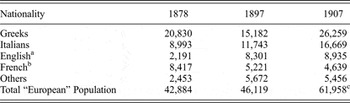
———New York Times, 22 Dec. 1879Alexandria's borderland environment dramatically expanded in the second half of the nineteenth century. An increase in immigration enlarged the city's foreign population tenfold, from 4,824 in 1848 to 49,693 in 1882. This figure was quite large, especially considering that by the early 1880s Alexandria's overall population was some 231,000, making foreign nationals and protégés over 21 percent of the total. The majority of these migrants were Southern European or “Mediterranean Islanders” (see Table 1).Footnote 29
Foreign Communities in Alexandria

Source: Essai de statistique générale (1879), vol. 2, 6; Statistique de l'Egypte (1914), 42.
aA large proportion of the British residents in Egypt were Maltese, who either had British citizenship or were under British protection.
bMany of the “French” residents in Egypt were Levantines, Algerian, or Tunisian (after 1881) who had either acquired French protégé status or French citizenship.
cThe total population of foreign-born residents of Alexandria in 1907 is listed as 65,279.
As I discussed in my introduction, the loosening of the capitulatory legal structure in Egypt allowed Western consulates considerable legal and jurisdictional authority and gave their subjects and protégés exemptions from most local taxes, which was a key factor in encouraging trans-Mediterranean capital flows and migration.Footnote 30 Another important catalyst for this population shift was two economic booms that dramatically increased the demand and price of Egypt's commercial crops. Both market booms were caused by major wars: the Crimean War in the 1850s significantly expanded the demand for and prices of most cash crops, and the U.S. Civil War in the 1860s led to the disappearance of American agricultural exports, especially cotton, from the European markets.Footnote 31
During the American Civil War, the price of cotton quadrupled in the open market, which persuaded cultivators to boost their cotton production and created unprecedented wealth and commercial opportunity. The growth of Egypt's cash crop production, particularly long-staple cotton, ensured the continual expansion of Alexandria, which in turn fostered the need for bankers, merchants, stockbrokers, insurance agents, and speculators, as well as porters, stevedores, day laborers, carriage drivers, waiters, and many other blue-collar workers. This attracted still more Egyptian, European, and Levantine migrants to the city. While these changes augmented the relative wealth of the country, they also magnified Egypt's dependence on international trade and finance. The reintegration of Alexandria into the global market was simultaneously intensified because of advances in transportation and communication technologies. Beginning in 1854, railroads were built across Egypt, which greatly increased the transportation speed of agricultural shipments from the countryside into Alexandria's port. In 1876, the railroad system expanded into Upper Egypt to a total of 2,112 kilometers (1,325 miles). By 1880, the Egyptian railways annually were transporting more than three million passengers and over a million tons of goods.Footnote 32 Alexandria's virtual transformation into an exportation depot, supplying raw long-staple cotton to Europe's factories, increased the relative power of the foreign consulates, and consequently of the city's foreign residents vis-à-vis the Egyptian state.Footnote 33
In 1861, the British placed an underwater telegraph cable connecting Alexandria with Malta, and directly linking Egypt with Europe. Consular communiqués would now take hours instead of weeks to reach their destinations. European consuls took full advantage of these closer communication links and frequently intervened with Khedival authority, at times resorting to gunboat diplomacy. The further integration of Egypt's agricultural economy into the world market increased European economic and political hegemony, which resulted in an almost complete loss of Khedival control over the Europeans and protégés residing in Alexandria. This naturally translated into an even greater control over the city's municipal institutions by its European and Levantine residents.Footnote 34
EXTRATERRITORIALITY AND THE BORDERLAND IDENTITIES OF THE “TRADING” CONSULS
Extraterritoriality as practiced in mid-nineteenth-century Egypt effectively bestowed tangible privileges on most foreigners residing in the country, which expanded the borderland class that was largely exempt from local laws and, more importantly, taxes. The extraterritorial realities gave tremendous powers to the consuls, who not only functioned as agents, lawyers, and judges for their respective subjects, but more significantly for our purposes, also had the power to admit native Egyptians and other non-subjects as protégés with the same legal and taxation privileges as their subjects. In addition to protecting and enhancing their subjects’ and protégés' mercantile and social interests, the Western consuls often banded together to pressure the Egyptian government into granting them favorable concessions. Though on the surface it might appear that these consular officers were compliant agents of the metropole, the reality was much more complex.
The American deputy consul-general, complaining to the U.S. State Department about the insubordination of the U.S. consular agent in Alexandria, declared, “Mr. Salvago disregards his official duties on account of his commercial business and leaves the management of the consulate in the hands of incompetent clerks.”Footnote 35 Indeed, consular representatives like Salvago were labeled “trading consuls”: they were not members of a diplomatic corps and were often unsalaried officers who simultaneously managed their own private businesses, which frequently diverged from their consular obligations.Footnote 36
The perceived disreputable character of these “trading consuls” created an abundance of rumors and gossip regarding all consular agencies in Egypt. Sometimes, the political enemies of a particular consular agent would disseminate such rumors in the Egyptian or foreign press.Footnote 37 There were certainly many opportunities for the agents to make illicit gains. A consular position gave its owner instant immunity from local laws and exemption from most local taxes, and it seems reasonable to conclude that some of these privileged positions were acquired through questionable means. In an effort to describe “the perversions of consular Jurisdictions,” the U.S. consul-general wrote to the State Department that “$1000 was offered by two separate parties in Damiata [Damietta] to obtain the vice consular agency.”Footnote 38
Many of the consular agents in Alexandria, and the rest of Egypt, were borderlanders par excellence, who used the capitulatory system to manipulate their official identities, juggling at times two or three “nationalities.” Most were not natives of the countries they represented, and some were even “native” Egyptians. For example, Belgium's consul-general Etienne Zizinia was ethnically and culturally Greek, Egyptian by “nationality,” and French by naturalization. The U.S. consul-general was amused by the fact that “Mr. Zizinia … was still under the jurisdiction of the French consulate general, in whose tribunal he was actually condemned not long ago in some petty commercial suit.”Footnote 39 In 1865, there was a debate among Alexandria's consuls-general over the election of the head of the Consular Corps. By the usual principal of seniority Zizinia would have gotten the position, but the majority of the consuls-general “objected to recognize as their head a resident merchant not subject to the jurisdiction of the country of which he is the official representative.”Footnote 40 The Zizinia family's business reach extended into other Mediterranean and European port-cities. In Marseilles, Etienne's brother George was not only a successful merchant, but after acquiring French citizenship in 1833, became the city's Greek counsel-general. Pandia Zizinia ran the family's business interests in Odessa and was also the Greek counsel-general there. In 1850, the Zizinia brothers' trans-Mediterranean commercial connection accounted for 7.8 percent of the goods arriving in Marseilles, with twenty-eight ships full of cargo totaling 6,610 tons.Footnote 41 In Alexandria and throughout the Mediterranean, dozens of merchant families, like the Zizinias, relied upon extended-family loyalties and the strategic acquisition of consular positions to expand and enhance their commercial branches across the region.Footnote 42 The Tossizza family, for instance, benefited its mercantile interests through a similar arrangement; Michael Tossizza was the Greek counsel-general in Alexandria and his brother Constantine held the same position in Livorno, Italy.Footnote 43
Not only did “non-nationals” fill many of the consul-general positions in Egypt, but most of the consular agents, dragomans, and clerks employed in Egypt were also local subjects. As documented in an 1837 report to the U.S. State Department, competition among Egyptians and Levantines for consular positions was fierce, and often involved money or gifts changing hands:
The exemption from the despotism of the local government is of such value to Rayahs [local subjects] that they are always anxious to enter the service of a consulate in any character; and in many instances, especially where they are debtors, or liable to punishment, they will pay considerable sums for a situation to those who can give them. It increases their personal standing; and gives them in many things the privileges of a European. This is one source from which a Consul may derive an income; and if he does not wish to appear in it, there are a thousand little delicate attentions, such as tributes of cashmere shawls, diamonds or other choice articles to the ladies, by which a native may make himself agreeable.Footnote 44
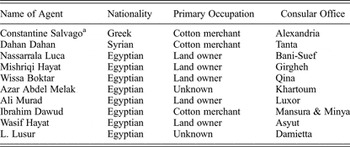
Thus, acquiring the extraterritorial “privileges of a European” was worth a considerable financial sum. Through their “purchase” of employment in a foreign consulate, local subjects were “elevated” to a more advantageous legal and social status. In the 1870s, except for the consul-general, none of the consular agents of the United States in Egypt were U.S. citizens (see Table 2).
“Foreign” United States Consular Agents in Late-Nineteenth-Century Egypt

Source: USDS, Dispatches, dispatches nos. 36, 31 July 1876, and 66 and 117, 6 Apr. 1877.
a Like the Zizinias, the Salvago family was involved in international trade. In 1870 the Salvago merchant family had eight ships carrying 2,789 tons of cargo berths in Marseilles. See Harlaftis, History of Greek-Owned Shipping, 90.
Many well-to-do Egyptians, mainly cotton merchants and large landowners, desired and successfully acquired consular positions. For some of them, acquiring these consulate positions was a family affair. The U.S. consul in Asyut was the prominent landowner Wasif Hayat, his son was the German consul, and both consulate operations were run from the same building. Wasif's brother Mishriqi was the U.S. consul in Girga.Footnote 45
In April 1877, responding to inquiries from the State Department, the U.S. consul-general wrote a long and detailed report ascertaining “what personal benefits were derived by the agents from their official positions.”Footnote 46 The report pointed to three important ones: The first was an automatic increase in social status, since the position of consular agent placed the holder “at least on a level with the highest local officials” and gave them easy access to the local elites, who were “generally on familiar social terms with them and were thereby enabled easily to adjust matters of difference and arrange any business affairs.”Footnote 47 A second advantage was that a position shielded the holder from a “considerable amount of irregular taxes demanded under various pretext by the Janissaries and other services and agents of the governors and other persons in official positions.” Lastly, the agents in practice had almost total immunity from local laws and prosecution.Footnote 48 These benefits motivated many Egyptians, Levantines, and Greeks to obtain consular positions, and in the process they became de facto legal borderlanders with all of the social and economic benefits of extraterritoriality.
JURISDICTIONAL FLUIDITY IN THE BORDERLAND
Becoming a consular agent or employee was not the only way to acquire extraterritoriality, and many Alexandrians were adept at playing the jurisdictional identity game to suit their immediate interests. The borderland milieu allowed for such manipulations by providing the perfect murky environment with multiple, often competing, sources of legal and political authority. The capitulatory system, as practiced in Egypt, enhanced this reality by allowing each consulate to function almost as its own independent state, complete with separate legal institutions.
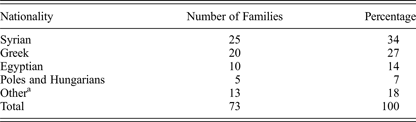
Consulate protection was granted not only to nationals, but also to non-nationals. Thousands of borderlanders from Greek, Maltese, Levantine, and Egyptian backgrounds sought the legal and economic protection that larger powers like France, Britain, Austria, and Russia could provide. Even the United States, a relatively small power in the mid-nineteenth century, had non-citizens under its protection; in 1867, its consulates in Alexandria and Cairo listed seventy-three families under their legal jurisdiction.
The U.S. State Department was wary of granting consular protection to non-citizens, and periodically discouraged the consul-general from continuing the practice, but the consuls-general always defended their authority to bestow protégé status.Footnote 49 In an 1866 letter to the U.S. secretary of state, the American consul-general in Alexandria, Charles Hale, conveniently linked the continuation of a capitulatory system to the promotion of American diplomatic prestige: “But if at the same time we had dismissed a number of protégés who had been accepted, recognized and protected by my predecessors, for a long series of years, I knew it would be reported to every European Government that we felt ourselves too weak in the midst of our war at home, to maintain our responsibilities here.”Footnote 50
Hale also forwarded to the State Department several petitions, signed by many of the American protégés in Egypt, pleading for continued American protection. He reminded the secretary of state that many of the protégés were “contributors to the fund for the relief of the widows and children of the United States soldiers during the late war.”Footnote 51 Protégés often made such patriotic gestures to the State Department during moments of national crisis, and especially during national holidays, often with the encouragement of the local consul. Though such actions may appear cynical, they were deemed important to “demonstrate” the protégés’ sympathies toward the United States.
Families Protected by United States in Alexandria and Cairo (1867)
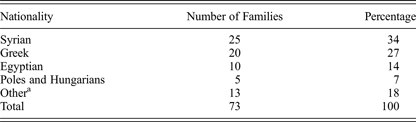
Source: USDS, Dispatches, dispatch no. 81, 15 Apr. 1867.
aThis group includes Russians, Macedonians, Moroccans, and Tunisians.
The degree with which many of the consuls-general and consuls defended the capitulatory system, often going against direct State Department policies, suggests that some of them gained illicit economic advantage by doing so. Though this would be difficult to prove, why else would these agents spend so much time and effort lobbying for a continuation of the protégé system? Perhaps the best indicator of foul play was Charles Hale's repeated reassurances to the State Department that he “received no benefit or advantage” from the protégés and that he “always encouraged their voluntary withdrawal.”Footnote 52 Hale, in particular, had a questionable reputation, and he was frequently accused of corruption in the American and the Egyptian foreign language press. For example, on 29 April 1869, the New York Herald wrote: “It is rumored here in well-informed circles that the corruption which has long been known to characterize all the European counselor agencies in Egypt has at length reached that of the United States. Our counsel, Mr. Charles Hale, has, it is said, been granted a salary by the Viceroy.… He forgets that the United States has a vigilant press, and that the American people will not tolerate such conduct in their foreign agents. This matter ought to be thoroughly sifted. If Mr. Hale has taken money he shall be recalled at once.”Footnote 53
Though it is difficult to verify the many charges made against Charles Hale (and we will return to those), we do know that he made many enemies among Alexandria's borderlanders and that they went to great lengths to remove him from office. But whether or not some consuls-general benefited economically from the protégé system is not as important to us here as is the fact that thousands of Europeans, Levantines, and even local subjects succeeded in acquiring protégé status from a dozen or so foreign powers. Even though these borderlanders often had social and economic interests that conflicted with the policies of both the Egyptian government and the foreign powers that granted them protection, many were largely successful in playing different sides against each other in order to maximize benefits to themselves.
It was not only individuals who competed to acquire protégé status; some borderland institutions and even corporate entities lobbied for capitulatory protection. For example, in June 1872, the Societa Artigiana Cosmopolita (Cosmopolitan working tradesmen society) applied to the U.S. secretary of state for consular legal protection. Although individually nearly all of the society's seventy-plus members were already “English, French, Italian, German, Greek” nationals or protégés, the organization as a whole had no extraterritorial rights.Footnote 54 Thus, when the Egyptian government “made an attempt to place them [the organization] under local jurisdiction,” the group members, as an organization, attempted to attain extraterritorial privilege. By becoming “incorporated” as an American corporate entity, the society would not only benefit from local legal immunity, but perhaps more importantly, it would also be exempt from most tax responsibilities.Footnote 55 Alexandria's borderlanders lived in constant fear of being placed under local jurisdiction and thus losing the social and economic benefits of extraterritoriality, and this drove many to undertake extreme measures to maintain their status. Some were so adept at the protégé game that they became “legal chameleons,” continually switching their legal identities to avoid taxation or prosecution by local or even other foreign consular courts.
ALEXANDRIA'S “LEGAL CHAMELEONS”
The very diversity of the nationalities to which the Kindinecos have belonged, may give rise to situations so strange that it would be impossible to reach a solution.Footnote 56
———Zoulfikar Pasha (Egyptian foreign minister) 23 July 1869Some of Alexandria's wealthier borderlanders were unsatisfied by the impermanence of a protégé status and sought to acquire full citizenship through naturalization. Two such Alexandrian residents, Etienne P. Mirzan from Smyrna and Giuseppe Santi from Sicily, traveled to the United States to initiate their naturalization process. Upon receiving their naturalization (Mirzan in 1855, and Santi in 1867), both men and their families continued to live in Alexandria. To these borderlanders, naturalization had nothing to do with living in America, but with maintaining and solidifying their legal borderland status. Santi, for instance, needed American protégé status, and later on citizenship, in order to continue to publish his controversial Italian Newspaper “Popolo” in Alexandria.Footnote 57 Maintaining an extraterritorial legal status in Egypt and living beyond the reach of local taxation and local laws was the primary goal of these professional borderlanders.
The case of two other “legal chameleons,” named Thomas and George Kindineco, spectacularly demonstrates the fluidity and flexibility of Egypt's jurisdictional borderland. Although the “real” legal identities of these two brothers may never be fully ascertained, a reasonably clear picture can be pieced together from the available records. Classified as Ra‘aya, or local non-Muslim subjects, the Kindinecos probably moved to Alexandria from Anatolia or the Levant in the 1840s. They were both wealthy, earning their money from extensive real-estate holdings and from importing timber, light industrial, irrigation, and farm machinery from the West, and especially from the United States.Footnote 58 The two brothers first acquired Greek consular protection, then due to some sort of financial misconduct the Greek consulate withdrew its protection, and subsequently they obtained Austrian protégé status.Footnote 59 In 1859, an Italian businessman named Visetti sued George and Thomas Kindineco through the Austrian consulate, and obtained a judgment for $8,000. To satisfy the debt, the Austrian Tribunal allocated some real estate owned by the Kindineco brothers in Alexandria. Before this legal judgment was executed, however, the Kindinecos renounced their Austrian protection and acquired American consular protection. This placed the brothers outside of the jurisdiction of the Austrian Tribunal, “while the Egyptian Tribunal refused to execute the judgment of a foreign court.”Footnote 60 Mr. Visetti's lawyers, nevertheless, began to pursue the matter with the Egyptian government, who in turn began pressuring the U.S. government. In an angry letter to U.S. Consul-General Sharif Pasha, the Egyptian minister of foreign affairs, took an unusually direct interest in the case of the Kindineco brothers and others with intentionally fluid legal identities: “It is my duty to inform you that the Egyptian government in the future will not recognize as capable of belonging to any other nationality or depending for any cause whatever upon any new protection … Mr. Kindineco who has already been successively local subject, then Austrian, then American.”Footnote 61
Dealing with these “political chameleons” frustrated some U.S. consuls-general as well, whose irritations regarding these issues can be seen through some of their dispatches to the State Department. For example, in a letter to the secretary of state, one of the consul-general's wrote: “I am at a loss to see how a practical distinction can be made; a man cannot be Rayah (Ra‛aya) and Frank at one and the same time.”Footnote 62 The Kindineco case, however, was never settled, in part because the brothers had relatively good relations with past U.S. consuls-general and especially Francis Dainese, acting consul-general in Alexandria from September 1863 until August 1864. A classic example of a “trading consul” and a borderlander himself, Dainese, a naturalized U.S. citizen, was previously the acting consul-general in Istanbul and became de-facto consul-general in Alexandria almost by coincidence. Visiting Egypt in the summer of 1863 for business reasons, he was asked to become the acting consul-general by the severely ailing holder of the position, William Sydney Thayer.Footnote 63 Dainese jumped at the opportunity and while he was in charge, overzealously demanded dozens of reparations from the Egyptian government over alleged economic injuries incurred by American protégés, including the Kindinecos.Footnote 64
Complicating matters even more was a controversial incident that took place on 15 July 1864. On that day, the Egyptian police raided the land of Thomas Kindineco because of an apparent violation involving damage to the ancient underground water cisterns lying underneath his land. Kindineco damaged the cistern while he was apparently testing one of his imported water pumps. While resisting the local police, some of his servants were arrested and his pump was confiscated.Footnote 65 Francis Dainese filed claims against the government and when these were not answered to his satisfaction, he threatened to “strike the national flag and to suspend diplomatic relations” with the Egyptian government.Footnote 66
However, with the arrival of Charles Hale as the new permanent consul-general in Alexandria in August of 1864, Francis Dainese was not only cast aside, but most of his policies and actions were reversed as Hale proceeded to repair relations with the Egyptian government. Hale even seized some of Dainese's property as collateral for a pending legal case against him, sparking a feud between both men that would last for a better part of a decade. After unsuccessfully appealing to the secretary of state, William Henry Seward (1801–1872), Dainese resorted to petitioning both houses of Congress. In 1866, he also published and widely distributed a 112-page book, The History of Mr. Seward's Pet in Egypt: His Acts Denounced, and His Usurpations Condemned by the Courts, which included the entire sixteen-page statement to both houses of Congress and an attached ninety-six-page appendix filled with supporting documents.Footnote 67 In the booklet, Dainese claimed that both Seward and Hale conspired to defraud him, and that the latter was corrupt and in the pay of Khedive Ismail. Eventually Daines was able to get judgments against Hale from both the Washington, D.C. and New York State Supreme Courts, though none of these rulings were enforceable in Egypt.Footnote 68 Eventually, however, those decisions were overturned in an 1875 Supreme Court ruling settling the matter in favor of Charles Hale and the “exercise of judicial functions in civil cases in Egypt was sustained.”Footnote 69
In the short term, the Kindinecos’ fortunes would also take a turn for the worse as Charles Hale would take the unprecedented step of revoking their protégé status. According to Thomas Kindineco, Hale did this deliberately after receiving monetary incentive from Khedive Ismail. In Thomas Kindineco's words, this was carried out in order to “release Ismail Pasha from the payment of an inconveniently large debt” owed to him.Footnote 70 Stripped of their American protégé status, prosecutions by some foreign merchants and the Egyptian government mounted, prompting both brothers to rethink their legal strategy and temporarily leave Egypt in late 1864.
To acquire a more permanent American legal status, Thomas set up his “official” residence in New York City and George bought a house and some real-estate in Washington, D.C. Soon after, they hired lawyers to follow up on their American citizenship paperwork, which they had initiated a couple of years before. Concurrently, and in the same manner as Francis Dainese, Thomas Kindineco and his lawyers petitioned the U.S. Senate and House of Representatives. The start of this petition warrants to be quoted in full:
To the Honorable Members of the Senate and House of Representatives: Your memorialist, the undersigned, Thomas Kindineco, would most respectfully submit to your honorable body that, through the official derelictions of Charles Hale, the Consul General of the United States in Egypt, and in violation of every principle of law and justice, he has been plundered of his large private property—to the utter destruction of a vast enterprise in which many American inventors and machinists are deeply interested—and in their behalf, as well as his own, he prays that Congress, in its wisdom, will take measures for the better protection of American citizens having transactions in countries like Egypt, as well as for the restoration of his personal rights.Footnote 71
Not only did Thomas Kindineco overtly appeal to the larger economic interests of the United States, but his testament to Congress included the supporting statements and signatures of several key American manufactures testifying as to the importance of continuing such transactions with their client for the overall “interests of American invention and commerce.”Footnote 72 There was also, of course, a “consular” certificate signed by none other than Francis Dainese in support of Kindineco's claims. Although it does not appear that the petitioning of congress by either Francis Dainese or Thomas Kindineco achieved any immediate results, the books and pamphlets that were published and the repeated press coverage of the events chipped away at Charles Hale's reputation.
Meanwhile, while waiting to obtain their citizenship papers, the Kindinecos did not stay in the United States; instead they traveled extensively throughout the Mediterranean to pursue their various business interests, returning to New York periodically to fulfill their residency obligations.Footnote 73 During that period, George Kindineco's home was in Florence, which for several years had been the residence of his family, and his brother Thomas resided in Gallipoli. For the duration of their absence, each of the two brothers hired a lawyer to represent his respective business interests in Alexandria. When the Kindinecos became naturalized U.S. citizens on 3 July 1868, they immediately telegraphed their attorneys in Alexandria to prepare for their eventual return to the city. Armed with the news of their clients' naturalization, the two lawyers contacted the American Consulate in order to confirm the Kindinecos' new national status and to file business lawsuits against several “native subjects.” Recounting to the State Department the “unreasonable” demands of the Kindinecos' lawyers, Charles Hale annoyingly declared: “I find great difficulty in dealing with their attorneys, whose demands are exacting and often palpably unreasonable, who are not Americans, and have no acquaintance with American law; whose papers are presented in foreign languages and filled with foreign technical terms, unknown to our law; who are changed from month to month with vexatious capriciousness; and for whose integrity or propriety of behavior the consulate has no guaranty and no jurisdiction to enforce.”Footnote 74
Despite Hale's annoyance with the two lawyers, and his long unfriendly history with the Kindinecos, upon his confirmation of their naturalization status he declared to the State Department that he “should be able to obtain from the Egyptian government a full recognition of them as citizens of the United States with all the privileges incident thereto.” He then proudly affirmed that: “We are strong enough, of course, to force a settlement on any basis which we think just.” Thus, despite the obvious inconvenience of “permanently” reaccepting the Kindinecos under U.S. jurisdiction, demonstrating American power “to force a settlement on any basis” was deemed more important.Footnote 75 The Egyptian government, however, made every attempt to refuse the recognition of the Kindinecos as American citizens on Egyptian soil. The Egyptian Foreign Minister attempted to explain to the U.S. consul that the “very diversity of the nationalities to which the Kindinecos have belonged may give rise to situations so strange that it would be impossible to reach a solution.”Footnote 76 Despite these objections, the Egyptian government finally yielded to the diplomatic pressure and on January 1871, it accepted the status of the Kindineco brothers as American citizens.Footnote 77 Interestingly, the official acceptance by the Egyptian government of the Kindinecos' U.S. citizenship came just a few months after the forced resignation of Charles Hale. It would appear that the repeated attacks on his reputation by Dainese, the Kindinecos, and the press had finally caught up with him.Footnote 78
It is clear from this study that the interests of borderlanders often contradicted state interests. States and their respective institutions are grounded in unambiguously defined absolutes, which a jurisdictional borderland simply does not possess. As borderland players, the Kindinecos were successful in most of their ambitious objectives by aggressively adapting to their environment and when necessary, altering their legal identities to suit their social and economic needs. The Kindinecos were extremely adept at successfully manipulating the local representatives of Greece, Austria, the United States, and the Egyptian government. The American consul-general's repeated declarations to the Department of State of how “the attorneys … of the Kindinecos persecute [him] almost daily with solicitations and enquiries,” powerfully demonstrates this important reality.Footnote 79 Only in a borderland environment were such overt manipulations possible.
CONCLUSION
Legal imperialism is the extension of a state's legal authority into another state and limitation of legal authority of the target state over issues that may affect people, commercial interests, and security of the imperial state. Extraterritoriality was quintessential legal imperialism; it extended Western legal authority into non-Western territories and limited non-Western legal authority over Western foreigners and their commercial interests.
———Turan Kayaoglu, Legal Imperialism Footnote 80Late-nineteenth-century Alexandria was by in large a “cosmopolitan” city, yet the legal infrastructure allowing such a diverse society to take shape was by its nature discriminatory. It is rather ironic that one of the primary vehicles for the development of such a heterogeneous society was the use, and most often abuse, of the extraterritorial legal structure practiced in Egypt in the second half of the nineteenth century. Alexandria's borderland society was built upon an economically exploitative and exclusionary colonial reality. It provided foreigners and protégés with many tax and legal advantages, leaving native Egyptians to shoulder most of the tax burden.Footnote 81 Most Egyptians were rightly resentful of the overall extraterritorial legal system and viewed it as an affront to Egyptian sovereignty.
Like most peoples inhabiting a transnational border region, Alexandria's jurisdictional borderlanders were primarily concerned with maintaining their flexible legal identities, while gaining maximum benefits from the institutions available to them. Many of the “trading consuls” in Egypt were typical borderlanders who effectively used the capitulatory system in order to acquire or maintain the legal and economic benefits of extraterritoriality. Some of these consular agents were native Egyptians who competed for these positions to obtain borderland status; others, like Etienne Zizinia, juggled two or three “nationalities,” while struggling to fulfill their consular obligations.
The Kindineco brothers dramatically demonstrate the fluidity of jurisdictional identity in nineteenth-century Alexandria. The ease with which the two brothers changed their legal identities and manipulated their respective environment is a classic demonstration of the borderland milieu as described by borderland scholars. Except that, in addition to crossing actual physical (usually maritime) borders like other borderlanders, they were also adept at crossing legal boundaries.Footnote 82 Though their particular case was extreme, it is important to note that there were thousands of other borderlanders in Alexandria who profited from the capitulatory system. All forty-two thousand “foreigners” residing in Alexandria in the 1870s, along with the native subjects who were able to acquire protégé status, benefited to some degree from their liminal political and legal status.Footnote 83 By treading their own paths in between the legal and institutional authorities of more than one state, Alexandria's borderlanders—like borderlanders everywhere—found and exploited an ever shifting jurisdictional borderland zone. For better or worse, this borderland community played a prominent and independent role in the shaping of historical events in Alexandria and Egypt as a whole.
With a few noted exceptions discussed in the introduction, historical studies of precolonial Egypt have mostly examined the political centers, either by focusing on the effects that competing European nation states had on Egypt, leading to the British occupation or the role of Khedival authority on Egyptian policies. This approach lumps the unique needs and desires of the foreign and protégé community in Egypt with the policies and objectives of the Western capitals. As the case of the Kindineco brothers clearly demonstrates, jurisdictional borderlanders have their own unique and independent agenda, which often conflicted with many of the competing “national” or imperial positions. Without an allegiance to any single government—be it Egyptian, Ottoman or Western—and living in a peripheral environment with multiple, separate, and often competing “national” institutions, these borderlanders thrived in the jurisdictional spaces created in between multiple authorities. This article merely recounts some extraterritorial cases of only one of the eighteen protégé-granting consulates in late-nineteenth-century Egypt. A survey of the rest of these important institutional actors would undoubtedly reveal a rich and complex web of social and economic interconnectivity, extending to other Mediterranean cities and beyond.Footnote 84
Indeed, jurisdictional borderlands were not unique to Alexandria, but existed in other Mediterranean and even global cities from Morocco to Japan. As Laura Benton has shown in Law and Colonial Cultures, extraterritoriality supplied a legal framework for the creation of a virtually global, albeit colonial, transnational society.Footnote 85 This certainly reflects the realities of many of the borderlanders we observed. By expertly using the existing extraterritorial legal system, the Zizinia family was well established in Marseilles and Alexandria and conducted commercial transactions throughout the Mediterranean and beyond.Footnote 86 Because of their extensive financial and logistical resources the Kindineco brothers navigated the jurisdictional borderland with relative ease, operating economically and legally in over a dozen cities on four different continents.
Finally, as Turan Kayaoglu has shown in his recent book, extraterritoriality functions as a form of legal imperialism. As we have seen, the consular courts were indeed in many ways the “organs of Western legal expansion in non-Western countries.”Footnote 87 However, while the concept of legal imperialism perfectly describes the top-down imposition of Western legal and economic will on the non-Western periphery, it only explains a part of the story. A jurisdictional borderland lens complements this overarching narrative by zooming into the microrealities on the ground and highlighting the agency and independence of the borderlanders themselves, who have their very own immediate interests that are often incompatible with the far-reaching imperial motives of the competing metropoles. None of the borderlanders we looked at saw themselves as vanguards of some imperial claim; they simply worked to enhance their immediate personal and business interests.Footnote 88 Thus, in precolonial Egypt, Western legal expansion was in-part a result of an indirect, irregular chipping away at local sovereignty from a variety of competing, independent, and often contradictory, local and extraterritorial actors. Examining non-Western cities and territories using a jurisdictional borderland lens is one way to achieve a more comprehensive understanding of the interconnected milieu of the late-nineteenth- and early-twentieth-century colonial world.Footnote 89