INTRODUCTION
The common octopus (Octopus vulgaris Cuvier, 1797) is a temperate and subtropical cephalopod, which is found in the Azores at depths of between 0 and ~250 m. The abundance of this species is known to decrease with depth (Sánchez & Martin, Reference Sánchez and Martín1993; Sánchez, Reference Sánchez, Belcari and Sartor1998; Sánchez et al., Reference Sánchez, Belcari and Sartor1998; Terpes & Peristeraki, Reference Terpes and Peristeraki2002), although this feature has never been studied in the Azores.
Octopus vulgaris is an important exploited octopus in the context of the cephalopod fisheries around the world. Examples of trap fishing for octopuses have been described for Portugal (Cunha & Moreno, Reference Cunha and Moreno1994); Spain (Galiza) (Guerra, Reference Guerra1981, Reference Guerra and Lang1997); Spain (Mediterranean Sea) (Sánchez & Obarti, Reference Sánchez, Obarti and Okutani1993); Canary Islands (Hérnandez-García et al., Reference Hérnandez-Garcia, Hérnandez-López and Castro1998); Gulf of Mexico (Withaker et al., Reference Withaker, Delancey and Jenkin1991); Japan (Moriyasu; Reference Moriyasu1983; Anon, 1986a, b, c); Australia (Anon, 1980a,b); and California (Rasmussen, Reference Rasmussen and Lang1997), among others. In the Azores, however, O. vulgaris is mainly exploited unofficially by local snorkelling divers, most of them operating with hooks along the shore, limited to the upper 15 m of depth (Gonçalves, Reference Gonçalves1991). It is known, however, that a subsidiary multi-specific trap fishery usually increases the contribution to the official octopus landings in the Azores, when the octopus abundance increases (Carreira, Reference Carreira2000), although this issue is still poorly understood. For these reasons, information on the true yields of this species in the Azores is rarely obtained. In the early nineties, for example, Gonçalves (Reference Gonçalves1993) estimated that the landing data officially reported on the Azorean fisheries statistics (yearly mean of 17 metric tonnes landed for the period 1948–1992) may have represented only some 5% of the real figure.
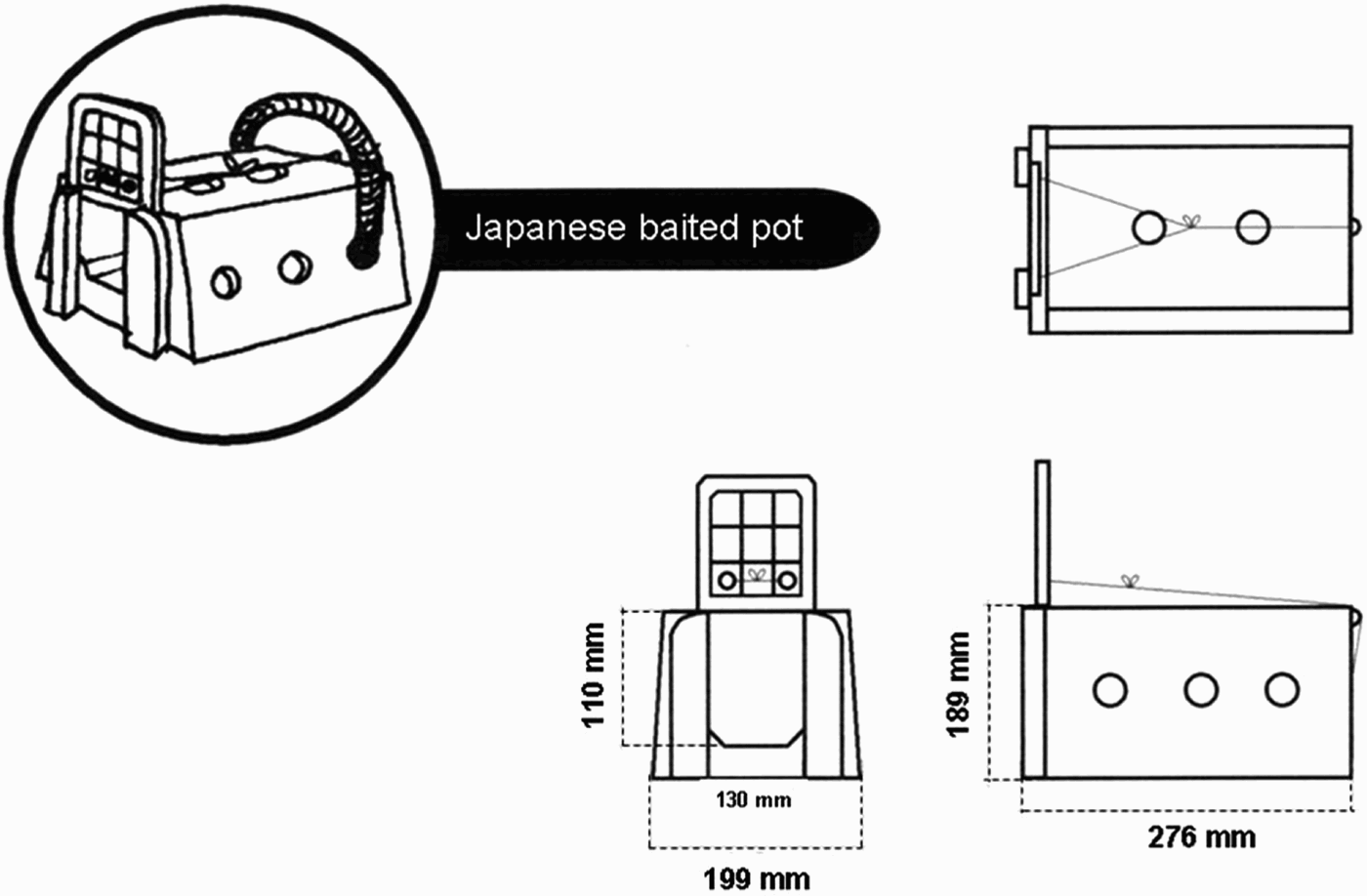
The informal nature of the octopus fishery in the Azores has implied a need for the local development of new fishing gears that prevent the concentration of the fishing effort for octopus to such a narrow habitat range. In this study, we tested a kind of trap that is known to be effective across the Pacific (Okutani, personal communication) but has never before been used in the Atlantic. We will entitle these traps Japanese baited pots (JBPs). These traps combine two appealing features to attract octopuses, providing both shelter and bait. The traps consist of a box, inside which a crab is tied to a string, therefore maintaining the door open. When an octopus enters the box and bites the crab, the box closes, thus preventing the octopus from escape. The JBPs are believed to be highly specific to octopus, and in contrast to what may happen when using the widespread unbaited pots (made of clay, PVC, or plastic), these are unlikely to attract spawning females, which are known to cease feeding shortly before spawning. The objective of this study is to preliminarily test for the suitability of the JBP in catching O. vulgaris in the Azores.
MATERIALS AND METHODS
Japanese baited pots (N = 90) were purchased directly from Yachiyo Co. Ltd, Yokosuka, (Japan). Each trap was made of plastic and is referred by the seller as ‘square large type with lid’, No. 2 (Figure 1).
The Japanese baited pot.

A total of 16 sets, composed of line strings of 21±3 traps (mean±SD) each, separated at regular intervals of 10 m, were performed during March 1998, June 1998 and December 1998 in the channel between Pico and Faial islands (within an area between 38°33.826′–38°35.200′N and 28°32.271′–28°35.540′W), at three target depths (25 m, 75 m, and 125 m). The JBPs were baited with live shore crabs (Pachygrapsus marmoratus). The study area was chosen due to its proximity to Horta harbour, which minimized the operation costs, and for the fact that the area is composed of a sandy-gravel bottom, well suited to operate this type of fishing gear. All sea operations were carried out on board the 11 m research boat LI ‘Águas Vivas’. A minimum overnight immersion was practised for each set; however, larger periods also occurred, especially when difficult sea conditions delayed retrieval of the gear. Replicate sets in each depth were carried out on successive days whenever possible, until a maximum of three was achieved. A total of 337 traps were recovered.
All specimens were sorted and identified to the species level. Subsequently, samples were deep frozen and kept at –20°C for further examination in the laboratory. Once defrosted, each octopus was weighed (total body weight, g), measured (dorsal mantle length, DML, mm) accordingly to standard procedures, and sexed.
Sex ratio (m/f) was computed and tested against the hypothesis of equality between sexes (1.0) through a χ2-test. The percentage of undersized octopuses obtained (750 g) (Reg. EC/N°850/98) was computed. We have included in this category specimens > 700 g instead, given that freezing is known to imply a loss on the total body weight (Gonçalves, Reference Gonçalves1993) in 2.58±0.226% (mean±lc95), increasing with size, up to 50 g. The CPUE was computed as the number of octopuses caught per trap, per hour and multiplied by 100 (no. octopuses/trap/hour *100) for each set. Mean and standard deviations were then computed for CPUE overall and in each target depth.
RESULTS
In total, 13.9% of the traps caught octopuses (for an immersion of 70.3±29.9 hours, mean±SD). The JBPs have shown to be highly specific in catching octopuses, with no by-catch. In one case only did the traps catch a different species, a moray eel (Muraena helena). However, we considered this event as being unusual, given that the trap was still open and the bait untouched.
The overall sex ratio (m/f) obtained was of 1:2, although not significantly differing from 1.0 (χ2 = 0.4658, df = 1, P = 0.4949). The size composition (DML) of the total sample varied between 60 and 220 mm (corresponding to total body weights of 43.4 g and 2603.9 g respectively) with an overall predominance of small animals; 61.7% of the overall sample was composed of animals smaller than 300 g and 25.5% of the sample was composed of specimens of the legal body weight to be sold at the fish auction, with 1280.4±570.3 g (mean±SD). No spawning females were caught during this survey.
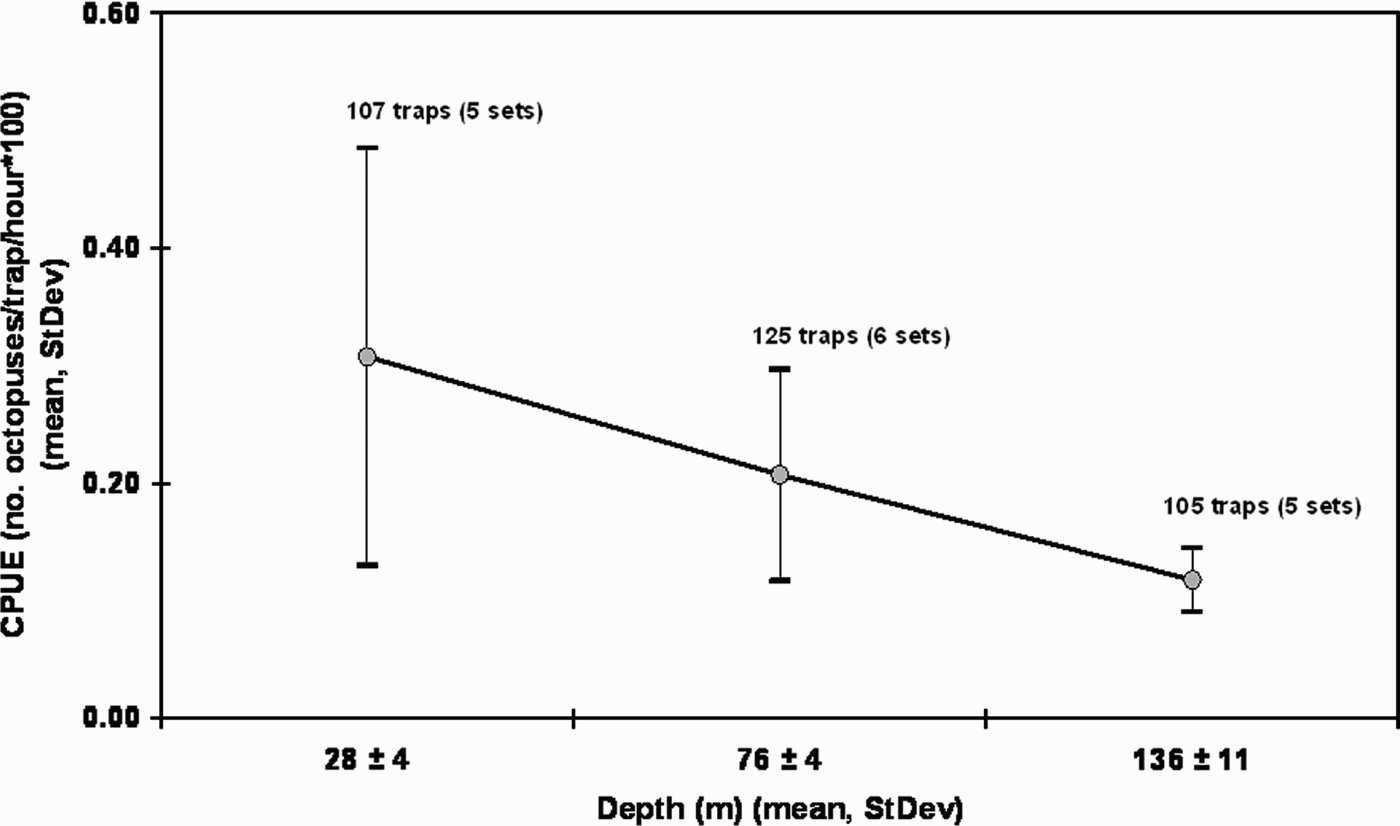
The average CPUE obtained during the experiment was 0.22±0.16 octopuses/trap/hour*100 (mean±SD). The set with the overall maximum CPUE was obtained in June with a value of 0.66 octopuses/trap/hour*100, corresponding to a value of 10.26 octopuses/trap/night*100. The variation on CPUE with depth showed a tendency for a steady decrease, always attaining the maximum values at lower depths (Figure 2). The lower depth (28±4 m) showed an average increment of CPUE of 36.6% ±19.7 (mean±SD) in comparison to the next depth below (76±4 m).
Variation (mean±SD) of CPUE with depth for Octopus vulgaris caught by JBPs in the Azores.

DISCUSSION
As expected, JBPs have shown a high specificity for octopuses. Our results showed a decrease of abundance (CPUE) with depth, which has also been recorded for this species across other geographical locations (Sánchez, Reference Sánchez1986; Sánchez & Martin; 1993; Sánchez et al., Reference Sánchez, Belcari and Sartor1998; Terpes & Peristeraki, Reference Terpes and Peristeraki2002), and when using distinct fishing methods.
A quarter of the total catch obtained with JBPs was of the legal marketable size. Furthermore, we noticed that, after being caught by JBPs, the animals not suited to be sold at the fish auction could have been delivered back to the sea in good condition, given that the JBP carry the advantage of keeping the octopuses safe from predators. We further suggest that this method may also be seen as a suited supplier of undersized specimens for aquaculture, especially considering the growing attention that this economic activity is currently experiencing in the Azores (First Workshop on Developing a Sustainable Aquaculture Industry in the Azores, 2–5 June 2008, Horta-Faial, Azores). This practice would, however, require a change to the policy currently enforced, which does not allow for the marketability of undersized octopuses. On the other hand, the JBP size may be adapted in order to become more effective in catching the required sizes, according to the type of market.
This study indicates that more attention is deserved by the JBP in the future. The absence of by-catch in JBPs further proves these traps as suitable for a mono-specific fishery. However, even if a more complete evaluation of the JBP is made to check for the potential of an octopus fishery solely based on these traps in the Azores, high yields must not be expected, since the area locally available for such a fishery, primarily located around the islands and seamounts, is very limited (approximately 2500 km2 of bi-dimensional area). A gradual development of such a fishery must be based on prior management measures (small fishing effort, starting from a well controlled number of fishing permits) and through the enforcement of data collection on biology and fishing effort. Thus, to assess for the potential of this species for exploitation by a trap based fleet, its stock assessment must be undertaken before any fishery occurs. We consider that, given the reasons stated above, the JBP may be suited for the development of a promising methodology to estimate the octopus abundance and population size, after some methodological aspects are decided, as per what has been used for crustacean stock assessment studies elsewhere (Eggers et al., Reference Eggers, Rickard, Chapman and Whitney1982; Defeo et al., Reference Defeo, Little and Barea1991; Waller et al., Reference Waller, Perry, Trigg, Mcbee, Erdman and Blake1995; Aedo & Arancibia, Reference Aedo and Arancibia2003). Such a method would be particularly applicable in the Azores and similar regions (islands of Madeira, Canaries, Cape Verde or São Tomé e Principe), where this species is exploited, although reliable fishing statistics and accurate estimates of the actual fishing effort are not generally available, despite the fact that these are the preferred input data generators for stock assessment models.
ACKNOWLEDGEMENTS
This study was supported by the Regional Government of the Azores, by the RIVA Grant (Recursos de Invertebrados Marinhos dos Açores). Gilberto P. Carreira benefitted from two scholarships provided by the Portuguese Foundation for the Science and Technology (FCT) (PRAXIS XXI/BM/13047/97 and PRAXIS XXI/BTI/22308/99). The latter was part of a grant funded by FCT (CORRAM–PRAXIS XXI/2/2.1/MAR/1707/95; POCTI/CTA/1707/95). We are indebted to several colleagues, who helped us throughout all the field and laboratory work: Paulo Martins; Humberto Rosa; Miguel Machete; Ana Paixão; Sara Magalhães; Jorge Fontes; José Gabriel; Sr Raposo; Luís Rosa, Marco Rosa, Marco Santos, Tiago Guerreiro. We would like to thank Christopher Pham for the suggestions given during the preparation of this manuscript. We are also indebted to Dr Okutani, who helped us with the purchase of the traps in Japan.