Acoustic variability refers to variations in dimensions of the speech signal other than linguistic content. For example, the same linguistic information can be spoken by different talkers or at different speaking rates, resulting in what Pisoni (Reference Pisoni1985) has termed variations in indexical, as opposed to linguistic, features of speech. Examining the effects of acoustic variability on first language (L1) and second language (L2) acquisition can have important theoretical and pedagogical implications. Theoretically, such studies can serve to specify how listeners accommodate variations in different indexical features, how indexical information is used by the language learner to facilitate retrieval of recently learned words, and whether the effects of variability differ for L1 and L2 acquisition. Pedagogically, any effects of acoustic variability, such as positive effects of acoustic variability on L2 vocabulary learning (Barcroft & Sommers, Reference Barcroft and Sommers2005; Sommers & Barcroft, Reference Sommers and Barcroft2007), can serve to direct educational practices so as to promote both L1 and L2 language learning.
In the present study, we extend previous results that indicate that sources of variability that affect phonetically relevant properties of a speech signal are retained by listeners and can be used to improve memory for L2 words, whereas phonetically irrelevant properties are either ignored or processed automatically (i.e., without conscious attention or costs to ongoing cognitive processes).Footnote 1 For purposes of the current work, phonetic relevance is defined as an acoustic property of speech signals that listeners of a given language regularly use for speech perception (e.g., formant frequencies in English). Critical to our proposal is that phonetic relevance is language specific; that is, properties of a speech signal that are used for identification in one language may not be phonetically relevant in another language. In the present work, we take advantage of the fact that Zapotec is a tone language (i.e., lexical distinctions are signaled by variations of the fundamental frequency [F0]/voice height/pitch in one or more syllables) to examine whether variability in F0 affects L2 vocabulary learning. Previous work with L1 English listeners, in which F0 variations were introduced by raising or lowering F0 by a constant percentage throughout the stimulus (F0 contour and formant frequency values remained unchanged), has revealed that F0 variability does not affect their ability to learn new L2 vocabulary; this finding was expected given that F0 is not lexically contrastive in English (Sommers & Barcroft, Reference Sommers and Barcroft2007). In contrast, because tone changes in Zapotec can be signaled by the same types of variations in F0 that were used in the earlier study with native English speakers (proportional changes throughout the duration of the stimulus) this type of acoustic variability is phonetically relevant to speakers of Zapotec. Consequently, we expect positive effects of F0 variability for bilingual Zapotec-Spanish listeners learning new L2 (Russian) words but not for Spanish-English bilinguals learning those same Russian words because changes in F0 are lexically contrastive in Zapotec but not in Spanish and English.
PREVIOUS RESEARCH ON ACOUSTIC VARIABILITY
Acoustic variability has been investigated across a variety of areas of language processing and language learning. As discussed in the next four sections, acoustic variability has been assessed for its effects on (a) L1 speech processing, (b) memory for L1 words, (c) learning L2 phonemic contrasts, and (d) learning vocabulary (mostly L2 vocabulary being learned by naïve learners—that is, absolute beginners with no prior study of the L2 in question). Additionally, whereas early research on acoustic variability tended to focus primarily on the talker as the source of variability, subsequent research has expanded its focus by examining other sources of variability, such as overall amplitude, speaking style (different voice types, such as excited or denasalized speech), F0, and speaking rate. Overall, the research indicates that the effects of variability depend on the area of language processing or learning under consideration as well as the particular source of variability used when creating the input to which participants are exposed (Barcroft & Sommers, Reference Barcroft and Sommers2005; Sommers & Barcroft, Reference Sommers and Barcroft2007). When it comes to L1 speech processing and L2 vocabulary learning in particular, an intriguing overall pattern has emerged for L1 English speakers learning new L2 Spanish vocabulary: Talker, speaking-style, and speaking-rate variability have produced one pattern of effects, whereas overall amplitude and F0 variability have produced another. This pattern of findings is summarized in the following sections.
Acoustic Variability and L1 Speech Processing
Many studies on L1 speech processing have demonstrated that presenting words in acoustically varied formats negatively affects performance on L1 speech identification tasks, including vowel perception (Assmann, Nearey, & Hogan, Reference Assmann, Nearey and Hogan1982), word recognition, and word naming (Mullennix, Pisoni, & Martin, Reference Mullennix, Pisoni and Martin1989; Sommers & Barcroft, Reference Sommers and Barcroft2006). Negative effects of this nature have been obtained using talker, speaking rate, and speaking style as sources of acoustic variability. For example, Mullennix et al. (Reference Mullennix, Pisoni and Martin1989) reported that identification of L1 words presented in noise was significantly poorer when the items were spoken by six different talkers than when only a single talker produced all of the stimuli. Sommers, Nygaard, and Pisoni (Reference Sommers, Nygaard and Pisoni1994) extended these findings by demonstrating that speaking-rate variability had similar negative effects on identification of L1 words; identification performance in their study was significantly lower for mixed speaking-rate conditions than for conditions with a single speaking rate.
Initially, the negative effects of acoustic variability were attributed to a mandatory normalization process during which phonetically relevant acoustic cues in the speech signal were transformed or normalized to match canonical representations stored in long-term memory (Pisoni, Reference Pisoni1993). Under this proposal, the poorer identification performance for conditions with acoustically varied formats reflected the additional processing demands needed for normalization in conditions in which indexical properties of the speech signal (e.g., talker characteristics, speaking rate, or speaking style) changed from trial to trial, compared with conditions in which these properties of speech remained consistent. Other research (Goldinger, Pisoni, & Logan, Reference Goldinger, Pisoni and Logan1991; Nygaard & Pisoni, Reference Nygaard and Pisoni1998; Nygaard, Sommers, & Pisoni, Reference Nygaard, Sommers and Pisoni1994), however, has suggested that indexical properties of speech signals are not normalized or removed from representations. Instead, findings from these investigations have suggested that the negative effects of acoustic variability on L1 word identification result from the additional processing required to encode and to store both the lexical and indexical information. According to this suggestion, rather than removing or normalizing acoustic variability, representations of spoken words contain both indexical and lexical information about the speech signal. Moreover, both types of information are transmitted in parallel in the acoustic speech signal, meaning that characterizing a specific acoustic property as either indexical or lexical depends on the nature of the information extracted. For example, formant frequency values are the principal determinant of vowel quality, a lexical characteristic, but they also serve to indicate talker gender (adult males have lower formant frequency values than adult females), an indexical feature.
Acoustic Variability and Memory for L1 Words
Several sets of findings on memory for L1 words (Goldinger et al., Reference Goldinger, Pisoni and Logan1991; Nygaard & Pisoni, Reference Nygaard and Pisoni1998; Nygaard et al., Reference Nygaard, Sommers and Pisoni1994) are consistent with the idea that listeners retain and use indexical information as an additional retrieval cue that can improve memory for L1 words. For example, Goldinger et al. (Reference Goldinger, Pisoni and Logan1991) compared serial recall performance for 10-word lists that were spoken either by one talker or by 10 different talkers (i.e., a different talker produced each word in the list). At a relatively short (i.e., 500 ms) interstimulus interval (ISI), performance was better for the single- than for the multiple-talker condition, consistent with the previous perceptual results demonstrating a multitalker cost in encoding. At a longer (i.e., 4 s) ISI, however, this effect was reversed: Serial recall was better for lists spoken by multiple than by single talkers. Goldinger et al. suggested that the interaction between presentation format (single or multiple talkers) and ISI was a result of the amount of time listeners had to encode and retain talker information; at short ISIs, listeners did not have adequate time to encode and store the indexical (i.e., talker) information and incurred a processing cost in the high-variability condition that was reflected in reduced memory performance. The longer ISI, in contrast, provided listeners with sufficient time to encode and store the talker information, and participants could use this information as an additional recall cue during the serial recall test. Similarly, Mullennix et al. (Reference Mullennix, Pisoni and Martin1989) demonstrated that memory for words spoken by multiple talkers was significantly better than memory for words spoken by only a single talker.
Acoustic Variability and L2 Phonemic Training
Another body of research has examined the effects of acoustic variability on learning L2 phonemic contrasts and, in particular, the English contrast between liquid consonants /ɹ/ and /l/ for native Japanese speakers. Multiple studies have demonstrated the effectiveness of using acoustically varied presentation formats during training for this contrast (Bradlow, Akahane-Yamada, Pisoni, & Tohkura, Reference Bradlow, Akahane-Yamada, Pisoni and Tohkura1999; Bradlow, Pisoni, Akahane-Yamada, & Tohkura, Reference Bradlow, Pisoni, Akahane-Yamada and Tohkura1997; Lively, Logan, & Pisoni, Reference Lively, Logan and Pisoni1993; Logan, Lively, & Pisoni, Reference Logan, Lively and Pisoni1991; see also Hardison, Reference Hardison2003). These findings provide an important extension to the work on acoustic variability and memory for L1 words because they demonstrate that at least some sources of acoustic variability can improve memory for novel phonetic forms. To our knowledge, the talker is the only source of variability that has been examined in this area of research to date.
A seminal study in this area was that of Logan et al. (Reference Logan, Lively and Pisoni1991), in which Japanese speakers were trained to discriminate English /ɹ/ and /l/ using a novel procedure with an increased degree of talker variability, given that previously examined training procedures (see Strange & Dittmann, Reference Strange and Dittmann1984) had led to little success. Participants in the study were trained to identify minimal pairs with English /ɹ/-/l/ contrasts in different positions within a word, such as in word-initial position (lock-rock) and word-medial position (oreo-oleo). A central hypothesis of the study was that talker variability could help the participants to establish “stable and robust phonetic categories that show perceptual constancy across different environments” (Logan et al., Reference Logan, Lively and Pisoni1991, p. 876). Results of the study (based on six participants) were consistent with this hypothesis: The training procedure that included increased talker variability led to small but reliable differences in performance in learning to perceive the /ɹ/-/l/ contrasts based on pretest-posttest comparisons. Logan and colleagues interpreted these findings as suggesting that listeners encode and store talker-specific information in long-term memory in such a way that it improves listeners’ abilities to distinguish between challenging L2 phonemic contrasts such as the /ɹ/-/l/ distinction for L1 speakers of Japanese.
A number of studies have expanded on Logan et al.’s initial findings by examining the effects of talker-varied training not only on perception of the /ɹ/-/l/ contrast but also on both production and long-term retention of the contrast. Bradlow et al. (Reference Bradlow, Akahane-Yamada, Pisoni and Tohkura1999) provides a good example of these extensions. In this study, Japanese speakers were trained using a similar high-talker-variability format as used in Logan et al. (Reference Logan, Lively and Pisoni1991) but were tested on both their receptive and productive abilities 3 months after training. Results based on the evaluations of native English-speaking listeners indicated improved performance levels for both the ability to perceive the /ɹ/-/l/ contrast and the ability to produce the contrast. These findings corroborate the numerous findings that speak to the value of using talker-varied input to train Japanese speakers on this well-known challenging English phonemic contrast.
It should be noted, however, that the type of tasks learners were required to perform in these studies have not, to date, required lexical access, or the activation and retrieval of words within the mental lexicon, on the part of the learners. Determining whether one has heard the word rake or lake does not imply (or require) that one has necessarily accessed a mental picture of a rake or a lake; it simply implies that one has heard /ɹ/ or /l/ as the first phoneme and has distinguished between the two word forms accordingly. The task could be completed with two nonwords (with respect to English), such as resp and lesp. In this case, lexical access of either word would not take place because the words do not exist (in English). In contrast to these studies that did not require lexical access, there are studies on the effects of acoustic variability that use tasks that do require lexical access, such as the studies on acoustic variability and L2 vocabulary learning reported in the next section.
Acoustic Variability and L2 Vocabulary Learning
The most recent development in research on acoustic variability and word learning concerns the effects of different sources of acoustic variability on L2 vocabulary learning among absolute beginners (Barcroft & Sommers, Reference Barcroft and Sommers2005; Sommers & Barcroft, Reference Sommers and Barcroft2007).Footnote 2 To date, studies in this area have examined the effects of five sources of acoustic variability—talker, speaking style, speaking rate, overall amplitude, and F0—on L2 vocabulary learning among participants with no previous study of the target language in question. The studies have focused on L2 vocabulary learning using words composed of phonemes that, for the most part, already exist in the learners’ L1 (English). As is normal in L2 vocabulary learning, however, some novel phoneme learning was involved (e.g., learning the Spanish trilled alveolar /r/ in the word reloj “clock”).
Barcroft and Sommers (Reference Barcroft and Sommers2005) examined the effects of variability in speaking style (i.e., voice type) and talker on the ability of speakers of English with no prior study of Spanish to learn Spanish vocabulary. Speaking style and talker were selected as sources of variability because they represent both intraspeaker (speaking style) and interspeaker (talker) variations that occur naturally. Three levels of variability were examined: no variability (one talker or one voice type), moderate variability (three talkers or three voice types), and high variability (six talkers or six voice types). For both talker and speaking-style variability, speed and accuracy of picture-to-L2 recall and L2-to-L1 translation served as dependent measures. The findings for both sources of variability indicated a positive and additive effect of acoustic variability; listeners were faster and more accurate in both types of recall when they learned the words in acoustically varied compared with acoustically consistent formats. Moreover, performance for learning with high variability was better (faster and more accurate) than for moderate variability, which, in turn, was better than with no variability.
In another study, Sommers and Barcroft (Reference Sommers and Barcroft2007) tested boundary conditions for the benefits of acoustic variability on L2 vocabulary learning by examining three different sources of variability: overall amplitude, F0, and speaking rate. The researchers hypothesized that two of these sources of variability—overall amplitude and F0—may not affect L2 vocabulary learning. This prediction expanded on earlier experiments designed to test the phonetic relevance hypothesis (Sommers et al., Reference Sommers, Nygaard and Pisoni1994) for the effects of acoustic variability on L1 speech processing. According to this hypothesis, listeners will encode and retain properties of the speech signal, such as talker characteristics and speaking rate, that affect acoustic features, such as formant frequencies and transitions, used for phonetic identification. In contrast, sources of variability that do not alter phonetically relevant speech features, such as overall amplitude (which affects perceived loudness but does not alter formant frequencies or other phonetically relevant parameters of the speech signal), either will be ignored or will be processed more automatically.
In applying the phonetic relevance hypothesis to studies of acoustic variability and L2 vocabulary learning, Sommers and Barcroft (Reference Sommers and Barcroft2007) reasoned that if the beneficial effects of talker and voice-type (speaking-style) variability are a result of listeners encoding and retaining phonetically relevant sources of variability, then sources of variability that are not retained (because they are not phonetically relevant—at least for the single-word stimuli tested in the study) should not provide a benefit in recall performance. Consistent with this extended phonetic relevance hypothesis, Sommers and Barcroft (Reference Sommers and Barcroft2007) found that neither variations in overall amplitude nor variations in F0 affected L2 vocabulary learning based on the same dependent variables used by Barcroft and Sommers (Reference Barcroft and Sommers2005). Although F0 contour is an important determinant of sentence prosody and therefore could provide important linguistic information, the stimuli for these experiments were isolated words, and F0 contour was maintained. Fundamental frequency was either raised or lowered by a fixed percentage throughout the duration of the stimulus. This manipulation does not affect acoustic properties of the speech signal that are used for phonetic identification, at least for speakers of a nontone language such as English. Speaking-rate variability, however, produced positive (and additive) effects on L2 vocabulary learning, as also would be predicted by the extended phonetic relevance hypothesis, given that changes in speaking rate alter a number of phonetically relevant acoustic properties including formant frequency transitions.
AN INTRIGUING PATTERN FOR DIFFERENT SOURCES OF ACOUSTIC VARIABILITY
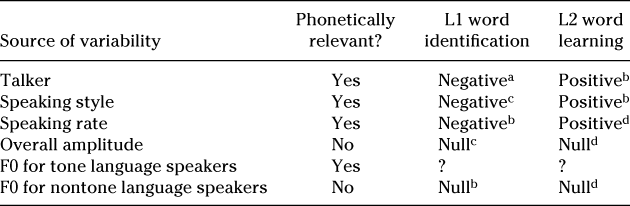
Taken together, the findings of Barcroft and Sommers (Reference Barcroft and Sommers2005), Sommers and Barcroft (Reference Sommers and Barcroft2007), and earlier studies suggest that the effects of acoustic variability on language learning and language processing depend on the source of acoustic variability examined. When it comes to L1 speech processing (as measured by L1 word identification, for example) and L2 vocabulary learning, native English speakers respond very differently to talker, speaking-style, and speaking-rate variability than they respond to amplitude and F0 variability. Table 1 summarizes extant findings with respect to the effects of different sources of acoustic variability on both L1 and L2 word processing. As indicated in the table, the first three sources of variability produce negative effects on L1 word identification and positive effects on L2 vocabulary learning, whereas the last two sources produce null effects on L1 word identification and null effects on L2 vocabulary learning.
Effects for different sources of variability on L1 word identification and L2 word learning

a Mullennix et al. (Reference Mullennix, Pisoni and Martin1989).
b Barcroft & Sommers (Reference Barcroft and Sommers2005).
c Sommers et al. (Reference Sommers, Nygaard and Pisoni1994).
d Sommers & Barcroft (Reference Sommers and Barcroft2007).
The positive effects on L1 word identification and L2 vocabulary learning observed for talker, rate, and voice-type variability, on the one hand, compared to the null effects for variability in overall amplitude and F0, on the other hand, have important theoretical implications for the role of acoustically varied input in language development. In our view, acoustic variability positively affects language development (particularly lexical development, as indicated by current findings) when one is learning a language because acoustically varied input leads to more robust representations of linguistic forms (e.g., lexical forms), which, in turn, increases degree of access and eventual retrieval of forms. As language development proceeds, users continue to process the indexical information contained in acoustically varied input, which, in turn, continues to affect (however slightly for each individual exposure) the canonical representations of linguistic forms stored in long-term memory.
From the perspective of the present framework, for a source of acoustic variability to have such an impact, it must be phonetically relevant because variations in acoustic parameters that do not serve as cues for phoneme identification are not retained as part of lexical representations. For speakers of English, talker, speaking style, and speaking rate are phonetically relevant and therefore produce positive effects on vocabulary learning, both L1 and L2 (noting Sommers, Barcroft, and Mulqueeny’s [2008] demonstration of positive additive effects of talker variability on learning low-frequency English vocabulary among adult native speakers of English). Overall amplitude and F0 variability, in contrast, are not phonetically relevant for single-word identification and therefore do not produce the positive effect on vocabulary learning (when learning a new form) nor the negative effect on speech processing (when processing a previously acquired form). Speakers of a tone language may respond to F0 variability differently, however, given that F0 should be phonetically relevant to them and, therefore, should produce the effects in question—namely, positive effects for learning new words (due to the development of more robust lexical representations) and negative effects for L1 word identification (due to the cost of processing and encoding indexical information).
ADDITIONAL INFORMATION ON F0 AND TONAL CONTRAST
Why F0 Is Contrastive in Some Languages Only
We elected to examine variations in F0 because changes in this parameter are lexically contrastive—that is, the same segmental sequence can be differentiated based on changes only in F0—in some but not all languages. In Zapotec, F0 is lexically contrastive. For example, the Zapotec segmental sequence ruchaa when pronounced with low tones on both syllables /ɾùtʃàː/ means “change,” but when the second syllable has a rising tone, /ɾùtʃǎː/, it means “reheat.” Another example that is commonly cited as an example of tonal contrasts is the segmental sequence ma in Mandarin, which changes from meaning “mother” to “hemp” to “horse” to “scold” according to the F0-based contours used to produce the word. The use of F0 to make such contrasts happens only in a restricted set of languages known as tone languages.
In tone languages, including Zapotec, more than one meaning can be associated with one segmental sequence, with the distinctions being signaled by differences in vocal source (F0) characteristics. For example, in Zapotec, an identical segmental sequence may have one meaning when low tones are used in both syllables but an entirely different meaning if high tones are used in both syllables. A male Zapotec speaker, for instance, might produce the low-tone meaning of the word with a relatively constant F0 of approximately 120 Hz, whereas the same talker might produce the high-tone meaning with a significantly higher F0 (e.g., 145 Hz). For a native speaker of Zapotec, therefore, attending to changes in the values of F0 from presentation to presentation is critical to accurate identification. In a nontone language such as Spanish, in contrast, absolute changes in F0 are not used contrastively; the word lechuga means the same thing (“lettuce”) whether there is an increase, decrease, or no change in F0 from presentation to presentation, and we would not expect native speakers of Spanish to be affected by variations in this parameter of the signal because proportional changes in F0 throughout a single-word stimulus are not lexically contrastive in their L1.Footnote 3
Isthmus (Coastal Plain) Zapotec: The Tone Language in This Study
Zapotec refers to a group of languages and regional dialects within the larger Oto-Manguean family of languages, all of which vary in the type and number of tonal contrasts that they employ. Many varieties of Zapotec are mutually unintelligible; others vary in their degree of mutual intelligibility. The variety spoken by participants in the present study was Isthmus Zapotec, or more precisely, Coastal Plain Zapotec (zapoteco de la planicie costera in Spanish or diidxazá in Isthmus Zapotec), a variety spoken in the Isthmus of Tehuantepec (in Oaxaca in southern Mexico) in cities such as Juchitán and La Ventosa. The ISO 639-3 code for this variety is zai (Pickett, Villalobos Villalobos, & Marlett, Reference Pickett, Villalobos Villalobos and Marlett2010). Isthmus Zapotec has both level and contour tonal contrasts, which makes it an ideal choice for testing the potential positive effects of F0 variability because, in the present study, F0 values, not tonal contours, were varied when presenting target words. Isthmus Zapotec has high, low, rising, and falling tones. Recall one example of how F0 level is used contrastively in Zapotec: The word ruchaa translates as “changes” when low tones are used in both syllables but means “reheat, dry, clean” when using a low tone followed by a high tone (Pickett, Black, & Cerqueda, Reference Pickett, Black and Cerqueda2001). An example of the contrastive use of F0 contour is the word rati, which means “he dies” if a falling tone is used in the final syllable but means “he is thirsty” if a rising tone is used in the final syllable (Redish & Lewis, Reference Redish and Lewis2009). Additional information about Isthmus Zapotec, including demographic information and trends in usage, has been made available by Pickett et al. (Reference Pickett, Villalobos Villalobos and Marlett2010).
F0 Variability in the Current Study
In implementing F0 variability in the current experiment, we closely modeled the general approach used in our earlier work that examined the effects of talker variability on L2 vocabulary learning (Barcroft & Sommers, Reference Barcroft and Sommers2005; Sommers & Barcroft, Reference Sommers and Barcroft2007). Specifically, in the earlier studies, talker variability was signaled primarily by variations in the first three vocal tract resonances (i.e., formants), whereas F0 remained unchanged. The rationale for using this procedure was that considerable evidence is available to suggest that formant frequencies are one of the principal cues that native English speakers (who were the participants in our earlier studies of talker variability) use for vowel identification. In the current work, we implemented the exact opposite pattern of variability in acoustic cues: F0 varied from presentation to presentation, whereas formant frequencies remained unchanged.
PURPOSE OF THE STUDY
According to Sommers and Barcroft’s (Reference Sommers and Barcroft2007) extended phonetic relevance hypothesis, F0 variability should produce positive effects in new word learning among L1 speakers of tone languages that use this parameter contrastively. Recall that, according to this proposal, the acoustic cues that are used for phonetic identification are determined by a listener’s L1 (as well as other languages in which the listener is proficient). Under conditions of variable input, listeners adjust or normalize only for these phonetically relevant cues and ignore or process more automatically sources of variability that do not affect phonetically relevant properties of the speech signal. For speakers of a tone language, therefore, F0 variability may produce positive effects when learning new vocabulary, at least for a fluent user of the language. The propositions described here constitute a challenging test of the extended phonetic relevance hypothesis in that they predict dissociation in the effects of F0 based on the phonetic relevance of tonal contrasts.
The present study was designed to test the extended phonetic relevance hypothesis by examining how F0 variability affects L2 vocabulary learning for Zapotec-Spanish bilinguals as compared to Spanish speakers who do not speak a tone language. Zapotec is a tone language (actually a group of tone languages, as explained previously) in that identical lexical content can signal different meanings depending on differences in the level or excursions of F0. Therefore, F0 variability should be phonetically relevant to Zapotec speakers, and the extended phonetic relevance hypothesis would predict that this source of variability should positively affect vocabulary learning. In contrast, Spanish speakers who do not speak Zapotec or any other tone language should not benefit from F0 variability, as was the case for native English speakers in Sommers and Barcroft (Reference Sommers and Barcroft2007).
RESEARCH QUESTIONS AND HYPOTHESES
The study was guided by the following research questions:
1. What is the effect (if any) of F0 variability on L2 (Russian) vocabulary learning among speakers of a tone language (Zapotec-Spanish bilinguals) as compared to speakers of a nontone language (Spanish speakers)?
2. If F0 variability has an effect, is the effect additive such that moderate variability (three levels of F0) produces more L2 vocabulary learning than no variability (one level of F0) and high variability (six levels of F0) produces more L2 vocabulary learning than both no variability and moderate variability?
If the extended phonetic relevance hypothesis is correct, F0 variability should produce positive effects on L2 vocabulary learning among the speakers of the tone language but not among the Spanish speakers who had not learned any tone language at the time of the study. The Spanish speakers had substantial knowledge of English, as explained subsequently, but English is also not a tone language, so the hypothesis still predicts null effects for this group. We also expected the positive effects of F0 variability for the tone language speakers to be additive, as has been observed in previous studies on talker, speaking-style, and rate variability among L1 speakers of English.
METHODS
Participants
Participants in the study were 18 Zapotec-Spanish bilinguals (10 female) from a region in Oaxaca near the cities of Juchitán, La Ventosa, and Tehuantepec and 24 Spanish speakers (13 female) enrolled in a university in Querétaro, Mexico. None of the 24 participants from Querétaro reported having learned any tone language prior to the study. However, they did have substantial knowledge of L2 English. To enter in the undergraduate engineering program in which they were enrolled, they had to receive a score of 450 or above on the paper version of the TOEFL, and they were required to complete Level 8 (eighth-semester-level English) to be able to graduate from the program. Therefore, the Querétaro participants could be considered as Spanish-English bilinguals, at least to a substantial degree. We will henceforth refer to this Querétero group as the Spanish speakers (to be compared to the Zapotec-Spanish bilinguals). None of the participants from either site reported any extensive knowledge of Russian (one Querétaro participant reported some prior study of Russian but still considered herself to be a novice). Age ranges were 18–45 for the participants from Oaxaca and 18–31 for the participants in Querétaro.
Experimental Words
As in Barcroft and Sommers (Reference Barcroft and Sommers2005), the 24 experimental words were divided into three groups of eight items each. The three groups of target words appear in Table 2. The target Russian words corresponded to the same target referents (e.g., “mushrooms,” “bear,” etc.) used by Barcroft and Sommers (Reference Barcroft and Sommers2005) in their study with target Spanish words, except for four replacements that were made to avoid using excessively easy Russian-Spanish cognatesFootnote 4 and to maintain similar numbers of syllables and phonemes in each word group.
Experimental words
All of the target words had been previously recorded from native speakers of Russian (three male and three female) in a sound-attenuating booth. The elicitation procedures were identical to those used to obtain native Spanish stimuli in Barcroft and Sommers (Reference Barcroft and Sommers2005). Participants were presented with a list of the 24 target words and were asked to produce them in four different voice types (conversational, excited, whispered, and nasalized). Only the conversational recordings were used in the current study. Recordings were blocked by voice type (e.g., all of the conversational productions were recorded followed by all the excited production, etc.), and block order for recording was selected randomly for each participant. The stimuli were recorded using a sampling rate of 44.1 kHz and 16-bit resolution. The root mean squared amplitude of the 24 words from each speaker was equalized prior to presenting them to participants. Twelve new native speakers were then recruited to identify all of the words spoken in a given voice type, with three participants hearing words spoken in each of the four voice types. Stimuli were presented in the clear (i.e., no background noise), and participants were instructed to identify the words they heard. All of the items spoken in the conversational voice type were identified correctly by all three participants in that condition. Thus, the stimuli were CD-quality productions that were readily identified by native speakers of the language.
Using the Praat software package (Boersma, Reference Boersma2001), six new instances of each word were created by changing the F0 of the word produced in the neutral or conversational voice. The six new instances of each word were created by both increasing and decreasing the F0 of the neutral-voice stimuli by 10%, 20%, and 30%. For example, if the unmodified signal had a F0 of 120 Hz at a given time point, the value of F0 was changed to 132 Hz for the 10% increase stimuli and 108 Hz for the 10% decrease stimuli. The changes in F0 were implemented using digital signal processing so as to produce changes in overall voice pitch without varying formant frequencies or transitions. To verify that the formant frequency values had not been significantly altered, formant tracks were generated for the original stimuli and the six variants of each word. The individual formant tracks were used to compute mean formant frequencies for the first four formants of the original version and the six F0-altered variants. In all cases, differences between the original and F0-altered formants were less than 1%.
Procedures
Participants were tested individually according to procedures that have been used previously to examine effects of F0 and other sources of variability on L2 vocabulary learning (Barcroft & Sommers, Reference Barcroft and Sommers2005; Sommers & Barcroft, Reference Sommers and Barcroft2007). Participants completed a learning phase followed by two test phases.
In the learning phase, each participant sat in front of the computer screen and viewed pictures of the to-be-acquired vocabulary while hearing the spoken form of the Russian word for each picture. Each picture appeared on the screen for 5 s. In each case, the target Russian word was spoken 750 ms after the picture appeared. Each participant attempted to learn eight words in each of the following three learning conditions: (a) no variability, or six repetitions spoken at one F0; (b) moderate variability, or two repetitions each spoken at three different F0s; and (c) high variability, or one repetition each spoken at six different F0s.
In each condition, participants heard six repetitions of each of the eight words. Thus, overall number of repetitions and exposure time remained the same for each word in each condition. Order of presentation within a condition was randomized once and that same randomized order was used for all participants. We used the same word order for the six repetitions within a condition to facilitate word learning and to avoid potential floor effects, as we thought it might be difficult for absolute beginners to learn the new word forms within the short time frame of a single experimental session. Words were also counterbalanced across variability conditions such that, for each group of participants, a given word was presented equally often in the no-, moderate-, and high-variability conditions. Order of conditions (no, moderate, high) was also counterbalanced such that, for both groups of participants, the no-, moderate-, and high-variability conditions were presented first, second, and third an equal number of times.
Finally, we also counterbalanced the specific talkers that were presented to listeners in the no- and moderate-variability conditions. Because individual talkers can differ significantly with respect to intelligibility (Bradlow & Pisoni, Reference Bradlow and Pisoni1999), we wanted to ensure that differences across variability conditions were not a consequence of the specific talkers used in a condition. Therefore, for both testing sites, talkers were counterbalanced across conditions such that each talker served equally often as the speaker for the no-variability condition and as one of the three talkers in the moderate-variability condition.
In the no-variability condition, three Zapotec-Spanish participants and four Spanish-speaking participants heard one of the six different F0 values (e.g., for three Zapotec-Spanish and for four Spanish-speaking participants the no-variability condition contained the 10% increase in F0; for another three Zapotec-Spanish and for four Spanish-speaking participants it contained the 10% decrease in F0, etc.). In the moderate-variability condition, half of the participants heard two repetitions each with the following changes in F0: +10%, −20%, and +30%; the other half heard two repetitions each with −10%, +20%, and −30% changes in F0. In the moderate- and high-variability conditions, the F0 level associated with a particular presentation was selected pseudorandomly (i.e., participants always heard the words in the same order, but the F0 level associated with that item was selected randomly without replacement).
The picture-to-L2 recall posttest was administered immediately after the learning phase. All participants performed the picture-to-L2 recall task prior to the L2-to-L1 recall task to avoid additional exposure to the spoken L2 word forms (cues for the L2-to-L1 recall task were the spoken L2 word forms). For the picture-to-L2 recall posttest, the participants attempted to produce the Russian word for each picture. The picture for each target word (the same one used in the learning phase) appeared on the screen in a random order different from the order used during the learning phase. Each picture appeared on the screen for a maximum of 5 s or until the participant provided a spoken response.
The L2-to-L1 recall posttest was administered after the cued L2 recall. For this posttest, participants heard Russian words and were asked to provide the Zapotec (for Zapotec speakers) or Spanish (for the Spanish speakers) translation of each word. The order of the Russian words was a random order different from the orders used for the learning phase and for the picture-to-L2 recall task. Participants were given a maximum of 5 s to provide the appropriate L1 translation for each word they heard. The Zapotec-Spanish bilinguals were allowed to produce target words in Spanish as a default if they could not think of the target word in Zapotec because these participants were advanced bilinguals who were very proficient in Spanish as well.
Scoring
Because they were absolute beginners in L2 Russian, we did not expect the participants tested in the current study to acquire nativelike word forms. We adopted a relatively simple scoring procedure. The criteria used to score the picture-to-L2 recall and L2-to-L1 recall were 1 point for a completely correct production, 0.5 points for a production with errors in a single phoneme, and 0 for all other responses. Thus, for example, a response of /ɡrʲiˈb/ (an actual participant response) instead of /ɡrʲiˈbi/, when presented with the picture of mushrooms, would earn a score of 0.5. Picture-to-L2 productions were scored by a native speaker of Russian who was blind to the level of variability under which the item was learned. Additionally, a heritage speaker of Russian who indicated that all target words were highly familiar and who was blind to condition scored approximately 30% of the productions as a reliability check. Interrater reliability was relatively high (r = .87) prior to discussions between the two raters regarding disagreements in scoring. The two raters disagreed on approximately 2.8% of the productions, with a majority (93%) of the disagreements between assigning a score of 0 or 0.5 (i.e., there was nearly complete agreement for productions that received a score of 1). Disagreements were resolved through discussions between the two raters for all but approximately 0.6% of productions. For these remaining disagreements, we consulted a second native speaker of Russian, and this individual’s determination was used as the final score. In the case of L2-to-L1 recall, the 0.5 score, although remaining part of the scoring protocol, was applied in only 5 out of 1008 cases (0.4%) because participants rarely deviated from the preestablished target L1 phonemes. Blind (to condition) scoring was also used for the L2-to-L1 dependent measure.
Analyses
Scores for picture-to-L2 recall were first submitted to an omnibus ANOVA with condition (no, moderate, high variability) as a within-subjects independent variable and language (Zapotec-Spanish, Spanish) as a between-subjects independent variable. If a significant interaction between condition and language was observed, then we planned to conduct separate ANOVAs to examine the effects of variability independently for the two participant groups. Scores for L2-to-L1 recall were analyzed separately in the same manner described previously for picture-to-L2 recall.
RESULTS
Picture-to-L2 Recall
Omnibus ANOVA
Results of the omnibus ANOVA on picture-to-L2 recall scores revealed a significant interaction between condition and language, F(2, 80) = 5.92, p = .004, η2 = .129, due to the rising mean scores as variability increased for the Zapotec-Spanish bilinguals but not for the Spanish speakers. It also revealed a significant effect of language, F(1, 40) = 222.49, p < .001, η2 = .848, due to the Spanish speakers’ higher accuracy scores overall. The mean percentage accuracy score was 24.35 (SE = 1.21) for the Zapotec-Spanish bilinguals and 48.24 (SE = 1.05) for Spanish speakers.
In light of the significant Condition × Language interaction for accuracy, two additional separate ANOVAs were conducted. One ANOVA was conducted for the Zapotec-Spanish bilinguals. Another was conducted for the Spanish speakers.
ANOVA by Language Group
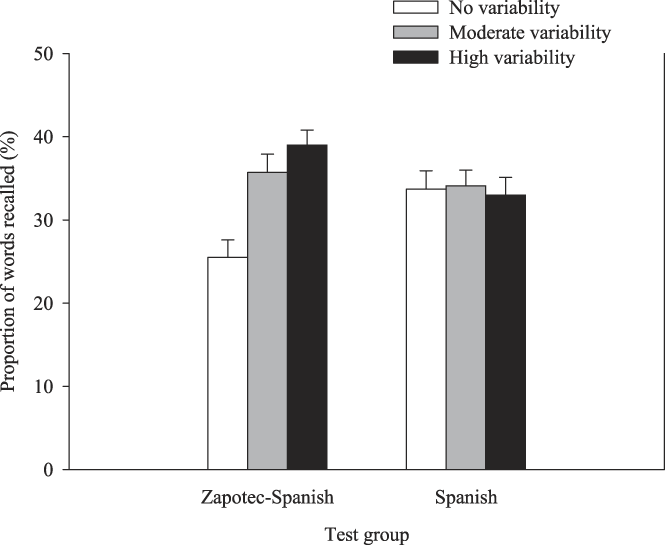
Figure 1 depicts picture-to-L2 recall results based on the proportion of words learned in each learning condition within each group. We present the results in this manner because our main interest was in the relative effect of each learning condition (no, moderate, and high variability) and not in differences in overall performance between the two groups (see the Discussion section for some factors that may have affected overall performance levels).
Proportion of picture-to-L2 recall in low, moderate, and high F0 variability conditions.
Results of the ANOVA on picture-to-L2 recall scores for Zapotec-Spanish bilinguals (left side of Figure 1) revealed a significant effect of condition, F(2, 34) = 12.89, p < .001, η2 = .431. Pairwise comparisons indicated that accuracy was significantly higher in the moderate-variability condition than in the no-variability condition, p = .005, and significantly higher in the high-variability condition than in the no-variability condition, p < .001, but not significantly higher in the high-variability condition as compared to the moderate-variability condition, p = .646.Footnote 5 Results of the ANOVA on picture-to-L2 recall scores for L1 Spanish speakers (right side of Figure 1) revealed no significant main effects.
L2-to-L1 Recall
Omnibus ANOVA
Results of the omnibus ANOVA on L2-to-L1 recall scores revealed a significant interaction between condition and language, F(2, 80) = 3.37, p = .039, η2 = .078, due to the rising mean scores as variability increased for Zapotec-Spanish bilinguals but not for the Spanish speakers. The main effect of language was also significant, F(1, 40) = 126.59, p < .001, η2 = .760, due to the Spanish speakers’ higher accuracy scores overall. The mean accuracy score for Zapotec-Spanish bilinguals was 42.30 (SE = 1.34), and for Spanish speakers it was 62.28 (SE = 1.16). No other significant main effects or interactions were revealed.
In light of the significant Condition × Language interaction for accuracy, two additional separate ANOVAs were conducted. One ANOVA was conducted for the Zapotec-Spanish bilinguals. Another was conducted for the Spanish speakers.
ANOVA by Language Group
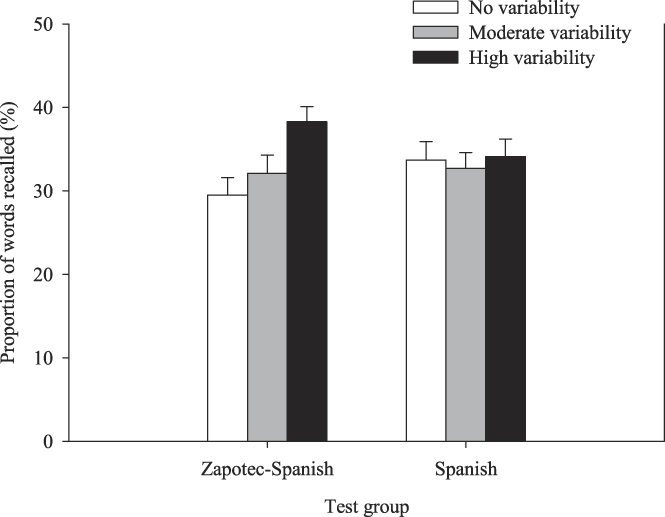
Figure 2 depicts L2-to-L1 recall results based on the proportion of words learned in each learning condition within each group. As with the picture-to-L2 results, we present the L2-to-L1 recall results in this manner because our main interest was in the relative effect of each learning condition (no, moderate, and high variability) and not in differences in overall performance between the two groups.
Proportion of L2-to-L1 recall in low, moderate, and high F0 variability conditions.
Results of the ANOVA on L2-to-L1 recall scores for Zapotec-Spanish bilinguals revealed a significant effect of condition, F(2, 34) = 9.04, p = .001, η2 = .347. Pairwise comparisons indicated that accuracy was significantly higher in the high-variability condition than in the no-variability condition, p = .006, and significantly higher in the high-variability condition than in the moderate-variability condition, p = .008, but not significantly higher in the moderate-variability condition as compared to the no-variability condition, p = .803. No other significant main effects or interactions were revealed. Results of the ANOVA on L2-to-L1 recall scores for L1 Spanish speakers (right side of Figure 2) revealed no significant main effects or interactions.
DISCUSSION
The present study provided a novel test of the extended phonetic relevance hypothesis (Sommers & Barcroft, Reference Sommers and Barcroft2007). According to this hypothesis, increased F0 variability can produce positive effects on L2 vocabulary learning for speakers of tone languages, such as Zapotec, and null effects on L2 vocabulary learning for speakers of other nontone languages, such as Spanish (and English), because the type of F0 variability used in the current study is phonetically relevant to the speakers of Zapotec but not to nontone language speakers. The results of the study support these predictions. The Zapotec-Spanish bilinguals benefitted substantially from F0 variability when learning new L2 (Russian) vocabulary, whereas the L1 Spanish speakers did not. Figures 1 and 2 demonstrate this pattern clearly. The left sides of these figures depict the positive additive effect of F0 variability for Zapotec-Spanish bilinguals, whereas the right sides demonstrate the null effects of F0 variability for the Spanish (and L2 English) speakers. The theoretical and pedagogical implications of these findings, which are consistent with the predictions of the extended phonetic relevance hypothesis, are discussed in the following sections.
Although it is possible that the present findings were due to the fact that the Zapotec speakers were bilinguals instead of the fact that they spoke a tone language (Zapotec), we find this possibility to be very remote for several reasons. First, as indicated previously, although the Spanish speakers in the present study may not have been highly advanced bilinguals, they had substantial knowledge of L2 English, as verified by the required score of 450 on the paper version of the TOEFL to enter into the undergraduate program in which they were enrolled and the requirement of the equivalent of eight full semesters of English to complete the program. Therefore, if the experience of having learned two languages led to increased sensitivity to the potential positive effects of F0 variability, then the Spanish-speaking participants from Querétaro should have demonstrated at least some benefit from F0 variability, but they did not. Second, previous research that has shown null effects for F0 variability on L2 vocabulary learning among English speakers (Sommers & Barcroft, Reference Sommers and Barcroft2007) is consistent with the null effects observed for the L1 Spanish speakers in the present study. Finally, and perhaps most important, we find little theoretical or research basis for the proposal that bilingualism itself should lead to greater sensitivity to F0 variability when compared to the proposal that previous extensive use of F0 as a contrastive feature of a language that one speaks fluently leads to greater sensitivity to F0 variability. For these reasons, the extended phonetic relevance hypothesis is a much more plausible explanation of the present findings than an explanation that focuses on bilingualism alone or on degree of bilingualism.
It is also possible that the positive effects of F0 variability in the Zapotec-Spanish group are a function of their lower overall performance in vocabulary learning as compared to the other group, but, again, we find this possibility to be extremely remote. It is clear that at least one or more differences between the two groups led to lower overall vocabulary learning in the Zapotec-Spanish group. In our view, the most likely candidate is that, on the whole, the Zapotec-Spanish group was not composed entirely of university students, who tend to have in common a similar degree of practice at studying on a regular basis within a highly rigorous program, committing information to memory for exams, and so forth. Therefore, a limitation of the present study is the differences across groups in these (and likely other) factors due to real-world constraints on the availability of subjects, particularly Zapotec-Spanish bilinguals. This difference in the amount of ongoing rigorous university-level study may have better equipped the Querétaro participants for learning 24 novel word forms. There is no reason to believe, however, that the higher performance of these participants was the reason for the null effects of F0 variability in this group. The mean score of the Querétaro group was 48.24%, which indicates that a ceiling effect was not involved, and we find no other convincing reason to believe that the null versus positive effects observed for F0 variability were due to the overall performance levels in vocabulary learning. An additional reason for suspecting that the higher overall performance levels for the Spanish speakers than for the Zapotec-Spanish bilinguals do not account for the null effects of variability derives from the results of previous studies. Barcroft and Sommers (Reference Barcroft and Sommers2005) found positive effects of variability for talker, rate, and voice type on overall performance levels very similar to those obtained for the Spanish speakers. A future study in this area could address this issue by working to obtain overall performance levels that do not differ significantly, which would certainly be a welcome addition, but we find no reason to propose that overall performance level moderates the effect or lack of effect of F0 variability.
Theoretical Implications
From a theoretical standpoint, the present findings provide strong evidence in favor of the extended phonetic relevance hypothesis. According to this hypothesis, for a source of variability to affect vocabulary learning and speech processing, it has to be phonetically relevant to the listeners (including learners) in question. In other words, when listeners are exposed to acoustically varied input, they attend to changes in acoustic features that are used for phonetic identification in languages they speak but do not retain indexical properties specified by acoustic variations that are not phonetically relevant. Previous studies (Barcroft & Sommers, Reference Barcroft and Sommers2005; Sommers & Barcroft, Reference Sommers and Barcroft2006, Reference Sommers and Barcroft2007) have demonstrated a pattern of findings that is consistent with these predictions: L1 speakers of English attend to indexical features of talker-varied, speaking-style-varied, and rate-varied speech (producing positive effects on L2 vocabulary learning and negative effects on L1 speech processing based on L1 word identification performance) but do not attend to indexical features of overall amplitude and F0-varied speech to the same degree or in the same manner (producing null effects on L2 vocabulary learning and L1 speech processing as demonstrated by L1 word identification performance). A challenging test of the extended phonetic relevance hypothesis, therefore, would be to demonstrate dissociable effects of a source of acoustic variability on the basis of the phonetic relevance of the changes associated with that type of acoustic variability. The findings of the present study reveal precisely such a dissociation in that speakers of a tone language (Zapotec) attended to indexical features of F0-varied speech (and benefitted from doing so with regard to L2 vocabulary learning), whereas speakers of a nontone language (Spanish and L2 English) did not attend to these features to the same degree or in the same manner (and therefore did not benefit from F0 variability with regard to L2 vocabulary learning).
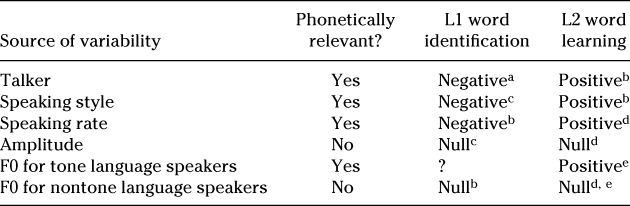
Table 3 presents a summary of findings on the effects of different sources of acoustic variability on L1 word identification and L2 vocabulary learning. The findings of the present study provide evidence to complete one of the two columns related to the effects of F0 variability on L2 word learning for speakers of a tone language, making the pattern of findings in this table even more consistent when it comes to the extended phonetic relevance hypothesis and our understanding of the effects of acoustic variability on new word form learning. In our view, language learners and language users attend to phonetically relevant acoustic variability throughout life. When learning new lexical items, this type of variability helps them to develop more distributed or robust representations of novel word forms and, in this way, improves vocabulary learning. Sommers et al.’s (2008) demonstration that at least one phonetically relevant source of acoustic variability (talker variability) positively affected novel L1 vocabulary learning (using low-frequency concrete nouns in English with adult native speakers of English) is consistent with this position. Once we have acquired a language, such as our L1, we still attend to phonetically relevant acoustic variability on a regular basis, and there is a cost to doing so, as is observable from all of the negative effects of phonetically relevant acoustic variability in the “L1 word identification” column in Table 3. The clear prediction for the one cell remaining in Table 3 is that F0 variability will have a negative effect on L1 word identification for speakers of a tone language. Testing this prediction will provide yet another strong test of the extended phonetic relevance hypothesis (see Future Research section).
An important but unresolved issue from the current study is the level of specificity at which variability operates to produce benefits in learning. One position is that listeners benefit from variability at a general level, such that if changes in an acoustic parameter are phonetically relevant (e.g., changes in F0), listeners will benefit from variability in that dimension even if the nature of the variability differs somewhat from how it is realized in the listener’s L1. According to this position, individuals whose L1 is tonal but has tone variations produced exclusively by varying F0 contour (e.g., Mandarin) could still benefit from F0 variability produced by proportional changes throughout the duration of the stimulus (the type of variability used in the current study), although the benefits may be reduced relative to conditions in which there is a match between the nature of variability in the L1 and the variability used during learning. At the other end of the continuum, it is possible that there needs to be a match at both the general and specific levels (e.g., the types of F0 variability introduced in the current study would only benefit speakers of tone languages that use absolute changes in F0 throughout the duration of the stimulus as lexically contrastive) for listeners to benefit from variability. The results of the current study are consistent with the benefit of match at both the general (introduction of F0 variations) and specific levels (Zapotec uses differences in F0 throughout the stimulus as lexically contrastive). It remains to be determined, however, whether speakers of a language in which only variations in F0 contour are used contrastively would also benefit from the same types of proportional F0 variations that were implemented in the current study.
Instructional Implications
As is the case with previous findings in this area (Barcroft & Sommers, Reference Barcroft and Sommers2005; Sommers & Barcroft, Reference Sommers and Barcroft2007), the findings of the present study continue to point to the importance of considering the language(s) that a listener-learner speaks when predicting the effects of different sources of acoustic variability on L2 vocabulary learning. The previous studies demonstrated that talker, speaking-style, and speaking-rate variability, but not amplitude and F0 variability, positively affect L2 vocabulary learning for speakers of English; the present study demonstrated that speakers of a tone language, Zapotec, can benefit from F0 variability, whereas speakers of Spanish, another nontone language like English, do not.
In light of the language-specific findings observed, L2 instructors and developers of L2 instructional materials can take into account the languages already spoken by their L2 students when determining which type of acoustic variability to incorporate. If instructional materials are designed to teach L2 vocabulary to speakers of one or more tone languages, inclusion of F0 variability can be expected to be beneficial. In the present study, this positive effect was observed for Zapotec speakers, but the findings suggest that similar benefits could be obtained with speakers of other tone languages in which F0 level is contrastive. If instructional materials are designed to teach L2 vocabulary to speakers of nontone languages, inclusion of F0 variability should not be expected to be beneficial. The present study demonstrated this null effect for Spanish speakers, but the findings suggest that similar null effects could be obtained for speakers of other nontone languages such as French, German, and English (the null effect of F0 for English also was demonstrated by Sommers & Barcroft, Reference Sommers and Barcroft2007). If instructional materials are designed to teach speakers of both tone and nontone languages, as frequently can be the case when teaching English as a L2 to students of multiple linguistic backgrounds, inclusion of F0 variability can be expected to improve L2 vocabulary learning for the tone language speakers without negatively impacting learning for the others. Inclusion of talker, speaking-style, and rate variability can be expected to improve L2 vocabulary learning for all learners, regardless of their L1.
FUTURE RESEARCH
As mentioned in the preceding sections, a logical next step in this area of research is to test the predictions of the extended phonetic relevance hypothesis by examining the effects of F0 variability on L1 word identification among speakers of a tone language. A study on this issue would allow us to provide an answer to the one remaining empty cell in Table 3, and the prediction of the extended phonetic relevance hypothesis is that F0 variability should have a negative effect on L1 word identification performance. As Table 3 indicates, previous studies have demonstrated negative effects of other phonetically relevant sources of variability, such as talker, speaking-style, and speaking-rate variability, on L1 word identification. If F0 is phonetically relevant to speakers of a tone language, as the present findings suggest, it follows that F0 variability should negatively affect L1 word identification performance, as is the case with other phonetically relevant sources of variability tested to date. Given that Isthmus Zapotec was the tone language examined in the present study and that Zapotec-Spanish bilinguals demonstrated positive effects of F0 variability on L2 word learning, Isthmus Zapotec would be a good first choice for testing the potentially negative effects of F0 variability on L1 word identification among speakers of a tone language.
Effects for different sources of variability on L1 word identification and L2 word learning
a Mullennix et al. (Reference Mullennix, Pisoni and Martin1989).
b Barcroft & Sommers (Reference Barcroft and Sommers2005).
c Sommers et al. (Reference Sommers, Nygaard and Pisoni1994).
d Sommers & Barcroft (Reference Sommers and Barcroft2007).
e Present study.
In addition to examining the effects of F0 variability on L1 word identification among speakers of Isthmus Zapotec, future research should expand to include other tone languages such as Mandarin, Vietnamese, Thai, and Lao. In doing so, it would be helpful to include nontone language speakers at equal levels of bilingualism (in their nontone languages) to confirm that it is previous experience with F0 as opposed to degree of bilingualism that leads to sensitivity to F0 variability. It also would be beneficial to examine whether the positive effects of F0 variability on L2 vocabulary learning increase as a function of (a) the overall degree to which tone is used as a distinctive feature in the L1s of the participants of the study, (b) the typology of the language with regard to its linguistic role for F0 (i.e., the number of types of tone inventories in the language, how sparsely or densely the language assigns tones to tone-bearing units, and so forth), or (c) both. Similarly, if it is found that F0 variability negatively affects L1 word identification performance among speakers of a tone language, the next step may be to examine whether the negative effect would increase as a function of the overall degree to which tone is used as a distinctive feature in the L1 in question, the typology of the language with regard to its linguistic role for F0, or both. Lastly, given that the research on acoustic variability and L2 vocabulary learning to date has focused on L2 vocabulary learning among absolute beginners (or naïve learners) with no previous study of the L2, future studies on acoustic variability and L2 vocabulary learning with L2 learners at different levels of proficiency (e.g., intermediate, advanced) should help to clarify whether L2 learners at these levels benefit in a similar way from phonetically relevant sources of acoustic variability, including F0 variability for speakers of tone languages. Addressing these issues in future studies will help to clarify the impact of F0 variability among speakers of tone languages and, in so doing, will play an important role in the larger ongoing effort to advance our understanding of the relationship between different sources of acoustic variability and the learning and processing of lexical form at different stages in life.