I. INTRODUCTION
Bismuth tungstate (Bi2WO6) has received growing attention in recent years due to its excellent photocatalytic performance under visible-light irradiation.Reference Zhang and Zhu1,Reference Fu, Pan, Yao and Zhu2 It has a narrow band gap of about 2.70–2.85 eV and presented photoabsorption properties from the UV light region to visible light shorter than 470 nm.Reference Zhang and Zhu1–Reference Yu, Zhang, Li, Du and Huang3 Bi2WO6 is usually reported to be synthesized via the hydrothermal method. Different morphologies such as flower microspheres and spherical and lamellar structures have been obtained by many authors.Reference Zhang and Zhu1,Reference Zhang, Wang, Zhou and Xu4–Reference Lou, Deng, Wang, Wang and Zhang6 Of these, lamellar structure Bi2WO6 or Bi2WO6 nanosheets are relevant because they exhibit higher activity than their counterpart with hierarchical nanosheet-based microspheres, probably due to its high specific surface area and particular exposed reactive facets.Reference Sun, Wang, Zhang, Gao, Jiang, Sun and Xie7–Reference Sun, Le, Jiang and Cheng10 However, the photocatalytic performance of pure Bi2WO6 is still not satisfactory due to its low quantum efficiency and the fast charge recombination of a single photocatalyst semiconductor.
Silver bromide (AgBr) with a narrow band gap (∼2.6 eV) is an important plasmonic photocatalyst which has attracted considerable research attention due to its high visible light photocatalytic activity.Reference Dai, Lu, Dong, Ji, Ping, Liu, Zhang, LI and Liang11 After irradiation, the Ag ions on the surface of the AgBr semiconductor are reduced and a certain number of silver nanoparticles were then produced. Ag nanoparticles can absorb visible light well due to the surface plasmon resonance (SPR) effect. As a result, AgBr modified photocatalysts, such as AgBr/TiO2,Reference Zang and Farnood12 AgBr/ZnO,Reference Shi, Liang, Ma, Meng, Zhong, Wang and Sun13 AgBr/g-C3N4,Reference Xu, Yan, Xu, Song, Li, Xia, Huang and Wan14 AgBr/Ag3PO4,Reference Amornpitoksuk and Suwanboon15 etc., have exhibited excellent photocatalytic activity for the degradation of organic dyes in much research. Through a facile precipitation–deposition process, AgBr/Bi2WO6 nanocomposites have been successfully synthesized with Bi2WO6 as the substrate.Reference Wang, Guo, Zhen, Yue, Xue and Fu16 It is believed that, by constructing an AgBr–Ag–Bi2WO6 nanojunction, AgBr/Bi2WO6 exhibits an extended visible-light photoresponse range and higher photocatalytic activity than single Bi2WO6.Reference Wang, Guo, Zhen, Yue, Xue and Fu16,Reference Lin, Liu, Hu, Liang and Cui17
In this experiment, we prepared Bi2WO6 nanosheets (NS-Bi2WO6) by using a simple hydrothermal process in the presence of CTAB and then synthesized AgBr/NS-Bi2WO6 using a facile deposition–precipitation method. Although there have been several articles published about AgBr/Bi2WO6 composite, none of the articles described an AgBr/Bi2WO6 nanojunction with Bi2WO6 nanosheets as the substrate. Both AgBr and Bi2WO6 nanosheets can be excited by visible light, and the composite exhibits a much higher discoloration rate than single Bi2WO6 nanosheets. It is found that NS-Bi2WO6 possesses a high adsorption capacity toward organic pollutants such as Rhodamine B (RhB), methyl orange (MO), and phenol. Due to various reasons, the adsorption ability of the AgBr-modified NS-Bi2WO6 nanosheets is even more evident than that of NS-Bi2WO6. In the meantime, KBr is found to be a more effective Br supply than CTAB for the preparation of an AgBr-modified Bi2WO6 nanocomposite.
II. EXPERIMENTAL DETAILS
A. Synthesis of Bi2WO6 nanosheets
NS-Bi2WO6 was prepared by using the same method previously described in the preceding paper.Reference Zhang, Hua, Teng, Liu, Qin and Ding9 Briefly, 0.5 mmol Na2WO4·2H2O, 1 mmol Bi(NO3)3·5H2O, and 0.025 g CTAB were dissolved in 40 mL deionized water and stirred for 30 min. Then, the mixed solution was poured into a 50 mL Teflon-lined autoclave. The autoclave was sealed into a stainless-steel tank and treated at 120 °C for 24 h. The product was washed several times with absolute ethanol and dried at 80 °C for 12 h.
B. Synthesis of AgBr/NS-Bi2WO6
AgBr/NS-Bi2WO6 composites were prepared by using a simple deposition–precipitation method in the presence of KBr or CTAB. The as-prepared NS-Bi2WO6 (0.3489 g) was added to 100 mL deionized water, followed by adding an appropriate amount of KBr or CTAB and stirring magnetically for 30 min. Then, an AgNO3 solution with an Ag:Br mole ratio of 1:1 was slowly added into the suspension. The resulting suspensions were magnetically stirred in the dark for 12 h. The final product was collected by centrifugation, washed with absolute ethanol, and dried at 80 °C for 12 h. The KBr content was determined with the mole ratio of Br to W for 1:10, 1:20, and 1:30, and the products were accordingly marked as K10, K20, and K30, respectively. Similarly, the AgBr/NS-Bi2WO6 prepared in the presence of CTAB with a Br:W mole ratio of 1:10 was marked as C10.
C. Characterization of photocatalysts
Powder X-ray diffraction (XRD) patterns were measured on a Bruker D8 Advance diffractometer (Bruker, Karlsruhe, Germany) with Cu Kα radiation. The elemental composition was detected by X-ray photoelectron spectroscopy (ESCALAB 250XI, Thermo Fisher Scientific Corp., Waltham, Massachusetts). The morphologies and microstructures of the samples were investigated by using a Tecnai F20 G2 S-TWIN transmission electron microcopy (FEI, Hillsboro, Oregon). UV-visible diffuse reflectance spectra of the samples were recorded on a UV/Vis NIR scanning spectrophotometer (Hitachi UV-4100, Tokyo, Japan) equipped with an integrating-sphere accessory in the wavelength range of 200–800 nm. Nitrogen adsorption–desorption measurements were conducted at 77.35 K using a Micromeritics 3Flex analyzer (Micromeritics Instrument Corporation, Norcross, Georgia). The Brunauer–Emmett–Teller (BET) surface area was calculated from adsorption data. Photoluminescence (PL) emission spectra of the samples were recorded at room temperature using a FLS980 PL spectrometer from Edinburgh Instruments (Edinburgh, UK) with the excitation wavelength at 300 nm.
D. Decolorization test
The adsorption performance of bare NS-Bi2WO6 and AgBr/NS-Bi2WO6 composites toward different pollutants, including RhB, MO, and phenol, at neutral pH was investigated. In a typical process, a 50 mg photocatalyst was dispersed in a 50 mL aqueous solution and magnetically stirred in the dark. An aliquot (4 mL) was sampled at certain time intervals, and the concentrations of the pollutants were monitored using a UV-vis spectrophotometer (Hitachi U-4100). The adsorption efficiency could be calculated by the formula: η (%) = (C 0 − C)/C 0, where C 0 is the initial concentration of the contaminants and C is the concentration at time t.
The photocatalytic activity of the AgBr/NS-Bi2WO6 photocatalysts was evaluated by the degradation of RhB, MO, and phenol solution under simulated solar light irradiation at a neutral pH. A 500 W Xe lamp (PLS-LAX500, Perfectlight, China) was used as a light source. 50 mL fresh aqueous suspension of pollutants and 50 mg of the prepared AgBr/NS-Bi2WO6 powders were placed in a 100 mL bottle with a cap. During the irradiation, 4 mL of the samples were removed at given time intervals, and the concentrations of the pollutants were determined. The photocatalytic activity of NS-Bi2WO6 was evaluated simultaneously as a reference.
III. RESULTS AND DISCUSSION
A. Catalyst characterization
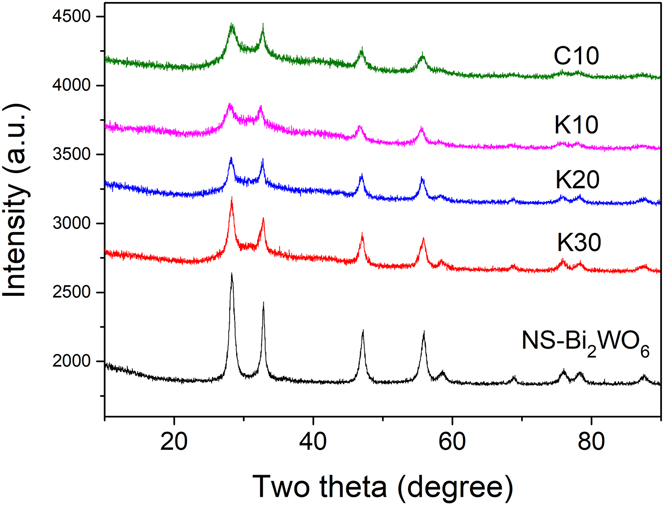
The typical XRD patterns of the obtained NS-Bi2WO6 and AgBr/NS-Bi2WO6 prepared by different Br sources and loaded with different contents of AgBr are illustrated in Fig. 1. For the pattern of NS-Bi2WO6, the diffraction peaks at 2θ = 28.47°, 32.95°, 47.22°, 55.93°, 58.76°, 68.90°, 76.09°, and 78.54° are assigned to the (131), (200), (202), (331), (262), (410), (193), and (382) crystal planes of rhombic Bi2WO6 (JCPDS No. 39-0256). Apart from Bi2WO6, no impurity phases were identified in the profile. For KBr-sourced AgBr/NS-Bi2WO6, the height of the diffraction peaks of Bi2WO6 is found to decrease when loaded with AgBr. It is noted that diffraction peaks of AgBr are not observed in the profiles. One of the explanations is that the AgBr deposited on the surface of Bi2WO6 is in small amounts and well dispersed. The faint peaks of AgBr are probably covered by the strong peaks of Bi2WO6.
XRD diffraction spectrum of NS-Bi2WO6 and AgBr/NS-Bi2WO6 prepared with different contents of KBr (K10, K20, K30) or CTAB (C10).

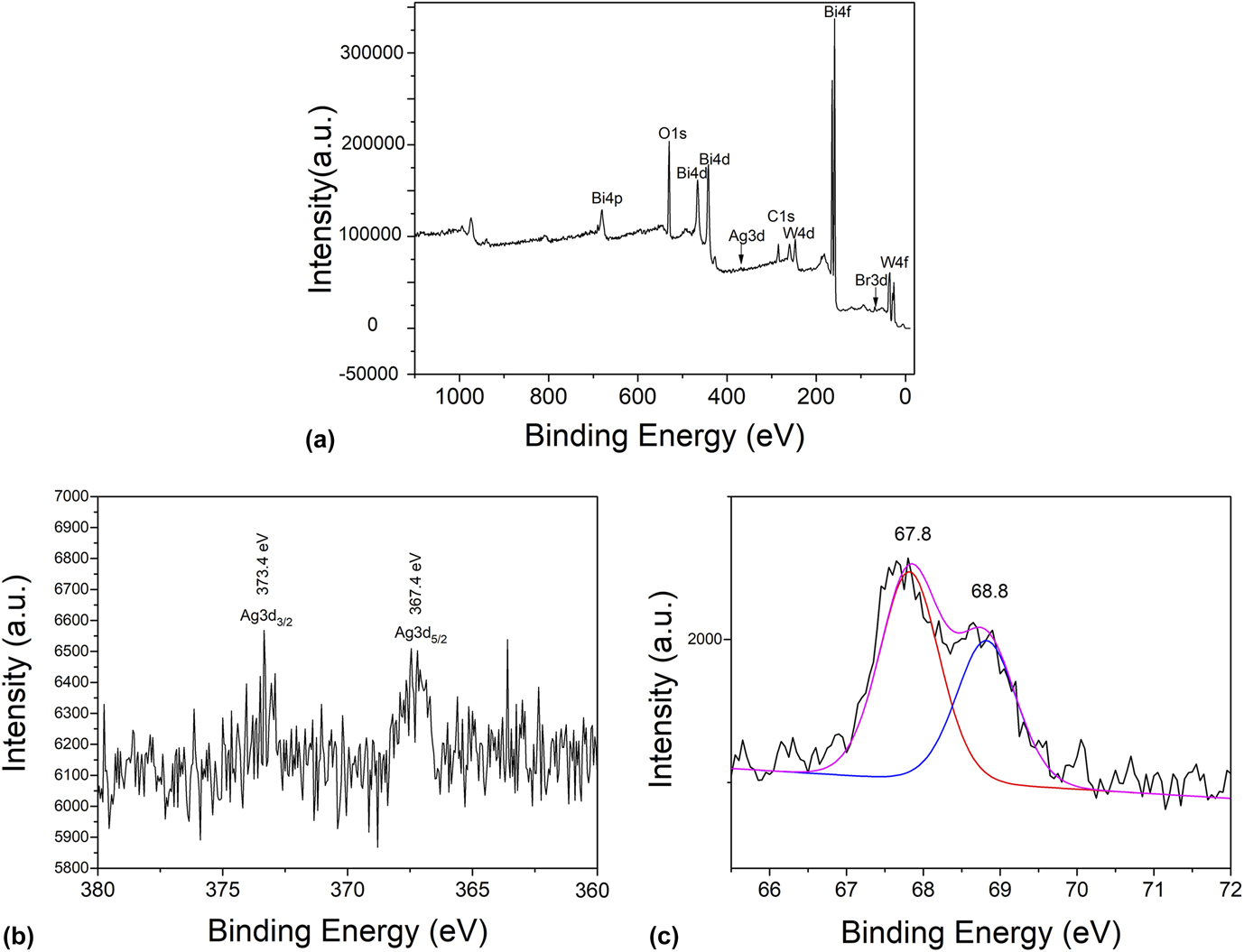
Surface chemical states of the as-obtained AgBr/NS-Bi2WO6 composite were examined by means of the XPS technique. The survey spectrum of K10 in Fig. 2(a) indicated that the photocatalyst contains Bi, W, O, Ag, Br, and C elements, in which the C element is from the XPS instrument itself. The weak signals from Ag and Br indicated that relevant elements are scarce compared with Bi, W, and O, which is in accordance with the XRD results. The Ag spectrum in Fig. 2(b) displays two faint peaks at 367.4 and 373.4 eV, which could be assigned to electron orbits of Ag 3d 3/2 and Ag 3d 5/2, respectively, corresponding to Ag+.Reference Chen, Yang, Li, Zeng, Wang, Niu, Zhao, An, Xie and Deng18 In Fig. 2(c), two peaks located at 67.8 and 68.8 eV can be assigned to Br 3d 5/2 and Br 3d 3/2, respectively, which is in good agreement with those of AgBr.Reference Yang, Guo, Guo, Zhao, Yuan and Guo19 The XPS data combined with XRD analysis revealed that there were both AgBr and Bi2WO6 species in sample K10.
XPS survey spectrum (a), high-resolution Ag 3d (b) and Br 3d (c) spectra for K10.

The morphology and crystal structure of the as-obtained AgBr/NS-Bi2WO6 (K10) were investigated by transmission electron microscopy (TEM) and the results are shown in Fig. 3. For the NS-Bi2WO6 synthesized by the same method in the former investigation,Reference Zhang, Hua, Teng, Liu, Qin and Ding9 the lamellar-like Bi2WO6 had predominantly exposed (001) planes. In this experiment, the TEM image in Fig. 3(a) showed that some nanoparticles were loaded on the surface of the Bi2WO6 nanosheets and formed a heterojunction structure. The HRTEM image in Fig. 3(b) demonstrates that the lattice spacings of the nanoparticles, determined to be 0.3334 nm, are in good agreement with the value for the cubic AgBr (111) plane (JCPDF card no. 06-0438). It can also be observed that the nanoparticles show a size distribution from 10 to 20 nm and some of them are found to be partially amorphous.
TEM (a) and HRTEM (b) images of K10.

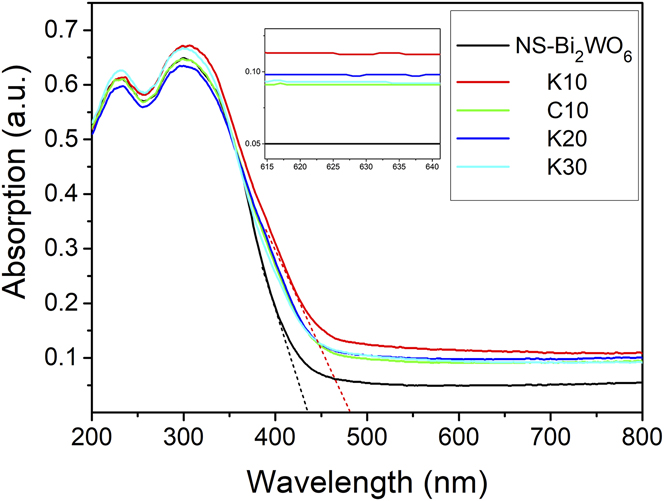
The optical absorption properties of the uncoupled and AgBr-coupled Bi2WO6 nanosheets were investigated using UV-vis spectrophotometry. Compared with NS-Bi2WO6, the typical UV-vis diffuse reflection spectra of AgBr/NS-Bi2WO6 composites exhibited an additional broad tail from approximately 470–800 nm, as shown in Fig. 4. As can be seen from the inset, the absorption intensity in the visible-light region varied with different AgBr-loading amounts, and K10 has the highest visible light absorption ability of all the samples. This observation can be ascribed to the SPR effect and the visible-light absorption ability of AgBr.Reference Fuku, Hayashi, Takakura, Kamegawa, Mori and Yamashita20 The visible light absorption intensity of K30 is even higher than that of C10. The absorption edge of NS-Bi2WO6 is estimated to be 436 nm, while K10 is red-shifted at 482 nm. The estimated band-gaps for Bi2WO6 and K10 were 2.84 and 2.57 eV, respectively. These findings imply that the enhanced photo-absorption property in the visible-light region can be realized using AgBr-loaded NS-Bi2WO6. Consequently, the photocatalytic performance of AgBr/NS-Bi2WO6 composites can be expected to be excellent compared with bare NS-Bi2WO6.
UV-vis diffuse reflectance spectra of NS-Bi2WO6 and AgBr/NS-Bi2WO6 composites prepared with different contents of KBr (K10, K20, K30) or CTAB (C10).

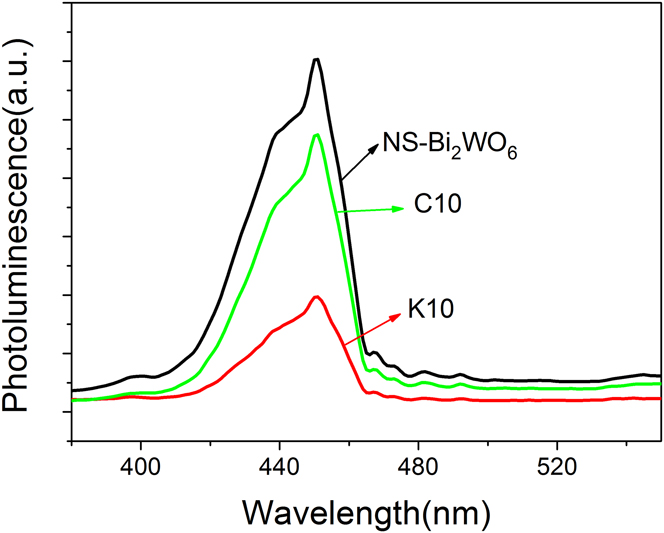
PL emission spectra is usually used to investigate the charge recombination and transfer behavior of photocatalysts since PL emission results from the recombination of free carriers.Reference Yu, Yu, Ho, Jiang and Zhang21 Figure 5 shows the PL spectra of the pre-synthesized NS-Bi2WO6 and AgBr/NS-Bi2WO6. Compared to NS-Bi2WO6, AgBr/NS-Bi2WO6 shows lower emission intensity, suggesting a higher separation efficiency of electron–hole pairs. The PL intensity of KBr-sourced K10, which contained more AgBr, decreased significantly compared to CTAB-sourced C10. The PL intensity significantly decreases with the introduction of AgBr, which means that the recombination of the photogenerated charge carrier is significantly inhibited in the semiconductor’s heterojunction.Reference Amornpitoksuk and Suwanboon15,Reference Subramanian, Wolf and Kamat22,Reference Zhang, Wang, Wang and Sun23 This result indicates that the introduction of AgBr can be expected to improve the photocatalytic activities of the Bi2WO6 photocatalyst.
Room temperature PL spectrum of NS-Bi2WO6 and AgBr/NS-Bi2WO6 composites (λexcitation = 300 nm).

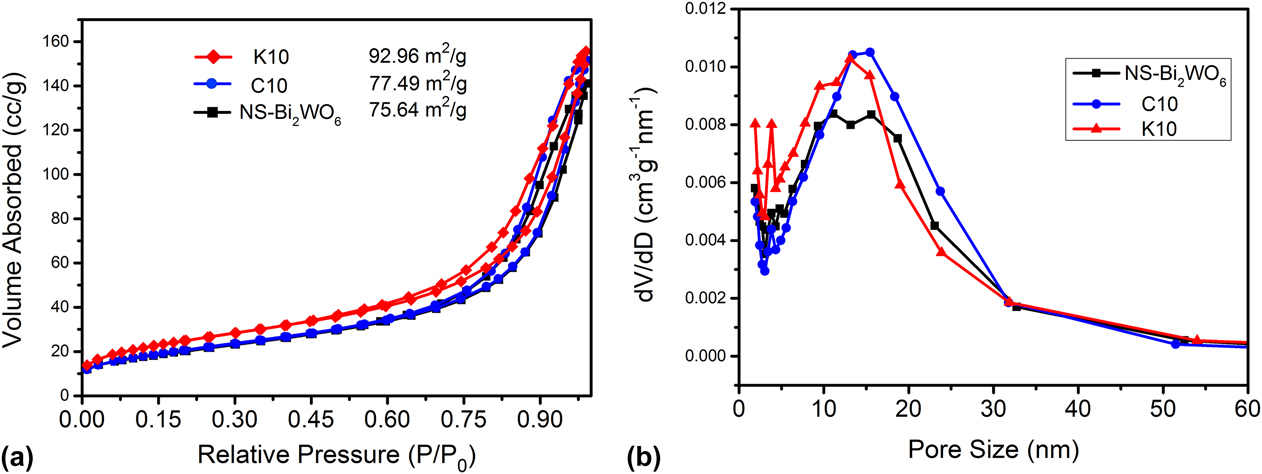
The N2 adsorption–desorption isotherms and pore size distribution of NS-Bi2WO6, C10, and K10 are shown in Figs. 6(a) and 6(b), respectively. The distinct hysteresis loop for the three samples can be categorized as a type-IV isotherm.Reference Sing24 The BET specific surface areas are calculated to be 75.64, 77.49, and 92.96 m2/g for NS-Bi2WO6, C10, and K10, respectively. Both KBr-sourced AgBr/NS-Bi2WO6 and CTAB-sourced AgBr/NS-Bi2WO6 had a higher BET specific surface area compared to bare NS-Bi2WO6. In the meantime, K10, which loaded with more AgBr, possesses a higher specific surface area than C10. The above results indicate that the introduction of AgBr is beneficial for boosting the specific surface area of the photocatalysts, and as a result, it might provide more reactive sites for the adsorption and catalysis process. In Fig. 6(b), the pore size distribution curves indicate that the as-obtained NS-Bi2WO6 and AgBr/NS-Bi2WO6 samples are rich in pores sized between 2 and 30 nm. Due to the porous texture and high surface area, the NS-Bi2WO6 and especially the AgBr/NS-Bi2WO6 composite could provide more adsorption and active sites for photocatalytic reactions compared to common materials.
(a) N2 adsorption–desorption isotherms and (b) pore size distributions of NS-Bi2WO6, C10, and K10.

B. Decolorization efficiency
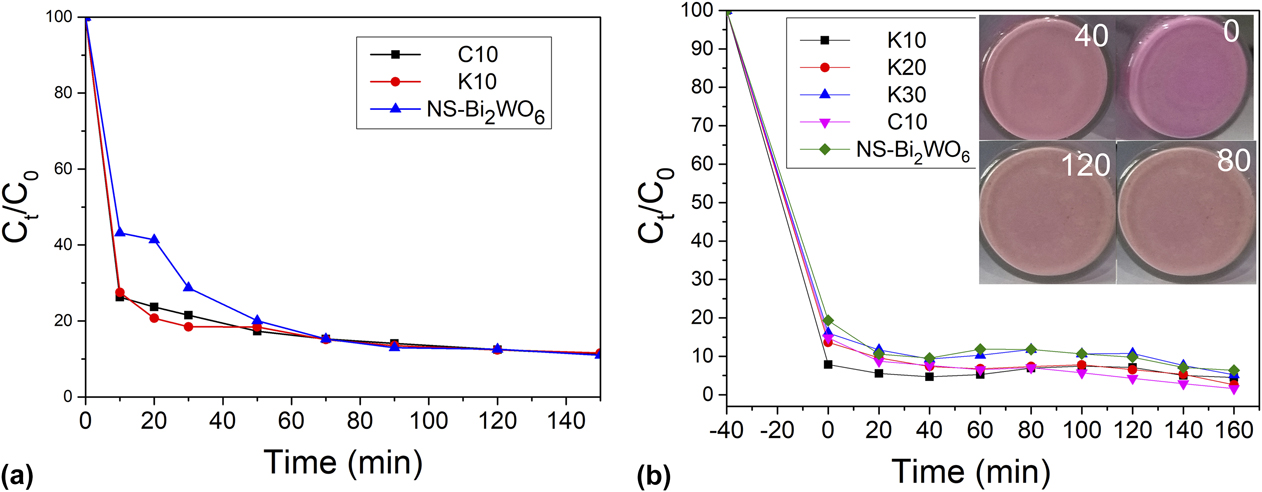
The adsorption performance of bare NS-Bi2WO6 and AgBr/NS-Bi2WO6 composites toward RhB was evaluated. A 50 mg photocatalyst was dispersed in an aqueous solution of RhB (50 mL, 5 mg/L) and magnetically stirred in the dark to test its adsorption ability. As shown in Fig. 7(a), 72.49%, 73.27%, and 56.76% of RhB is removed after 10 min adsorption by K10, C10, and bare NS-Bi2WO6, respectively. K10 and C10 had a higher adsorption than NS-Bi2WO6 at the initial stage of adsorption. After a 90-min dark reaction, the adsorption–desorption equilibrium was nearly achieved and more than 85% of the RhB was adsorbed for all the three samples.
(a) Adsorption of RhB over NS-Bi2WO6, C10, and K10 as a function of time; (b) Decolorization of RhB over bare Bi2WO6 and AgBr/NS-Bi2WO6 nanocomposites.

To evaluate the photoactivity of AgBr/NS-Bi2WO6, a 50 mg photocatalyst was dispersed in 50 mL of RhB aqueous solution (5 mg/L) and continuously stirred in the dark for 40 min before the light was turned on. Figure 7(b) shows the change in the relative concentration of RhB versus irradiation time. Both KBr-sourced and CTAB-sourced AgBr/NS-Bi2WO6 exhibit a much better decolorization efficiency than bare NS-Bi2WO6, and the decolorization rate of K10 is even higher than that of C10. The decolorization efficiencies decreased in the following sequence: K10 > C10 > K20 > K30 > NS-Bi2WO6. The result indicates that KBr is a more efficient Br source to construct the AgBr/NS-Bi2WO6 nanostructure with high decolorization efficiency compared to CTAB. Surprisingly, more than 94% of RhB removal was achieved in the presence of K10 after 40 min adsorption. For NS-Bi2WO6, the value was about 81%. The adsorption rates are slightly above but within the experiment error as compared to the adsorption results, as shown in Fig. 7(a). The photographs inserted in Fig. 7(b) show the color of K10 powders after different irradiation times. After 40 min adsorption, the K10 powders were deep pink, indicating that the RhB molecules were adsorbed on the surface of the photocatalyst. At the same time, the solution was transparent and nearly colorless (not shown here). With increasing irradiation time, the K10 powder color changed to pale pink gradually, indicating that the adsorbed RhB molecules were continuously decomposed in the catalytic process.
Obviously, there are two main factors contributing to the high decolorization rate of the AgBr/NS-Bi2WO6 composite. One of the reasons is the enhanced photocatalytic activity achieved by the construction of the AgBr/NS-Bi2WO6 nanostructure. Former investigations have proposed that the nanostructure is in connection with a so-called Z-scheme mechanism, which efficiently promoted the separation of electron–hole pairs.Reference Amornpitoksuk and Suwanboon15–Reference Lin, Liu, Hu, Liang and Cui17,Reference Feng, Zeng, Chen, Ma, Zhao, Jin, Lu, Wu and He25–Reference Wen, Xie, Chen and Li28 The other reason is ascribed to the high adsorption capacity of the AgBr-modified NS-Bi2WO6 nanosheets as mentioned above. In view of the results given in Figs. 7(a) and 7(b), the high decolorization efficiency of the AgBr/NS-Bi2WO6 composite toward RhB molecules is mainly attributed to the high adsorption capacity of the materials.
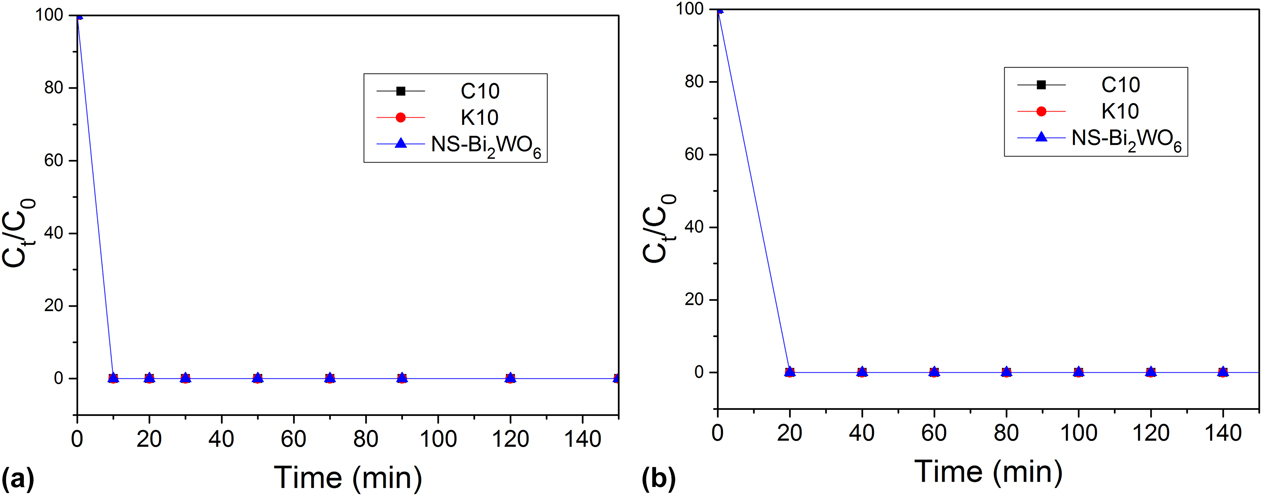
Anionic dye MO was chosen as a model organic pollutant to further evaluate the adsorption and photocatalytic abilities of the AgBr/NS-Bi2WO6 nanocomposite at room temperature. For this purpose, a 50 mg photocatalyst was homogeneously dispersed into 50 mL of MO aqueous solution (10 mg/L). Figures 8(a) and 8(b) show the adsorption and photodegradation of MO over NS-Bi2WO6, C10, and K10 as a function of time, respectively. For all three samples, MO was adsorbed almost entirely after 10 min adsorption in the dark. The previous investigationReference Sun, Le, Jiang and Cheng10 reported that lamellar Bi2WO6 was able to selectively adsorb positively charged species such as RhB and methylene blue (MB), as well as the MO molecules in acidic conditions. The highly active open surface of the CTAB-templated monolayer Bi2WO6, which was covered by negatively charged Br− ions, was responsible for the high adsorption ability. In this experiment, massive adsorption of positively charged RhB and negatively charged MO by NS-Bi2WO6 were simultaneously observed at a neutral pH. The high adsorption ability undoubtedly derives from the open surfaces and the high specific surface area of the materials, but the underlying mechanism is still unclear. The results are analogous to the RhB experiment in that the photodegradation rate cannot be evaluated by the concentration change of MO because the adsorption rate of the powders is significantly higher and the MO solution can be decolorized to being nearly colorless in a very short amount of time.
(a) Adsorption and (b) decolorization of MO over NS-Bi2WO6, C10, and K10 as a function of time.

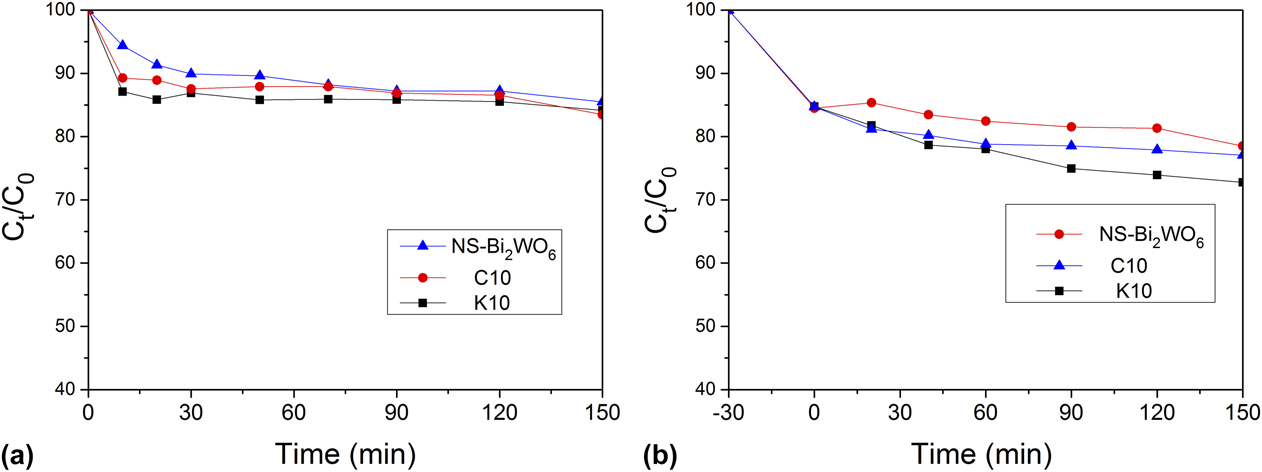
Phenol was chosen as a model organic pollutant to further evaluate the adsorption and photocatalytic abilities of the AgBr/NS-Bi2WO6 composite. For this purpose, a 50 mg photocatalyst was dispersed and stirred in 50 mL of phenol aqueous solution (10 mg/L) at room temperature. Figure 9(a) shows the adsorption of phenol as a function of time over NS-Bi2WO6, C10, and K10, respectively. The three samples showed almost equivalent levels of adsorption. The adsorption–desorption equilibrium was achieved in 50 min and about 15% of phenol was adsorbed. In Fig. 9(b), the kinetic profiles for the phenol degradation are presented. Prior to the photocatalytic test, the solution was continuously stirred in the dark for 30 min. After 150 min irradiation, roughly equivalent levels of phenol were removed from all the three samples. The percentage degradation of phenol for NS-Bi2WO6, C10, and K10 was 21.50%, 22.95%, and 29.21%, respectively.
(a) Adsorption and (b) degradation of phenol over NS-Bi2WO6, C10, and K10 as a function of time.

C. Decolorization mechanism
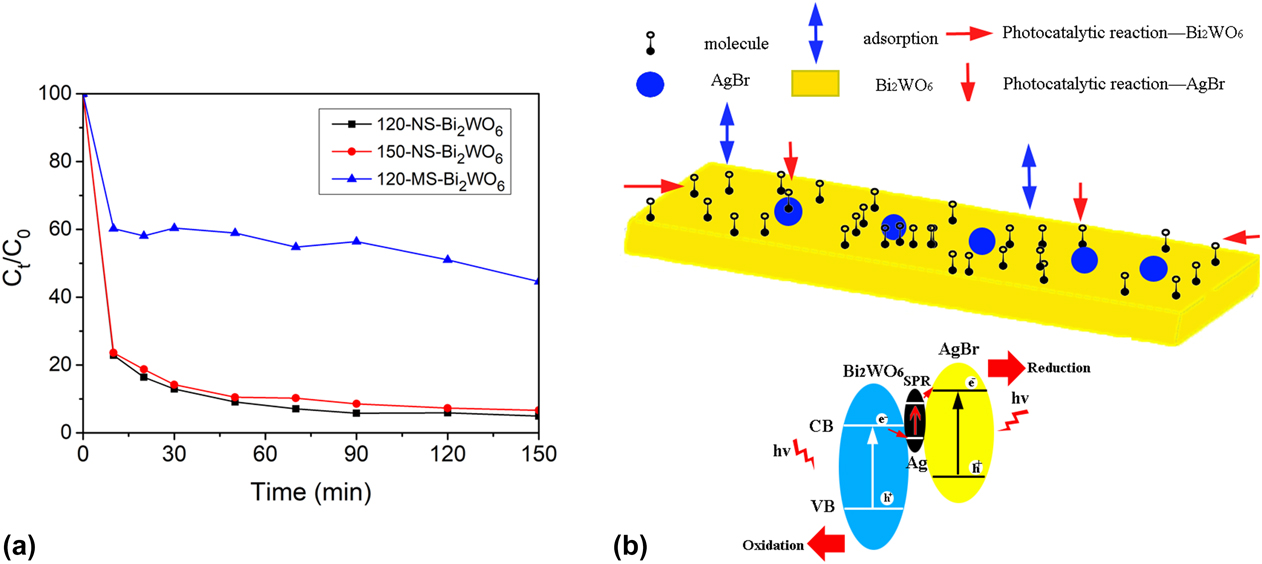
To investigate the influence of the preparation conditions on the adsorption performances of different Bi2WO6 photocatalysts, Bi2WO6 nanosheets prepared at 150 °C with CTAB as a template (150-NS-Bi2WO6) and a microsphere Bi2WO6 prepared at 120 °C without using a template (120-MS-Bi2WO6) were used for the purpose of comparison. Figure 10(a) shows the adsorption ability evaluation of different Bi2WO6 photocatalysts (50 mg) toward RhB (50 mL, 5 mg/L). The adsorption–desorption equilibrium between RhB and NS-Bi2WO6 was acquired within a 70-min dark reaction. More than 90% of the RhB was removed for both 150-NS-Bi2WO6 and 120-NS-Bi2WO6. However, the value is 40% for 120-MS-Bi2WO6. Bi2WO6 nanosheets have an evidently higher adsorption capacity than the microsphere Bi2WO6, which demonstrated the strong influences of microstructure on the adsorption performances of Bi2WO6. It is reported that the adsorption performance of certain materials is associated with its textural structure, pore size distribution, surface area, pore volume, and so on.Reference Wang, Wang, Han, Tang, Zhong, Huang and Chen29–Reference Kim, Seo, Lee, Moon, Lee, Yi and Paik35 In this experiment, the high specific surface area of NS-Bi2WO6 is one of the reasons which contributed to the enhancement of the adsorption ability. The second and main reason is ascribed to the {001} exposed facets of the Bi2WO6 nanosheets,Reference Zhou, Zhang, Lin, Long, Zhang, Lin, Wu and Wang8,Reference Zhang, Hua, Teng, Liu, Qin and Ding9 which provide highly active open surfaces for the adsorption process. The previous investigationReference Zhou, Zhang, Lin, Long, Zhang, Lin, Wu and Wang8 reported lamellar Bi2WO6 can selectively adsorb positively charged species like RhB, MB as well as the MO molecules in acidic conditions. And the highly active open surface of CTAB-templated monolayer Bi2WO6 which covered by negatively charged Br− ions was responsible for the high adsorption ability. In this experiment, massive adsorption of positively charged RhB and negatively charged MO by NS-Bi2WO6 were simultaneously observed at neutral pH. The high adsorption ability is undoubtedly derived from the open surfaces and the high specific surface area of the materials, although the underlying mechanism is still unclear. At the meantime, both NS-Bi2WO6 and AgBr/NS-Bi2WO6 showed low adsorption rate in the adsorption of phenol, which is another issue that should be carefully considered in the future.
(a) Adsorption of RhB over 120-NS-Bi2WO6, 150-NS-Bi2WO6, and 120-MS-Bi2WO6 as a function of time; scheme for (b) adsorption and photocatalytic reaction of the AgBr/NS-Bi2WO6 nanojunction system.

A possible mechanism for the enhanced decolorization capacity of the AgBr/NS-Bi2WO6 nanojunction system for dye removal is shown in Fig. 10(b). The adsorption rate is so fast that the pollutant molecules were nearly fully adsorbed on the surface of the nanoparticles in a short period. Under light exposure conditions, the AgBr nanoparticles which evenly dispersed on the surface of NS-Bi2WO6 will react with the pollutant molecules in a photocatalytic process. Meanwhile, NS-Bi2WO6 also has high photocatalytic ability in the degradation of dyes. The enhanced photocatalytic activity can be understood by a plasmonic Z-scheme mechanism as shown at the bottom of Fig. 10(b). As we know, AgBr will be partially decomposed into metallic Ag when exposed to light irradiation.Reference Dai, Lu, Dong, Ji, Ping, Liu, Zhang, LI and Liang11–Reference Lin, Liu, Hu, Liang and Cui17,Reference Yang, Guo, Guo, Zhao, Yuan and Guo19 Ag nanoparticles anchored on the AgBr surface can absorb the visible light by SPR effect.Reference Dai, Lu, Dong, Ji, Ping, Liu, Zhang, LI and Liang11–Reference Wang, Guo, Zhen, Yue, Xue and Fu16 Meanwhile, both AgBr and Bi2WO6 can be excited to produce photogenerated electrons and holes. The photo-induced electrons from Bi2WO6 could easily flow into metal Ag through the Schottky barrier, and the electrons in Ag subsequently transfer to the VB of AgBr.Reference Wang, Guo, Zhen, Yue, Xue and Fu16,Reference Lin, Liu, Hu, Liang and Cui17 These excited electrons are trapped O2 in the solution to form super oxygen anionic free radicals •O2−, which induce the degradation of dye molecules.Reference Lin, Liu, Hu, Liang and Cui17,Reference Zhang, Wu, Bao, Wang, Tian and Zhang36 The photo-induced holes from Bi2WO6 with a strong oxidation power escape from the pair recombination would react with OH− or H2O to form hydroxyl radical (•OH) which has strong oxidation ability to oxidize the dye molecules.Reference Lin, Liu, Hu, Liang and Cui17,Reference Zhang, Wu, Bao, Wang, Tian and Zhang36 The internal charge transmission improves the separation of photogenerated electron–hole pairs in the AgBr/NS-Bi2WO6 nanojunction system, resulting in a higher photocatalytic activity than bare NS-Bi2WO6.
IV. CONCLUSION
In summary, AgBr was successfully incorporated onto the exposed planes of Bi2WO6 nanosheets via a facile deposition–precipitation method. Bi2WO6 nanosheets and the AgBr-modified Bi2WO6 nanosheets both showed high efficiency in removing MO, RhB and phenol molecules from aqueous solutions. The high decolorization efficiency is mainly attributed to the extinguished adsorption ability of the Bi2WO6 nanosheets and the AgBr-modified Bi2WO6 nanosheets, which are characterized by their high surface area and the exposed reactive {001} facets of Bi2WO6. The preparation method and the nanosheet-like structure are the main factors influencing the adsorption performance of the materials. Meanwhile, AgBr/NS-Bi2WO6 nanosheets exhibited improved photocatalytic activity for the degradation of pollutants than NS-Bi2WO6 under simulated solar light irradiation and KBr-sourced AgBr/Bi2WO6, which, incorporated with more AgBr, showed better photocatalytic performance than the CTAB-sourced samples.
ACKNOWLEDGMENTS
The authors are grateful to the funding from the Achievement Transfer Program of Institutions of Higher Education in Chongqing (KJZH17131), the “Chunhui Project” of Ministry of Education of the People’s Republic of China (Grant No. Z2016175), the Scientific Research Project of Fuling District (Grant No. FLKW, 2017ABA1007), and the Scientific Research Foundation of Yangtze Normal University (Grant No. 2015XJXM01).