Introduction
Global agriculture is now facing the unprecedented challenges of providing food, feed, and fiber for a rapidly growing population. Achieving these goals while maintaining ecosystem resilience, conserving biodiversity, and socio-economic balance of farmers represents a formidable challenge (Cooper & Dobson, Reference Cooper and Dobson2007). Pesticides are often used to enhance agriculture production by suppressing agricultural pests, but the efficacy of pesticides is saturated over time (Lechenet et al., Reference Lechenet, Bretagnolle, Bockstaller, Boissinot, Petit, Petit and Munier-Jolain2014; Gaba et al., Reference Gaba, Gabriel, Chadœuf, Bonneu and Bretagnolle2016). Their repeated, long-term indiscriminate use can also degrade agricultural soils (Shahid et al., Reference Shahid, Ahmad, Khalid, Siddique, Saeed, Ashraf, Sabir, Niazi, Bilal, Naqvi, Hakeem, Akhtar and Sabir2016) by affecting the physicochemical properties (AL-Ahmadi, Reference AL-Ahmadi2019) as well as harming microbial communities and disturbing their beneficial activities (Arora et al., Reference Arora, Arora, Sahni, Sehgal, Srivastava and Singh2019). Biodiversity loss is another big challenge resulting from pesticide overuse (Maxwell et al., Reference Maxwell, Fuller, Brooks and Watson2016). Biodiversity losses in terrestrial ecosystems also decrease provision of ecosystem services, like pollination and biomass production that provide vital benefits to humans and are important for ecosystem resilience (Tilman et al., Reference Tilman, Cassman, Matson, Naylor and Polasky2002; Chaplin-Kramer et al., Reference Chaplin-Kramer, Sharp, Mandle, Sim, Johnson, Butnar, Milà i Canals, Eichelberger, Ramler and Mueller2015). Yields of many crops are no longer increased in intensified farming (Ray et al., Reference Ray, Ramankutty, Mueller, West and Foley2012), compromising the economic and environmental viability of this strategy (Tittonell, Reference Tittonell2014).
Sustainable development aims at improving conservation, protection, restoration, and sustainability of the terrestrial ecosystems for the long-term benefits to mankind (Newbold et al., Reference Newbold, Hudson, Arnell, Contu, De Palma, Ferrier, Hill, Hoskins, Lysenko and Phillips2016). In order to maintain the balance between food security and conserving biodiversity, sustainable production practices like organic farming can lower ecological footprints without sacrificing the economic benefits and food security (Foley et al., Reference Foley, Ramankutty, Brauman, Cassidy, Gerber, Johnston, Mueller, O'Connell, Ray and West2011). Organic farming systems increase arthropod diversity and enhance ecosystem services, like predation and parasitism, ultimately reducing insecticide use by up to 97% (Mäder et al., Reference Mäder, Fliessbach, Dubois, Gunst, Fried and Niggli2002). Organic production maximizes the use of local resources to enhance soil fertility (Gomiero et al., Reference Gomiero, Pimentel and Paoletti2011; Leifeld, Reference Leifeld2012), but also has some socio-economic pros and cons for small holder farmers and developing countries. Since synthetic chemicals are prohibited in certified organic production systems, organic crops contain lower levels of insecticide and heavy metal residues compared to conventionally grown ones (Baker et al., Reference Baker, Benbrook, Iii and Benbrook2002).
Herbivore densities in organic farms are generally regulated vertically and horizontally (fig. 1) i.e. mediated through bottom-up forces by soil or plant quality (Scherber et al., Reference Scherber, Eisenhauer, Weisser, Schmid, Voigt, Fischer, Schulze, Roscher, Weigelt and Allan2010; Letourneau et al., Reference Letourneau, Armbrecht, Rivera, Lerma, Carmona, Daza, Escobar, Galindo, Gutiérrez and López2011), and top-down forces, those governed by the natural enemies (Cardinale et al., Reference Cardinale, Harvey, Gross and Ives2003; Finke & Denno, Reference Finke and Denno2004) while horizontal herbivore regulation is through competition among members of same trophic levels. Organic farming may enhance below and above ground biodiversity and boost up plant resistance to herbivores, facilitating the bottom-up forces on the herbivores and possibly help to reduce insecticide loads and concerns in agriculture sector (Birkhofer et al., Reference Birkhofer, Bezemer, Bloem, Bonkowski, Christensen, Dubois, Ekelund, Fließbach, Gunst and Hedlund2008; Krey et al., Reference Krey, Nabity, Blubaugh, Fu, Van Leuven, Reganold, Berim, Gang, Jensen and Snyder2020; Gu et al., Reference Gu, Zalucki, Men, Li, Hou, Zhang, Ge and Ouyang2022). For instance, lower populations of leafhoppers, Circulifer tenellus (Baker) was noted in organic production systems of tomatoes due to higher accumulation of salicylic acid produced by well-established rhizosphere microbial communities (Blundell et al., Reference Blundell, Schmidt, Igwe, Cheung, Vannette, Gaudin and Casteel2020). So, organic farming can increase plant resistance and decrease plant attractiveness toward herbivores. Meanwhile, manure amended soil provides brown food web species to the generalist predators as alternate resources and directly support the top down effects in the organic farming (Brown and Tworkoski, Reference Brown and Tworkoski2004; Muñoz-Cárdenas et al., Reference Muñoz-Cárdenas, Ersin, Pijnakker, van Houten, Hoogerbrugge, Leman, Pappas, Duarte, Messelink and Sabelis2017). Organic farming enhances the abundance of arthropods (Tuck et al., Reference Tuck, Winqvist, Mota, Ahnström, Turnbull and Bengtsson2014; Van Bruggen & Finckh, Reference Van Bruggen and Finckh2016), which, in turn, results in the higher resource competition among the members of same trophic levels (Kaplan & Denno, Reference Kaplan and Denno2007). Altogether, organic farming is a system of sustainable production of crops that have the potential to regulate herbivore communities by supporting bottom up and top-down forces.
Horizontal and vertical modes of herbivorous pest regulation in organic farming.

Greater abundance and diversity (Gurr et al., Reference Gurr, Wratten and Luna2003; Simon et al., Reference Simon, Bouvier, Debras, Sauphanor, Lichtfouse, Hamelin, Navarrete and Debaeke2011; Lichtenberg et al., Reference Lichtenberg, Kennedy, Kremen, Batary, Berendse, Bommarco, Bosque-Pérez, Carvalheiro, Snyder and Williams2017; Mabin et al., Reference Mabin, Welty and Gardiner2020) of arthropod predators translates to higher likelihood of biological control of herbivore on organic farms (Farooq et al., Reference Farooq, Razaq and Shah2022). For example, increased predator diversity was observed to suppress cabbage aphid, Brevicoryne brassicae L. and green peach aphid Myzus persicae Sulzer (Hemiptera: Aphididae) populations in collards (Snyder et al., Reference Snyder, Snyder, Finke and Straub2006). Herbivore suppression due to diverse predator communities might be linked with complementary use of shared prey resources (Niche complementarity hypothesis) (Straub & Snyder, Reference Straub and Snyder2006; Lynch et al., Reference Lynch, Smith, Chapman, Crossley, Crowder, Fu, Harwood, Jensen, Krey and Snyder2022). Moreover, soil organic matter improves soil microclimate in organic mix vegetables farms and is responsible for even distribution of coleopteran carabid predators (Aldebron et al., Reference Aldebron, Jones, Snyder and Blubaugh2020). Crowder et al. (Reference Crowder, Northfield, Strand and Snyder2010) also reported that more evenly structured and abundant predator communities can strongly suppress herbivore communities and increase plant growth in organic farms.
Although, a number of past studies have illustrated the role of organic farming in top-down regulation of herbivores by attracting insectivorous birds (Tremblay et al., Reference Tremblay, Mineau and Stewart2001; Otieno et al., Reference Otieno, Jacobs and Pryke2019a, Reference Otieno, Pryke, Butler and Jacobs2019b), little has been reported on the community structure of hexapods, i.e., abundance, species evenness and diversity, in organic maize crops compared to conventional ones at field scales. Here, we aim to (1) assess the role of predator's abundance, diversity, and evenness in lowering the herbivore populations, and hypothesized that maize production systems (organic and conventional) affect (2) hexapod community structures and (3) their diversity.
Materials and methods
Field site description
We conducted experiments in the research area of Department of Entomology, Bahauddin Zakariya University (BZU), Multan, Pakistan, at an elevation of about 123 m above the sea level. The climatic conditions of the region is semi-arid with very hot summers (highest temperature 50°C) and cold winters (lowest temperature 4.5°C) with an average annual rainfall of 190 mm (Amer et al., Reference Amer, Aslam, Razaq and Afzal2009; Hussain et al., Reference Hussain, Mubeen, Akram, Ahmad, Habib-ur-Rahman, Ghaffar, Amin, Awais, Farid and Farooq2020). The Multan region produces major share of the country's staple food and fiber crops, such as wheat, maize, rice, and cotton. In the BZU, organic land has been maintained since 2003 for research purposes and livestock manure applied regularly to maintain soil fertility, whereas synthetic fertilizers have been used only in the conventional fields.
Experimental design
The seeds of maize variety AG-589 were cultivated on 10 August 2020, and 12 February 2021, in two separate maize experimental fields (organic and conventional). The organic and conventional fields were approximately1 km apart from each other. Each field comprised of three subplots, each measuring 20 × 6 m and separated from the nearby plot with one meter buffer zone which was a walking pathway without any vegetation. Although, individual subplots in either organic or conventional systems were very close to each other and were unlikely to be independent due to arthropod dispersal ability. Still, such dispersal was possible within the system but not between the systems (from organic to conventional fields) due to large separating difference between both systems. Additionally, to ensure effective sampling and to avoid edge effects, we counted hexapods from middle rows of individual subplots. We planted the seeds on the ridges (0.75 m apart) with the dibbling method at a plant spacing of 45 cm. One month prior to sowing, livestock manure (9.25 t ha−1) with 0.46% Nitrogen (N), 0.46 mgg−1 phosphorus (P) and 0.89 mgg−1 potassium (Aziz et al., Reference Aziz, Ullah, Sattar, Nasim, Farooq and Khan2010) was applied into the organic field. We applied 227.24 kg ha−1 and 143.26 kg ha−1 N and P, respectively, as diammonium phosphate (18% N and 46% P) and urea (46% N), as per the local recommendation of the region after sowing of maize in the conventional field using the broadcast method. No pesticides were applied to either fields to suppress insect herbivores or weeds. Weeds were removed manually using hand.
Hexapod sampling
Hexapod populations were recorded from two consecutive years at weekly intervals. Sampling began three weeks after sowing, as negligible hexapods were present in the first two weeks, and remained continued once a week until crops were matured. Sampling was started from 2nd week of September in 2020 and 2nd week of March in 2021 that continued through 1st week of October in 2020 and 1st week of May in 2021. From each subplot of both field types (i.e., conventional and organic), we selected 16 plants at random from the middle two rows to avoid aggregation and edge effects and observed the whole plant to assess hexapod communities being present on selected plants. All hexapods were brought back to the laboratory and identified using morphological keys (Edde, Reference Edde2021). The collected voucher specimens were stored as wet collection as well as dry collections in the IPM laboratory at Department of Entomology, Faculty of Agricultural Sciences and Technology, BZU, Multan, Pakistan. Hexapods were categorized as herbivores and predators based on their ecological role, feeding behavior, and trophic position. The phytophagous hexapods that feed on green plants and carnivore hexapods that feed upon phytophagous insects were classified as herbivores and predators, respectively. Hexapods were visually observed from the selected plants and the numbers of the larvae of Lepidoptera and Diptera, whereas adults and nymphs (for Hemiptera only) or larvae of Coleoptera, Thysanoptera, and Neuroptera (see Tables for species names) were counted and recorded.
Statistical analysis
We pooled the number of individuals for each insect species present in the organic and conventional maize fields across all sampling dates in each year. Principal component analysis (PCA) was used to measure various patterns of variations among the herbivore and natural enemy communities in organic and conventional maize production. For this purpose, two primary components were selected based on the eigenvalues as suggested by Kaiser (Reference Kaiser1974), who suggested that only those components will be selected that have eigenvalues greater than 1. Moreover, the first two components comprise the 90.99% proportion of variance. PCA analysis was performed using GraphPad Prism Version 9.0 (GraphPad Inc., San Diego, California, USA).
Diversity index of hexapods in organic and conventional fields was calculated by using the Shannon–Weaver diversity index formula (Shannon, Reference Shannon1948),

where Pi represents the proportion of single species in the total abundance of a given sampling unit.
Dominance or evenness index of hexapods in organic and conventional fields was calculated by using the Simpson dominance index formula (Simpson, Reference Simpson1949),

where C is the Simpson dominance or evenness, Pi represents the proportion of single species in the total abundance of a given sampling unit.
The effect of farming systems on the overall abundance of hexapods and each functional group i.e., herbivores and predators, was assessed by using multivariate Analysis of Variance (MANOVA). The effect of farming system on individual species, diversity, and dominance were assessed by using non parametric generalized linear mixed model (GLMM). Year was fitted as the random effect in the models and the farming systems treated as the fixed effect. The relationship between herbivore density and four predictors i.e., predator density, predator diversity, and predator evenness was determined by using simple linear regression. The means of herbivore densities were tested for homogeneity of variance using a Shapiro–Wilk test and found to be typically non-normal. Therefore, these means were log (x + 1) transformed to satisfy conditions of normality and then subjected to analysis. All the data were analyzed by using Statistix 8.1 and graphs were plotted using Origin Pro 2022.
Results
Hexapod communities
A total of 16 hexapod species (12 herbivorous pest and 4 natural enemies) were recorded in this study from organic and conventional maize fields during 2020 and 2021 (Table 1). Figures 2 and 3 present hexapod abundance overall and that of herbivores and predators between conventional and organic maize. We found that overall hexapod abundance was higher in conventional fields (MANOVA: Wilks lambda = 0.327, F17, 174 = 21.1, P < 0.001); whereas herbivore density (MANOVA: Wilks lambda = 0.410, F13, 178 = 19.73, P < 0.001) was significantly lower in organic plots as compared to conventional maize plots. Conversely, predator density (MANOVA: Wilks lambda = 0.854, F4, 187 = 7.99, P < 0.001) was higher in organic vs conventional maize plots. Of all the hexapods observed, only populations of Rhopalosiphum maidis and Bemisia tabaci differed not significantly between organic and conventional maize plots (Table 2).
Effect of organic and conventional farming of maize on hexapod abundance (a), herbivores abundance (b) and predator abundance (c) in 2020 and 2021 pooled data. Bars and boxes topped with line having *, ** and *** show significant differences between groups at P < 0.05, 0.01, and 0.001, respectively.

Biplot of herbivores Atherigona soccata (As), Chilo partellus (Cp), Spodoptera litura (Sl), Spodoptera frugiperda (Sf), Helicoverpa armigera (Ha), Cicadulina mbila (Cm), Rhopalosiphum maidis (Rm), Bemisia tabaci (Bt), Frankliniella occidentalis (Fo), Oxycarenus hyalinipennis (Oh), Dalbulus maidis (Dm) and Chaetocnema pulicaria (Chap) and predators Chrysoperla carnea (Cc), Coccinella septempunctata (Cs), Chilomenes sexmaculata (Chs) and Brumoides suturalis (Bs). The light shaded spots represent the farming system i.e., organic and conventional, and arrows represent the vector of variables.

Total numbers of hexapod species observed in organic and conventional maize fields

a Only predacious phase (larvae) was observed.
Generalized linear mixed model effects of organic and conventional farming of maize on seasonal totals (per plant) of herbivores and predators in 2020 and 2021 (insect counts pooled across the years)

a Only predacious phase (larvae) was observed.
Farming systems and diversity indices
The Shannon–Weaver diversity index of overall hexapods were similar in both types of farming systems (F1, 4 = 3.44, P = 0.137, fig. 4a). Herbivores diversity was significantly lower in organic fields (F1, 4 = 262.81, P < 0.001, fig. 4b), while predator diversity was significantly higher in organic fields (F1, 4 = 256.82, P = 0.001, fig. 4c). Simpson dominance index of hexapods was significantly lower in organic maize when compared to conventional maize (F1, 4 = 158.01, P < 0.001, fig. 5a). Herbivore dominance was significantly lower in organic fields (F1, 4 = 78.61, P = 0.001, fig. 5b), while predator dominance was significantly higher in organic fields (F1, 4 = 335.7, P < 0.001, fig. 5c).
Shannon–Weaver diversity index for hexapods (a), herbivores (b), and predator (c) communities in organic and conventional maize in 2020 and 2021 (pooled data). Bars and boxes topped with line having ns show no significance and *** show significant differences between groups at P < 0.001.

Simpson dominance index for hexapods(a), herbivores (b), and predator (c) communities in organic and conventional maize in 2020 and 2021 (pooled data). Bars and boxes topped with line having *** show significant differences between groups at P < 0.001.

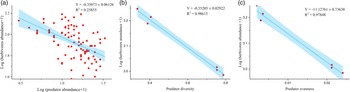
There was a significant, but negative relationship, between mean predator abundance and mean herbivore abundance (F 1, 94 = 32.78, P < 0.001, fig. 6a). Predator diversity (F 1, 4 = 101.29, P < 0.001, fig. 6b) and evenness (F 1, 4 = 101.29, P < 0.001, fig. 6c) were significantly and negatively associated with herbivore abundance.
Relationships between the herbivore densities and (a) predator densities (b) predator diversity, and (c) predator evenness in maize fields. Note that population data for herbivore and predators are log (x + 1) transformed and pooled for both the years.

Discussion
We observed a higher abundance of herbivores in conventional maize plots, while predator abundance was greater in organic maize plots. In prior studies, hexapod herbivores of maize, including Ostrinia nubilalis Hubner (Phelan et al., Reference Phelan, Mason and Stinner1995), often have ovipositional preference for conventionally grown maize compared to organic. Similarly, Aphis gossypii Glover was more abundant in conventional cotton fields, while its predators Coccinella septempunctata L. (Coleoptera: Coccinellidae), Chrysoperla carnea Stephens (Neuroptera: Chrysopidae) and Allograpta exotica (Widemann) (Syrphidae: Diptera) were in greater densities on organic cotton plants (Lu et al., Reference Lu, Perkins, Li, Wu, Zalucki, Gao and Furlong2015). Higher densities of cereal leaf beetles, Oulema spp. (Coleoptera, Chrysomelidae) and aphids were found in conventional wheat fields as compared to organic ones, whereas organic farming supported greater abundance of predators and parasitoids (Török et al., Reference Török, Zieger, Rosenthal, Földesi, Gallé, Tscharntke and Batáry2021). Another study demonstrated that phytophagous mites were significantly higher in conventional strawberry systems as compared to organic fields, whereas reverse situation was observed for hexapod natural enemies (Jacobsen et al., Reference Jacobsen, Moraes, Sørensen and Sigsgaard2019). Conventional agricultural practices accompanied by the use of synthetic fertilizers enhance herbivore abundance (Yardım and Edwards, Reference Yardım and Edwards2003). The manure application could reduce herbivore populations (Chau and Heong, Reference Chau and Heong2005) by increasing predator densities in manure-treated areas (Brown and Tworkoski, Reference Brown and Tworkoski2004).
Our results show that organic maize supports a higher abundance of predators as compared to conventional maize. This direct positive impact of organic farming on predator abundance was consistent with previous studies, those demonstrating enhanced abundance of predator functional groups on organic fields (Bengtsson et al., Reference Bengtsson, Ahnström and Weibull2005; Tuck et al., Reference Tuck, Winqvist, Mota, Ahnström, Turnbull and Bengtsson2014). On organic farms, synthetic pesticides are rarely used to manage insect herbivores and farmland weeds (Muneret et al., Reference Muneret, Auriol, Bonnard, Richart-Cervera, Thiéry and Rusch2019), which results in (1) increased availability of prey resources for predators and (2) increased local heterogeneity due to the production of natural vegetation in and around the field. Enhanced plant heterogeneity due to the production of natural vegetation in the form of farmland weeds is crucial for driving biological control on organic farms because they provide diverse floral resources and more hunting and hiding sites for predators (Galloway et al., Reference Galloway, Seymour, Gaigher and Pryke2021). Moreover, organic agriculture provides favorable microclimates responsible for enhanced plant resistance against herbivory supporting bottom up control of herbivores (Blundell et al., Reference Blundell, Schmidt, Igwe, Cheung, Vannette, Gaudin and Casteel2020) and also provide the brown food web species as an alternate host to the predators that directly triggers the top down control of herbivores (Muñoz-Cárdenas et al., Reference Muñoz-Cárdenas, Ersin, Pijnakker, van Houten, Hoogerbrugge, Leman, Pappas, Duarte, Messelink and Sabelis2017). Altogether, higher predator abundance can be attributed to favorable environments generated by organic managements like, lower pesticides exposure and supplement fields with offsite fertilizer like manure.
It has long been debated that increased predator biodiversity enhances biocontrol services in ecosystems (Root, Reference Root1973; Cardinale et al., Reference Cardinale, Harvey, Gross and Ives2003, Reference Cardinale, Srivastava, Emmett Duffy, Wright, Downing, Sankaran and Jouseau2006; Snyder et al., Reference Snyder, Snyder, Finke and Straub2006; Farooq et al., Reference Farooq, Razaq and Shah2022). Increasing the species evenness or enhancing the relative abundance of predators have the potential to improve biocontrol services (Crowder et al., Reference Crowder, Northfield, Strand and Snyder2010). The reason might be that relatively more even predator communities can occupy various complementary feeding niches. To sum up, more evenly distributed predator communities are potentially more important for providing biocontrol services on organic fields.
We noted predator abundance, diversity, and evenness as strong predictors of herbivore suppression because organic maize supports higher abundance of predators and there was a negative relationship between herbivore densities and predator abundance. This conclusion supports the natural enemy hypothesis that confers the herbivore suppression through enhanced abundance of natural enemies (Root, Reference Root1973; Cook-Patton et al., Reference Cook-Patton, McArt, Parachnowitsch, Thaler and Agrawal2011). It is well documented that organic farming supports higher densities and diversity of predators (Muneret et al., Reference Muneret, Auriol, Bonnard, Richart-Cervera, Thiéry and Rusch2019; Galloway et al., Reference Galloway, Seymour, Gaigher and Pryke2021). Increased abundance and evenness of predator species can improve or weaken the biological control (Hooper et al., Reference Hooper, Chapin, Ewel, Hector, Inchausti, Lavorel, Lawton, Lodge, Loreau and Naeem2005; Cardinale et al., Reference Cardinale, Srivastava, Emmett Duffy, Wright, Downing, Sankaran and Jouseau2006; Hillebrand et al., Reference Hillebrand, Bennett and Cadotte2008; Crowder et al., Reference Crowder, Northfield, Strand and Snyder2010). The key factor determining the effect of predator evenness on herbivore suppression is the overlapped foraging areas of predator communities. If predator communities share common food niches and foraged in the overlapped areas of each other, they often encounter each other while searching and hunting for the same prey (Laubmeier et al., Reference Laubmeier, Rebarber and Tenhumberg2020). This phenomenon more likely results in negative interactions like interference and intraguild predation that ultimately reduce herbivore suppression.
Organic farming has socio-economics pros and cons for small land holders. The major concerns related to this production system in developing countries includes market barriers and certification (Gómez et al., Reference Gómez, Barrett, Buck, De Groote, Ferris, Gao, McCullough, Miller, Outhred and Pell2011) of organic product, lower productivity (Connor, Reference Connor2013; Ponisio et al., Reference Ponisio, M'Gonigle, Mace, Palomino, De Valpine and Kremen2015) and lack of research and education for small scale farmers (Kleemann, Reference Kleemann2011). Meanwhile, organic farming systems provide several benefits to small land holders. In spite of lower productivity of organic farms, the economic profitability of this system is still maximum as compared to others (Ramesh et al., Reference Ramesh, Panwar, Singh, Ramana, Yadav, Shrivastava and Rao2010; Reganold and Wachter, Reference Reganold and Wachter2016), because organic products are demanded globally and sold at a premium price as compared to conventional products (Aryal et al., Reference Aryal, Chaudhary, Pandit and Sharma2009). In organic farming systems, substitutions of synthetic chemicals with low-energy and locally available farm inputs reduces the production cost of the farmer (Setboonsarng, Reference Setboonsarng2006). However, this production system is labor intensive, but, the working of kith and kins on subsistence farms also reduces the external production costs of farmers (Kleemann, Reference Kleemann2011). Organic farming has high environmental resilience to climatic shifts (Gattinger et al., Reference Gattinger, Muller, Haeni, Skinner, Fliessbach, Buchmann, Mäder, Stolze, Smith and Scialabba2012; Skinner et al., Reference Skinner, Gattinger, Muller, Mäder, Flieβbach, Stolze, Ruser and Niggli2014), and together with the diversified ecosystem techniques (intercropping, crop rotation), it can potentially lower the risk of crop failure. Cost–benefit analysis of organic production systems proved reasonable benefits for resource-poor farmers due to the reduction of production costs in developing countries (Amoabeng et al., Reference Amoabeng, Gurr, Gitau and Stevenson2014). Nevertheless, organic farming is a favorable system for the subsistence growers as they do not need to buy synthetic chemicals like fertilizers and pesticides, rather they apply farmyard manure and extracts of plants or their parts as fertilizers and pesticides, respectively (Carvalho, Reference Carvalho2017). Mostly, these inputs are easily and freely available in developing countries, for instance, manure of cattle raised for household needs can be used as organic fertilizers.
In conclusion, conventional maize supported a higher herbivore population, while organic maize supported a higher predator population. The predator diversity and evenness increased more in organic fields. We conclude that enhancing the relative abundance of predators has the potential to suppress herbivores on organic farms. Moreover, predator abundance, diversity, and evenness were shown to be strong predictors of herbivore suppression. To sum up, organic farming may not only be able to restore degraded ecological services but can also help subsistence farmers by lowering input costs for crop production. However, this is preliminary research and further research will be directed toward the determination of losses due to insect herbivores for cost–benefit analysis of both types of crops and evaluation of indigenous plant extracts for managing insect pests.
Data
The datasets generated and/or analyzed during current study are available from the corresponding author on reasonable request
Acknowledgements
We thank Dr Jessica Pruett (Thad Cochran Research Center, The University of Mississippi, Oxford, MS, USA) and Miss Faiza Hafeez (School of Biological Sciences; University of Nebraska—Lincoln, Lincoln, United States) for reading the manuscript, edits, and comments, and to Shahbaz Asghar, Haider Ali, and Hafiz Muhammad Usman (MSc scholars at Department of Entomology, Bahauddin Zakariya University) for help with data collection and species identification.
Author contributions
This research is the part of MS thesis of A. H. M. R. conceived, designed the experiment, and supervised all the research. A. H. conducted field experiment and collected data. F. M. S. and M. O. F. analyzed the data. M. O. F. and A. H. wrote the initial draft and F. M. S. reviewed, edited, and wrote the final draft. All authors improved and upgraded the manuscript.
Financial support
The authors did not receive specific support from any organization for the submitted work.
Competing interest
The authors have no conflict of interest.
Ethical standards
This article does not contain any studies with human or other animal subjects.
Declaration
This study was approved by the Advance Studies and Research Board of the Bahauddin Zakariya University.
Consent to participate
All the authors agree to participate.
Consent to publication
All authors agree to publish.