Sarah Reichardt's study is not simply concerned with the ‘analytical facts’ of four Shostakovich string quartets (nos 6–9). Nor is it concerned to place Shostakovich's music within an explanatory historical context. Reichardt wishes to ‘go beyond’ both analysis and biography in order to account for this music's ‘ability to hold meaning for a vast array of listeners’ (7). To this end she adopts another familiar, albeit less traditional, approach to musicological inquiry: the application to music of a body of theory, in this case that of Jacques Lacan. While Lacan provides the theoretical anchor point, there is also extensive use of Robert Hatten's markedness theories,Footnote 1 along with James Hepokoski and Warren Darcy's work on genre and deformationFootnote 2 and other post-structuralist thought – Derridean concepts, in particular, assume a prominent role.
Reichardt's approach to theorizing musical meaning is perhaps closest to that of Lawrence Kramer, in that the works she analyses are treated ‘as if they embody the characteristics of the modern subject’ (13). This might seem dangerously simplistic, suggesting a straightforward transparency of communication. But because the ‘modern subject’ is in some sense constructed, and in a specifically Lacanian sense ‘constituted […] in the symbolic order’,Footnote 3 Reichardt's approach is able to draw on some of the more subtle aspects of Kramer's hermeneutics, which, she reminds us, can be read as an argument ‘for understanding music not necessarily by means of what it “says”, but “by the way it models the symbolization of experience”’ (11).Footnote 4 This conception also helps to avoid the assumption that listeners are passive decoders of musical meaning. Listeners, for Reichardt, are active, in that ‘the ambiguities in the music allow [them] to redeploy the signifying act such that it reflects how they experience existence’ (13).
The book is structured clearly, in five chapters. The Introduction offers a brief but useful summary of a number of significant influences from the field of musicology, and concludes with a passing reference to the ‘interpretive minefields’ that prevail in Shostakovich research. Chapter 1 then looks at particular aspects of Lacanian theory, explaining that his concept of ‘the real’ forms ‘the foundation for the critical-theory approach’ of the book (1). This approach to Lacanian theory, which owes much to Slavoj Žižek's Looking Awry, allows Reichardt to develop a plausible methodological approach.Footnote 5 Shostakovich's music is conceived as a symbolic discourse that ‘exists as an attempt by the subject to symbolize experience’ (9). This premise serves to justify the contention that the Sixth, Seventh, and Eighth Quartets (analyses of which provide the basis of Chapters 2, 3, and 4 respectively) can each be interpreted usefully with reference to one of the objects encountered in Lacanian psychoanalysis (and represented with a symbol or matheme): S( ) (applied to the Sixth Quartet), objet petit a (applied to the Seventh), and Φ (applied to the Eighth). These objects are conceived as a product of ‘the real's encounter with discourse’ (9), and the universality of such a process serves to explain the meaning that these works hold for a ‘vast array of listeners’.
While this appeal to an intersubjective psychoanalytical framework has a degree of novelty, in practice it will have much in common with other approaches familiar to readers. The dominant pattern of argument here is one that seeks to connect musical structure to non-musical meaning via a ‘trope’ or ‘schema’ – what Giles Hooper has usefully described as ‘a kind of metaphorical map’.Footnote 6 Lacan's three objects – S(), objet petit a, and Φ – serve precisely this purpose, and a considerable portion of the book therefore makes the case for drawing analogies between Lacan's objects and Shostakovich's music, with varying degrees of success. This process of ‘troping’, too, is indicative of Kramer's influence, but Reichardt's work also owes a clear debt to Hatten. In 2001 Nicholas Cook and Nicola Dibben highlighted the work of Hatten as ‘to date, the most comprehensive attempt to incorporate expressive and structural analysis within a coherent critical practice’.Footnote 7 Reichardt is to be commended for drawing on this key achievement in Hatten's work, and while there are certain inconsistencies, especially in Chapter 4, there is also a sense in which certain problems associated with Hatten's work are skilfully avoided. For example, the assertion of what might, with reference to Lacan, be termed a shared (modern) subjectivity allows Reichardt to avoid some of the difficulties encountered in Hatten's own writing concerning the ‘competent listener’ and the recovery of listening competencies associated with the historical past.Footnote 8
It is Chapter 2 that perhaps works hardest to adhere to the book's stated aim of interpreting the quartets ‘through the lens of Žižek's Lacanian-influenced critical theory’ (12). We have noted that the book's primary concept is ‘the real’: in this discussion of the Sixth Quartet the focus is on the real as theorized in terms of S().Footnote 9 The real, for Lacan, is ultimately unknowable, and in that sense (but perhaps only in that sense) comparable to Kant's noumena. Through the process of symbolization we do, to some extent, assimilate the real, but it always escapes full comprehension. Reichardt draws on Foucault's ‘epistemes of knowledge’Footnote 10 to posit a number of human strategies for coping with the irrational void of the real, its senseless emptiness. These are: to ignore it (a strategy that characterizes the modern era), to claim that it can be controlled (characteristic of the Enlightenment), and to read the ruptures caused by the real as signs of the divine (characteristic of the Renaissance). Each of these strategies (extended by the introduction of Jacques Attali's modes of sociomusical relation)Footnote 11 is mapped onto one of the movements of the Sixth String Quartet. This yields some interesting results, and Reichardt's points concerning the explanatory role of Derrida's concept of the textual graft are particularly well argued. On the whole, the chapter on the Sixth Quartet is, I would suggest, the most successful in the book, despite some limitations to which I shall return.
In Chapter 3, concerning the Seventh String Quartet, the book drifts somewhat from its stated aim, in that Lacanian theory becomes considerably less prominent. We are expecting at this point an interpretation that pays close attention to the second of Lacan's objects, the objet petit a. Somewhat surprisingly, only one paragraph of the chapter discusses it directly and, more confusingly, objet petit a is conceived in terms of drives, sidelining the key word so commonly used to define it: desire.Footnote 12 In fact, Žižek's Looking Awry (one of Reichardt's primary theoretical points of reference) draws on an explicit opposition between drive (connected to another of Lacan's objects: Φ) and desire (connected, as we have said, to objet petit a).Footnote 13 It is certainly the case that the objet petit a was one of Lacan's most elusive and continually revised concepts, but this is not clearly acknowledged, and there is no explanation of why Reichardt's account of it appears so at odds with other scholarship. In the absence of specific Lacanian theory as a primary point of reference in Chapter 3, Reichardt draws at length on the notion of two deaths, which, it is argued, the Seventh String Quartet enacts. The ideas on which Reichardt draws (from authors that now include Hepokoski and Darcy, Alexander Ivashkin, and Naomi CummingFootnote 14) again enliven the discussion of Shostakovich's music, and the central tropes concerning death and rite make for an engaging account of this relatively short but fascinating work. Robert Rival's interpretation of the Seventh Quartet, published in a previous issue of this journal, would provide for it an elucidating point of comparison.Footnote 15
In analysing the Eighth String Quartet, Reichardt is faced with a much larger body of secondary literature, a point acknowledged early in the chapter with particular reference to David Fanning's monograph on the work (73).Footnote 16 It is perhaps for this reason that Chapter 4 has a more descriptive character and lacks the strong sense of integration between ‘expressive and structural analysis’ achieved in other parts of the book. Although much of the discussion is given over to a descriptive/analytical account of the work, we encounter once again a cogent deployment of Lacanian psychoanalytical theory, which offers an intriguing means of conceiving the domineering presence of the DSCH motive throughout the work. Reichardt now turns to the third object in the Lacanian triangle introduced in Chapter 1: Φ. This can be termed ‘the phallus as signifier of desire or jouissance’Footnote 17 and is explained by Žižek in terms of protuberances that are ‘almost too present’ – a ‘formless content’ that, like the other objects, offers a means to address and yet remain distant from the central abyss of the real.Footnote 18 In approaching this object Reichardt, as in previous chapters, layers tropes. Drawing on Jean-François Lyotard, Julia Kristeva, and, again, Derrida and Žižek, she considers at some length the notion of the proper name, which has a clear relevance to the use of the DSCH moniker. This allows for a provocative account of its role in the Eighth Quartet as a whole, in which it is subjected to a process of ‘hollowing out’ and through which ‘we experience a symbolization of the relationship of our constructed universe with respect to the real as, in the end, reality is centred around emptiness in the same way that the proper name is a shell emptied of signification’ (93). This sheds new light on the opposing interpretations of Fanning and Kramer, in that the notion of the proper name (DSCH) functions as an inescapable symbolization of the real, which hollows out meaning and yet makes existence possible. Lacanian theory here allows us to recognize the insight offered by Kramer's claim that the music of the Eighth Quartet has somehow ‘lost its capacity for meaning’ (95).Footnote 19 Reichardt sees a virtue in this sense of loss and failure, and through it integrates also Fanning's insistence on the achievement of autonomy in the quartet's last movement. Drawing on Gregg Horowitz's concept of autonomy,Footnote 20 as that which the work of art achieves by revealing the impossibility of the transcendence at which it aims, she argues that the failure of the quartet to transcend the DSCH motive is the very point that ‘marks its autonomy’ (95). It is the Lacanian phallus or Φ that provides a means to theorize these apparent contradictions and relate them directly to the DSCH motive that dominates the quartet as a whole.
By the time she reaches the Ninth Quartet Reichardt has, so to speak, run out of Lacanian objects – the three points of the Lacanian triangle have already been mapped onto the preceding quartets. As in Chapter 2, where the four movements of the Sixth were considered in terms of Foucault's three epistemes of knowledge, Reichardt has to find a means of augmenting her chosen theoretical toolbox. In both instances the extension is a little awkward. In relation to the movements of the Sixth this is achieved by mapping Foucault's epistemes of knowledge onto Attali's modes of sociomusical production.Footnote 21 (Reichardt's claim that Attali's book ‘is easily interpreted as being structured around Foucault's epistemes’ (38) perhaps tells us more about the rather free associations drawn between different theories in Composing the Modern Subject than about any genuine compatibility between the two systems.) In relation to the Ninth Quartet the theory of Mikhail Bakhtin is introduced in such a manner that all the Lacanian theory deployed thus far is tied to one side of an opposition: epic vs novel.Footnote 22 The result of this theoretical move is potentially problematic in two respects. Firstly, the theories themselves can become distorted. Bakhtin's opposition is certainly worthy of close attention: the theoretical distinction between the epic as that which is past, absolute, singular, and closed, and the novel which, by contrast, is current, diffuse, plural, and open is undoubtedly ripe for musicological engagement. However, to equate all aspects of the Lacanian objects discussed in earlier chapters with the epic to me suggests oversimplification. Surely the complex notions of S() (the signifier of the lack in the other), objet petit a (the cause of desire), and Φ (the phallus as signifier) can be related to both terms of Bakhtin's epic/novel opposition (if they should be related at all). The second problem concerns not so much the distortion of theories but the musical structures to which they are applied. In relation to the Ninth Quartet, for example, a number of Reichardt's most useful analytical findings, such as those concerning the use of octatonic relations in the finale, make little reference to the wider troping strategies in play. Furthermore, when a notion such as ‘novelization’ is specifically engaged, the insistent recourse to qualities such as flexibility, multiplicity, and diffusion seems strained.
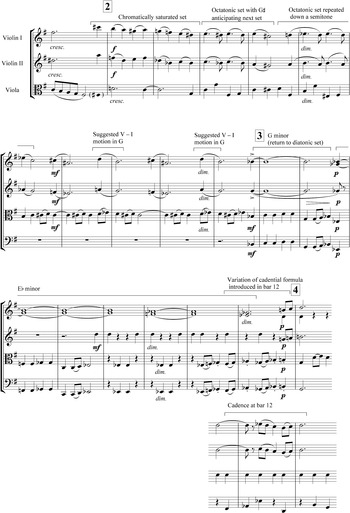
Returning to the Sixth Quartet, again the process of applying a body of theory threatens to distort the music under scrutiny. Discussing the first movement, Reichardt suggests that the act of ‘slipping’ into E♭ minor in the continuation section in part indicates that ‘the movement has been unable to avoid the real’ (29–30). E♭ minor is characterized here as an intruding or opposing force.Footnote 23 But to my ears this continuation section does not disrupt or stand in opposition to the G major of the presentation. Firstly, the disruption of classical conventions is not confined to the occurrence of E♭ (or A♭, which takes on a similar role for Reichardt) but is a notable process throughout the movement right from the opening ostinato figure in the viola. Secondly, if we look in more detail at the presentation, there is not a sense of a simple slip into E♭ minor at all. The suggestion of E♭ minor actually occurs towards the end of the presentation, at which point it sounds more like a chromatic neighbour to the G major tonality that opened the work (see 1). If there is a sense of localized disruption it is around rehearsal Fig. 2. The bar prior to this implies a diminished seventh chord, which leads with a crescendo to two bars (upbeat included) containing all the notes of the chromatic scale. After this stark shift from G major to a high saturation of dissonance we move gradually back towards the diatonicism of the opening. This is underlined by a move through two two-bar phrases, each with a decidedly octatonic sonority, to a thinner texture that juxtaposes a dissonant quasi-cadential figure with something resembling a V–I motion in G major. We then return to diatonicism with two phrases, the first in G minor and the second in E♭ minor, which provide a sense of transition back to G major because of the connection already set up at bar 12 between the notes A♭ and E♭ and the tonality of G major (a connection which draws in turn on conventions of the flattened sixth and Neapolitan substitutions/inflections) and because of the reintroduction of the ostinato D that opens the movement. The lead into G major at Fig. 4 even closely resembles the cadential figure heard throughout the quartet, which functions to my ears as a remnant of tonal convention rather than an irrational intrusion or ‘invading force’ (30). The repeated juxtaposition of D and E♭, which Reichardt describes as ‘duelling drones’, might be read in the light of this interpretation as performing a function similar to a ‘standing on the dominant’Footnote 24 passage, which articulates a sense of stasis prior to a thematic statement or return.
Shostakovich, String Quartet no. 6, first movement, Fig. 111–41 (bars 23–42) with comparison of concluding cadential material to Fig. 011–12 (bars 11–12).

By insisting on a specific mapping of Lacan's S() onto the recurring cadential figure (heard first at bar 12) as well as onto the medium-scale structure (the example discussed here) and the large-scale tonal structure of the movement, Reichardt is perhaps liable to misrepresent important musical relationships, or at least ignore the sense in which her interpretation might be resisted by aspects of the musical structures under analysis. Shostakovich's musical language may indeed suggest a generalized uncertainty concerning the modern subject, but there are problems with identifying such meanings with specific musical ideas in the manner that Reichardt tends to suggest.
Such criticism should certainly not be taken to undermine Reichardt's otherwise sophisticated and richly argued book. Any proposed musical meaning, especially one couched in terms of a complex theoretical paradigm, will tend to encounter some level of resistance from the musical relations it seeks to explain; and this resistance, I would suggest, intensifies as analysts seek out further layers of detail. It is in this sense, I think, that the limitations of Reichardt's study can be taken as instructive. The application of Lacanian theory to musical texts and practices is undoubtedly a worthwhile pursuit and yields some fascinating insights, but, as when any apparatus is borrowed from another discipline, claims for a direct (analogical) correspondence between the structural features of a given work and specific theoretical concepts have a tendency to become more unstable as our analytical findings develop. While she may at times overstate the breadth of Lacan's applicability, Sarah Reichardt has done much to stimulate further investigation in this area.