The literature on the social policies of governments in advanced industrialized nations is burgeoning. In recent decades, there has been a major debate on whether or not the role of partisan governments is as crucial after the oil price crises of the 1970s as it is normally perceived to have been before that time.Footnote 1 With the collection and release of fine-grained data on the social rights of citizens, a consensus appears to be emerging that partisan governments still matter, however. The most notable finding is that since around 1980, right-wing governments have become associated with significant drops in citizens’ social rights.Footnote 2
In the existing literature, transfer programmes related to the labour market are almost always at the centre of attention both theoretically and empirically. Theoretically, most existing research views social policies as related to the labour market. The power resource theory posits that the distribution of power between the labour movement and employers has been the main factor driving welfare-state expansion,Footnote 3 while the varieties of capitalism approach argue that the skills structure of the labour force is the root cause of cross-national differences in social protection.Footnote 4 Empirically, studies have predominantly either looked at the developments in unemployment, sick-leave and work accident replacement rates,Footnote 5 or highly aggregated spending categories.Footnote 6
This article studies the healthcare policies of right-wing governments. I argue that health care is inherently different from the social policies normally studied in the literature and that the political dynamics of partisan governments are, therefore, in this respect likely to be markedly different as well. Health care is characterized by two important features from the current perspective. First, failing health is a life course risk, meaning that it is largely uncorrelated with the income distribution. High-income and low-income individuals are almost equally exposed to the risk of failing health.Footnote 7 This sets health-related risks apart from labour market-related risks, which are negatively correlated with income.Footnote 8 Secondly, health care is predominantly publicly financed and with universal access in all Western nations except the United States.Footnote 9 Effectively, this implies that the advocates of retrenchment face resistance from a coalition of strong public producer groups and users from all income segments except from those with a relatively high income.
I assume that right-wing governments are motivated by two goals, re-election and pursuing policies, that benefit their core constituency (high-income individuals), but due to the inherent features of health care the two goals conflict. The preferences of the core constituency are best met by expanding private market provision at the expense of provision. This will reduce the tax burden of this group, who will then only have to pay according to use, all else equal reducing their total costs.Footnote 10 Yet such policies are likely to be highly unpopular among middle-income voters, who must be accommodated to ensure re-election.
Inspired by authors like Pierson and Hacker, I argue that right-wing governments will practise a strategy of marketization via compensation.Footnote 11 The strategy has two components. The first component is to match the left wing in terms of public spending and availability of public services. This is vital in order to win the votes of the crucial middle-income group to whom a pure private market-based healthcare system would constitute a significant welfare loss. The second component is to actively encourage and financially support the expansion of private health care, notably through private health insurance (PHI) and opting out of the publicly provided scheme, alongside the existing public healthcare system. Since this expansion does not happen at the expense of the public healthcare system, it is likely to be perceived as less of a threat and possibly even as a public good. Expanding private health care has two positive consequences from the perspective of right-wing governments. Usage of private health care is, first of all, in general skewed markedly towards high-income individuals, i.e., the core constituency of the right.Footnote 12 In addition, to the extent that universal social policies, like public health care, generate their own popular support, the introduction of market-like institutions may gradually undermine that support and pave the way for less covert reforms at a later stage.Footnote 13 The argument presented here is tested in a large-N quantitative analysis and in case studies of Australia and Denmark, two countries that are dissimilar on a number of counts, but similar with respect to the partisan composition of their governments.
As discussed in the conclusion, this article illustrates a general phenomenon, namely that right-wing governments not only face unique challenges compared to left-wing governments, but also have a range of strategies available to them when meeting them. It is a central message of this article that the strategy that is chosen can be predicted by the nature of the programme constituency. Effectively, this article adds considerable nuance to the existing literature on social policy reforms in mature welfare states.
Health care and the social policy literature
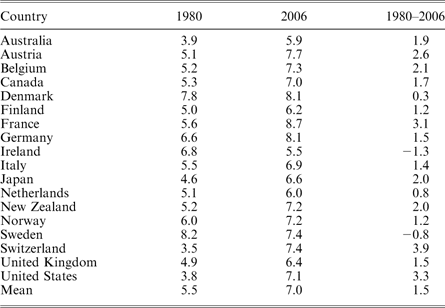
Health care is a core component in all welfare states in advanced industrialized nations. As Table 1 documents, public healthcare spending takes up an average of 7 per cent of gross domestic product (GDP) in the eighteen nations analysed in this article; only publicly provided old-age pensions consume a larger share. It is also evident from Table 1 that healthcare spending has increased steadily since 1980, thereby adding to the fiscal stress experienced in many nations.Footnote 14 Given the size and growth of healthcare spending and the ensuing political conflicts over cost containment and market reforms, it is noteworthy that ‘students of the welfare state – who have intensively examined the post-1970s development of other prominent realms of social policy – have devoted surprisingly little attention to these crucial disputes, leaving the field almost entirely to health policy specialists.’Footnote 15 The few existing studies either view health care as yet another social policy area in line with, for example, unemployment protection, or are preoccupied with the moderating effect of institutions on healthcare politics. In my opinion, the former perspective does not pay sufficient attention to the particulars of healthcare provision, while the latter neglects the role of political parties, notably right-wing parties, which I want to study.
Public Health Care as a Percentage of GDP in 1980 and 2006

Note: Data for some countries are from 2005 as data from 2006 are unavailable. Source: OECD (2010).
Castles, and Huber and Stephens have presented two prominent examples of social policy research that fundamentally view health care as a policy area with the same underlying mechanisms as all other social policies.Footnote 16 Both books hold that the main driver of expansion on both health care and the other major social policy areas at least until around 1980 was partisan governments with left-wing incumbency leading to more spending and right-wing incumbency leading to comparably less spending. This fits, according to the authors, with the power resource theory which posits that left-wing governments are moved to provide generous public welfare schemes in order to facilitate the largest amount of economic redistribution possible. After 1980, none of the authors of these two books finds any strong effects of partisan governments – neither on health care nor on any other social programmes. This is attributed to the permanent fiscal austerity that has prevailed in most Western nations since the late 1970s.
Table 1 makes clear that almost all countries have seen rising public healthcare spending since 1980. This clearly does not resonate well with the argument that fiscal stress has ruled expansionist policies out. In the literature, the continuing expansion is normally viewed as caused either by Baumol's cost disease, where productivity increases in the service sector trail those of industry and agriculture, or by the rapid technological innovations that lead to ballooning medical prices (so-called ‘excess health inflation’).Footnote 17 These factors are probably important, but we cannot conclude, based on the findings of Castles and Huber and Stephens, that partisan governments play no role at all. Importantly, even if we were to accept their results at face value, their regression estimates are only able to capture whether or not there is a difference in total public spending between having a left-wing or right-wing government. Yet partisan governments may matter in more subtle ways that are impossible to detect in this manner. I will argue below that the healthcare area in modern-day welfare states is characterized by a political dynamic that forces both left-wing and right-wing parties to expand spending on health, and show empirically how some of the health expenditure increases in Australia and Denmark have been caused by deliberate political choices rather than simply socio-technological push factors.
Immergut and Hacker have highlighted the importance of veto points when analysing the politics of health care in a cross-national perspective,Footnote 18 and Hacker points to the role of single-payer or multi-payer arrangements (or hierarchical versus decentralized medical systems). Focusing on Hacker, who arguably presents the most relevant framework for studying modern-day healthcare politics, the main proposition is that marketization has been on the agenda in most nations, but with relatively modest success. Only in settings with few veto points and a hierarchical medical system has marketization been implemented, yet even here without path-breaking changes. Hacker argues that marketization initiatives, including greater reliance on out-of-pocket financing and decreasing public spending as a share of total health spending, are electorally unpopular and likely to run into fierce opposition from vested interests, essentially making politicians of all party colours refrain from any large-scale reforms.
It makes sense that popular disapproval and the potential for open conflict with producer groups and the medical industry make politicians shy away from market reforms. But then again, this does not necessarily imply that partisan governments no longer play an active role. Part of the problem with Hacker's argument is that it relies on a rather dichotomous understanding of healthcare reforms as either advancing public or private provision. I believe this hides more subtle instances of marketization where the two forms of provision go hand in hand. This, in fact, is what I label ‘marketization via compensation’, a policy strategy of particular interest to right-wing governments, as will be discussed in the next section.Footnote 19
Marketization via compensation
In the social policy literature, ‘partisan politics’ is almost always equated with ‘left-wing governments’ and right-wing governments are merely the residual category from which the left more or less successfully deviates. One of the questions often posed is whether left-wing governments really were the main driver of social spending and welfare rights in the post-war decades, or whether other factors mattered more.Footnote 20 Also, does left-wing incumbency still lead to more welfare than right-wing governments would allow?Footnote 21 What reform strategies are introduced by left-wing governments that actually do want to introduce retrenchment?Footnote 22 All these questions are tremendously interesting, but they also reflect a neglect of right-wing governments as more than just the mirror image of left-wing governments. This is unfortunate because, as emphasized by Pierson, in mature welfare states where the left mostly fights to protect the status quo, the pro-active force advocating policy change will be the right.Footnote 23 I will argue that thinking more explicitly about right-wing governments allows us to understand the politics of health care much better than we would otherwise be able to.
There is general agreement in the literature to view left-wing and right-wing parties as representing low-income and high-income groups, respectively. Left-wing parties do so by advocating generous social policies that entail redistribution of income from the rich to the poor, while right-wing parties fight such policies. Yet parties, or at least party leaders, are also commonly assumed to be office-seeking, even if this means giving up on their policy preferences. This is why, according to Pierson, right-wing governments will refrain from retrenchment – because such actions would endanger their prospects of re-election. While rarely made explicit, the theoretical weight ascribed to either the policy-seeking or office-seeking behaviour of politicians is to a large extent the root cause of much of the disagreement on the role of parties in the social policy literature. Solving this piece of algebra is hence the only way forward if we want to understand the partisan politics of governments. Doing so requires serious attention to the special features of individual policy areas that determine the specific policy preferences of parties.
Social programmes like unemployment protection, sick pay, work accident insurance and early retirement schemes are all aimed at meeting risks that relate to the labour market. Labour market-related risks are well known to be negatively correlated with income: low-income individuals are significantly more exposed to unemployment and the like than high-income individuals.Footnote 24 For this reason, it also makes eminent sense that left-wing governments favour the expansion of these kinds of programmes, while right-wing governments try to reduce them. Recently, Korpi and Palme and Allan and Scruggs have shown that this is actually the case empirically.Footnote 25
Failing health, however, is a life-course risk, i.e., a risk that is predominantly uncorrelated with the income distribution (but see below): all individuals regardless of income must at some point in life expect to fall ill.Footnote 26 Given the potentially ruinous costs of purely out-of-pocket medical treatment, this has a profound impact on the preferences of most citizens for public health care. The reason is that only the most well-to-do are able to pay for health care when they need it. To all other individuals, including those middle-income individuals whose votes are necessary for any government that wants to get re-elected, a pure private market healthcare system would imply a very significant potential welfare loss.
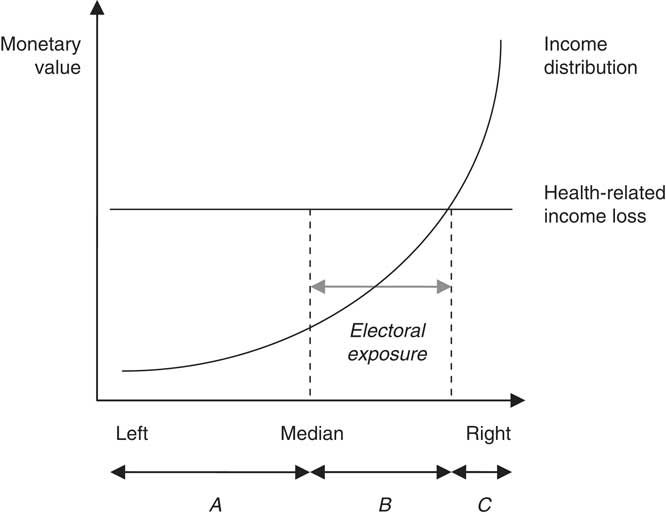
Figure 1 outlines the logic visually, albeit in a stylized fashion. It shows how the potential health-related income loss (medical expenditure and loss of wage income) is uncorrelated with the income distribution, while income itself takes a quasi-exponential form, as it is known to do empirically.Footnote 27 The assumption that potential health-related income loss is uncorrelated with the income distribution may need a little clarification. It has been well documented that there is a negative correlation between income and health status,Footnote 28 and yet it has also been shown that actual take-up, i.e., usage of public health care, is strongly skewed towards high-income individuals.Footnote 29 In other words, although high-income individuals on average have slightly better health than low-income individuals, this is not mirrored in how much these individuals benefit from public healthcare provision. Health care in this respect resembles other life course-related social programmes like education, the full usage of which is well known to require high levels of cultural capital, something that is disproportionally located among high-income families.Footnote 30
Life-course risks and demand for public healthcare protection

Since there is a gap between the health-related income loss and income of the median voter, an electoral exposure appears that adversely affects right-wing governments. All voters with an income below the health-related income loss will favour public healthcare provision that effectively closes the space between the two. Yet all voters with an income above the health-related income loss will in fact favour a private market solution as high-income individuals will only have to pay for their own health care.Footnote 31 In sum, right-wing governments are squeezed between the pro-public preferences of the important middle-income voters (group B) and the pro-private preferences of the high-income voters (group C). This is a dilemma of which left-wing governments are luckily relieved, because all their voters (group A) have an income below the health-related income loss.
The problems of right-wing governments are aggravated by the fact that health care de facto is a universal service in all Western nations except the United States. This means that the pro-public coalition is likely to be quite sizeable compared to most other social programmes. Public health care is supported first of all by those producer groups – professionals and bureaucrats – who directly earn their living in that area, and who constitute fairly strong groups in their own right. Apart from these vested interests, low-income and middle-income voters are also likely to punish any politician vowing to remove universal access to health care. As noted by Pierson, the fact that a programme is already up and running means that the pro-public coalition merely has to fight to protect the status quo, while the reform advocates have to overcome not only organized opposition from vested interests, but also the negative bias of the electorate against large-scale reforms.Footnote 32
How do right-wing governments solve the dilemma? Even if we assume that governments are strictly office seeking, it may be a dangerous strategy to ignore the preferences of the high-income constituency entirely, because this might jeopardize their financial support from this group, upon which right-wing parties in general are heavily dependent. Moreover, if we allow for the not totally naïve notion that politicians sometimes are motivated by genuine policy preferences, the dilemma only grows. I suggest that the answer lies in the strategy of marketization via compensation, a strategy that allows the government to ride two horses, so to speak, but which simultaneously generates some rather startling side effects.
The strategy of marketization via compensation consists of two components. First, the right-wing government needs to match the policies of the left-wing in terms of spending on public healthcare provision. The crucial middle-income voters have to feel comfortable that the quality of the public services and their access to them are secure with the government. Given the well-organized spending advocates in the area and the presence of a credible left-wing alternative for dissatisfied voters in many nations, right-wing governments will be keen to allocate as many resources as the left.
Money is often the symbol of political commitment in mature welfare states. Politicians who want to be seen to be taking a problem seriously normally pledge to spend additional sums on the policy area in question. Conversely, politicians promising to solve social problems without spending more money often risk being viewed as opportunistic or hostile towards the welfare state. Yet while pledging additional money constitutes a transparent and straightforward symbol of commitment, it still leaves considerable room for partisan governments to differ.
The second component of marketization via compensation consists of the active encouragement and financial support of private market health care and may take the form of indirect support of private health insurance (PHI) and opting out. The aim of this component is to please the core constituency who cannot get a smaller public healthcare sector, but who may nevertheless get the private market alternative they favour. While it does not reduce the tax burden, it has other advantages for high-income individuals. Most significantly, it is well established that usage of private market health care, notably PHI, is positively correlated with income, partly because PHI is often dependent on employment status and companies tend to award higher-ranking employees with more generous PHI than lower-ranking employees; and partly because even government-supported PHI schemes may be too expensive, particularly for low-income individuals, to purchase.Footnote 33
An additional advantage, which is more of a long-run golden prospect, is that the introduction or expansion of private market health care may eventually erode public support for public health care. Korpi and Palme and Rothstein posit that universal social policies, like public health care in all Western countries except the United States, generate their own popular support because a large part of the middle-income voters rely on the programmes.Footnote 34 Regarding health care, this support is enhanced because of the nature of health-related risks, which do not discriminate between people according to income. By gradually expanding the role of private market health care alongside public health care, public attitudes towards the private market alternatives may change in a process of institutional layering.Footnote 35 This mirrors Pierson's finding on housing policies in Britain and the United States: ‘The existence of a highly popular private alternative, owner occupation, makes public programs appear inferior, and, for most of the electorate, irrelevant.’Footnote 36
To sum up, I argue that we ought to see clear partisan effects on health care, but in quite different ways than normally expected. If my argument is correct, we should see clear partisan effects in a large-N analysis with labour market schemes as the dependent variable – where the pro-public preferences of the middle-income voters are comparably low – but no partisan effects on health care. The reason for the lack of partisan effects will not be due to the irrelevance of partisan governments, but rather because partisan effects are more subtle than what may be captured in conventional time-series cross-section regression analyses. The effect of right-wing governments will be visible in two interrelated ways. First, no active steps will be taken to curtail public spending. Quite the opposite in fact: right-wing governments will deliberately implement expansionist policies so that no visible difference is apparent between left-wing and right-wing governments. Secondly, and in contrast to the behaviour of left-wing governments, right-wing incumbency will entail a surge in public spending on private market health care, either via indirect support for PHI or as opting out, where the government purchases the services of private market operators.
Quantitative evidence
Data and Analytical Technique
The empirical part of this article consists of two sets of evidence. The first set is conventional large-N time-series cross-section regression analysis. I use this to test the first proposition, namely that right-wing incumbency entails a reduction in labour market-related programmes compared to left-wing incumbency, but that there is no difference between partisan governments when it comes to health care. The second set of evidence is comprised of case studies of Australia and Denmark. Case studies are necessary in order to test the second proposition that right-wing governments rely on the strategy of marketization via compensation. In this section, I start out by discussing the data and analytical technique used in the quantitative analysis and the next section presents the quantitative evidence.
I use Scruggs's newly released data on unemployment replacement rates for the period 1980–2002 as my measure of labour market-related programmes.Footnote 37 Unemployment replacement rates capture the value of social benefits in case of unemployment as a ratio to the wage of the average production worker. Korpi and Palme and Allan and Scruggs show that right-wing governments since around 1980 have curtailed the social rights of individuals on a number of programmes, but I focus on unemployment replacement rates because I simply want a contrast with my analysis of public health care, and unemployment protection is arguably more important than workplace accident insurance and sick pay.Footnote 38
Health care is a universal programme in all advanced industrialized nations outside the United States, and therefore focusing on the social right to receive public healthcare does not make much sense in a cross-national study like this one. Instead, I use public healthcare spending as a percentage of the GDP as my dependent variable. Partly, this is due to a dearth of good alternative data on government intervention, but it also reflects a theoretical point that I believe has been underappreciated in the literature: in modern-day politics, the symbol of sincere political commitment is above all else the allocation of extra monetary resources – especially in areas of such complexity as health care. For this reason, public spending is actually a highly valid measure of right-wing governments’ willingness to appear enthusiastic about public health care.
Right-wing incumbency is measured as right-wing cabinet portfolio as a percentage of all cabinet portfolios and is taken from Swank's Comparative Parties Dataset.Footnote 39 A series of socio-economic variables are also included as controls. It is evidently important to control for the unemployment rate, although unemployment replacement rates are not directly influenced by changes in unemployment levels. I also include the proportion of the population aged 65 years or more, the female labour-force participation rate, real growth in GDP and net government lending.Footnote 40 Finally, a measure of economic globalization is included, namely the new KOF index collected by Dreher,Footnote 41 which combines a total of twenty-four measures of trade and capital movements.
The analysis is based on an error correction specification. Error correction models have won widespread popularity in recent years as a better means of capturing the long-term and short-term effects of explanatory variables on the dependent variable. These models include both the actual value and first difference of all time-variant explanatory variables together with the lagged dependent variable measured by its actual value. The basic logic is that the changes in an explanatory variable constitute a shock to the equilibrium relationship between explanatory and dependent variables. As a response to the shock, the dependent variable will return to the equilibrium over a period of time. The first difference in the explanatory variable measures the short-term response to the shock, while the value of the explanatory variable measures the long-term response.Footnote 42 Error correction models are well suited to the present purpose. By studying changes in the dependent variable, it is possible to gauge the effect of right-wing governments after 1980. The alternative – relying on the absolute value of variables – implies that we are attempting to explain the total level of social spending. Yet, given Allan and Scruggs's finding that right-wing governments did not have a negative impact until around 1980, this variable cannot be expected to explain the total level, which is strongly influenced by political decisions in the previous decades.
All variables are lagged one year as is customary in the literature. As suggested by Beck and Katz,Footnote 43 I estimate an ordinary least squares (OLS) regression model with panel-corrected standard errors. I estimate both random effects and fixed effects models. The former allows us to gauge the between-country effect of the variables, while the latter allows us to study the within-country, or temporal, effects of the variables. Taken together, these models should allow us to draw a robust conclusion about the impact of the partisan variable.
Findings
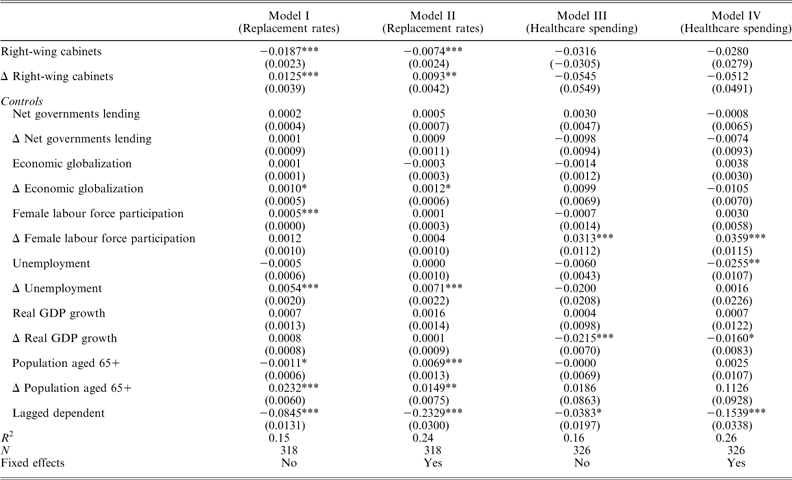
Table 2 reports the findings from the quantitative analysis. Model I reports the random effects model on unemployment replacement rates. It is evident that right-wing governments have a clearly negative impact on replacement rates compared to left-wing governments (the short-term positive effect is entirely dominated by the long-term effect as the long-term effect is calculated by dividing the long-term coefficient by the lagged dependent variable). The negative impact remains when fixed effects are included in Model II. This finding corroborates those of Korpi and Palme and of Allan and Scruggs. It is comforting to note that their widely cited findings can be reproduced in an error correction model.
The Effect of Right-wing Government, 1980–2000

Note: Panel-corrected standard errors in brackets. ***p-value < 0.01; **p-value < 0.05; *p-value < 0.10. All independent variables are lagged one year.
Next, Models III and IV study the partisan effects on public healthcare spending. Comparing these models with Models I and II, it is immediately evident that the partisan dynamics are wildly different: on unemployment replacement rates, right-wing governments have a negative impact; on healthcare spending, right-wing incumbency has no effect. Looking at the controls, we see that most variables behave as expected, lending additional credibility to the results. Rising unemployment leads to rising replacement rates, arguably as the number of citizens with a vested interest in these benefits increases. Female labour force participation has a similar effect in the random effects model, which indicates that a rising number of women in the workforce increases the number of voters interested in expanding these benefits. The same effect can be found when it comes to health care, but here the effect is short term, which makes sense because the healthcare area primarily relates to female labour-force participation as a source of jobs. As females often find jobs in the healthcare sector, it makes sense that this variable has a year-to-year effect on healthcare spending as this reflects rising wage payments to the newly employed women. Real growth of GDP is, finally, negatively related to healthcare spending in the short term, because it corrects for changes in the denominator. All in all, the quantitative evidence indicates that the healthcare area is different from labour market-related programmes like unemployment protection. Next, I will examine in more detail exactly what this entails from the perspective of partisan politics.
Case Selection
As mentioned above, the object of this research was to study, first, whether right-wing governments do actively increase public spending, and thereby to discover whether the lack of partisan effects in the quantitative analysis is not caused by institutional or economic factors having crowded out partisan effects altogether. Secondly, my object was to study whether right-wing governments encourage and support private market healthcare financially, for instance through tax breaks on PHI and opting out policies, where public providers are forced to purchase services from private market operators. To do so, I need to move from a large-N analysis to case studies, because this is the only way to get a firm understanding of the exact policies of incumbent right-wing governments.
In his influential study, Hacker distinguishes between two institutional dimensions that structure healthcare politics in advanced industrialized nations.Footnote 44 The first dimension is the number of veto points and the other dimension is whether or not the medical system is hierarchical (i.e., payment is made by only one buyer) or decentralized (i.e., there are many buyers). It is consequently crucial to select cases that diverge as much as possible on these two dimensions, because I want to isolate the effect of right-wing governments. Therefore, the case selection follows a ‘most different systems design’, one that is particularly well suited to test propositions about the universal import of a factor (here right-wing incumbency) across highly diverse institutional contexts. In addition, the cases have to fulfil two basic criteria regarding the independent variable, namely that they have been governed by a right-wing government for such a period of time that it could leave a legislative footprint as well as by a left-wing government for a roughly equal period of time. Though it is sometimes neglected – consider Pierson's seminal book that studies the Thatcher and Reagan administrationsFootnote 45 – we cannot analyse the effects of a right-wing government properly without actually including a left-wing government as a shadow case.
Australia and Denmark fulfil all the criteria. Australia has, according to Hacker, a veto-ridden political system and a decentralized medical system, while Denmark has a veto-free political system and a hierarchical medical system. They also differ in terms of the electoral system (Australia is majoritarian; Denmark has proportional representation (PR)) and welfare state traditions (the Australian welfare state historically rests on residual principles; the Danish on universal principles).Footnote 46 In terms of government colour, Australia was governed by Labour between 1983 and 1996 after which the right-wing Liberal-National Coalition took over until 2007. Denmark was governed by a Social Democratic government between 1993 and 2001 and a right-wing Liberal-Conservative government from 2001 onwards. These two cases, in short, allow for the best possible test of the effect of right-wing governments vis-à-vis left-wing governments across very different political and medical systems.
Denmark
Denmark is in many respects a proto-typical example of a universal welfare state with generous social policies generating a large amount of redistribution as well as strong vested interests.Footnote 47 For many decades, the Danish National Health Service has provided free access to health care for all national citizens and, as a consequence, the level of spending on public health care was quite high by as early as 1980 (see Table 1). The number of physicians per 1,000 inhabitants was 3.2 in 2006, which is slightly above the OECD average of 3.1, and the number of nurses was 14.3 per 1,000 inhabitants compared to the OECD average of 9.6.Footnote 48 The relatively high number, particularly of nurses, is a testament to the strength of the unions organizing the medical professions in Denmark.
The Social Democrats came to power in 1993 as the main party in a coalition government that encompassed three minor centre parties – the Social Liberals, the Centre Democrats and the Christian Democrats. In the 1994 general election, the Christian Democrats were voted out of parliament, while the Centre Democrats voluntarily left the government in 1996. Over the whole period, the parliamentary backing of the government was provided by the two extreme left-wing parties, the Socialist People's party and the Unity List. Under the Social Democratic-led government, very few marketization initiatives were introduced. Quoting Green-Pedersen, ‘Provider/purchaser models have not become common, the organization of the primary health-care sector has remained largely unchanged, and user fees … have hardly been discussed.’Footnote 49
In 2001, a right-wing government consisting of the Liberals and the Conservatives came to power with the parliamentary backing of the Danish People's Party, an extreme right party. Compared to the previous right-wing government that was in office between 1982 and 1993, the new one did not have to rely on the parliamentary support of small centre parties, but could pursue a more rightist policy if it so wished. However, the government energetically refused to take any steps that might be confused with anti-welfarism, arguing that any major welfare reform would need the agreement of the Social Democrats as well. Improving the quality of public health care in particular was a key issue in the campaign leading to the 2001 electoral victory, and therefore a great deal of attention was given to the area when the government entered office.Footnote 50 Three developments should be mentioned.
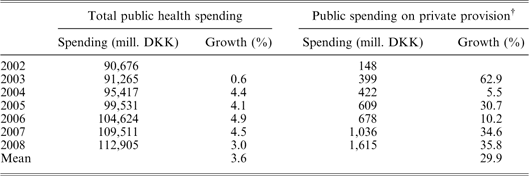
The first development is a radical expansion of public spending and the number of employees in the public sector. An illustration of this was seen in 2004, when the government launched an advertising campaign claiming that it had expanded the public sector by some 14,000 new jobs since 2001 (on a total of around 800,000). While not all of these jobs were related to health care, the health caresector figured very prominently in the ensuing debate, in which the left-wing parties questioned whether there had been any expansion at all, while the government proudly proclaimed that it was fully responsible for all the new jobs. From the perspective of traditional partisan politics, this fight over who is best at expanding the public sector is baffling. But looking at Table 3, it becomes clear that total public spending on health care did rise considerably under the right-wing government. Apart from their first year in office, when new expansionist measures may not yet have manifested themselves, yearly increases, in constant prices, never dropped below 3 per cent.
Spending Trends in Denmark, 2002–08*

Note: *Spending in constant prices. †Direct government outlays and value of tax breaks on private health insurances. All spending is shown in constant prices with 2000 as base year.
Source: Ugebrevet A4 (2008); Rigsrevisionen (2009); Statistics Denmark (2010).
It is also evident from Table 3 that public spending on private market provision has increased even more. The average increase between 2002 and 2008, the last year with available data, amounts to an enormous 30 per cent. This relates directly to the two other developments – the waiting-list guarantee and the introduction of tax-exempted employer-sponsored PHI. The waiting-list guarantee was introduced in 2002 and gave patients the right to medical treatment at private hospitals, even abroad, if the public healthcare system was unable to provide treatment within two months. In 2007, this period was reduced further to one month.Footnote 51 In 2001, only a few small private hospitals existed in Denmark, and therefore a new private healthcare market had to be created. The local authorities which managed public health care in Denmark were required to negotiate with the private market operators, who since 2005 have been organized into the Association of Private Hospitals and Clinics (APHC).
The strict waiting-list guarantee almost automatically meant that the local authorities had to start opting out, but it would seem that the government additionally tried to boost the income and size of the private market healthcare system. The Audit of the State Accounts, an independent government auditing agency, published a report in 2009 that criticized the government for having over-compensated the private market operators for their costs.Footnote 52 Two episodes provide evidence of this.
The negotiations between the local authorities and APHC broke down in 2006, and the government intervened and set the exact prices. The local authorities had offered 80 per cent of the per-patient funding that public hospitals are awarded because private market operators are freed from many administration tasks and on-the-job medical training. This price level was acceptable to 100 private hospitals and clinics that were not members of the APHC, and that had all agreed with the local authorities before negotiations with APHC broke down. The government intervened and chose to set prices at 95 per cent, even though the non-organized private operators had been content with much less.
The second episode concerns a temporary suspension of the waiting-list guarantee between November 2008 and July 2009 following a major strike among medical personnel. In this period, the local authorities were allowed to outsource to individual operators rather than negotiate with them en bloc. This led to prices that were between 11 and 62 per cent lower than those previously negotiated. In other words, the legislative decision to force the local authorities to negotiate with the private market operators rather than using the well-known outsourcing mechanism had generated vastly inflated prices.
The third and final development to be mentioned is the introduction of tax exemption for PHI paid by employers on behalf of their employees.Footnote 53 Before 2002, very few Danes, around 50,000 of a population of around five million, enjoyed the benefits of PHI, but with the tax exemption this figure rocketed: by the end of 2002, the number was 125,000; by 2005 it was 375,000, and by 2008 it was estimated at around 945,000, almost all provided via the workplace.Footnote 54 As in other countries, it has been fairly well documented that there is a strong bias in the social profile of individuals with PHI. The unemployed and individuals outside the workforce are obviously hugely underrepresented, and public employees are rarely offered PHI, while employees in private occupations, and especially those with a high income, are offered it.Footnote 55
Australia
The Australian welfare state is characterized by relatively strong residual elements, although the historic strength of the labour movement, at least until the 1970s, entailed that social policies in general were more generous than those, for instance, in the United States.Footnote 56 Universal public healthcare insurance was introduced by Labour in 1975 (the Medibank) together with the Health Insurance Levy to finance it (commenced in 1976). The late introduction of universal access goes a long way in explaining the relatively low level of public spending in 1980 evident in Table 1. The following years saw a large measure of rollback under the right-wing Fraser Government. In 1976, Medibank Private, a state-owned fund competing with other private funds, was established; in 1978, the Health Insurance Levy was removed; and in 1981, tax rebates on PHI were introduced and universal coverage abolished.Footnote 57
In 1983, Labour entered office and immediately removed the PHI tax rebate. Private insurance funds were not permitted to offer PHI for medical costs already covered by Medicare, the new universal health insurance scheme introduced in 1984. The explicit reason was that such private funding might undermine universal insurance. Labour's healthcare policies fundamentally summed to a resounding rejection of the market-oriented policies of the previous right-wing government, because private coverage, especially for the young and the old, became increasingly unattractive compared to Medicare. Consequently, from 1984 to 1996, the proportion of the population covered by PHI decreased steadily from 50 per cent to 33 per cent.Footnote 58
In 1996, the right-wing Liberal-National Coalition won the general election and entered government with John Howard as prime minister. In the three subsequent elections, the right-wing parties had proposed alternative schemes to Medicare, but had in the run-up to the 1996 general election chosen to embrace the universal system.Footnote 59 However, the acceptance of the Medicare scheme went hand in hand with policies to halt the decline in PHI coverage. The new government took several important initiatives to that end.Footnote 60 In 1997, the Private Health Insurance Incentive Scheme was introduced, which contained two new policies: a means-tested subsidy for the purchase of PHI and a tax penalty on high-income earners without PHI. The tax penalty took the form of a 1 per cent Medicare levy surcharge. In 1998, the means-tested subsidy was replaced with a 30 per cent premium rebate on PHI purchases, regardless of income. The rebate came in two variations: one, by far the most popular, where the insurance funds offer members a reduced premium and then get the premium loss they have incurred reimbursed by the government; another, where the members pay the full premium and then get a rebate through the tax system at the end of the financial year. In 2005, the rebate increased to 35 per cent for people aged 65 to 69 and 40 per cent for people aged 70 and above.
In 1999, the community rating principle was relaxed. Since 1953, private insurance companies have not been allowed to base either access or premiums on factors like age, sex, health status, previous use of health services, employment status or occupation. The system was, in other words, based on pure community rating. With the new legislation, Lifetime Community Rating, premiums for health insurance now vary according to the age at which the member joins. For every year after age 30 in which a member has not taken out PHI, the price increases by 2 per cent. This penalty continues to accumulate until age 65, at which point the prospective member has to pay 70 per cent more than if she had joined by age 30. The new legislation was combined with a very high-profile media campaign (‘Run for Cover’) that explicitly highlighted the fiscal incentives to buying PHI at a young age.
The effects of the premium rebate and the relaxation of the community rating are highly visible. From 1998, when PHI coverage reached an all-time low of 30 per cent, coverage rose dramatically to some 45 per cent of the population just three years later. As the Australian Institute of Health and Welfare, a government agency, concluded, ‘[t]he result was a substantial shift of funding responsibility from the private health insurance funds to the Australian Government.’Footnote 61
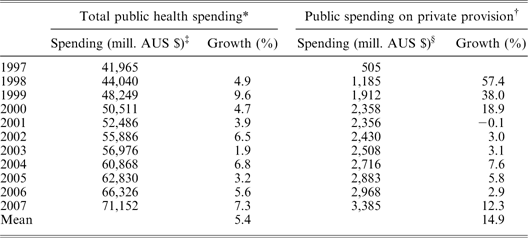
The costs in terms of increasing public spending are evident from Table 4. Under the leadership of the diehard conservative John Howard, total public spending almost doubled in constant prices. But public spending on private health care grew at an even faster pace, around 15 per cent per year on average, leading to a six-fold increase. In terms of the redistributive effect of these policies, a number of studies indicate that PHI schemes in Australia primarily have been and continue to be to the benefit of high-income and middle-income individuals, whereas low-income individuals have to make do with Medicare.Footnote 62
Spending Trends in Australia, 1997–2007

Notes: *Federal and state spending. †Private health insurance premium rebates. All spending in constant prices with ‡2007 and §2005, respectively, as base years.
Source: Australian Institute of Health and Welfare (2009); OECD (2010).
As in Denmark, then, we find a clear partisan pattern. The Liberal-National Coalition had to accept the universal Medicare system, which had led to a very significant drop in PHI coverage, and therefore was difficult to tackle head-on. But as in Denmark, other means were available, most notably the massive expansion of publicly funded private market health care. Historically, Australia has had a large private market healthcare sector, and therefore the Liberal-National Coalition did not have to create one from scratch as has happened in Denmark. Rather, it could simply introduce the premium rebate, relax the community rating principles and let the market take care of the rest.
Partisan politics revisited
This article has studied the healthcare politics of right-wing governments. Both health care and right-wing governments have, according to my reading, been somewhat neglected in the social policy literature. Health care is the second largest social policy area in most advanced industrialized nations and has, despite the fiscal stress experienced in many places, seen a significant increase in the share of GDP allocated to it. Although this is an unambiguous observation, it has implications for the existing literature that have been underappreciated. Both the new politics approach introduced by PiersonFootnote 63 and the modern-day versions of the power resource theoryFootnote 64 more or less explicitly assume that expansion is difficult, if not impossible; the main line of disagreement concerns whether governments are able to retrench or not. There is some merit to these different strands of argument, but they are both coloured by the lack of theory concerning social programmes that are not related to the labour market.
I argue that thinking more thoroughly about the special nature of health care automatically leads to a stronger focus on right-wing governments as well. Right-wing governments are of particular interest in an analysis of healthcare politics in mature welfare states for two reasons. First of all, healthcare programmes in all Western nations, with the exception of the United States, are universal and consume huge amounts of fiscal resources. This means that left-wing governments merely have to fight to retain the status quo, while right-wing governments will be the proactive force that will try to engineer cutbacks. Secondly, as health-related risks are scattered almost equally across the income distribution, the supporters of right-wing parties split in two with the middle-income voters wanting public health care and the high-income voters wanting private health care. This puts right-wing governments in a dilemma that left-wing governments are freed from, because their voters all have low or middle incomes. The resulting right-wing strategy, marketization via compensation, is able to explain why public healthcare spending in general is rising and why public spending on private healthcare is rising even more.
While socio-technological push factors presumably are important, because they fuel public demand, I have shown that right-wing governments in Australia and Denmark deliberately introduced policies that entailed dramatic increases in public outlays. The increased levels of public healthcare spending cannot simply be an instance of technology run amok. I have shown that the right-wing governments implemented policies like waiting-list guarantees that by themselves led to expansion. Also, similar trends in Australia and Denmark are not simply instances of catching-up, as the former by 1980 had spent relatively little on public health care, while the latter had been a high spender. In sum, partisan politics matters – it just does not matter in the way we previously thought.
The hidden nature of the partisan politics of health care does not imply that it has no consequences on social outcomes like equality, well-being and health security. To be sure, to the extent that right-wing governments are forced to maintain generous levels of spending on public health care, there are limits to the detrimental effects of marketization via compensation compared to the head-on retrenchment of social rights. However, as noted above, it is well established that PHI in particular benefits high-income individuals much more than other income segments. There is, therefore, no doubt that those partisan differences outlined in this article do have real-life ramifications in terms of at least equal access to equal health care.
In general, thinking about partisan politics in mature welfare states seems to require more theorizing about how characteristics of individual policy areas influence the political process. One salient characteristic is whether a social programme is aimed at risks related to the labour market or to life courses. Another is whether compensation or other similar strategies are possible. Pierson outlines a total of three strategies for avoiding blame: compensating the losers of retrenchment, obfuscation of information and division of opponents.Footnote 65 While the concept of compensation is used in a slightly different way here than originally intended by Pierson, it is nevertheless fruitful to consider it merely as one of many potential strategies. When it comes to healthcare, I would argue that compensation is a crucial strategy, but in other policy areas other strategies may be more prudent – if they can be implemented, that is. In sum, I would argue that future work on partisan politics should, as a minimum, consider these two questions: what type of risk does the social programme aim to alleviate? And is it possible to use a blame-avoidance strategy?
On the basis of these considerations, Table 5 presents a tentative and ideal-type display on the politics of partisan governments. In a situation where we are dealing with risks related to the labour market and where blame avoidance is possible, we should expect to find the clearest instance of partisan politics with the right wing being free to pursue their generic preferences unobstructed, although probably hidden behind various blame-avoidance devices. When blame avoidance is not possible, right-wing governments might be expected – at least compared to the situation where blame avoidance is possible – to be much less aggressive. Essentially, this is another way of saying that we may expect a negative association between right-wing governments and replacement rates and transfer spending documented in Table 2 to hide important variations. Looking into this relationship will be an important task for future research.
A Typology of Partisan Politics

Next, when we are dealing with risks related to the life course and blame avoidance is possible, we ought to see marketization via compensation. Other types of blame-avoidance strategies, like obfuscation and division, might also be employed, but at least when it comes to health care the adverse effects on the middle-income group are so large and the vested interests so strong that these other strategies would appear highly risky. Finally, when blame avoidance is not possible, we should see unconditional expansion where the left and right in a country battle to provide the most generous social policies in order to win office. While it may be argued that blame avoidance is always possible to some extent, it is nevertheless also true that some programmes and elements of programmes are more visible than others, as Lindblom has recently shown.Footnote 66 This, too, indicates that there is much more to the politics of partisan governments than meets the eye.