The herbicide 2,4-D, a synthetic auxin, was initially marketed by the American Chemical Paint Company in 1945 (Cobb et.al. Reference Cobb and Reade2010). It represents the first selective, broad-spectrum broadleaf herbicide available for use in corn and has been applied in corn for over 60 years. Tolerance to 2,4-D in monocots has been attributed to their vascular tissue structure (scattered in bundles), limited translocation, and ability to metabolize 2,4-D (Kelley et al. Reference Kelley and Riechers2007; Monaco et al. Reference Monaco, Weller and Ashton2002). Applications of 2,4-D to corn can result in curvature of the stem or leaning, stalk brittleness, leaf rolling in the whorl, and malformation of the brace roots. As early as 1949, Rossman and Staniforth (Reference Rossman and Staniforth1949) reported that corn inbred lines can differ in the amount of leaning, brittleness, and leaf rolling that occurs following 2,4-D applications at the six-to-eight-leaf stage. Subsequently, Rodgers (Reference Rodgers1952) demonstrated differences between corn inbred lines and hybrids in brittleness of the stalk following application of 2,4-D. Today, seed companies routinely screen new hybrids for sensitivity to auxinic herbicides such as 2,4-D. Due to injury concerns and the availability of broad-spectrum grass and/or broadleaf herbicides with less potential for injury, currently less than 0.1% of the Midwest’s corn acreage is treated POST with 2,4-D (Proprietary Third Party Data, 2014).
Current 2,4-D labels restrict applications in corn to preplant, PRE, and early-POST application (Anonymous 2015b). Preplant applications of 2,4-D between 560 and 1120 g ae ha−1 require 7 to 14 d between application and planting. PRE application requires 3 to 5 d between planting and application, with a recommended rate of 1120 g ae ha−1. Broadcast POST applications of 2,4-D in corn are limited to 280 to 560 g ae ha−1 and a maximum corn height of 20.3 cm. Additionally, the labels contain precautionary statements warning that corn may become brittle and susceptible to breakage from winds or mechanical cultivation following application.
Aryloxyalkanoate dioxygenases (AADs) are a class of bacterial enzymes that catalyze the oxygenolytic cleavage of 2,4-D to nonherbicidal dichlorophenol and glyoxylate. The AAD-1 enzyme from Sphingobium herbicidovorans was found to metabolize both 2,4-D and members of the aryloxyphenoxypropionate class of grass herbicides, including R-cyhalofop, R-haloxyfop, and R-quizalofop (Wright et al. Reference Wright, Shan, Walsh, Lira, Cui, Song, Zhuan, Arnold, Lyn, Yau, Russel, Cicchillo, Peterson, Simpson, Zhou, Pansamuel and Zhang2010). Subsequently, the aad-1 gene was inserted into a recipient corn line through silicon carbide fiber–mediated transformation (Wright et al. Reference Wright, Shan, Walsh, Lira, Cui, Song, Zhuan, Arnold, Lyn, Yau, Russel, Cicchillo, Peterson, Simpson, Zhou, Pansamuel and Zhang2010). The transgenic maize plants were screened with R-haloxyfop, and events with a single intact copy of the aad-1 plant transcription unit in the surviving population were selected for evaluation and characterization. The inheritance of the aad-1 gene was stable across all the generations evaluated and followed single-locus Mendelian segregation. The transgenic corn plants demonstrated robust tolerance to POST applications of quizalofop at 280 to 560 g ae ha−1 and 2,4-D at 1120 to 4480 g ae ha−1. Corn containing aad-1 has also demonstrated tolerance to PRE applications of 2,4-D applied immediately after planting. The AAD-1 event DAS-40278 received deregulation from the US Department of Agriculture in 2014 (Shea Reference Shea2014). Commercially available SmartStax® Enlist® corn hybrids contain the SmartStax® traits plus the AAD-1 trait, resulting in herbicide resistance to 2,4-D, aryloxyphenoxypropionates, glyphosate, and glufosinate, as well as resistance to coleopteran and lepidopteron insect pests.
A new premix of 2,4-D choline and glyphosate dimethylamine (trade name: Enlist® Duo with Colex-D technology) has been developed by Dow AgroSciences. The new herbicide premix contains 195 g ae L−1 of 2,4-D choline and 205 g ae L−1 of glyphosate dimethylamine. The maximum single application rate of the new premix formulation is 1065+1120 g ae ha−1 of 2,4-D choline plus glyphosate (Anonymous 2015a). A single application may be applied prior to, at, or immediately after planting of corn containing AAD-1 and glyphosate-resistance traits (Anonymous 2015a). Two applications of this new premix herbicide may be applied after emergence and through the V8 corn growth stage (Anonymous 2015a). There is currently no published data concerning the tolerance of corn containing AAD-1 and glyphosate-resistance traits to 2,4-D choline plus glyphosate. The objective of this research was to determine the tolerance of corn containing AAD-1 and glyphosate-resistance traits to single or multiple POST applications of the new 2,4-D choline plus glyphosate premix.
Materials and Methods
Field studies were conducted in 2011 at 14 trial locations across the Midwest: three in Iowa, three in Illinois, three in Indiana, one in Kansas, one in Minnesota, one in Ohio, and two in Wisconsin. Treatments were arranged in a randomized complete block design with four replications. Plot sizes were 3 m (four rows) wide by 12.2 m long. Each treated plot was paired with a glyphosate-treated control plot immediately behind the treated plot for injury and yield comparison. A PRE application of acetochlor plus atrazine (Keystone® or Keystone® LA herbicides, Dow AgroSciences, 9330 Zionsville Road, Indianapolis, IN 46268), at the recommended rate based on soil type, was applied across the entire trial area for weed control. The control plots were sprayed at the V4 corn growth stage with glyphosate at 1120 g ae ha−1. A corn hybrid containing AAD-1 and glyphosate-resistance traits (SmartStax® Enlist® experimental hybrid, Mycogen, 9330 Zionsville Road, Indianapolis, IN 46268), hereafter referred to as Enlist® corn, was utilized in all studies. In addition, the same corn hybrid without the AAD-1 trait (SmartStax experimental hybrid SLB01VX//BE95XT null, Mycogen) was planted in front of all first replicate plots, such that each herbicide treatment was also sprayed across the non–AAD-1 hybrid for visual confirmation of 2,4-D injury. All trials were conducted with either conventional or reduced tillage methods, using the recommended fertilizer rates for each location. The target seeding rate was 86,074 seeds ha−1 with a planting depth of 3.8 to 5 cm.
Herbicide treatments were applied with either a CO2-pressurized backpack sprayer or a pressurized tractor sprayer with flat-fan spray tips calibrated to deliver 140 L ha−1 spray volume at 138 to 262 KPa. Herbicide rates were based on the maximum recommended labeled use rates, which will be referred to as 1×: 2,4-D amine (DMA® 4 IVM, Dow AgroSciences) at 1065 g ae ha−1, 2,4-D choline plus glyphosate premix formulation (Enlist® Duo, Dow AgroSciences) at 1065+1120 g ae ha−1, and glyphosate (Durango® DMA, Dow AgroSciences) at 1120 g ae ha−1. Single POST treatments of 2,4-D at 2×, glyphosate at 2×, and 2,4-D choline plus glyphosate premix at 1× and 2× were applied at the V4 and V7 corn growth stage. Sequential POST applications of the 2,4-D choline plus glyphosate premix at 1× and 2× were made at the V4 corn growth state followed by (fb) application at the V7 corn growth stage. Additionally, PRE applications of 2,4-D amine fb V4 and V7 applications of 2,4-D choline plus glyphosate premix were applied at 1× and 2× rates. All POST treatments included ammonium sulfate (N-Pak® AMS, Winfield Solutions, P.O. Box 64589, St. Paul, MN 55164-0589) at 2.5% (v/v).
Crop tolerance evaluations included visual evaluations of injury, chlorosis, growth inhibition, leaning, and necrosis, recorded immediately prior to the V4 POST application and at 2, 7, and 14 d after the V4 (DAAB) and V7 POST applications (DAAC). Visual assessments were recorded on a scale of 0% to 100% as follows: injury, with 0% meaning no injury and 100% meaning plant death; chlorosis, with 0% meaning no chlorosis and 100% meaning no green color; growth inhibition, with 0% meaning no reduction in growth and 100% meaning no plant growth; necrosis, with 0% meaning no necrotic tissue and 100% meaning all tissue necrotic; and leaning, with 0% meaning identical to the paired control plot and 100% meaning plants parallel to the ground. Brace root injury ratings were recorded following the tassel stage on a scale of 0 to 10 as follows: 0, no injury; 0 to 1, slight brace root swelling/wandering; 1 to 3, moderate swelling/wandering and root proliferation, slight brace root fusing; 3 to 5, moderate brace root fusing and/or slight brace root stunting; 5 to 7, severe brace root fusing and malformation, moderate to severe brace root stunting; 7 to 9, severe brace root stunting; and 10, total inhibition of brace root formation. Yields were determined by harvesting plots using conventional harvesting equipment and adjusted to 15.5% moisture. Before analysis, the yields for each herbicide treatment were converted to a percentage of the paired control plot located immediately behind and adjacent to each treatment plot.
A linear mixed model (ANOVA) was fit using the lme4 package in R version 3.2.1 (The R Foundation for Statistical Computing, c/o Institute for Statistics and Mathematics, Wirtschaftsuniversität Wie, Welthandelsplatz, 1020 Vienna, Austria). In the model, herbicide treatment was the fixed effect and trial location and replication were random effects. To satisfy ANOVA assumptions, visual crop injury, brace root injury, and yield were subjected to a Box-Cox transformation using the car package in R, which determined the power transformation that maximized the log likelihood function for each response variable. However, back-transformed data is presented. Mean separations are based on transformed data and means are rounded to whole numbers. Where the ANOVA test indicated treatment effects were significant, means were separated at P≤0.05 using Tukey’s HSD test. Using JMP®, version 11 from SAS® (SAS Institute Inc., Cary, NC 1989-2007), Pearson correlation coefficients were calculated by the pairwise method to assess visual injury correlation with soil pH or organic matter, relative humidity, temperature at application, or time to first precipitation. These analyses showed an absence of correlation, either positive or negative, with values ranging from +0.3 to −0.3.
Results and Discussion
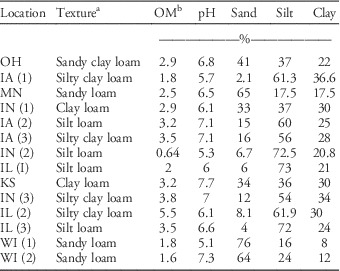
Physical and chemical characteristics of soils across trial locations were representative of Midwestern corn production areas with sandy loam (3 locations), loam (10 locations), and silty clay loam (1 location) soil textures (Table 1). Ten of the 14 trial locations received 0.5 to 3.7 cm of precipitation within 72 h after the PRE application (data not shown). There was no herbicide treatment by location interaction for visible injury, brace root injury, or yield; therefore, data were pooled across locations. PRE applications of 2,4-D amine at 1× or 2× rates resulted in 0% and 0.4% visual injury immediately prior to the V4 application (data not shown).
Physical and chemical characteristics of the soils

a Soil Survey Division Staff, Soil Conservation Service (1993) US Department of Agriculture Handbook 18, Soil Survey Manual. Chapter 3, Figure 3-16, Soil Texture Classification Triangle.
b Abbreviation: OM, organic matter.
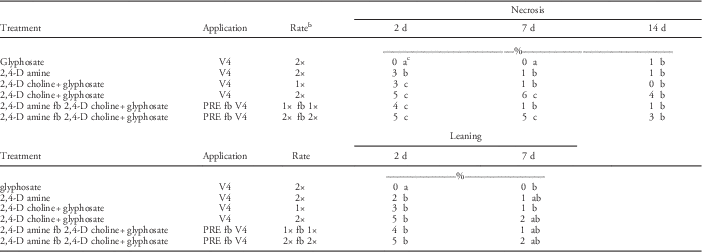
Enlist® corn exhibited excellent tolerance to the 2,4-D choline plus glyphosate premix at 1× and 2× rates applied POST at the V4 corn growth stage (Figure 1). Maximum injury following the V4 2,4-D choline plus glyphosate treatments was observed 2 DAAB, with 4% and 9% mean visual injury at 1× and 2× rates, respectively (Figure 1). Visual injury 2 DAAB was expressed as necrosis (leaf spotting) and/or leaning (Table 2). Leaning injury 2 DAAB averaged 5% or less across locations (Table 2). At 7 DAAB, visual injury declined to 2% and 8% at 1× and 2× rates, respectively (Figure 1), with necrosis as the primary form of injury (Table 2). Necrosis injury was limited to the leaves that intercepted the herbicide spray with the leaves in the whorl at time of application exhibiting no necrotic spots. By 14 DAAB, visual injury had declined to 1% and 5% at 1× and 2× rates of 2,4-D choline plus glyphosate, respectively (Figure 1), with necrosis being the primary injury symptom (Table 2). The level of injury did vary slightly across locations, indicating that environmental conditions and corn growth at time of application may influence crop response (Figure 1). An analysis of temperature, humidity, and rainfall preceding and following application timings was conducted, but no correlation between injury and environmental conditions was observed (data not shown). The 1× rate of 2,4-D choline plus glyphosate resulted in similar crop response as did the 2× rate of 2,4-D (Figure 1).
Visual injury in Enlist® corn at 2, 7, and 14 days after V4 POST applications of 2,4-D, glyphosate and 2,4-D choline+glyphosate premix. Mean data are provided below the box plots. Means within a graph with no common letter(s) are significantly different according to Tukey’s HSD at P<0.05. Abbreviations: DAAB, days after V4 postemergence application; fb, followed by; gly, glyphosate, PRE, preemergence.

Percent leaf necrosis and leaning in Enlist® corn at 2, 7, and 14 d after V4 POSTFootnote a application

a Abbreviations: fb, followed by; PRE, preemergence; V4, postemergence application at V4 corn growth stage.
b Application rates were as follows: 2,4-D choline+glyphosate 1×, 1065+1120 g ae ha−1; 2,4-D 2×, 2240 g ae ha−1; glyphosate 2×, 2240 g ae ha−1.
c Means within a column with no common letter(s) are significantly different according to Tukey’s HSD at P<0.05.
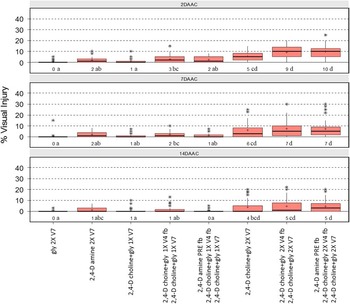
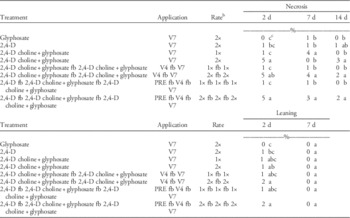
Crop response following applications of the 2,4-D choline plus glyphosate premix to V7 corn resulted in injury similar to V4 application. Visual injury was observed at 2 DAAC with the single V7 application of 1× and 2× rates resulting in 1% and 5% visual injury, respectively (Figure 2). Sequential applications of 2,4-D choline plus glyphosate to V4 and V7 corn resulted in 3% and 10% visual injury 2 DAAC for 1× and 2× rates, respectively. However, the injury levels resulting from single and sequential 2,4-D choline plus glyphosate applications were not different. Crop response was expressed primarily as necrosis (Table 3). Enlist® corn tolerance to 2,4-D choline plus glyphosate applied at the V7 corn growth stage was not affected by previous applications of 2,4-D applied PRE and 2,4-D choline plus glyphosate applied POST at the V4 corn growth stage. Similar to the V4 POST application, level of injury did vary slightly across locations as shown in the box plots in Figure 2.
Visual injury in Enlist® corn at 2, 7, and 14 days after V7 POST applications of 2,4-D amine, glyphosate, and 2,4-D choline+glyphosate premix . Mean data are provided below the box plots. Means within a graph with no common letter(s) are significantly different according to Tukey’s HSD at P<0.05. Abbreviations: DAAC, days after V7 postemergence application; fb, followed by; gly, glyphosate, PRE, preemergence.

Percent visual injury in Enlist® corn at 2, 7, and 14 d after V7 POSTFootnote a application.

a Abbreviations: fb, followed by; POST, postemergence; PRE, preemergence; V4, postemergence application at the V4 corn growth stage (four visible leaf collars); V7, postemergence application at the V7 corn growth stage (seven visible leaf collars).
b Application rates were as follows: 2,4-D choline+glyphosate 1×, 1065+1120 g ae ha−1; 2,4-D 2×, 2240 g ae ha−1; glyphosate 2×, 2240 g ae ha−1.
c Means within a column with no common letter(s) are significantly different according to Tukey’s HSD at P<0.05.
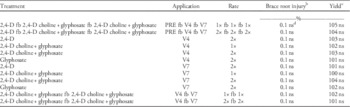
POST over-the-top applications of 2,4-D to corn greater than 20 cm in height can result in brace root malformations. Rossman (1949) first reported proliferation of brace roots in corn. Gunsolus and Curran (Reference Gunsolus and Curran1999) described 2,4-D applications as causing fusion of the brace roots. Applications of 2,4-D choline plus glyphosate at the V4 corn growth stage, the V7 corn growth stage, or the V4 corn growth stage fb the V7 corn growth stage did not result in fusion of brace roots in Enlist® corn (Table 4).
Brace root injury and yield in Enlist® cornFootnote a

a Abbreviations: fb, followed by; PRE, preemergence; V4, postemergence application at the V4 corn growth stage (four visible leaf collars); V7, postemergence application at the V7 corn growth stage (seven visible leaf collars).
b Brace root injury assessed on a 0 to 10 scale.
c Yield converted to % of paired untreated (glyphosate only) plot.
d Means within a column with the letters ns are not significantly different according to Tukey HSD at P≤0.05.
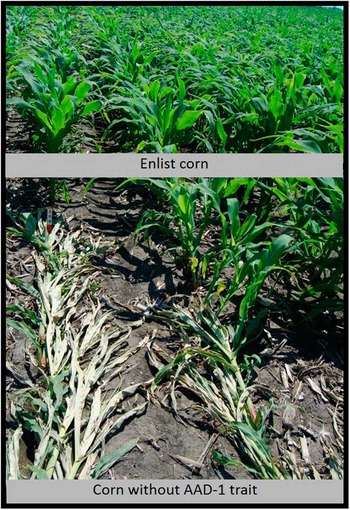
Application of 2,4-D to corn taller than 20 cm may cause stalk leaning and/or brittle snap (Peterson 2016). Leaning of the corn stalk can range from a few degrees from perpendicular to the soil to greater than 60° from perpendicular. Corn will typically recover from leaning induced by 2,4-D within 14 d. At 2 DAAB and 2 DAAC, Enlist® corn exhibited slight leaning (≤5%) as a result of 1× and 2× applications of 2,4-D choline plus glyphosate premix, but quickly recovered (Tables 2 and 3). Applications of 2,4-D can also cause the stalk to become brittle, resulting in the stalk breaking at the soil surface. Brittle snap most commonly occurs when corn is at the V5 to V8 growth stages at the time of application and is actively growing. Enlist® corn treated with 1× or 2× rates of 2,4-D choline plus glyphosate premix did not exhibit brittle snap (data not shown). At one Iowa location, high winds caused severe brittle snap of the corn hybrid without the AAD-1 trait that was treated with 2,4-D choline plus glyphosate premix, which was planted in front of the first replicate plot of the Enlist® corn, which had no brittle snap (Figure 3).
Brittle snap in corn hybrid without AAD-1 trait following V7 POST application of 2,4-D choline+glyphosate at 2× rate, compared to absence of brittle snap in Enlist® corn, at Iowa trial location.

Across all locations, slight leaf necrosis was the most common injury observed following applications of the 2,4-D choline plus glyphosate premix herbicide. There was an increase in necrosis as the applied rate increased from 1× to 2× the maximum recommended use rate. Applications of 2,4-D amine alone at 2130 g ae ha−1 applied POST to V4 and V7 corn caused similar levels of necrosis as the 1× rate of 2,4-D choline plus glyphosate premix. Additionally, researchers have observed discoloration in small areas of the leaf within 3 to 12 h of application that corresponds to where the necrotic spots ultimately form (DM Simpson, personal communication). The water-soaked appearance may indicate that there has been leakage of the cytosol in the affected areas. Subsequently, it has been hypothesized that the adjuvants contained in 2,4-D choline plus glyphosate premix formulation are increasing the amount of 2,4-D being absorbed into the leaf, resulting in a temporary localized high concentration of 2,4-D, which elicits a transient herbicidal effect at the cellular level prior to AAD-1 detoxifying 2,4-D to non-herbicidal dichlorophenol.
Enlist® corn demonstrated minimal crop injury following application of 2,4-D choline plus glyphosate premix applied at 1× and 2× the maximum label rates POST to V4 and V7 corn (Figures. 1 and 2). The most common form of response following POST applications of 2,4-D choline plus glyphosate was leaf necrosis. Under conditions of rapid early corn growth, the 2,4-D choline plus glyphosate premix may result in slight leaning at 1 to 2 d after application. Neither single nor sequential POST applications of 2,4-D choline plus glyphosate premix at 1× or 2× rates had an effect on corn yield (Table 4). Enlist® corn enables the application of the 2,4-D choline plus glyphosate premix at maximum label rates with minimal visual injury on corn and no influence on corn grain yield (Table 4).