Earth and environmental science education in schools can play an important role in developing students’ capacity to engage critically with and respond to complex socio-ecological challenges such as climate change and the consumption of natural resources (Hodson, Reference Hodson2003). In 2017, a new senior Earth and Environmental Science (EES) syllabus was approved by the Queensland Curriculum and Assessment Authority (QCAA) for implementation with Year 11 (16-year-old) students in 2019. The new syllabus supersedes the previous senior Earth Science syllabus that has been enacted in Queensland secondary schools since the year 2000 (Queensland Board of Senior Secondary School Studies [QBSSSS], 2000), and represents the state’s interpretation of the senior Earth and Environmental Science Australian Curriculum developed by the Australian Curriculum, Assessment and Reporting Authority (ACARA, n.d.-a) for students in Years 11–12. Queensland’s new EES syllabus aims, in part, to develop students’ appreciation of how EES can be used to understand contemporary issues, and the interconnectedness of Earth’s systems (QCAA, 2017).
The redeveloped Queensland syllabus includes an explicit focus on environmental science. Environmental science is often viewed as being fundamental to sustainable development, as it ‘has the capacity and intellectual reputation to define the environmental limits within which all sustainability decisions need to be made’ (Longhurst Reference Longhurst2008, as cited in Chalkley, Blumhof, & Ragnarsdóttir, Reference Chalkley, Blumhof, Ragnarsdóttir, Jones, Selby and Sterling2010, p. 97). Earth science, on the other hand, has been traditionally viewed as part of the problem when it comes to issues that concern environmental sustainability, such as the exploitation of mineral resources, which has contributed to a perceived incompatibility between the geosciences and Education for Sustainable Development (ESD; Jones, Trier, & Richards, Reference Jones, Trier and Richards2008). Despite this possible disparity, Chalkley and colleagues (Reference Chalkley, Blumhof, Ragnarsdóttir, Jones, Selby and Sterling2010) contend that there is a ‘natural alignment’ between the Earth and environmental sciences and ESD, given that both disciplines can support a holistic understanding of environmental issues and problems through their shared focus on the Earth, its resources and environments (p. 93).
The introduction of the new EES syllabus presents an important opportunity to understand better the theoretical orientations or underpinnings of the curriculum. Given the natural alignment between EES and ESD, we were interested in identifying opportunities that the curriculum presents to engage senior students with ESD. Specifically, the research question that guided this study was: To what extent does the Senior Queensland EES syllabus reflect the tenets of ESD? In this study, we employ document analysis in order to answer the research question. As such, our analysis is limited to the intended curriculum (or curriculum as written), rather than the enacted curriculum, or that which students might experience in the classroom (Marsh & Willis, Reference Marsh and Willis2007). We begin by reviewing two conceptual perspectives that informed the design of our study, ESD and orientations to curriculum. Next, we explore the context in which this research was conducted, with a focus on senior schooling and EES education in Queensland, before outlining the structure and organisation of the EES syllabus, and detailing our chosen research design and procedures.
Education for sustainable development
Global concerns for the future of our planet and the species it hosts were strengthened when the Brundtland Report focused on equity and sustainability as the means through which development can meet ‘the needs of the present without compromising the ability of future generations to meet their own needs’ (World Commission on Environment and Development, 1987, p. 8). Calls to educate people about these concerns and to encourage action on the ensuing social and ecological consequences were amplified in the Agenda 21 action plan emerging from the 1992 Earth Summit (United Nations, 1993), and consolidated in the objectives of UN Decade of Education for Sustainable Development, 2005–2014 (United Nations Educational, Scientific and Cultural Organization [UNESCO], 2014). Australia responded swiftly to these global calls, releasing a succession of statements and action plans that formed the foundation of policies and programs designed to build capacity to educate for a sustainable future (see Australian Government Department of Environment and Heritage, 2000, 2005, 2009). Gough (Reference Gough2011), among others, tracked how sustainability became part of environmental education in Australia (e.g., see Kennelly, Taylor, & Serow, Reference Kennelly, Taylor and Serow2011; Stevenson, Ferreira, & Emery, Reference Stevenson, Ferreira and Emery2016). The concept of ESD entered the sustainability discourse, evolving into a key enabler for the Sustainable Development Goals (UNESCO, 2017). According to UNESCO (2018), ESD:
… empowers learners to take informed decisions and responsible actions for environmental integrity, economic viability and a just society, for present and future generations, while respecting cultural diversity. It is about lifelong learning, and is an integral part of quality education. ESD is holistic and transformational education which addresses learning content and outcomes, pedagogy and the learning environment. It achieves its purpose by transforming society. (para. 1)
We interpret three key features within this definition that inform our research: (1) the intent to develop citizens prepared to take action; (2) the need for a holistic approach to ESD; and (3) the goal for education to be transformational. Developing students’ capacity to take action for a sustainable future calls for the identification of crucial competencies that enable students to think critically and creatively, make well-grounded, rational decisions, and act appropriately to address the problems that threaten their future (van den Branden, Reference Van den Branden2015). UNESCO identifies key sustainability competencies that individuals will need for action in diverse and complex contexts, representing ‘an interplay of knowledge, capacities and skills, motives and affective dispositions’ (UNESCO, 2017, p. 10). The competencies relate to abilities in systems thinking, anticipatory thinking, understanding norms and values, strategic thinking, collaboration, critical thinking, self-awareness and integrated problem-solving. Others have identified similar competencies (van den Branden, Reference Van den Branden2015), supporting the tenet that ESD enables transition to a sustainable world through acquisition of key competencies and achievement of specific learning outcomes. However, concerns exist that positioning youth as agents of change is idealised and aspirational, and fails to attend to the underlying assumptions surrounding students’ capacity for negotiating agency in the complexities of everyday life (Walker, Reference Walker2017).
ESD not only integrates skills development and learning content into the curriculum, it also promotes holistic understanding that recognises interconnectedness and looks to alternative futures (Paige & Lloyd, Reference Paige and Lloyd2016). A holistic approach incorporates multiple perspectives on the content, recognising that socio-cultural and economic factors are often the cause of environmental problems, and addresses the paradox of how development can be compatible with sustainable futures (Boeve-de Pauw, Gericke, Olsson, & Berglund, Reference Boeve-de Pauw, Gericke, Olsson and Berglund2015). However, the system of formal education itself is not positioned to challenge the prevailing paradigms of governments that support economic growth and wealth accumulation (McFarlane & Ogazon, Reference McFarlane and Ogazon2011). Others point out how difficult it is to interrogate human relationships with nature in a society where consumption and modernity are favoured, and a neoliberal perspective reinforces social norms that are maladaptive to environmental outcomes (Schindel Dimick, Reference Schindel Dimick2015). The ideas for creative and effective teaching methods presented in a review of trends in ESD (see UNESCO, 2017) illustrate the tenet that education must equip its learners to deal with a diversity of perspectives and a variety of contexts in order to achieve environmental sustainability.
Transformational learning requires a paradigmatic shift in thinking rather than ‘business as usual’ (Laszlo, Reference Laszlo2001), shifting focus on educating about the environment (facts and concepts) to educating for the environment (systemic change and critical reflection). Sterling (Reference Sterling2010) describes the need for a sustainable education paradigm to incorporate both an instrumental view that is content-focused, stressing outcomes and effectiveness, and an intrinsic view that encourages critical reflection on assumptions and that emphasises process. The underlying tenet is that simply learning content is insufficient to cause shifts in social norms or result in transformational learning (Sterling, Dawson, & Warwick, Reference Sterling, Dawson and Warwick2018). UNESCO (2017) favours a whole-institution approach that incorporates transformative pedagogies for delivering ESD. However, tensions exist in this domain, as the role of sustainability in schools is often squeezed out by the mandate to prioritise numeracy and literacy (Barnes, Moore, & Almeida, Reference Barnes, Moore and Almeida2018). Furthermore, ESD will remain at the fringes of curricula as long as teaching practice is grounded in education about the environment, and teaching materials are delivered as self-contained packages (Robottom, Reference Robottom2014). Even within purpose-built ‘sustainability schools’, transformational learning remains elusive (Kuzich, Taylor, & Taylor, Reference Kuzich, Taylor and Taylor2015). Therefore, the holistic and transformational tenets of ESD demand an ‘action-oriented transformative pedagogy’ (UNESCO, 2018, p. l10). Our perspectives about building capacity for active participation and creating alternative futures are informed by Tilbury and Cooke (Reference Tilbury and Cooke2005), who outline five key components of a ‘learning for sustainability’ approach: envisioning a better future, systemic thinking, critical thinking, participation in decision-making, and networks and partnerships for change. Our view is that a strong curriculum can guide the development of crucial competencies that students will need to make decisions about the future of our planet.
Orientations to curriculum
The present study is also underpinned by scholarship in curriculum theory, which is in part concerned with making explicit the presuppositions underlying curriculum development. Curriculum studies are important work, because in present times, ‘educators have little control over curriculum, the very organizational and intellectual center of schooling’ (Pinar, Reference Pinar2008, p. 5). Indeed, curriculum policymakers’ decisions about what knowledge to value depend on their ‘theoretical orientations and perspectives’, and their ‘cultural investments in the educational enterprise’ (Deng & Luke, Reference Deng, Luke and Connelly2008, p. 70), and it is this subjective curriculum content that is ultimately translated into realised versions of knowledge (Deng & Luke, Reference Deng, Luke and Connelly2008).
School subjects, subject matter and curriculum have been theorised by a vast number of scholars; however, of particular interest to us are the ways in which the purposes and content of curriculum have been theorised. Eisner (Reference Eisner1985) proposed five orientations to curriculum, designed to function as ‘tools’ for analysing existing school curricula, and as ‘foundations for the sharpening of discourse about the planning of new programs’ (p. 85). Eisner (Reference Eisner1985) describes how these orientations to curriculum are more than ‘mere abstract philosophies’, but have profound implications for schooling in defining major aspects of educational practice (p. 83). Given the aims of ESD reviewed herein (i.e., holistic, action-oriented and transformational education), Eisner’s (Reference Eisner1985) thinking about curriculum as social adaptation, social reconstruction, and as a technical undertaking, are of particular relevance to our analyses and interpretations of the EES syllabus.
While both social adaptation and social reconstruction look to society to define curriculum content, they offer distinctly different ways of thinking about the purposes of curriculum. While a social adaptation perspective views the purpose of schools and schooling as serving the interests of society, social reconstruction is concerned with developing a level of critical consciousness among children and young adults such that they can recognise societal problems and do something about them (Eisner, Reference Eisner1985). Historically, social adaptation emanates from curriculum being used as a tool for remedying societal needs, such as preparing students to meet skills shortages in the workforce. At present, we see this idea extended to political and economic needs such as a possible deficit in STEM-skilled professionals in the global workforce, to which we have seen the rapid emergence of, and investment in, science, technology, engineering and mathematics (STEM) education worldwide. Importantly, a social adaptation perspective views schooling as ‘maintaining the status quo’, since the societal interests being served are not radical in nature and little consideration is given to preparing students for alternative futures (Eisner, Reference Eisner1985, p. 74). In sum, Eisner (Reference Eisner1985) evokes the image of a social adaptation orientation to curriculum in his statement: ‘the society orders and the school obeys’ (p. 77).
A social reconstructionist orientation to curriculum is concerned with remedying societal problems with a view to societal transformation. Curriculum content is less concerned with academic disciplinary knowledges and more concerned with real, meaningful and often controversial social problems, which, in the context of EES, may include issues such as the extraction, use and management of natural resources; the impact of climate change on the frequency and intensity of natural disasters; and alternative energy sources, such as coal seam gas. Eisner (Reference Eisner1985) describes how a social reconstructionist perspective ‘does not avoid dealing with such issues by retreating to the abstractions of the academic disciplines; but uses the knowledge provided by academic disciplines for dealing with what is socially significant’ (p. 78). The vision of a social reconstructionist curriculum is taking action to build a better world than the one in in which we live (Eisner, Reference Eisner1985).
Eisner’s (Reference Eisner1985) description of curriculum as technology is also of relevance to our study, given that it is a means-end approach to curriculum in which important purposes of education like ESD tend to ‘fall by the wayside’ (p. 81). Curriculum as technology refers to the ways in which school education can be reduced to achieving a set of prescribed and standardised learning objectives through the most efficient and effective means possible (Eisner, Reference Eisner1985). The technical nature of curriculum emphasises well-defined, measurable learning objectives; carefully designed, sequential learning tasks that enable student achievement; and accountability upon teachers to provide evidence of their educational effectiveness through their maintaining of records of assessment scores. Eisner (Reference Eisner1985) evokes the image of a ‘staircase with few landings and no hallways feeding into it’ when describing curriculum as technology, and tells us that ‘the aim of the staircase is to increase the efficiency with which one arrives at the top floor’ (p. 82). One implication of conceiving of curriculum as a technical undertaking is that greater attention is given to the processes in an education system, rather than the substantive purposes. In a process-oriented system driven by a technical orientation to curriculum, ESD is unlikely to receive significant attention in the classroom, particularly when it is competing against other political agendas, including globalisation and international comparison (Smith & Stevenson, Reference Smith and Stevenson2017).
Research context: Senior schooling and EES education in Queensland
Queensland’s senior EES syllabus represents the first significant revision of the preceding Earth Science syllabus in also two decades (see QBSSSS, 2000). While the explicit inclusion of Environmental Science in the revised syllabus suggests a new focus for learning, the Earth Science syllabus also recognised the importance of learning about the environment, acknowledging that such a focus ‘strongly enhances this curriculum by adding the scientific study of human interaction with earth’s systems’ (p. 2). This focus is reinforced further in a statement in the document’s Rationale. Here it is recognised that Earth science can play a critical role in conserving the integrity of Earth’s systems:
Earth is a unique planet and its natural environments represent our greatest asset. They provide the locations for homes and the resources essential for life: the materials produced from rocks and minerals and fossil fuels, the soil in which food is grown, the water humans drink, and the air they breathe. The global community will be sustained only if benefits can continue to be derived from earth’s environments without jeopardising the availability of the resources and the integrity of the natural systems. (p. 2)
Coming to understanding important sustainability issues, ‘such as global warming, holes in the ozone layer and resource depletion, and of the need for hazardous waste disposal in a geologically responsible manner’ (QBSSSS, 2000, p. 4), is also identified in the Earth Science syllabus as one of eight key aims of the curriculum.
At the time the Earth Science syllabus was written, curriculum and assessment authorities in each state and territory in Australia were responsible for devising and enacting its own senior school curricula; however, in late 2008, the independent statutory authority, ACARA, was established. One of its key purposes was to develop a national curriculum across a range of subject areas from ‘Foundation’ (5-year-old students) to Year 12. The most recent phases of curriculum development have seen the release of a range of senior Australian curricula, including Biology, Chemistry, Physics and EES. Each state and territory education authority in Australia is responsible for ensuring that the senior secondary courses they offer integrate the Australian Curriculum learning content and achievement standards (ACARA, n.d.-b).
Within the Australian EES Curriculum, Sustainability is explicitly positioned as one of three ‘cross-curriculum priorities’ (the others being Aboriginal and Torres Strait Islander histories and cultures, and Asia and Australia’s engagement with Asia), which present opportunities for teachers to select contexts for learning that incorporate relevant key concepts (ACARA, 2016). The cross-curriculum priorities can be developed or applied through the learning content, and ‘add depth and richness’ to student learning (ACARA, 2016, para. 2). The Sustainability priority is intended to support students’ understanding of the interconnectedness of Earth’s systems and the important role that EES can play in informing decisions for a more sustainable future:
… students appreciate that Earth and environmental science provides the basis for decision making in many areas of society and that these decisions can impact the Earth system, its environments and its resources. They understand the importance of using science to predict possible effects of human and other activity, and to develop management plans or alternative technologies that minimise these effects and provide for a more sustainable future. (ACARA, n.d.-a, p. 24)
The Queensland EES syllabus is one of a suite of senior syllabus documents that were redeveloped and revised in 2017 (see QCAA, 2018a). The new syllabuses represent one aspect of significant changes to Queensland’s senior schooling system that commenced with Year 11 students in 2019. These changes are intended to enhance the integrity of senior subject assessments, and of the Queensland Certificate of EducationFootnote 1 (QCE; QCAA, 2018b), and must be considered alongside our document analyses (Bowen, Reference Bowen2009). Key changes include the introduction of external assessment in most senior subjects (noting that, until the end of 2018, all senior assessment in Queensland was school-based), the development of quality assurance processes to enhance the quality and comparability of remaining school-based assessment, changes to QCE eligibility requirements, and the introduction of the Australian Tertiary Admission Rank (ATAR) (QCAA, 2018b). The ATAR replaces the Overall Position (OP) that was used to gain university entry in Queensland since 1992 (QCAA, 2018c). This significant change brings Queensland in alignment with many other states and territories in Australia that already use the ATAR.
The EES syllabus is comprised of four units of study (as per the Australian ESS Curriculum) that are studied over a 2-year period: Unit 1: Introduction to Earth systems; Unit 2: Earth processes — energy transfers and transformations; Unit 3: Living on Earth — extracting, using and managing Earth’s resources; Unit 4: The changing Earth — the cause and impact of Earth hazards.
Each unit houses two, three or four ‘topics’ that organise key subject matter (e.g., Unit 1 has four topics, the first being ‘Earth systems and models’). The subject matter outlines knowledge and skills that students must acquire and provides the basis for student learning experiences. The syllabus also outlines a list of Science as a Human Endeavour (SHE)Footnote 2 concepts, which, while not assessed, should be made familiar to students with a view to ‘develop an appreciation for the nature and development of science, and its use and influence on society’ (QCAA, 2017, p. 14, original emphases). Guidance is also provided ‘to clarify the scope of the subject matter and identify opportunities to integrate science inquiry skills and SHE strands into the subject matter’ (QCAA, 2017, p. 15). The guidance includes an indication of teaching and learning time, opportunities to integrate the SHE strand, suggested practicals (to develop science inquiry skills), and syllabus links between the units. Each of these elements is shown in Figure 1, with a view to illustrate how the learning content is organised.
An excerpt drawn from the EES syllabus (Unit 1: Introduction to Earth systems) that illustrates the organisation of the learning content (QCAA, 2017, p. 24). © State of Queensland (QCAA) 2019.

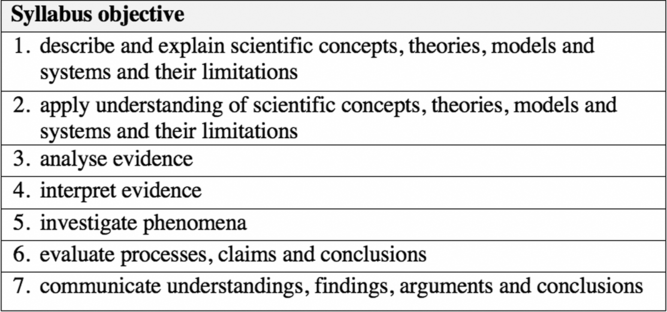
The syllabus outlines seven objectives that guide specific objectives for each unit, and must be demonstrated by students by the end of their course of study (Figure 2). Students are provided with opportunities to demonstrate how well they have achieved the objectives through the course assessment (i.e., data tests, research investigations and experiments). While the assessment for Units 1 and 2 is formative and internal (school-based), the assessment for Units 3 and 4 is summative. Fifty percent of the assessment for these units is internal, while the remaining 50% is external, and can contribute to the calculation of an ATAR for tertiary entrance (QCAA, 2017).
The EES syllabus objectives (QCAA, 2017, p. 5). © State of Queensland (QCAA) 2019.
Methodological approach
In this study, document analysis (Bowen, Reference Bowen2009; Creswell, Reference Creswell2014) was employed to examine the extent to which the EES syllabus reflects the tenets of ESD. Specifically, two levels of content analyses (Bowen, Reference Bowen2009) were performed. First, a broad analysis examined keywords to identify any prominent sustainability themes that might foreshadow elements of ESD that exist within the subject matter. The second, deeper level of analysis was guided by an ‘ESD curriculum key’ developed specifically for this study, which searched for evidence of four tenets of ESD in the intended curriculum, as guided by our review of the literature. Our methodological approach to both levels of analyses is described below.
Level 1 content analysis: Keyword count
At this level of analysis, we carried out a keyword count to get a broad sense of the syllabus, and to identify any prominent sustainability themes that might underpin the document. In our identification of keywords, the fourth author (Author 4) identified keywords that relate specifically to the disciplinary discourse of EES in Section 1.1.1, Rationale (housed within Section 1, Course Overview) and the Unit Descriptions for each of the four units (QCAA, 2017). We chose to focus on these sections so as to avoid the repetition of terms in the main subject matter that would prevent substantial themes from being identified. Author 4 searched for keywords that related to EES content knowledge (e.g., Earth~resources), processes (e.g., energy~transformation) and skills (e.g., collecting~data), and highlighted these in situ on a digital copy of the syllabus. Where EES-related skills appeared as forms of the same base word in the document (e.g., investigate and investigating), one iteration was recorded as a keyword. Generic information in the Rationale about Queensland’s senior science subjects was not included in the analysis, as it did not relate to the disciplinary discourse of EES.
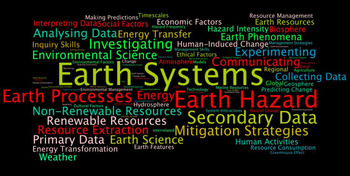
The identified keywords were discussed and agreed upon by the first and second authors (Author 1 and Author 2), who knew the curriculum well from their reading and rereading of the document, and from their experiences teaching science curriculum units in their respective initial teacher education programs. Once we were satisfied that the keywords met our criteria, and that none were overlooked, their frequencies were calculated using Microsoft Excel™, and a word cloud generated using Wordle™. This provided a visual representation of the most frequent terms identified by the analysis.
Level 2 content analysis: ESD curriculum key
The second level of content analysis was guided by a ‘curriculum key’ (see Johannesson, Norðdahl, Óskarsdóttir, Pálsdóttir, & Pétursdóttir, Reference Jóhannesson, Norðdahl, Óskarsdóttir, Pálsdóttir and Pétursdóttir2011). To develop the key, we drew upon notions of critical environmental education (Tilbury & Cooke, Reference Tilbury and Cooke2005) and the features of ESD (as explored earlier in this article), including UNESCO’s (2018) definition, wherein ESD is positioned as a type of ‘transformational education that addresses learning content and outcomes, pedagogy, and the learning environment’ (para. 1). The curriculum key considers how ESD may manifest as:
Learning content: Integration of critical sustainability issues in the curriculum.
Pedagogy and learning environments: Promotion of learning and teaching that is learner-centred, exploratory, action-oriented and transformative, and inspires students to act for sustainability.
Societal transformation: Opportunities to empower students to assume active roles as agents of change to envision and create alternative futures; enable a transition to sustainable economies and societies; and act upon local and global sustainability challenges.
Learning outcomes: Opportunities to develop critical thinking; systemic thinking; futures-thinking; values clarification; collaborative decision making and problem solving; and reflection.
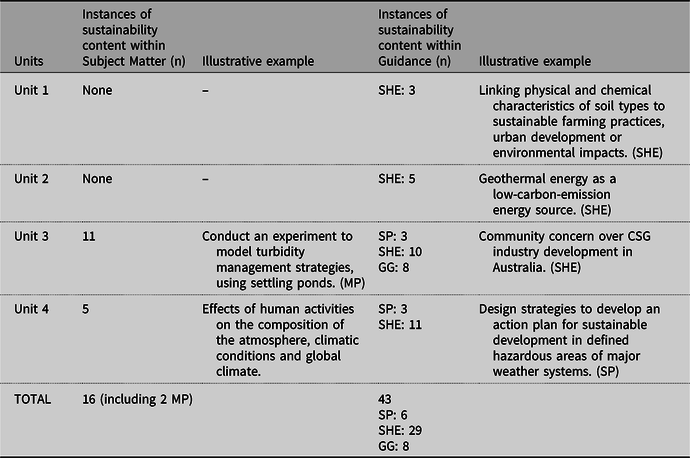
The curriculum key was used to analyse the Course Overview (specifically, Sections 1.1 Introduction and 1.2 Teaching and Learning), as we anticipated that the overview would explicate the priorities of the syllabus. It was also used to analyse Units 1 through 4. This included the unit descriptions and objectives, the unit topics (which contain the Subject Matter and Guidance), and the assessment guidance. Author 1 analysed the document using the first two components of the key (Learning content and Pedagogy and learning environments), while Author 2 applied the third and fourth components (Societal transformation and Learning outcomes). This involved carefully reading and rereading the identified sections of the syllabus, and identifying segments of text that aligned with our assigned dimensions of the ESD curriculum key, until we were satisfied that all relevant segments were identified. The text segments were recorded in a table to help organise and make sense of the data (noting that segments of subject matter and guidance were recorded separately for each unit), before they were reviewed and discussed to ensure we were satisfied they appropriately represented each dimension of the curriculum key. During this process, careful consideration was given to objectivity and sensitivity, ensuring the meaning of the text was being represented fairly (Bowen, Reference Bowen2009). Illustrative examples of text segments are shown in Table 1.
A summary of the number of instances of sustainability learning content identified within the syllabus, categorised according to their type

Note: MP = mandated practicals. SP = suggested practicals. GG = general guidance, and is a term that we have used to identify guidance that does not fall into one of the other two categories. SHE = Science as a Human Endeavour.
Findings and discussion
In the following sections, we present and discuss the findings of our analysis of the EES syllabus, with a view to illuminate the extent to which the intended curriculum reflects the tenets of ESD. We begin by presenting the word cloud that was generated from the first phase of document analysis before examining closely the findings that emerged from the second phase, as guided by the ESD curriculum key.
Level 1 findings: frequency of keywords
The word cloud that was generated as an outcome of the first phase of document analysis is shown in Figure 3. At a glance, there are very few terms related directly to ESD. ‘Earth systems’ appears most prominently (noting that ‘Earth processes’ is also prominent), which is unsurprising, given that the syllabus is very clear about its intention to engage students in learning about Earth’s processes and the complex interactions between Earth’s systems (QCAA, 2017). Terms that relate to science inquiry skills also appear frequently, such as investigating, experimenting, collecting data, analysing data and communicating. The prominence of ‘secondary data’ suggests that opportunities to engage with this type of data is an important part of the intended curriculum, which could relate to sustainability contexts. For example, in the overview for Unit 3, it states that students will apply secondary data to ‘explain decisions relating to environmental and social implications of extracting, using and managing Earth resources’ (QCAA, 2017, p. 37).
The word cloud generated during the first level of document analysis.

There are no sustainability terms per se that feature prominently within the word cloud. In spite of the inclusion of environmental science in the new syllabus, the term ‘sustainability’ was not found in the Rationale or Unit Overviews. Nonetheless, there are a number of learning content terms that could relate to sustainable development, such as ‘renewable resources’, ‘non-renewable resources’, ‘resource extraction’ and ‘mitigation strategies’. ‘Earth hazard’ is the second most frequent term identified in the word cloud, and is the focus of Unit 4. While not a sustainability term itself, its prominence might foreshadow opportunities to learn about the sustainability of environments and communities in the context of Earth hazards in Unit 4.
Level 2 findings: Learning content
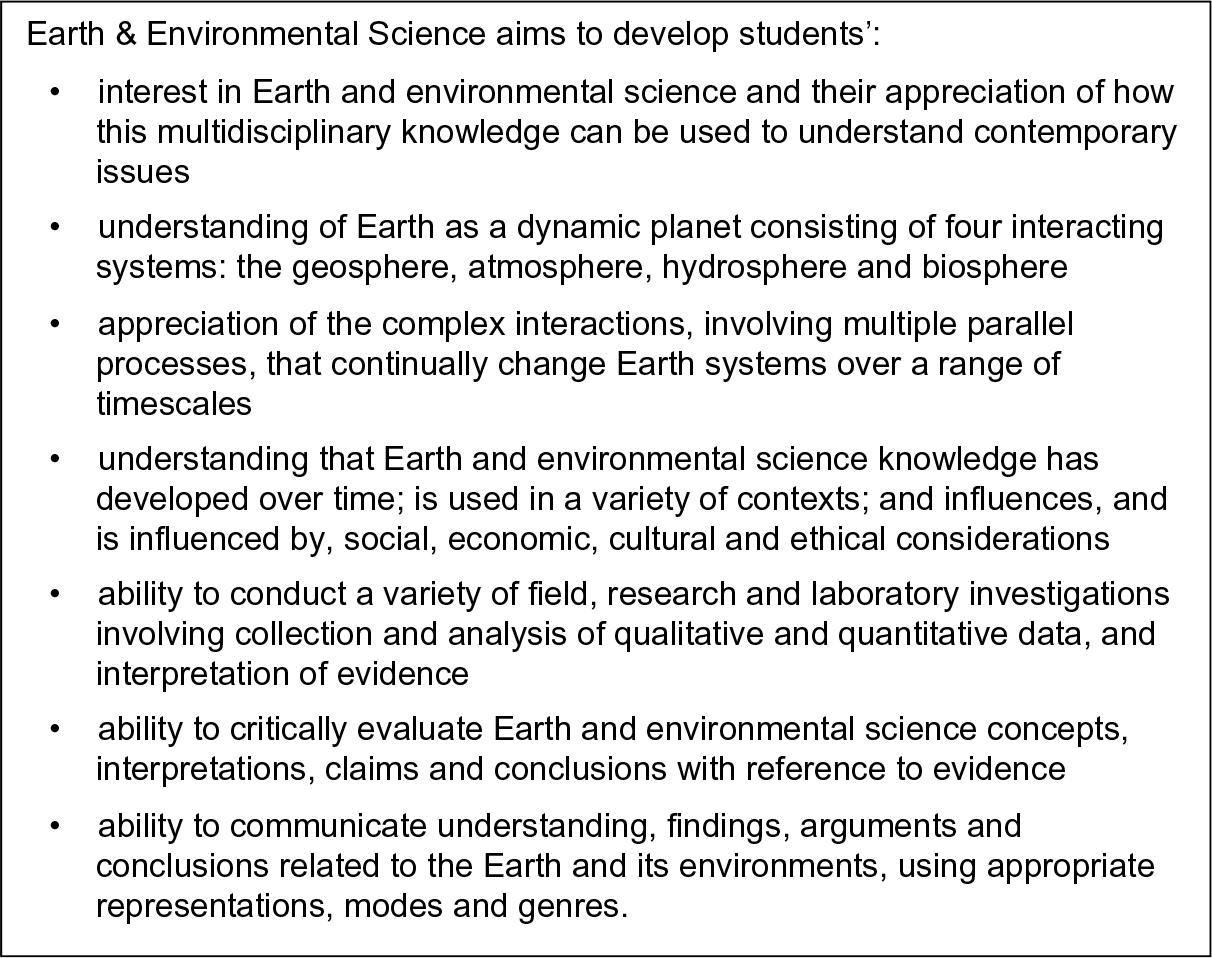
The analysis of the syllabus for ESD learning content examined the extent to which critical sustainability issues and sustainability-related content are integrated in the curriculum. The Course Overview was examined first. While we considered that it may foreshadow sustainability learning content that appears later in the syllabus, no sustainability content was identified. Explicit reference to learning about sustainability is not included in the aims of the syllabus (shown in Figure 4), although ‘contemporary issues’ could include socio-ecological challenges such as global climate change and a sustainable energy future. A single reference to sustainability appears in Section 1.2.5 Subject Matter, in a list of SHE concepts with which students ‘should become familiar’: ‘Scientific knowledge can be used to develop and evaluate projected economic, social and environmental impacts and to design action for sustainability’ (QCAA, 2017, p. 14). We found the absence of sustainability in the Course Overview to be somewhat unexpected, particularly given the document’s explicit focus on environmental science. Another notable omission that may influence the representation of sustainability learning content was found in Section 1.1.2 Underpinning Factors, wherein three underpinning factors, or ‘skill sets’, are identified:
literacy – the set of knowledge and skills about language and texts essential for understanding and conveying Earth & Environmental Science content
numeracy – the knowledge, skills, behaviours and dispositions that students need to use mathematics in a wide range of situations … [and]
21st Century skills – the attributes and skills students need to prepare them for higher education, work and engagement in a complex and rapidly changing world. (QCAA, 2017, p. 6)
The stated aims of the EES syllabus, as drawn from Section 1.1.1, Rationale (QCAA, 2017, p. 2). © State of Queensland (QCAA) 2019.

These underpinning factors are common to the suite of revised senior Queensland syllabuses, and it is expected that students ‘learn through and about these skills’ (QCAA, 2017, p. 7) over the course of study. Here, sustainability is not represented as one of the underpinning factors. This, too, is an unexpected finding given that sustainability is a cross-curriculum priority in the Australian Curriculum (ACARA, 2016). Given this omission from the Queensland syllabus, we were interested to learn how prominently sustainability issues appear in the learning content.
Table 1 presents a summary of the findings of the analysis of Units 1 through 4. The two left-hand columns present a count of sustainability content identified in the subject matter, with an example to illustrate, while the right-hand columns present examples of sustainability content within the guidance. It was found that the number of identified examples of guidance that were relevant to our analysis (n = 43) greatly outnumbered the instances of sustainability content found in the subject matter (n = 16). Twenty-nine of these are represented by SHE examples.
Our analysis of Unit 1 found no sustainability learning content in the subject matter, and the fewest examples of guidance with links to sustainability (n = 3; Table 1). In this unit, students learn about the development of Earth’s systems; they ‘can explore ways to predict future changes to the geosphere, atmosphere, hydrosphere and biosphere; [and] provide advice about ways to mitigate the effect of human-induced change’ (Unit Overview; QCAA, 2017, p. 19). In spite of this, advising on how to mitigate human-induced change on Earth’s systems is limited to one example of guidance (i.e., monitoring the Earth’s atmosphere using ‘Global Atmosphere Watch’; see World Meteorological Organization website, www.wmo.int/gaw). Given the focus of Unit 1, we were surprised to find that the link between the thinning of stratospheric ozone and human activities has not been included in the curriculum. It is suggested that ‘Further investigation of the ozone layer could look at historical records that show changes in the thickness of the layer at different locations’ (QCAA, 2017, p. 24); however, the opportunity to learn about how global cooperation on this issue saw the banning of ozone-depleting chemicals is not offered.
Similarly, no sustainability content was found in the subject matter for Unit 2, while sustainability-related guidance is limited to five examples (Table 1). The unit overview identifies a range of contexts relevant to energy transfer and transformation in Earth systems that could be investigated, including energy for human consumption and the importance of environmentally friendly energy sources. The issue of climate change is introduced by way of SHE guidance. Again, the unit overview states that students will apply ‘secondary data to explore ways to predict future changes to the different Earth systems and provide advice about ways to mitigate the effect of human-induced change’ (QCAA, 2017, p. 28); however, no such opportunities were identified in our analysis.
Unit 3 and Unit 4 were found to include significant sustainability learning content. Unit 3 explores the extraction, use and management of Earth’s resources. In this unit, students learn about:
… the need for sustainable [energy] sources to maintain quality of everyday life, balanced with the need to limit the effect that extraction and use will have on different Earth systems …. [they] examine case studies to analyse secondary data and make decisions about the viability of using renewable and non-renewable Earth resources using an ‘ecological footprint’ … [and explore] the importance of monitoring and modelling to manage these resources at local, regional and global scales. (QCAA, 2017, p. 37)
The subject matter includes topics such as the use and management of renewable and nonrenewable resources. It is noted that the concept of ecosystem services is included, an important sustainability concept (Millennium Ecosystem Assessment, 2005); however, the focus is limited to provisioning services (e.g., the provision of clean air, food and water) and the economic value of ecosystem services, while the value of supporting, regulating and cultural services is overlooked.
The guidance for Unit 3 includes 21 examples of how sustainability concepts can be integrated into the subject matter (Table 1). Three suggested practicals are included, two of which include a sustainability focus (i.e., advising on impact mitigation for the issues of topsoil erosion, and species abundance and distribution). Other engaging contexts for learning that are offered include coal seam gas mining in Australia; sustainable fisheries; and the negative effect of human activities on animal and plant populations, and efforts to restore ecosystems. Opportunities to design action for sustainability are offered for the topics of renewable energy, sustainable harvesting of aquacultural species, and calculating an ecological footprint.
In Unit 4, the subject matter examines the cause and impact of Earth hazards on people and the environment; how human activities can influence the frequency, magnitude and intensity of natural hazards; and the development of mitigation and environmental management strategies. The other major topic explored is the cause and impact of global climate change. Here, the subject matter concerns how human activities can alter the composition of the atmosphere and global climate. Students also learn about the effect of climate change on Earth systems, species distribution, crop productivity, sea level, rainfall, surface temperature and extent of ice sheets. Like Unit 3, the guidance for Unit 4 includes myriad examples of how sustainability can be integrated into the subject matter, and these examples include a greater focus on engaging students in active ways. For example, it is suggested that students design strategies to develop an action plan for sustainable development in defined hazardous areas of major weather systems; design strategies to limit environmental, social and economic consequences of Earth hazards on communities; and identify action on climate change.
While these findings indicate that the scope of the syllabus includes significant opportunities to engage with sustainability learning content, the greatest representation of such appear as SHE concepts (n = 29), which are not assessed. This is of concern, as opportunities to learn about sustainability issues when the curriculum moves from intended to enacted will likely be variable. Similarly, research has shown that learning content that is not assessed is often afforded low priority within the enacted curriculum (Barnes et al., Reference Barnes, Moore and Almeida2018). Relegating sustainability content to suggested guidance marginalises this knowledge, indicating that the curriculum is oriented towards social adaptation, where radical shifts in thinking are avoided in favour of alignment with economic policy and social norms (Eisner, Reference Eisner1985).
Level 2 findings: Pedagogy and learning environments
ESD espouses student-centred, transformative pedagogies that include active, inquiry-based,participatory and experiential learning approaches (Bosselmann, Reference Bosselmann2001; Cotton & Winter, Reference Cotton, Winter, Jones, Selby and Sterling2010). In keeping with these principles, the second element of the ESD curriculum key concerns the extent to which the syllabus promotes teaching and learning that is learner-centred, exploratory, action-oriented and transformative, and inspires students to act for sustainability.
In analysing the syllabus for evidence of ways in which it might promote ESD pedagogies and learning environments, we began by looking for the identification of a pedagogical framework. The Course Overview includes a section entitled ‘1.2.4 Pedagogical and Conceptual Frameworks’. This section clarifies the use of the term ‘inquiry’ within the syllabus, and outlines a 4-point framework to describe the inquiry process (i.e., forming and describing an inquiry; finding valid and reliable evidence; analysing and interpreting evidence; and evaluating the conclusions, processes or claims); however, the syllabus itself ‘is not intended to endorse or recommend an inquiry-based learning approach’ (QCAA, 2017, p. 11, original emphasis). Although a school may choose to adopt an inquiry-based approach, the syllabus is instead intended to assist schools in aligning the EES curriculum and assessment expectations with their chosen pedagogical framework.
Although the syllabus does not mandate a particular pedagogical framework, it is a requirement that students engage in science inquiry and learn science inquiry skills (QCAA, 2017). The pedagogical framework that a school chooses, therefore, must provide opportunities for students to work like scientists, and, in this way, support the development of these outcomes. As we have previously identified, our analysis of the syllabus for evidence of sustainability learning content revealed the inclusion of a number of critical sustainability issues in the prescribed subject matter and/or the accompanying guidance. These issues present authentic contexts for meaningful scientific inquiry, and in this way, the syllabus presents the potential to support learner-centred and exploratory pedagogies and learning environments in line with ESD principles.
As outlined in our analysis of Learning Content, Unit 3 and Unit 4 include a number of examples of guidance that seek to engage students in the design of action for sustainability. For example, the following is offered in Unit 3 in the context of learning about the relationship between human activities and natural hazards:
Scientific knowledge can be used to evaluate projected environmental impacts of natural hazardous events, such as droughts, floods, bushfires or landslides due to human activity, and design strategies and an action plan for sustainable human interaction with the natural environment. (QCAA, 2017, p. 58)
Engaging students in the development of a research-informed action plan that outlines strategies for interacting with the natural environmental in sustainable ways presents a powerful example of action-orientated learning; however, given that these suggestions are offered as guidance, whether or not they are actually enacted in schools will depend on teachers’ instructional decisions. Indeed, there are many opportunities to engage students in transformative learning if the syllabus is enacted in a way that students use EES knowledge and practices to develop a critical understanding of sustainability issues, such as global climate change, water security, natural hazards and a sustainable energy future, on local, regional and global scales; to reflect on their own beliefs and values; and contribute to action on these issues (Sterling, Reference Sterling2010).
‘Sustainability pedagogies’ are guided by a number of principles that include ‘participatory and inclusive education processes, transdisciplinary cooperation, experiential learning and the use of the environment and community as learning resources; all of which involve student-centredand interactive enquiry-based approaches to teaching and learning’ (Cotton & Winter, Reference Cotton, Winter, Jones, Selby and Sterling2010, pp. 41–42). While the syllabus does not generally refer to specific teaching strategies (and, indeed, decisions about how to enact the curriculum are usually school-based), case studies, a teaching strategy advocated by ESD scholars (Cotton & Winter, Reference Cotton, Winter, Jones, Selby and Sterling2010) appear in Units 3 and 4 as a way of engaging students with learning content that links to sustainability. For example, in the Subject Matter in Unit 4, students ‘compare and contrast case studies of positive and negative human influences on ecosystem viability at local, regional and global scales’ (QCAA, 2017, p. 44) in order to learn about the human impacts of using renewable energy sources on ecosystems. Examples of possible case studies are provided, such as species removal, habitat destruction, pest introduction and dryland salinity, and Indigenous Australian sustainability practices.
Level 2 findings: Societal transformation
Given that the notion of societal transformation is a key principle of ESD (UNESCO, 2018), it represents the third dimension of our curriculum key. To examine the extent to which this tenet is reflected in the EES syllabus, we searched for opportunities wherein students are empowered to assume active roles as agents of change to envision and create alternative futures; enable a transition to sustainable economies and societies; and act upon local and global sustainability challenges (UNESCO, 2018).
From our initial readings of the syllabus, we were immediately aware that its purposes are at odds with societal transformation. The Course Overview states that the underpinning factors ‘are derived from current education, industry and community expectations’, and that students’ participation in EES will provide them with the ‘knowledge, skills, capabilities, behaviours, and dispositions that will help [them] live and work successfully in the 21st century’ (QCAA, 2017, p. 6). The syllabus does not identify EES as providing students with opportunities to recognise and act upon important sustainability challenges, an indicator of a ‘transformative’ curriculum (Eisner, Reference Eisner1985). In this way, the syllabus privileges capitalist and neoliberal ideologies, wherein a means-ends model to curriculum development has been adopted. Here, the purpose of the curriculum is to prepare students for the world of work (a social adaption orientation to curriculum), and critical and action-oriented considerations of people’s relationship with the natural environment are marginalised or nonexistent (Hursh, Henderson, & Greenwood, Reference Hursh, Henderson and Greenwood2015).
It seems that there are very few transformative educational experiences mandated within the context of the sustainability content identified earlier in this article. In Unit 3, a range of sustainability content is noted; however, we could not identify any subject matter that positions students as active citizens who can envision and take action to realise sustainable futures. While there are instances where students are, for example, required to evaluate the effectiveness of the resource industries’ environmental monitoring strategies, and investigate the sustainability of renewable resources, they are not required to go a step further and consider alternative management approaches or sustainable solutions, or take action in response to the findings from their investigation and evaluation of current practices. Similarly, in Unit 4, students are required to evaluate the effect of hazard mitigation strategies and draw conclusions about the extent to which natural and human processes contribute to climate change; yet they are not expected to act upon their findings. The lack of emphasis on action within the syllabus may simply recognise the limited agency youth have in the real world (Walker, Reference Walker2017), countering the dominant discourse in ESD that youth can negotiate sustainable futures. However, the opportunity to provide innovative and authentic experiences where students can develop and practise skills that could lead to future societal change is missed.
Level 2 findings: Learning outcomes
The final principle of ESD proposed by UNESCO (2018) relates to learning outcomes. In our analysis of the syllabus, we searched for evidence of the following ESD learning outcomes: critical thinking, systemic thinking, futures-thinking, values clarification, collaborative problem solving and decision making, and reflection (Tilbury & Cooke, Reference Tilbury and Cooke2005; UNESCO, 2018).
It was found that the aims and objectives of the syllabus, as outlined in the Course Overview, reflect the aforementioned technical nature of the curriculum and its intent to prepare students for further study and work as a scientist. For example, it is noted that students will develop ‘a deep understanding of … discipline knowledge; the skills used by scientists …; and the ability to coordinate their understanding of the knowledge and skills associated with the discipline to refine experiments, verify known scientific relationships, explain phenomena with justification, and evaluate claims’ (QCAA, 2017, p. 1). The seven aims of the syllabus do not explicitly include any ESD learning outcomes, with the exception of one, which refers to the ‘ability to critically evaluate Earth and environmental science concepts, interpretations, claims and conclusions with reference to evidence’ (QCAA, 2017, p. 2, emphasis added).
ESD learning outcomes are also absent from the Syllabus Objectives (Figure 2) and subsequent course assessment, which prioritise the development of scientific knowledge and science inquiry skills. The summative assessment for Unit 3 (a data test and student experiment) and Unit 4 (a research investigation and examination) is highly prescriptive. Perhaps this is not surprising when students’ achievement in the subject can be used to calculate an ATAR; however, it suggests that teachers will be afforded little opportunity to use the summative assessment tasks to engage in exploratory and transformative approaches to teaching and learning that prioritise ESD learning outcomes such as futures-thinking and values clarification.
A research investigation task in Unit 4 requires students to evaluate a claim about the cause and impact of earth hazards or global climate change by drawing on a range of credible information sources. As part of this task, students’ ability to critically evaluate research processes, claims and conclusions about the cause and impact of Earth hazards or global climate change is assessed. This represents the only assessed opportunity to critically evaluate scientific claims or conclusions in relation to sustainability content identified in our analysis of the intended curriculum.
Reference to some relevant learning outcomes were found in the 21st century skills identified in the syllabus (one of the document’s underpinnings factors); namely, critical and creative thinking, and collaboration and teamwork. Critical thinking (and reflection) ‘challenges us to examine the way we interpret the world and how our knowledge and opinions are shaped by those around us’ (Tilbury & Cooke, Reference Tilbury and Cooke2005, p. 5). Teachers can support students to think critically by providing opportunities to understand the reasons for environmental problems, encouraging students to deconstruct normative rhetoric around environmental issues, and supporting students to reconceptualise these issues with sustainability values in mind (Quigley & Lyons, Reference Quigley, Lyons, Bellocchi, Quigley and Otrel-Cass2017). As outlined in our findings for Societal Transformation, there is some encouragement of these kinds of activities in the Guidance, wherein students design actions for sustainability. While it is noted that ‘elements of 21st century skills are embedded in the syllabus objectives, unit objectives and subject matter’ (QCAA, 2017, p. 9), we could find little explicit evidence of this in our analysis of the intended curriculum.
Systems-thinking is an important ESD learning outcome, which, according to Tilbury and Cooke (Reference Tilbury and Cooke2005), ‘is a way of thinking based upon a critical understanding of how complex systems … function by considering the whole rather than the sum of the parts. Systemic thinking … emphasises holistic, integrative approaches, which take into account the relationships between system components’ (p. 5). As shown in Figure 3, ‘Earth~Systems’ emerged as the most frequently identified term in our Level 1 analysis. In completing the next level of analysis, we realised that Earth’s systems are used mostly as an organising framework for content knowledge. Limited subject matter that encourages systems thinking was identified within the syllabus, even in Unit1: Introduction to Earth systems, which ‘describ processes and phenomena that occur in different Earth systems and how they are interrelated’ (QCAA, 2017, p. 19, emphasis added). The use of Earth systems to organise subject matter is illustrated in this unit, wherein the unit topics independently deal with Earth systems. A fairer representation of systems thinking was identified in the subsequent units, which include subject matter about weather patterns, the cycling of matter, and the effects of mineral extraction and Earth hazards on Earth’s systems.
In our analysis of the syllabus, we also searched for instances of futures-thinking, collaborative decision making and problem solving, values clarification and reflection. There are few opportunities in the intended curriculum for students to work collaboratively or with stakeholders from industry or community, to think about or propose solutions to sustainability challenges. This is limited to the few aforementioned instances wherein students could loosely ‘design action for sustainability’ (see Societal Transformation). These also represent the few opportunities wherein students are able to reflect upon current practices (e.g., environmental monitoring techniques). The analysis did not identify any requirements that students think critically about their own and others’ beliefs about the environment and sustainable development; evaluate information and arguments of different stakeholders; or recognise and evaluate conflicting information, evidence or arguments relevant to sustainability issues (Gilbert & Hoepper, Reference Gilbert, Hoepper and Gilbert2004). In this way, the syllabus does not support a holistic understanding of important issues, as multiple perspectives on the learning content are not included (Boeve-de Pauw et al., Reference Boeve-de Pauw, Gericke, Olsson and Berglund2015).
Summary and conclusions
In this study, we employed document analysis to investigate the extent to which the senior Queensland EES syllabus reflects the tenets of ESD. Overall, it was found that the syllabus includes a good representation of sustainability learning content within the Subject Matter, namely in Units 3 and 4, which concern the extraction, use and management of Earth’s resources, and the cause and impact of Earth hazards, respectively. The learning content in these units is supported by the provision of authentic and engaging contexts (e.g., coal seam gas mining and sustainable fisheries) by way of Guidance (particularly those that relate to the SHE strand of the syllabus); however, as Guidance is intended to illustrate ways to teach the subject matter and is not mandated or assessed, the extent to which different sustainability contexts are employed when the curriculum is enacted in classrooms is likely to be variable.
The remaining ESD tenets examined in this study are marginalised or absent within the syllabus. It was found that there is potential for the syllabus to support learner-centred, exploratory approaches to learning and teaching when the curriculum is enacted, particularly if schools adopt an inquiry-based approach to frame the investigation of sustainability issues; however, action-orientated and transformative approaches that inspire students to act for sustainability are not promoted. Opportunities to empower students to actively envision and create alternative futures, and act upon local and global sustainability challenges are scarce and limited to a few opportunities to design actions for sustainability in relation to issues such as climate change. Similarly, no ESD learning outcomes, such as systemic thinking, futures-thinking and values clarification, are explicitly promoted or assessed in the syllabus, with the exception of critical thinking.
Overall, it appears that the extent to which the syllabus reflects the tenets of ESD is limited chiefly to sustainability learning content. In this way, it positions schools as places to raise awareness about sustainability issues that concern EES, rather than places for taking action on these issues; a focus on education about sustainability, rather than for sustainability (Tilbury & Cooke, Reference Tilbury and Cooke2005). While learning about sustainability issues is important, this is not sufficient on its own to realise the transformative potential of ESD. Given the explicit inclusion of environmental science in the new syllabus and the natural alignment between EES and ESD (Chalkley et al., Reference Chalkley, Blumhof, Ragnarsdóttir, Jones, Selby and Sterling2010), particularly compared to other senior science subjects like Chemistry, Physics and Biology, we assert that the syllabus represents a ‘missed opportunity’ to engage students with ESD and, in particular, to develop their capacity to transform society by contributing positively to important socio-ecological challenges in which EES can play a role.
It appears that the absence of sustainability in the Course Overview (including the Subject Aims and Underpinning Factors) is quite telling about how ESD is marginalised within the syllabus. As noted at the beginning of this article, notions of sustainability and the importance of learning about the environment are explicated in the Rationale of the preceding Queensland Earth Science syllabus (QBSSSS, 2000). Furthermore, developing students’ understanding of sustainability issues like global warming was stated as one of eight key aims of the syllabus. This explicit focus on sustainability was not identified in the Rationale or aims of the EES syllabus.
While a subject like EES ostensibly appears to be a ‘natural fit’ with ESD, our findings suggest that the current syllabus was not developed with a view to overtly prioritise the tenets or aims of ESD. Ironically, the overarching purposes of the syllabus, as explicated in the Rationale, is to develop discipline-specific knowledge and science inquiry skills, and to prepare students to live and work successfully in the 21st century; yet this purpose fails to recognise the environmental, social and economic challenges facing young adults entering the workforce, and the sustainability competencies they require to meet these challenges and contribute to a sustainable economy. This disconnect between ESD and a 21st century education is problematised by Bell (Reference Bell2016), who notes that:
… most discussions of 21st century education are premised on servicing, rather than transforming, the current global economy … a separate discourse has emerged about 21st century education that, while outlining important 21st century skills and competences, typically makes no mention of ESD and arguably pays insufficient attention to the sustainability challenges that will likely define the prospects for human existence on this planet beyond the next century (pp. 48–49, emphasis added).
In line with Bell’s (Reference Bell2016) concerns, the EES syllabus (underpinned by social adaptation and curriculum as technology orientations to curriculum) pays insufficient attention to ESD.
As noted earlier in this article, the EES syllabus is one of a suite of senior syllabuses in Queensland that were developed at a time when significant changes to senior schooling were occurring. Most importantly, Queensland was transitioning from school-based senior assessment to external testing, and introducing the ATAR for the purposes of tertiary entrance, in alignment with other states and territories (QCAA, 2018c). While it could be speculated that these external factors have shaped the development of a highly technical syllabus, Smith and Watson (Reference Smith and Watson2019) contend that STEM-related subjects are ‘inherently unable to provide the type of deep transformational education’ (p. 1) required for a sustainable future given that their purpose (i.e., ‘to prepare students for a hypermodern, techno-optimist, competitive global future’ [p. 6]) is at direct odds with the purposes of ESD.
Despite strong international ESD policies, there is little evidence that the tenets of ESD are being realised in Australian schools (Barnes et al., Reference Barnes, Moore and Almeida2018). In their recent research article, aptly titled ‘Sustaining Education for Sustainability [EfS] in Turbulent Times’, Smith and Stevenson (Reference Smith and Stevenson2017) note that diminished state and federal policy support for ESD/EfS in Australia has led to a ‘hostile’ policy environment that places it ‘in competition with other educational policies that (overtly or covertly) receive greater priority’ (p. 79). In the context of a technical orientation to curriculum that marginalises ESD, our findings lend support to Smith and Stevenson’s assertion that the extent to which global sustainability can be achieved through education is contingent upon individual school leadership and culture to create the necessary conditions for nurturing ESD approaches that build upon assets within the school community. More likely, in a neoliberal climate where achievement, accountability and international competitiveness dominate the educational discourse, the capacity to implement ESD for societal transformation is limited (Smith & Watson, Reference Smith and Watson2019).
The implications of our analysis of the Queensland EES syllabus extend to curriculum developers internationally. The persistence of EES curricula underpinned by a technical orientation will continue to hamper efforts to shift the dominant paradigm of neoliberal norms and attitudes towards the goals of global sustainable development. The challenge for curriculum developers is to ‘connect the discourses on ESD and on 21st century education, particularly around their common promotion of transformational pedagogy’ (Bell, Reference Bell2016, p. 54), so as to help students take action towards realising their preferred futures. A strong expression of ESD within the curriculum will allow for more nuanced and imaginative dialogue about how to bridge the gap between practice and policy, and realize the transformative potential of ESD.
Funding
This work was supported by QLD Department of Science, Information, Technology and Innovation Advance Queensland Women’s Academic Fund.