Introduction
The Queen's Medical Centre campus of Nottingham University Hospitals National Health Service (NHS) Trust is a large UK teaching hospital, which provides a busy rhinolaryngoscopy service to patients in different locations across both of the Trust's campuses. Prior to 2017, the service was delivered using reusable eyepiece rhinolaryngoscopes with light sources of varying quality and limited capacity to record images. In 2017, reusable video-rhinolaryngoscopes replaced these, allowing the user to view images on a monitor stack with a much-improved light source and to take still images of examination findings. In early 2019, the service deployed the single-use, disposable Ambu aScope 4 RhinoLaryngo Slim endoscope (Ambu, Ballerup, Denmark) to facilitate video-rhinolaryngoscopy on the wards and in the emergency department, and to overcome patient ‘track-and-trace’ documentation issues. These disposable rhinolaryngoscopes have been described in detail by Mistry and colleagues.Reference Mistry, Russell, Walker and Ofo1
Following deployment of the single-use device, a prospective service evaluation in late 2019 revealed that 145 devices were used in a month, equating to a projected annual cost to the service of £261 000. In a similar setting to ourselves, Mistry and colleagues later reported that the cost per use of a reusable video-rhinolaryngoscope was £11.00 cheaper than the Ambu aScope 4 RhinoLaryngo Slim when used in the out-patient department (£94.00 vs £105.00) and £73.00 more expensive when used in the surgical assessment unit (£178.00 vs £105.00).Reference Mistry, Russell, Walker and Ofo1 Together, these findings provided the stimulus for further analysis of the costs related to rhinolaryngoscope use at our Trust.
We aimed to estimate the costs of conducting rhinolaryngoscopy by means of conventional reusable devices in a UK teaching hospital. We subsequently made inferences about how rhinolaryngoscopy costs might have differed had single-use devices been used instead. Our primary objective was to determine the cost per use of a reusable video-rhinolaryngoscope at our Trust and to compare this with the cost per use of the single-use, disposable Ambu aScope 4 RhinoLaryngo Slim.
Materials and methods
This cost-comparison study was conducted at the Queen's Medical Centre campus of Nottingham University Hospitals NHS Trust, UK. The Queen's Medical Centre is a tertiary referral centre for ENT, which offers a rhinolaryngoscope service to out-patients, in-patients and emergency department patients across both campuses of the Trust.
Cost per use is equal to the total cost of purchase and ownership divided by the number of uses. This includes the costs related to purchase and depreciation, servicing and maintenance, and reprocessing and storage. We store reusable rhinolaryngoscopes in the ENT out-patient department in a single drying cupboard (Lancer UK, Cambridge, UK). When a rhinolaryngoscope is required in the ENT out-patient department, it is collected by a healthcare assistant and brought to the clinic room for use. Following use, rhinolaryngoscopes are pre-cleaned by a healthcare assistant and batch-transported every 30 minutes to the central reprocessing suite, where they undergo high-level disinfection in one of four Getinge ED-Flow automated endoscope reprocessors (Getinge, Gothenburg, Sweden). After reprocessing, the rhinolaryngoscopes are returned to the ENT out-patient department by a healthcare assistant.
Cost data are reported from the Trust's perspective. For reusable rhinolaryngoscopes, we collected cost data for a five-year period (1 July 2014 to 30 June 2019) from the following sources: (1) ENT out-patient department; (2) supply company sales representatives; (3) central reprocessing suite; and (4) NHS supply chain. We estimated labour costs using the healthcare assistant band two midpoint annual salary (£17 652; 2019/20). We used published cost data for single-use equipment and utilities required to reprocess intubating fibrescopes.Reference Mouritsen, Ehlers, Kovaleva, Ahmad and El-Boghdadly2 We modelled unit and total cost data for rhinolaryngoscopy using different numbers of reusable devices. We then created similar models for the disposable Ambu aScope 4 RhinoLaryngo Slim based on the same number of procedures per year. In order to simulate these costs, we obtained unit prices for the Ambu aScope 4 RhinoLaryngo Slim and the associated Ambu aView monitor (Ambu, Ballerup, Denmark) from Ambu UK (St Ives, Cambridgeshire, UK). We used 2019 national unit costs relevant to the NHS, exclusive of value-added taxation and any locally applied discounts.
We prospectively collected utilisation data for reusable and disposable devices. For the reusable devices, we used the number of rhinolaryngoscopes passing through the automated endoscope reprocessors over a 13-week period (2 September 2019 to 29 November 2019) as a surrogate measure of the number of procedures performed. These data are captured and stored electronically as part of the central reprocessing suite's quality assurance and governance procedures related to endoscope reprocessing. For the disposable rhinolaryngoscopes, we prospectively collected the number of devices used over a single month (14 November 2019 to 13 December 2019).
There are no reporting guidelines for cost-comparison studies. However, we have used the Consolidated Health Economic Evaluation Reporting Standards, which focus on costs related to the health consequences of interventions, to guide our report.Reference Husereau, Drummond, Petrou, Carswell, Moher and Greenberg3
Results
The central reprocessing unit recorded 1194 reprocessing episodes for rhinolaryngoscopes in the 13-week evaluation period, giving an estimate of 4776 reusable rhinolaryngoscope uses per year. We recorded 145 disposable rhinolaryngoscope uses during the second evaluation period (4.14 weeks), giving an estimated use of 1821 disposable rhinolaryngoscopes per year. Thus, annual rhinolaryngoscope use was estimated at 6597 uses.
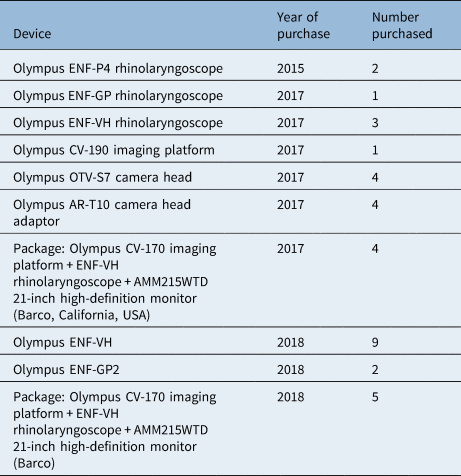
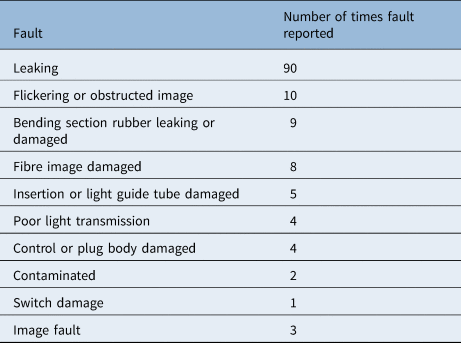
Over the five-year costing period, 26 reusable Olympus rhinolaryngoscopes (Olympus, Southend-on-Sea, UK), 10 Olympus imaging systems including monitors and necessary cabling, and ancillary equipment were purchased to replace the existing suite of 25 reusable eyepiece rhinolaryngoscopes; our equipment inventory is detailed in Table 1. The total acquisition cost for this equipment was £532 118, with each device given a seven-year service life by the manufacturer. We divided the total acquisition cost by the service life in years in order to calculate the total annual capital consumption (depreciation) cost across all devices, which was £76 017 (A = £15.92 per use). During the costing period, all rhinolaryngoscopes, imaging systems and camera heads were maintained and repaired under annual service plans. The total service plan cost was £56 565 per year (B = £11.84 per use). During the costing period, 131 repairs were required, giving a median of 2 (interquartile range, 1–3) repairs per month (Table 2). Labour costs related to the cleaning and transportation of used rhinolaryngoscopes to and from the ENT out-patients department were £32 300 per year (i = £6.76 per use). The total acquisition cost for the four Getinge ED-Flow automated endoscope reprocessors, each with a Getinge T-DOC Endocycle datalogging system, was £276 800. Each automated endoscope reprocessor has a seven-year service life, thus giving an annual consumption cost of £39 543. All four automated endoscope reprocessors were the subject of fully comprehensive service plans, giving a total cost of £38 792. Using scanned data from the central reprocessing suite, we estimated that the reprocessing of rhinolaryngoscopes represented 30.8 per cent of automated endoscope reprocessor annual activity. Thus, the cost related to the purchase and maintenance of the four automated endoscope reprocessors could be estimated as £24 127; that is, 30.8 per cent of £78 335 (ii = £5.05 per use). The total cost for labour, detergent, disposables and utilities for the reprocessing of rhinolaryngoscopes in the central reprocessing unit was £124 988 (iii = £26.17 per use). Thus, the total cost of reprocessing (C) = i + ii + iii = £37.98 per use. Finally, the Lancer drying cupboard had been in use for 11 years, without need for repair, and was the subject of an annual service contract. As such, the annual cost related to the Lancer drying cupboard was £4109 (D = £0.86 per use).
Rhinolaryngoscopy equipment purchased during costing period*

* Data refer to rhinolaryngoscopes purchased for and used at Queen's Medical Centre, Nottingham, assessed during the costing period of 1 July 2014 to 30 June 2019.
Type and number of user-reported faults with rhinolaryngoscopes over costing period*

* Data refer to rhinolaryngoscopes purchased for and used at Queen's Medical Centre, Nottingham, assessed during the costing period of 1 July 2014 to 30 June 2019.
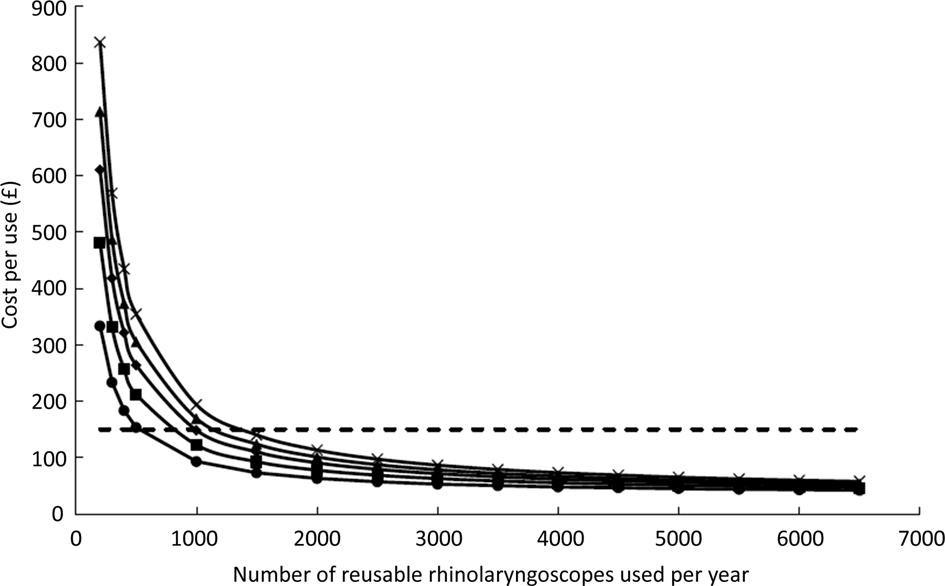
The annual cost of rhinolaryngoscopy with the reusable devices was the sum of A + B + C + D, giving a total of £318 106 or £66.61 per use. Proportionally, costs relating to cleaning and reprocessing constituted 57.0 per cent of the total cost per use, with capital consumption caused by depreciation of rhinolaryngoscopes accounting for 23.9 per cent, rhinolaryngoscope service contracts accounting for 17.8 per cent, and drying and storage accounting for 1.3 per cent. The unit purchase cost of a disposable Ambu aScope 4 RhinoLaryngo Slim was £150, while the purchase cost of the Ambu aView monitor was nil, as these were included free of charge with every £4000 purchase of the rhinolaryngoscope. Therefore, the annual cost of rhinolaryngoscopy using the disposable Ambu aScope 4 RhinoLaryngo Slim and associated monitor was £273 150 or £150 per use. As such, the total annual cost for the use of rhinolaryngoscopes at our Trust was £591 256. If all procedures had been performed using a reusable rhinolaryngoscope, our model (Figure 1) estimated that the cost per use would be £57.31 and the total cost per year would be £378 074, giving rise to a potential annual saving of £213 182.
Variation of the cost per use, as the number of procedures performed varies for different ENT out-patient departments. Each solid line represents an ENT out-patient department with a different number of reusable rhinolaryngoscopes (× = Queen's Medical Centre with 26 devices; ▴ = 20 devices; ♦ = 15 devices; ■ = 10 devices; ⬤ = 5 devices); the dashed reference line represents the cost per use of the disposable Ambu aScope 4 RhinoLaryngo Slim endoscope.

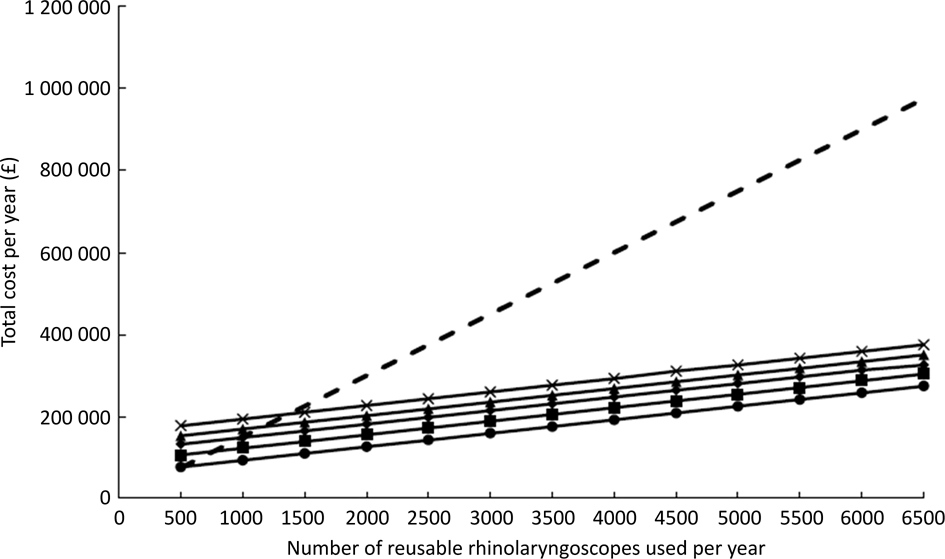
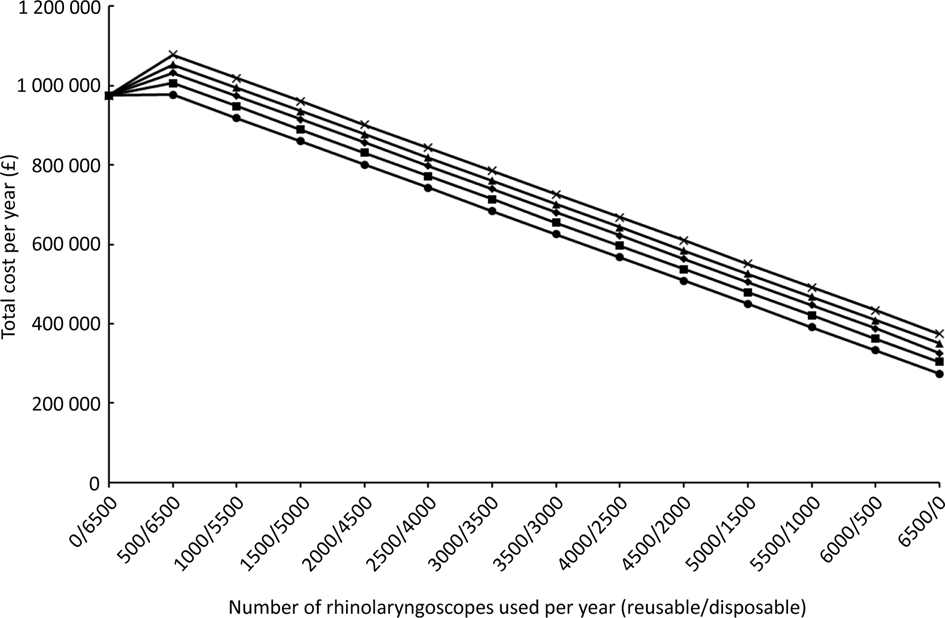
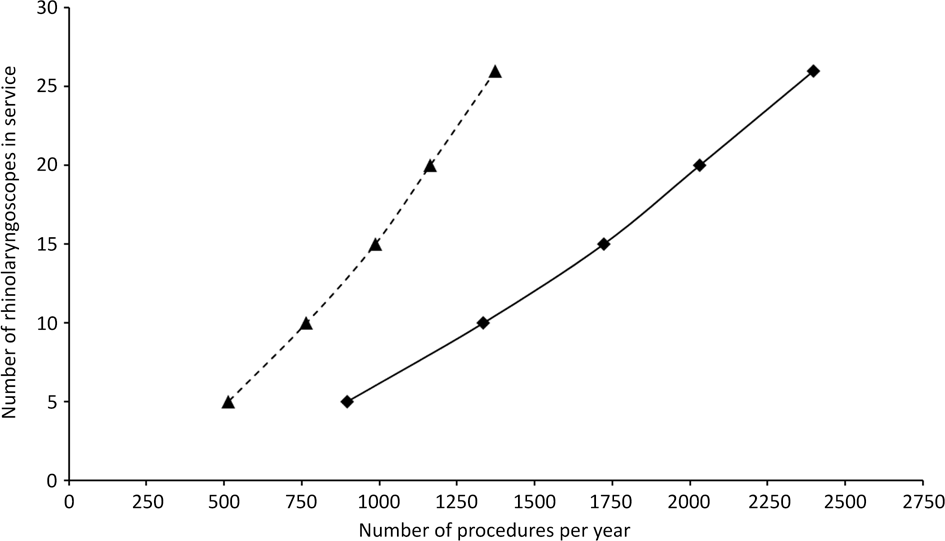
Figures 1 and 2 demonstrate how the cost per use and total cost vary with the number of procedures per year and with the number of reusable rhinolaryngoscopes. Figure 3 demonstrates how the total annual cost varies as the ratio of reusable and disposable rhinolaryngoscopes used varies for a fixed number of procedures per year. Figure 4 is derived from data used in Figure 1 and is an isopleth for cost per use, such that the costs of a reusable and a disposable rhinolaryngoscope are equal at any point along the curve (i.e. a break-even point); we have plotted cost isopleths for the standard (£150) and discounted (£100) unit price of the Ambu aScope 4 RhinoLaryngo Slim. For our Trust, these points are reached after 1374 uses (£150 isopleth) and after 2398 uses (£100 isopleth), respectively.
Variation of the total cost of rhinolaryngoscope use, as the number of procedures performed varies for different ENT out-patient departments. Each solid line represents an ENT out-patient department with a different number of reusable rhinolaryngoscopes (× = Queen's Medical Centre with 26 devices; ▴ = 20 devices; ♦ = 15 devices; ■ = 10 devices; ⬤ = 5 devices); the dashed reference line represents the total cost of the disposable Ambu aScope 4 RhinoLaryngo Slim endoscope.

Variation of the total cost of rhinolaryngoscope use, as the ratio of reusable or disposable devices is varied for a fixed number of procedures per year. Each solid line represents an ENT out-patient department with a different number of reusable rhinolaryngoscopes (× = Queen's Medical Centre with 26 devices; ▴ = 20 devices; ♦ = 15 devices; ■ = 10 devices; ⬤ = 5 devices).

Cost isopleths for rhinolaryngoscope use. The plots are derived from the data used in Figure 1, and they represent the points where the cost per use of reusable and disposable rhinolaryngoscopes is equal. The solid line is an isopleth for £100, and the dashed line is an isopleth for £150. Along each curve, the cost is equal for disposable and reusable rhinolaryngoscopes at any point. Therefore, for any given number of reusable rhinolaryngoscopes, to the right of a curve it is cheaper to purchase and use reusable devices, and to the left of the curve it is cheaper to purchase and use disposable devices.

Discussion
We have demonstrated that it is cheaper to use a reusable video-rhinolaryngoscope than a disposable device in a busy ENT tertiary referral centre with a centralised decontamination service. We have created a generic model, which can be used to estimate and compare the considerable costs associated with the purchase and ownership of rhinolaryngoscopes. In line with previous work, the lion's share of expenditure is spent on the reprocessing of reusable devices.Reference Mistry, Russell, Walker and Ofo1 While disposable rhinolaryngoscopes represented just over a quarter of total utilisation, they were associated with a disproportionate increase in total cost. We believe that ENT services could use our model to improve decision-making with regard to the purchase of rhinolaryngoscopes, whether disposable or reusable.
Mistry and colleaguesReference Mistry, Russell, Walker and Ofo1 recently published their micro-costing study of rhinolaryngoscope use at a tertiary referral centre in London, where 5740 rhinolaryngoscopies are performed annually in their out-patient and acute surgical assessment units. A finding consistent with our study is that cost per use of reusable video-rhinolaryngoscope decreases exponentially with increasing use, such that disposable devices only become cheaper to use at lower rates of utilisation. The authors found that it cost £94 per use of a video-rhinolaryngoscope in the out-patient department, based on 4957 uses. This cost included a 20 per cent uplift for additional capital, repair and reprocessing costs, and it comprised £30.00 capital, £23.00 for repairs and £41.00 for reprocessing. In contrast, we did not add any cost uplifts, so that our cost per use comprised £15.92 capital, £11.84 for servicing and £37.98 for reprocessing. Setting aside the 20 per cent cost uplift, the cost differences between the two studies are not surprising, insofar as our total capital expenditure is lower (£532 000 vs £604 000), we used a longer amortisation period (seven years vs five years) as per the manufacturer's recommended length of service, and our total annual service costs were lower (£57 000 vs £72 000). The difference in cost per use serves as a reminder that cost per use is not fixed, and it will vary for individual hospitals dependent on: their initial capital expenditure, the actual or projected length of service (amortisation period), whether service plans are fully comprehensive, and differences in reprocessing arrangements.
An important consideration in the interpretation of our findings is that we have not compared the value associated with either device. In broad terms, value may be realised at organisational, departmental, user and patient levels. At the time of writing, there were no published cost-effectiveness studies of disposable and reusable rhinolaryngoscopes. However, a number of examples exist in the literature that support the value of disposable endoscopes. Châteauvieux and colleaguesReference Châteauvieux, Farah, Guérot, Wermert, Pineau and Prognon4 demonstrated that single-use bronchoscopes had a multitude of positive organisational impacts associated with their use, such as a reduction in the number of support services necessary to ensure consistent availability of a ready-to-use bronchoscope (e.g. no need to reprocess or service). At departmental level, it is likely that disposable rhinolaryngoscopes will improve the ability to perform video-rhinolaryngoscopy out-of-hours in remote sites such as the emergency department, as the equipment is lighter, more portable and easier to set up than reusable equipment.Reference Marshall, Dagaonkar, Yeow, Peters, Tan and Tai5 Furthermore, during peaks of activity or reusable device unavailability, disposable rhinolaryngoscopes should provide a useful alternative, thus reducing costs related to delays in patient investigation and treatment.Reference Mistry, Russell, Walker and Ofo1 At user level, disposable rhinolaryngoscopes have compared favourably with their reusable counterparts in terms of image quality, ergonomics and scope navigation.Reference Mistry, Russell, Walker and Ofo1 Notably, the disposable Ambu aScope 4 RhinoLaryngo Slim can record still and video imaging, thus allowing senior surgeons to review endoscopic examinations without the need to re-examine the patient. From the patient's perspective, a recent study in Italy has found non-pathogenic bacterial recovery rates of 16.1 per cent and 6.5 per cent from reusable rhinolaryngoscopes following disinfection by a chlorine dioxide wipe system or by an endoscope washer-disinfector, respectively.Reference Ditommaso, Giacomuzzi, Cipriani, Zaccaria, Cavallo and Boggio6 This is against a backdrop of a 2.8 per cent risk of cross-infection related to biofilm formation on bronchoscopes, despite adherence to high-level disinfection guidelines.Reference Mouritsen, Ehlers, Kovaleva, Ahmad and El-Boghdadly2,Reference Ofstead, Doyle, Eiland, Amelang, Wetzler and England7–Reference Ofstead, Quick, Wetzler, Eiland, Heymann and Sonetti9 While it is considered to be low, the risk of bacterial or prion-related cross-infection with a reusable rhinolaryngoscope still exists.10 Disposable devices mitigate this risk altogether.
• Disposable video-rhinolaryngoscopes are a new alternative to reusable devices, offering a number of advantages over reusable counterparts
• The potential cost and health benefits they offer are yet to be described
• Video-rhinolaryngoscopy total costs are estimated by summing costs for purchase and depreciation, servicing and maintenance, reprocessing and storage
• Reusable video-rhinolaryngoscope reprocessing accounts for over half of total cost of ownership
• Reusable video-rhinolaryngoscopes, used for 6597 procedures per year, cost £66.61 per use at our centre; disposable devices cost £150.00 per use
• Reusable device costs decrease exponentially with increasing use; at our centre, cost per use became cheaper than a disposable device after 1374 procedures
Our study is not without its limitations. We have used published cost data for single-use equipment and utilities used to reprocess intubating fibrescopes in automated endoscope reprocessors; we felt that a similar costing exercise at our centre would not yield vastly different data in this respect, as we use automated endoscope reprocessors also.Reference Mouritsen, Ehlers, Kovaleva, Ahmad and El-Boghdadly2 We have used non-discounted prices in our comparison in order to present a level playing field for each type of device and to create a more generalisable cost model. Other limitations relate to the cost model itself, specifically that it relates to those services which use a central decontamination unit for reprocessing, and which pay for fully comprehensive annual service and repair contracts. In terms of functionality, the Ambu aView monitor permits video-recording, whereas the Olympus imaging platforms that we have purchased do not include this without additional capital outlay, which is not considered in our comparison. Finally, we have not accounted for the costs related to the storage and disposal of the disposable device. As a rough estimate, Hospital Episode Statistics show that over two hundred thousand endoscopic examinations of nasopharynx were performed in English NHS hospital out-patient departments in 2018–2019.11 If these had been performed using the Ambu aScope 4 RhinoLaryngo Slim, approximately 50 000 tonnes of waste would have been created. An estimate of the associated environmental costs is beyond the scope of this study.
Conclusion
Disposable rhinolaryngoscopes may present a cheaper solution to new or existing services with relatively low rates of rhinolaryngoscope utilisation. However, for larger, established services considering replacement of their reusable rhinolaryngoscopes with disposable units, it is likely that the recurring costs will be prohibitive in the medium to long term. The Ambu aScope 4 RhinoLaryngo Slim offers a number of advantages, such that many acute services will wish to use a disposable or reusable device dependent on patient location. These ‘hybrid’ services should have processes in place to ensure that the convenience of a disposable rhinolaryngoscope does not cause expenditure to escalate out of control. Future studies should aim to describe and calculate the ‘added-value’ that disposable or reusable devices may offer, such that procurement decisions are not taken on a simple cost basis.
Data availability statement
The data that support the findings of this study are available from the corresponding author upon reasonable request.
Competing interests
Author RM has received honoraria and airway training equipment for consultation work performed for Ambu UK.