

%20--%3e%3c!DOCTYPE%20svg%20PUBLIC%20'-//W3C//DTD%20SVG%201.0//EN'%20'http://www.w3.org/TR/2001/REC-SVG-20010904/DTD/svg10.dtd'%3e%3csvg%20version='1.0'%20id='Layer_1'%20xmlns='http://www.w3.org/2000/svg'%20xmlns:xlink='http://www.w3.org/1999/xlink'%20x='0px'%20y='0px'%20width='64px'%20height='64px'%20viewBox='5.5%20-3.5%2064%2064'%20enable-background='new%205.5%20-3.5%2064%2064'%20xml:space='preserve'%3e%3cg%3e%3ccircle%20fill='%23FFFFFF'%20fill-opacity='0'%20cx='37.785'%20cy='28.501'%20r='28.836'/%3e%3cpath%20fill='%23595959'%20d='M37.441-3.5c8.951,0,16.572,3.125,22.857,9.372c3.008,3.009,5.295,6.448,6.857,10.314%20c1.561,3.867,2.344,7.971,2.344,12.314c0,4.381-0.773,8.486-2.314,12.313c-1.543,3.828-3.82,7.21-6.828,10.143%20c-3.123,3.085-6.666,5.448-10.629,7.086c-3.961,1.638-8.057,2.457-12.285,2.457s-8.276-0.808-12.143-2.429%20c-3.866-1.618-7.333-3.961-10.4-7.027c-3.067-3.066-5.4-6.524-7-10.372S5.5,32.767,5.5,28.5c0-4.229,0.809-8.295,2.428-12.2%20c1.619-3.905,3.972-7.4,7.057-10.486C21.08-0.394,28.565-3.5,37.441-3.5z%20M37.557,2.272c-7.314,0-13.467,2.553-18.458,7.657%20c-2.515,2.553-4.448,5.419-5.8,8.6c-1.354,3.181-2.029,6.505-2.029,9.972c0,3.429,0.675,6.734,2.029,9.913%20c1.353,3.183,3.285,6.021,5.8,8.516c2.514,2.496,5.351,4.399,8.515,5.715c3.161,1.314,6.476,1.971,9.943,1.971%20c3.428,0,6.75-0.665,9.973-1.999c3.219-1.335,6.121-3.257,8.713-5.771c4.99-4.876,7.484-10.99,7.484-18.344%20c0-3.543-0.648-6.895-1.943-10.057c-1.293-3.162-3.18-5.98-5.654-8.458C50.984,4.844,44.795,2.272,37.557,2.272z%20M37.156,23.187%20l-4.287,2.229c-0.458-0.951-1.019-1.619-1.685-2c-0.667-0.38-1.286-0.571-1.858-0.571c-2.856,0-4.286,1.885-4.286,5.657%20c0,1.714,0.362,3.084,1.085,4.113c0.724,1.029,1.791,1.544,3.201,1.544c1.867,0,3.181-0.915,3.944-2.743l3.942,2%20c-0.838,1.563-2,2.791-3.486,3.686c-1.484,0.896-3.123,1.343-4.914,1.343c-2.857,0-5.163-0.875-6.915-2.629%20c-1.752-1.752-2.628-4.19-2.628-7.313c0-3.048,0.886-5.466,2.657-7.257c1.771-1.79,4.009-2.686,6.715-2.686%20C32.604,18.558,35.441,20.101,37.156,23.187z%20M55.613,23.187l-4.229,2.229c-0.457-0.951-1.02-1.619-1.686-2%20c-0.668-0.38-1.307-0.571-1.914-0.571c-2.857,0-4.287,1.885-4.287,5.657c0,1.714,0.363,3.084,1.086,4.113%20c0.723,1.029,1.789,1.544,3.201,1.544c1.865,0,3.18-0.915,3.941-2.743l4,2c-0.875,1.563-2.057,2.791-3.541,3.686%20c-1.486,0.896-3.105,1.343-4.857,1.343c-2.896,0-5.209-0.875-6.941-2.629c-1.736-1.752-2.602-4.19-2.602-7.313%20c0-3.048,0.885-5.466,2.658-7.257c1.77-1.79,4.008-2.686,6.713-2.686C51.117,18.558,53.938,20.101,55.613,23.187z'/%3e%3c/g%3e%3c/svg%3e)
%20--%3e%3c!DOCTYPE%20svg%20PUBLIC%20'-//W3C//DTD%20SVG%201.0//EN'%20'http://www.w3.org/TR/2001/REC-SVG-20010904/DTD/svg10.dtd'%3e%3csvg%20version='1.0'%20id='Layer_1'%20xmlns='http://www.w3.org/2000/svg'%20xmlns:xlink='http://www.w3.org/1999/xlink'%20x='0px'%20y='0px'%20width='64px'%20height='64px'%20viewBox='5.5%20-3.5%2064%2064'%20enable-background='new%205.5%20-3.5%2064%2064'%20xml:space='preserve'%3e%3cg%3e%3ccircle%20fill='%23FFFFFF'%20fill-opacity='0'%20cx='37.637'%20cy='28.806'%20r='28.276'/%3e%3cg%3e%3cpath%20fill='%23595959'%20d='M37.443-3.5c8.988,0,16.57,3.085,22.742,9.257C66.393,11.967,69.5,19.548,69.5,28.5c0,8.991-3.049,16.476-9.145,22.456%20C53.879,57.319,46.242,60.5,37.443,60.5c-8.649,0-16.153-3.144-22.514-9.43C8.644,44.784,5.5,37.262,5.5,28.5%20c0-8.761,3.144-16.342,9.429-22.742C21.101-0.415,28.604-3.5,37.443-3.5z%20M37.557,2.272c-7.276,0-13.428,2.553-18.457,7.657%20c-5.22,5.334-7.829,11.525-7.829,18.572c0,7.086,2.59,13.22,7.77,18.398c5.181,5.182,11.352,7.771,18.514,7.771%20c7.123,0,13.334-2.607,18.629-7.828c5.029-4.838,7.543-10.952,7.543-18.343c0-7.276-2.553-13.465-7.656-18.571%20C50.967,4.824,44.795,2.272,37.557,2.272z%20M46.129,20.557v13.085h-3.656v15.542h-9.944V33.643h-3.656V20.557%20c0-0.572,0.2-1.057,0.599-1.457c0.401-0.399,0.887-0.6,1.457-0.6h13.144c0.533,0,1.01,0.2,1.428,0.6%20C45.918,19.5,46.129,19.986,46.129,20.557z%20M33.042,12.329c0-3.008,1.485-4.514,4.458-4.514s4.457,1.504,4.457,4.514%20c0,2.971-1.486,4.457-4.457,4.457S33.042,15.3,33.042,12.329z'/%3e%3c/g%3e%3c/g%3e%3c/svg%3e)
%20--%3e%3c!DOCTYPE%20svg%20PUBLIC%20'-//W3C//DTD%20SVG%201.0//EN'%20'http://www.w3.org/TR/2001/REC-SVG-20010904/DTD/svg10.dtd'%3e%3csvg%20version='1.0'%20id='Layer_1'%20xmlns='http://www.w3.org/2000/svg'%20xmlns:xlink='http://www.w3.org/1999/xlink'%20x='0px'%20y='0px'%20width='64px'%20height='64px'%20viewBox='5.5%20-3.5%2064%2064'%20enable-background='new%205.5%20-3.5%2064%2064'%20xml:space='preserve'%3e%3cg%3e%3ccircle%20fill='%23FFFFFF'%20fill-opacity='0'%20cx='36.924'%20cy='28.403'%20r='28.895'/%3e%3cpath%20fill='%23595959'%20d='M37.442-3.5c8.99,0,16.571,3.085,22.743,9.256C66.393,11.928,69.5,19.509,69.5,28.5c0,8.992-3.048,16.476-9.145,22.458%20C53.88,57.32,46.241,60.5,37.442,60.5c-8.686,0-16.19-3.162-22.513-9.485C8.644,44.728,5.5,37.225,5.5,28.5%20c0-8.762,3.144-16.343,9.429-22.743C21.1-0.414,28.604-3.5,37.442-3.5z%20M12.7,19.872c-0.952,2.628-1.429,5.505-1.429,8.629%20c0,7.086,2.59,13.22,7.77,18.4c5.219,5.144,11.391,7.715,18.514,7.715c7.201,0,13.409-2.608,18.63-7.829%20c1.867-1.79,3.332-3.657,4.398-5.602l-12.056-5.371c-0.421,2.02-1.439,3.667-3.057,4.942c-1.622,1.276-3.535,2.011-5.744,2.2%20v4.915h-3.714v-4.915c-3.543-0.036-6.782-1.312-9.714-3.827l4.4-4.457c2.094,1.942,4.476,2.913,7.143,2.913%20c1.104,0,2.048-0.246,2.83-0.743c0.78-0.494,1.172-1.312,1.172-2.457c0-0.801-0.287-1.448-0.858-1.943l-3.085-1.315l-3.771-1.715%20l-5.086-2.229L12.7,19.872z%20M37.557,2.214c-7.276,0-13.428,2.571-18.457,7.714c-1.258,1.258-2.439,2.686-3.543,4.287L27.786,19.7%20c0.533-1.676,1.542-3.019,3.029-4.028c1.484-1.009,3.218-1.571,5.2-1.686V9.071h3.715v4.915c2.934,0.153,5.6,1.143,8,2.971%20l-4.172,4.286c-1.793-1.257-3.619-1.885-5.486-1.885c-0.991,0-1.876,0.191-2.656,0.571c-0.781,0.381-1.172,1.029-1.172,1.943%20c0,0.267,0.095,0.533,0.285,0.8l4.057,1.83l2.8,1.257l5.144,2.285l16.397,7.314c0.535-2.248,0.801-4.533,0.801-6.857%20c0-7.353-2.552-13.543-7.656-18.573C51.005,4.785,44.831,2.214,37.557,2.214z'/%3e%3c/g%3e%3c/svg%3e)
%20--%3e%3c!DOCTYPE%20svg%20PUBLIC%20'-//W3C//DTD%20SVG%201.1//EN'%20'http://www.w3.org/Graphics/SVG/1.1/DTD/svg11.dtd'%3e%3csvg%20version='1.1'%20id='Layer_1'%20xmlns='http://www.w3.org/2000/svg'%20xmlns:xlink='http://www.w3.org/1999/xlink'%20x='0px'%20y='0px'%20width='64.000977px'%20height='64px'%20viewBox='0%200%2064.000977%2064'%20enable-background='new%200%200%2064.000977%2064'%20xml:space='preserve'%3e%3cg%3e%3ccircle%20fill='%23FFFFFF'%20fill-opacity='0'%20cx='32.064453'%20cy='31.788086'%20r='29.012695'/%3e%3cg%3e%3cpath%20fill='%23595959'%20d='M31.943848,0C40.896484,0,48.476562,3.105469,54.6875,9.314453C60.894531,15.486328,64.000977,23.045898,64.000977,32%20s-3.048828,16.457031-9.145508,22.513672C48.417969,60.837891,40.779297,64,31.942871,64%20c-8.648926,0-16.152832-3.142578-22.513672-9.429688C3.144043,48.286133,0,40.761719,0,32.000977%20c0-8.723633,3.144043-16.285156,9.429199-22.68457C15.640137,3.105469,23.14502,0,31.943848,0z%20M32.060547,5.771484%20c-7.275391,0-13.429688,2.570312-18.458496,7.714844C8.381836,18.783203,5.772949,24.954102,5.772949,32%20c0,7.125,2.589844,13.256836,7.77002,18.400391c5.181152,5.181641,11.352051,7.770508,18.515625,7.770508%20c7.123047,0,13.332031-2.608398,18.626953-7.828125C55.713867,45.466797,58.228516,39.353516,58.228516,32%20c0-7.3125-2.553711-13.484375-7.65625-18.513672C45.504883,8.341797,39.333984,5.771484,32.060547,5.771484z%20M44.117188,24.456055%20v5.485352H20.859863v-5.485352H44.117188z%20M44.117188,34.743164v5.481445H20.859863v-5.481445H44.117188z'/%3e%3c/g%3e%3c/g%3e%3c/svg%3e)
Posterity's view of Charles II's musical tastes has forever been coloured by Roger North's claim that ‘during the first years of Charles II all musick affected by the beau-mond run[s] into the French way’.Footnote 1 Consequently, studies of English Restoration court music have named France as the chief source of musical inspiration at the English court in the 1660s and 1670s.Footnote 2 While there can be no doubt about the effects of his French sojourn in the late 1640s and early 1650s on many of Charles's tastes and habits, North's explanation for the French fad reveals a more complex web of European musical exchanges:
Because at that time the master of the Court musick in France, whose name was Baptista,Footnote 3 (an Italian frenchifyed), had influenced the French style by infusing a great portion of the Italian harmony into it, whereby the Ayre was exceedingly improved.Footnote 4
A great deal of the French musical culture the young Charles encountered had to a large extent been appropriated from Italy.Footnote 5 Although Lully had been dancing at the French court since 1651, his composing career started to soar only in the 1660s, after Charles had been restored as king of England.Footnote 6 Before Lully, numerous Roman-trained singers and composers had visited the French court through the extensive importation by Cardinal Mazarin (1602–61) of Roman art and music as a means of power representation inspired by his old Barberini patrons. Without seeking to downplay the significance of the ‘24 violins’, this article highlights the Italian music at the English court. I argue that Charles II's ‘Italian Musicke’ was hired in 1664 by the secretary of state Sir Henry Bennet to perform Roman chamber music, to which Charles had first been exposed during his stay at the French court. The appointment of the Italian ensemble, I suggest, was made in imitation of French cultural practices, which had reached new heights at the hands of Mazarin but ultimately derived from Barberini Rome.
Between 1664 and 1666, the Roman Vincenzo Albrici (1631–90) and his brother and sister, together with Pietro Cefalo (161?–168?), Giovanni Sebenico (c.1640–1705), Matteo Battaglia (dates unknown) and an unnamed castrato arrived to form Charles II's ‘Italian Musicke’. The group served at the English court until the Test Act of 1673 (which required all courtiers to take Anglican Communion once per year) forced Charles to disband it. Most musicians returned to the Continent, although some transferred to the queen's Catholic chapel, which was exempt from the Act. Perhaps because of a previous lack of evidence regarding the recruitment of the Italian ensemble, little research has attempted to penetrate its function at court. Margaret Mabbett examined the archival evidence available in 1986, arguing that Charles hired the ensemble to establish Italian opera in England.Footnote 7 Since then, only the work of Peter Leech has considered the Italian ensemble to any extent. Leech's research, however, exclusively treats the ensemble's engagement in the Catholic chapel of Catherine of Braganza.Footnote 8 This article introduces a series of recently discovered letters, hitherto unknown to musicologists, regarding the recruitment of Italian musicians for the English court, and re-evaluates the already known documentary evidence in a wider European context in order to shed new light on the Italian music at the English court in the 1660s and early 1670s.Footnote 9
Charles II, cosmopolitanism and Italian music
During the past few decades, historians have increasingly argued that early modern English history needs to be studied within its Continental context. Scholars such as Jonathan Scott and Malcolm Smuts have noted a tendency among former political historians to focus on the unique aspects of English history while neglecting similarities with Continental Europe. This is true also for musical and cultural history. As Smuts has observed, England was by no means isolated:
In the seventeenth century England, Scotland and Ireland were ruled by an elite whose mental horizons and social environments were essentially European rather than English or British. Stuart kings and courtiers interacted regularly with European aristocrats and frequently knew more about events in Paris, Madrid or Vienna than about local conditions in Scotland, Ireland or many parts of England. Their culture and intellectual outlook owed at least as much to international as to purely English or British traditions.Footnote 10
This international outlook was part of a European aristocratic habitus – a set of values and practices shared by the European ruling elite, who all looked to the same courts as models for their tastes and manners.Footnote 11 At the end of the seventeenth century, Paris was the centre of European cultural fashion; half a century earlier, Paris had itself modelled its cultural activities on Rome.
Mid-seventeenth-century Rome was an important European musical centre, emerging as a safe highlight of the educational travels of noblemen and professional musicians alike.Footnote 12 During the papacy of Urban VIII (1623–44), the Barberini family famously manifested their power through ambitious architectural projects and equally ambitious musical patronage.Footnote 13 By mid-century, the city enjoyed a longstanding reputation as the unrivalled centre for vocal artistry: in 1641, the composer Marco Marazzoli (b. c.1602–5, d. 1662) claimed that ‘all men in this world seek to send pupils to Rome to have them study, because that is where the schooling is’,Footnote 14 and a few years later the young castrato Atto Melani begged his patron Mattias de’ Medici to allow him an extended stay in Rome so that he could learn from the best virtuosi.Footnote 15
The repertoire performed by virtuoso singers was as important for the display of princely splendour as the singers’ vocal prowess. Although opera has long dominated discussions of seventeenth-century princely image-building through music, scholars have recently argued that chamber music played an equally important role, as that which Claudio Annibaldi has called humanistic patronage intended to display the refined taste and artistic sensibility of the patron.Footnote 16 Roger Freitas has suggested that seventeenth-century Roman cantatas were composed for performance in private conversazioni of Italian princes as a form of courtly recreation emphasizing the wit and refined taste of the host and guests.Footnote 17
Such humanistic forms of power representation increasingly relied on exclusivity as a safeguard against social imitators, substituting an intimate group of spectator-participants for the public audience of Renaissance outdoor spectacles.Footnote 18 As Frederick Hammond has shown, the performance of cantatas by composers such as Marazzoli, Luigi Rossi (1597/8–1653) and Giacomo Carissimi (1605–74) at Roman courts took place in exclusive contexts where the presence of a small circle of guests often depended on the personal invitation of the patron, similar to the musica secreta of late sixteenth-century Ferrara. The more intimate the circumstances, the greater honour to the guest.Footnote 19 Cardinal Antonio Barberini's employment of the famous castrato Marc’ Antonio Pasqualini (1614–91) and the composer Rossi – known for his cantatas – in his private musical establishment suggests that chamber music was as important as operas in the Barberini display of splendour, showing that the courtly ideal of music underpinning humanistic patronage was still prevalent in the mid-seventeenth century.Footnote 20
Jules Mazarin (born Giulio Mazzarini) was a product of the Roman cultural environment. A papal nuncio to France under the patronage of the Barberini, Mazarin was made a cardinal by Louis XIII in 1642. As de facto ruler of France during the minority of Louis XIV, Cardinal Mazarin sought to assert his political authority by means similar to those employed by his old masters: as Madeleine Laurain-Portemer has argued, ‘The example of his patrons had forever convinced him that the grandeur of a reign is not measured only by power abroad or peace at home, but that it also requires the influence of culture.’Footnote 21 Through his belief in the political importance of artistic patronage and in the superiority of Rome, Mazarin made strenuous efforts to introduce Roman culture in Paris and to educate the young Louis XIV in its art and music. After the accession of Giovanni Battista Pamphili to the papacy in 1644, the Barberini cardinals themselves sought refuge in Paris, for a few years presumably adding their personal influence to Mazarin's conviction.Footnote 22
In addition to transforming the Hôtel de Chevry-Tubeuf (known as the Palais Mazarin) into a veritable museum of Roman art and architecture, Mazarin imported opera and chamber music.Footnote 23 One of the performers called to Paris was the young Melani, who spent the winter of 1644 and spring of 1645 in the service of Mazarin and the queen mother, Anne of Austria.Footnote 24 Anne was not the only queen to enjoy Melani's services at the time. Earlier in 1644, Henrietta Maria, queen of England, had taken refuge from the English Civil War at the French court. According to Melani, Henrietta Maria enjoyed his singing as much as her sister-in-law did:
Hardly two evenings pass that I do not go to serve Her Majesty, and she does me a thousand honours. Music delights her so much that for four hours one must accept the idea of doing nothing else. [The same is true] for the queen of England, so that when I do not go [to serve] one, I go to the other.Footnote 25
The 16-year-old Charles escaped England and joined his mother at Saint-Germain in 1646.Footnote 26 For political reasons which suited him and Mazarin equally well, Charles's presence in France was never officially recognized. Nevertheless, Ronald Hutton has shown that he was treated with extraordinary honour by the French royal family. After an ‘accidental’ meeting was staged between Charles and his French relatives in the forest of Fontainebleau, he was invited to the entertainment at the palace. Charles was allowed to walk with and sit next to Louis, was given a chair of equal size, was allowed to replace his hat in the royal presence, and was admitted to the highly exclusive petit lever as part of the group attending the king as he got dressed. After this occasion, he appeared regularly at the balls, assemblies, hunts and theatrical productions of the French court.Footnote 27
Charles arrived in Paris just in time for the première of the extravagant Orfeo by Rossi and the librettist Francesco Buti (1604–82) in March 1647, again featuring the royal favourite, Melani. In a letter to the duke of Modena, the singer Venanzio Leopardi reported that a separate performance was to be put on for Henrietta Maria:
This evening was represented again l'Orfeo at the Royal Palace, in the presence of the queen, the king, the cardinal [Mazarin], Mademoiselle, and all the princesses, managed as usual without failure, and his Majesty wished that it should be performed two more times for the Queen of England, and for the numerous nobility in Paris, who are devoted to the court and family.Footnote 28
Plenty of chamber music was performed between the operas; indeed, Alessio Ruffatti has shown that a large number of Rossi's cantatas were performed at the French court by Italian and French musicians.Footnote 29 In February 1647, Leopardi described a musical soirée put on by himself, Rossi and Melani, at which the young Charles was present: ‘We entered into the cabinet where we found the queen, the cardinal [Mazarin], the duke of Enghien. The first son of England, the Prince of Wales, sat in front of the queen.’Footnote 30 The group then proceeded to perform together with two putti soprani lent to the French court by the duke of Modena. There is evidence to suggest that Charles may have taken the prima donna of Orfeo as his mistress. Anna Francesca Costa (fl. 1640–54), known as La Cecca, was another Medici client lent to the French court for the first time in 1645. She became a great favourite of Mazarin and Anne of Austria, and sang the role of Euridice in Rossi's opera.Footnote 31 In June 1664, Sir Bernard Gascoigne (1614–87) wrote to Bennet about a young female singer under the patronage of Costa's old patron Gian Carlo de’ Medici who
ist in a reasonble Perfection, and ist Excellent voice […] and besayde, the Gerle, is no vere Ogly and I belive, our Master sciould like her better then Cecca Costa, being nott above 16 yeare of age, and as I think a Mayde, bott for this, I will nott Promise, a truth.Footnote 32
Both John Rosselli and Paola Besutti have interpreted Gascoigne's letter as suggesting that Costa was Charles's mistress.Footnote 33
Between managing the remains of the English fleet in Holland, Charles was in Paris for parts of Rossi's second visit in 1648–9, before the civil disturbances known as the Fronde (1648–53) put a stop to the Parisian lives of both king and composer.Footnote 34 After his famous escape from Worcester in 1651, Charles again settled with his mother in the French capital, then still racked by civil war. He was reunited with the French royal family after his attempts to negotiate with the frondeurs on their behalf in 1653 and his subsequent escape from the Louvre to Saint-Germain, where the king, queen mother and Mazarin had taken refuge from the violence in Paris. Charles rode with the royal party as they re-entered Paris in October the same year, and was once again treated to Mazarin's exceptional entertainments.Footnote 35 He left for the last time in July 1654, late enough to have experienced Mazarin's latest operatic extravaganza, Carlo Caproli's Le nozze di Peleo e di Theti in April and May, featuring Vittoria Caproli, Filiberto Ghiofi, Giuseppe Ghiofi, Antonio d'Imola, Girolamo Pignani and the Englishman Thomas Stafford, who had arrived from Rome together with Caproli's troupe.Footnote 36 After the 1654 production of his opera, Caproli was appointed maître de la musique du cabinet du roi to Louis XIV; although Caproli returned to Rome the following year, his title suggests something about the esteem for Roman music at the mid-seventeenth-century French court.Footnote 37 As Henry Prunières pointed out, the fact the Roman librettist and recruiter of Louis's Italian troupe, Buti, was rewarded with naturalization and a pension of 2,000 livres – and in effect became a minister for the arts – indicates the value that Mazarin placed on his services.Footnote 38 Charles thus spent much of his unstable and impoverished youth at a court where Mazarin's promotion of exclusive chamber performances by Roman-trained castrati and lavish opera productions played as important cultural and political roles as the Vingt-quatre Violons and later Lully's ballets de cour. Arguably, his early Romano-French education in humanistic patronage governed some of Charles's choices upon his belated accession to the English throne.
Bennet, Gascoigne and the recruitment of the Italian ensemble
When Charles II returned to the English throne in the 1660s, his chief challenge was perhaps not to assert his authority over his subjects, but to re-establish the aura of the Stuart monarchy in the eyes of fellow European rulers. The indignities of revolution and exile had deprived the young king of the cultural items and practices underpinning representational Baroque kingship, well known to him both through his upbringing at the cosmopolitan and artistically refined court of Charles I and through his youth spent in Paris.Footnote 39 Even in Commonwealth England, the conceptual link between kingship and artistic patronage was strong enough for parliamentarians organizing the return of the king to buy back as much of Charles I's scattered picture collection as possible before Charles II arrived at Whitehall, and for Charles himself to spend over £2,000 on paintings to accentuate his kingship the day before the Declaration of Breda.Footnote 40 As Jerry Brotton has observed: ‘Political restoration was meaningless without the material restitution of the trappings of royal power.’Footnote 41
Charles's attempt to provide patronage of exclusive Italian chamber music in imitation of his cousin Louis and Mazarin was probably part of this process. The leader of the king's Italian ensemble, Vincenzo Albrici, was a child of the Roman musical milieu. He was born into a family of musicians and studied under Carissimi at the Collegio Germanico, Rome. He served as organist in the Chiesa Nuova and under Bonifacio Graziani (1604/5–64) in the Chiesa del Gesù, before travelling to Sweden as the leader of Queen Christina's Italian ensemble in 1652.Footnote 42 After the queen's abdication in 1654, Vincenzo and his brother Bartolomeo travelled to Germany, where Vincenzo became kapellmeister to Johann Georg II of Saxony in 1656. In August 1663 the brothers obtained dismissal documents and travel passes for an undisclosed location.Footnote 43 By June 1664, Vincenzo, at least, was working in England.
It is a well-established fact that Albrici eventually became the leader of Charles II's Italian ensemble,Footnote 44 but it has hitherto not been known who recruited him or the other musicians in the group. The closest lead has been the ex-ambassador, courtier and theatre manager Thomas Killigrew, who in February 1667 told Samuel Pepys ‘that he hath gathered nine Italians from several courts in Christendome to come to make a consort for the King, which he doth give 200 l a year apiece to’.Footnote 45 When Pepys heard a performance by the ensemble a week later they were escorted by Killigrew (see below, p. 354). Apart from Pepys, no evidence to corroborate Killigrew's involvement in their activities has yet surfaced.
Instead, references in a series of letters so far unremarked by musicologists show that the driving force behind the recruitment of the Italian ensemble was Sir Henry Bennet (Lord Arlington from 1665), secretary of state for the southern department and an old friend and agent of Charles's. Bennet was helped by his friend and diplomatic contact in Florence, Gascoigne. Once the Albricis arrived, they themselves initiated the recruitment of new musicians. Helen Jacobsen has shown that Bennet was a highly influential artistic patron who engineered much of Charles II's cultural patronage by procuring exclusive goods (ranging from food and wine to marble chimney pieces and works of art) to match the lifestyles of Continental princes. Bennet operated through close-knit diplomatic networks built up through extensive travel in Italy, France and Spain during the civil war and interregnum, which benefited himself as much as they did the king.Footnote 46 Yet Bennet's involvement with the Italian ensemble, or indeed any music at the English court, has not previously been noticed among musicologists.
Gascoigne's musical activities have been given only marginally more attention, but he was a crucial person in Bennet's diplomatic network. Born in Florence as Bernardo Guasconi, he grew up together with the Medici princes. After embarking on a military career, he fought on the Royalist side in the English Civil War. He was granted denizenship in October 1661, but travelled between Florence and London for the rest of his life, sourcing Italian art, wine, coaches and musicians for Bennet and the king and recruiting spies for Bennet's European intelligence network.Footnote 47 Gascoigne would have been the ideal agent for recruiting Italian singers: he was a native Italian with close links to the Medici, all of whom were famous for their patronage of star singers. Indeed, as Prunières pointed out, although Rome was the focus of contemporary musical development, many of the famous singers of the mid-seventeenth century hailed from Florence, where the Medici funded the training of promising boys and girls, many of whom were sent to train in Rome or to work with Roman composers.Footnote 48 Frequently lent to foreign courts, the Medici singers played an important role in the dissemination of Roman vocal music to France and northern Europe.
The story of Albrici's recruitment begins, somewhat obliquely, with the outbreak of war between England and Holland in 1664. Gascoigne's simultaneous close links with the Stuart and Medici courts forced him to return to Florence in order not to compromise the Tuscan trading interests in the Dutch Republic.Footnote 49 His return journey is the context for the series of letters discussing the recruitment of Charles II's Italian musicians. Gascoigne was granted a travel pass for Tuscany on 4 January 1664, and probably reached Florence in May.Footnote 50 On 15 March he was in Paris, treating Bennet to a letter filled with French court gossip. This letter was probably sent towards the end of his stay, because only ten days later – on 25 March – Gascoigne wrote to Bennet and Joseph Williamson from Turin.Footnote 51 Shortly after, in April 1664, an undated letter from Gascoigne to Bennet was registered in the English state paper annals as having been received. The letter itself is undated, but was probably sent in late March or early April. The first paragraph of the letter was written in Italian (probably as a compliment to Bennet, who was proficient in several languages), and introduces Albrici:
Curious to see England, Sig.re Vincenzo Albrizzi comes here, who has been head of music to the duke of Saxony, and is an excellent composer and musician. He has asked me to present him to Your Illustrious Eminence as I do thus to favour him of your Protection.Footnote 52
Gascoigne then continued in his heavily Italian-inflected English:
I have hard, from the virginalls maker, that you was willing, to have in your hause, a virtuoso; to divert you, att naight, wen you come att home, weri of bisnisse[.] This man, to be ounder your protection was were willing, to be att your hause, att your officers table; with out any other auantage, bott to serve you; and ist the best master for teycing and composingh of our age; and he can learne, to your yung ladyes and will be all his pretention, to live in your hause, as your domestic servant, with out any stipendy or interesse.
And if the king will give to him some boyes, and gerles, to learne, ist vere confident in little tyme, to make them, att his Mag:ty satisfaction[.] and besayde, he can compose, in Englice; and in all languages; to have the king Englice musicien of the Ciappel; sing his composition as well for the cerch, as for the ciamber; att the Italian way.Footnote 53 I belive will be a man of your satisfaction; and have no other interesse with you, bott the scieltre of your hause and your protection.
I have send him in England, being a man that have no equall in composing and vere civill[.]Footnote 54
The reception date of the letter, coupled with Gascoigne's presence south of the Alps in late March 1664, suggests that Albrici, too, may have been in northern Italy in the spring of 1664, perhaps visiting relatives in Senigallia.Footnote 55 The letter itself implies that Gascoigne and Bennet were the driving forces behind the recruitment of Albrici, originally envisaging him as Bennet's household musician but also clearly hoping to introduce him at court.
Gascoigne's letter also provides the key to who put Albrici (who had left Dresden in August 1663) in touch with Gascoigne and the English court. The ‘virginalls maker’ who told Gascoigne that Bennet was looking for a ‘virtuoso’ was probably the famous harpsichord builder Girolamo Zenti (b. 1609–11, d. 1666–7), who had served with Albrici at Queen Christina's courts in Sweden. Zenti joined the English court from Paris possibly as early as 1662, but did not receive a regular salary from Charles II until 27 January 1664. Only two days later, he was issued with a travel pass for Italy, leaving his assistant Andrea Testa in charge.Footnote 56 Zenti thus left England only a few weeks after Gascoigne, whom he must have known at court, and with whom he may perhaps have caught up in Paris. One might even speculate that they travelled together towards Italy, and met Albrici somewhere along the way.
Albrici probably arrived in England in spring 1664: the letter introducing him was received in England in April 1664, and a hitherto unknown copy of his undated Saxon travel pass is preserved between documents dated June and October 1664 in a volume of German state papers.Footnote 57 On 7 June 1664, Gascoigne again wrote to Bennet, and in an oft-cited passage declared: ‘I am vere Glad that the Musicien I sendit to you provs learned and Civill; Civility being no ordinarye quality of a Musicien, bot Preyde.’Footnote 58 Peter Holman has suggested that Gascoigne's letter may refer to Giovanni Battista Draghi (c.1640–1708),Footnote 59 but in the light of Gascoigne's previous letter promising that Albrici was ‘vere civill’, it is clear that the musician was Albrici. After he arrived in England, Albrici was presumably introduced at court by Bennet, since on 9 December Gascoigne was ‘vere glad, that Sig:re Vincentio, give good satisfaction to the King’.Footnote 60 A note of the salaries due to Vincenzo and Bartolomeo Albrici from June 1666 gives their starting date as 1 October 1665, suggesting that Albrici may not have been formally hired by the court until over a year after his arrival in England.Footnote 61
The interim period may have been spent recruiting a full ensemble for the king. Charles's state papers preserve an undated proposal, written in Italian, outlining the possible cost and composition of an ensemble:
The way used in all courts is to give them, normally fifty pieces [of gold] each for the journey.
The woman will cost more if she is to have the comforts she requires.
For salary they will not want less than in Germany which is 200 pieces each per annum.
The woman will want three hundred pieces_____300
The castrato two hundred pieces______________200
And if his Majesty wanted these also so that the concert was complete and could serve both in the chamber and in the theatre one would need[:]
[A] Contralto_____200
[A] Tenor________200
[A] Bass_________200
The poet who is the principal_____200
Thus for these six people one thousand three hundred pieces per annum would be required. Regarding us, his Majesty can do as he pleases.Footnote 62
Mabbett tentatively dates the proposal to 1663, and plausibly argues that it was submitted by Vincenzo and Bartolomeo Albrici, since the following page in the state paper volume preserving the document contains an English translation of the outline which specifies their names as additional members of the ensemble:
ye yearly salarys and entertainment of his Maj[esty's] Italian MusickeFootnote 63
| £ | s | d | |
|---|---|---|---|
| One Contralto__________ | 200 | 00 | 00 |
| One Tenore__________ | |||
| One Basse__________ | |||
| The Poete__________ | |||
| The Woman__________ | 300 | 00 | 00 |
| The Eunuche__________ | 200 | 00 | 00 |
| Signor Vincenzo__________ | 200 | 00 | 00 |
| his brother__________ | 200 | 00 | 00 |
| 1700 | 00 | 00 |
Vincenzo Albrici's name in the English proposals indicates that he was known at court, suggesting that the outline was submitted in 1664, when Bennet introduced Albrici to the king. The reference to the singers’ salary in Germany suggests that the brothers envisaged recruiting at least some members from there – unsurprisingly, given the number of star Italian singers engaged at German courts.
It is clear that Vincenzo and Bartolomeo's sister, Leonora, eventually took up the role as ‘the woman’ in the ensemble. Her whereabouts between leaving the Swedish court in late spring 1654 and arriving in England are uncertain, as is her arrival date in England. Similarly, the names of the contralto, tenor and bass have long been known: Cefalo, previously of San Antonio at Padua and known to have sung the role of an ‘old wife’ in the Venetian production of Aurelio Aureli and Pietro Ziani's Le fortune di Rodope e Damira in 1657;Footnote 64 the tenor Sebenico, a Legrenzi pupil who had previously served as vicemaestro di cappella at Cividale de Friuli and in the choir of San Marco in Venice;Footnote 65 and the Bolognese Battaglia, who may have been a pupil of Maurizio Cazzati, and whom the Albrici brothers probably recruited during a stay at the Neuburg court in 1665 (the brothers were given travel passes on 25 March).Footnote 66 The newcomers entered the king's service on 1 April 1666, after Bartolomeo was issued with a travel pass to fetch them from the Continent.Footnote 67
The name of the castrato in the ensemble remains, however, unknown. Mabbett speculates that he was Hilario Suarez, who had performed with the Albricis in Sweden. The only known record of Suarez in England is dated 18 November 1679, when he, together with Draghi, Bartolomeo Albrici and Francisco Galli, petitioned the king for payment of wages four years in arrears. Suarez thus cannot be proved to have been in England before 1675 – two years after the Italian ensemble was disbanded.
Again, Gascoigne's letters to Bennet shed light on the issue, showing that Gascoigne was tasked with finding a castrato shortly after sending Albrici to England, but that it took at least until February 1665 before he found a potentially suitable candidate. Gascoigne began the hunt on reaching Tuscany in June 1664, writing to Bennet in the letter of 7 June:
I finden in Florence, one Eunuche of 16 yeare of Age; that ist vere exellent voice, bott have nott itt such Perfection as Antonio had that was in England. And I belive I could prevaile with his father, to give him to me, to send him in England; ist vere Civill boy and sing extremely well and ist learned; and for his entertenement, I sciuold rewite him to your Pleasire, after ist com in England, as you sciould tinch that he deserve, after the King and you had heard him.
Besayde, hiere is a Girle of 16 yeare, that the last Cardinall John Carlo, kepet in his one house under a Severe discipline of Musica, e, I could to, prevayle with her mother to bring her in England att this present, ist in a reasonble Perfection, and ist Excellent voice: that I believ and, with the licence for both the Great duke, and I belive that a moderate Pension, could Satisfeye this Gerle too; if his Mag:ty was willing to have this boy and Gerle, and send a way thos FrenchmenFootnote 68 that nott worth a fidelstich, I will serve him, and he sciall spend not vere much […]
For bringhinh, the Gerle, and the Boy in England and give some money tho the boy father, make Close [clothes], for the gerle for the mother, and for the boy, and to send them Honorably in England, I belive 400 pound could serve, or ther abouths; if his Mag:ty Encline to itt write me, and I sciall Serve him.Footnote 69
There is no evidence that either of the young singers ever came to England, and Gascoigne's subsequent letter suggests that he was still looking. Back in Florence from a brief sojourn in the Tuscan countryside a fortnight later, he wrote: ‘Hier I sciall finde, one excellent Eunuche, fitt, for his Mag:tys service; I will doo my endeaver, to send him over.’Footnote 70
In addition to elucidating Bennet's, and by extension Charles's, recruitment strategies, Gascoigne's letters show the king's interest in the patronage of Italian singers. Charles's involvement with Costa was discussed above, and Gascoigne's letter of 7 June mentioned a castrato called Antonio ‘that was in England’. A hitherto uncited letter from Gascoigne to Bennet reveals him to be the famous Antonio Rivani (1629–86), also known as Ciecolino:
By your last letter you are pleased to tell me that His Mag:ty for his pleasire was willingh to have one Eunuche. I believe that ist possibile, that I persuade Sig:re Antonio the Ciecolino, to come to serve his Mag:ty; Concerningh his qualityes and his perfection in singingh I sciall say nothing; haveing bein with his Mag:ty al ready; and by him well known.Footnote 71
Rivani, a boyhood friend of Melani and a former protégé of Cardinal Gian Carlo de’ Medici, has not previously been known to have visited England. After successes in Florence and Rome, he was in Paris in 1660 and 1662;Footnote 72 perhaps during this time he also crossed the Channel to perform at the English court, although no evidence exists to confirm the dates of his visit. Both Zenti and the guitarist Francesco Corbetta (c.1616–81) were apparently recruited to England via France, and both appear to have travelled between the courts to some extent.Footnote 73 The lending of gifted musicians between courts was a common form of giving diplomatic favours – Zenti was indeed at the French court on loan from Camilio Pamphili – and there is no reason to suppose that this practice did not extend to Anglo-French diplomatic relationships.
Rivani did not visit a second time; on 9 December 1664, Gascoigne was considering other options:
About Ciecolino, I hieare his Mag:tys pleasire; and he ist al ready in the service of the quin of Sweden att Rome; I am vere glad, that Sig:re Vincentio, give good satisfaction to the King; and I will too the best, to get a young castrato, to send to you. S:r I have one that att this present ist att Rome, under the discipline, of one Sig:re Abbatini, mester of capelle, to San Luigi de Francesi; that ist 16 yeares old; and ist vere good musicien as the tell me; ist a Florentine born; and his father have bin with me; and I believe, if I like him, he will be content he sciould come; bott I must give to his father 200 corones, some thingh to him selfe and to his master, close for him selfe, and his voyage, that I feare will coste, before he ist in England 150 pound sterling or ther abouts[.]
Ther ist now, a nother young boy of 11 yeares of age, that ist nott itt gelde; and ist willing to be; ist of a vere good kepe, and sing prittly well for his age; if you order me, I will treate with his father, and master, and tray if I can aggriue with him, and have the boy geld; and after send the same in England; bott this I belive will cost as much, or a little lesse. I sciall espect your forther order, and in the same tyme, will loke about if can finden any better; and ist enough you order me wath I sciall doo; bott send no mony, because, you sciall reemborse me after, of wath I sciall spend in itt.Footnote 74
With Rivani out of reach, the choice was between a 16-year-old student of Antonio Maria Abbatini (1595–1679), maestro di cappella of San Luigi dei Francesi in Rome, and a younger boy who had not yet been castrated. In seventeenth-century Italy it was common practice for promising boys to enter contracts with teachers or patrons who paid for the operation. Although Gascoigne was evidently familiar and comfortable with such procedures, English attitudes towards castrati were ambivalent; their voices were increasingly admired, but their physical status regarded with suspicion and contempt.Footnote 75 Gascoigne's final letter on the matter, from February 1665, suggests that Bennet quailed when faced with the alien practice of castrating boys:
As for the relife of your conscience, to nott pott you in a necessity, to doo so greatt a sinne as to geld a boy I sciall sciortly send you one al ready geld, and as good musicien, about 16 yeare of age, nott ist perfect, because wath he sciall want Sig:re Albrici sciall adde to him[.]Footnote 76
Since the damage of castration was already done (and on somebody else's conscience), Bennet might as well take advantage of the boy's lovely voice; he wanted the product, but preferred to forget how it had been made. This correspondence suggests that Gascoigne and Bennet's strategy for engaging a castrato was, unless they could persuade a star like Rivani, to find a young singer who could be further trained under their patronage. A similar strategy was employed by the Medici, who frequently took on promising singers and subsequently saw their fame soar all over Europe.Footnote 77
The name and arrival date of the castrato sent to England remains shrouded in mystery. That one eventually arrived is clear from the diaries of Pepys and of John Evelyn in the first months of 1667: Evelyn heard ‘Rare Italian Voices, 2 Eunuchs & one Woman’ at court in January; and in February, Pepys also heard two castrati perform with the ensemble.Footnote 78 The other castrato was probably Cefalo, hired in 1666. Thus, over several years in the mid-1660s, Bennet, Charles and Albrici built up an ensemble that vaguely resembled the 1664 outline: by January 1667, it consisted of the three Albrici siblings, Cefalo, Sebenico, Battaglia and an unidentified castrato. This group resembles the small core ensemble that accompanied Johann Georg II of Saxony to the spa town of Hirschberg in July 1661. In addition to a number of German instrumentalists and his two kapellmeisters, Vincenzo Albrici and Giuseppe Peranda, Johann Georg took two sopranos, an alto, a tenor, a bass and Bartolomeo Albrici to play the organ.Footnote 79 These forces would have permitted the performance of the ensemble motets and cantatas in vogue, which were frequently written for two sopranos, two sopranos and bass, or alto, tenor and bass, with figured bass accompaniment.
Charles and Bennet's strategy of letting esteemed musicians and diplomatic contacts handle the recruitment of musicians corresponds to the practices of other Continental rulers: the negotiations leading to the recruitment of Queen Christina's Italian ensemble, for example, were led by her singer and valet de chambre Alessandro Cecconi; the French ambassador to Rome vetted singers for Mazarin; and in January 1650, when Henrich Schütz found a candidate in Danzig for the long-vacant post of vice-kapellmeister at the electoral court in Dresden, Johann Georg II conducted negotiations via the military officer on site.Footnote 80 Like Louis and Johann Georg, Charles utilized the networks of musicians already in his employ, and the geographical location and political connections of diplomats, ambassadors and acquaintances abroad. This shows that, far from being peripheral and insignificant, Charles II's court participated in the international competition for – and diplomatic lending of – star musicians on a comparable level to other European rulers’ courts.
Thus, through the efforts of several of his courtiers, the king of England could finally boast an Italian ensemble matching those that his Continental rivals had nurtured since the 1650s. Charles II's court managed to attract some of Europe's most esteemed musicians, such as Rivani, Zenti and Vincenzo Albrici, competing for their services with heavyweight cultural patrons like Christina of Sweden, Louis XIV, Johann Georg II of Saxony, and even to some extent the Medici. Charles's information regarding singers’ abilities and recent musical trends came straight from the heart of France's and Italy's elite musical environments, with Gascoigne doubtless taking advantage of his links with the musically influential Medici clan to secure singers suitable for the king's and Bennet's needs. The musicians who arrived in England had to a large extent been hand-picked by Gascoigne or Albrici for their musical abilities; the following section discusses what was expected of them at the English court.
The function of the Italian ensemble at the English court
When Bennet arranged for the arrival of the Italian ensemble, Charles II was not simply importing musicians and repertoire. He appropriated a concept, of the prestige of which he had become aware during his youth on the Continent. This section reviews the surviving evidence (state paper entries, eyewitness accounts by Pepys and Evelyn, more Bennet–Gascoigne correspondence, and related musical repertoire) of the Italian ensemble's activities at the English court. I will argue that the Italian ensemble was kept structurally and musically apart from the court's regular musical establishments, and that the Italian musicians performed sacred and secular chamber music in private spaces at the court and, from 1666, in the queen's Catholic chapel.
The clearest indication of the duties of the Italian ensemble by the late 1660s is a 1668 petition in which Sebenico requested to replace Albrici in all his posts when the latter had departed:
The humble petition of Giovanni Sebenico one of your Majestys Musicians[:]
Humbly shewth that haveing served your Majesty for the space of two years and the place of Master of y. Italian Musick being now vacant as well as for your Majestys Chamber or Cabinett as of her Majestys Chapell and Cabinett[.]
Most humbly beggs your Majestys gracious favour to be pleased to confer upon me the sayd place and I shall be ever ready with my fellow Musicians to serve your Majesty and every festival day her Majesty in her Chappell as wee shall be ordred.Footnote 81
Sebenico was appointed on the same day, 29 April 1668.Footnote 82 His petition shows that by 1668 the Italian ensemble performed in the king and queen's private apartments and occasionally in the queen's Catholic chapel.Footnote 83 In a manner similar to that of other European courts, Whitehall was constructed to allow different levels of access to the monarch. Although Charles II's court was more open than those of his predecessors, access to the Privy Chamber, the Privy Gallery and the king's private apartments was still restricted; physical proximity to the king was a sign of power.Footnote 84 The location of a performance thus offers some indication of its audience.
The notion that the Italian ensemble played in private settings is further supported by eyewitness accounts of their performances. In January 1667, Evelyn heard the ensemble ‘in his Majesties greene Chamber next to his Cabinet’.Footnote 85 The green chamber was a conference room where Pepys attended meetings with the king and members of his cabinet.Footnote 86 The ‘Cabinet’ was probably the room – sometimes called the closet – where the king kept his paintings and curiosities, which Evelyn visited in November 1660 and Pepys in June 1664.Footnote 87 Both rooms were located on the Privy Gallery and accessible only to those privileged with access to the Privy Chamber. Similarly, Pepys witnessed a performance intended for the queen and her ladies-in-waiting when visiting Whitehall in September 1668:
So I to White-hall, and there all evening on the Queen's side; and it being a most summerlike day and a fine warm evening, the Italians came in a barge under the leads before the Queen's drawing-room, and so the queen and the ladies went out and heard it for almost an hour; and it was endeed very good together but yet there was but one voice that alone did appear considerable, and that was Seignor Joanni.Footnote 88
Whitehall palace was situated on the bank of the Thames, with the queen's apartments facing the river. The barge with the musicians appeared on the river beneath the leads outside the queen's drawing room. The ‘leads’ refers to the flat, leaded rooftop of the low buildings by the water next to the Privy Stairs (see Figure 1). The leads formed a terrace, where the queen had a little garden and whence the royals watched processions and fireworks on the river.Footnote 89 Although outdoors and possibly overheard by people in boats on the crowded river, the performance was aimed at listeners placed in the queen's private lodgings, and hence deep in restricted court territory.
View of Whitehall from the River Thames, showing the queen's lodgings and the leads in front. Wenceslaus Hollar (1607–77), Palatium regis prope Londinum, vulgo White-hall, c.1647. Yale Center for British Art, Paul Mellon Collection.

Sebenico's 1668 petition also sheds light on the Italian ensemble's performances in the queen's Catholic chapel. Importantly, the document shows that the Italian ensemble appeared there only on feast days and was not incorporated in the chapel's day-to-day musical establishment.Footnote 90 The constant observer Pepys records hearing the Italian ensemble in the queen's Catholic chapel only on Easter Day 1667 and 1668.Footnote 91 I would argue that the routine of providing Easter music for the queen's chapel started in 1667: Pepys specifically commented on the Italian music and castrati in the Catholic chapel at Easter 1667, but had not mentioned either after his visit in 1666.Footnote 92 In 1666, Easter Day fell on 15 April; only two weeks earlier, Bartolomeo Albrici had received a travel pass to fetch Cefalo, Sebenico and Battaglia from abroad. They would hardly have made it back in time for the Easter service. The year before, in 1665, both Albrici brothers were granted passes to go abroad the day before Easter, which fell on 26 March.Footnote 93 Since Leonora Albrici would not have been allowed to sing in the Catholic chapel, the arrival of the new singers was necessary for the ensemble to perform in the religious setting.Footnote 94
The only performance at which the Italian ensemble's repertoire can be determined is at a court masque in 1671. This is also the largest-scale occasion at which the Italian musicians are known to have appeared. Nearly 50 years after the event, North wrote about it as a singing competition between different nations, naming the pieces performed by some contestants:
Once the King had a fancy for a comparison to hear the singers of the severall nations, Germans, Spanish, Italian, French, and English, performe upon the stage in Whitehall. The Italians had that mentioned elsewhere – Che dite che fatte, &c. The English brought up the arrere under great disadvantage, with – I pass all my hour in a shady old grove, &c; for tho’ the King chose that song as the best, others were not of his opinion.Footnote 95
The Italian contribution was the final trio, ‘Amante che dite’, from Carissimi's cantata Sciolto havean dall’ alte sponde (also known as I naviganti), which was to become the most widely disseminated secular piece by Carissimi in seventeenth-century England.Footnote 96 This is the only piece the ensemble can be proved to have performed in England – no repertoire from the ensemble's employment at the English court survives. Although the issue needs further investigation, Peter Wollny has suggested that kapellmeisters sometimes owned their own music libraries, unlike court composers in the employ of Roman princes, whose works remained the property of their patrons.Footnote 97 If any of the Albricis’ repertoire was ever kept at the English court, it most likely perished in the Whitehall fire of 1698. However, Sciolto havean dall’ alte sponde and its final trio was also probably part of the ensemble's repertoire of Roman motets and cantatas in Sweden. Sciolto havean is included in two manuscript volumes, now in Christ Church Library, Oxford, preserving some of the ensemble's secular repertoire from their Swedish employment: Mus. 377 and 996 contain secular cantatas predominantly by Carissimi and Rossi, and also by Marazzoli and Antonio Cesti (1623–69). Both were copied by Angelo Bartolotti during the ensemble's sojourn in Uppsala, where the Swedish court was located during the final months of Christina's reign. Mus. 377 was presented to Oliver Cromwell's ambassador to Sweden, Bulstrode Whitelocke, after a concert in 1653; Mus. 996 probably reached England in a similar way.Footnote 98 In addition, John Blow's scorebook, Christ Church Mus. 14, contains two secular cantatas by Carissimi; unlike other English copies of Carissimi cantatas, these do not have concordances extant in Britain that could have served as copy texts.Footnote 99 Blow was active at the English court in the early 1670s, and could have copied the cantatas from material belonging to the Italian ensemble.
Secular Italian cantatas by Albrici himself survive in London, British Library, Harley MSS 1501 and 1273, and in Christ Church, Mus. 17 and 350.Footnote 100 While none of these sources has any proved connection with the court of Charles II, the majority date from the second half of the seventeenth century and the music could plausibly have been performed at court. Like Blow, the scribes of these sources – Pietro Reggio (1632–85), Richard Goodson, Sr (1655–1718), Henry Aldrich (1648–1710) and Humphrey Wanley (1672–1726) – all had excellent musical contacts who could have provided them with accurate copy texts.
A complete copy of Albrici's cantata Vo cercando la speranza survives together with the aria ‘Manda i nobili allori’ in London, British Library, Harley MS 1501, copied by Reggio in the mid-1680s; Oxford, Christ Church, Mus. 350 contains ‘Voglio amarvi luci’ in the hand of Goodson, and British Library, Harley MS 1273 holds ‘Non sò se l'ho da dire’ copied by Wanley in the early eighteenth century.Footnote 101 The largest number of Albrici cantatas are preserved in Christ Church, Mus. 17, copied by Aldrich at Christ Church in the late seventeenth century. The manuscript contains complete copies of the cantatas Luci belle, sete stelle and Viva, viva la fortuna, and incomplete copies of Perchè piangete amanti and Vo cercando la speranza, all of which have complete concordances in Dresden, Sächsische Landesbibliothek, Staats- und Universitätsbibliothek, Mus. K–1–52.Footnote 102 This suggests some overlap of repertoire between the Saxon and the English courts, as well as between the English and Swedish. In addition to the secular Italian cantatas, it seems safe to assume that Latin sacred music by Albrici was performed in the queen's Catholic chapel, and probably also at mealtimes and in private settings.Footnote 103 A German copy of Albrici's Laudate pueri in Christ Church, Mus. 1034B is the only sacred work by Albrici to survive in England.Footnote 104
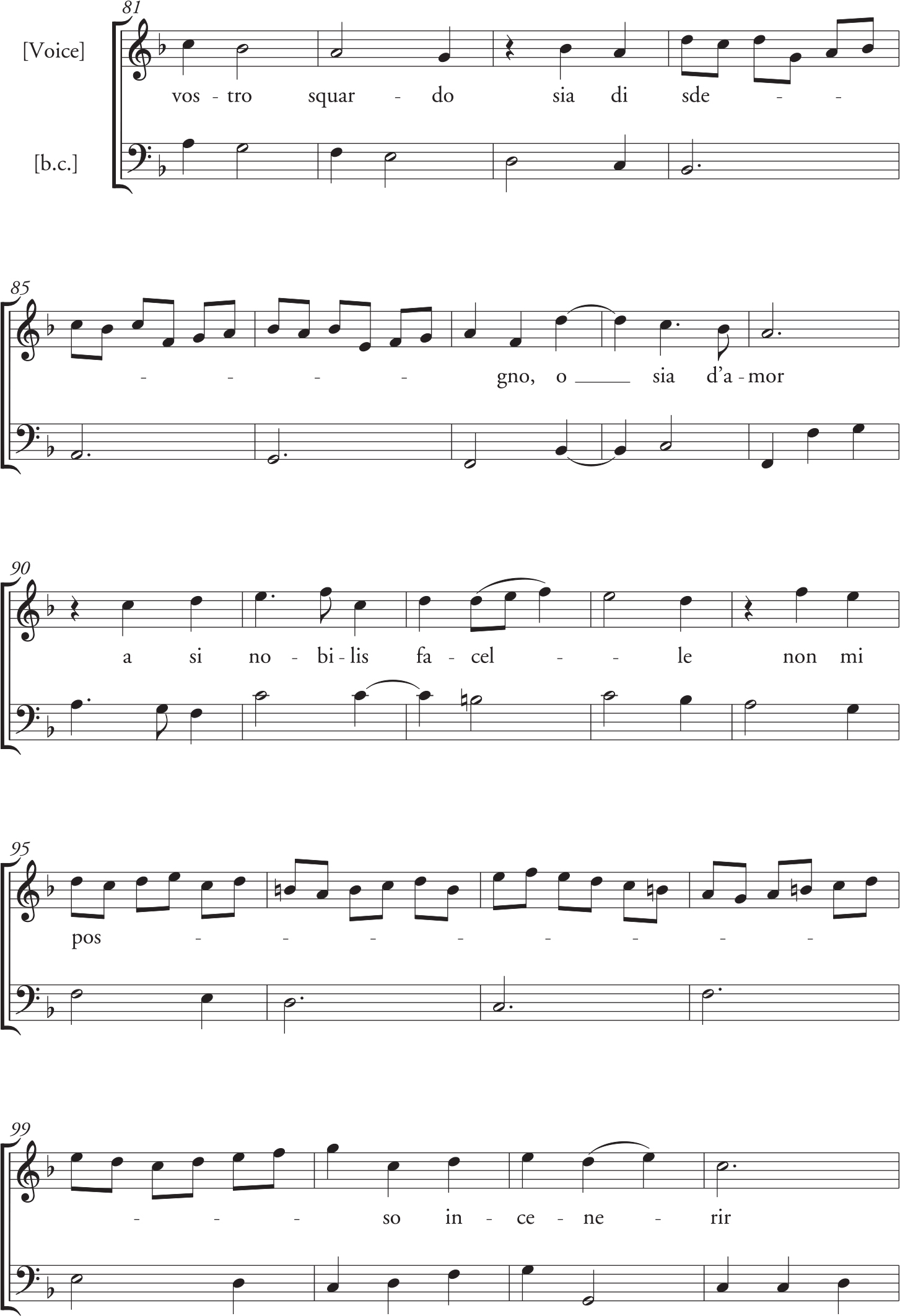
The repertoire preserved in the manuscript sources of Albrici's, Carissimi's and Rossi's music differs greatly from the north Italian repertoire common in England during the first half of the seventeenth century. Instead of the largely declamatory style of the stile nuovo composers such as Alessandro Grandi (1586–1630), Giovanni Rovetta (b. 1595–7, d. 1668) and Giovanni Felice Sances (c.1600–1679), the cantatas of Rossi and Carissimi are multi-sectional works mixing stile recitativo with lyrical arias, dialogues or trios, featuring long expressive melismas and bold dissonances. In Sciolto havean dall’ alte sponde, two trios of imitative counterpoint in C minor frame an allegory of two lovers on a tempestuous sea told in passionate recitatives and duets by two sopranos, and intermittently commented on in recitative by the bass (see Example 1). Similarly, nearly all the secular Italian works by Albrici preserved in English sources are multi-sectional cantatas, featuring sections in stile recitativo, melismatic arias with frequent leaps, high tessitura and varied rhythms paired with lively and more heavily figured bass lines than would have been common in 1660s England (see Examples 2–3).Footnote 105
‘Amante che dite’ (final trio from Carissimi's Sciolto havean dall’ alte sponde), bars 1–10. Edited from Oxford, Christ Church, Mus. 996.

Albrici's Vo cercando la speranza, bars 63–78. Edited from London, British Library, Harley MS 1501.

Albrici's ‘ Voglio amarvi luci’, bars 81–102. Edited from Oxford, Christ Church, Mus. 350.
This Roman-style repertoire would have been highly exclusive in England in 1664: I have argued elsewhere that the earliest English sources of Roman vocal music date from the late 1670s, and that the repertoire was not systematically copied in England before the 1680s.Footnote 106 Apart from a short visit by Rivani to the English court in the very early 1660s (see above, p. 339), no musicians familiar with the Roman repertoire are known to have visited England before Albrici.Footnote 107 Consequently, few English music-lovers who had not encountered Roman-style music abroad would have been familiar with Roman-style music before Albrici's arrival. This suggests that it was not only the performances of the Italian ensemble that were out of reach for ordinary Englishmen and women, but their repertoire as well.
The Italian ensemble thus appears to have been musically separate from the regular music establishments at court, performing different repertoire and sometimes on separate occasions. Material in the state papers of Charles II indicates that the ensemble was also kept structurally separate from the majority of court musicians. Bennet was the Italian musicians’ chief patron, and once they were established at court it was to Bennet that the ensemble directed most of their questions and concerns. When, in 1666, the Italian musicians petitioned the king to order a London banker to pay their wages quarterly on his behalf, they had already pleaded with Bennet (now Lord Arlington):
Wherefore, since my Lord Arlington has promised us that he will beg Your Majesty on our behalf in this matter, and make a London banker called [blank] give us satisfaction, we make this most humble request, so that Your Majesty may deign, with your innate clemency, to do us this favour.Footnote 108
Some years later, a letter signed by Leonora Albrici (who still did not speak English) again pleaded with Bennet to ensure the payment of her and Bartolomeo's wages:
My ignorance in the English tongue forceth me to relate in this paper unto your Lo:p the necessityes of my brother, & my owne; which is that after that, by your Lo:ps grace, we were againe received in the service of His Ma:tie we have allwayes been in our pay a quarter of a year behind the other Italian Musitians; although His Ma:ties Royall Bounty had severall times given order to the Privy Purse, that we should be paid as the others, and kept no more backward than the others: for all this we are allwayes a quarter behind the others, and we cannot receive it although many Persons of Honour of the Court has intreated for us at severall times with the said Privy Purse.Footnote 109
In addition to illustrating Bennet's patronage of the Italian musicians at court, Leonora's petition suggests that the Italian ensemble was paid from the king's private accounts, instead of the usual Treasury of the Chamber or the Exchequer of the Receipt. This suggests that the Italian ensemble unusually was under the jurisdiction of the secretary of state (at this time, Bennet) instead of the Lord Chamberlain (Edward Montagu, earl of Manchester).Footnote 110 Gascoigne left to Bennet and the king to decide the salary of a young castrato in June 1664, ‘as you sciould tinch that he deserve, after the King and you had heard him’;Footnote 111 this again suggests that Bennet was responsible for the Italian musicians once they arrived at the English court.
This structural separation from the regular court-music establishment probably served the ends of both Charles II and his Italian musicians: exclusive performances served the patron through enhancing his status and eliminating the risk of social imitators, while equally benefiting the social status of successful performers (especially singers). Gifted singers often enjoyed close access to their patron, and those with social ambitions frequently sought to establish themselves as courtiers rather than servants; they performed at the request of their patron or his closest representatives, but were cautious about accepting offers from others.Footnote 112 For instance, in 1687, Evelyn observed that Pepys's private concert with the famous Siface (Giovanni Francesco Grossi, 1653–97) was ‘obtained by peculiar favour & much difficulty of the Singer, who much disdained to shew his talent to any but Princes’.Footnote 113 By the 1680s, Pepys had gained significant influence in London society, but Siface was apparently reluctant to risk his reputation by performing in a less prestigious context than the court.
The relatively advantageous social position of hand-picked Italian musicians is again elucidated in Gascoigne's letters to Bennet. Planning to bring Rivani to England in September 1664, Gascoigne wrote:
For his pencion I tinch the Kingh can give to him, no lesse then 300 pound [per] annum; and make him serve as Page of the Bacch Steres, as the Emperor, and all other Princes have done, when he have bin att ther Court, and so the Cardinall Gian Carlo his old master, and that ist for havingh him ready, att any tyme, att their pleasure, and to satisfye this boyes ambition.Footnote 114
The letter shows that giving minor court positions to singers was a widespread practice, and that singers expected the same in England as elsewhere. In the early 1660s, the guitarist Corbetta had already been named Groom of the Privy Chamber to the queen and Page of the Back Stairs to the king.Footnote 115 Albrici had no reason to expect lesser treatment: in Dresden in 1662, the Elector Johann Georg II became the godfather of Albrici's infant son, indicating that the Albrici family, too, rubbed shoulders with the great and powerful.Footnote 116 When Gascoigne sought Bennet's protection on behalf of Albrici, he made it clear that Albrici expected to be placed at ‘your officers table’ and thus would not be treated like a servant.Footnote 117
Indeed, the respectful treatment of Leonora Albrici at a 1667 Royal Society concert – described by Pepys – further indicates the social status of the Albricis and the protection they enjoyed.Footnote 118 On recording the event, Pepys included a seemingly unusual request from Killigrew that the fellows refrain from kissing Leonora:
Seignor Vincentio, who is the maister Composer, and six more where of two Eunuches (so tall, that Sir T. Harvy said well that he believes they did grow large by being gelt, as our Oxen do) and one woman, very well dressed and handsome enough but would not be kissed, as Mr. Killigrew, who brought the company in, did acquaint us.Footnote 119
That Killigrew needed, and took the trouble, to tell the company to leave Leonora alone implies how performing women – a novelty in England since the Restoration – were otherwise treated.Footnote 120 Similarly, the fact that Pepys recorded Killigrew's warning implies that he thought it unusual. Leonora's position at court was apparently strong enough for her employers to ensure that she was treated with respect. Only appearing in private performances of chamber music, under the protection of the king and the secretary of state, probably helped protect Leonora's social status.
The Albricis and Italian opera in England?
I have argued above that Albrici and his associates were recruited between 1664 and 1666 as a chamber ensemble primarily to perform Roman motets and cantatas – such as Sciolto havean dall’ alte sponde – in a private context. This line of argument differs radically from the traditional assumption that the so-called Albrici troupe was recruited as an opera ensemble in a bid to introduce Italian opera into England. The notion of the Italian ensemble as an opera troupe was largely based on Mabbett linking Catherine of Braganza's organist Draghi to the ensemble through an entry in Pepys's diary on 12 February 1667. On this occasion, Pepys apparently witnessed the embryo of a joint operatic venture involving Draghi, Killigrew, Sir Robert Moray and Lord Brouncker. Pepys arrived at Brouncker's house, together with his host, to ‘hear some Italian musique’:
Here we met Tom Killigrew, Sir Rob Murray, and the Italian Seignor Baptista – who hath composed a play in Italian for the Opera which T. Killigrew doth intend to have up; and here did sing one of the acts. Himself is the poet as well as the Musician, which is very much[.]Footnote 121
Pepys's statement that Draghi had written both the music and the libretto of the opera led Mabbett to suggest that Draghi was ‘the poet’ (taken to mean librettist) of the Albricis’ proposal (above, p. 337), and that the Italian ensemble was an opera troupe brought in to fulfil Charles II's wish for an Italian opera house in England.Footnote 122 This assumption was later built on by Holman and Leech.Footnote 123
There is no evidence that Draghi was part of the king's Italian ensemble. The first known record of Draghi in England is Pepys's diary entry of 12 February 1667, by which time the ensemble had been active at court for nearly a year (see above, p. 338). In this entry, Pepys explicitly separates Draghi from the Italian ensemble; at the end of the passage describing his encounter with Draghi at Brouncker's, he wrote:
By hearing this man [Draghi] tonight, and I think Captain Cooke tomorrow and the Quire of Italians on Saturday, I shall be truly able to distinguish which of them pleases me truly best, which I do much desire to know and have good reason and fresh occasion of judging.Footnote 124
When attempting to decide which of the Italian or Italianate performers he preferred, Pepys pitted Draghi and the Italian ensemble against each other, suggesting that he did not perceive Draghi as a member of the group. Pepys also refers to Albrici as ‘Vincentio, who is one of the Italians the King hath here, and the chief composer of them’, but does not include Draghi among the king's Italians. Over a century later, John Hawkins included a lengthy entry on Draghi in his A General History of the Science and Practice of Music (1776), but omitted both Albrici and Sebenico.Footnote 125 This suggests both that Draghi and the Italian ensemble operated in largely different contexts and that evidence of the ensemble's activities was scarce even in the 1760s and 1770s, probably owing to the private nature of their performances.
The Italian ensemble at court was seemingly built up between summer 1664 and spring 1666, without court records mentioning Draghi. The first record of Draghi at court is as organist in the queen's Catholic chapel in 1677, although North claimed that Draghi replaced Sebenico as organist as early as 1673, when the Italian ensemble was disbanded.Footnote 126 In 1702, Draghi petitioned Queen Anne for the continuation of a pension granted him by William III as a reward for nearly 30 years’ service in the royal family. A Treasury minute book from 1702 summarizes the content of the petition:
That about 3 years since in consideracion of near 30 years service in the Royall Family, & of his being – Incapacitated by the Gout to provide for himself in the way of his Profession His late Maty was pleased to allow him 100 l. a year, of which he has yet not received but 100 l for one year thereof[.] Prays the Continuation the said Pencion for his support.Footnote 127
The queen was unimpressed, and it was simply noted that she had ‘always given him 50 l per annum’; but the minute suggests that Draghi was not appointed earlier than 1668. Since his employment by the royal family had been only for ‘near 30 years’, he may have been hired later. Thus, if a poet was ever engaged for the Italian ensemble, he is not likely to have been Draghi.
An opera troupe in residence would have been an unlikely thing in 1660, and one led by Albrici even less likely. With the exception of the north Italian itinerant Febiarmonici, fixed opera ensembles did not exist. Groups of musicians were hired for specific performances, as when Mazarin commissioned singers for his opera productions, but most singers soon moved on to other engagements. In Rosselli's words, ‘opera singer’ was not a profession in the mid-seventeenth century, because ‘operas were too few and far between to occupy most of anyone's time’.Footnote 128 The reputation of Albrici was built on sacred and chamber music; if Charles's intention was indeed to introduce Italian opera, why recruit a musician with no known experience of the genre? A large number of German-speaking courts had already employed talented Italian opera composers.Footnote 129 Gascoigne was ideally based in northern Italy, and his vast networks could easily have produced equally competent musicians. Yet opera is never mentioned in the Bennet–Gascoigne correspondence.
That the Italian ensemble was not an opera troupe does not mean that there was no interest in opera in Restoration England. Charles did give his father's art agent Giulio Gentileschi a patent to start an Italian opera in London in 1660, but the scheme came to nothing.Footnote 130 Charles enjoyed French opera, as is indicated by the performances of Robert Cambert's Ariadne (1674) and French-inspired court entertainments such as Calisto (1675). In addition to Killigrew's attempts, Nicholas Staggins and Blow petitioned the king for permission to create ‘an academy or opera of musick’,Footnote 131 and in February 1674, Evelyn reported having heard ‘an Italian Opera in musique, the first that had been in England of this kind’.Footnote 132 Nothing is known about this alleged opera, which perhaps was a one-off event staged by court musicians, but it does show that there was an awareness of opera in Restoration England. Travelled aristocrats such as Evelyn or Killigrew, who experienced opera at the Roman and Venetian carnivals, certainly contributed to this awareness.Footnote 133 However, the specialism of Albrici in church and chamber music, the exclusive nature of the Italian ensemble's performances at court, the lack of evidence of public appearances and the respectful treatment of Leonora (treatment otherwise denied to female performers) suggest that the Italian ensemble was never intended to appear in such public staged performances planned by Killigrew and his colleagues.
Conclusion
The activities of the king's ‘Italian Musick’ came to an end with the Test Act of 1673, which required all members of court to receive Anglican Communion and thus barred the Italians from their positions. Albrici had left in 1668; Cefalo received a pass to return to Italy in April 1673, and Sebenico followed him in July.Footnote 134 Battaglia and Bartolomeo Albrici transferred to the Catholic chapel, whose members were exempt from the Test Act. Bartolomeo remained in England for the rest of his life, making a living as a harpsichord teacher to Mary Evelyn, among others, and was still listed as a Gregorian in the Catholic chapel of James II in 1687.Footnote 135 Battaglia remained for over a decade after the disbandment of the Italian ensemble; Mabbett suggests that he married Leonora Albrici, and mentions that he was paid £300 from the Secret Service accounts for unspecified services in September 1677.Footnote 136 He returned to Neuburg in 1685, where he had served before joining the English court nearly 20 years earlier.Footnote 137
While Charles's ‘conventional’ (to use Annibaldi's term) patronage of large-scale music has been relatively well explored, the recruitment and function of the Italian ensemble begins to elucidate the king's humanistic musical patronage. This followed Continental, rather than specifically English, models: founded with the recruitment of Albrici by the diplomats Bennet and Gascoigne in the summer of 1664, the Italian ensemble mirrored Italian chamber music-making cultivated at the French court under the influence of Mazarin – drawing on the same repertoire and on musicians of similar training. Their performance style and rare chamber-music repertoire was doubtless intended to showcase the king's wit and artistic refinement, and the privacy of their performances ensured both the social status of the musicians and the exclusivity of Charles's musical patronage. In the first decade after his Restoration, Charles II engaged in the European competition for star musicians and musical recognition on similar levels and through similar means as did confirmed heavyweight patrons such as Louis XIV and Queen Christina.
North's jibe that Charles ‘could not bear any musick to which he could not keep the time’ has led scholars to comment that Charles's musical tastes were not above average.Footnote 138 Whatever his understanding of the actual music, Charles and his advisers were evidently sophisticated enough to understand the importance of following current European musical fashions in order to establish his credentials with the Continental ruling elite. With his Italian ensemble, Charles signalled a fondness for what was regarded as Catholic culture; his international background had equipped him with tastes suited to impress fellow monarchs, but which turned out to be too Continental to convince his subjects of his commitment to the Protestant faith.Footnote 139 Hired in imitation of rulers on the Continent, the ensemble was disbanded almost for the same reason. Charles's pro-Catholic court, his cultural imitation of absolutist Continental rulers and his dalliances with France raised fear of papism and arbitrary government in the English Parliament. It was in essence a clash of expectations: between the king's own notions of kingly behaviour and the religious and political sensibilities of Parliament.


 Open access

