Introduction
Sleep abnormalities are frequent in neurodegenerative diseases such as Alzheimer's disease (AD) and Parkinson's disease (PD) (Raggi and Ferri, Reference Raggi and Ferri2010). Sleep disturbances often impair quality of life (QoL) of these patients because of reduced daytime vigilance and altered circadian rhythms, and they can also contribute to the decision to institutionalize the patient (Pollak and Perlick, Reference Pollak and Perlick1991; Hope et al., Reference Hope1998; Gaugler et al., Reference Gaugler2000; Vitiello and Borson, Reference Vitiello and Borson2001; Harper et al., Reference Harper2004). As a consequence, night-time disturbances of patients can increase social and psychological load of caregivers, already burdened by the cognitive impairment and motor dysfunction of the care recipient, and could have severe implications on their quality of sleep (Bliwise et al., Reference Bliwise1995; Donaldson et al., Reference Donaldson, Tarrier and Burns1998; Vitiello and Borson, Reference Vitiello and Borson2001; McCurry et al., Reference McCurry2007; Neikrug et al., Reference Neikrug and Ancoli-Israel2010).
Despite this, knowledge about the night-time complaints of caregivers of patients with AD and PD is limited (Smith et al., Reference Smith, Ellgring and Oertel1997; Pal et al., Reference Pal2004; McKibbin et al., Reference McKibbin2005; Creese et al., Reference Creese2008).
Sleep disturbances in caregivers of patients with AD can result from several factors directly related to the disease such as nocturnal agitation and sundowning, insomnia, sleep-related movement disorders, obstructive sleep apnea, circadian rhythm disorders, and medications induced sleep impairment (Raggi and Ferri, Reference Raggi and Ferri2010). On the other hand, sleep in PD can be impaired by REM sleep behavior disorder, periodic limb movements in sleep, tremor, early morning dystonia, nocturnal akinesia, hallucinations, respiratory disturbances, psychiatric comorbidities, cognitive impairment, and by the effects of pharmacological treatments (Raggi and Ferri, Reference Raggi and Ferri2010), with severe reflections on caregivers’ quality of sleep. Moreover, physical and psychological strain, depression, age-related changes in sleep architecture and circadian rhythmicity, poor sleep hygiene practices, decay of daytime structured activities, and caregiver vigilance (a pattern of hyperalertness and physiological arousal at night) could also play a major role (McCurry et al., Reference McCurry2007). As a result, despite different degrees of severity across the few studies conducted so far, sleep disturbances are considered frequent in caregivers of patients with these two neurodegenerative diseases, ranging from 27% to more than 60% (Smith et al., Reference Smith, Ellgring and Oertel1997; Pal et al., Reference Pal2004; McKibbin et al., Reference McKibbin2005; Creese et al., Reference Creese2008). Furthermore, poor sleep quality has been more frequently reported in female caregivers, and it has been associated with nocturnal disruptions by the care recipient, burden of care, and depression (Smith et al., Reference Smith, Ellgring and Oertel1997; Pal et al., Reference Pal2004; McKibbin et al., Reference McKibbin2005; Creese et al., Reference Creese2008).
Notwithstanding the broad group of both common and specific potential sleep abnormalities, there are no studies aimed to compare sleep disturbances in caregivers of patients with various neurodegenerative conditions. Additionally, we lack information about the relationship between caregivers’ sleep problems and their QoL.
Therefore, we evaluated the frequency and key correlates of subjective sleep quality in a group of caregivers of patients with AD and PD to point out the key differences that could require specific assessment and treatment, and we investigated the relationship between self-reported poor sleep and QoL.
Methods
We consecutively recruited 40 patients with probable AD (McKhann et al., Reference McKhann1984), 40 patients with PD without dementia, and their primary caregiver during their routine visit to our Clinic between January 2009 and December 2009. Caregivers were spouses (90%), sons, or daughters of the patient. Paid caregivers were not included in the study. The control group was composed by 150 healthy subjects (56 women, 94 men; mean age: 66.7 ± 5.1), enrolled among the spouses or friends of patients attending the neurology department for acute vascular disorders, matched for age and sex to the caregivers’ group.
All patients were evaluated by an experienced neurologist using the following instruments: Mini-Mental State Examination (MMSE) (Folstein et al., Reference Folstein, Folstein and McHugh1975), Neuropsychiatric Inventory (NPI) (Cummings et al., Reference Cummings1994), and the Unified PD Rating Scale (UPDRS) motor scale (for PD patients only) (Fahn et al., Reference Fahn, Elton, Fahn, Marsden, Calne and Goldstein1987). Disease severity was defined by means of Clinical Dementia Rating (CDR) Scale for patients with AD (Morris, Reference Morris1993), and Hoehn and Yahr Scale for patients with PD (Hoehn and Yahr, Reference Hoehn and Yahr1967).
Sleep quality of caregivers and controls subjects was evaluated using the Pittsburgh Sleep Quality Index (PSQI) (Buysse et al., Reference Buysse1989). PSQI is a standardized questionnaire including 19 individual items regarding the quality of sleep patterns over the past month. It consists of seven components, namely, “subjective sleep quality,” “sleep latency,” “sleep duration,” “habitual sleep efficiency,” “sleep disturbances,” “use of sleep medication,” and “daytime dysfunction.” Each of the seven component scores is weighted equally on a scale of 0 (no difficulty) to 3 (severe difficulty). The seven component scores are then summed to yield a global PSQI score, ranging from 0 to 21, with a higher score indicating poorer sleep quality. A PSQI score >5 was taken to indicate poor sleep.
QoL of caregivers was assessed with the McGill Quality of Life Questionnaire (MQoL) (Cohen et al., Reference Cohen1995; Reference Cohen1996), a 16-item questionnaire, each rated from 0 (not at all) to 10 (extremely). MQoL includes five domains, three of which are health related (physical well-being, physical symptoms, psychological symptoms) and two non-health related (existential well-being, support). Moreover, the respondent is also asked to indicate her/his self-perceived QoL in the past two days in a single-item scale (MQoL-SIS), rated from 0 (very bad) to 10 (excellent).
Caregiver burden was assessed with the Caregiver Burden Inventory (CBI) (Novak and Guest, Reference Novak and Guest1989), a 24-item self-administered rating scale. Its scores ranged from 0 (lowest level) to 100 (highest level). CBI includes five domains of burden: time dependence, developmental, physical, social, and emotional.
Depressive symptoms were evaluated in caregivers using Beck Depression Inventory (BDI) (Beck et al., Reference Beck1961), a self-reported scale with 21 items, each rated from 0 to 3, obtaining a total score ranging from 0 to 63 (higher total scores indicate more severe depressive symptoms). A score >14 indicates a clinically significant number of self-reported depressive symptoms. The BDI score was also evaluated omitting the two sleep questions, to control for possible redundancy effect.
The study was approved by the institutional review board, and informed consent was obtained from all participants.
Statistical analyses were carried out using SPSS 10.0 (SPSS, Chicago, IL). The Mann-Whitney U test, Kruskal Wallis test, and Fisher's test were used as appropriate. Binary correlation was evaluated with Pearson's correlation. To investigate risk factors for impaired sleep quality in the caregiver populations, we divided caregivers in good sleepers (total PSQI score ≤5) and poor sleepers (total PSQI score >5). We then compared every two subgroups for clinical and demographic characteristics, and for sleep-related complaints using a univariate statistical analysis. Multiple logistic regression analysis was used to adjust for relevant covariates (including patient's age, caregiver's age and sex, duration of disease, disease severity, BDI, CBI total score, Tot-MQoL, and all MQoL domains) and to determine the independent correlates of poor sleep. Because of the multiple statistics, a p-value ≤0.01 (two-tailed) was considered significant. Cohen's estimate of effect size (ES) was used to quantify the magnitude of the differences between groups. As defined by Cohen, ESs of 0.2–0.5 were designated as “small,” of 0.5–0.8 as “medium,” and those above 0.8 as “large.”
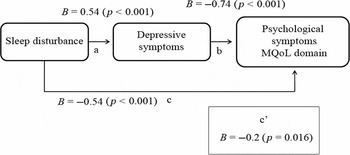
Finally, we developed a model of QoL (psychological symptoms MQoL domain), based on the results of our analyses. In particular, we hypothesized that sleep quality of caregivers could have both a direct and indirect effect on their QoL, and that these effects were mediated by depressive symptoms. We tested the above-mentioned model of QoL with the test of the mediating effect, which is an extension of the three regression equations proposed by Baron and Kenny (Baron and Kenny, Reference Baron and Kenny1986). In the first equation, the mediator (depressive symptoms) is regressed on the independent variable (sleep disturbance). In the second equation, the dependent variable (QoL) is regressed on the independent variable (sleep disturbance). Lastly, the dependent variable (QoL) is regressed on the mediator (depressive symptoms) and the independent variable (sleep disturbance). These three regression equations provide tests of linkages in the mediation model. If these conditions all hold as predicted, the effect of the independent variable on the dependent variable must be less in the third equation than in the second.
Results
Sample characteristics
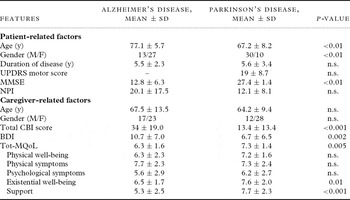
Main demographic and clinical features of patients and their caregivers are shown in Table 1. Patients with AD were slightly older than patients with PD and showed lower scores at the MMSE (the latter finding was expected, since we included only patients with PD without dementia). No differences between patients with AD and PD were observed for duration of disease and NPI scores. Caregivers of patients with AD (ADCG) reported higher burden, lower QoL (Tot-MQoL, existential well-being, and support domains), and higher BDI scores than caregivers of patients with PD (PDCG).
Clinical and demographic features of patients with AD and PD, and their caregivers

UPDRS = Unified Parkinson's Disease Rating Scale; MMSE = Mini-Mental State Examination; NPI = Neuropsychiatric Inventory; CBI = Caregiver Burden Inventory; BDI = Beck Depression Inventory; MQoL = McGill Quality of Life Questionnaire.
Evaluation of self-reported sleep quality
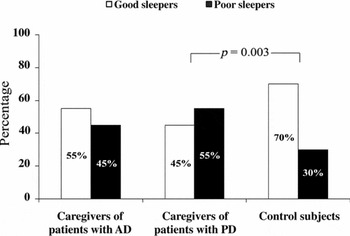
ADCG (18 subjects, 45%) and PDCG (22 subjects, 55%) were more frequently poor sleepers (global PSQI score >5) compared to controls (45 subjects, 30%), however, only the difference between PDCG and control subjects was statistically significant (p = 0.003) (Figure 1). Moreover, although the difference did not reach statistically significance, five ADCG (12.5%) and nine PDCG (22%) had a global PSQI score ≥10, indicating moderate to severe dysfunction, while in the control group, only 14 subjects (9.3%) had a global PSQI ≥10.
Prevalence of good sleepers and poor sleepers among caregivers of patients with AD and PD, and control subjects.

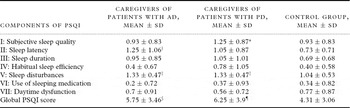
As shown in Table 2, the mean global PSQI score of ADCG (5.8 ± 3.5) was not significantly different from that of PDCG (6.25 ± 3.9; p = 0.67). However, both groups of caregivers showed significantly higher scores than control subjects (4.3 ± 3.1; p < 0.01). Among the reported night-time complaints, explored by means of the seven components of PSQI (PSQI component score >1), 38 (70%) ADCG reported reduced subjective sleep quality, 39 (72.5%) reported difficulties falling asleep (“sleep latency”), 37 (67.5%) reduced sleep duration, and 40 (100%) disturbed sleep, including patient's frequent awakenings, sundowning, and nocturnal wandering (25% of cases). Thirty-two (80%) PDCG complained of reduced subjective sleep quality and 40 (100%) of increased sleep disturbances. Among the causes of disrupted sleep, the most important and frequently reported was disruptive nocturnal behavior of the care recipient (35% of cases). Moreover, 25 (62.5%) PDGC reported increased sleep latency, and 27 (67.5%) reduced sleep duration. No significant differences were found in the seven components of PSQI between caregivers of the two neurodegenerative disorders (Table 2). Notwithstanding the poor sleep quality reported, only a minority of caregivers was using sleeping medications (12.5%). The use of antidepressants was equally low (7.5%). No patients were receiving non-pharmacological support for their sleep disturbance.
Components PSQI scores in caregivers of patients with AD and PD, and control subjects

PSQI = Pittsburgh Sleep Quality Index; AD = Alzheimer's disease; PD = Parkinson's disease.
*p = 0.004 (vs. control subjects; ES: 0.37); † p = 0.004 (vs. control subjects; ES: 0.58); ‡ p = 0.003 (vs. control subjects; ES: 0.58); § p = 0.009 (vs. control subjects; ES: 0.44); ¶ p = 0.003 (vs. control subjects; ES: 0.55).
Correlates of poor sleep quality in caregivers of patients with AD and PD
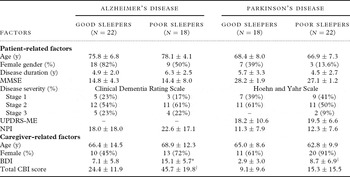
Table 3 shows the clinical and demographic characteristics of the two groups of caregivers with and without sleep complaints (global PSQI score >5). In the AD group, poor sleepers were significantly more heavily burdened than good sleepers (p < 0.001; ES: 1.09), and reported more depressive symptoms (p = 0.003; ES: 1.4). Also in the PD group, poor sleepers reported more depressive symptoms than good sleepers (p < 0.001; ES: 1.3). The association between poor sleep and depressive symptoms did not significantly changed when we evaluated the BDI score omitting the two sleep questions. No differences were found in both groups in the remaining variables examined, excluding QoL (see below).
Clinical and demographic characteristics of the caregivers of patients with AD and PD according to their reported sleep quality

MMSE = Mini-Mental State Examination; UPDRS = Unified Parkinson's Disease Rating Scale; NPI = Neuropsychiatric Inventory; BDI = Beck Depression Inventory; CBI = Caregiver Burden Inventory.
*p = 0.003; † p < 0.001.
Relationship between poor sleep quality and QoL
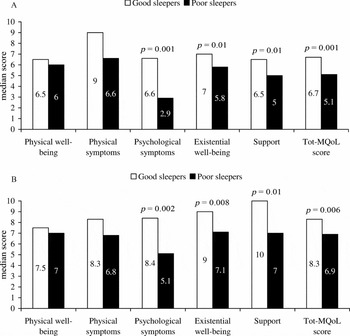
Compared to good sleepers, poor sleepers of both groups of caregivers reported lower scores both in Tot-MQoL and in all the MQoL domains, with the exception of the physical well-being and physical symptoms domains (Figure 2). Moreover, in the whole sample, as in the two groups of caregivers, quality of sleep was inversely related to Tot-MQoL (r = –0.44; p < 0.001), existential well-being (r = –0.38; p = 0.001), psychological symptoms (r = –0.54; p < 0.001), and support domains (r = –0.28; p = 0.01). Partial correlations between sleep quality and the psychological symptoms MQoL domain remained significant after controlling for age (r = –0.54; p < 0.001), sex (r = –0.49; p < 0.001), burden of care (r = –0.42; p < 0.001), and BDI score (r = –0.27; p = 0.01).
Differences in MQoL domains median scores between caregivers of patients with AD (A) and PD (B) with and without sleep complaints.

The mediating effect of depressive symptoms on sleep disturbance and QoL
A mediation analysis was conducted to verify the hypothesis that impaired sleep and depressive symptoms would intercorrelate with one another and would both correlate with QoL in both groups of caregivers. The results of mediation analysis, shown in Figure 3 and Table 4, support the hypothesized model for the psychological symptoms MQoL domain. According to the mediation analysis, when depressive symptoms are controlled, the strength of the association between the independent variable (sleep disturbance) and the dependent one (psychological symptoms MQoL domain) decreases, although remaining significant (B = –0.2; p = 0.016), indicating that depressive symptoms partially mediated the effects of sleep impairment on QoL.
Result of the mediation model.

Multiple regression analyses for testing the mediating role of depression

QoL = psychological symptoms MQoL domain.
Independent correlates of poor sleep
At multivariate analysis, after adjusting for relevant covariates, psychological symptoms MQoL domain (OR 0.67, 95% CI 0.55–0.82, p < 0.001) and depressive symptoms (OR 1.16, 95% CI 1.06–1.27, p = 0.001) were independently associated with poor sleep.
Discussion
In this observational study, we specifically investigated the subjective sleep quality and its contribution to QoL in a group of primary caregivers of patients with AD and PD (without dementia). Our study has documented high frequency of poor sleep quality in caregivers of patients with AD and PD, and it has shown that poor sleep and QoL are significantly associated in these populations after controlling for sociodemographic and clinical variables.
In the present study, nearly 50% of caregivers of patients with AD and PD reported poor sleep quality, and 12.5%–22.5% of caregivers rated their overall night-time problem as moderate or severe. Sleep disturbances appear to be the major night-time problem, frequently reflecting disruptive nocturnal behavior of the care recipient, but sleep-onset insomnia (difficulty falling asleep) and insufficient sleep quality were also frequently reported. Notwithstanding this, the use of sleeping medications was low, and no patients were receiving non-pharmacological support.
In the only other study that evaluated the night-time complaints of 20 caregivers of patients with PD, and implemented the PSQI as measure of sleep quality, Pal et al. reported that 40% of them were poor sleepers and the most frequently abnormal component sleep score was “sleep disturbances” (Pal et al., Reference Pal2004). On the other hand, to our knowledge, there are no published surveys on caregivers of patients with AD assessed with the PSQI, making it difficult for direct comparison of our study with earlier studies. Nevertheless, on the whole, our study confirms a high prevalence of poor sleep quality in caregivers of AD and PD patients, and it supports previous reports concerning correlation of sleep quality with burden of care (especially in caregivers of patients with AD) and depressive symptoms (Smith et al., Reference Smith, Ellgring and Oertel1997; Pal et al., Reference Pal2004; McKibbin et al., Reference McKibbin2005; Creese et al., Reference Creese2008).
Interestingly, no significant differences were observed in the night-time complaints reported by the two caregivers’ groups. Taking into account the intrinsic differences between the two disorders, purposely emphasized in this study, as we did not include PD patients having dementia, our findings suggest that neurodegenerative diseases, because of their impact on cognitive functions or motility of the care recipient, pose great physical and psychological strain on carers, and the interactions of these factors on sleep quality should be considered.
The major finding of this study is that the overall QoL indices, as well as satisfaction with many specific life domains, were correlated with quality of sleep scores: the poorer the sleep quality the poorer the perceived QoL. In line with this, poor sleepers of both groups of caregivers reported lower scores both in Tot-MQoL and in all the MQoL domains, with the exception of the physical well-being and physical symptoms domains. This association is congruent with data obtained in the general population and among patients with various medical conditions (Zammit et al., Reference Zammit1999; Zeitlhofer et al., Reference Zeitlhofer2000; Caap-Ahlgren and Dehlin, Reference Caap-Ahlgren and Dehlin2001; Leger et al., Reference Leger2001). Moreover, the difference between the two groups in the psychological symptoms MQoL domain remained significant after adjusting for age, sex, burden of care, and depressive symptoms, and in the multivariate analysis the same aspect of QoL was the most important independent factor associated with poor sleep. These data support the view that sleep quality may influence many aspects of QoL in caregivers of patients with AD and PD, and poor sleep should be considered as an independent negative contributor in the theoretical models of QoL (Kyle et al., Reference Kyle, Morgan and Espie2010).
There are many explanations for the association between poor sleep and QoL, but the most likely, according to our results, is a synergistic action of poor sleep with depressive symptoms. Indeed, although the group of caregivers of patients with AD reported more depressive symptoms than caregivers of patients with PD, when we examined the two groups according to their reported sleep quality, we found that poor sleepers showed significantly higher BDI scores than good sleepers in both groups, and depression has been shown to be an important determinant of QoL (Belle et al., Reference Belle2006; Martinez-Martin et al., Reference Martinez-Martin2008; McCabe et al., Reference McCabe, Firth and O'Connor2009; Välimäki et al., Reference Välimäki2009). Furthermore, depression is a leading cause of insomnia (Benca, Reference Benca2001), as well as an inherent co-existing symptom, and thus may substantially contribute to the association between sleep and QoL. On the other hand, impaired sleep is an important additional source of depression for many individuals, setting up a vicious, self-perpetuating cycle (Rosch, Reference Rosch1996). Taking these considerations together, we infer that there is a tight relationship between subjective sleep quality, depressive symptoms, and perceived QoL. Results of mediation analysis are in line with this hypothesis.
Our results also suggest that improving caregivers’ sleep could have positive impacts on their QoL. Hence, an appropriate pharmacological and/or non-pharmacological treatment approach, tailored to the underlying sleep disturbance, should be implemented. In this regard, non-pharmacological interventions, such as cognitive behavior therapy for insomnia, appear to be particularly effective (Morin, Reference Morin2004).
A limitation of the study is the lack of objective measures of sleep quality, such as actigraphy or polysomnography, to verify the accuracy of self-report data, but we think it is difficult to obtain these measures when examining large populations of subjects. Moreover, the tools used in this study are brief and easily administered, allowing a simple and straightforward implementation in everyday clinical practice. On the other hand, however, the PSQI is a general sleep quality measure with an uncertain relationship to accepted diagnostic categories (e.g. the International Classification of Sleep Disorders – II), so that in routine clinical practice other measures of sleep quality, such as the Insomnia Severity Index (Bastien et al., Reference Bastien, Vallières and Morin2001), should also be implemented.
Another limitation of the study is that sleep of the patients was not studied, so we could not assess whether sleep disturbance in the patients was a factor in sleep disturbance in the caregivers. However, since this aspect has been already investigated in previous studies (Pal et al., Reference Pal2004; McCurry et al., Reference McCurry2007), we concentrated the focus of our research on the relationship between sleep quality and QoL.
In conclusion, we found that among caregivers of patients with AD and PD, poor sleep is frequent and significantly linked to QoL and depressive symptoms. Identifying the nature of sleep disturbances not only in patients but also in their caregivers is important as appropriate treatment may lead to a better management of the needs of families coping with these patients.
Conflict of interest
None.
Description of authors’ roles
Dr. Chiara Cupidi contributed substantially to conception and design, analysis, and interpretation of data; was involved in critical revision of the paper for important intellectual content; and obtained final approval of the version to be published. Dr. Sabrina Realmuto contributed substantially toward acquisition, analysis, and interpretation of data; was involved in critical revision of the paper for important intellectual content; and obtained final approval of the version to be published. Prof. Gianluca Lo Coco contributed substantially toward analysis and interpretation of the data; was involved in critical revision of the paper for important intellectual content; and obtained final approval of the version to be published. Dr. Antonio Cinturino contributed substantially toward acquisition of data; was involved in critical revision of the paper for important intellectual content; and obtained final approval of the version to be published. Dr. Simona Talamanca contributed substantially toward acquisition of data; was involved in critical revision of the paper for important intellectual content; and obtained final approval of the version to be published. Dr. Valentina Arnao contributed substantially toward acquisition of data; was involved in critical revision of the paper for important intellectual content; and obtained final approval of the version to be published. Dr. Valentina Perini contributed substantially toward acquisition of data; was involved in critical revision of the paper for important intellectual content; and obtained final approval of the version to be published. Prof. Marco D'Amelio contributed substantially to conception and design, analysis, and interpretation of data; was involved in critical revision of the paper for important intellectual content; and obtained final approval of the version to be published. Prof. Giovanni Savettieri contributed substantially to conception and design, analysis, and interpretation of data; was involved in critical revision of the paper for important intellectual content; and obtained final approval of the version to be published. Dr. Daniele Lo Coco contributed substantially to conception and design, acquisition, analysis, and interpretation of data; prepared first draft of the paper; and obtained final approval of the version to be published.