Introduction
The rapid and recent development of systems for fish farming in cages has been associated with an increase in parasitic diseases (Nowak, Reference Nowak2007). In these systems, cages protect the cultivated fish against predators, but the free water flow could allow parasites to be transmitted from these systems to wild fish and cause serious environmental problems such as the decline of wild populations (Frazer, Reference Frazer2009). Another impact observed in areas used for cage farms is the attraction of piscivorous birds, such as cormorants including Phalacrocorax spp. Brisson, 1760 (Carss, Reference Carss1990, Reference Carss1993), fish (Ramos et al., Reference Ramos, Vidotto-Magnoni and Carvalho2008; Carvalho & Ramos, Reference Carvalho and Ramos2010; Ramos et al., Reference Ramos, Zanatta, Zica, Silva, Carvalho, Cyrino, Furuya, Ribeiro and Scorvo-Filho2010) and molluscs (Edgar et al., Reference Edgar, Macleod, Mawbey and Shields2005). Molluscs can act as intermediate hosts for trematodes of the family Diplostomidae Dubois, 1970 (Karvonen et al., Reference Karvonen, Savolainen, Seppälä and Valtonen2006).
The genus Austrodiplostomum Szidat & Nani, 1951 is known to have a complex life cycle that includes two intermediate hosts (molluscs and fish) and a definitive host (piscivorous birds). In Brazil, piscivorous birds Phalacrocorax olivaceus (Humboldt, 1805) and Phalacrocorax brasilianus (Gmelin, 1789) are parasitized by Austrodiplostomum compactum (Lutz, 1928) (Diplostomidae) (Machado et al., Reference Machado, Takemoto and Pavanelli2005; Noronha et al., Reference Noronha, Sá, Knoff, Muniz-Pereira and Pinto2009), and species of the genus Biomphalaria Preston, 1910 were recorded as intermediate hosts for this parasite (Ostrowski de Núñez, Reference Ostrowski de Núñez1982; Violante-González et al., Reference Violante-González, García-Varela, Rojas-Herrera and Guerrero2009). Thus, the increase in the numerical abundance of these definitive and intermediate hosts of A. compactum in areas used for fish farms can interfere with the transmission this parasite, affect the wild ichthyofauna and cause increased infections in Plagioscion squamosissimus.
Austrodiplostomum compactum metacercariae have been recorded in a wide variety of Brazilian fish, including the order Characifomes – ‘piranha’, Serrasalmus maculatus (Kner, 1858) (Characidae), ‘traíra’, Hoplias malabaricus (Bloch, 1794) (Erythrinidae), ‘campineiro’, Schizodon borellii (Boulenger, 1900) (Anostomidae) and ‘pacu-prata’, Metynnis maculatus (Kner, 1858) (Serrasalmidae); Siluriformes – ‘cascudos’, Hypostomus ancistroides (Ihering, 1911), Hypostomus hermanni (Ihering, 1905), Hypostomus iheringii (Regan,1908), Hypostomus margaritifer (Regan, 1908), Hypostomus regani (Ihering, 1905), Hypostomus strigaticeps (Regan, 1908), ‘cascudo-abacaxi’, Megalancistrus parananus (Peters, 1881) (Loricariidae) and ‘bagre’, Auchenipterus osteomystax (Miranda-Ribeiro, 1918) (Auchenipteridae); and Perciformes – ‘tucunarés’, Cichla ocellaris Block & Schneider, 1801, Cichla monoculus Spix & Agassiz, 1831, ‘joaninha’, Crenicichla britskii Kullander, 1982, ‘carás’, Cichlasoma paranaense Kullander, 1983, Geophagus brasiliensis (Quoy & Gaimard, 1824), ‘porquinho’, Geophagus proximus Castelnau, 1855, ‘caroço-de-manga’, Satanoperca pappaterra (Heckel, 1840) (Cichlidae) and ‘corvina’, Plagioscion squamosissimus (Heckel, 1840) (Sciaenidae) (Machado et al., Reference Machado, Takemoto and Pavanelli2005; Novaes et al., Reference Novaes, Ramos, Carvalho and Silva2006; Yamada et al., Reference Yamada, Moreira, Ceschini, Takemoto and Pavanelli2008; Paes et al., Reference Paes, Carvalho and Silva2009a, Reference Paes, Carvalho and Silvab; Zica et al., Reference Zica, Santos, Ramos, Zanatta, Carvalho and Silva2009, Reference Zica, Wunderlich, Ramos and Silva2010, Reference Zica, Brandão, Zawadzki, Nobile, Carvalho and Silva2011), demonstrating that this form of the parasite has a low specificity with regard to the second intermediate host (fish).
Plagioscion squamosissimus, the most important non-native species in artisanal fishing in the southeast region of Brazil (Torloni et al., Reference Torloni, Santos, Carvalho and Corrêa1993; Agostinho et al., Reference Agostinho, Vazzoler, Thomaz, Tundisi, Bicudo and Matsumura-Tundisi1995), presents high rates of infection with A. compactum metacercariae (Paes et al., Reference Paes, Carvalho and Silva2009a) and is therefore susceptible to this parasite. Thus, the aim of this study was to evaluate the influence of cage farming on A. compactum metacercariae infections in P. squamosissimus specimens caught in an area close to the fish farm and an area that is not affected by the fish farm.
Material and methods
Collection and examination of fish
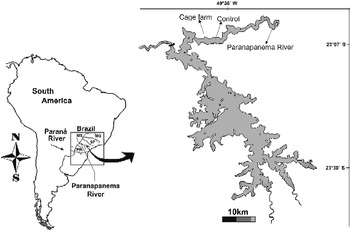
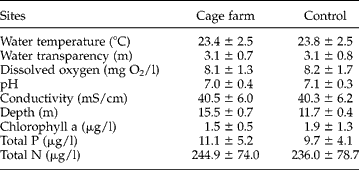
This study was conducted on a cage fish farm consisting of approximately 200 cages each with a volume of 6 m3 (cage farm area, 23°07’37”S, 49°30.71’37.31”W) and in a similar physiographic location that was not influenced by the fish farm (control area, 23°07’36”S, 49°59.23’10”W). Both study areas were located in the Chavantes reservoir (medium Paranapanema River) in the municipality of Ipaussu, São Paulo State, Brazil (fig. 1, table 1).
Map of the hydrographical network to show the Chavantes reservoir and sampling sites in the Paranapanema River, municipality of Ipaussu, São Paulo State, Brazil.

Physical and chemical characteristics (mean and standard error) of the sampling sites in the Chavantes Reservoir, from Carvalho et al. (Reference Carvalho, Silva, Ramos, Paes, Zanatta, Brandão, Zica, Nobile, Acosta, David, Carvalho, David-Silva and Silva2012).

Samples of the fish species P. squamosissimus were collected monthly from March of 2009 to February of 2010 using gillnets (meshes: 3–14 cm between adjacent nodes). In the cage farm area (CF), specimens were collected close to the demarcation buoys of the farm, approximately 2 m from the first groups of cages. The control area (CT) was located approximately 3 km upstream of the fish farm studied.
Sixty-five fish specimens, 37 from the cage farm area and 28 from the control area, were collected, frozen and transported to the laboratory, where specimens were weighed (total weight in grams of the fish with viscera) and measured (standard length in centimetres measured from tip of the snout to the last vertebra), and their eyes were removed and examined with the aid of a stereomicroscope. Metacercariae were collected from the vitreous humour, fixed in AFA solution (70% alcohol, formaldehyde and acetic acid) under a cover slip and preserved in 70% alcohol (Eiras et al., Reference Eiras, Takemoto and Pavanelli2006). Metacercariae were stained with carmine and cleared with eugenol for identification. Morphological analyses were carried out with the aid of a computerized system for image analysis (Qwin Lite 3.2, Leica Microsystems, Wetzlar, Germany).
Data analysis
The prevalence, mean intensity of infection and mean abundance were calculated according to Bush et al. (Reference Bush, Lafferty, Lotz and Shostak1997), and the condition factor (K= (Wt/Lsb)*100), in which Wt = total weight (g) and Ls = standard length (in mm), was calculated according to Vazzoler (Reference Vazzoler1996). The exponent b was derived from the length–weight relationship (Le Cren, Reference Le Cren1951) calculated from all of the grouped fish.
The prevalences in the cage farm area and control area were compared using the Z-test, and the mean intensity of infection and mean abundance were compared using the Mann–Whitney test (U-test). To evaluate the possible correlation between the total weight, standard length and condition factor of collected specimens and the mean abundance, the Spearman correlation test was used, both separated by area and for all fish collected, regardless of the sampling area. In addition, to investigate the possible effect of fish length on the abundance of A. compactum metacercariae, the mean length of fish from the control and cage farm areas were equalized by removing the smallest fish from the control group and the largest fish from cage farm. Then fish from the control area (n= 19) and the cage farm area (n= 14) were compared using the Mann–Whitney test (U-test). The significance level used was P< 0.05. All statistical tests were conducted using the SigmaStat 3.1 software (Systat Software Inc., California, USA).
Parasite and host voucher specimens were deposited in the Coleção Helmintológica do Departamento de Parasitologia (CHIBB 6963) and Coleção do Laboratório de Biologia e Genética de Peixes (LBP 9192), respectively, in the Instituto de Biociências, Universidade Estadual Paulista, municipality of Botucatu, São Paulo State, Brazil.
Results
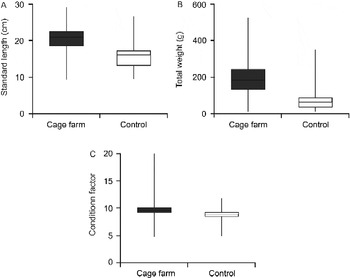
Thirty-seven fish from the cage farming area with an average standard length of 20.83 ± 0.64 (9.2–28.9) cm and an average total weight of 206.23 ± 18.55 (12.4–519.0) g, and 28 fish from the control area with an average standard length of 15.62 ± 0.69 (9.4–26.6) cm and an average total weight of 77.56 ± 13.57 (12.6–355.9) g were examined. The standard length, total weight and condition factor of P. squamosissimus specimens collected in the cage farming area were greater than those found for specimens from the control area (fig. 2A–C).
A comparison of (A) standard length, (B) total body weight and (C) condition factor of Plagioscion squamosissimus from the cage farm and control areas (P < 0.001; P < 0.001 and P= 0.001, respectively).

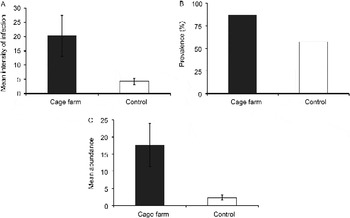
Six hundred and fifty (1–170 per host) parasites were collected in P. squamosissimus specimens from the fish farm area, and 73 (1–20 per host) were collected in specimens from the control area. The prevalence (CF = 86.4%, CT = 57.1%), mean intensity of infection (CF = 20.31 ± 1.13, CT = 4.29 ± 7.14) and mean abundance (CF = 17.70 ± 6.27, CT = 2.35 ± 0.77) were higher for fish obtained from the cage farm area than for fish from the control area (P < 0.05) (fig. 3A–C). By comparing the mean abundance of A. compactum metacercariae between the homogenized groups (control area: n= 19, mean fish length = 17.42 ± 2.88; cage farm area: n= 14, mean fish length = 17.24 ± 2.54; P= 0.074), we also observed a higher mean abundance (P= 0.026) in fish from the cage farm area (28.21 ± 11.30) in comparison with the fish from the control area (3.16 ± 1.11).
A comparison of (A) the prevalence, (B) mean intensity of infection and C) mean abundance of Austrodiplostomum compactum metacercariae in Plagioscion squamosissimus from the cage farm and control areas (P= 0.039; P= 0.019 / Z = 2.340 and P= 0.002, respectively).

No significant correlations were observed (P > 0.05) between the mean abundance and standard length, total weight and condition factor for hosts from cage farming and control areas, or for all specimens grouped independently of the sampling area.
Discussion
The life cycle of diplostomid parasites is completed in the small intestine of piscivorous birds (Karvonen et al., Reference Karvonen, Savolainen, Seppälä and Valtonen2006). Biomphalaria spp. act as the first intermediate hosts (Ostrowski de Núñez, Reference Ostrowski de Núñez1977, Reference Ostrowski de Núñez1982; Violante-González et al., Reference Violante-González, García-Varela, Rojas-Herrera and Guerrero2009), and fish serve as second intermediate hosts (Karvonen et al., Reference Karvonen, Savolainen, Seppälä and Valtonen2006). Several species of Biomphalaria have been registered in São Paulo State (Corrêa et al., Reference Corrêa, Murgel, Piza, Ramos, Morais and Rosário1970), and Biomphalaria straminea (Dunker, 1848) and Biomphalaria gabrata (Say, 1818) have been recorded in the drainage basin of the Paranapanema River (Corrêa et al., Reference Corrêa, Murgel, Piza, Ramos, Morais and Rosário1970; Teles & Vaz, Reference Teles and Vaz1987). In addition, Oliveira & Krau (Reference Oliveira and Krau1970), Barbosa (Reference Barbosa1983) and Callisto et al. (Reference Callisto, Moreno, Gonçalves, Ferreira and Gomes2005) reported a positive association between Biomphalaria molluscs and environments rich in organic matter.
Our results showed a significant increase in the rate of infection of A. compactum metacercariae in eyes of P. squamosissimus at sites used for cage farming. The possible causes of this increase may be related to the organic enrichment of the sediment and water. Areas close to fish farms receive much of the generated effluent (fish faeces and unconsumed rations) that is then deposited in the sediment and water column (Beveridge, Reference Beveridge2004) or is consumed by omnivorous fish species (Ramos et al., Reference Ramos, Vidotto-Magnoni and Carvalho2008, Reference Ramos, Zanatta, Zica, Silva, Carvalho, Cyrino, Furuya, Ribeiro and Scorvo-Filho2010). Thus, this organic enrichment could change the local abundance of molluscs (Edgar et al., Reference Edgar, Macleod, Mawbey and Shields2005) and fish (Carvalho et al., Reference Carvalho, Silva, Ramos, Paes, Zanatta, Brandão, Zica, Nobile, Acosta, David, Carvalho, David-Silva and Silva2012) in these areas. Additionally, the high availability of fish that are either cultivated or local species in these areas acts as an attractive factor to piscivorous birds such as P. brasilianus and P. olivaceus (Carss, Reference Carss1990, Reference Carss1993; Flowers et al., Reference Flowers, Poore, Mullen and Levy2004). Together, the increased numbers of molluscs, fish and piscivorous birds, all of which are hosts involved in the life cycle of A. compactum, could lead to increased transmission of A. compactum to definitive and intermediate hosts.
Results showed that P. squamosissimus specimens in the fish farm area were infected with up to 170 metacercariae, but in the control area fish harboured fewer than 20 metacercariae per host. According to Eiras (1994), the presence of A. compactum metacercariae can cause loss of vision and blindness in fish with high rates of infection, making them more susceptible to predation (Seppälä et al., Reference Seppälä, Karvonen and Valtonen2004) and facilitating the transmission of the parasite to definitive hosts. According to Karvonen et al. (Reference Karvonen, Kirsi, Hudson and Valtonen2004), a single snail can release up to 10,000 cercariae per day. Thus, it can be inferred that the increased abundance of intermediate hosts (molluscs and fish) due to the cage farm and a higher possibility of predation by piscivorous birds leads to an increase in the number of eggs and cercariae dispersed into the environment. Consequently, chances of infection by A. compactum metacercariae are increased in P. squamosissimus, explaining the higher infection levels observed in the cage farming area.
Despite the high rates of infection with A. compactum metacercariae, analyses relating the mean abundance to the condition factor, standard length or total weight did not present significant values. These results show that, unlike other studies conducted by Paes et al. (Reference Paes, Carvalho and Silva2009a), there is no direct relationship between the host biometry and the number of metacercariae in the eyes. Comparisons between population variables such as the standard length, total weight and condition factor of P. squamosissimus between the cage farming area and the control area showed that the high mean abundance of A. compactum metacercariae in the cage farming area did not affect the well-being of these individuals.
Species of the genus Austrodiplostomum, including adults and metacercariae, can infect approximately 125 host species from different animal groups (Eiras, 1994; Niewiadomska, Reference Niewiadomska1996). Thus, the increase in metacercariae in areas used for cage farming as a result of the increased numbers of their intermediate and definitive hosts, together with the low host specificity of this parasite (Yamada et al., Reference Yamada, Moreira, Ceschini, Takemoto and Pavanelli2008), may increase the possibility of infection in other fish species. Therefore, we suggest that the presence of cage farming influences the infection of P. squamosissimus with metacarcariae of A. compactum due to an increased abundance of intermediate and definitive hosts that are attracted by the availability of food resources generated by fish farms.
Acknowledgements
The authors are grateful to the Botucatu Bioscience Institute (IBB) and Aquaculture Center – São Paulo State University (CAUNESP) for the use of laboratory facilities and logistics. This work, which complies with current Brazilian laws, was supported by FINEP (Financiadora de Estudos e Pesquisas - process number: 3626/05) and by FAPESP (Fundação de Amparo a Pesquisa do Estado de São Paulo - process number 2008/58792-1).