I originally began researching this essay to address a disarmingly simple question: why do many Cambodians dislike the Vietnamese so much? A common representation of this animosity, which may date from the early 1800s, is the story of the cooking pot. In this tale, the Vietnamese are said to have buried three Khmer up to their necks to make a tripod, lit a fire between them, and placed a pot on their heads to boil water for tea (Khmers Kampuchea Krom Federation 2009, 41). What better indication could one have of Vietnamese barbarism? A 1970 poster adds a religious slant, depicting the earth goddess Nang Thorani destroying Vietnamese troops by wringing out her hair and drowning them (Harris Reference Harris2005, 57). Antipathy peaked under the Khmer Rouge, when being Vietnamese—or having a “Khmer body, Vietnamese mind”—could get one killed. Such ethnic antagonism has persisted into the present.
This essay decenters the usual approaches to Khmer-Vietnamese ethnic relations. First, it goes outside of what is now Cambodia to examine the contest for the lower Mekong Delta (in today's Vietnam) from the mid-1700s to the 1860s. This contest has shaped ethnic relations as well as Cambodian and Vietnamese views on sovereignty.
Second, it argues that the creation of a new “superspace” of French Indochina (1887–1945) preempted conflicts over sovereignty and territory from breaking out. This large entity, which joined all five pays (countries) of Tonkin, Annam, Cochinchina, Laos, and Cambodia, was a non-national space with ambiguous borders. It offered some protection for Khmer, in that French rule prevented Vietnamese from encroaching on Cambodian sovereignty. In this superspace, a wide variety of imagined and actual communities could coexist without entering into conflict over actual territory. It follows from the above that this essay rejects treating the boundaries of the current nation-states of Cambodia and Vietnam as “natural” frames of reference.
Third, this historical background explains the ethnic antagonism that lingered until 1945, but cannot sufficiently explain the ethnic violence that occurred later. For that, the First Indochina War (1945–54) and decolonization were foundational. Amidst economic and political insecurity, the superspace of French Indochina, which had contained the conflicting aspirations of Vietnamese, Cambodians, Lao, and others, crumbled. This collapse allowed a welter of groups, from gangsters to well-organized political movements, to seize local power. But given the numbers of groups, and the chaotic political situation, it was not clear who would ultimately win, where the boundaries of new polities would be, or whether Cambodians would continue to be marginalized in a society dominated by Vietnamese.
As the superspace of French Indochina fell apart from 1945 onwards, unresolved historical issues lingered. Cambodia's claim to enclaves in Vietnamese-dominated Cochinchina reemerged as a contentious issue. A three-cornered contest then developed among French, Khmer, and Vietnamese. Would Khmer ally with the French against the Vietnamese, or with the Vietnamese to kick out the French? Alternatively, would the Việt Minh convince Cambodians that their best interests would be served by joining a trans-ethnic communist movement? In 1945, no one knew, and the twists and turns of the next four years testify to the constant renegotiation of political alliances.
When France ceded Cochinchina to the new state of Vietnam in 1949, it attempted to resolve a territorial dispute in favor of the Vietnamese. This botched “resolution” has inflamed Khmer-Vietnamese relations up to the present. Understanding this history sheds light on the genesis of one of the great tragedies of the twentieth century, the death of 1.7 million inhabitants of Cambodia under Khmer Rouge rule. Khmer Rouge racism did not come out of nowhere. It was nurtured by stories of Vietnamese imperialism over Khmer lands, shaped by the turmoil of the First and Second Indochina Wars, affected by the propaganda and policies of leaders as diverse as Vietnam's Ngô Đình Diệm and Cambodia's Sihanouk and Lon Nol, and reached its peak under Pol Pot's rule.
Cambodian animosity to the Vietnamese is often presented as a constant of Vietnamese-Cambodian interactions since the seventeenth century, and an anti-Vietnamese strain has influenced some foreign scholarship on Cambodia (e.g., Martin Reference Martin1994, 5–44). Relations between Vietnamese and Khmer, however, have ranged from friendly to hostile. Antipathy has ebbed and flowed. This essay, nonetheless, does not focus on debunking primordialist arguments that shape popular discussions of Vietnamese-Khmer relations. While nationalists often deploy primordialist arguments, primordialism has largely been discredited in the study of nationalism and ethnicity. “We are all constructivists now,” the sociologist Rogers Brubaker has commented, putting forth a view largely shared by historians and political scientists (Brubaker Reference Brubaker2009, 28; Fearon and Laitin Reference Fearon and Laitin.2003; Suny Reference Suny2001, 865). The issue at hand is not whether identity and ethnic relations are constructed, but how.
Creating Ethnicity: Khmer and Vietnamese in the Lower Mekong Delta
Bluntly speaking, we should avoid the assumption that ethnicity is an immutable and historically useful category of analysis. In making sense of Vietnamese encounters with the Khmer, I have found David Howell's arguments over shifting historical identities in Japan to be particularly suggestive. Howell notes that “ethnicity” is a term that is absent from premodern Japanese understandings of identity. Instead, he identifies three “geographies of identity”—those of polity, status, and civilization—through which the Japanese rulers drew territorial and symbolic boundaries in premodern Japan (Howell Reference Howell2005, 1–19). These “geographies” were also institutions: even as they were superseded, they “prepared the way for the adoption of the structures and technologies of the modern nation-state” (3).
Vietnam had similar institutions. By the eighteenth and nineteenth centuries, it too tried to incorporate its periphery and subject peoples through a territorializing polity, particular status hierarchies, and “civilizing” practices. Arguably, as in Japan, the concept of ethnicity did not exist in Vietnam or in precolonial Southeast Asia. Hjorleifur Jonsson proposes that in precolonial Southeast Asia, “ethnic identity was analogous to rank in the pervasive tributary systems of the time” (Jonsson Reference Jonsson2005, 9). When the French arrived in Indochina, they abandoned the old tributary relations and adopted new understandings of territory, hierarchical relations, and the civilizing process. They recast tributary relations with small groups as relations with ethnic groups. We can see this as the “ethnicization” of the Khmer of the delta as well as of the Vietnamese.
The entire zone from Phnom Penh down to the lower Mekong Delta was a multiethnic zone of contact. Vietnamese control over small parts of the lower Mekong Delta in particular dated from the eighteenth century. This remote area was far from the core of the Cambodian or Vietnamese polities. Filled with marshes, crisscrossed with rivers (and, eventually, canals), it straddled land and sea. The Mekong Delta was a place in between the port-, coastal-, and sea-oriented “water frontier” and “littoral society” discussed elsewhere by Li Tana (Reference Tana, Cooke and Tana2004) and Charles Wheeler (Reference Wheeler2006) and the plains-oriented empires discussed by Winichakul and others (e.g., Winichakul Reference Winichakul1994). With limited state capacity, land-based empires struggled to gain access to this area. It was a wet, lowlands version of the highlands “Zomia” discussed by Willem van Schendel (Reference van Schendel, Kratoska, Raben and Nordholt2005) and James Scott (Reference Scott2009).
By the end of the seventeenth century, a new political actor entered the Mekong Delta: the Vietnamese Nguyễn lords. The Nguyễn had expanded southwards to Cambodian Prey Nokor (Saigon), and in the eighteenth and nineteenth centuries pushed further south and west into the “Water Frontier” of the Mekong Delta. Nguyễn rulers moved into lands that had traditionally been claimed by the Cambodian monarchy and that were lightly populated by Khmers.
Modern Vietnamese accounts emphasize the significance of 1757, when Cambodia supposedly gave up sovereignty over the Mekong Delta. As one work states, “from 1757, the entire region from Đồng Nai to Hà Tiên formed part of Vietnam's national territory and [this] was recorded clearly on our administrative maps. The border between our country and Cambodia [Chenla] had been demarcated clearly” (Phan et al. 1998, 70). Right after this unambiguous statement of Vietnamese sovereignty, the authors state that the Cambodia-Vietnam border was not definitively fixed until 1847, and that some Vietnamese claims (e.g., over Hà Tiên on the Gulf of Siam or over areas settled by Khmer) had been temporarily reversed (71–72). In short, 1757 was not the turning point Vietnamese historians often assume. Cambodians contested Vietnamese rule over parts of the delta well into the nineteenth century. Some still contest this view today.
Vietnamese legitimate their claims by stating that Cambodian monarchs “ceded” territory in the Mekong Delta. In 1904, however, Étienne Aymonier argued that the cession of Preah Trapeang (Trà Vinh) and Basak (Sóc Trăng) in the mid-eighteenth century, carried out by a contender to the Cambodian throne during an internal Cambodian struggle for power, was virtually forced upon the Cambodians: “the term cession poorly characterizes these incessant [Vietnamese] encroachments, which did not ratify any formal act” (Aymonier Reference Aymonier1904, 787, 788). It is perhaps most accurate to state that in 1757, a Cambodian contender to the Cambodian throne traded away rights to govern peripheral territories and peoples that he did not control, and that Vietnamese barely had settled, so that he could gain Vietnamese support and seize power at the center of his future realm. Aymonier adds that immediately after 1758, while most Khmer of the lower Mekong Delta were theoretically subject to Vietnamese rule, “the Khmer still occupied the interior of these vast territories, apparently retained their national leaders, recognized the authority of their own kings, but did not have to submit any less to the influence and power of the Annamite mandarins” (788).
Limited space precludes a discussion of the extensive evidence, in Vietnamese chronicles, of Khmer resistance to the Vietnamese as well as de facto Khmer self-rule or autonomy in the Mekong Delta (see Choi 2004, 33; Quốc Sử Quán Triều Nguyễn 1998,13, 312–36). Emperor Minh Mạng's rule (1820–41), however, marked a turning point in Vietnamese-Khmer relations. Minh Mạng pursued a far more aggressive policy towards Cambodia and the Khmer than his predecessors (Choi 2004, 129). His actions provoked Khmer animosity and resistance. Some Khmer joined Vietnamese in the Lê Văn Khôi rebellion in southern Vietnam from 1833 to 1835 in order to preserve southern autonomy against the centralizing Nguyễn state.
From the 1820s onwards, the Nguyễn monarchy believed that the Khmer could eventually become loyal subjects by adopting the names, language, clothing, and civilizational practices of the Vietnamese. To Vietnamese rulers, the different customs and beliefs of the Khmer were not a barrier to eventual assimilation (“Trấn Tây phong thổ ký” [1838] Reference Tana2007, 148–57). To borrow David Howell's formulation for Tokugawa attempts to make the Ainu Japanese, the Nguyễn rulers “were more concerned with exteriority – the visible compliance with norms – than with the internalization of the principles behind these norms” (Howell Reference Howell2005, 16). Simply put, since the Nguyễn state did not have the institutional capacity to transform inner beliefs rapidly, it focused on the outer signs of acquiescence to Nguyễn rule. This was not a modern understanding of ethnicity, which combines concerns with interiority (beliefs) with exteriority (public rituals and other outward markers of difference perceived to be essential).
The Nguyễn dynasty, however, did not stop at “assimilation lite.” Of pivotal significance was Vietnam's occupation of eastern Cambodia under Emperor Minh Mạng from 1835 to 1841. Cambodians deeply resented this occupation. In late 1840, faced with what they perceived to be a threat to their continuing existence as a country, Cambodians rose up in widespread rebellion. The French missionary Miche wrote in that year that “civil war is ravaging Cochinchina, and Annamite Cambodia is in flames” (Annales 1842, 148–49, see also Chandler Reference Chandler1973). Khmer living in Hà Tiên, An Giang, Kiên Giang, Sóc Trăng, Trà Vinh, and Vĩnh Long all participated in this revolt, which dragged on into 1843 (Quốc Sử Quán Triều Nguyễn 1998, 312–36). In 1846, Siam and Vietnam signed a treaty that put the Cambodian king Ang Duong back on his throne. Pressured by Siam, the Nguyễn dynasty finally withdrew from its “protectorate” in eastern Cambodia. Vietnam retrenched in order to consolidate its hold on the lower Mekong Delta.
When the French invaded Vietnam in 1858, their actions catalyzed “long-simmering tensions.” Cham and Khmer rose up the next year in An Giang Province, and by the end of 1859, the uprising “was spreading out of control” (Ramsay Reference Ramsay2008, 151). In 1860, a Vietnamese chronicle records that Cambodian troops invaded An Giang and Hà Tiên (Quốc Sử Quán Triều Nguyễn 1998, 423). Under relentless pressure, the Nguyễn court formally ceded three provinces of southern Vietnam to France in 1862, followed by the three westernmost ones in 1867. This complicated history drives home the simple point that Khmer, whether in Cambodia or in the lower Mekong Delta, were still challenging Vietnamese claims to the delta in the 1860s.
The arrival of the French, however, radically transformed the contest. The French declared Cochinchina a directly ruled colony, and the Nguyễn dynasty signed a treaty ceding this region to France. All Vietnamese sovereignty claims over the area were rendered null and void. In contrast, France declared Cambodia a protectorate in 1863. In theory if not in fact, France accepted the Cambodian monarchy's claim to sovereignty over Cambodia proper. Left unsettled until 1949 was the resolution of Cambodian sovereignty claims over parts of the lower Mekong Delta.
France soon created a new entity—French Indochina—to incorporate its Lao, Vietnamese, and Cambodian possessions. In his path-breaking Vietnam or Indochina, Goscha (Reference Goscha1995) has articulated a contest between two resulting visions of space: the “Vietnamese” and the “Indochinese.” Left mostly undiscussed in his work are other conceptions of space, such as those of the Lao, the Cambodians, or the highland minorities. French Indochina became a non-national “superspace” within which multiple conceptions of space, at local, regional, and Indochinese scales of analysis, could comingle and be accommodated. This “superspace” had no exact equivalent in Southeast Asia, but can be compared to British India, with its princely states and directly colonized regions, or French West Africa. Although Vietnamese were the dominant ethnicity in Indochina, they were still subordinate to the French colonial state, a fact that helped to keep the peace between Khmer and Vietnamese. The status of French Indochina's internal borders was left purposefully ambiguous. The French saw these lines not as national borders but as administrative ones separating the five pays of French Indochina.
Under French rule, Vietnamese migrants flooded into Cambodia and the lower Mekong Delta. Sizeable numbers lived in the Cambodian provinces bordering Vietnam. Vietnamese, not Khmer, staffed much of the French colonial apparatus in Cambodia (Lê Hương 1971, 82). By 1945, roughly 300,000 Vietnamese made Cambodia their home. The situation in the lower Mekong Delta contrasted sharply. Vietnamese in-migration to the lower Mekong Delta upended the ethnic balance of the delta. If Khmer probably formed the majority in the delta in the early nineteenth century, the 350,000 Khmer formed only 10 percent of the population of Cochinchina by 1944. They concentrated in the provinces of Trà Vinh (85,000), Rạch Gía (65,000), Sóc Trăng (80,000), and Châu Đốc (45,000) (VNA 1948f).
While the French promoted Vietnamese in-migration to the delta, they reversed the Nguyễn dynasty's attempt to assimilate Khmer to Vietnamese norms and civilization. Instead, the French saw themselves as “protecting” the Khmer, even as they pursued policies that undermined Khmer interests. (For example, French and Vietnamese heavily dominated the ranks of the Cambodian and Cochinchinese administrations, while Khmer were shunted into lower-level positions.) The French encouraged Cambodians and Vietnamese to stay apart. In Cochinchina, while Khmer settlements were often “interspersed” with Vietnamese and Chinese ones, Khmer usually grew up in their own smaller settlement within a larger administrative unit (Thạch Voi 1988, 13). Vietnamese of the delta rarely intermarried with Khmer: one 1948 report, echoing a 1907 one on the low level of intermarriage, suggested that one in ten Cambodian marriages were with Vietnamese (Mathieu Reference Mathieu1907, 596; VNA 1948f). The same low rate of Khmer-Vietnamese intermarriage was found on the Cambodian side of the border.
The educational system and religious practice encouraged separation between ethnic groups. To complement Franco-Vietnamese schools, the French set up a limited number of Franco-Khmer schools and allowed temple schools. Under the French, the Khmer of the Mekong Delta (the Khmer Krom) strengthened their religious ties to Cambodia. From the 1920s onwards, the Buddhist Institute in Phnom Penh reached out to Khmer Krom in Cochinchina, trained their monks, and supplied the populace with printed Khmer materials (Edwards Reference Edwards, Marston and Guthrie2004, 75–78). In 1944, the French placed the Mekhon (heads of the Buddhist sangha in Cochinchina) under “the spiritual authority of the Leaders of the Sects in Cambodia” (VNA 1948f). These developments encouraged more Khmer Krom to identify with Cambodia and to travel there for study (VNA 1948f).
Khmer Krom also established political ties with Cambodia. Historians of Cambodia routinely mention the role of key individuals with lower Mekong Delta roots, such as Son Ngoc Thanh, Son Ngoc Minh, Pach Chhoeun, Son Sann, Tou Samouth, or the Khmer Rouge leaders Ieng Sary and Son Sen, in post-1945 Cambodian history. Son Ngoc Thanh, for example, came from Trà Vinh and worked at the Buddhist Institute in Phnom Penh before becoming a famous nationalist leader. Son Sen, who later became the Khmer Rouge minister of defense, attended a Franco-Khmer school in Trà Vinh town (Bunthorn Som 2010, 22). Lon Nol, the fiercely anti-Vietnamese general who overthrew Sihanouk in 1970, had such connections: one grandfather hailed from the province of Tây Ninh (once claimed by Cambodia, now part of Vietnam). Lon Nol himself studied in Saigon (Harris Reference Harris2005, 168). Many of these individuals would become strongly anti-Vietnamese.
Despite Khmer Krom links to Cambodia, Vietnamese historiography today assumes that the lower Mekong Delta naturally formed part of the emerging Vietnamese nation. It did not. The delta was once characterized by its absence of people, not its Vietnameseness. The few Khmer of the region lived scattered in villages, far from the control of any state. If Khmer Krom were oriented anywhere, it was towards Cambodia, not Saigon. Their autonomy and isolation was destroyed as new migrants—Chinese, Vietnamese, then French—poured into the delta and completely refashioned it. This major demographic shift, accompanied by fundamental social and ecological transformations, would set the stage for the violence of the post-1945 years. But as earlier suggested, the creation of the superspace of French Indochina blocked the final Vietnamese attempt to claim the lower Mekong Delta for an emerging Vietnamese nation. It also allowed the Khmer Krom to keep alive their claim to the same territory while establishing stronger ties with Cambodia. The final struggle between Khmer and Vietnamese for the lower Mekong Delta, in other words, was put on hold from 1862 to 1945. It would have to be resolved from 1945 onwards.
The End of World War II and the Upheaval in Khmer-Vietnamese Relations
The year 1945 marked the end of World War II and the beginning of multiple anti-colonial conflicts in Southeast Asia. Vietnamese brought their independence struggles to all corners of French Indochina. In Cambodia, Vietnamese troops were found as far west as Battambang and Siem Reap. Cambodians also crossed borders: Khmer military units circulated in the lower Mekong Delta (western Cochinchina) as well as in Cambodia. And, after a hiatus of over sixty years, extensive Khmer-Vietnamese violence broke out. Given that Khmer and Vietnamese had overwhelmingly avoided bloodshed since the 1880s, the task is to explain this sudden change.
Before describing and analyzing this violence, it is worth stressing that in many places, Khmer and Vietnamese managed to get along. V.M. Reddi states that Son Ngoc Thanh, briefly foreign minister of Cambodia in the summer of 1945, “had been exhorting the Cambodians to collaborate ‘sincerely and fraternally’ with the Vietnamese” (Reddi Reference Reddi1970, 108). Ben Kiernan notes the role of Khmer Krom radicals such as Thach Choeun (aka Son Ngoc Minh), perhaps the first Khmer member of the Indochinese Communist Party, and Lam Phay, brother-in-law of Son Ngoc Thanh, who collaborated with the Vietnamese and, “under the name Chan Samay later became a senior member of the Khmer communist movement” (Kiernan Reference Kiernan2004, 21–24, 50). The Cambodian political leader Pach Chhoeun, originally from Cochinchina, travelled to Sóc Trăng and Trà Vinh Provinces in late 1945 to call on Khmer monks and lay followers to join with the Vietnamese against the French (Ban Liên Lạc 1998, 45). Collaboration was even found outside the realm of politics. A Vietnamese monk, Minh Đăng Quang, studied Theravada Buddhism in Cambodia and established a branch of the Khát sĩ (mendicant) order in the Mekong Delta. He attracted both Vietnamese and Khmer followers.
Despite such collaboration, Vietnamese-Khmer relations from 1945 to 1954 were marked by distrust and even violence. From September 1945 to mid-July 1947 Khmer-Vietnamese violence was worst. One source states that the “darkest nights” for western Cochinchina occurred at the beginning of 1946 (Hoành 1957, 60), when Khmer killed an undetermined number of Vietnamese. Vietnamese repeatedly refer to these killings as “cáp duồn”—a Khmer term that refers to the beheading of the Yuon, or Vietnamese. Whether beheading was common or not, the term “cáp duồn” has crystallized, for the Vietnamese who lived through these times, the horror of the experience.
Vietnamese sometimes refer to Khmer actions as a “movement” (phong trào) to kill Vietnamese, but no Khmer authority centrally coordinated the atrocities. This point is key: the initial violence in 1945 and 1946 seems to have been a concatenation of localized grievances, partly linked to the French reoccupation of the delta, not part of a larger movement. As the war went on, however, and as a range of outside actors became involved in local affairs, violence became linked to broader ethnonationalist claims. The story of this violence has to be pieced together from fleeting mentions in military archives, memoirs, and secondary sources. This largely suppressed history has never been adequately described or analyzed, nor has its significance been addressed.
Explanations for the violence diverge along ethnic grounds. Vietnamese often assert that the first wave of Khmer attacks on Vietnamese were baseless, senseless, and brutal, and were incited by the French. A typical account is one by Nguyễn Hiến Lê, a writer who opposed the French return but who did not join the Việt Minh:
Many Thổ (Cambodians) would get drunk and pillage, seeking places full of belongings, and whatever Vietnamese they met they would “cáp duồng” (cut off the head). The Thổ tragedy in southern Vietnam was truly catastrophic: in times of peace, they [the Khmer] were docile and courteous, but in times of disorder [loạn] they became brigands. (Nguyễn Hiến Lê 2006, 348)
Vietnamese communists add a twist to this kind of story, blaming the French military and their intelligence services for inciting the Khmer (Hướng Tân and Hồng Đức 1954, 25). The Vietnamese view seems simplistic. While the French did indeed play Khmer off against Vietnamese from December 1945 onwards, in the earlier period they were absent from the countryside. Furthermore, while it seems incontrovertible that some Khmer attacked innocent Vietnamese, the story is complex. When the Việt Minh seized power in the countryside during August and September 1945, it antagonized a wide range of actors. It is probable that the Việt Minh antagonized some Khmer as well, who then lashed out.
When Khmer have remembered the same events, they have focused on Vietnamese violence against the Khmer, including massacres, as well as dispossession of Khmer lands (Taylor Reference Taylor2012), but ignore Khmer violence against Vietnamese. An American document from 1979, conveying Khmer Krom beliefs, states that in 1945,
thousands of Khmer Krom were killed in pogroms carried out in various locations in the Ca Mau, Soc Trang, and Bac Lieu areas. The most common method of killing was by setting fire to buildings into which Khmer Krom had been herded. Those who tried to flee from the buildings were shot. The stories of these pogroms have been passed down orally through successive generations of Khmer Krom. (Vietnam Archive 1979)
If Vietnamese and Cambodians point fingers at each other and at the French, the French try to absolve themselves of responsibility. French sources repeatedly assert that “a latent animosity” existed between Khmer and Vietnamese under French rule, but “never had a chance to manifest itself.” One source blames the violence on the Việt Minh: “In 1945, the Việt Minh became all powerful in the provinces and did not fail to demonstrate to its antagonist the superiority of its position. In a natural reaction, at the time when French authority was being re-established in these areas, numerous Cambodian elements collaborated with our troops and in certain cases took revenge” (SHD 1954).
This essay rejects monocausal explanations that assign full responsibility for the violence to one actor. Instead, it explores how a dynamic of violence developed over time, one in which multiple parties played a role. Its genesis was complicated. On seizing power from the French on March 9, 1945, the Japanese promised independence to the peoples of Indochina. In this context, both Cambodians and Vietnamese took actions in Cambodia and Cochinchina that antagonized the other. In the summer of 1945, King Sihanouk claimed that Cochinchina belonged to Cambodia. Relations between Khmer and Vietnamese predictably worsened. From Phnom Penh, one Vietnamese correspondent wrote to a Saigon friend in July 1945 that “despite everything, there is a feeling of loathing between Cambodians and us” (NAC 1945a).
The Việt Minh began setting up Vietnamese-led units on Cambodian soil from 1945, recruiting Vietnamese from towns, cities, and rubber plantations. French sources blamed the Việt Minh for violence. One source, for example, states that on August 12, 1945, Việt Minh units burned down “116 houses in Khum Prasat” (probably in Prey Veng Province) and exactly a month later, reportedly burned down “658 houses and three temples” in Soc Noc (SHD 1946e). We should take such claims with a grain of salt: the French were mostly absent from rural Cambodia at this time, and a range of groups, from bandits to political parties, vied for control of the country. It is possible that groups here identified as “Việt Minh” were nothing of the sort.
The Việt Minh hoped that Sihanouk's claim to Cochinchina would not gain traction among Cambodian political leaders. This was wishful thinking. In late August 1945, Nguyễn Thanh Sơn, a leading communist in western Cochinchina, contacted the Cambodian government “to suggest that the Cambodian government ally with Vietnam to defend the sovereignty of the two peoples faced with the French colonialists' return to Indochina.” But when the Cambodian leader Son Ngoc Thanh met with Dr. Phạm Ngọc Thạch and the Administrative Committee of Nam Bộ to discuss this proposal, the Cambodians surprised the Vietnamese by proposing that Cambodia should receive the two Cochinchinese provinces of Trà Vinh and Sóc Trăng. (These provinces had heavy concentrations of Khmer.) The talks broke down when Vietnamese and Cambodians failed to agree on forms of cooperation (Ban Liên Lạc 1998, 44).
By the last months of 1945, relations between Khmer and Vietnamese in Cambodia had become tense. On October 11, the Phnom Penh chief of special police wrote that Cambodians were asking, “What is the Government waiting for? The enemy is becoming numerous.” The meaning of this enigmatic remark seems clarified by reports that Vietnamese who continued to work for the French “were threatened with assassination” (NAC 1945b). A few days later, “the Annamite colony learned with anxiety about the disappearance of His Excellency the Prime Minister Son Ngoc Thanh.” (He had been arrested by the French General Leclerc.) At that time, the Vietnamese community saw Thanh as a friend. In the Vietnamese quarters of Phnom Penh, residents organized themselves into self-defense groups under the Việt Minh umbrella (NAC 1945c). Vietnamese had few alternatives. At the end of 1945, the Cambodian government eliminated ethnic Vietnamese village chiefs (mekhum) in Vietnamese villages (Lê Hương 1971, 15), thereby depriving itself of natural intermediaries to the Vietnamese population.
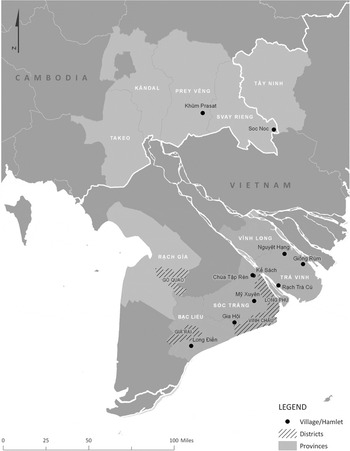
The crisis in Cambodia spilled over into Cochinchina. Tracking the resultant conflicts is difficult, because they occurred over a broad area (see figure 1). Killings occurred in the entire area between Phnom Penh and the South China Sea. Lê Hương notes that the Vietnamese communities hardest hit in Cambodia were in Kandal Province, Prey Veng, Takeo, and Svay Rieng. These areas, all with a significant Vietnamese population, lie near the Cambodia-Cochinchina border. In Vietnam, Lê Hương mentions that Khmer pillaged, raped, and killed Vietnamese (and some Chinese?) in Trà Vinh, Bạc Liêu, and Sóc Trăng (Lê Hương 1971, 252). To these places General Trần Văn Trà adds Rạch Giá and Tây Ninh Provinces, as well as the Cambodian areas near the border with Tây Ninh (Trần Reference Linh1999, 59–60; 2006, 179). All of these areas had significant concentrations of Khmer. At least one province with a small Khmer population, Vĩnh Long, also saw Khmer killings of Vietnamese (Đảng ủy-Bộ Chỉ Huy Quân Sự Tỉnh Vĩnh Long 1999, 1:56). Finally, recently opened French archival sources state that violence, including Vietnamese reprisals, was found in Châu Đốc and Cà Mâu Provinces as well (SHD 1946a, 1946b). Vietnamese groups across the political spectrum appear to have widely retaliated against such killings.
Sites of Khmer-Vietnamese violence, 1945–47. The map above shows provinces, particular districts, and villages mentioned in this article in both Cambodia and Vietnam in which Khmer-Vietnamese violence broke out. The map is not comprehensive. Map created by Nuala Cowan based on data supplied by the author.

The exact temporal and geographical sequence of events remains unclear. Witnesses sometimes mix together what happened in August and September 1945, when French authorities were nowhere to be seen in rural areas, with what probably happened in early 1946, when the French military seized control of major towns of the delta. By January 4, 1946, the French and their forces had taken the province seats of Trà Vinh and Sóc Trăng, while Bạc Liêu township was taken by January 29, 1946 (Trần 2006, 191). The French failed, however, to gain control of large rural swathes of the delta.
In Cochinchina, the province of Trà Vinh may have seen the earliest massacres. One source notes that on or after December 12, 1945, when the French military returned to Trà Vinh, some Khmer rose up: “Amidst the chaos, with people fleeing their homes, some Khmer following the French rose up, looted, set fire to homes, and beheaded Vietnamese” (Địa phương chí tỉnh Vĩnh Bình 1973, 44). Thomas Engelbert writes that “uproar was created first in Trà Vinh, then spread later to Sóc Trăng and Bạc Liêu. Khmer militias used their guns and settled old scores … with their Vietnamese neighbors, especially the poor Khmer tenant farmers with their Vietnamese landlords.” Engelbert adds that the “the majority of Khmer in Nam Bộ were poor tenant farmers, dependent on Vietnamese or Chinese landlords” (Engelbert Reference Engelbert, Engelbert and Schneider2000, 128–29).
The possible link between tenancy and violence is intriguing, as some Khmer Krom lived in areas with large agricultural estates and high numbers of tenant farmers. Indeed, the village of Kế Sách, a site of violence, formed part of the huge La Batsche plantation, and Sóc Trăng had other French, Chinese, and Vietnamese landlords (Trương 1980, 41–42; Vưong Liêm 2003, 88). A key commonality seems to be the role of youth. In his village in Sóc Trăng Province, for example, Vương Liêm noted that “the most numerous, and the most zealous” of the Khmer in Kế Sách opposing the Việt Minh were youth and young men (Vương Liêm 2003, 105).
While many accounts present the violence as coming out of the blue, it fits the pattern of “priming” for violence discussed by Hinton (Reference Hinton2005) in Cambodia or “preparation and rehearsal” for riots analyzed by Brass (Reference Brass2003) in India. Months of upheavals from the late summer of 1945 onwards, followed by the Việt Minh attempt to seize power in the south, lay the groundwork for violence. Vương Liêm gives a riveting description of how some Khmer became worked up in Tập Rèn, a village in Sóc Trăng Province populated by Vietnamese and Khmer. At the time, Li was a boy. One day in late November 1945, a large crowd of Khmer youth and young adults gathered, yelling and getting worked up about fighting the Việt Minh. “Armed with sticks and knives, they marched back and forth in the neighborhood like a provocation.” As night fell, the situation became even more tense. His sister had heard that the Khmer were going to “cáp duồng” (behead) the Vietnamese:
We anxiously waited, fearful of the unruliness of the crowd of youths with sticks, on tenterhooks, not knowing if the [Việt Minh] militia would arrive in time. … I was shaking so much that I could not stop my teeth from chattering, so my older sister dragged out some old clothes, wrapped me in them, and hugged me, pressing my feet and hands together. … Suddenly, the distant sounds of footsteps became clearer. There was an explosion of people talking. It was the Việt Minh! (Vương Liêm 2003, 105–7)
Many were not so lucky to avert disaster. Trương Dương Vũ, in his evocative memoir, recounts Năm Trương's experience in Sóc Trăng in 1945 and 1946:
When in Đại An, Năm Trương witnessed our fellow kin [đồng bào] from Trà Vinh fleeing to Sóc Trăng. Sampans, overflowing with people from the other side of the Bassac were crossing over to Sóc Trăng. The stories they told about fleeing made one shudder with fright. Our fellow kin from Trà Vinh abandoned their houses, all their worldly possessions and jumped into their sampans. Those who did not flee in time were beheaded, disemboweled, the young hacked to pieces. … The faces of our Trà Vinh compatriots were terror-stricken. (Trương 1980, 15)
Commenting on the destruction and killings of December 1945 into early January 1946, the Chinese writer Vương Hồng Sển of Sóc Trăng Province lamented how “cruel” Cambodians took advantage of the French desire to repress the Vietnamese (and others?) in his village: “They seized belongings, and set fires so that the sky was darkened in the hamlet of Hòa An. They were without conscience, amusing themselves by killing people for no reason” (Vương 1994, 396).
It appears that violence spiked again in February and March 1946. The limited evidence suggests that no central authority, whether French, Vietnamese, or Khmer, was in control, but that the French military acted as a clear catalyst. General Nyo, referring to reports of a “struggle” between Vietnamese and Khmer in Châu Đốc, Sóc Trăng, and Trà Vinh Provinces, wrote that “we must avoid, at all costs, that our Cambodian auxiliaries thwart our aims – [we must] try to stifle a well-known racial hatred” (SHD 1946a). General Nyo's statement had no effect on his subordinate commanders. By early March, his intelligence services were reporting with alarm that Trà Vinh, Châu Đốc, and Sóc Trăng “live in fear of the Cambodians. … Followed by their wives and children, they [the Cambodians] pillage and kill, and in some areas they make all the men disappear.” For Trà Vinh Province, this source adds, “the Administration and the Army are using Cambodians to continue the ‘cleansing’ (nettoyage). Every Annamite is considered to be ‘Viet Minh,’ thus criminal, and thus is shot, most often without due process” (SHD 1946b).
One source published long after the events had passed suggested that “there were places like the district of Vĩnh Châu, Giá Rai (Bạc Liêu) where an entire village of more than one hundred was killed” (Hoành 1957, 60). A third source on Bạc Liêu's history elliptically states that “around this time”—apparently in January 1946—“incidents” occurred in the villages of Vĩnh Trạch, Hưng Hội, Vĩnh Châu, Châu Thới, Hòa Bình, Long Điền, Vĩnh Mỹ, and Khánh Bình. From the context, it appears that these “incidents” were violent (Ban Chấp Hành 2002, 1:117).
Killing occurred elsewhere as well. One source, apparently speaking of 1946, states that Khmer on both sides of the Cochinchina-Cambodia border near Tây Ninh “rose up against the Vietnamese. … From bases in Cambodia, they crossed the border, finding and killing Vietnamese, setting fire to houses [and] stealing property, causing untold misery, death and grief” (Ban Liên Lạc 1998, 92). Yet this Vietnamese source does not mention attacks launched by the Việt Minh on Tây Ninh town in March 1946, in which—among other things—it “completely burned down” a Cham village (VNA 1947a).
Killings gave rise to counter-reprisals, but it is extremely difficult to know how widespread they were. After blaming French intelligence for causing “contradictions” that led Khmer to kill Vietnamese, General Trần Văn Trà then admitted that the party “used force to repress, and arrested hundreds of Khmer” (Trần Reference Linh1999, 59–60). A source of uncertain reliability, apparently referring to Sóc Trăng and Bạc Liêu Provinces, presents the Việt Minh reaction as much bloodier:
Cambodians were executed by the hundreds. The number of victims cannot be determined. During the months of December 1945 and January 1946, massacres of Cambodians were particularly common in the provinces of Sóc Trăng (Cai Sach and Go Co regions). In Bạc Liêu province, assassinations were still a daily occurrence until April [1946]. (SHD 1946d)
The closest any Vietnamese has come to providing a “smoking gun” is in this revelatory Việt Minh document, captured by the French military in Cà Mâu:
The [Communist] Party has never called for the massacre of Cambodians. On the contrary, it has always pursued a policy of friendship towards them to gain their sympathy. However, cadres who came from elsewhere gave the order to massacre Cambodians, thus creating diplomatic difficulties given the barbaric attitudes toward ethnic minorities. Comrades are requested to carry out strict inquiries in such cases in order to uncover the agents of such crimes and to report to the regional committee. (SHD 1946c)
This document, in trying to blame other cadres, shows how the Việt Minh was riven by internal turmoil at this time; it also shows how local cadres, paying no attention to central party directives, took matters into their own hands and worsened the ethnic conflict.
While this early phase, from August 1945 through March 1946, saw numerous killings, there was spatial variation in these deaths. Ethnic violence was concentrated in areas with large numbers of Khmer, but even in these areas, some villages were hit hard while others were bypassed. Tư Hớn, the representative of the People's Committee on the Labaste Plantation in Sóc Trăng, noted that Khmer killed many in the Long Phú district of Sóc Trăng Province, fewer in the village of Kế Sách, and none in the part of Kế Sách that bordered Cần Thơ Province. “Reaching Tân Lập, it was as if one had entered a safe area. … Here it seemed utterly calm” (Trương 1980, 41–42).
Killing begat killing. French sources indicate that in January and February 1947, the Việt Minh launched repeated attacks on Cambodian villages in the lower Mekong Delta. On January 23, 1947, French military sources reported an attack on the Cambodian village of “Nguget Sang” [sic: Nguyệt Lãng?] in Trà Vinh Province. An estimated 100 inhabitants were massacred, the entire village went up in smoke, and 800 people were left homeless (SHD 1947a). One month later, on February 26, 1947, Việt Minh units reportedly burned down 500 dwellings in the Cambodian village of Giồng Rùm, 10 miles southeast of Trà Vinh town, while also attacking the town of Nguyên Hung to the west of Trà Vinh (SHD 1947b). The village of Kế Sách, in Sóc Trăng Province, with its population of Khmer, Chinese, and Vietnamese, also experienced “a very difficult period between July 1946 and July 1947,” apparently because of retaliatory Việt Minh attacks (VNA 1948e).
When the French returned to the countryside from 1946 onwards, their forces were weak. Nonetheless, they slowly began to reach out to the Khmer. At first, the French flirted with the idea of giving the Khmer minority in Cochinchina greater political power. A Vĩnh Long Province military history claims that the French promised Khmer self-rule in the framework of a country of South Vietnam. Reports indeed show that, for a short time, the French allowed a Khmer Party to function in the south as a counterweight to the Việt Minh. Yet Việt Minh mistakes more than French skill often turned the tide. In Sóc Trăng Province, the province chief wrote in October 1947 that:
Since my return to Soctrang, I have sensed a very clear and troubling hesitation on the part of the Khmers. Subject to very violent terrorism on the part of the Việt Minh, while being approached with a very skilled propaganda by the latter, some hamlets and even villages have adopted a passive attitude, refusing even to take up arms to defend themselves. … It took stupid and repeated mistakes by the Việt Minh, who burned some remote villages, for the Cambodians to proclaim once again their union [with France]. (VNA 1947b)
The years from 1945 to 1947 may have constituted the worst period during the entire war in terms of indiscriminate violence by indigenous inhabitants against civilians. In these years, the rural order broke down throughout Cambodia and Cochinchina. A wide variety of groups, from brigands to armed political bands, took advantage of the opportunity.
By late 1947, the situation on the ground was in transition. The French slowly devolved power to Cambodians in Cambodia. In Cochinchina, they shifted from large-scale sweeps to small-scale and incremental “pacification.” This process included the accelerated construction of small outposts in which Khmer irregulars were grossly over-represented. At the same time, the ethnic dynamic had shifted. The strengthening of the French presence as well as the rise of the Khmer Issarak in Cochinchina and Cambodia began to alter the dynamics of conflict.
The Khmer Issarak began to play a key role: but who, exactly, were they, and what was their relationship with the Việt Minh? A Cambodian monk founded the Khmer Issarak Party (Phak Khmer Issarak) in Bangkok at the end of 1940. The first Khmer Issarak military units were organized in Thailand in May 1941 by Thai Prime Minister Phibun (Goscha Reference Goscha2000, 227). According to V. M. Reddi, by late 1945, “the Issaraks were raiding sporadically the border areas of Cambodia” (Reddi Reference Reddi1970, 121). By 1947, French provincial reports from Cochinchina began to mention the Issarak.
In these early years, the term “Issarak” referred to heterogeneous Cambodian bands that operated autonomously. They shared, it seems, only one common belief: opposition to the French and to Francophiles (Reddi Reference Reddi1970, 122). While analysts tend to characterize the Issarak along political lines, in some places, its groups resembled local outlaws. Goscha characterizes Issarak nationalist and warlord Dap Chhuon as the leader of “a colorful but impressive crowd of men, composed of soldiers as well as arms traffickers and common criminals” (Goscha Reference Goscha2000, 231). Michael Vickery has argued that “often the vocation of Issarak was no more than a device to give a patriotic cover to banditry, which had long been endemic in parts of rural Cambodia; and the ‘bandit charisma’ may have been as strong a motive as nationalism in attracting men to Issarak life” (Vickery Reference Vickery1984, 6).
Despite Issarak shortcomings, the Việt Minh decided to ally with the Issarak against the French. The French reported in November 1947 that the Khmer Issarak and Việt Minh had worked out a plan to collaborate. In Cambodia and Cochinchina, Vietnamese and Khmer units were to choose either an Issarak or a Việt Minh commander. Furthermore, “the Khmer Issarak would send troops to the Cambodian zone of Cochinchina. For their part, the Việt Minh would be authorized to act in Cambodian territory in areas where the Annamite population was predominant.” In October 1947, the Việt Minh sent instructors to Surin, Cambodia, to train Khmer Issarak (SHD 1947c).
As collaboration increased, Issarak and Việt Minh tried to articulate convergent interests. Support for Issarak groups in Cambodia, where ethnic Cambodians were the majority, advanced the Việt Minh goal to defeat the French. But in the lower Mekong Delta, the Việt Minh struggled to convince Khmer that it would treat the Khmer minority fairly. No Issarak, however, wanted to replace French with Vietnamese rule. Furthermore, the Việt Minh continued to threaten, kidnap, and sometimes kill Khmer leaders who were perceived to be helping the French. Engelbert quotes the intercepted letter of a Khmer from Trà Vinh in which the father complains about Việt Minh exactions: “families … either [had to] pay ransom or their houses would be burnt” (Engelbert Reference Engelbert, Engelbert and Schneider2000, 129). French sources record that in September 1948, the Việt Minh killed a Cambodian monk from Lang Cat, Rạch Giá Province. Nonetheless, in the short run, some Cambodians in the lower Mekong Delta saw the advantage of joining with Việt Minh forces to expel the French from Khmer strongholds.
Following 1947 and 1948 agreements, Khmer Issarak units from Cambodia sent troops to the Khmer parts of the lower Mekong Delta, while Khmer Krom leaders took charge of some Issarak units within Cambodia. For example, Sangsariddha, a Khmer “mestizo” from Trà Vinh, led a platoon near Kampot (in Cambodia) in 1948; this unit had “acted in spectacular fashion” (VNA 1948d). Another Khmer Krom from Trà Vinh, Sovann, led a unit of 100 Issarak that worked on the Cambodian-Vietnamese border near the Vinh Tế canal (SHD 1948c). The same year, a Khmer Krom from Rạch Gía, Sary, was in charge of sixty Issarak fighters stationed at the edge of Hà Tiên, Châu Đốc, and Rạch Giá Provinces. They operated under the Khmer leader Son Ngoc Minh, who commanded troops in the Cambodia-Cochinchina frontier region (SHD 1948d).
The neat division of responsibility envisioned between Khmer Issarak and Việt Minh rarely materialized. The Việt Minh never treated the Khmer Issarak as equal partners or allowed Vietnamese to serve under independent Issarak command authority. Furthermore, the Việt Minh did not restrict itself to those parts of Cambodia where ethnic Vietnamese were numerous. Việt Minh and joint Việt Minh–Issarak units roamed all over Cambodia: from Siem Reap near the Thai border all the way to Cambodia's border with Cochinchina. Some of these bands collaborated closely with the Việt Minh, while others seem to have been independent. A French report claimed that at “the beginning” (1945 or 1946), Việt Minh bands in Cambodia were “composed entirely of Vietnamese,” and recruited Khmer cadres with “great difficulty.” “In general, the heads and presidents of committees in Cambodia were Vietnamese with Cambodian names or Cambodians from Cochinchina” (SHD 1952).
By 1948, the French had become bogged down in both southern Vietnam and Cambodia. The French Commissioner for Cambodia Léon Pignon fretted that the deteriorating military situation threatened political equilibrium. “The Viet-Issarak move and strike at will. The capital is, in practical terms, dependent on the loyalism of Cambodian troops precisely at a time when the political situation has become increasingly murky” (SHD 1948a). Another report from 1948, infused with a sense of siege, stated that nine out of thirteen Cambodian provinces suffered a “generalized insecurity”:
In the south, a large swath of territories now is undergoing the fate of the neighboring lands of Cochinchina. … The extension of the war zone to the entirety of the southern sroks [villages] has been accompanied by a large “implantation” of terrorism [and] assassination of bureaucrats and village notables, aided by numerous clandestine Committees. The threatened [village] notables had fled and we are seeing already in Phnom Penh a flood of refugees. The vise is tightening on the country. (SHD 1948b)
By 1948, the French and the Việt Minh were pursuing rival strategies to win over the Cambodians. First, the French continued their patronage of members of the Cambodian elite in Cambodia as well as of the Khmer minority in Cochinchina, and articulated this support in ethnic terms. As the French military slowly grew stronger, it was increasingly able to help defend Khmer communities in Cochinchina against the Việt Minh. It freely provided these communities with weapons for self-defense.
The Việt Minh perceived French actions as part of a “divide and rule” strategy. According to one Vietnamese source, the French “incited the Khmer to ethnic hatred” against the Vietnamese by spreading the belief that “Vietnamese oppressed Khmer and that only the French would bring independence to the Khmer” (Đảng ủy-Bộ Chỉ Huy Quân Sự Tỉnh Vĩnh Long 1999, 1:60). There is some truth to these claims. Tracts from 1948 spread by French units in Cambodia, for example, chastised some Cambodians for “handing themselves over to … your hereditary enemy” and for becoming the “valets” of the Vietnamese. Other French-sponsored tracts claimed that the Việt Minh “were progressively infiltrating your Mekong provinces, very rich areas that they covet. … The price of their aid will be your southern provinces!” (SHD 1948c).
The French drove a wedge between the Khmer of the lower Mekong Delta and the Việt Minh. Nonetheless, in some areas, the Khmer remained leery of the French for not protecting them. In Tây Ninh Province, for example, Khmer had retreated into the forests after the violence of 1946 and 1947, losing all contact with the French administration into 1948 (VNA 1948b). Despite these missteps, the trend until 1949 was that Khmer gave their allegiance or acquiescence to whichever force, French or Vietnamese, was most powerful in any particular locality.
Faced with French success, the Việt Minh shifted its policy towards the Khmer, but made numerous missteps along the way. From 1945 to 1947, the Việt Minh had often undercut any gains it had made by its indiscriminate use of violence against Cambodians. By 1948, the Việt Minh shifted towards a more complicated calculus of attraction, coercion, and terror. As the Trà Vinh provincial chief reported in April 1948, “the Việt Minh are modifying their political attitudes towards the Khmer ethnic minority. They are now recruiting Cambodians into administrative positions in the villages [under their control]” (VNA 1948a). A report from the next month stated that Khmer in the province were being “greatly worked over” and that separate Khmer Issarak units were being established (VNA 1948c). By August and September of that year, similar reports were coming out of Sóc Trăng Province, where the province chief reported heavy Issarak propagandizing among the large Khmer population (VNA 1948e).
This shift in policy had ambiguous results. Issarak propagandizing continued to increase, but as a November 1949 report from Trà Vinh stated, the Issarak “were encountering serious difficulties,” including apparent rebellions (SHD 1948e). Missteps continued. The Việt Minh repeatedly expressed condescension towards Cambodians. A major Việt Minh document from late 1949 provides a hodge-podge of clichés about the Khmer: “The Cambodian is simple and natural. He does not think of elevated problems [ and] can be tricked easily. Culturally, he is culturally poor and superstitious, goes to temple, respects monks. Cambodians do not have strong will” (SHD 1949a).
We can conclude that despite sincere Việt Minh efforts, Việt Minh and Khmer Issarak forces became estranged. As Khmer ethnonationalism in both Cambodia and Cochinchina increased in influence, the Việt Minh found it difficult to control the Khmer. Khmer saw themselves as choosing between Khmer units (including Khmer Issarak) or the French for protection. Organizational differences solidified, and Khmer realized that on certain issues, such as the fate of the provinces of Trà Vinh or Sóc Trăng in Cochinchina, they were at loggerheads with the Việt Minh.
On June 4, 1949, rebuffing a long-standing Cambodian territorial claim, France awarded Cochinchina to the new state of Vietnam. This act, whose significance is completely ignored in modern histories of Vietnam, was pivotal in Khmer-Vietnamese relations. The Khmer of the Mekong Delta came to realize that they had become a small minority in a new entity, the state of Vietnam. While foreign affairs and defense remained in the hands of the French, domestic affairs were now under Vietnamese control. The political future of the Khmer in the new country seemed in doubt. Trịnh Thới Cang, a Khmer monk from Sóc Trăng arrested in December 1949 on the charge that he supported the Việt Minh, framed the acute dilemma now facing all Khmers in southern Vietnam. His eloquent statement to the police deserves to be quoted at length:
I have always thought that the unjustified waste of our [Khmer] lifeblood was, for the Khmer minority, a slow death. … but that the [Việt Minh-led] Revolution would bring nothing but disaster and servitude because the evolution of the Khmer was not ready for this and would lead the Khmer minority, severed from its Mother Country, to a slow death, a suicide or an irreparable disintegration. I am loyal to the manifesto of the Parti Khmère. The experience of History is too recent, too persuasive, to imagine collaboration with communist elements, which would lead to the suppression of our freedom, our rights, and above all our religion.
… The French Parliament's ratification of the unification of southern Vietnam with the rest of Vietnam has taken away from us the last hope to be considered Cochinchinese comparable in statute to the French Canadians. … I consider this quasi-total repudiation of our rights to have been unjustly anti-Cambodian.
The fatal hour has arrived whereby the Cambodians of southern Vietnam are directly in the grip of the [Vietnamese] Administration . … The Cambodians … are caught between two antagonists, both Vietnamese. If His Excellency Bao Dai succeeds in rallying all the members of the Resistance [i.e., Việt Minh] and re-establishing peace, Cambodians will have to answer to their atrocities against Vietnamese, with no distinction made between Việt Minh or [the state of] Vietnam. What will end up being our fate, the debasement … reserved for the vanquished? (SHD 1949b)
Cang's worries were quickly realized. The Vietnamese moved quickly to assert their power over minority groups and to replace any remaining French province chiefs with Vietnamese ones (VNA 1949). Fear of a repetition of ethnic violence precipitated some Vietnamese actions, but the end result was to assert Vietnamese power over Khmer.
The Việt Minh could not take advantage of such actions, for the Issarak–Việt Minh alliance was fraying. As it fell apart, Việt Minh access to the Khmer communities suffered. In February 1950, some Issarak in Trà Vinh Province allied with French forces and turned against the Việt Minh. By August 1950, Issarak were spreading propaganda near Bạc Liêu and Sóc Trăng, two areas with heavy concentrations of Khmer, asking the population to remain neutral in the upcoming Việt Minh offensive (SHD 1950a, 1950c). In future years, the Việt Minh would continue to reach out to the Issarak in Vietnam, but they had little success. The era of collaboration was coming to a close, as ethnonationalism increasingly shaped the actions of Cambodians and Vietnamese. In the process, the Khmer Krom of the lower Mekong Delta were increasingly left behind.
If the Cambodian government periodically tried to intervene on behalf of “its” Cambodians within the borders of Vietnam, the Vietnamese—whether Việt Minh or the new government—ignored their claims. Cambodian governmental actions were undercut by racism against ethnic Vietnamese in Cambodia. Pro-royalist propaganda from 1950 that circulated in Cambodia, for example, accused Maison Sivong, a head of the Khmer Issarak, of being “purely of Annamite nationality” (SHD 1950b). Another piece of propaganda warned Cambodians against working against the monarchy, against their race, and against Buddhism by collaborating with the Vietnamese (SHD 1950a). In 1952, some Vietnamese living in Takeo Province, Cambodia, fled into Vietnam: they claimed that Cambodians in their villages had threatened to decapitate them unless they left the region (VNA 1952).
The Khmer Krom monk Trịnh Thới Cang had asked: “What will end up being our fate, the debasement … reserved for the vanquished?” (SHD 1949b). In small ways and large, the fate of the Khmer Krom would bedevil successive Vietnamese and Cambodian governments for the next sixty years.
Conclusion: The Meaning and Legacies of Khmer-Vietnamese Violence
The Khmer-Vietnamese violence that shook the lower Mekong Delta from 1945 onwards has fallen into obscurity except perhaps among those who experienced it. Neither the Vietnamese nor the Cambodian government wants to resurrect memories of this past. Yet this violence was far from anomalous in Asia. Scholars, of course, have often focused on large-scale wars on the continent from 1937 onwards. When we “scale down” our analysis, however, we can appreciate the massive extent of localized insecurity, touching tens of millions of civilians, that began during the Pacific War and continued past 1945. This insecurity, coupled with the drive to decolonization, sometimes led to extensive violence. From partition in India, all the way over to the dislocation and conflict in Manchuria and the Korean Peninsula, localized ethnic conflicts broke out. In Southeast Asia, Mekong Delta violence was mirrored in other colonies going through decolonization, such as Burma, Cambodia, and the Netherlands East Indies.
Before 1945, Vietnamese-Khmer antagonism occasionally flared up, and violence occasionally broke out, but the norm was a fragile coexistence. Looking at this earlier period, we cannot conclude that ethnic cleavages had hardened and led to violence. The evidence is too contradictory to support such a claim. The period from 1945 to 1949, however, marked a turning point in Khmer-Vietnamese relations. Massacres and other conflicts, building on existing grievances, spiraled out of control. They entrenched an ethnic antagonism that had long-term consequences. It is all the more remarkable, then, that these events are rarely mentioned in the secondary literature. They have never been portrayed as significant.
As the superspace of French Indochina crumbled, Cambodia and Vietnam were refashioned by dominant ethnic elites into new, ethnically defined nation-states. But these nation-states, with their sharply distinct borders, imposed a cartographic “solution” on Khmer and Vietnamese conflicts that was destined to fail in the short term. At the heart of this failure were the Khmer communities of the lower Mekong Delta. They could not fit within “Cambodia,” as they existed outside of Cambodia's borders. Neither could they fit within Vietnam: many Khmer felt an allegiance to Cambodia, and the new state of Vietnam and its successors failed to develop an inclusive political culture that protected minority rights.
The legacy of this failed solution has shaped Vietnamese and Cambodian politics to the present. By the 1950s, when the French were ceding authority to the new states of Vietnam and Cambodia, mutual distrust between Khmer and Vietnamese ran deep. This distrust shaped policies ranging from Cambodian restrictions on Vietnamese employment in Cambodia to Vietnamese suppression of Khmer-language instruction in Vietnam. In the long run, when the Second Indochina War (1954–75) spilled over into Cambodia (and communist Vietnamese forces occupied safe havens on Cambodian soil against the Cambodian government's wishes), Cambodian antipathies to the Vietnamese sharpened. This sentiment probably contributed to the massacres of Vietnamese in Phnom Penh in 1970. In hindsight, it seems clear that Khmer Rouge racism fed off these earlier Khmer-Vietnamese conflicts in both Cambodia and Cochinchina.
It would be presumptuous to call these massacres and their legacy the “missing link” in the explanation for the importance of race hatred in Khmer Rouge ideology in the 1970s, as a multitude of factors shaped Khmer Rouge worldviews. I do believe, however, that the extensive ethnic violence of the 1940s, followed by France's 1949 award of Cochinchina to the new state of Vietnam, reshaped Khmer-Vietnamese relations and contributed to Khmer Rouge antipathy to the Vietnamese. The fact that key Cambodian nationalists (including Son Sann and Son Ngoc Thanh as well as Khmer Rouge leaders Ieng Sary and Son Sen) had lower Mekong Delta roots adds plausibility to this thesis. The Khmer Rouge attacks on Vietnam from 1975 onwards, their desire to “take back” the lower Mekong Delta and to purge Cambodia proper of Vietnamese, grew out of previous ethnic conflicts between Vietnamese and Khmer. These earlier conflicts from the 1940s, in other words, lay the groundwork for a catastrophe whose legacy haunts us today.
Acknowledgments
For help on this essay, I would especially like to thank David Chandler, Chris Goscha, Philip Taylor, Liam Kelley, Li Tana, three anonymous reviewers for the Journal of Asian Studies, and one person in Vietnam who prefers, because of the sensitivity of the topic, not to be identified. Research for this essay was supported by a Sigur Center for Asian Studies (George Washington University) research grant as well as a Fulbright-Hays fellowship. I thank the Vietnam National University–Ho Chi Minh City for hosting my research stay in Vietnam.