Introduction
In developing countries undergoing health or epidemiological transition, a malnutrition pattern is predominantly emerging that is characterized by under-nutrition in children and ever-increasing obesity in adults (Popkin & Doak, Reference Popkin and Doak1998; Chopra et al., Reference Chopra, Galbraith and Darnton-Hill2002; Popkin, Reference Popkin2004; Prentice, Reference Prentice2006; Hossain et al., Reference Hossain, Kawar and El Nahas2007; Madanat et al., Reference Madanat, Troutman and Al-Madi2008). The World Health Organization (WHO) in 1997 emphasized that obesity is becoming a major health problem in many developing countries, particularly in adult women (WHO, 1998). Recently, WHO estimates that globally there are more than 1 billion overweight adults and at least 300 million of them are obese (WHO, 2003). Overweight and obesity are now considered as serious health problems, and very important risk factors for many chronic diseases, including type 2 diabetes, cardiovascular disease, hypertension and stroke, and certain forms of cancer and disability. In developing countries, obesity often co-exists with under-nutrition and presents serious social and psychological dimensions, affecting virtually all ages and socioeconomic groups (WHO, 2003).
In recent years, the prevalence of overweight and obesity in Botswana has increased with the rapid socioeconomic development. However, no nationally representative studies have been conducted to assess the prevalence and covariates of overweight and obesity. In order to establish effective prevention strategies, identifying potential determinants of overweight and obesity is imperative. The objectives of this study are: (i) to estimate the prevalence of overweight and obesity and (ii) to identify the socio-demographic determinants of overweight and obesity in Botswana using data from the 2007 Botswana Family Health Survey IV.
Data and Methods
Data
The Botswana Family Health Survey IV (BFHS IV) was conducted between September 2007 and January 2008 by the Central Statistics Office in close collaboration with UNICEF (Central Statistics Office, undated). The Multiple Indicator Cluster Survey (MICS) was combined with the BFHS IV because of the similarity of the indicator modules. Four questionnaires were administered, namely the Household Questionnaire, Female Questionnaire (administered to females aged 12–49), Male Questionnaire (administered to males aged 12–49) and the Under-5 Questionnaire (Central Statistics Office, 2009).
For this study, respondents aged 20–49 years were selected for the analysis. Other criteria include performing analysis for men and women separately. One other important feature of the BFHS IV is that for the first time, the survey collected information on adult weight and height for calculation of body mass index (BMI). The sample used in this study was weighted to ensure that it was nationally representative.
Measurement of variables
The dependent variables are (a) overweight and (b) obesity. The prevalence of overweight and obesity is commonly assessed by using BMI, defined as weight in kilograms divided by the square of height in metres (kg/m2). In this study, BMI is categorized into four groups as per WHO recommendations: underweight (BMI<18.5 kg/m2), normal (18.5≤BMI<25 kg/m2), overweight (25≤BMI<30 kg/m2) and obese (BMI≥30 kg/m2). Body mass index used in the logistic regression analysis was coded in such a manner that it had two categories: being overweight and obese (BMI≥25) or not (BMI<25). Being overweight and obese assumed a value of 1 and 0 otherwise.
Height was measured in centimetres during the survey but was later converted to metres during the analysis. Male subjects with height <1.0 and >2.03 m and weight <40 and >185 kg were excluded from the analysis because they were considered outliers. The percentage of male subjects with height <1.0 m constituted less than 0.5% and none had height above 2.03 m. For women subjects, the cut-off points were: <0.97 and >1.89 m for height and <35 and >170 kg for weight. None of the women had a weight above 170 kg. However, those with weight below 35 kg constituted 0.2%. Thus the percentage excluded from the analysis would not bias or influence the study results.
The independent variables used for analysis in this study are socio-demographic characteristics as collected in the 2007 BFHS IV. Age in years was categorized as follows: 20–24, 25–29, 30–34, 35–39, 40–44 and 45–49. Place of residence was aggregated as city/town, urban village and rural. Marital status was created as never married, currently married (married and living together) and formerly married (separated, divorced and widowed). Educational level achieved was measured as never having attended school and among those who attended school, whether they had primary, secondary, higher, non-formal or non-standard curriculum. For the purpose of this study, four categories of education were created as follows: those who never attended school classified as having no education. Non-formal and non-standard curriculum and primary were combined together to create primary education. Secondary and higher educational levels remained unchanged.
Statistical analysis
The prevalence estimates of overweight and obesity categories were calculated as percentages. Analysis of variance (ANOVA) was used to test whether differences between mean BMI are significant or not. To evaluate the association between obesity and associated factors, multivariate logistic regression analysis was applied to estimate the multivariable-adjusted odds ratio (OR) of overweight and obesity through the levels of various explanatory factors. For the multivariate analysis, underweight subjects were excluded and normal weight subjects were used as the referent for the factors associated with overweight and obesity. The adjusted ORs are presented together with a 95% confidence level. For all comparisons, p-values <0.05 are considered statistically significant.
Results
Out of 9023 subjects selected for analysis, 54% were women whilst 46% were men. Most of the respondents (49.1%) were in their twenties and roughly a fifth were aged over 40 years. The distribution of the sample was fairly even between cities/towns, urban villages and rural areas (approximately a third in each location). Almost half the selected sample comprised of never-married people, while formerly married constituted about 3%. Slightly more than 50% of respondents had attained secondary education.
Prevalence of overweight and obesity
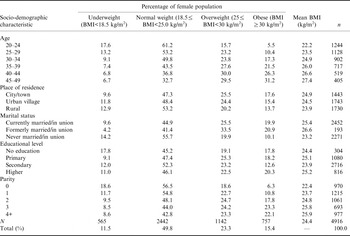
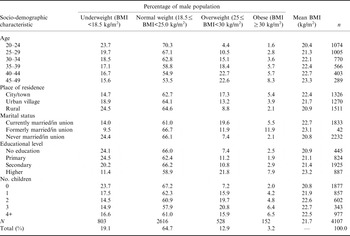
Tables 1 and 2 present the percentage distribution of the population categorized as underweight, normal weight, overweight and obese for men and women separately by selected socio-demographic variables, and mean BMI. Overall the proportion of subjects underweight was higher among men than women: 19.1% and 11.5% respectively. Underweight was more prevalent among the 20- to 24-year-olds (17.6% and 23.7% for women and men respectively), rural areas (12.9% and 24.5% for women and men respectively), never married (14.2% and 24.4% for women and men respectively), those with no education (17.8% and 24.1% for women and men respectively) and among those with no children (18.6% and 23.7% for women and men respectively).
Percentage of the female population underweight, normal weight, overweight and obese by socio-demographic characteristics and mean BMI, 2007 BFHS IV (N=4916)

Percentage of the male population underweight, normal weight, overweight and obese by socio-demographic characteristics, 2007 BFHS IV (N=4107)

With regard to overweight and obesity, more women than men were overweight and obese. Approximately 23.3% of women compared with 12.9% of men were found to be overweight, and 15.7% of women compared with 3.2% of men were obese.
Mean BMI values for women and men were 24.4 kg/m2 and 21.7 kg/m2 respectively, showing a mean difference of 3 kg/m2. Body mass index increased with increasing age and education for both women and men. However, mean BMI increased for women of high parity and remained fairly stable for men with increasing number of children ever born. The BMI was slightly higher for cities/towns compared with rural areas (mean difference of 0.9 for women and 1.6 for men). Analysis of variance (ANOVA) indicated that differences in mean BMI across groups were statistically significant.
Factors associated with overweight and obesity
Overweight increased with age for both women and men. For instance, 16.3% of the 20- to 24-year-old women were overweight compared with 32.0% of the 45- to 49-year-old women. The prevalence of overweight and obesity was high for both women and men in cities/towns compared with rural areas. Overweight and obesity were also common among the currently married compared with the never-married women and men. Among men, overweight and obesity were more pronounced among those with post-secondary education compared with their counterparts with other educational achievement, if any.
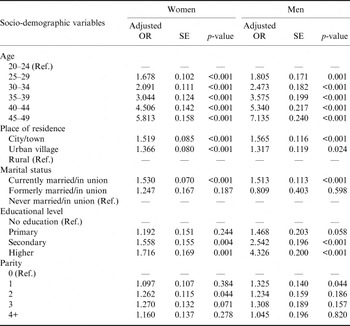
Table 3 shows the results of multivariate regression analysis that identified socio-demographic factors associated with increased BMI (overweight and obesity) for women and men separately. For women, those aged 45–49 years were 5.8 times more likely to be overweight or obese than those aged 20–24 years. The likelihood of experiencing overweight and obesity increased steadily with increasing age for both women and men. Women who resided in cities/towns were 1.5 times more likely to be overweight or obese than those residing in rural areas. Currently married women were 1.5 times more likely to be overweight or obese compared with those who were never married. Women with post-secondary education were 1.8 times more likely to be overweight and obese than those who had no education. These relationships are statistically significant and the observed trends in women are similar to those observed for men.
Socio-demographic variables associated with increased BMI (overweight and obesity) in adult Botswana women (N=4303) and men (N=3282) identified by logistic regression model (adjusted odds ratios)

SE represents standard error; Ref. is the reference category. Note that the odds ratios presented are results of a multivariate logistic model including all variables shown in the table.
In short, significant levels of overweight and obesity were observed in older adults, city/town dwellers, married couples and respondents with higher levels of education, and these relationships were statistically significant at the 5% level.
Discussion
Overweight and obesity are important factors in the increasing prevalence of non-communicable diseases such as hypertension, and thus contribute to premature mortality (WHO, undated). The 2007 BFHS IV had an adult health section designed to provide nationally representative anthropometric data for Botswana. These data show an adult Botswana population that is predominantly overnourished among the females and undernourished among the males. The prevalence of overweight and obesity tends to be concentrated among urban settings, older population, married people and people with higher levels of education. Urbanization, ageing and education achievement have been on the rise in Botswana, which could impact negatively on overweight and obesity and consequently on the prevalence of non-communicable diseases such as hypertension and stroke, cardiovascular disease and type 2 diabetes (Must et al., Reference Must, Spadano, Coakley, Field, Colditz and Dietz1999; WHO, 2000; Visscher & Seidell, Reference Visscher and Seidell2001; Manson et al., Reference Manson, Skerrett, Greenland and Vanltallie2004; Terres et al., Reference Terres, Pinheiro, Horta, Pinheiro and Horta2006; Suleiman et al., Reference Suleiman, Alboqai, Yasein, El-Qudah, Bataineh and Obeidat2009).
Because being overweight and obese have traditional and cultural undertones, these connotations present complexities in the prevention and management of overweight and obesity. It has been observed that in South Africa, being obese is perceived to reflect affluence and happiness in many sectors of the African population (Puoane et al., Reference Puoane, Steyn, Bradshaw, Laubscher, Fourie, Lambert and Mbananga2002). These authors observed that overweight or obesity in women is thought to reflect on a husband's ability to care for his wife and family. Overweight and obesity are also thought to reflect persons who are healthy and without HIV/AIDS (Clark et al., Reference Clarks, Niccolai, Kissinger, Peterson and Bouvier1999). These perceptions are also prevalent in Botswana.
Although BMI provides a simple index of weight-for-height that is commonly used in calculating overweight and obesity in adult populations, it has various limitations that need to be discussed. One such limitation is the fact that not all individuals with increased BMI have excessive fat accumulation. Some individuals with high BMI may have massive muscles and low fat.
Conclusions and Recommendations
This study set out to investigate the prevalence of overweight and obesity and their determinants. The study found that the adult Botswana population has higher levels of overweight and obesity among women and higher levels of under-nutrition among men. About 39% of women were either overweight or obese compared with only 16% of men. High levels of overweight and obesity were observed in older adults, city/town dwellers, married couples and respondents with higher levels of education. These patterns of overweight and obesity in the adult female population and underweight among the adult male population of Botswana have policy and programme implications. The paper found a double burden of under- and over-nutrition in adults in Botswana.
In Botswana, overweight and obesity appear to start at a young age: the data show 21% of women were either overweight or obese at the ages of 20–24 years while 23.7% of men were underweight. Therefore, primary prevention of both overweight and under-nutrition must start at a young age. Thus although overweight is a problem particularly among women, underweight remains an important public health problem among men.
The relationship between education and BMI shows that women with no education had lower BMI than those with schooling. Uneducated women tend to work in sectors of the economy that require manual work, unlike their better-educated counterparts. Ideally, women with high levels of education should be better informed about the relationship between body weight and health and therefore less likely to be overweight or obese. Through reading and accessing other forms of media, educated women should be aware and take cognizance of the preferred body image of thinness. As a result they would try to control their body weight in an attempt to conform to the media images that they internalize. However, they should also be made aware that the desire for extreme thinness can be problematic as it can result in anorexia. The data, however, are showing exactly the opposite of this expectation. Women with higher educational attainment tend to have high BMI. Better educated women tend to live mainly in urban areas where the majority of fast food restaurants are located and these areas are also characterized by overweight and obesity, which increases the likelihood of women experiencing overweight and obesity. More aggressive campaigns about weight control and its health benefits targeting both men and women need to be undertaken.
Further studies need to be undertaken to understand in-depth the cultural attitudes of Batswana toward weight, diet and physical activity. These studies will help shed light on the best strategies that could be employed to tackle the overweight and obesity epidemic ravaging the country. Prevention strategies may not succeed if they do not tackle cultural meanings of being overweight and obese.
Acknowledgments
The author wishes to acknowledge and thank the Central Statistics Office in the Ministry of Finance & Development Planning for allowing the author to use the 2007 BFHS IV data set.