History of studies with EGb 761®
Clinical trials of EGb 761® can be divided into generations of studies. In the early days, many of the numerous studies incorporated methods common two decades ago or more. They showed that EGb 761® was superior to placebo in improving symptoms of aging-associated cognitive impairment and dementia (e.g. Taillandier et al., Reference Taillandier, Ammar, Rabourdin, Ribeyre, Pichon, Niddam and Pierart1986; Weitbrecht and Jansen, Reference Weitbrecht and Jansen1986; Wesnes et al., Reference Wesnes, Simmons, Rook and Simpson1987; Halama et al., Reference Halama, Bartsch and Meng1988; Hofferberth, Reference Hofferberth1989). With the emergence of cholinesterase inhibitors, new concepts and methods developed, and modern studies with Ginkgo biloba extract were undertaken, confirming the results of previous trials showing that this extract is superior to placebo (Kanowski et al., Reference Kanowski, Herrmann, Stephan, Wierich and Hörr1996; Kanowski and Hoerr, Reference Kanowski and Hoerr2003; Le Bars et al., Reference Le Bars, Katz, Berman, Itil, Freedman and Schatzberg1997; Reference Le Bars, Kieser and Itil2000).
Studies with EGb 761® in the 21st century
Although the primary result in a highly selected group of formerly untreated patients in the USA was negative, Schneider et al. (Reference Schneider, DeKosky, Farlow, Tariot, Hoerr and Kieser2005) found a significant improvement with EGb 761® in a subgroup of patients with neuropsychiatric symptoms. To confirm the reliability of this finding, further studies were initiated.
GINDEM-NP study
In 2007, Napryeyenko and Borzenko published the results of the GINDEM-NP study – a randomized, placebo-controlled, double-blind, multicenter trial in 400 outpatients aged ≥50 years with dementia (Napryeyenko and Borzenko, Reference Napryeyenko and Borzenko2007). Patients were included if they had Alzheimer's disease (AD) according to the National Institute of Neurological and Communicative Disorders and Stroke (NINCDS) and Alzheimer's Disease and Related Disorders Association (ADRDA) criteria or vascular dementia according to the National Institute of Neurological Disorders and Stroke (NINDS) and Association Internationale pour la Recherche et l'Enseignement en Neurosciences (AIREN) criteria. Patients had to have mild to moderate dementia, including a total score for the screening Test for the Early Detection of Dementia with Discrimination from Depression (TE4D) of ≤34 and a Syndrom-Kurztest (SKT) cognitive battery total score of 9–23, and also neuropsychiatric features with a Neuropsychiatric Inventory (NPI) total score >5. Patients were randomized to receive a dose of 240 mg/day EGb 761® or placebo for 22 weeks. The main outcome measures were the SKT cognitive battery total score. Secondary outcomes included: NPI, Gottfries-Bråne-Steen Scale (GBS) (including activities of daily living (ADL) subscale), Clock Drawing Test (CDT), Verbal Fluency Test, Hamilton Rating Scale for Depression (HAM-D), Concomitant Symptoms Scales (dizziness and tinnitus).
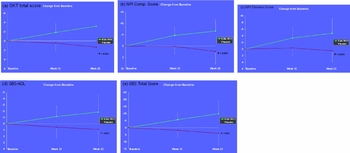
Baseline data were comparable between the two groups. After 22 weeks, a significant difference in the main outcome variable (SKT total score) was observed between placebo and EGb 761® (Figure 1a). Statistically significant differences were also seen for the NPI composite, NPI distress (caregiver), GBS ADL and GBS total scores, CDT, Verbal Fluency Test, HAM-D and Concomitant Symptoms Scales (Figures 1b–1e).
Change from baseline in primary (a) and secondary (b–e) outcomes in the GINDEM-NP study. Adapted from Napryeyenko and Borzenko, Reference Napryeyenko and Borzenko2007.

In terms of safety, the total number of adverse events reported during the treatment period was considerably lower with EGb 761® than placebo (302 versus 481).
GOTADAY and GOT-IT! studies
The GOTADAY and GOT-IT! studies were designed to be two identical randomized, placebo-controlled, double-blind clinical trials in patients with dementia with neuropsychiatric features. Both studies enrolled outpatients with mild to moderate dementia (including probable AD (NINCDS/ADRDA), probable vascular dementia (NINDS/AIREN) or possible AD (NINCDS/ADRDA) with cerebrovascular disease (NINDS/AIREN)), SKT total score 9–23 and NPI composite score >5. Patients were randomized to receive treatment with 240 mg EGb 761® or placebo for 24 weeks. Primary outcome measures were SKT and NPI. Secondary outcomes included Alzheimer's Disease Cooperative Study-Clinical Global Impression of Change (ADCS-CGIC), Alzheimer's Disease Activities of Daily Living International Scale (ADL-IS), DEMQOL-Proxy, Verbal Fluency Test, and 11-point box scales for tinnitus and dizziness.
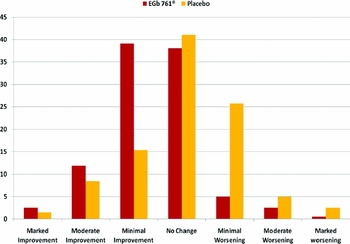
Baseline characteristics were similar between the two arms in both studies. In both studies, significant differences in changes on SKT total score and NPI composite score were seen between EGb 761® and placebo (P < 0.001 for both). The NPI caregiver distress score was also significantly different between the groups in both studies. The distribution of ADCS-CGIC categorical scores indicates more frequent improvements with EGb 761® and more frequent worsening with placebo in both studies (Figure 2; P < 0.001 for both). Improvements in DEMQOL-Proxy and Verbal Fluency Test were also significantly better with EGb 761® than placebo in both studies. All results were thus reproducible.
Categorical Alzheimer's Disease Cooperative Study-Clinical Global Impression of Change (ADCS-CGIC) scores in the GOTADAY study. Reproduced with permission from Ihl et al., Reference Ihl2011a.

EGb 761® and cholinesterase inhibitors
In 2009, a small exploratory study of 94 outpatients aged ≥50 years compared the efficacy of EGb 761® alone with that of donepezil alone and in combination with EGb 761® (Yancheva et al., Reference Yancheva, Ihl, Nikolova, Panayotov and Schlaefke2009). Patients were included if they had AD and neuropsychiatric features, TE4D score ≤35, SKT 9–23, NPI total score ≥5, no other psychiatric disorder, HAM-D <20 and no severe somatic disorder. Patients were randomized in a 1:1 manner to receive 240 mg/day EGb 761®, 5 mg/day (increasing to 10 mg/day) donepezil or their combination for 24 weeks. No other antidementia or anticholinergic drugs were allowed. Outcomes measures were SKT, NPI total score, GBS-ADL subscore, HAM-D, CDT and Verbal Fluency Test.
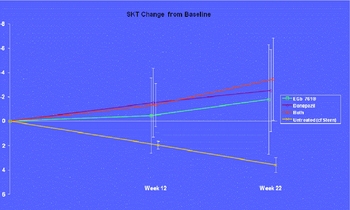
The results of this study were remarkable. At week 22, there were no significant differences between the three treatment groups for any of the outcome measures. In terms of absolute values, improvements with EGb 761® or donepezil were in the same range as the improvements with the combination, though the latter usually showed the biggest numerical (albeit not significant) improvements. Figure 3 shows the results for the SKT, including a comparison with untreated patients from another study (Stern et al., Reference Stern, Mohs, Davidson, Schmeidler, Silverman, Kramer-Ginsberg, Searcey, Bierer and Davis1994).
Changes in Syndrom-Kurztest (SKT) total score in a study comparing Gingko biloba EGb 761 alone, donepezil alone and a combination of Gingko biloba EGb 761 and donepezil, including untreated patients from another study. Reproduced with permission from Yancheva et al., Reference Yancheva, Ihl, Nikolova, Panayotov and Schlaefke2009.

Cross-study comparison of NPI total score
The NPI total score is used as an outcome measure in many studies involving anti-dementia drugs. This measure can therefore be used to compare results across a variety of studies involving different anti-dementia products (Ihl et al., Reference Ihl, Frölich, Winblad, Schneider, Burns and Möller2011b), although it is important to bear in mind the limitations of cross-study comparisons due to varying characteristics of study populations, including age and severity of disease.
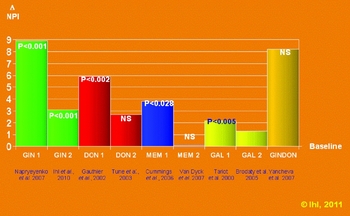
Figure 4 shows that the largest drug–placebo difference for all products between baseline and six months (8.9 points) was achieved with EGb 761® in the study by Napryeyenko and Borzenko (Reference Napryeyenko and Borzenko2007). A lower drug–placebo difference of 3.2 points was achieved with EGb 761® in the GOTADAY study (Ihl et al., Reference Ihl2011a). For donepezil, the largest drug–placebo difference was 5.9 points (P < 0.002) (Gauthier et al., Reference Gauthier, Feldman, Hecker, Vellas, Emir and Subbiah2002) and the smallest 2.7 points, which was not significant (Tune et al., Reference Tune, Tiseo, Ieni, Perdomo, Pratt, Votaw, Jewart and Hoffman2003). For memantine, a small statistically significant superiority over placebo was observed in one study (3.8 points; P < 0.028) (Cummings et al., Reference Cummings, Schneider, Tariot and Graham2006), but another study showed virtually no difference at all (0.1 points; not significant) (van Dyck et al., Reference van Dyck, Tariot, Meyers and Malca Resnick2007). For galantamine, only small drug–placebo differences of 2.2 and 1.3 points were seen in two separate studies (Tariot et al., Reference Tariot, Solomon, Morris, Kershaw, Lilienfeld and Ding2000; Brodaty et al., Reference Brodaty, Corey-Bloom, Potocnik, Truyen, Gold and Damaraju2005). Importantly, the effect observed with the combination of EGb 761® and donepezil was similar to that achieved with EGb 761® alone in the Napryeyenko and Borzenko study (Napryeyenko and Borzenko, Reference Napryeyenko and Borzenko2007; Yancheva et al., Reference Yancheva, Ihl, Nikolova, Panayotov and Schlaefke2009).
Cross-study comparison of changes in Neuropsychiatric Inventory (NPI) total score with various anti-dementia agents. Highest and lowest drug–placebo differences found are demonstrated. GIN = Ginkgo biloba extract EGb761; DON = donepezil; GAL = galantamine; MEM = memantine; GINDON = combination therapy of Ginkgo biloba extract EGb761 and donepezil. Reproduced with permission from Ihl et al., Reference Ihl, Frölich, Winblad, Schneider, Burns and Möller2011b.

Summary
Recent studies showed that EGb 761® at a dose of 240 mg/day improves cognitive function, neuropsychiatric symptoms, activities of daily living and quality of life in patients with mild to moderate dementia. The strength of the effects was strong enough to be detected by caregivers and independent clinicians. Improvements in neurosensory symptoms associated with old age and dementia were also demonstrated. The results were reproducible in independent trials. Safety data reveal no important safety concerns with EGb 761®. Rates of adverse events reported during treatment with EGb 761® intake were not higher than those during placebo intake.
Conflict of interest
Over the past three years Ralf Ihl has received honoraria for consulting and expertise from Global Life Sciences, IFE, Merz, Bezirksregierung Arnsberg, and Swiss professional media. He has received speaking and publishing honoraria from Austroplant, Caritas Siegen, KDA, Lebenswerk, Medical Tribune, KBV, Pierrel, Pfrimmer Nutritia GmbH, Schwabe, APK, Amtsgericht Krefeld, Landgericht Düsseldorf, WDR, Beltz Test, BOD, Hogrefe, Med. Komm, Thieme, Urban & Vogel, and Westermeyer.