INTRODUCTION
The taxonomy of Sotalia dolphins remained doubtful for over a century, until morphological (Monteiro-Filho et al., Reference Monteiro-Filho, Monteiro and Reis2002) and genetic data (Cunha et al., Reference Cunha, da Silva, Lailson-Brito, Santos, Flores, Martin, Azevedo, Fragoso, Zanelatto and Solé-Cava2005; Caballero et al., Reference Caballero, Trujillo, Vianna, Barrios-Garrido, Montiel, Beltrán-Pedreros, Marmontel, Santos, Rossi-Santos, Santos and Baker2007) revealed two distinct species in this genus: Sotalia guianensis (van Bénéden, 1864), which lives in the coastal-estuarine region, and the exclusively freshwater Sotalia fluviatilis (Gervais, 1853). Sotalia guianensis is distributed from Honduras to south Brazil, whereas S. fluviatilis occurs in most of the Amazon Basin (da Silva & Best, Reference da Silva and Best1996; da Silva et al., Reference da Silva, Fetuccia, Rodrigues, Edwards, Moreno, Moura, Wedekin, Bazzalo, Emin-Lima, do Carmo, Siciliano and Utreras2010). Both species face conservation issues and S. guianensis has recently been listed as ‘vulnerable’ in Brazil (MMA, 2014). Although still considered ‘data deficient’, S. fluviatilis is also likely under threat, as are all other river dolphin species around the world (Reeves et al., Reference Reeves, Smith, Crespo and Notarbartolo di Sciara2003; Secchi, Reference Secchi2012).
The Amazon Estuary is the only geographic area where the two Sotalia species may co-occur. Two factors create the scenario for a possible sympatric zone there: the fresh water from the Amazon River reaches the Atlantic Ocean, forming a wide plume a few hundred kilometres into the sea (Muller-Karger et al., Reference Muller-Karger, McClain and Richardson1988; Goulding et al., Reference Goulding, Barthem and Ferreira2003). Hence, dolphins in the Amazon mouth are actually living in fresh water. At the same time, S. guianensis is known to enter up to hundreds of kilometres upriver (da Silva & Best, Reference da Silva and Best1996). Thus, the two species may coexist in sympatry in the estuary, and this could allow hybridization between S. guianensis and S. fluviatilis (Cunha et al., Reference Cunha, da Silva, Solé-Cava, Ruiz-Garcia and Shostell2010), although there are no previous data on possible hybrids.
The existence of interspecific hybridization in cetaceans has been documented in captivity and in the wild, including intergeneric crossings (Dohl et al., Reference Dohl, Norris and Kang1974; Nishiwaki & Tobayama, Reference Nishiwaki and Tobayama1982; Baird et al., Reference Baird, Willis, Guenther, Wilson and White1998; Bérubé & Aguilar, Reference Bérubé and Aguilar1998; Zornetzer & Duffield, Reference Zornetzer and Duffield2003) and even between Sotalia and Tursiops (Caballero & Baker, Reference Caballero and Baker2010). If hybridization does occur between different species and genera, the chance that this event has occurred between the two species of Sotalia, which diverged only 2.3 million years ago (Cunha et al., Reference Cunha, Moraes, Medeiros, Lailson-Brito, da Silva, Solé-Cava and Schrago2011), is even greater. Almost all of the samples from the Amazon Estuary analysed so far have been molecularly identified as S. guianensis (Cunha et al., Reference Cunha, da Silva, Lailson-Brito, Santos, Flores, Martin, Azevedo, Fragoso, Zanelatto and Solé-Cava2005, N = 21; Ruiz-Garcia et al., Reference Ruiz-Garcia, Mejia, Escobar-Armel, Tejada-Martínez and Shostell2013, N = 76). However, those studies relied exclusively on mitochondrial sequences, so the possibility that some samples were hybrids between the two species could not be assessed.
We investigated the occurrence of hybridization between S. guianensis and S. fluviatilis by analysing 76 specimens from the Amazon Estuary. Species identification and the test for hybrids were done using a molecular diagnostic method based on polymerase chain reaction–restriction fragment length polymorphism (PCR–RFLP) analysis using the introns of two nuclear genes.
MATERIALS AND METHODS
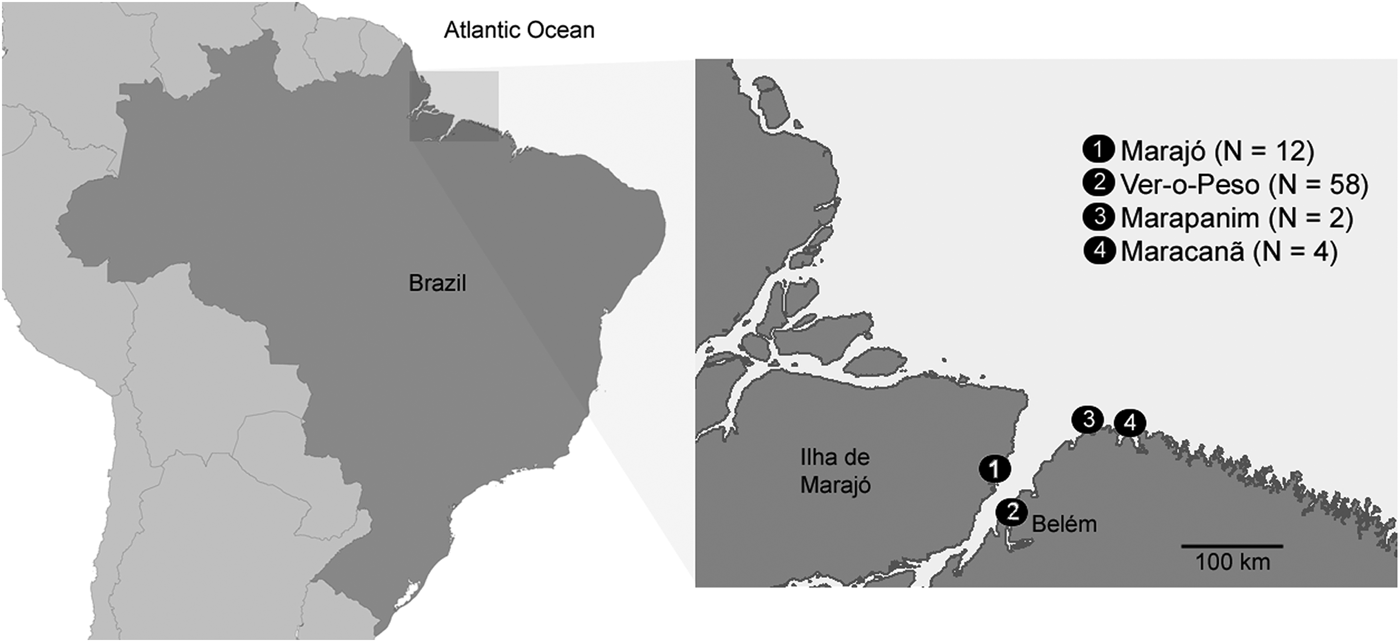
Samples were collected from Sotalia spp. dolphins that stranded in the Amazon Estuary (N = 18) and from love charms sold in Mercado Ver-o-Peso in Belém (Pará State, N = 58) (Figure 1). Previous studies using mtDNA have shown that love charms sold in the Ver-o-Peso are from S. guianensis (Cunha & Solé-Cava, Reference Cunha and Solé-Cava2007; Gravena et al., Reference Gravena, Hrbek, da Silva and Farias2008; Sholl et al., Reference Sholl, Nascimento, Leoncini, Bonvicino and Siciliano2008), and samples have been assigned to the Amazon Estuary population using microsatellite data (Cunha et al., Reference Cunha, da Silva, Santos, do Carmo and Solé-Cavasubmitted). DNA from all samples was purified by the standard phenol-chloroform procedure (Sambrook et al., Reference Sambrook, Fritsch and Maniatis1989).
Sampling sites in the Amazon River estuary. Samples from site 2 were of unknown origin at the time of sampling, since they were obtained from ‘love charms’ sold at a market in this location.

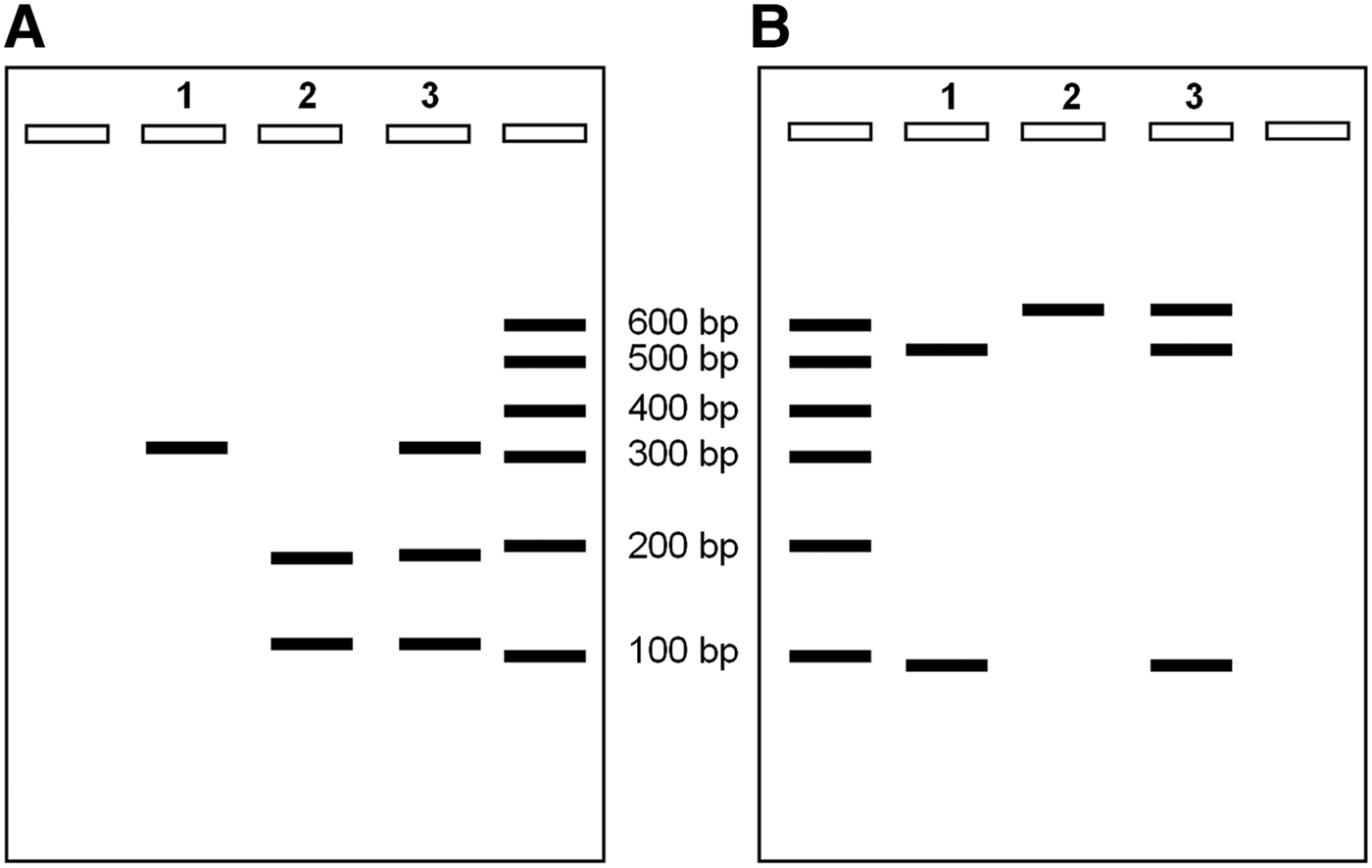
To develop PCR-RFLP diagnostic systems using nuclear DNA regions, we used sequences of the glucocerebrosidase (GBA) and the α-lactalbumin (Lac-1) genes from GenBank (EF027024-25, EF027010-11). Both genes are known to contain fixed polymorphisms between S. guianensis and S. fluviatilis (Caballero et al., Reference Caballero, Trujillo, Vianna, Barrios-Garrido, Montiel, Beltrán-Pedreros, Marmontel, Santos, Rossi-Santos, Santos and Baker2007). Sequences were aligned in the software MEGA 5.10 (Tamura et al., Reference Tamura, Peterson, Peterson, Stecher, Nei and Kumar2011), and the program WebCutter 2.0 (http://rna.lundberg.gu.se/cutter2) was used to find restriction sites in the diagnostic region of each gene. One enzyme was selected for each gene: HapII for GBA and TspRI for Lac-1. Both PCR-RFLP systems were expected to be able to diagnose the two species and to detect hybrids between them (Figure 2).
Schematic diagrams with the expected results of the two diagnostic PCR-RFLP systems, (A) GBA/HapII and (B) Lac-1/TspRI, where (1) is S. fluviatilis, (2) is S. guianensis and (3) represents the pattern expected for a hybrid. The last lane of A and first lane of B represent a 100 bp DNA ladder.

To test both systems, we used voucher DNA samples of S. guianensis (N = 4) and S. fluviatilis (N = 2), which were identified through sequencing. We also mixed the PCR products of the two species to simulate hybrid individuals. Later, we used the two systems to analyse the remaining 76 samples.
GBA and Lac-1 were PCR-amplified using primers described in Roca et al. (Reference Roca, Georgiadis, Pecon-Slattery and O'Brien2001) and Milinkovitch et al. (Reference Milinkovitch, Bérubé, Palsbøll and Thewissen1998), respectively. Amplifications were performed in 15 µl reactions containing 1 unit of Taq polymerase, 0.20 mM dNTPs, 2.5 mM MgCl2 and 0.5 µM of each primer, and the following thermal conditions: 3 min at 95°C; 30 cycles of 1 min at 93°C, 1 min at 57°C (GBA) or 55°C (Lac-1) and 1 min at 72°C; plus 5 min of final extension at 72°C. The PCR products were visualized after electrophoresis in 1% agarose gels in TBE buffer.
Restriction analyses of the GBA and Lac-1 PCR products followed the manufacturers’ procedures (HapII, Amersham Biosciences and TspRI, New England BioLabs). We used 4 µl of PCR product in 20 µl final volume reactions. Digestions were performed overnight and restriction patterns were visualized after electrophoresis in 2% agarose gels in TBE buffer.
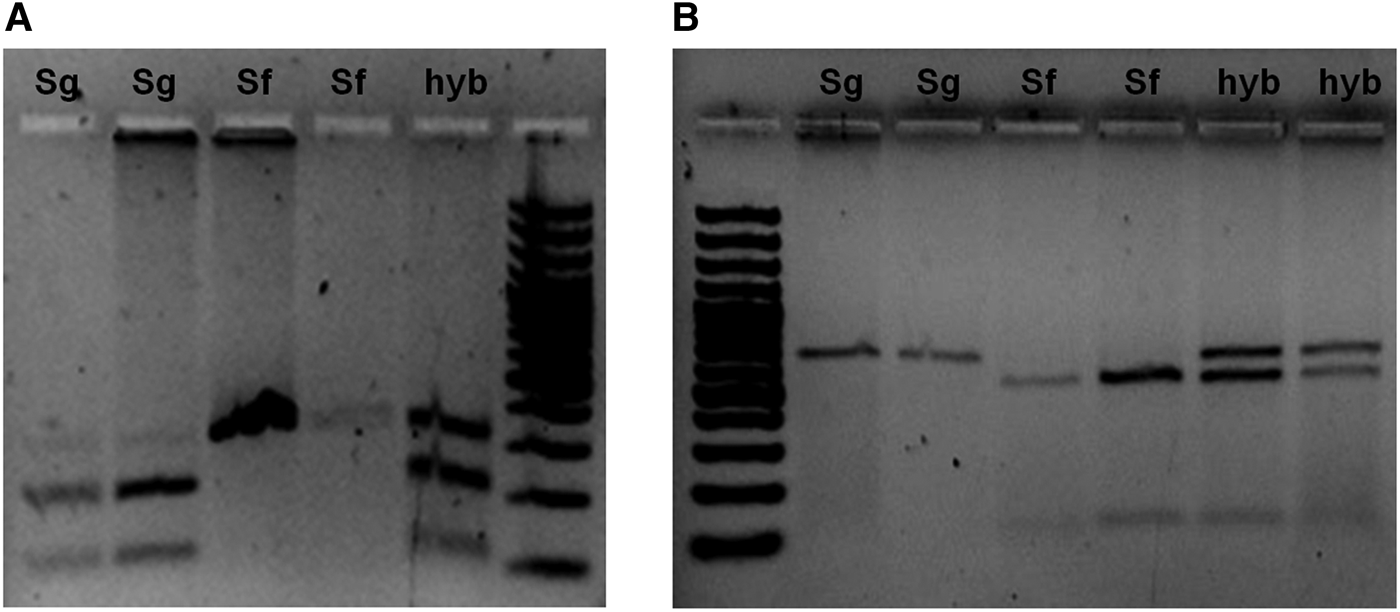
For the GBA/HapII system (Figure 3A), samples of S. guianensis had two bands (200 and 100 bp), whereas S. fluviatilis samples showed only one band (300 bp), indicating that the GBA fragment remained intact. The simulated hybrids revealed three bands on the agarose gel, which were 300, 200 and 100 bp, thus presenting a third pattern.
PCR-RFLP diagnostic systems in 2% agarose gels. (A) GBA/HapII specific patterns. Samples coded as ‘Sg’ are S. guianensis, samples ‘Sf’ are S. fluviatilis and sample ‘hyb’ is the simulated hybrid. (B) Lac/TspRI specific patterns. Sample codes are the same as in (A), and sample ‘hyb’ is a second simulated hybrid. We used a 100 bp molecular ruler.

For the Lac-1/TspRI system (Figure 3B), S. guianensis showed only one band (~600 bp), whereas S. fluviatilis produced two bands (500 and 100 bp). The mixed sample of Sotalia spp. showed the expected three bands pattern (600, 500 and 100 bp) (Figure 3B).
To confirm the patterns obtained, 15 samples (including the six individuals used as controls) had their GBA and Lac-1 introns sequenced. The PCR products were purified using magnetic beads (Agencourt AMPure XP Kit) and sequenced in both directions in an ABI 3500 platform (Applied Biosystems) using specific chemistry.
Sequences were edited using the SeqMan 7 program (DNASTAR, Inc.). Species identification was confirmed by a similarity search in GenBank (http://www.ncbi.nlm.nih.gov) using the Blastn algorithm and by alignment analysis in MEGA 5.10.
RESULTS
Using the GBA/HapII we could identify 35 of the 76 samples as S. guianensis. One sample produced an ambiguous PCR-RFLP pattern and was sequenced for identification. The remaining 41 samples failed to amplify.
With Lac-1/TspRI, we identified 24 samples as S. guianensis. Eight samples generated ambiguous banding patterns and had their Lac-1 intron sequenced. The remaining 44 samples failed to amplify.
The nine samples sequenced for confirmation of the PCR-RFLP systems were identified as S. guianensis. Combining all identifications, we verified that of 76 samples, 51 were confirmed as S. guianensis (67%), whereas 25 could not be identified with the methods used in this study. No individual of S. fluviatilis or any hybrid between the two species was detected.
Of these 51 S. guianensis samples, 43 were collected in the Ver-o-Peso market and eight in the estuary. Microsatellite analysis of the Ver-o-Peso samples indicated that they belonged to different individuals (Cunha et al., submitted).
DISCUSSION
All 51 samples that could be analysed using the diagnostic systems and the sequencing of GBA or Lac-1 were S. guianensis. This study thus confirms, through the analysis of nuclear genes, that the amulets sold in popular markets of the Amazon belong to S. guianensis as indicated by previous studies based on mtDNA (Cunha & Solé-Cava, Reference Cunha and Solé-Cava2007; Gravena et al., Reference Gravena, Hrbek, da Silva and Farias2008; Sholl et al., Reference Sholl, Nascimento, Leoncini, Bonvicino and Siciliano2008; Ruiz-Garcia et al., 2013). Microsatellite data has further shown that the illegal trade of love charms is supplied by a population of S. guianensis in the Amazon Estuary (Cunha et al., submitted). Therefore, all samples analysed in this study belonged to S. guianensis from the Amazon delta. Up to now, 150 samples from the delta have been molecularly analysed, and S. fluviatilis has not been detected (Cunha et al., Reference Cunha, da Silva, Lailson-Brito, Santos, Flores, Martin, Azevedo, Fragoso, Zanelatto and Solé-Cava2005; Ruiz-Garcia et al., 2013; this study). Although the lack of evidence does not confirm that S. fluviatilis does not exist in the Amazon Estuary, it is a strong indication. It is noteworthy that other freshwater mammals, such as the Amazonian manatee Trichechus inunguis and the river dolphin Inia araguaiensis, do occur in the same area where our samples were collected (Domning, Reference Domning1981; Siciliano et al., Reference Siciliano, Valiati, Emin-Lima, Costa, Sartor, Dorneles, Silva and Oliveira2016).
At the same time, the absence of S. guianensis × S. fluviatilis hybrids in our sample does not rule out their existence. Hybridization has been observed among other animals in the Amazon Estuary, for example, between the Antillean manatee Trichechus manatus and the freshwater Amazonian manatee T. inunguis (Vianna et al., Reference Vianna, Bonde, Caballero, Giraldo, Lima, Clark, Marmontel, Morales-Vela, Souza, Parr, Rodríguez-Lopez, Mignucci-Giannoni, Powell and Santos2006). The lack of hybrids in our sample could be due to the absence or very low abundance of S. fluviatilis in the region, as suggested by the DNA data, or it could reflect a very infrequent event, which is usually the case.
If S. fluviatilis is absent from the estuary, the sympatric area for Sotalia dolphins may still occur upstream in the Amazon River because marine S. guianensis is known to enter fresh water in other areas of its distribution (da Silva & Best, Reference da Silva and Best1996). How far upriver S. guianensis exists is presently unknown. Thus, we emphasize that studies in the Amazon delta and lower Amazon River should attempt to detect hybridization as a way to check for the existence of a sympatry zone between the two species. Another interesting avenue for research is using environmental DNA (eDNA) to try to detect the presence of S. fluviatilis in the Amazon estuary, and of S. guianensis up the Amazon river (see Foote et al., Reference Foote, Thomsen, Sveegaard, Wahlberg, Kielgast, Kyhn, Salling, Galatius, Orlando and Gilbert2012 for an example).
The PCR-RFLP systems developed here are recommended for this goal. They are able to successfully discriminate the two Sotalia species and their potential hybrids, and provide faster results than DNA sequencing at a lower cost. We estimated that the simultaneous use of the two PCR-RFLP systems is 7–25 times faster and 3.37 times cheaper than sequencing. If a single PCR-RFLP system is chosen, then the method becomes even more attractive in terms of time and cost. These diagnostic systems are ideal for fast and cheap initial screening of a large number of samples, leaving DNA sequencing for those that cannot be identified through PCR-RFLP.
ACKNOWLEDGEMENTS
We thank Antonio M. Solé-Cava for providing laboratory facilities for the study, and for suggestions to an early draft.
FINANCIAL SUPPORT
This work was financially supported by the Conselho Nacional de Pesquisa e Desenvolvimento Científico – CNPq, Brazil (Grant #102124/2011-6, and scholarship #560236/2010-7). This scientific paper was developed with Amazonas government support through the Fundação de Amparo à Pesquisa do Estado do Amazonas (PAPAC 020/2013 Process # 062.00888/2014).