‘I came in on a tank, and only a tank will evict me.’
Abu Zuhair Tahir Yahya, PM of Iraq, 1968.Footnote 1
‘The first measure will be to recall the previous parliament and make sure the proceedings are constitutional.’
Muhammad Naguib, President of Egypt, 1952.Footnote 2
To many observers, the fall of Hosni Mubarak in Egypt looked much like a coup. The natural, most pressing question of the day seemed to be: was it a good or bad coup?Footnote 3 By ‘good’ most people mean a development that furthers democracy, the rule of law and economic growth. We have few theoretical or empirical tools to address this question. While coups have been a staple of twentieth-century politics, their aftermath has eluded systematic scrutiny.
We seek to change that by studying the occurrence of competitive elections after coups. Since elections are a necessary condition for democracy, understanding how (and under what conditions) forceful seizures of executive power lead to liberalizing outcomes is a point of considerable interest. We find that there is considerable variation: it could be months or decades to the next election. Table 1 shows that, historically, most coups d’état were not followed by elections during the five years after. Whoever took power opted to rule without popular consent. The table also shows a remarkable reversal: after 1991, most coups were followed by elections. We argue that important factors changed with the end of the Cold War, which explain this reversal.
Coups Ending in Elections ≤ 5 Years

With few exceptions, scholars to date have focused on the causes of coups.Footnote 4 We would argue that what is needed is a more thorough understanding of the consequences, how they vary and how this variation might, in turn, influence the incentives of potential coup plotters.
We consider explanations based on domestic factors and forces. Economic development, economic growth and who leads a coup may help account for the occurrence of elections after coups. But they are unable to fully explain the reversal we observe. External actors can significantly affect the value of holding onto power after a coup succeeds; more importantly, what outsiders want is at least somewhat historically contingent. With the end of the Cold War, the West began to promote free elections in the rest of the world. While elections have not always been free and fair, nowadays nine out of ten countries around the world hold regular elections that are significantly more competitive than the forms of political contestation that most of them had before 1990.Footnote 5 Outside forces may be unable to intervene quickly enough to forestall a rapid power grab, but foreign donors have ample time to influence the direction of new and vulnerable regimes.
Our empirical section exploits original elections data on 249 coups between 1945 and 2004. We use official development assistance as a proxy for Western pressure to hold elections. We show that dependence on Western aid tends to make countries more likely to hold competitive elections after coups – but this result only holds for the post-Cold War cases.
Our identification strategy exploits the fall and breakup of the Soviet Union, a development that is arguably exogenous to countries’ inherent propensity to hold post-coup elections. The fall of the Soviet Union had two main, potentially related, consequences. First, countries in need of aid could no longer ‘shop around’ and play the West off against the Soviet Union – there was no more aid from the Soviet Union. Secondly, the fall of the Soviet Union also affected Western views about the potential and need for the promotion of democracy.
Our argument seeks to contribute to the literature in three ways. First, we study an important and relatively neglected choice faced by all coup leaders before their new regime has taken shape: what is to be done with power? We agree with intuitions in the literature that regime insiders are often split on this issue in principle, with some prepared to withdraw from power and call for elections while others are determined to set policy by themselves.Footnote 6 We show that foreign pressure can play a role in swaying this consequential choice. We also hope to open a debate on other consequences of coups,Footnote 7 such as when they make civil wars more (or less) likely.
Secondly, our research has important implications for the staying power of democratic political institutions. By one count, three out of every four failures of democracy are the result of a successful coup d’état.Footnote 8 This makes forceful power seizures the biggest single danger to democracy. If the international community can affect the consequences that coup plotters face after they succeed in their attempt to grab power, democratic failures need not last long. The anticipation of elections may also affect the incentives of potential plotters to attempt a coup in the first place. Thus democratic institutions may be more durable and less frail due to countries’ changing post-coup trajectories.
Thirdly, we aim to contribute to the vibrant literature on the international influences on democratization. Initial attention in the literature sought to identify broad causal links between relatively macro concepts such as membership in international organizations and democratization.Footnote 9 Scholars have now started to look more into micro processes, for example by examining the role of outsiders in elections.Footnote 10 By linking foreign pressure and post-coup election choices, we reveal the calculus of leaders who can do much to affect the liberalizing trajectory of their countries. Perhaps surprisingly, the international community may have more leverage with coup entrepreneurs than with authoritarian incumbents more generally. While this article only examines the role of aid dependence, this research agenda can be extended to cover the role of international organizations, conditionality in trade agreements and other international influences on leaders’ post-coup political choices.
A THEORY OF ELECTIONS AFTER THE COUP
Existing Literature
We define a coup d’état as the seizure of effective executive authority through the threat or use of force. The actors perpetrating the coup may include the military, the police, a domestic armed group, a member of the governing elite or some other set of domestic actors. The use of force may be overt, such as fighting in the capital, or may come in the form of tacit support for the power grab by the military and security apparatus.Footnote 11
Traditionally, coups d’état have been understood to be caused by political instability. Instability, whether it is manifested in institutional gridlock or mass protests, invites members of the ruling elite or military to supplant the government and take the reins of power into their own hands. There are many explanations of the causes of political instability, but two stand out. One examines a country's level of economic modernization and the development of its political institutions, tracing the roots of instability to a lack of congruity between the two. As economic modernization transfigures urban and rural communities around the world, there is pressure on governments to meet the demands of a new class of politically conscious and mobilized individuals. When governments fail to deliver, instability follows.Footnote 12 A related view argues that political instability is caused by political illegitimacy. Governments become illegitimate when they fail to deliver on the expectations of their citizens. Economic performance is an important measure of how governments are meeting expectations. Thus economic decline can be profoundly destabilizing, while economic growth may solidify a government's claim to legitimacy.Footnote 13
Other extant explanations of the causes of political instability focus on how and why the army – often a player – intervenes in politics.Footnote 14 Often the army sees itself as the bulwark against chaos, and justifies its intervention into government by invoking threats to a country's institutional stability, economic welfare or foreign policy direction.Footnote 15 This tendency is reinforced where the army holds a special place in society, for example due to events surrounding the origin of the state.Footnote 16
These insights have made important progress possible, but they do not fully explain what shapes post-coup choices. Why a successful leader of a forceful takeover of power would organize elections remains something of a puzzle. After all, such actors are adept at grabbing power through irregular, unconstitutional means. That may make them resilient once they are in office, or at the very least it may indicate that they are not interested in (democratic) constitutional procedures. More importantly, we argue that the existing literature ignores how the potential consequences of coups affect the incentives of potential coup plotters.
If it were the case that elections conducted by coup entrepreneurs were mere façade, serving to establish their hold on power, the question would be trivial. While this kind of election does occasionally take place, the focus of this article is on competitive elections, which are substantially fair and free of fraud. Coup leaders rarely compete in such elections, and even when they do, only sometimes emerge victorious. Thus the conceptual puzzle is, why would coup leaders agree to hold elections, the consequences of which may substantially reduce their power over a country's affairs?
Even though not all coups start in autocracies, following a coup, a country is by almost any definition an autocracy. That makes the literature on authoritarian regime breakdown and democratic transitions a good starting point. One well-known proposition in that literature argues that democratization and economic development are systematically related.Footnote 17 One plausible hypothesis would then be that holding competitive elections after coups is related to a country's level of economic development: all else equal, a more developed country is more likely to face pressure to hold elections.Footnote 18
While we do not believe that this argument is wrong, we believe its explanatory power is limited. To demonstrate why, we offer a simple, two-stage decision-making timeline in the appendix. The kinds of factors that enable coup leaders to succeed in taking power are often systematically related to their ability to stay in power. In the case of economic development, it is easier to grab power via a coup in underdeveloped countries. This induces attrition in the sample of observed events, weakening the relationship between development and time to elections. Countries with higher levels of economic development may be more likely to hold elections after coups, but they are also unlikely to experience a coup in the first place, and so are not under observation at the stage we are focusing on.
Our Argument
In order to understand why some coups lead to elections, we should consider the relationship between pre-coup policy, what a coup leader would favor as an ideal post-coup policy and the policy outcomes that elections would produce. Suppose the pre-coup status quo corresponds to the median voter's preferred point, as would typically be the case ‘soon’ after free and fair competitive elections. Under these conditions, the only coups that would occur would be those seeking to install a durable (military) government. This fits many observed events. For example, Franco's coup in Spain was a response to a socialist victory at the polls in 1936. The military was not interested in elections, because they were bound to produce the same ‘radical’ left-wing policy outcome.
While those coups may have become paradigmatic of how we think of the forceful seizure of power, we would argue that they do not tell the whole story. When the pre-coup status quo policy outcome moves away from the preferences of the median voter, we may see a ‘guardian coup’: the military takes power from a corrupt and inept civilian administration and promises to return the country to elections after reforming the system. The 1960 coup in Turkey, the 1974 coup in Portugal and the Bangladeshi coup in January 2007 fit this description. In such cases, the actions of the army are greeted with popular enthusiasm, as is the promise to hold fresh elections after purging corrupt politicians. When unpopular governments move status quo policy away from the median voter's ideal point (through corruption or repression of the opposition), coup leaders may have enough to gain in terms of policy from seizing and then relinquishing power to make doing so worthwhile.
Finally, where the status quo policy is closer to what the coup plotters can get in post-coup elections, we may not see any coups; and if we did, they would not be followed by a transition to democracy. Potential coup plotters with policy preferences farther away from the median voter than the current government should be less likely to launch coups, because they may be pressured to hold elections that would produce policies even more unfavorable to them than those of the current government. For a mathematical formalization of this argument, see the appendix.
What kinds of factors are likely to push coup leaders toward elections? The existence and history of a country's democratic political institutions can be important. Democratic institutions tend to consolidate in part by creating widely shared norms and expectations among the population at large about the desirability of electing one's own leaders. Coups in established democracies may result in a swifter return to elections, due to the difficulty the new rulers face in stymieing popular expectations. Even if the coup leaders accuse the democratic government of mismanagement and use that as a pretext to seize power, they would have to deal with mounting expectations to return to the barracks once their job is done. The probability of successfully retaining power without elections may be lower in such cases. Because coup leaders have to hand over power, their incentive to carry out a coup may be lower in the first place.
It is also potentially important to consider the identity of the actors who participate in the coup. Professional militaries are often the culprits, but other regime insiders – ministers or former members of the military (who may have turned rebels) may sometimes be responsible.
In cases where military-led coups produce military regimes, Barbara Geddes has argued that corporate interests pull the military back to the barracks, creating factions and splits within the leadership.Footnote 19 The empirical record suggests that debates about what to do with power are indeed common among successful military coup leaders. In the 1960 Turkish case, the army moved to take power away from an inept and increasingly authoritarian Menderes government. Soon, disagreement emerged between the army's commander in chief, General Cemal Gürsel, and some of the younger officers. Gürsel, who favored a quick return to civilian administration, prevailed in the end.Footnote 20 A similar rift within the Egyptian Free Officer movement emerged between the formal leader of the army, General Muhammad Naguib, and the young charismatic Nasser after the 1952 coup.Footnote 21 If military regimes are more prone to factions, then coups led by military actors may be more likely to lead to a speedy handover of power in elections.Footnote 22
If factionalism lowers the probability of retaining power without elections, it is also important to note that a professional military may be better at putting together a government and staving off challenges to its rule – in short, at staying in power without elections. The net effect on time to elections after coups is, therefore, not as clearcut. Recent work notes that the incentives of the military may be more complex than currently thought.Footnote 23
While societal demands for elections, and the identity and skill of the perpetrating actors, may play a role in a state's post-coup trajectory, scholars have recently begun to acknowledge the importance of outside factors as forces for democratization. It is well known that coup leaders care intensely about international reactions to their undertakings. In his first communiqué, Colonel Jean-Bédel Bokassa of the Central African Republic, for example, hurried to announce (among policy changes such the ‘abolishment of the bourgeoisie’) one important continuity – that ‘all foreign agreements shall be respected’.Footnote 24 The Greek colonels intensely lobbied the US government for speedy recognition and argued that their hold on power depended on securing American support.Footnote 25 In Guatemala, General Manuel Orellana, who ousted the Conservative government in 1931, tendered his resignation before the National Congress when the United States withheld recognition.Footnote 26 Coup leaders have often made negotiations with foreign donors a top priority upon seizing office. Major Daouda Malam Wanke, head of the presidential guard that deposed the corrupt leader of Niger in 1999, assured the European Union (EU) that elections would be held soon in order to secure a lifeline of Western aid. One of the poorest countries in the world, Niger lives off foreign aid – it comprises up to 80 per cent of its operating budget, varying somewhat over time. The September 2003 coup in Guinea-Bissau, the coup in Mali in 1991 and others tell similar stories.
Such sensitivity to international potential reactions should not come as a surprise, since many countries depend on the outside world for key resources. Country leaders can try to isolate themselves from foreign pressure by relying on small groups of loyal supporters, but coup entrepreneurs have to contend with an especially precarious domestic situation. Foreign support may co-ordinate expectations among wavering backers and cause them to fall in line, whereas foreign condemnation may undermine domestic confidence in the regime's ability to deliver indispensable outside resources.
The international audience's reaction to a coup depends on many factors. There was relatively little Western pressure to hold elections during the Cold War period. The United States and the former colonial powers in Europe displayed an ambiguous attitude toward coups and coup plots: sometimes helping, sometimes thwarting and sometimes doing nothing. The American involvement in Allende's removal has given US democratization policy during the period a poor reputation. The United States sometimes opposed coups in support of freely elected governments.Footnote 27 Because the world was thought to be a chessboard of West vs. East, attitudes toward both the extra-constitutional seizure of power and on whether to pressure for elections varied depending on which side of the ideological conflict the relevant actors took. The same applied to the policies of the other major donors. After the Cold War ended, dependent countries could not credibly threaten to defect to the USSR as a source of foreign aid. This gave Western powers more bargaining leverage to demand elections.
After the Cold War, however, major players in international affairs – including the United States and the EU – professed a commitment to defend democracy, including by punishing attempts to bring down elected incumbents. In fact, US presidents have been bound since 1997 by an act of Congress to suspend foreign aid if a recipient country experiences a coup d’état.Footnote 28 The EU made a comparable commitment in 1991.Footnote 29 This insistence on competitive elections reflects normative concerns with the political rights of others, but also rests on an understanding that a liberal international order is in the long-term strategic interests of the West.Footnote 30
We do not claim that foreign donors universally apply pressure to hold elections. Geopolitical considerations can still play a role. We merely argue that there has been an overall shift toward support for restoring democratic institutions. Even if the demands are not for fresh elections but for the reinstatement of a previously elected democratic incumbent, this shift implies that we are more likely to observe elections after a coup in the post-Cold War period than before. Furthermore, the effect should be strongest among states that are most dependent on access to Western-provided benefits.
The end of the Cold War has also been marked by an increase in the prevalence and lethality of civil wars. The occurrence of a coup d’état is sometimes interpreted as a civil war that did not take off. The bad news is that the country may still be at risk.Footnote 31 Pressing for elections in this context may be seen (whether rightly or wrongly) as a stabilizing factor by the international community.Footnote 32
All these factors motivate the international community to press the country on liberalization, which we argue has important implications for coup leaders. We should also note that the effect of international pressure on the probability that a coup d’état will succeed is probably limited. Outsiders can do little to affect the rapid chain of events often associated with a power grab. Even in cases in which Western militaries have ‘boots on the ground’, there has been a reluctance to get drawn into local struggles for power.Footnote 33 While the events surrounding a coup d’état often occur too quickly for direct outside intervention to make a difference, the aftermath of a successful seizure of power presents the new leaders with a difficult – and potentially protracted – consolidation phase. The international community is presented with ample opportunities to impose conditions on the country's leaders, while the new leaders worry about having sufficient resources to stave off challenges to their untested grip on power. Some coup leaders may succeed in ‘coup proofing’ their hold on power, while others who are more dependent on foreign support may face greater hurdles. Unlike the case of economic development and coups, we would not expect the same attrition in the case of estimating the impact of foreign aid on time to elections after coups. Coups happen as easily in aid-dependent states as elsewhere, and the full range of values of that independent variable is available at the second stage.
We expect outsiders’ demands for elections to be potentially decisive in determining a coup leader's strategy, especially where outside actors control a country's access to substantial resources. We can think of several ways to gauge this proposition. We focus on Western development aid flows as a particularly prominent example in which the international audience can exercise significant leverage. Our focus on Western development aid flows has several distinct advantages. First, since a broad range of countries is highly dependent on aid flows, we should be able to find effects for a relatively large sample of post-coup decisions. Secondly, the list of countries most dependent on foreign aid changes relatively little – if at all – from the Cold War to the post-Cold War era. In other words, it is not the demand for foreign aid, but the democratic conditionality of foreign aid that has fundamentally changed with the end of the Cold War.Footnote 34
There is a large literature on how foreign aid impacts democracy. Many scholars are skeptical that the effects are positive, blaming the politically motivated targeting of aid by donor governments.Footnote 35 A well-known null finding argues the case for no effects.Footnote 36 Others see in aid a much more pernicious influence on freedoms, citing the ‘curse’ of unearned income.Footnote 37 A recent study of autocratic regimes sees a conditional effect that depends on the size of the ruling coalition.Footnote 38
We differ from most studies of aid and freedoms, in that we do not look at broad regime trajectories but focus on trajectories conditional on a successful coup d’état. We agree that democratic conditionality is key for whether aid helps democracy.Footnote 39 The effects of conditionality on coup leaders may be systematically different from the impact on the broader population of a country's leaders. A coup leader's tenuous grip on power (at least initially) may give more leverage to outsiders. Leaders new to power may also have fewer strategic relationships with donors, thus enabling a more principled conditionality policy. The occurrence of a coup may be more obvious than the gradual slippage of freedoms, enabling a more immediate and co-ordinated international response.
We also aim to contribute to the literature on the international dimensions of democratization.Footnote 40 We agree that Western linkage and leverage matter;Footnote 41 we show how it matters in the context of a forceful, unconstitutional seizure of power. Much of the extant literature tends to focus on elections or on democratization broadly defined. The main idea in the elections-centered literature is to improve the quality and legitimacy of elections: whether by international observation, legal help or coordinating mass responses to vote theft.Footnote 42 We focus on one specific causal process of international influence on democracy (aid dependendence on incentives) and on one pathway (coups to elections) in order to improve causal inference.
Our argument has implications for whether and what kinds of coups were committed before and after the end of the Cold War. To the extent that holding elections after coups can reduce the ‘prize’ to be gained by seizing power, factors that make post-coup elections more likely are bound to make coups less likely. Thus one reason that coups are in relative decline may relate to perceptions of their changing payoffs. Our argument also implies that a greater proportion of the post-Cold War coups were guardian coups, where the preferences of the coup leaders are not incompatible with those of the median voter. Since they expect to be asked to hold elections, actors would only gamble on a coup if the resulting policy shift toward the median voter is worthwhile.
Hypotheses
Our theoretical development, derived with the help of the model offered in the appendix, suggests the following testable hypotheses:
Hypothesis 1: Higher levels of economic development increase the probability of a post-coup election.
Hypothesis 2: Coups committed against existing democracies are more likely to result in elections.
Hypothesis 3: Coups committed by the military increase the probability of a post-coup election.
Hypothesis 4: Greater dependence on Western aid flows increases the probability of post-coup elections, but only in the post-Cold War era.
If modernization theory is correct, per Hypothesis 1 we would expect to see fewer coups in countries with high levels of economic development. This would make it harder to detect the effects in empirical tests.
Hypothesis 2 recognizes the effects of pre-existing institutions. We will require the country to have a tradition of democratic elections in order to better capture the effect of institutionalization.
Hypothesis 3 traces differences in observed trajectories to the identity and organization of the actors seizing power. The military may be systematically different from other actors when it comes to ruling without a popular mandate, depending on whether military actors are also better at staving off challenges to their rule.
Finally, Hypothesis 4 seeks to connect the changing international norms and expectations to the decision to hold elections. Specifically, it seeks to uncover the potential effects of leverage based on countries’ dependence on foreign aid. When conditionality changes, we would expect to see discernible effects on the timing of competitive elections. While these hypotheses are not mutually exclusive, our identification strategy is strongest on identifying the effect of Hypothesis 4.
Data
To test these potential causal relationships requires appropriate data on coups and elections. Our coup d’état dataset is based on a database of political leaders called Archigos,Footnote 43 which codes the identities of all leaders in 164 countries around the world from 1875–2004 and includes information about how they assumed and left office. We look at how power is transferred between two leaders to identify events that may qualify as coups. Archigos first codes a variable to identify all ‘irregular’ exits by a leader. From there, it codes a number of additional variables to distinguish between the different types of irregular exits. An irregular exit occurs when constitutional or customary provisions for how power is supposed to change hands in a country are not observed. Not all irregular exits are coups. We use additional variables to tell us whether the case involved the use of force; whether force was used or merely threatened; and whether the military, rebels, government insiders or foreigners were involved in the events. A coup occurs where (1) force is threatened or used, (2) the military, government insiders or rebel actors are involved and (3) foreign actors play a minor role.
A change in power within a military junta, if it involves the threat or use of force, is considered a coup. Social revolutions and popular uprisings are generally not considered coups, unless at some point a group of actors connected to the government threatened or used force to remove the government in place. Unsupported assassinations, where the perpetrator or perpetrators lack the basic organization or resources to take power, are not considered coups. Likewise, the forcible ouster of a regime by foreign actors is not considered a coup.
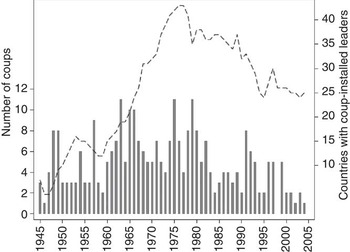
Based on this information, we identify 249 instances of coups d’état between 1949 and 2004.Footnote 44 Figure 1 illustrates the prevalence of coups over time and the number of countries with coup-installed leaders in office.
What happened to the coup d’état?

While our definition captures a broad consensus, differences with previous operationalizations inevitably remain.Footnote 45 The basic insights we share with the literature are the emphasis on the use or threat of force in effecting regime change, and the notion that the transfer of power should violate constitutional or customary procedures in order to qualify as a coup. We disagree with some existing operationalizations in one or more of the following ways.
First, we do not include unsuccessful coups. Coup plots and failed attempts are difficult to establish systematically and independently of potentially questionable claims and interpretations by governments.Footnote 46
Secondly, we do not require the irregular transfer of power to result in substantially new policies in order to qualify as a coup. We feel that whether or not the actors who seize power choose to adopt new policies matters, but that it should more properly be conceived of as a dependent variable in its own right. In fact, policy choice may be endogenous per our argument, making a definition of coups along those lines problematic.
Thirdly, we allow the perpetrators of a coup d’état to be members of the government security apparatus or members of the government itself (for example, Daud Khan to Taraki in Afghanistan) or rebel forces battling the government (for example, Habre to Deby in Chad). We do so because the emphasis on extra-constitutionality and the use of force associated with coups should cover such events. This practice makes our approach consistent, unlike several other approaches.
Some existing datasets propose a more narrow view of the coup d’état, suggesting that only takeovers by government insiders (as opposed to insurgents) qualify. However, we have found that these claims are inconsistently applied. For example, in about one-third of the cases in which we find that rebels effected the government takeover, the Marshall and Marshall datasetFootnote 47 codes that a coup d’état has taken place. The authors do not clarify why these cases count but not the other two-thirds of similar transfers of power we identify. We aim to consistently apply our basic definition to all cases in the record.
An important advantage of using the Archigos dataset is that we know the full universe of cases from which we are deriving observations. Because Archigos records all leadership transfers, we can select the subset of those that fit the description of coups without worrying that some transfers were not recorded in the first place. Thus while coding decisions can be made about which transfers are defined as coups, we are confident that all candidates for successful coups are contained in the data. We are also consistent in applying coup coding decisions to all transfers of power that meet a particular rule. The degree of correlation between our data and other sources ranges from 65 to 82 per cent, suggesting that we both depart from and share substantial agreement with previous work. The online appendix offers replication results with alternative data.
Data on elections comes from the National Elections Across Democracy and Autocracy (NELDA) dataset.Footnote 48 This dataset codes all national-level elections in 165 countries – presidential, legislative and parliamentary – together with a variety of attributes that allow us to determine whether an election was competitive. A competitive election is defined as one in which (1) political opposition is allowed, with more than one candidate allowed to run for office (2) multiple parties are allowed and (3) the office of the incumbent leader is contested.
We combine the coup and elections data to generate our unit of analysis – the time to election after a successful coup. Coup spells thus form the basic building block of our data. A country enters a coup spell in the year it experiences a successful coup, and exits a coup spell when it holds a competitive election.Footnote 49 A country that is currently in a coup spell and experiences a fresh coup has its current spell censored and enters a fresh coup spell. The format of the data is country-year.
Our dependent variable is the termination of the coup spell by an election (coupfail), and we allow this process to have an underlying duration. Conceiving of the problem in this way allows us to group observations and deal appropriately with cases that are censored.Footnote 50
We combine two datasets to provide us information on 249 distinct coup spells in 164 countries, observed between 1945 and 2004. The average duration of a spell is eight years, and the range spans from under one year to thirty-six years (Libya).
We study elections, rather than democracy, because elections are well-defined, measurable events – and because they really do matter. It therefore behooves us to first examine how elections affect the tenure of coup leaders. The NELDA dataset allows us to track whether the actor who led the coup was out of power after the elections, in both the Cold War and post-Cold War eras. The results are unambiguous: in 78 per cent (Cold War) to 76 per cent (post-Cold War) of cases, coup leaders lost power after an election. These elections can therefore be characterized as meaningful transfers of power. There is additional information (only for the post-Cold War era) on the nature of elections, which shows that international observers agreed that more than 82 per cent of all post-coup elections were free and fair.Footnote 51 We also checked the liberalization trajectories of countries experiencing coups with the Polity dataset.Footnote 52 We found that post-1991 coups led to substantially more liberalization than pre-1991 coups, supplying yet another ‘face’ validity confirmation of the idea that elections matter.Footnote 53
Table 1 shows that the end of the Cold War is associated with a significant flip in the time to elections for coups: approximately three-quarters of coups resulted in elections in under five years, in contrast to the pattern before, when three-quarters of coups installed authoritarian regimes in power.Footnote 54
When it comes to Hypothesis 4, we can do more to visualize the over-time variation in the data. We can base our identification strategy on the observation that the end of the Cold War constitutes an exogenous shock to the West's willingness to tie various benefits to progress toward democracy.
We start by observing that the period in which the coup occurs in effect represents being assigned either to a control group (= pre-1991) or a treatment group (= post-1991). In the treatment framework often used in experimental research, we have different ‘dosages’ of treatment. In this case, highly aid-dependent countries are treated with a ‘higher dose’ than those at low levels of aid dependence by the end of the Cold War. More highly treated units should differ in their propensity to adopt elections.
We divide countries into two categories: high and low levels of foreign aid dependence. The cut-off point is 6 per cent of GDP derived from aid, roughly the median in our sample. We perform within-group comparisons to see how the end of the Cold War produces different outcomes in each group. We construct a binary indicator of whether the country experiencing a coup held elections within five years. This representation of our dependent variable is simple and intuitive.
Table 2 provides a simple comparison of the average incidence of coups followed by elections, by aid dependence and by period. Consistent with our expectations, we see a much greater share of the high-dependence group held elections within five years after a coup. The table adds a simple t-test of means, revealing that only the high-dependence group exhibits a statistically significant mean shift between the two periods.
Proportion of Coups Ending in Elections ≤ 5 Years

The four groups shown on this table are not necessarily comprised of comparable observations. Countries experiencing coups may be different in important ways. For the counterfactual comparison framework to be plausible, we need to eliminate these types of differences as much as possible so that treated (post-1991) coup events are as similar as possible to control (pre-1991) events. We turn to regression analysis next.
ANALYSIS OF POST-COUP ELECTIONS
We divide our sample into two sets of ‘coup spell’ years: before and after 1991. Our choice of regression model for the grouped-duration data we have is the probit, which shares many of the advantages of duration models while being relatively intuitive and straightforward to interpret.Footnote 55
With the country-year (of a country during a coup spell) as our unit of observation, we estimate a model in which the dependent variable is whether or not a country held competitive elections in a given year. Our main independent variable is dependence on Western aid, defined as the ratio of the total aid receipts reported to the OECD and the country's gross domestic product (GDP) that year, lagged by one year.Footnote 56 We expect to find that aid dependence has no effect on whether elections are held before the end of the Cold War, but is positively related to the occurrence of post-Cold War elections, as per Hypothesis 4.
We include a number of other variables in the estimation. First of all, because we want to know whether the process of adopting elections is path dependent, we include a measure of the number of years since the coup. It may be that the longer a country remains in a coup spell, the less likely it is to adopt elections, as leaders consolidate their power base or become more unpopular and therefore more wary of a competitive contest. It could also be that the effect goes the other way: that the need to rebuild legitimacy through competitive elections increases over time. We only include a linear counter of years since the coup – including more complex forms such as cubic splines did not add explanatory power to the model. We include a weighted average of the ten-year history of coups, ranging from 0 for countries with no coups in the last ten years to a theoretical maximum of 1 for a country hypothetically experiencing ten coups in each of the last ten years. The idea is to capture how the path dependence of coups may affect coup leaders’ willingness to move to elections faster (thus avoiding a fresh coup in highly coup-prone settings).
Secondly, we use the NELDA dataset to generate and include a binary measure of whether or not the country was an electoral democracy when the coup occurred. The idea is to see whether institutions are sticky: if countries that have a tradition of electing their government revert to having elections faster, that would be evidence of the residual bite of institutions. Because we are interested in the effect of institutionalized democracy, we code this variable as 1 for countries that have had electoral democracy for at least seven years.Footnote 57
Next, we include a logged and lagged measure of GDP per capita, measured in constant 1995 dollars. It may be that domestic pressures to adopt elections are greater in societies at a higher level of socio-economic development, as per Hypothesis 1. In particular because a country's aid dependence and GDP per capita are likely negatively correlated, we need to include this variable as a covariate in the model. We include a lag of economic growth in the regression as well: arguments tying the behavior of political actors to legitimacy and crises suggest that a country's economic performance may play a role in the decision to hold elections.Footnote 58 The source of the GDP data are the Penn World Tables.
We also include a dummy variable for whether the country is a former French colony in an effort to account for the presence and impact of French troops. Unlike other colonial powers, France has been willing to station troops in colonies and use them in support of (or against) the government in place.Footnote 59 The presence of foreign troops is another way in which the international community may affect the timing of elections after coups in a particular country. While the source of troops and period may differ, we know enough about French troops and former colonies to make this covariate theoretically relevant.
We draw on the Archigos dataset to include a variable that measures whether military actors committed the initial seizure of power. We do so in an attempt to capture the different calculations and capabilities of the military in the post-coup strategic environment (Hypothesis 3).
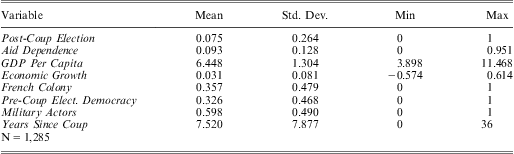
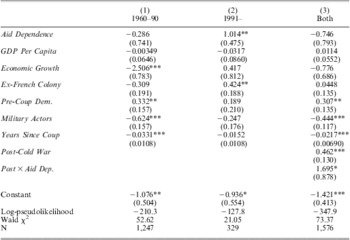
Table 3 presents the basic descriptive characteristics of the data. Table 4 shows the results of the probit analysis. We include only pre-1990 and only post-1991 models (Models 1 and 2, respectively), to provide a sense of what a fully interactive model on the full sample would look like.Footnote 60 Our theoretical argument posits a changing effect only for the Aid Dependence variable. Yet it is easy to suppose that Paris gave actors in French colonies different messages, depending on the period. It may also simply be of interest to not force the effects of the variables to be consistent across the two periods.
Summary Statistics

Probit Model of the Likelihood of a Post-Coup Election

Robust standard errors in parentheses. ***p < 0.01, **p < 0.05, *p < 0.1.
In line with Hypothesis 4, during the Cold War Aid Dependence has no statistically significant relationship with the probability that a country will move to the ballot box after a coup. This is evident in the split-sample models, and the difference between Aid Dependence during the Cold War and Post-Cold War × Aid Dependence is statistically significant (X 2 = 3.73; p < 0.0535, two-tailed tests) in the interactive model.
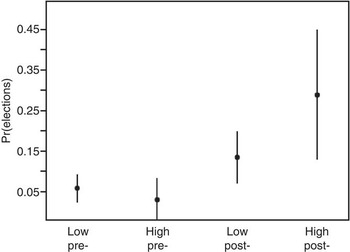
In substantive terms, Figure 2 illustrates that for the pre-1990 period, the probability of holding elections in a given year was between 0.03 and 0.05. Varying Aid Dependence does little to alter this picture. In the post-1990 period, setting Aid Dependence at the 25th percentile lowers the probability to 0.13, whereas setting Aid Dependence at the 75th percentile increases the probability to 0.30.Footnote 61 The predicted probabilities are in line with the simple t-test shown in Table 2: the increase in the likelihood of holding post-coup elections is strongest for the most aid-dependent states.
Predicted probability of competitive election after coup by high and low level of Aid Dependence and Pre- and Post-Cold War Period

The modernization hypothesis culled from the existing literature (Hypothesis 1) fares less well. GDP Per Capita has no significant effect on the probability of elections after a coup; in results not reported here, we find that the introduction of an additional variable – Post-Cold War × GDP Per Capita – also failed to show a significant relationship in the post-Cold War era.Footnote 62 This non-finding is consistent with selection-induced attrition in the economic development variable. While the mean GDP per capita in countries that are in a coup spell is US$ 1,404 (1995 constant dollars), the mean for all countries observed between 1960 and 2001 is US$ 5,235. Thus the variation in the economic development variable that remains in the coup-spell sample may be insufficient to precisely identify the effect of modernization on holding elections. Or the modernization hypothesis may be too crude to identify the factors at play in the decision to hold elections after coups.
The effect of economic growth is of some interest. During the Cold War, economic growth decreased the probability of holding an election, in line with a ‘legitimacy’ argument in which the coup leader could use economic growth to buy off any opposition. In the post-Cold War era, however, this effect dissipates. Even coup leaders who presided over growing economies could not rely on that as grounds for postponing elections after 1991. This result is noteworthy and suggests the need for further research.
The effect of democratic political institutions is to increase pressure for elections, in line with Hypothesis 2. Comparing Models 1 and 2 would suggest, somewhat surprisingly, that an electoral democracy that was overthrown by a coup during the Cold War era was more likely to subsequently hold elections.Footnote 63 The evidence on Hypothesis 2, tracking institutionalization, is therefore somewhat mixed. It could be that the Model 2 sample has most coups occurring against electoral democracies, by virtue of the increasing prevalence of the elections, thus reducing the availability of sufficient variation in this independent variable.
We also note that the time elapsed since the country entered a coup spell has a negative effect on the likelihood of elections, confirming the hypothesized effect of Svolik and others.Footnote 64
If the coup was launched by Military Actors, this significantly reduced the probability of a post-coup election, which contradicts Hypothesis 3.Footnote 65 How does the direction of the effect square with findings by Geddes, who argues that military dictatorships are more prone to exit?
The discrepancy could be due to at least three factors. First, we study the timing of post-coup elections, which shares some ground with (but is not the same as) the liberalization of dictatorships. Some dictatorships may not have come to power through coups, and thus the research questions we ask and the research design may be different. Perhaps even more relevant is Geddes’ emphasis on ‘consolidated’ dictatorships, which are understood as regimes that have been in power for at least three years. We include many shorter-lived cases.
Secondly, Wright posits that there is an interactive effect between aid dependence and whether the regime is led by the military, arguing that greater dependence on aid slows down democratization for military regimes.Footnote 66 This might explain the apparent discrepancy with Geddes’ prediction. Our data, however, are not rich enough to allow us to introduce an interaction effect between aid dependence and military leadership. Thus we cannot arbitrate definitively on the relative importance of military leadership in coups.
Thirdly, the impact of the military on post-coup elections may be complex. On the one hand, these are more professionally capable soldiers, who are able to stave off challengers. On the other hand, they might want to go to the barracks. The net effect on longevity in office, without elections, is unclear.
Overall, the results in Table 4 help shed light on why elections are much more likely to follow coups after the end of the Cold War. Dependence on Western donors for development aid, and potentially for growth-spurring policies, helps explain why countries that would have remained under a post-coup dictatorship pre-1991 were much more likely to experience competitive elections post-1991. Importantly, economic development, rising as it may be for most of the world, plays only a small role in explaining the observed variation in the timing of elections after a coup.
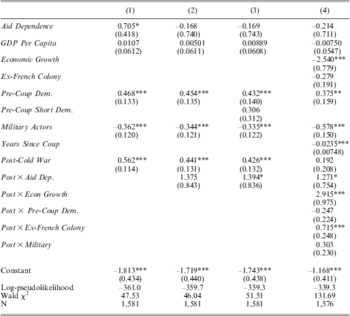
Table 5 shows additional specifications on the full sample of interest. Model 1 includes only hypothesized variables and excludes the interactive term for aid dependence. While most of the results discussed so far are replicated, we see that in this version the model indicates that aid dependence is always associated with a faster onset of elections. As Model 2 shows, this is purely an artifact of failing to account for the important changes that accompany the end of the Cold War. While the interactive effect of aid and the end of the Cold War barely misses statistical significance, the linear combination of aid and the aid interaction term is significant at the p < 0.05 level. Model 3 attempts to distinguish between the benefits of a longer vs. a shorter history of electoral democracy in a country (variable Pre-Coup Short Dem., less than seven years of democracy). We see that longer-term democratic consolidation, with a minimum of seven years of experience with democracy (and two elections), is associated with a faster return to elections after a coup, but not the shorter-term measure. This is consistent with Hypothesis 2. Model 4 is a less constrained model with a fuller set of covariates. The findings largely mirror those presented in Models 1 and 2 in Table 5.
Probit Model of the Likelihood of a Post-Coup Election: Additional Specifications

Robust standard errors in parentheses. ***p < 0.01, **p < 0.05, *p < 0.1.
We confine the analysis to the years prior to 2001 due to data availability. We believe the dynamics we describe are in place post-2001, the War on Terror and the rise of China notwithstanding. We expect that the dynamic may be somewhat weakened, but the insistence on (and legitimacy of) elections is still much more in place than during the Cold War.
DISCUSSION
Our theory and the empirical evidence suggest that coups arise in a non-random manner. We deal with this in a variety of ways. We try to understand theoretically how the non-randomness arises.Footnote 67 We seek to understand the implications for our estimation strategy and to formulate a clear argument about the exogenous variation underpinning our identification strategy.
One may be concerned that many factors change with the end of the Cold War apart from the international community's increased willingness to tie benefits to democratization. For example, domestic publics might have become disenchanted with dictatorial rule, resulting in domestic pressure on successful coup leaders to hold elections and discouraging the incidence of coups.Footnote 68
We agree that the end of the Cold War increased countries’ willingness to hold elections for many reasons. The indicator variable for the end of the Cold War in Model 3 in Table 4 shows that we are more likely to see elections after coups in the present period. At some level, this finding simply indicates that there are currently other reasons for the popularity of elections, and the dummy variable captures those trends.
The presence of other changing covariates, on their own, is not a cause for concern for our estimates, unless these covariates are both omitted and correlated with the main independent variables of interest. We would need a reason to believe, for example, that the level of domestic demand for elected government is systematically related to levels of aid dependence. Though we cannot rule out this possibility, we also cannot readily identify an alternative explanation that would challenge our identification strategy.
Because, as we suggested earlier, there might be attrition in the values of the dependent variable, we ran a model of coup occurrence to check whether our intuitions are right. We found that high levels of economic development are a strong predictor that a country will stay free of coups, which can help explain (via selection on observables) why the coefficient of economic development on time to elections is positive but insignificant.Footnote 69 Thus our intuition is correct, and the tests of our arguments constitute ‘hard’ tests.
Our theory rests on a presumed shift in Western attitudes on foreign aid to countries that have experienced coups. Do we actually observe such conditionality in action? Are anecdotal reports merely rhetorical flourishes by policy makers, or are coup leaders indeed generally punished for failing to schedule and hold elections?
First, we would expect to see differences in how the immediate aftermath of an unconstitutional seizure of executive power affects aid receipts. If pre-1991 Western policies were inconsistent and predicated on ad hoc, geostrategic considerations, we would not expect to see a decline in outside assistance across the board. By contrast, if the post-Cold War period is any different, we would expect to see post-coup aid diminish.
The data bears out this expectation. Comparing Western aid levels for the year of the coup to those for the preceding year, we see a 20 per cent decline for the thirty-five coups beginning after 1991 and no drop for the 150 coups beginning in the 1960–90 period (for which data is available). A t-test of equality of means reveals that the difference in aid decline is statistically significant.Footnote 70 This translates into about twenty-five million dollars in aid lost by countries in the year of their coups after 1991, and nine million gained in the period before.Footnote 71
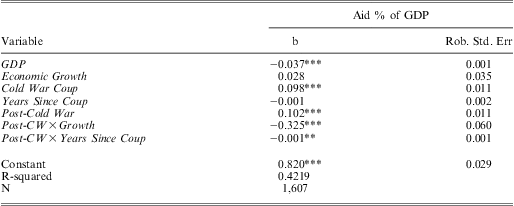
Secondly, we would expect aid receipts to keep declining the longer a country resists holding elections after the end of the Cold War, but we would expect no similar effect for the 1960–90 sample. Table 6 shows that this is indeed the case from an ordinary least square regression of Western aid receipts after coups.Footnote 72 As the variable Years Since Coup indicates, aid did not change the longer coups endured before the end of the Cold War. In the post-Cold War era, however, the linear combination of Years Since Coup and Post-Cold War × Years Since Coup yields a coefficient of −0.002 (SE < 0.001, p-value < 0.001). In other words, after the Cold War, each year without an election after a coup significantly decreased foreign aid. Not surprisingly, the difference between the Cold War era and the post-Cold War era is statistically significant (p < 0.001).Footnote 73
OLS of Aid Receipts After Coups

***p < 0.01, **p < 0.05, *p < 0.1.
We next look at the number of coups perpetrated by rebels in our dataFootnote 74 to determine whether there is a trend toward more coups by rebel fighters, as may be the case in a period marked by more (and changing) civil wars. If this is the case, the move to hold elections after coups may reflect concerns that are specific to rebels. It may also indicate that one causal pathway through which dependence on Western benefits leads to elections is Western concern for avoiding a civil war. We find that twenty-four of 165 coup events were rebel led in the period 1960–90. This compares to three out of forty-three post-1990 events that were rebel led. If anything, the prevalence of such actors has declined. It is therefore unlikely that rebel leadership is responsible for a faster onset of elections after the end of the Cold War.Footnote 75
Finally, we offer some observations on the relative importance of international and domestic factors in the recent trend toward competitive elections after coups. Most of the domestic-based explanations from the theoretical section do not fare well in our tests. Neither economic development nor military leadership shows strong and consistent results across the periods we examine. Economic growth seems more important by comparison. International pressure, proxied by aid dependence, plays a role along the lines predicted by the theoretical discussion. Countries that are former French colonies move much faster to hold elections post-Cold War, another testament to possibly international factors (French influence) at work. It seems that much of what has changed about the consequences of successful coups d’état relates to changing international norms and pressures.
CONCLUSION
We do not endorse coups, either during or after the Cold War. Their occurrence indicates that the military or some other actor may intervene with ease in politics. The dangers of extra-constitutionality are real and likely to lurk in the background for quite a while in countries that experience a coup. We claim merely that the consequences of coups today tend to be significantly different than they were during the Cold War. In the first decade after the end of the Cold War, we saw a window of opportunity for swift pressure and possibly durable democratic openings after coups. Thus we conclude that the more recent crop of coups is ‘better’.Footnote 76
Ideally, all coups are like the Portugal 1974 example: ending an autocratic spell, ushering in a swift transition to democracy and placing the military under strong civilian control. We are closer to the Portugal-like coups today than ever before; we do not want to push our claims any further in this regard.
Some of the events that drive coup leaders to hold elections would be idiosyncratic and difficult to generalize about. Our findings indicate that some of the systematic reasons behind the switch are, to a significant degree, attributable to international influences. The literature on the international dimensions of democratization has recognized the importance of promoting rights and freedoms, increasing electoral integrity and structuring incentives for leaders to abide by the democratic bargain they strike with their populations. We show how outside incentives have profoundly altered the calculus of rulers who formerly took power in order to maintain it. Somewhat paradoxically, it may be precisely those rulers who are most vulnerable to outside pressure; conditionality has the best chance in those cases.
Appendix
We offer a simple two-stage optimization problem in which a coup plotter decides whether to attempt to grab power and whether to hold elections after that.
Consider the following timeline:
-
1. A coup plotter chooses between attempting a coup or sticking with the status quo. If the status quo is chosen, the actor gets
 $$${{t}_{sq}}\, \in \,[0,1] $$$
in expected utility, which can be thought of as the benefit of some policy outcome or as a transfer of resources.
-
2. If attempted, the coup succeeds with probability
$$$\alpha \, \in \,(0,1) $$$
. Failure yields 0 in expected utility. -
3. If the attempt succeeds, the coup entrepreneur decides between calling for elections or retaining power. Calling for elections brings an expected utility of
$$${{t}_m}\, \in \,[0,1] $$$
, which is simply where the median voter would set the policy outcome or the transfer of resources. -
4. If they attempt to stay in power, the coup plotters succeed with probability
$$$\beta \, \in \,(0,1) $$$
. Failure yields 0 as a pay-off (and power changes hands without elections); success yields a pay-off of 1.


In this set-up, the actor will attempt to keep power after a coup if:
 $$\beta \,{\rm{ - }}\,{{t}_m}\,\geq \,0.$$
A coup will be attempted if:
 $$\alpha V\,{\rm{ - }}\,{{t}_{sq}}\,\geq \,0,$$
where V, the expected continuation of pay-off after a successful coup, is:
 $$V\, = \,\left\{ {\matrix{\beta &#x0026; {{\rm{if}}\; \; \beta \,{\rm{ - }}\,{{t}_m}\,\geq \,0,} \cr {{{t}_m}} &#x0026; {{\rm{if}}\; \; \beta \,{\rm{ - }}\,{{t}_m}\, \lt \,0} \right.$$
To derive comparative statics, we imagine that both α and β are functions of some main independent variable(s) of interest x and of some covariates of interest y. We will assume that α and β are continuous and second-order differentiable functions of the parameters. For simplicity, we will assume that the second-order derivative with respect to x is 0. The marginal effect of a change in x for a value of the argument x = x* and for a specific draw of the covariates y = y* on whether to attempt a coup depends on the impact on the probability of successfully grabbing power and on the change in the post-coup continuation stage:
 $$\frac{\partial }{{\partial x}}[\alpha V^\ast\,{\rm{ - }}\,{{t}_{sq}}]\, = \,\frac{{\partial \alpha (x^\ast,y^\ast)}}{{\partial x}}V(x^\ast,y^\ast)\, + \,\frac{{\partial V(x^\ast,y^\ast)}}{{\partial x}}\alpha (x^\ast,y^\ast),$$
where the marginal change in the post-coup continuation value is:
 $$\frac{{\partial V(x^\ast,y^\ast)}}{{\partial x}}\, = \,\left\{ {\matrix{ {\frac{\displaystyle{\partial \beta (x^\ast,y^\ast)}}{{\displaystyle\partial y}}} {{\rm{if}}\;\,\beta \,{\rm{ - }}\,{{t}_m}\,\geq \,0,} \cr 0 {{\rm{if}}\;\,\beta \,{\rm{ - }}\,{{t}_m}\, \less \,0.} \right$$
The key factors motivating these choices will be status quo policy, the policy outcome under competitive elections, and the probabilities of successfully seizing and holding onto power.
We can think about how factors that may be influencing either the probability of successful power seizure (α) or the probability of surviving in power without elections (β) (or both) play out. It is useful to consider some realistic restrictions on how specific factors may influence α and β.
First, and perhaps least likely, it could be that
 $$$\scale 115% \frac{{\partial \alpha (x^\ast,y^\ast)}}{{\partial x}} $$$
and
 $$$\scale 115% \frac{{\partial \beta (x^\ast,y^\ast)}}{{\partial x}} $$$
are signed differently. This would mean that the same factor (at least under some conditions) makes coups easier to pull off, but then makes it harder for the coup leaders to stay in power without elections.
Secondly, it could be that
 $$$ \scale 115% \frac{{\partial \alpha (x^\ast,y^\ast)}}{{\partial x}} $$$
and
 $$$ \scale 115% \frac{{\partial \beta (x^\ast,y^\ast)}}{{\partial x}} $$$
are both increasing (or decreasing) in terms of changes in the independent variable x. We will only consider the increasing case as the decreasing case is analogous. Consider state strength. It is easier to commit coups in weak states, and it is easier to avoid a call for elections in strong states (because civil society is underdeveloped, for example). In this case, an increase in state weakness, by (1) and (2), makes it both more attractive to commit a coup and to attempt to keep power. This implies that a selection dynamic is at work: we are most likely to witness coups in countries where elections are least likely.
Thirdly, it could be that
 $$$ \scale 115% \frac{{\partial \alpha (x^\ast,y^\ast)}}{{\partial x}}\, \gt \,0 $$$
and
 $$$ \scale 115% \frac{{\partial \beta (x^\ast,y^\ast)}}{{\partial x}}\, = \,0 $$$
. In this case, a causal factor facilitates coups but has no bearing on whether elections are chosen.
Fourthly, it could be that
 $$$ \scale 115% \frac{{\partial \alpha (x^\ast,y^\ast)}}{{\partial x}}\, = \,0 $$$
and
 $$$ \scale 115% \frac{{\partial \beta (x^\ast,y^\ast)}}{{\partial x}}\, \gt \,0 $$$
. Substantively, this says that a variable has no (or a negligible) impact on whether power can be seized from the government, but would make elections more or less likely at the second stage. In this case, no selection dynamic is at work and we can estimate the effect of the causal factor in observational data.
We also note that calling for elections reduces the prize that coup plotters may look forward to, and so the attractiveness of seizing power in the first place decreases. In Expression 1, this is given by
 $$$ \scale 115% \frac{{\partial V(x^\ast,y^\ast)}}{{\partial x}}\,\alpha (x^\ast,y^\ast) $$$
, a quantity that is generally not 0. This tends to discourage precisely the types of coups that would otherwise lead to an attempt to stay in power
 $$$(\beta \, \gt \,{{t}_m}) $$$
. Even without directly affecting local actors’ ability to perpetrate a coup, insistence on elections would tend to decrease the appetite for coups.