

Introduction
The polarised explanations of the period under investigation that continue today are that the Maastricht Criteria (1991) and Italy’s adherence to the compliance entry conditions provide a major explanation for Italy’s reduced competitiveness and compromised domestic economic conditions. This was the view espoused by Berlusconi and his political allies in the 2006 election. The electoral victor, Romano Prodi, was instrumental in accepting the EMU1 entry conditions agreed to in a prior electoral term. The position of Prime Minister Prodi and his sympathisers was that Italy’s economic problems were an inevitable outcome of its entrenched political and economic infrastructure even though they may have been exacerbated by requirements and settings for EMU entry.
This paper uses primary data-observation and interviews, and reported documentation as secondary data, and applies an interdisciplinary approach that relies on cultural backdrops to interpret views or events, and economic analysis to explain them. We have accessed Italian language commentary, historical interviews, letters and memos from politicians and diplomats. We investigate some of the main claims of those who trace the decline of Italy’s economy to issues surrounding the participation in the EMU and the established peg values of the Lira/Deutschmark (LIT/DM) in the Exchange Rate Mechanism (ERM). Specifically, this requires assessing the appropriateness of the requisite exchange rate arrangements and whether benchmark criteria required for compliance for EMS and EMU entry were set appropriately. Some findings2, 3 have revealed that Italy’s lack of competitiveness was evident before the economic crisis of the early 1990s. Were Italy’s economic fragility and declining competitiveness exacerbated by the euro (Prodi view), or largely caused by the euro (Berlusconi view), or have Italy’s economic problems been largely independent of the euro?
Background
While there was widespread institutional support for Italy’s membership of the EMU within Italy, this was not nearly so clear outside of Italy. Both the French and German leaders, Mitterrand and Kohl, were quite firm that the Maastricht conditions would be neither softened nor delayed for Italy or any other member state.Reference Dyson4
In early 1997, a Franco-German plan for postponing Italy’s admission to the EMU until 2002 was revealed. This was an example of the initial scepticism towards Italy’s entry into the EMU. The first signs of a changing attitude came from the German Manufacturers Association calling for Italy’s admission into the EMU. During 1997, this view was also espoused by the then new French Prime Minister, Lionel Jospin, who ‘believed that the presence of Italy and Spain was necessary to balance Germany’s preference for price stability’.5
Within Italy, the major interest groups of the Confindustria (Confederation of Italian Industry), the Bank of Italy and the financial institutions were adamant that ‘it was absolutely crucial for Italy to get into the euro’.6 At the same time there was concern about the impact of the Italian government adherence to the Maastricht Treaty requirements of 1991, and few believed that the government would engage in the massive budget cutting that was required to meet these criteria.Reference Mack Smith7 There were some within the political elite who recognised the potential impending dangers to Italy if it did not make substantive changes to its economy to meet the Maastricht Criteria. These fears were well expressed by the Minister for European Integration under the second Berlusconi government (2001–2006):
It is obvious that EMU was for us the inevitable recognition that the trick of spending ourselves out of trouble had come to an end. The Euro is for Italy no more and no less than a bitter but necessary medicine. At the same time, having been through the process of joining the Euro, it has always been clear to me that the medicine could not cure, but only at best cure the symptoms. Addressing the underlying causes of our malaise was left to us. This needs still to be done. Perhaps bad habits are hard to die. I would also add that the attitude of the ECB has been stiffer than one could have hoped for. The fact is that, after the Euro, Italy had to come to terms with these problems and it is doing so only lately.3
According to another Italian parliamentarian, Spini, Italy had been governed on a consensus basis typified by uncontrolled public expenditure and poor economic management. The moment this expenditure was either removed or cut, the consensus machine would come to a halt. Attaining EMU entry benchmarks was simply unattainable without breaking the ‘camel’s back’.8 The Governor of the Bundesbank during the mid 1990s, Hans Tietmeyer, also expressed doubts about the likelihood of Italy meeting its ongoing commitments following the depressed economic conditions that resulted from attaining acceptance into the EMU.Reference Marshall9 A communiqué prepared by the US Consulate in Florence in June of 1992, as Italy’s political and economic crisis unfolded, suggested that the political elite seemed paralysed and incapable of responding to the enormous challenges facing them with the Maastricht Criteria. The communiqué said:
A debate on this [Maastricht Treaty], according to our sources, would involve inevitably a discussion on the necessary measures to reach the parameters requested to enter the first [EMU] group. Our advice observes that Italian politicians are tending to wait until the last moment to be forced to act. Nonetheless it is clear that if some were to realize that the last minute is now and every delay will render the attainment of these results more difficult, if not impossible. According to our contacts, the politicians cannot see beyond their noses, and therefore I am very pessimistic that measures taken to reduce [Italy’s] deficit will be taken soon.Reference Mastrolilli and Molinari10
Lost competitiveness since qualifying for and adopting the euro
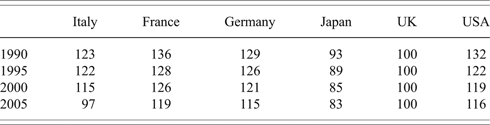
The Economist (19 May 2005)11 summarised Italy’s plight as the ‘sick man of Europe,’ alluding to Italy’s zero growth rate in 2005 and the fifth straight year of virtual economic stagnation, the lowest growth of all countries in the European Union and under half the average for the rest of Europe. But Italy’s ills went further than just no and low growth. Since the early 1990s Italy has suffered from a declining position of relative economic competitiveness in comparison with its peers. As much of the advanced industrial world deregulated and removed business obstacles, Italy responded slowly to these required changes. Productivity indicators such as shown in Table 1 demonstrate how Italy gradually dropped consistently in GDP for hours worked in a comparison with other advanced countries such as the US, Germany and France, between 1990 and 2005. Productivity was already declining in Italy in the mid 1990s and declined even faster after 2001 as shown by Table 1.
UK based GDP per hour worked-comparative study 1990–2005
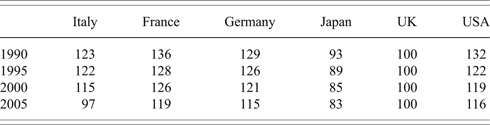
Source: UK National Statistics, February 2007.12
According to the IMF’s analysis, Italy’s competitiveness had declined in relation to Germany and France due to higher inflation and lower productivity output.13 The Italian unit labour cost index shows a competitiveness loss of around 20% between the first quarter 1988 and the same quarter in 1992.14 This decline was confirmed by an additional report issued by the World Economic Forum in 2005 under the title ‘Global Competitiveness Index Report’. In 2001, Italy’s ranking was 26th in competitiveness. By 2005, Italy’s position had slipped to 47th in the world according to Alborghetti.Reference Alborghetti15
Giorgio La Malfa took the view that Italy’s problems are deep-seated and their source is more complex than the requirements of entering the EMS or the value of the Lira at the time of entering the EMU:
A serious consideration of the country’s economic performance over a longer period of time leads to the conclusion that the problem of Italy’s sluggish economic growth is a longstanding one. If one breaks down by decades the post-war period, one can notice that, in the years 1951–1968, Italy’s average annual rate of growth was 5.6%. Then it went cyclically down to 4%, 3%, 2% – down to the current 0 to 1%. I insist: the problem is both serious and longstanding.3
The Euro as the cause of Italy’s economic ills? Prelude to Maastricht and the crisis of the European Monetary System (EMS) – 1979 until 1992
Most of the EU member States were part of the EMS, which aimed to ‘create a zone of monetary stability’ through pegged exchange rates. States within the EMS participated in the Exchange Rate Mechanism (ERM) with exchange rate fluctuation limited within an adjustable peg.16 The original purpose of exchange rate stability shifted to achieving price stability during the 1980s when inflation rates among Member States started to differ increasingly. The terms and conditions of Italy’s entrance into the EMS as moderated by the Italian Central Bank in 1978 stipulated that the Lira’s ability to conform to a specified spread to other currencies within the union was limited. Consequently, Italy entered the EMS with an oscillation band for exchange rate adjustment of up to 6% (+6 to −6%) until 1990, when it was decided to use a narrower band. The three newcomers to the system (Spain, the UK and Portugal) used the wider band.Reference De Grauwe17 Other members were only permitted a 2.25% band oscillation.
Italy joined the EMS enthusiastically, viewing membership as less of a choice and more of an obligation. Weber noted that:
The debate over ‘multi-speed’ Europe in the run-up to Maastricht clearly demonstrated that a country unable or unwilling to be a part of the EMS risked sacrificing legitimacy as a full member of the EU or whatever other institutional arrangements might come out of the negotiations. Such a position might have made sense substantively in a technical environment, but it simply did not make sense within the EC.Reference Weber and Aggarwal18
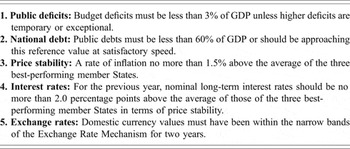
The Maastricht Treaty provided a comprehensive institutional and legal arrangement for an EMU. In 1990, Stage I of the EMU was introduced when member countries abolished all capital controls. The transition to monetary union was Stage II, when member countries were required to demonstrate adequate convergence and the European Monetary Institute was established to strengthen cooperation between central banks. Stage III involved locking into a permanent pegged exchange rate within member states, followed by the introduction of a single currency. The convergence criteria as set out in the Treaty for the European Union (Articles 109j and 104c) are listed in Table 2. The five criteria included the level of government debt and budget deficit, which were viewed by many as unattainable for Italy.19 There were even some that thought that initially the Germans had formulated the Maastricht benchmarks relating to budgetary entry criteria at a level meant to prohibit Italy from qualifying.5 As Harper points out ‘The growing contradiction between Italy’s European aspirations and its capacity to fulfil them came to a head in 1992.’Reference Harper and McCarthy20 Understanding the structural nature of the Italian approach towards the Euro is centred strongly around key events which all occurred in a short space of time in 1992. In February 1992, the Italian President dismissed the Parliament and called for new elections. Five days later the caretaker government led by Giulio Andreotti signed Italy’s commitment to the Maastricht Treaty, which would involve shock therapy to Italy’s economic policies.
1991 Maastricht criteria for participation in the euro

Source: El-Agraa (2004).Reference El-Agra21
More dramatically, 17 February 1992 witnessed the first act of the most serious political crisis of post-war Italy. The bulk of the Italian political elite turned out to have been involved in the systemic corruption now known as Tangentopoli. The revelation of the scandal plunged the country into deep political crisis, and would eventually bring major changes to the Italian political system. At the same time, Italy’s party system was feeling the strains of the economic restrictions and challenges posed by European ‘regulations’ to which Italy was not accustomed. Pasquino observes that Italy’s weakness in preparation and readiness for the new challenges posed by the Maastricht Criteria was highlighted by a ‘vincolo esterno’, an external treaty imposing rules and regulations and limits to the country’s economic policies.22 These political developments inevitably delayed and impeded Italy’s economic recovery and ability to meet its obligations for Maastricht. As soon as the ruling elite were under the scrutiny of external agents, in this case the European Commission, their ability to transgress, ignore or overrule was curbed. The economic time bomb was set in motion.
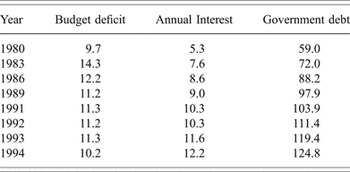
The two most serious and interrelated weaknesses of the Italian economy throughout the 1980s and into the 1990s were the annually growing budget deficits, and the high level of public debt. At the time of the signature of the Maastricht Criteria, Italy only met one of the five criteria for accession, and the country’s budget deficit in 1992 was three times higher than the European Criteria benchmark. As Galimberti and Paolazzi noted, Italy’s budget deficit between 1972 and 1992, on average, had run to 10% of GDP.23 From a realistic point of view, it was impossible simply or immediately to reduce these high public deficits to 3% of GDP, let alone maintain them at that level. In 1980, the Italian public deficit reached 9.7%, and in 1991 it ran to 11.3%, as can be seen from Table 3.Reference Arcelli24 Achieving public deficits of 3% of GDP, given the high government spending trend, was going to be a difficult feat in the best of circumstances. It was going to be even more difficult when neighbouring European states were growing faster whilst maintaining budget deficits at significantly lower levels. The greatest difficulty facing Italy was the growing interest on its outstanding debt, which increased from 5.3% in 1980 to over 10% in 1991. As can again be seen from Table 3, Italy’s total government debt crept up from 59% of GDP in 1980 to an astonishing 124% in 1994. The EMU criteria requirement was 60% of GDP.
Budget deficit, interest rate and public debt as a percentage of GDP – 1980–1994

Source: M. Arcelli (1997) Storia, Economia e Societa’ in Italia 1947–1997, p. 311.Reference Arcelli24
Achieving the required result on inflation levels and interest rates (third and fourth criteria as summarised in Table 2) would also pose serious difficulties for the economy. In the years after the signature of the Maastricht Treaty, Italy’s transition to the euro came down to a mixture of different forms of ‘economic shock’ treatment that few other Member States experienced. The fifth Maastricht Treaty criteria of the EMS required the adoption of a narrower fluctuation band for exchange rate movements. The second feature of the EMS was the European Currency Unit (ECU), composed of a basket of EMS member currencies providing bilateral exchange rates. On January 1, 1999 the ECU was transformed into the euro at the rate of 1ECU = €1.
German reunification
The fall of the Berlin Wall in 1989 brought profound changes to the European political and economic landscape and beyond. According to Galimberti and Paolazzi,23 the fall of the Berlin Wall had two key effects on the Italian economy. In the first place, the reunification of Germany redirected resources and demands towards the powerful German economy. German Chancellor Kohl announced in February 1990 that East and West marks would be converted on a one-to-one basis. Currency conversion rates created tensions and wage demands in the east that underpinned increased consumption within the German economy.25 In the second place, the fall of the Berlin Wall led to large German budget deficits as a result of the funding requirements for reunification. This unanticipated development exacerbated the lira’s problems by being forced to operate within an untenable pegged exchange rate band. In its efforts to manage inflation, the Bundesbank had to push up German interest rates, creating a flow-on effect to Europe.Reference Bufacchi and Burgess26 High German interest rates attracted foreign capital inflow that put downward pressure on the lira and the pound, setting the stage for the devastating speculative attack that drove certain currencies out of the European Monetary System in September 1992.Reference Harper and McCarthy20 Italy’s exit of the EMU has been extensively discussed.23, Reference Arcelli24, Reference Padoa-Schioppa28
The monetary crisis of 1992
After nearly two decades in which the EMS had effectively stabilised currencies in Europe, in 1992 it went into crisis. The markets were not convinced that the (almost) fixed EMS exchange rates were sustainable given the disparate economies across Europe. France and Italy were in recession (or close to it), while Germany was caught in difficulties surrounding its very costly reunification. The boom year of 1988 saw Italian economic growth hit 4%, but then it slid to ever lower levels until it reached a recession level in 1993, as Figure 1 clearly demonstrates. Concerns increased throughout 1992 about the poorly performing Italian economy. There were clear signs that Italy’s growth rate was falling to below 1% while other European countries were recording double that rate of growth. The slow economic growth was quite consistent with the deflationary policies that were required to achieve the Maastricht criteria. Moreover, Italian growth rates were extremely vulnerable, not only to domestic economic conditions, but also to the external environment.
Italian GDP growth levels in percent (1980–1995). Source: M. Arcelli (1997) Storia, economia e societa’ in Italia 1947–1997, p. 311.Reference Arcelli24

Italy’s poor economic performance throughout the early 1990s reinforced the unsustainability of existing exchange rate arrangements and encouraged further speculation against the lira. Throughout 1992, the Bank of Italy was obliged to bail out its currency (buy lira and sell foreign currency reserves) on so many occasions that its reserves were almost exhausted.Reference Arcelli24 On 13 August 1992, in a blow to the struggling Italian government, Moody’s Investor Service downgraded the credit rating of the country’s foreign-currency obligations to an Aa3 rating, down from Aa1.
The setting of a Lira/Deutschmark (LIT/DM) parity in 1990 had aimed at fulfilling the conditions of the Maastricht Treaty requirements for Euro-zone entry for Italy. The set criteria dictated domestic economic policies targeted at reducing inflation and government debt and preparing for fixed exchange rates within a limited band in line with the proposed EMS. The LIT/DM narrow target zone was tested by higher interest rates in the first half of 1992 that put upward pressure on the lira and an appreciating real LIT/DM exchange rate reinforced the inappropriateness of current exchange rate arrangements.Reference Svensson29 Tronzano views the attack on the lira as the result of growing macroeconomic imbalances caused by large budget deficits and a very high domestic debt/GDP ratio.Reference Tronzano30 Market conditions in the second half of 1992 forced the lira to be viewed by market players as ‘over-valued’, causing a significant reduction in the profitability of the tradable sectors and hence increased current account deficits. It had become ‘In the end …unsustainable’ according to one expert.Reference De Grauwe17
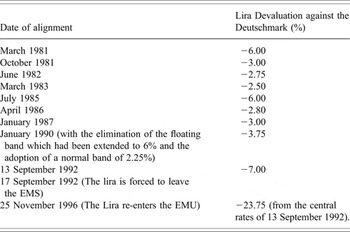
These developments signalled the lack of credibility of the parity or the inflexibility of the narrow band of the fixed exchange rate that translated into devaluation expectations and eventually the oncoming lira crisis. On 13 September 1992 the lira was devalued by 7% against the Deutschmark (Table 4). Finally, on 16 September there was so much selling of the currency that Italy was obliged to exit the EMS. The main reason was Italy’s persistent inflation gap with Germany as there had been no realignment after 1987 to compensate for these divergent price trends.
Realignments of the lira after entering the EMS

Source: Adapted from Galimberti and Paolazzi (1998).23
Devaluations occurred against the Spanish Peseta, the Portuguese Escudo and the Irish Punt. By November of 1992 reforms and changes had been made to the EMS providing it with a wider band of movement from their central rates.31 The Italian lira, for example, re-entered the EMS with 23.75% devaluation from its central rate in 1992 as shown in Table 4.
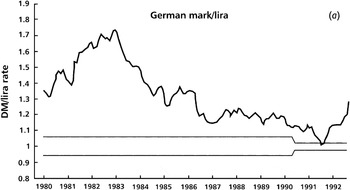
The numerous realignments of the lira raise the question of the credibility of the foreign exchange rate parities adopted by the EMS. A simple test proposed by SvenssonReference Svensson29 applies the efficient market test that the forward exchange rate quoted today reflects the expected future spot market rate. According to this theory, a forward exchange rate is an unbiased predictor of a future spot rate. Therefore, if the forward rate exceeds the upper limit of the accepted band of fluctuation, it indicates that participants expect that the future top rate will exceed the existing limit and that the rate is unsustainable. The data (Figure 2) show that, in the second half of 1991, the forward rate (the German Deutschmark price in lira expected in the future) started deviating more significantly from the upper limit of the band of fluctuation allowed within the EMS. The band of fluctuation defines the limits within which the exchange rate must remain if there are no realignments. This deviation of the forward rate above the limits set reflects the market expectation of a revaluation of the DM and a devaluation of the Italian lira. De Grauwe argues that it was mainly the move in 1987 to a less flexible fixed exchange rate that destabilised the system.Reference De Grauwe17 Prior to 1987 there was an understanding in the market that small but frequent alignments would be expected without triggering a destabilising speculative crisis. According to De Grauwe, the 1987 re-arrangement ‘made the system too rigid and more prone to speculative attacks, and ultimately led to its demise.’Reference De Grauwe17 This explanation is consistent with the increased size of devaluations of the LIT/DM after 1987 (Table 4), and the ultimate lack of sustainability of the LIT/DM exchange rate in 1992. In essence, a mixture of external factors and internal developments exacerbated the situation. These included the monetary fallout from the German reunification, the strict Maastricht convergence criteria, the European-wide recession, and a rigid exchange rate system creating a fragile balance which made it more susceptible to speculative attacks.
Implicit forward German mark/lira five-year rates – 1980–92. Source: P. De Grauwe (2000), p. 123.Reference De Grauwe17

Austerity measures and Italy’s compliance with the Maastricht criteria
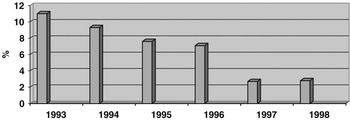
Over the following years, the budget deficit needed to be reined in from over 11% in 1993 to less than 3% in 1998. Part of the budget deficit cure required tremendous budget cuts to government expenditure, which are consistent with deficit reductions as shown in Figure 3.
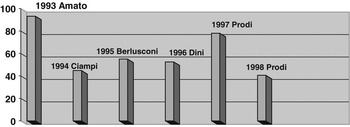
Figures 3 and 4 show that between 1993 and 1998, Italian policy imposed some of the most severe budget cuts in history. The Amato government in 1993 carried out the deepest budget cuts in modern Italian history, to a total of 93 billion lira. These cuts were harshly felt, and continued to influence the Italian economy for years.Reference Barbacetto, Gomez and Travaglio33 Budget reductions under the following governments, while not quite as severe, were nonetheless also deep.
Budget deficits, percentage GDP between 1994 and 1998. Source: Banca d’Italia and Istat reproduced in La Repubblica, 5 July 2005.32

Budget cuts between 1994–1998 (in billion lira). Source: Ansa-Centrimetri, From Il Giornale, 30 June 2005.34

Italy’s decision to join the EMU
After the 1992 crisis, the EMS changed dramatically. Italy re-entered the EMS in 1996 at an adjusted parity of the lira against the DM and with a broader band of adjustment. This involved the final transition toward the EMU and the deflationary policies implemented to establish exchange rate credibility. The accepted band of fluctuation increased to 30%, reducing the incentive for a speculative attack motivated by inducing realignment, as the currency could now move within a larger accepted range. Member countries gradually adapted to the band for their exchange rate to fluctuate within by adopting the range from 1997 onwards. The system was more stable, as monetary authorities were committed to intervene to prevent the exchange rate from moving outside the band.Reference De Grauwe17
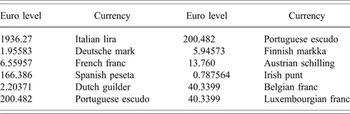
At the time of the agreed exchange rate system in 1998, in which each member country of the EMU group negotiated and accepted its proposed rate of exchange against the euro, it was alleged by the centre-right government of Berlusconi that the pegging of the lira to the euro was incorrect. The centre-right government claimed that the parity rate of 1936.27 lira (see Table 5) to the euro as agreed to in 1998 was inflated and produced an inflationary effect by providing a conversion value that made products more expensive than had previously been the case. If the number of lira per euro was set too high it also means that the euro/lira rate (0.005 euro/lira) was too low. This overvaluation of the euro and undervaluation of the lira was the reason for the inflationary impact of the parity. It meant that the other States found lira-priced products cheap relative to imported products. The centre-right claim as to the inflationary impact of the exchange rate parity was also exacerbated by sellers making a one-off windfall gain by raising the initial conversion to euro prices above parity level. The OECD also argued that the lira pegging was underpriced (meaning the euro price of lira was too low) and gave a competitive advantage to Italy. It claimed that ‘Germany entered EMU at a disadvantageously high (post-unification) exchange rate, whereas Italy entered at a favourably low (post EMS crises) one – in both cases far from equilibrium and leading to a period of convergence in conformity to the “law of one price”.’35
The 11 ‘euro conversion rates’ established in 1998

Source: http://www.italyflash.com/italyflash/shortt/money/money.html, accessed 5 April 2006.36
The convergence of economies via ‘the law of one price’ refers to the idea that there is an in-built tendency for equality of prices across the countries that use a common exchange rate. The OECD thus held the view that, if the lira was undervalued, demand for the products of the underpriced currency will raise prices until they equal those of the overvalued currency within the union. The problem with this proposition is that prices are often ‘sticky’ and that the exchange rate adjustments were restricted. The OECD claim suggests that parity values are not significant as prices will adapt via a market adjustment mechanism. Neither of these claims is strongly supported by evidence and, in fact, both support an explanation of how Italy was given a relative boost in becoming more competitive by the parity setting.
Britain escaped and remained outside the euro
Britain left the EMS for different reasons than Italy. The divergent price and competitiveness issues that affected Italy were not significant for Britain. The issue for the UK was matching the restrictive monetary policy adopted in Germany after the inflationary impact of spending induced by German reunification. The recession in the UK required a loose monetary policy that could only realistically be implemented outside the EMU. The policy conflict between the Bank of England and the Bundesbank was noticed by speculators who recognised that the UK authorities were tempted to cut their links with the mark so as to follow a more expansionary monetary policy.Reference De Grauwe17
Britain left the ERM in 1992, when its exchange rate became overvalued. Although Rose found there was not a gradual deterioration in the credibility of the ERM that would explain the 1992 EMS currency crisis, he did identify the circumstances of ‘other ERM participants’ experiencing the UK recession, and a cumulative deterioration in Italian public finances and the competitiveness problems in both Italy and the UK.37 He points out that ‘by late August, there were growing (but still weak) indications from the financial markets that a general revaluation of the DM against other currencies was called for: this realignment certainly seems to be consistent with the underlying macroeconomic fundamentals from a theoretical viewpoint.’37 Italy differed significantly from the UK when it came to lack of competitiveness. Although both countries rejected the draconian contraction policies required if remaining in the ERM, there was a difference in how deep-seated their problems were. The possibility of Italy going it alone was seriously jeopardised by its declining competitiveness. Moreover, Italy had invested so much in the EMS and did not see a realistic alternative, dictated by its geography, its economic dependence on the European Union, and its commitment to a full German unification. Germany and the other founding member States ultimately recognised that Italy’s inclusion in the EMU was integral to its acceptance and credibility. In other words, there was a symbiotic relationship between Italy and the other member States.
The UK on the other hand had different interests. For example, ‘the City of London does more business with the rest of the world than with Europe.’ This was an argument used to uphold the potential for the UK to join the EMU, but it in fact symbolised the financial strength of London in particular also beyond the euro area. Johnson also notes that ‘no government has ever tried to sell the idea of a single currency to the British people.’Reference Johnson38 The lack of popular policy to strengthen public support for the euro probably reflects the political judgements of the lack of both government and public commitment to the cause. ‘The attitude of the British government towards a European … economic integration was always lukewarm at best.’39
The new Blair Government, elected in 1997, committed Labour, in principle, to joining the EMU. Its platform on Europe was to be the first UK Government to support the UK’s European integration. The problem was that Britain needed to wait until its business cycle was more aligned with that of the rest of Europe. In 1998, Britain was at the top of its economic cycle whilst continental Europe was in recession. It was estimated that the UK would have to reduce public spending by £20 billion to offset the stimulus from lower interest rates in the euro zone. This was untenable politically to a government that was elected on a platform that called for the expansion of education and healthcare. Moreover, the euro zone members did not intend to include Britain in the key euro decision-making bodies, which humiliated the British government and ultimately diminished support for European integration.39 The ‘Save the Pound’ alliance bankrolled by business, and with ex-Prime Minister Thatcher as its mentor, was able to prevail over the government’s intention of joining the EMU. Moreover, Blair did not want to call a referendum on the euro unless he was sure of gaining the necessary support.
Conclusion
In 2006, Berlusconi publicly blamed the euro for his country’s economic difficulties, and he blasted former Prime Minister and former President of the European Commission Romano Prodi, his political arch-rival, for having led Italy into the European monetary union. ‘Prodi’s Euro conned us all,’ Berlusconi put it. By pointing the finger at ‘Prodi’s Euro’ as an explanation for Italy’s ills Berlusconi was trying to absolve his own government’s poor economic performance. In a BBC interview of June 2005, Prodi explicitly rejected the euro being the cause of Italy’s economic difficulties, stating that ‘the problem is not the euro, the problem is Italy.’40
The unexpected German re-unification of 1989 was one of the single most disruptive influences on the financial markets of a number of European Member States.23, Reference Arcelli24, Reference Padoa-Schioppa28 It caused unacceptable inflation levels in Germany, which then ignited the inflationary fears of the Bundesbank. The subsequent measures taken by the Bundesbank conflicted with the anti-recessionary policy priorities of the UK. This was identified by speculators as a serious impediment to the survival of the ERM. The unrealistic convergence criteria for Italy, and the inappropriateness of the fixed exchange rate system adopted in 1987, were viewed as too restrictive and too easy for speculators to destabilise. There was much less consensus on the appropriateness of set exchange rate parities in the ERM and EMU. Italy’s decision to join the EMS, at variance with what the UK did, was less a choice than an obligation. The major drivers of European unification decided Italy needed to be included, and Italy itself, both at political and grass-root levels, was always emotionally, geographically and economically ‘in’. It could be argued that the Italian decision to rejoin the EMS was a mistake. This decision cannot be blamed on the euro. The Central Italian Bank was required to keep interest rates high, deterring investment and contributing to the restructuring of the Italian economy. In any case, Italy experienced a significant decline in productivity from around 1990, long before the introduction of the euro.
While the British budget deficit shrunk, Italy’s remained high until 1996. The reality was that, as a member of the EMU, Italy could not pursue an independent monetary and fiscal policy as Britain was able to do. Moreover, Prodi feared there might not be a second wave of membership into the EMU. In the short term, this decision has certainly constrained Italy’s ability to follow independent economic policies. Italy’s economic growth and business cycle between 1980 and 1995 (Figure 1), although subdued, followed the traditional seven-year business cycles experienced by most countries. This is consistent with ‘normal’ economic factors that drive a business cycle and not the euro dominating the cycles. It is also clear that, during the late 1980s and early 1990s, Italian leaders were distracted by political problems and were slow to act to reduce Italy’s budget deficits consistent with the requirements of Maastricht.
The leap towards the euro was a significant one for the Italian economy and yet it has failed to deliver sustained improvements in competitiveness or standards of living. It was a tour de force for the Italian economy, and one that was made largely oblivious to the long-term economic hardships the country faced when compared with the other member States ahead. The source of these hardships is to be sought in external developments, economic baggage from the past including the poor economic management inherent in the Italian political leadership, as well as meeting convergence criteria to achieve euro entry. Certainly Italy’s original membership of the ERM, and its keenness subsequently to adopt the euro, were partially driven by the country’s inability to come up with alternatives similar to those open to the UK. Italy’s declining economic competitiveness became more visible in its struggle to achieve economic integration with its European neighbours partly because it had previously managed its economy more idiosyncratically than had the other original EU member States. Italy’s involvement in the union from its very inception ultimately meant that it had little choice but to be a part of the new ‘European economic tiger’, unless it wanted to remain ‘the sick man of Europe’. Italy’s weaknesses were exacerbated by the challenges that the Euro posed but there is little evidence to suggest that they were caused by its adoption of the euro.
Bruno Mascitelli is a senior lecturer in International Business and European Studies in the Faculty of Business and Enterprise at Swinburne University of Technology, Melbourne, Australia. He has published on European issues including the Italian political economy, Italian corruption and the impact of the end of the Cold War on the Italian polity. His other research interests include Italian-Australian trade relations and the impact of Italian immigrants on Italian–Australia trade.
Julie Gerstman is a lecturer in economics and finance in the Faculty of Business and Enterprise, Swinburne University of Technology. She was in an academic exchange to Oxford-Brookes University, UK in 2005.