

INTRODUCTION
Although the Mediterranean Sea is one of the best known geographical areas of the world, there are many regions and habitats that remain insufficiently studied, and several taxonomic groups are still poorly known from this region (Coll et al., Reference Coll, Piroddi, Steenbeek, Kaschner and Ben Rais Lasram2010). Improved species descriptions as well as data on geographical distributions are still a high priority. The Ebro Delta, Spain constitutes a good example of how a coastal area of great ecological significance in the western Mediterranean can still remain insufficiently known for some crustacean peracarid taxa such as mysids.
Hemimysis is a group of small-sized and usually red coloured mysids widely distributed throughout the north-eastern Atlantic Ocean, the Mediterranean Sea, the Black Sea and the Caspian Sea (Tattersall & Tattersall, Reference Tattersall and Tattersall1951; Bacescu, Reference Bacescu1954; Ledoyer, Reference Ledoyer1989). Usually, Hemimysis individuals form dense swarms in open waters (>6000 ind. m−3; Ketelaars et al., Reference Ketelaars, Lambregts-van de Clundert, Carpentier, Wagenvoort and Hoogenboezem1999) or in dark submarine caves (more than 105 individuals m−3; Carola et al., Reference Carola, Coma, Riera and Zabala1993). Some species have been extensively studied, mainly H. anomala involved in recent invasive events in the northern hemisphere (see Wittmann & Ariani, Reference Wittmann and Ariani2009; Minchin & Boelens, Reference Minchin and Boelens2010 for references). The genetic structure of Mediterranean cave-dwelling Hemimysis populations has been studied for H. margalefi and H. speluncola (Lejeusne & Chevaldonné, Reference Lejeusne and Chevaldonné2006). This work confirms the strong influence of habitat disjunction (natural fragmentation) on population structure.
Hemimysis lamornae has a vast distribution from sub-Arctic Icelandic waters to the North Sea and western Baltic waters and to the Mediterranean and the Black Sea. The species breeds all the year (at least in captivity) and its biology is reasonably well studied (Cannon & Manton, Reference Cannon and Manton1927; Manton, Reference Manton1928; Foxon, Reference Foxon1940; Tattersall & Tattersall, Reference Tattersall and Tattersall1951). Bacescu (Reference Bacescu1936) distinguished 3 subspecies, according to size-range of individuals, number of thoracopod articles, armature of uropod and telson: H. lamornae typica (Couch, Reference Couch1856) from the Atlantic European coast; H. lamornae mediterranea Bacescu, Reference Bacescu1936 from the Mediterranean Sea; and H. lamornae pontica (Czerniavsky, Reference Czerniavsky1882) from the Black Sea. As demonstrated by its extended distributional area, H. lamornae shows remarkable adaptative capacities.
The subspecies H. lamornae mediterranea is documented from the Ebro Delta (Sant Carles de la Ràpita, Spain). However, H. lamornae mediterranea was only known from the Gulf of Naples (Bacescu, Reference Bacescu1936; Wittmann, Reference Wittmann2001) and a submarine cave in Marseille (Ledoyer, Reference Ledoyer1989). The present paper deals with the recent discovery of a new population in the Ebro Delta, Sant Carles de la Ràpita, Spain. Previous descriptions only describe the main diagnostic characters of H. lamornae mediterranea. This present study provides a full description of both the male and female, as well as information on ontogenetic variability of diagnostic characters of this Catalonian population.
MATERIALS AND METHODS
Mysids were collected from a breakwater of the Sant Carles de la Ràpita harbour (Alfacs Bay, Ebro Delta, 40°37′12″N 0°35′34″E) at a depth of 0.3–0.5 m. Samplings were carried out in June and November 2010, always during night-time (21:00–22:00 h), with a hand-held net (mesh-size: 500 µm; mouth aperture diameter: 35 cm). Samples were preserved in 70% ethanol for laboratory examination.
Individuals of H. lamornae mediterranea were identified and separated from other species and classified into 6 demographic categories according to the following sexual characteristics: (1) juveniles (secondary sexual characteristics absent); (2) immature males (terminal segment of the antennular peduncle with non-hirsute apendix masculina on the ventral surface; with developing pleopod 4); (3) mature males (antennule with hirsute apendix masculina; pleopod 4 developped); (4) immature females (with developing oostegites at the bases of the two posterior thoracopods); (5) mature females (with a well-developed marsupium); and (6) brooding females (mature females with eggs or larvae in the marsupium).
The total length (TL) was measured from the tip of the rostrum to the posterior end of the telson, excluding spines. Dissection and measurements were taken with a Nikon SMZ800 stereo microscope equipped with an image analysing system (AnalySIS, SIS, Münster, Germany). An Olympus BH-2 microscope was used for the description of appendages morphology.
Hemymisis lamornae, Norman (Reference Norman1892), pp. 247–249, partim.
Hemimysis sp. Colosi (Reference Colosi1929), pp. 428–430, figure 21.
Hemimysis lamornae mediterranea, Bacescu (Reference Bacescu1936), pp. 77–82, figure 3.
Hemimysis lamornae, Tattersall (Reference Tattersall1951), p. 163.
Hemimysis lamornae, Tattersall & Tattersall (Reference Tattersall and Tattersall1951), p. 335.
Hemimysis lamornae mediterranea, Ledoyer (Reference Ledoyer1989), pp. 45–46, figure 3.
Hemimysis lamornae mediterranea from the Ebro Delta. (A) Female, dorsal view; (B) female, lateral view; (C) male, lateral view; (D) antenna of female, ventral view; (E) antennula of male, dorsal view; (F) antenna of male, ventral view. (A–B) Brooding female, TL = 6.8 mm; (C) mature male, TL = 6.2 mm; (D) brooding female, TL = 6.1 mm; (E–F) mature male, TL = 5.8 mm.

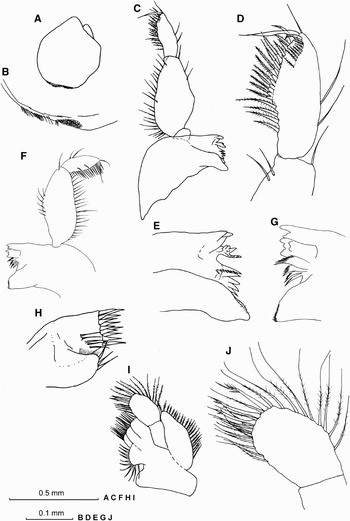
Hemimysis lamornae mediterranea from the Ebro Delta. (A) Labrum; (B) posterior margin of labrum; (C) right mandible; (D) mandibular palp, articles 2 and 3; (E) incisor to molar processes of right mandible; (F) left mandible; (G) incisor to molar processes of left mandible; (H) maxillule; (I) maxilla; (J) maxillar palp. (A–B, F–G & I–J) Brooding female, TL = 6.1 mm; (C–E) mature male, TL = 5.8 mm; (H) immature male, TL = 4.4 mm.

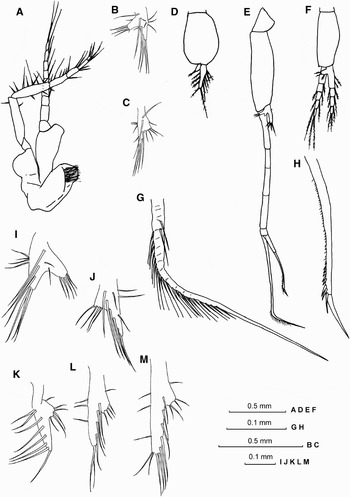
Hemimysis lamornae mediterranea from the Ebro Delta. (A) Endopod of first maxilliped; (B) distal articles of endopod of first maxilliped; (C) endopod of second maxilliped; (D) distal article of endopod of second maxilliped; (E) third thoracopod; (F) distal articles of third thoracopod endopod; (G–K) fourth to eighth thoracopods; (L) distal articles of eighth thoracopod endopod. (A–B) Mature male, TL = 5.8 mm; (C–D & I–K) brooding female, TL = 6.1 mm; (E–H) brooding female, TL = 5.1 mm.

Hemimysis lamornae mediterranea from the Ebro Delta. (A) Eighth male thoracopod; (B–F) first to fifth male pleopods; (G, H) distal armed seta of penultimate and ultimatearticles of 4th male pleopod exopod, respectively; (I–M) first to fifth female pleopod. (A, & D–H) Mature male, TL = 5.8 mm; (B–C) mature male, TL = 5 mm; (I–M) brooding female, TL = 6.0 mm.

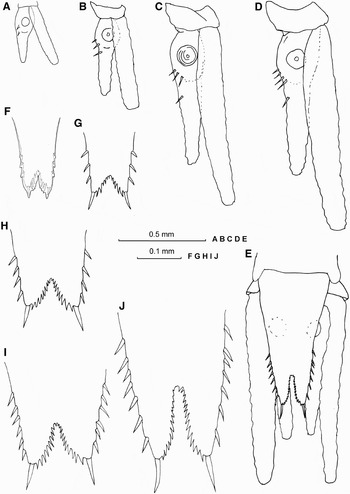
Hemimysis lamornae mediterranea from the Ebro Delta. (A–B) Ventral view of uropod of two juveniles of different size; (C–D) ventral view of uropod of male and female, respectively; (E) dorsal view of telson and uropods of mature male; (F) distal end of telson of postnauploid; (G–H) distal end of telson of two juveniles of different size; (I–J) distal end of telson of immature and mature male, respectively. (A, G) Juvenile, TL =2.0 mm; (B, H) juvenile, TL = 3.2 mm; (C, E, J) mature male, TL = 5.8 mm; (D) brooding female, TL = 6.1 mm; I, immature male, TL = 4.4 mm; (F) postnaupoid premoult intramarsupial stage.

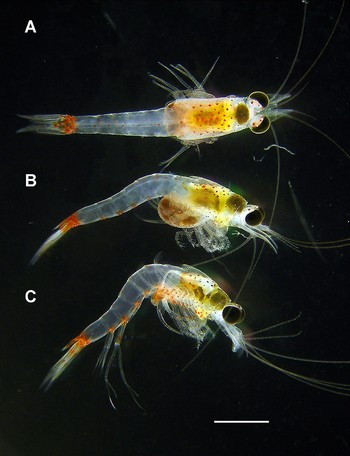
Hemimysis lamornae mediterranea from the Ebro Delta. (A) Brooding female, dorsal view; (B) brooding female, lateral view; (C) male, lateral view. Scale bar: 2 mm.

MATERIAL EXAMINED
Sant Carles de la Ràpita harbour, Ebro Delta, Spain: 9 brooding females (TL range: 5.5–6.2 mm); 4 immature females (TL range 4.6–5.1 mm); 4 mature males (TL range 4.8–5.8 mm); 10 immature males (TL range 3.3–4.4 mm); 3 juveniles (TL range 2–3.2 mm) and 1 intramarsupial postnauploid specimen; 30 April 2010. A total of 10 males and 10 females have been deposited in the Biological Collections of Reference of the Institut de Ciències del Mar (CSIC) in Barcelona, under accession codes ICM_20110207_01.
DESCRIPTION
General form robust. Carapace with a short subtriangular rostrum with rounded apex; antero-lateral angles rounded; posterior margin emarginated, leaving the last two thoracic somites exposed in dorsal view; cervical groove present. Eyes large, globular, slightly broader than the eyestalk, extending laterally beyond the limits of the carapace; cornea pigment black. Pleon with first five somites subequal in length; sixth somite twice as long as the fifth (Figure 1A–C). Antennular peduncle as long as antennal scale; first article longer than broad, second article shortest, third article slightly longer than broad supporting an hirsute appendix masculina on the male (Figure 1E). Antennal peduncle 3-segmented, not extending beyond antennal scale; second article longest; inner distal margin of second ant third articles with 1–2 and one setae, respectively. Protopod of antenna with outer distal angle rounded. Antennal scale lanceolate, with apical suture, 3.5 times as long as maximum width, proximal half of outer margin naked and straight (Figure 1D, F). Labrum almost oval, longer than wide, posterior margin with two distinct areas consisting of a cluster of short setae and an area covered with small scale-like protrusions (Figure 2A, B). Mandibles well developed; three-segmented palp, 2nd article about twice as long as 3rd with 3–7 setae on dorsal margin and 21–22 setae on ventral margin (Figure 2C, F). Distal segment of mandible palp with 18 ventral spinose setae and one distal large conspicuous seta, dorsal margin with two setae (Figure 2D). Left mandible setal row consisting of four hirsute spines and right mandible setal row consisting of one hirsute spine and four entire spines (Figure 2E, G). Maxillule basis (outer lobe) apex armed with ten setae and five setae on ventral surface; coxal endite (inner lobe) with three apical setae and a row of small setae (Figure 2H). Maxilla with distal article of endopod longer than wide, setose on its distal two-third distal margin, apex armed with three cuspidate setae; exopod extending to 1/3 of distal article of endopod, with 22 setae on lateral margin; lateral margin of coxa armed with 11 setae (Figure 2I, J). First and second thoracic appendages formed as maxillipeds, similar to those of other species of the genus. First thoracopod with prominent lobe on the basis armed with 13 spinose setae and two rows of small setae on the proximal and distal margins; endopod with ischium and merus subequal in length, armed with 3 and 4 spinose setae on their medial margins, respectively; carpus with 7 spinose setae on its medial margin and 1 distal spinose seta on its distal margin; propodus with 3 spinose setae on its proximal medial margin, 3 spinose setae on its distal margin and 6 spinose setae on its lateral margin; dactylus shorter than propodus, armed with 8 spinose setae and 1 distal strong nail (Figure 3A, B). Second thoracopod longer than first; endopod with the merus armed with 3 setae on its medial margin; carpus and propodus subequal in length armed with a single medial seta and 2 medial distal setae, respectively; dactylus half length of propodus, armed distally with 3 strong and spinose nails (Figure 3C, D). Third to eighth thoracopods with the endopod longer than exopod; endopods with the inner margin of the basis rounded, pre-ischium short and more or less triangular in shape, ischium and merus subequal in length, carpo-propodus three-segmented, dactylus shorter that the distal segment of the carpo-propodus and armed with a slender nail; exopods nine segmented (Figure 3E–L). Male genital apophyses bearing hirsute apical setae (Figure 4A). Female pleopods rudimentary, unsegmented plates (Figure 4I–M). Male pleopods 1 and 2 stronger and larger than female pleopods; pleopod 3 with large sympod (Figure 4B–C); endopod short, unsegmented and armed with a few setae (Figure 4D); pleopod 4 with small unsegmented endopod; exopod five-segmented, distal articles bearing a long seta which is armed terminally with a shorter seta with small setae along one side (Figure 4E, G,H); pleopod 5 biramous, with two segmented sympod, and four articles both on endopod and exopod (Figure 4F). Exopod of uropod slender, about one and half times as long as the telson. Endopod of uropod shorter, extending beyond apex of telson for 1/4 of its length, armed on the inner margin near statocyst with two or three (juveniles) to five (mature female) setae (Figure 5A–D). Telson short, about sub-equal in length to the last abdominal somite, two times as long as broad (Figure 5E); lateral margins converging distally, armed on the distal half with 3–4 (postnauploide and juveniles) to seven (mature male) setae; telson cleft to about one fourth of its length, cleft armed with 6–8 (juveniles) to 14 (mature male and female) spines; apical lobes with a long strong seta at distal end (Figure 5F–J).
SIZE
Maximum size (total length) was 5.8 mm in adult males and 6.2 mm in females.
COLOUR
The Ebro Delta individuals have the body transparent with red-orange coloured specks evenly distributed on the carapace, eyestalks, medial dorsal and ventral pleon, thoracopods, pleopods, telson and uropods; with large black eyes (Figure 6).
DISTRIBUTION
Mediterranean Sea, known from Naples, Italy; Marseille, France and Ebro Delta, Spain.
HABITAT
Hemimysis lamornae mediterranea is a slightly euryhaline species that lives in shallow waters between and on rocks, algae (Cystoseira) or among Zostera (Bacescu, Reference Bacescu1936, Reference Bacescu1941). It emerges from outside on the sea bottom during the night and also in the nocturnal surface plankton (Wittmann, Reference Wittmann2001). During the day, it is an abundant species in some submarine caves where it had a tendency to occur in abundance in the moderately lit areas being replaced in the darkest areas by H. margalefi and H. speluncola (Ledoyer, Reference Ledoyer1989).
REMARKS
Hemimysis lamornae mediterranea Bacescu, Reference Bacescu1936 closely resembles the other two subspecies, H. lamornae typica (Couch, Reference Couch1856) and H. lamornae pontica (Czerniavsky, Reference Czerniavsky1882). The three subspecies can be distinguished by their different size as well as by some morphological details. However, Ledoyer (Reference Ledoyer1989) expressed doubts about their validity and proposed to raise H. lamornae mediterranea as a valid separate species.
In the northern species, H. lamornae typica, the range of adults length was 8–10 mm, the cleft of the telson was one-quarter of its length, the lateral margins of the telson were armed with seven to ten setae, the endopods of the uropods were armed with 10–12 setae and the spinules arming the cleft of the telson were 36 (Sars, Reference Sars1879; Tattersall & Tattersall, Reference Tattersall and Tattersall1951).
Bacescu (Reference Bacescu1936) examined large numbers of specimens of H. lamornae from Romanian waters and the Gulf of Naples. By comparing these with the descriptions of specimens from northern waters of Europe, he found that certain differences between them remained constant. Adult specimens from Romanian waters, including many breeding, and therefore adult, females agreed closely with Czerniavsky's description of H. pontica. The length of adults was 6–7 mm, the cleft of the telson was only one-seventh to one-eighth of the telson length, the lateral margins of the telson were armed with five to eight setae, the uropod endopods were armed with a single seta and the spinules arming the cleft of the telson were sixteen to seventeen. Bacescu (Reference Bacescu1936) found that these characters were quite constant and he did not find any intermediate forms between the Romanian and Napoli especimens. He considered that the northern type, as described by Sars (Reference Sars1879), Norman (Reference Norman1860) and Zimmer (Reference Zimmer, Brandt and Apstein1909), was the original species and called it Hemimysis lamornae var. typica; that the Naples type, which he called H. lamornae var. mediterranea has been derived from it and that the Romanian form, H. lamornae var. reducta (synonymous with H. pontica, Czerniavsky, Reference Czerniavsky1882) was derived from the Mediterranean form. Such a zoogeographical scheme was supported and amplified to new species by Ledoyer (Reference Ledoyer1989).
The Mediterranean specimens of H. lamornae mediterranea from Naples were 6–8 mm in length, the cleft of the telson was one-fifth to one-sixth of the length of the telson, the cleft was armed with 22–30 spinules, the lateral margins bore five to seven setae, the inner margin of the endopod of the uropod was armed with three to five setae and the tarsus of the endopods of the thoracic limbs was divided into only three, rarely four, subsegments (Bacescu, Reference Bacescu1936).
The Ebro Delta specimens agree with the Bacescu's description of the Naples population of H. lamornae mediterranea but there is some difference with the Marseille specimens studied by Ledoyer (Reference Ledoyer1989). The specimens from Marseille differ slightly from those of the Naples and Ebro Delta, especially in the number of setae on the inner margin of the uropod endopod (armed with 2–3 setae) and the thoracopod carpo-propodus (divided into four subsegments, three-segmented in the Naples and Ebro Delta populations). Nevertheless, the number of setae and the shape of the maxilla, the relatively small number of spines on the uropod endopod and on the lateral margin of the telson perfectly distinguish this subspecies. Moreover, in the Ebro Delta population, H. lamornae mediterranea was not found coexisting with H. margalefi, a situation that may be common in underwater cave habitats (Ledoyer, Reference Ledoyer1989). This latter species is distinguishable from H. lamornae mediterranea by the shape and armature of the antennal scale, maxilla and telson.
Such morphological differences between populations may result from phenotypic plasticity in response to varying environmental conditions (e.g. temperature, salinity, food availability, flow regime, predator/prey interactions, etc.) within different geographical areas (Scheiner & Callahan, Reference Scheiner and Callahan1993). Intraspecific geographical variations have been observed in other mysids species, such as variation in the number of spines on the lateral margins of the telson between populations of both Praunus flexuosus and P. neglectus (Mauchline, Reference Mauchline1971), geographical differences in the proportions of the antennal scale of Neomysis americana (Williams et al., Reference Williams, Bowman and Damkaeri1974) or in the eye and telson morphology of N. integer and Mesopodopsis slabberi (Remerie et al., Reference Remerie, Bourgois and Vanreusel2005).
The ontogenetic morphological differences observed in H. lamornae mediterranea means to take care in the assignment of individuals to this subspecies, especially if adults are not available for examination. Following Wittmann (Reference Wittmann, Köhn, Jones and Moffat1992), without detailed species descriptions based on a diversity of characters, the morphological and typological species concepts may be erroneous.
To date, 10 mysid species (including H. lamornae mediterranea) are known from the estuarine and coastal zones of the Ebro Delta: Siriella clausi, Gastrosaccus mediterraneus, G. roscoffensis, G. sanctus, Leptomysis lingvura, L. mediterranea, Diamysis lagunaris, Mesopodopsis slabberi and Schistomysis assimilis (Suau & Vives, Reference Suau and Vives1957; Chinchilla & Comín, Reference Chinchilla and Comín1977; San Vicente & Munilla, Reference San Vicente and Munilla2000), a value probably underestimated in this area characterized by highly structuring environmental gradients and diversity of habitats.
Although it is difficult to draw a border between coastal and deep species, in well-known Mediterranean areas such as the Gulfs of Marseille and Naples, the reported number of species is much higher (Macquart-Moulin, Reference Macquart-Moulin1965; Wittmann, Reference Wittmann2001). Therefore, much remains to be studied to better understand the mysid biodiversity of one of the largest delta of the Mediterranean and European coasts.
ACKNOWLEDGEMENT
This work was supported by the Ministry of Science and Research to G.G. (post-doctoral fellowship; INIA).