Introduction
Leptin is a hormone secreted from adipose tissue that was first discovered to regulate eating, satiety and body weight. In addition to its function in metabolic control, leptin has been recognized as a more complex hormone involved in regulating the hypothalamic–pituitary–adrenal (HPA) axis (Auwerx & Staels, Reference Auwerx and Staels1998). Stress is known to activate the HPA axis thus increasing glucocorticoid levels, which in turn stimulate leptin production. Evidence from several studies suggests that experiences of psychological stress may have the potential effect of increasing leptin levels. Higher serum leptin levels have been associated with awareness of higher stress in men (Otsuka et al. Reference Otsuka, Yatsuya, Tamakoshi, Matsushita, Wada and Toyoshima2006), stress-related psychopathological symptoms (Liao et al. Reference Liao, Lee, Lee and Huang2004), phobic anxiety in women (Brennan et al. Reference Brennan, Fargnoli, Williams, Li, Willett, Kawachi, Qi, Hu and Mantzoros2009) and trait anxiety in elderly people (Narita et al. Reference Narita, Murata, Hamada, Kosaka, Sudo, Mizukami, Yoshida and Wada2008). Depression has shown inconsistent findings, with some studies showing increased leptin levels (Antonijevic et al. Reference Antonijevic, Murck, Frieboes, Horn, Brabant and Steiger1998; Rubin et al. Reference Rubin, Rhodes and Czambel2002) but others low levels of leptin (Kraus et al. Reference Kraus, Haack, Schuld, Hinze-Selch and Pollmacher2001; Jow et al. Reference Jow, Yang and Chen2006). A large population-based study of adults found a fourfold increased risk for elevated leptin levels in men suffering from both depressed mood and social isolation (Häfner et al. Reference Häfner, Zierer, Emeny, Thorand, Herder, Koenig, Rupprecht and Ladwig2011).
Bearing in mind that psychosocial stress has been shown to be related to higher leptin levels in adults, this raises the question of whether this finding can also be observed in children. However, apart from studies on eating disorders investigating the metabolic aspect of leptin (Hebebrand et al. Reference Hebebrand, van der Heyden, Devos, Köpp, Herpertz, Remschmidt and Herzog1995; Casanueva et al. Reference Casanueva, Dieguez, Popovic, Peino, Considine and Caro1997; Kopp et al. Reference Kopp, Blum, Ziegler, Mathiak, Lubbert, Herpertz, Deter and Hebebrand1998; Focker et al. Reference Focker, Timmesfeld, Scherag, Buhren, Langkamp, Dempfle, Sheridan, de Zwaan, Fleischhaker, Herzog, Egberts, Zipfel, Herpertz-Dahlmann and Hebebrand2011; Herpertz-Dahlmann et al. Reference Herpertz-Dahlmann, Buhren and Seitz2011; Hebebrand & Albayrak, Reference Hebebrand and Albayrak2012), no study has examined whether altered leptin levels can be found in children with mental disorders or social stress. Peer problems may be important in this context because, when occurring in children from age 9 to 12 years, it has the potential to cause stress in children. Children at this age are faced with how to get along with others (Erikson, Reference Erikson1959), and how to establish close and enduring interpersonal relationships (Baumeister & Leary, Reference Baumeister and Leary1995). These important goals, when threatened, may become sources of stress (e.g. Lazarus & Folkman, Reference Lazarus and Folkman1984). Thus, we hypothesized that there is an association between peer problems and leptin, and that this association cannot be fully explained by body mass index (BMI). To investigate the relationship between psychosocial stress and leptin levels in children, we determined the relationships between peer problems, emotional symptoms and serum leptin levels in two population-based birth cohorts. In addition, we examine possible confounders of this relationship (gender, BMI, socio-economic and lifestyle variables, pubertal status and sex hormones), and the potential role of BMI in psychological stress.
Method
Study population
Data from two ongoing German birth cohort studies were combined for the present analysis. The German Infant Nutritional Intervention (GINI)-plus study is a prospective birth cohort study that was initiated to investigate the influence of nutritional intervention during infancy, and also air pollution and genetics, on allergy development. Details on study design, recruitment and exclusion criteria have been described elsewhere (Filipiak et al. Reference Filipiak, Zutavern, Koletzko, von Berg, Brockow, Grubl, Berdel, Reinhardt, Bauer, Wichmann and Heinrich2007; von Berg et al. Reference von Berg, Koletzko, Filipiak-Pittroff, Laubereau, Grubl, Wichmann, Bauer, Reinhardt and Berdel2007). A total of 3317 children (55.4%) of the original study population participated in the 10-year follow-up. Loss to follow-up was associated with a lower level of parental education, a negative history of parental atopy, the absence of atopic diseases of the child during the first 2 years of life, and residency in Wesel. The second population-based birth cohort was the ‘Influences of lifestyle-related factors on the immune system and the development of allergies in childhood’ (LISA-plus) study (Heinrich et al. Reference Heinrich, Bolte, Holscher, Douwes, Lehmann, Fahlbusch, Bischof, Weiss, Borte and Wichmann2002; Schnabel et al. Reference Schnabel, Sausenthaler, Schaaf, Schafer, Lehmann, Behrendt, Herbarth, Borte, Kramer, von Berg, Wichmann and Heinrich2010). A total of 1761 children (56.9%) of the original study population participated in the 10-year follow-up. Loss to follow-up was strongly associated with a lower level of parental education and residency in Wesel or Leipzig.
Of the 2892 subjects from GINI-plus (n = 1802) and LISA-plus (n = 1090) whose parents consented to the assessment of blood tests and for whom blood drawings had been performed, data from the Strengths and Difficulties Questionnaire (SDQ) were available for 2827 participants [1443 boys (51%), 1384 girls (49%)] of the 10-year follow-up. These data constituted the sample presented in this paper. For both studies we obtained approval by the local ethics committees (Bavarian General Medical Council, University of Leipzig, Medical Council of North-Rhine-Westphalia) and written consent from the participants' families.
Assessment of emotional and peer problems categories
The parent-reported SDQ (Goodman, Reference Goodman1997; Woerner et al. Reference Woerner, Becker and Rothenberger2004) is a brief behavioral screening questionnaire for children that comprises 25 items on psychological attributes divided into five subscales: emotional symptoms, conduct problems, hyperactivity/inattention, peer relationship problems, and prosocial behavior. Each item is reported as 0 = ‘not true’, 1=‘somewhat true’ and 2=‘certainly true’. For the present analysis, the two subscales emotional symptoms and peer problems were used to cover psychological stress. These subscale scores range from 0 to 10, where higher scores denote more problems.
Blood assessment
Serum leptin levels were measured from 2348 non-fasting and 462 fasting blood samples. Fasting blood samples were drawn between 0730 and 0930 hours from children fasted overnight prior to the blood sampling. Blood samples were centrifuged after collection and stored frozen at −80°C until assayed for leptin, estradiol (girls) and testosterone (boys). Leptin concentrations in serum were measured using a commercially available radioimmunoassay (Mediagnost, Germany). The sensitivity of the test was 0.1 ng/ml. Intra- and interassay coefficients of variation (CVs) were between 4.0% and 10.4% for the range 2.1–38.1 ng/mL of leptin. Serum samples were measured for testosterone and estradiol by the fully mechanized immunoassay system Modular (Roche, Germany). The analytical sensitivity was 0.087 nmol/l for testosterone and 18.4 pmol/l for estradiol. Intra- and interassay CVs for testosterone measurements were below 4.06% for a concentration of 6.2 nmol/l and 2.83% for 20.2 nmol/l, respectively. For estradiol, intra- and interassay CVs were found to be lower than 5.29% for a concentration of 378 pmol/l and lower than 3.56% for 1941 pmol/l respectively.
Statistical analysis
Comparisons of serum leptin levels are reported as mean values with standard deviations (s.d.). A 0.05 level of significance was considered. Distributions of serum leptin levels and SDQ subscales emotional symptoms and peer problems were skewed; logarithmic transformations were applied to normalize the distributions. Linear regression analyses were applied to evaluate the associations between log-transformed serum leptin concentrations (fasting and non-fasting levels) and log-transformed emotional symptoms and peer problems subscale scores, and three adjusted models were tested (model 1: age at blood test, fasting serum leptin sample, gender, study center, parental education, household income, single parent family; model 2: same as model 1 plus BMI; model 3: same as model 2 plus pubertal status). The primary model included all confounders (model 3). To consider the influence of food (Houseknecht & Spurlock, Reference Houseknecht and Spurlock2003) and the diurnal rhythm of leptin (Wolthers et al. Reference Wolthers, Heuck and Skjaerbaek1999; Ankarberg-Lindgren et al. Reference Ankarberg-Lindgren, Dahlgren, Carlsson, Rosberg, Carlsson, Wikland and Norjavaara2001), we examined the fasting serum leptin sample (n = 462), applying linear regressions controlled for confounders unadjusted and adjusted for confounders. To control for intermediate variables on a causal path from exposure to outcome, a sensitivity analysis was conducted, including all covariates of model 3 plus physical activity, energy intake, and television (TV) viewing/video/computer (PC) game use. To investigate the effect of sex steroids on the emotional/peer problems relationship with leptin, we conducted gender-stratified analyses of the primary model with testosterone in boys and estradiol in girls as additional confounders. The associations between peer problems, leptin and BMI were illustrated by dividing the sample into quartiles of leptin and tertiles of BMI. To investigate whether leptin could account for the association between peer problems and BMI and also for the association between peer problems and emotional symptoms, further sensitivity analyses were conducted with leptin as the confounding variable. Finally, to test whether the association between peer problems, emotional problems and leptin could also be generalized to other stressors, we conducted additional analyses with the SDQ subscales hyperactivity/inattention, conduct problems, and prosocial behavior.
Assessment of confounders
Based on previously published evidence we adjusted for a variety of factors that could potentially confound the relationship between higher leptin levels and emotional and peer problems. The most important variable that determines leptin concentration is body fat mass (Speakman et al. Reference Speakman, Stubbs and Mercer2002). However, because of our study design, BMI (weight in kg/height in m2) was used to represent the degree of body fat, and was calculated from weight and height measured by a physician during the clinical examination. We controlled for the influence of food by adjusting for fasting serum leptin levels (0 = no, 1 = yes) in the total sample. To control the effect of social differences we adjusted for parental educational level, household income and living in a single parent family. Parental education on highest grade completed by either the mother or the father was grouped into low (<10th grade), medium (10th grade) or high (>10th grade). Net household income was calculated as equivalent income according to the Organization for Economic Cooperation and Development (OECD) guidelines (Hauser, Reference Hauser1988; Sausenthaler et al. Reference Sausenthaler, Kompauer, Mielck, Borte, Herbarth, Schaaf, von Berg and Heinrich2007) and grouped into low, medium and high tertiles of household income.
To account for differences in leptin concentrations associated with the onset of puberty or the tempo at which this developmental event unfolds (Margetic et al. Reference Margetic, Gazzola, Pegg and Hill2002), age at blood drawing and pubertal status were also included in the primary model. Pubertal status was calculated using the German Pubertal Development Scale (PDS; Petersen et al. Reference Petersen, Crockett, Richards and Boxer1988; Watzlawik, Reference Watzlawik2009). Parents rated the maturational status of their child on five markers of pubertal development, and a sum score was calculated based on the number of markers rated as present. Physical activity was assessed by parental report of how many hours their children exercised outside of school per week, and was grouped based on its distribution within the study population as: (0) high (⩾75th percentile), (1) medium (25th–75th percentile) and (2) low (<25th percentile). We adjusted for total energy intake (in kJ) based on a Food Frequency Questionnaire (FFQ; Stiegler et al. Reference Stiegler, Sausenthaler, Buyken, Rzehak, Czech, Linseisen, Kroke, Gedrich, Robertson and Heinrich2010). TV or video viewing and PC use was grouped as: (0) low (<1 h/day), (1) medium (1–2 h/day) and (2) high (⩾ 3 h/day). In gender-stratified analyses, serum estradiol levels were added as a confounder for girls and serum testosterone levels for boys. All computations were performed using the statistical software package SAS for Windows, version 9.2 (SAS Institute, USA).
Results
Subject characteristics
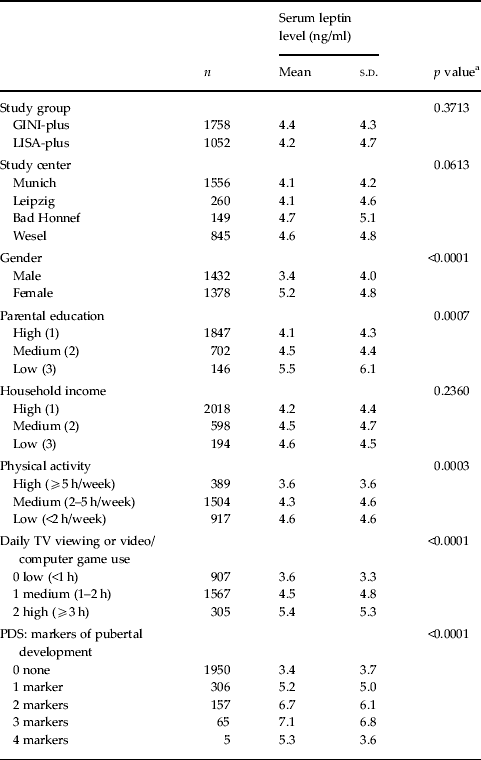
Subjects were assessed at a mean of 10.54 years (s.d. = 0.25) after baseline survey at birth. Characteristics of the sample and differences in serum leptin levels are presented in Table 1. Higher leptin levels were found among girls, children with low parental education, children with low physical activity, and high TV or PC use. There were also significant differences in leptin levels dependent on markers of pubertal development, indicating higher leptin levels with advanced pubertal development.
Serum leptin levels by characteristics of the GINI-plus and LISA-plus study sample (n = 2810) at the 10-year follow-up

PDS, Puberty Development Scale; s.d., standard deviation.
a p values for distributions between the different categories by the Mantel–Haenszel χ 2 test for categorical data, by ANOVA for continuous data.
Association between emotional symptoms and peer problems and serum leptin levels in the total sample
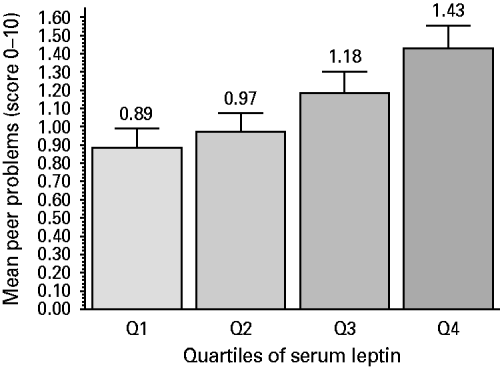
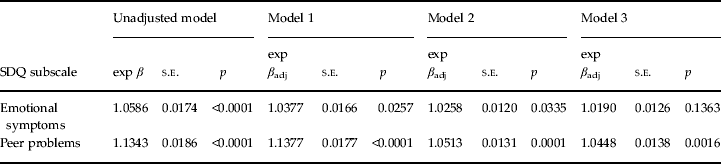
Linear regression, controlling for age, fasting serum leptin levels and socio-demographic background, showed that increases in emotional symptoms (exp β = 1.04, s.e. = 0.02, p < 0.03) and peer problems (exp β = 1.14, s.e. = 0.02, p < 0.0001) were positively associated with higher leptin levels (Table 2). Adding BMI, the relationship remained significant for both variables (exp β = 1.03, s.e. = 0.02, p < 0.04 and exp β = 1.05, s.e. = 0.01, p = 0.0001 respectively). Peer problems were significantly associated with leptin when adding pubertal development as a confounder (exp β = 1.05, s.e. = 0.01, p = 0.002), whereas the relationship was attenuated for emotional symptoms. When adding the potential intermediate variables energy intake, physical activity, daily TV viewing/video/PC game use to the full model, the estimate for peer problems did not change. The relationship between peer problems and leptin is illustrated in Fig. 1, which shows mean levels of peer problems in relation to leptin quartiles.
Mean levels of peer problems measured by the Strengths and Difficulties Questionnaire (SDQ) in relation to leptin quartiles.

Unadjusted and adjusted associations between emotional symptoms and peer problems and serum leptin levels at 10 years of age in the total sample (n = 2810)

SDQ, Strengths and Difficulties Questionnaire; s.e., standard error.
The regression coefficient (β) expresses the change in log-transformed serum leptin that is associated with a 1% change in the independent variables (SDQ subscales).
Model 1: adjusted for age at blood test, gender, fasting serum leptin, study centre, parental education and household income.
Model 2: adjusted for model 1 factors plus body mass index (BMI) levels.
Model 3: adjusted for model 2 factors plus pubertal status (primary model).
Association between emotional symptoms and peer problems and serum leptin levels in the fasting leptin sample
Examining the fasting serum leptin sample (Table 3), adjusted linear regression showed that the association between peer problems and serum leptin levels (exp β adj = 1.08, s.e. = 0.04, p = 0.0294) was significant, whereas no significant relationship was found with emotional symptom score (exp β adj = 1.01, s.e. = 0.03, p = 0.85).
Association between emotional symptoms and peer problems and fasting serum leptin levels (n = 462)

SDQ, Strengths and Difficulties Questionnaire; s.e., standard error.
The regression coefficient (β) expresses the change in log-transformed fasting serum leptin that is associated with a 1% change in the independent variables (SDQ subscales).
Model 1: adjusted for age at blood test, gender, study centre, parental education, household income, body mass index (BMI levels) and pubertal status (primary model).
Gender-stratified subanalyses in the total sample showed that, in the primary model plus estradiol (girls) and testosterone (boys) as confounder, serum leptin levels were positively associated with peer problems (exp β adj = 1.05, s.e. = 0.02, p = 0.03) in girls, whereas the association was borderline statistically significant in boys (exp β adj = 1.04, s.e. = 0.02, p = 0.05) (data not shown). No significant results were found for emotional symptoms.
Emotional symptoms and peer problems in relation to BMI and leptin
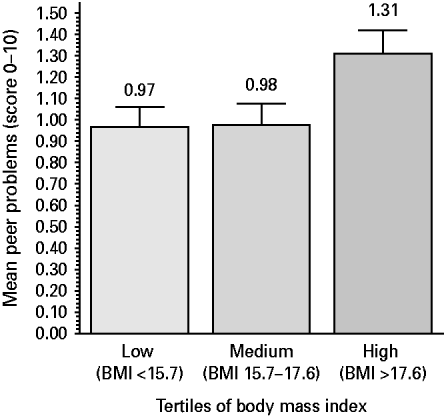
There was a significant relationship between peer problems and BMI (p < 0.0001), independent of age, sociodemographic factors and other confounding factors of model 3. This result is illustrated in Fig. 2, which shows mean levels of peer problems in relation to tertiles of BMI. However, when leptin was added as a confounder into the peer problems/BMI relationship, this association was no longer significant (p = 0.1225). By contrast, there was no significant association between emotional symptoms and BMI, and adding leptin as a confounder did not change the results.
Mean levels of peer problems measured by the Strengths and Difficulties Questionnaire (SDQ) in relation to body mass index (BMI) tertiles.

Examining the relationship between emotional symptoms and peer problems and the potential confounding effect of leptin, we found that the emotional symptoms/peer problems relationship remained significant when leptin was added to the full model (exp β = 1.11, s.e. = 0.02, p < 0.0001).
We found no significant associations between leptin and any other measures of behavioral problems (SDQ subscales hyperactivity/inattention, conduct problems, and prosocial behavior) (data not shown).
Discussion
Peer problems at age 10 years were found to be significantly associated with elevated serum leptin levels controlled for fasting serum leptin levels, socio-economic status (SES), BMI and pubertal development. The association between leptin and peer problems remained statistically significant in the fasting serum leptin sample, and when stratified by gender.
We know of no other study that has examined the association between mental health problems or social stress and leptin levels in children. In agreement with the results from previous studies on leptin concentration and body weight, we found that serum leptin concentrations were dependent on gender and BMI (Hassink et al. Reference Hassink, Sheslow, de Lancey, Opentanova, Considine and Caro1996; Blum et al. Reference Blum, Englaro, Hanitsch, Juul, Hertel, Müller, Skakkebæk, Heiman, Birkett, Attanasio, Kiess and Rascher1997; Garcia-Mayor et al. Reference Garcia-Mayor, Andrade, Rios, Lage, Dieguez and Casanueva1997). Our findings of a more advanced pubertal development together with higher leptin levels are also in agreement with a study showing leptin concentrations to be higher in post-pubertal girls than in prepubertal girls (Demerath et al. Reference Demerath, Towne, Wisemandle, Blangero, Chumlea and Siervogel1999). Our result of lower SES being associated with higher leptin levels is in agreement with the Avon Longitudinal Study of Parents and Children (ALSPAC) investigating socio-economic inequalities in cardiovascular risk factors at age 10 years (Howe et al. Reference Howe, Galobardes, Sattar, Hingorani, Deanfield, Ness, Davey-Smith and Lawlor2010).
Although we hypothesized that emotional symptoms might be associated with leptin, we did not observe a significant association after adjustment for confounding variables or in the fasting serum leptin sample, indicating that emotional symptoms are associated with leptin to a lower degree in children. However, there is inconsistent evidence for depression and its association with leptin levels among adult populations (Antonijevic et al. Reference Antonijevic, Murck, Frieboes, Horn, Brabant and Steiger1998; Kraus et al. Reference Kraus, Haack, Schuld, Hinze-Selch and Pollmacher2001; Rubin et al. Reference Rubin, Rhodes and Czambel2002; Esel et al. Reference Esel, Ozsoy, Tutus, Sofuoglu, Kartalci, Bayram, Kokbudak and Kula2005; Jow et al. Reference Jow, Yang and Chen2006; Yang et al. Reference Yang, Xie, Zhang, Wang, Li, Zhou and Tang2007; Pasco et al. Reference Pasco, Jacka, Williams, Henry, Nicholson, Kotowicz and Berk2008; Lawson et al. Reference Lawson, Miller, Blum, Meenaghan, Misra, Eddy, Herzog and Klibanski2011). Our results of a differential effect of emotional symptoms and peer problems may indicate that both categories capture different forms of social or psychological stress-related problems.
Our finding of a more pronounced leptin/peer stress association in girls reflects a gender-specific stress response. The greater total body fat in women could potentially contribute to the heightened association between leptin and stress responses (Rosenbaum et al. Reference Rosenbaum, Nicholson, Hirsch, Heymsfield, Gallagher, Chu and Leibel1996). Another explanation may be that the girls in our study were experiencing higher levels of peer stress compared to the boys. Investigating social stress at entry into adolescence, a previous study found that girls who start puberty show higher physiological stress reactions (cortisol levels) than girls who mature later (Sontag et al. Reference Sontag, Graber, Brooks-Gunn and Warren2008).
Assuming that the SDQ subcategory peer problems is indicative of high social stress, our finding of peer problems being related to leptin levels is consistent with prior findings that elevated circulating levels of leptin have been reported in people with high levels of perceived daily stress (Otsuka et al. Reference Otsuka, Yatsuya, Tamakoshi, Matsushita, Wada and Toyoshima2006), in children of low socio-economic position (Howe et al. Reference Howe, Galobardes, Sattar, Hingorani, Deanfield, Ness, Davey-Smith and Lawlor2010), in people suffering from depression (Raison et al. Reference Raison, Capuron and Miller2006), in men suffering from social isolation (Häfner et al. Reference Häfner, Zierer, Emeny, Thorand, Herder, Koenig, Rupprecht and Ladwig2011) and in patients with post-traumatic stress disorder (Liao et al. Reference Liao, Lee, Lee and Huang2004). The high leptin levels found in these studies are explained by activation of the stress response system of the HPA axis. Therefore, one explanation for our results is that the elevated leptin levels may be interpreted as a potential adaptive response to psychological stress. Leptin might have been increased to attenuate the stress response resulting from persistent HPA axis activation by chronic social stress (Otsuka et al. Reference Otsuka, Yatsuya, Tamakoshi, Matsushita, Wada and Toyoshima2006). It is possible that peer problems reflect a ‘defeat’ stress response that results in activation of the HPA axis, which mediates an increase in glucocorticoid levels. The increased levels of glucocorticoids are capable of stimulating the synthesis and secretion of leptin. Several studies have investigated relationships between peer stress and HPA axis activation by measuring saliva cortisol (glucocorticoids) levels. Peer rejection (Gunnar et al. Reference Gunnar, Sebanc, Tout, Donzella and van Dulmen2003; Peters et al. Reference Peters, Riksen-Walraven, Cillessen and de Weerth2011), peer conflict (Flinn & England, Reference Flinn and England1995; Flinn, Reference Flinn, Panter-Brick and Worthman1999) and peer victimization (Vaillancourt et al. Reference Vaillancourt, Duku, Decatanzaro, Macmillan, Muir and Schmidt2008) were all found to be associated with cortisol levels. Future studies are required that evaluate cortisol levels to examine whether social stress is capable of stimulating the synthesis and secretion of leptin. However, leptin might be a potential biomarker to provide additional information on the psychological and social well-being of children.
A plausible explanation for the peer problems/leptin association may be that BMI and obesity have a major contribution to social stress. Children with stress eat more, acquire a higher body fat mass, and thus through increased leptin resistance exhibit higher leptin levels. This agrees with evidence that suggests that people who are more responsive to psychological stress are at an increased risk of developing obesity (Bjorntorp, Reference Bjorntorp2001; Brydon et al. Reference Brydon, Wright, O'Donnell, Zachary, Wardle and Steptoe2007). However, the biological mechanisms underlying this phenomenon are poorly understood. Stress might promote obesity and contribute to abdominal obesity by stimulating increases in leptin. Our results show that peer problems are closely related to BMI levels. Thus, the higher leptin levels in our study may be the result of higher fat mass in those children with obesity who also have a higher prevalence of psychological stress. Subjects with higher fat mass have high leptin levels (Considine et al. Reference Considine, Sinha, Heiman, Kriauciunas, Stephens, Nyce, Ohannesian, Marco, McKee, Bauer and Caro1996) because of a presumed resistance to the appetite suppressant and metabolic effects of leptin (‘leptin resistance’).
However, up to now the direction of the peer problems/obesity relationship remains unclear, that is whether psychological stress causes obesity or whether obesity has an effect on social stress. The results from population-based studies have shown that overweight/obesity is related to peer problems in children, whereas other features of psychopathology, particularly emotional disorders and conduct disorders, did not display strong associations (Boneberger et al. Reference Boneberger, von Kries, Milde-Busch, Bolte, Rochat and Ruckinger2009; Drukker et al. Reference Drukker, Wojciechowski, Feron, Mengelers and van Os2009; Pitrou et al. Reference Pitrou, Shojaei, Wazana, Gilbert and Kovess-Masfety2010). Obese children are more picked on or bullied by other children (Lumeng et al. Reference Lumeng, Forrest, Appugliese, Kaciroti, Corwyn and Bradley2010), and overweight children experience stigmatization as early as age 6 (Pitrou et al. Reference Pitrou, Shojaei, Wazana, Gilbert and Kovess-Masfety2010).
Our result that other potential stressors (other subdomains of behavioral problems) failed to show any association with leptin levels suggests that this relationship is specific to this type of stressful problem. Thus, peer problems could be specific for HPA activation. Our speculation is also supported by a previous study measuring cortisol levels in children (Peters et al. Reference Peters, Riksen-Walraven, Cillessen and de Weerth2011). The findings of this study indicate that peer group processes are related to HPA activation because children who were excluded by their classmates had elevated cortisol levels. This effect was weaker for children with more friends or better friendships. Thus, we may speculate that activation of the HPA stress response system resulting in higher leptin levels is particularly sensitive to feelings of being rejected and isolated from peers in middle childhood, but is less influenced by other potential stressors.
Strengths and limitations
The strength of our study lies in the inclusion of a wide range of potential confounders, including several socio-economic indicators such as parental income and single parent family, along with lifestyle factors, pubertal development and sex hormones. Given the current paucity of available data for children, these findings provide the first contribution of leptin to the field of HPA axis response to psychological stress in children.
Our study also has limitations, first because the cross-sectional design only provides associations between variables, and not causal relationships. Second, although the study is population based, the results may not be fully representative for the total population with regard to sociodemographic characteristics and non-random loss to follow-up. A sensitivity analysis revealed that children from lower socio-economic background were slightly more likely to drop out over time (data not shown) (Sausenthaler et al. Reference Sausenthaler, Kompauer, Mielck, Borte, Herbarth, Schaaf, von Berg and Heinrich2007). Although our population has an over-representation of high SES families, we found that peer problems were associated with increased leptin levels. As both education and income are associated with leptin levels, we may therefore have underestimated the effects. Third, our study design meant that we were unable to obtain fasting serum leptin samples of all children, although it is generally accepted that the effect of individual meals on serum leptin levels is small (Birketvedt et al. Reference Birketvedt, Florholmen, Sundsfjord, Osterud, Dinges, Bilker and Stunkard1999). The reason to also use non-fasting leptin was that we wanted to determine the association between leptin and emotional symptoms/peer problems in a large population-based sample. The question of whether leptin from non-fasting samples could be useful for these associations has not been addressed in previous studies, and might therefore be of interest. Another reason to consider non-fasting levels, even though they are influenced by diet, is that leptin levels may be more representative of average circulating levels, especially in non-fasting subjects. Fasting samples may be not representative of a subject's normal daily physiological state. Two studies (Hancox & Landhuis, Reference Hancox and Landhuis2011; Khafaji et al. Reference Khafaji, Bener, Osman, Al Merri and Al Suwaidi2012) have performed repeated measurements of blood serum samples among fasting and non-fasting subjects, and reported correlations in the region of 0.95 for leptin levels, suggesting good reliability. Hancox & Landhuis (Reference Hancox and Landhuis2001) conclude that non-fasting leptin levels are probably sufficient for population-based research.
Because we accounted for fasting blood samples as a confounder, and the results showed a significant peer problems/leptin relationship in those 462 children who fasted overnight prior to the blood sampling, we probably eliminated bias due to the influence of food. Fourth, in the non-fasting blood samples diurnal variations in concentrations may have resulted in random misclassification. However, because fasting serum samples were drawn between 0730 and 0930 h, which is the time of day when circulating leptin concentrations would be expected to be at their nadir (Schoeller et al. Reference Schoeller, Cella, Sinha and Caro1997; van Aggel-Leijssen et al. Reference van Aggel-Leijssen, van Baak, Tenenbaum, Campfield and Saris1999), it seems unlikely that diurnal variation in leptin concentrations would have had a significant impact on the relationship between leptin and peer problems observed in the present study. In general, the normal within-individual diurnal variations of leptin are of a much smaller magnitude than the inter-individual variation determined by significant differences in body adiposity (Brannian et al. Reference Brannian, Schmidt, Kreger and Hansen2001). Fifth, although we adjusted for BMI in our analyses, we were unable to adjust for body fat mass, which reflects the degree of adiposity and is a stronger predictor of leptin levels. Although it is generally accepted that BMI as a global indicator of body fat is a predictor of serum leptin (Considine et al. Reference Considine, Sinha, Heiman, Kriauciunas, Stephens, Nyce, Ohannesian, Marco, McKee, Bauer and Caro1996; Sumner et al. Reference Sumner, Falkner, Kushner and Considine1998), there may be a residual confounding of fat mass not explained by BMI. Sixth, our findings may have been limited by the fact that emotional symptoms and peer problems were assessed by parental report, rather than by children self-report. However, the measures of ‘emotional symptoms' and ‘peer problems’ used for this study have been well validated to assess behavioral problems among children (Goodman, Reference Goodman1997; Woerner et al. Reference Woerner, Becker and Rothenberger2004). Finally, our study design meant that an evaluation of cortisol levels in our study population was not possible, although this would have been helpful for a hypothetical explanation that higher leptin levels are an adaptive response to psychological stress.
Conclusions
Our results indicate that, in children, higher leptin levels are associated with psychological stress, and with peer problems in particular. Elevated leptin levels might also be the result of higher fat mass in those children who have a higher prevalence of peer problems secondary to their obesity problem. Future studies are required to investigate whether body fat mass confounds the association between leptin and peer problems. Our results point to a potential influence of social relationships during childhood on the risk of developing obesity and metabolic alterations later in life.
Appendix
GINI-plus Study Group
The GINI-plus Study Group comprises the Helmholtz Zentrum München, German Research Center for Environmental Health, Institute of Epidemiology, Munich (Heinrich J, Wichmann HE, , Sausenthaler S, Zutavern A, Chen, Chih-Mei, Schnappinger M, Rzehak P); Department of Pediatrics, Marien-Hospital, Wesel (Berdel D, von Berg A, Beckmann C, Groß I); Department of Pediatrics, Ludwig Maximilians University, Munich (Koletzko S, Reinhardt D, Krauss-Etschmann S); Department of Pediatrics, Technical University, Munich (Bauer CP, Brockow I, Grübl A, Hoffmann U); IUF – Institut für Umweltmedizinische Forschung at the Heinrich-Heine-University, Düsseldorf (Krämer U, Link E, Cramer C); Centre for Allergy and Environment, Technical University, Munich (Behrendt H).
LISA-plus Study Group
The LISA-plus Study Group consists of the following: Helmholtz Zentrum München, German Research Center for Environmental Health, Institute of Epidemiology, Munich (Heinrich J, Wichmann HE, Sausenthaler S, Chen CM, Schnappinger M); Department of Pediatrics, Municipal Hospital ‘St.Georg’, Leipzig (Borte M, Diez U), Marien-Hospital Wesel, Department of Pediatrics, Wesel (von Berg A, Beckmann C, Groß I); Pediatric Practice, Bad Honnef (Schaaf B); Helmholtz Centre for Environmental Research – UFZ, Department of Environmental Immunology/Core Facility Studies, Leipzig (Lehmann I, Bauer M, Gräbsch C, Röder S, Schilde M); University of Leipzig, Institute of Hygiene and Environmental Medicine, Leipzig (Herbarth O, Dick C, Magnus J); IUF – Institut für Umweltmedizinische Forschung, Düsseldorf (Krämer U, Link E, Cramer C); Technical University Munich, Department of Pediatrics, Munich (Bauer CP, Hoffmann U); ZAUM – Center for Allergy and Environment, Technical University, Munich (Behrendt H, Grosch J, Martin F).
Acknowledgments
This research was funded by grants 01 EG 9732 and 01 EG 9705/2 (LISA study) and 01 EE 9401-4 (GINI study) from the Federal Ministry for Education, Science, Research, and Technology, FKZ 20462296 from the Federal Ministry of Environment, and Ludwig-Maximilians-University's innovative research priority project MC-Health.
We thank all the families who participated in the GINI-plus study and LISA-plus study. Furthermore, we thank all members of the GINI-plus and LISA-plus study groups for their excellent work.
Declaration of Interest
None.