Lipin-1 is a member of an evolutionarily conserved protein family. The protein possesses phosphatidate phosphatase activity and catalyses the formation of diacylglycerol in the glycerol-3-phosphate pathway (Csaki and Reue, Reference Csaki and Reue2010). It has been implicated in the regulation of triglyceride and phospholipid biosynthesis. Variation in the lipin-1 gene (LPIN1) has been reported to be associated with fat traits in livestock. In pigs, variation in the gene has been associated with variation in intramuscular fat levels and visceral fat levels (He et al., Reference He, Xu, Zhao, Fan, Yu, Zhu, Li, Peng and Liu2009). In Brown Swiss dairy cows (Bos taurus), Cecchinato et al. (Reference Cecchinato, Ribeca, Chessa, Cipolat-Gotet, Maretto, Casellas and Bittante2014) described that single nucleotide polymorphisms (SNPs) in the gene affected milk protein and casein content, and Pegolo et al. (Reference Pegolo, Cecchinato, Mele, Conte, Schiavon and Bittante2016) found that LPIN1 SNPs were associated with variation in some cattle milk fatty acid levels.
The wild yak (Bos mutus) is a bovid that is native to the Himalaya, and is found chiefly in northern Tibet and the western regions of the Qinghai Province of China. The main habitat is between 3000 and 5500 m of altitude in mountainous and plateau regions, where there are grasses and sedges accessible as food (Schaller and Liu, Reference Schaller and Liu1996). The domestic yak (Bos grunniens) has descended from the wild yak. Domesticated yaks have been kept for thousands of years, primarily for their milk, fibre and meat and also as beasts of burden. Yak milk contains 16.9–17.7% milk solids, 4.9–5.3% protein, 5.5–7.2% fat, 4.5–5.0% lactose, and 0.8–0.9% minerals, and it is richer in polyunsaturated fatty acids, protein, casein and fat, than B. taurus cows' milk (Nikkhah, Reference Nikkhah2011).
The yak lipin-1 gene has not been described, but in B. taurus cattle the gene is located on chromosome 11, and consists of at least 19 coding exons spanning over 79 kb. In the context of the finding of associations between B. taurus LPIN1 and variation in dairy traits (Cecchinato et al., Reference Cecchinato, Ribeca, Chessa, Cipolat-Gotet, Maretto, Casellas and Bittante2014), and the similarity between the B. taurus and B. grunniens genomes, LPIN1 would appear to be a good candidate as a gene that might affect milk traits in yaks. This is supported by the observation of high levels of LPIN1 expression in B. taurus mammary gland tissue (Bionaz and Loor, Reference Bionaz and Loor2008).
In this study, PCR-single stranded conformational polymorphism (PCR-SSCP) analysis was used to screen for variation in yak LPIN1 in four populations. Yak milk traits were analysed to ascertain if associations existed between variation in LPIN1 if found, and variation in those milk traits.
Materials and methods
All research involving animals was carried out according to the guidelines for the care and use of experimental animals that have been established by the Ministry of Science and Technology of the People's Republic of China (Approval number 2006-398). The research was approved by the Animal Care Committee of Gansu Agricultural University.
Yaks and blood samples
In total 500 yaks from four populations were investigated. These included Tianzhu white yaks (n = 111), Qinghai yaks (n = 91), wild × domestic-cross yaks (n = 38) and Gannan yaks (n = 260 from 26 different farms, all female). Blood samples from these yaks were collected onto FTA cards (Whatman, Middlesex, UK), and genomic DNA was purified from the dried blood spots using the method of Zhou et al. (Reference Zhou, Hickford and Fang2006).
Milk traits assessed
The age and parity of the Gannan yaks were recorded. Milk samples (25 ml) were collected early in lactation (at approximately 56 d in milk), and in the morning and evening, over a period of three days. The six replicates per yak were mixed and transported to the laboratory for analysis.
The yak milk samples were assessed for protein content, fat content, lactose content, total solids and non-fat solids by the Ministry of Agriculture, Animal Fur and Product Quality Supervision and Testing Centre (Lanzhou, China) using a FOSS MilkoScan FT120 milk analysis instrument (Shanghai, China). Each sample was measured in triplicate and the mean trait values calculated.
PCR amplification and SSCP analysis
PCR primers were designed based on a published B. taurus cattle LPIN1 DNA sequence (AC_000168.1). They would notionally amplify a 337 bp fragment containing part of the 5′ untranslated region (UTR) of yak LPIN1. The primers were 5′-GAGAGAACATGGGAGGGGAG-3′ and 5′-TCGCCTGACGACTAGCACCTG-3′.
PCR amplifications were performed in a 20-μl reaction containing the DNA from one 1.2 mm punch of FTA card, 150 mm of each dNTP (Takara, Dalian, China), 2.5 mm Mg2+, 0.25 μm of each primer, 0.5 U of Tɑq DNA polymerase (Takara) and ddH2O to make up to volume. The PCR amplification involved an initial denaturation for 2 m at 94°C. This was followed by 35 cycles of incubation for 30 s at 94°C, 30 s at 62°C, 30 s at 72°C, and a final extension of 5 m at 72°C.
Variation in the LPIN1 amplicons was screened for using a SSCP analysis. A 2-μl aliquot of the PCR products was mixed with 8 μl of loading dye (98% formamide, 10 mm EDTA, 0.025% bromophenol blue and 0.025% xylene cyanol) and then denatured at 98°C for 10 m, prior to being rapidly cooled on wet ice for 5 m. The denatured amplicons were then loaded on 16 × 18 cm, 12% acrylamide: bisacrylamide (37.5 : 1) (Bio-Rad, Hercules, CA, USA) gels. Electrophoresis was performed for 18 h in 0.5 × TBE at 240 V and at 17.5°C. The gels were silver-stained according to the method of Byun et al. (Reference Byun, Fang, Zhou and Hickford2009).
Sequencing of amplicons and sequence analysis
Yaks that had PCR-SSCP patterns that were deemed to be homozygous were sequenced directly by the Sangon Biotechnology Company Limited (Shanghai, China). Those amplicons that were only found in a heterozygous form, were sequenced using a rapid sequencing approach that is described by Gong et al. (Reference Gong, Zhou and Hickford2011). Sequence analyses, translations and comparisons were carried out using DNAMAN version 5.2.10 (Lynnon Biosoft, Vaudreuil, Canada).
Statistical analysis
Associations between the LPIN1 genotypes and variation in milk traits were tested using the SPSS statistical software (version 16.0, SPSS Institute, USA). General linear models (GLMs) were employed to compare the various milk traits between yaks with differing genotypes. A Bonferroni correction was applied to these analyses to reduce the chances of obtaining false positive results during the various comparisons. The influence of farm and parity were included in the linear models as fixed effects. The linear models were: Yijk = μ + Gi + Pj + Fk + eijk, where Yijk = the dependent variable, μ = the population mean, Gi = genotype, Pj = fixed effect of parity, Fk = fixed effect of the farm, and eijk = random error.
Results and discussion
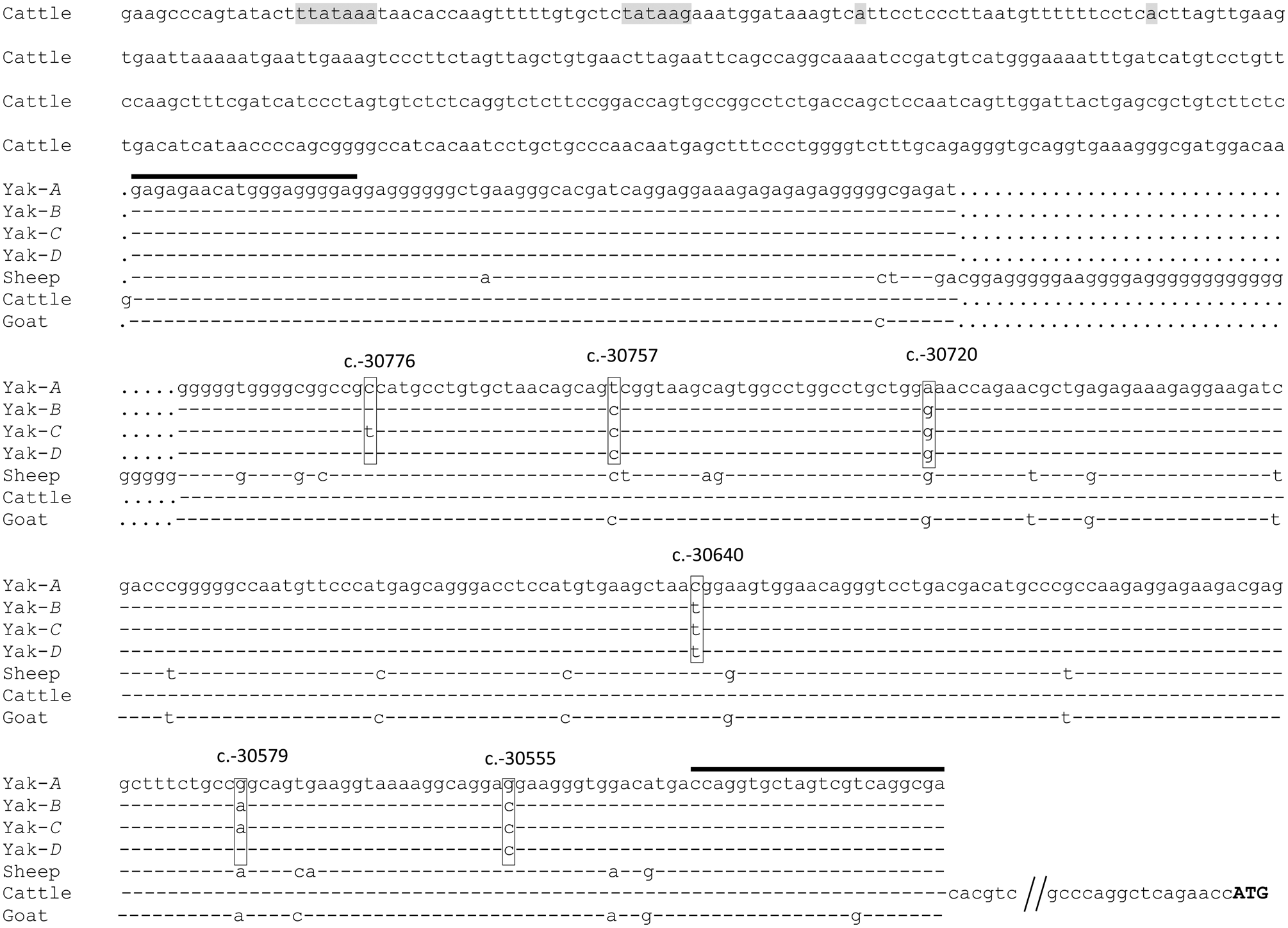
The PCR amplicons produced four PCR-SSCP patterns, with either one or a combination of two patterns being observed in each yak (online Supplementary Fig. S1). Sequencing of the amplicons revealed four sequence variants in the region amplified (accession numbers MH588439–MH588442; Fig. 1). The frequencies of the genotypes and variants found in the four yak populations, are presented in online Supplementary Table S1.
Alignment of the yak LPIN1 5′ UTR variant sequences, together with sheep, cattle and goat LPIN1 sequences. Dashes indicate nucleotides identical to the top sequence, and dots have been introduced to improve the alignment. Putative TATA boxes and Cap sites are shaded, and the ATG translation start codon is shown in upper case and bold. The SNPs found in the yak sequences are in boxes and the positions are indicated above. Numbering of nucleotide follows the HGVS nomenclature (http://www.hgvs.org/mutnomen/). The primers binding regions are indicated with horizontal bars above the target sequences. The GenBank accession numbers of the sheep, cattle and goat LPIN1 sequences are NC_019460.2, AC_000168.1 and NC_022303.1, respectively.

Six SNPs were identified (Fig. 1) in the four sequence variants. Given that the 5′ UTR of a gene can play an important role in the regulation of gene expression at the post-transcriptional level, the SNPs found may have a functional effect. The ability of a gene region to affect that gene's expression is, in part, determined by its sequence, hence variation in the 5′ UTR may in some way affect LPIN1 expression and consequently milk traits. It is therefore notable that three of these SNPs occurred at positions that are conserved across some other ruminant species (Fig. 1). The functional effect of these SNPs is, therefore, worthy of further investigation.
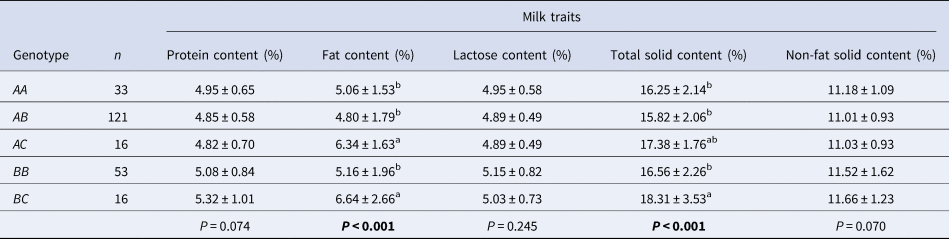
The effect of yak LPIN1 genotype on five milk traits was investigated in 260 female Gannan yaks. Of the seven genotypes detected, only five (AA, AB, AC, BB and BC) occurred at a frequency of over 5%, and hence association analyses were only carried out with these genotypes. Associations were detected with milk fat, and total milk solid content (Table 1). Individuals with the AC and BC genotypes had higher milk fat content than those with the AA, AB and BB genotypes (P < 0.001), and individuals with the BC genotype had a higher milk solid content than those with the AA, AB and BB genotypes (P < 0.001). This suggests that C is contributing to the increase in milk fat content. The 5′ UTR genotype had a trend of association with milk protein content, and this is consistent with the finding of a trend of association with milk non-fat solid content (Table 1). There was no association observed between LPIN1 genotype and milk lactose content.
Comparison of milk traits between different LPIN1 genotypes in Gannan yaks

Note: Different superscripts in the same column indicate a significant difference (P < 0.05). P < 0.05 are in bold.
The association results described here for yaks, are consistent with the findings of Cecchinato et al. (Reference Cecchinato, Ribeca, Chessa, Cipolat-Gotet, Maretto, Casellas and Bittante2014) and Pegolo et al. (Reference Pegolo, Cecchinato, Mele, Conte, Schiavon and Bittante2016) for B. taurus. Cecchinato et al. (Reference Cecchinato, Ribeca, Chessa, Cipolat-Gotet, Maretto, Casellas and Bittante2014) were the first to report associations between LPIN1 and milk traits. They described two SNPs, rs137457402 and rs136905033 (these being T > G and T > C substitutions), which were located at the 3′-end of intron 2 and in the 3′ untranslated region respectively. The first SNP was associated with variation in total protein percentage and casein percentage, but the effect was small, with the additive effect of the T allele equal to 0.027 (PPN0 = 0.979) and 0.021 (PPN0 = 0.98) for protein and casein percentage respectively. This explains approximately 2% of the additive genetic variances for these traits.
Pegolo et al. (Reference Pegolo, Cecchinato, Mele, Conte, Schiavon and Bittante2016) found that the same two SNPs in B. taurus LPIN1 were associated with variation in milk fatty acids. The T allele of rs136905033 was positively associated with C14 : 1 cis9, C15 : 0, and C16 : 1 cis-9, whereas it was negatively associated with α-linolenic acid (C18 : 3 cis-9, cis-12, cis-15). This positive association of the T allele with variation in C14 : 1 cis-9 and C16 : 1 cis-9, suggests it may positively affect the activity of the mammary gland, where these two fatty acids are mainly produced (Mele et al., Reference Mele, Conte, Castiglioni, Chessa, Macciotta, Serra, Buccioni, Pagnacco and Secchiari2007).
While the region of yak LPIN1 studied here is upstream of the two SNPs described in B. taurus (Cecchinato et al., Reference Cecchinato, Ribeca, Chessa, Cipolat-Gotet, Maretto, Casellas and Bittante2014), the associations were found with both protein and fat traits, along with milk solid traits. This supports the contention that LPIN1 is having an effect on milk traits in two bovine species, and is consistent with yaks and cattle being closely related to each other. However, this does need to be balanced against the findings of Nafikov et al. (Reference Nafikov, Schoonmaker, Korn, Noack, Garrick, Koehler, Minick-Bormann, Reecy, Spurlock and Beitz2014), who found no association between a SNP in the 5′ UTR of Holstein cattle and milk traits.
Supplementary material
The supplementary material for this article can be found at https://doi.org/10.1017/S002202991900089X
Acknowledgements
This study was financially supported by the Project for Creative Basic Research Group of Gansu (17JR5RA137).