Implications
Using an in vitro fermentation technique, findings from this experiment support the fact that both quantitative and qualitative production of short-chain fatty acids and related kinetics were influenced by fermentation of various sources of resistant starches obtained from native starches characterized by different inherent starch characteristics. A better understanding of kinetic parameters related to fermentation could be useful to select ingredients that encourage fermentation in specific areas in the gastrointestinal tract of pigs, in an effort to modulate fermentation end-products by the microbial community.
Introduction
Resistant starch (RS) is the fraction of ingested starch that escapes enzymatic digestion by endogenous enzyme in the upper gastrointestinal tract and passes into the colon where it can be fermented by caecal and colonic microbial communities (Bach Knudsen et al., Reference Bach Knudsen, Hedemann and Lærke2012). Nutritionally, RS, along with non-starch polysaccharides and non-digestible oligosaccharides, is regarded as non-digestible carbohydrate (NDC). The presence of RS in feeds is related to several factors including starch source, amylose content and starch granule size (Giuberti et al., Reference Giuberti, Gallo, Cerioli and Masoero2012). Although high-RS diets were associated with lower apparent total tract digestibility of nutrients (Gerrits et al., Reference Gerrits, Bosch and Van den Borne2012) and lower feed efficiency (Regmi et al., Reference Regmi, van Kempen, Matte and Zijlstra2011), there is growing interest in including both RS and other sources of NDC in pig diets because of potential prebiotic properties (Bach Knudsen et al., Reference Bach Knudsen, Hedemann and Lærke2012). In particular, RS can provide a source of fermentable carbohydrates for caecal and colon microbiota and with fructo-oligosaccharides can synergistically raise the number of bifidobacteria in faeces (Hedemann and Bach Knudsen, Reference Hedemann and Bach Knudsen2007; Bach Knudsen et al., Reference Bach Knudsen, Hedemann and Lærke2012). In growing pigs, long-term intake of RS (as raw potato starch) reduced damage to epithelial cells and increased butyrate concentration in colon digesta, which might improve mucosal integrity (Nofrarías et al., Reference Nofrarías, Martínez-Puig, Pujols, Majó and Pérez2007).
The main end-products of RS fermentation are gases (i.e., H2, CO2 and CH4) and short-chain fatty acids (SCFA) (Englyst et al., Reference Englyst, Kingman, Hudson and Cummings1996). In pigs, SCFA can exert specific physiological effects (Williams et al., Reference Williams, Bosch, Boer, Verstegen and Tamminga2005). In particular, acetate reaches muscle tissues where it contributes to energy supply, whereas propionate is converted to glucose in the liver (Williams et al., Reference Williams, Verstegen and Tamminga2001). Finally, butyrate is considered as the most important SCFA that can stimulate development, growth and renewal of intestinal cells (Bach Knudsen et al., Reference Bach Knudsen, Hedemann and Lærke2012) and can reduce epithelial cell apoptosis, thus leading to decreased skatole formation and absorption (Claus et al., Reference Claus, Lösel, Lacorn, Mentshel and Schenkel2003). Not only the amount of RS reaching the large intestine has great importance, but also its composition and physical structure may affect SCFA fermentation patterns (Brouns et al., Reference Brouns, Kettlizt and Arrigoni2002) and absorption (van der Meulen et al., Reference van der Meulen, Bakker, Bakker, de Visser, Jongbloed and Everts1997; Regmi et al., Reference Regmi, van Kempen, Matte and Zijlstra2011). However, it remains uncertain whether fermentation of RS obtained from different starch sources may influence total amount and individual concentration of SCFA.
Being the production of SCFAs in the large intestine difficult to determine because of a rapid absorption from the gut lumen, in vitro fermentations are frequently used as reliable alternatives to estimate SCFA production (Coles et al., Reference Coles, Moughan and Daragh2005). In addition, as the biggest variation between fermentable ingredients seems to occur in SCFA production (Williams et al., Reference Williams, Bosch, Boer, Verstegen and Tamminga2005), it could be interesting to evaluate individual SCFA concentrations and related kinetics over time, especially when a wide range of substrates with different fermentabilities is examined (Awati et al., Reference Awati, Williams, Bosch, Li and Verstegen2006).
As a consequence, an in vitro experiment (based on enzymatic digestion followed by in vitro fermentation) was conducted to investigate whether various sources of RS, derived from native starches characterized by heterogeneous starch chemistry and structure, can influence total and individual SCFA concentrations and related kinetics. The objective of this study was to explore whether various sources of RS, obtained from native starches and characterized by inherent heterogeneous starch chemistry and structure, can influence SCFA concentrations and relative production kinetics. We hypothesized that RSs obtained after hydrolysis of various native starches are not equivalent SCFA providers, and therefore fermentation kinetics for total and individual SCFA would be different after in vitro large intestine fermentation.
Material and methods
Starch sources
Eight native purified starches, selected to cover a wide range of starch chemistry and structure, were tested: wheat (WeS; 111685, Merck, Milan, Italy), pea (PeS; Nastar, Cosucra Group Warconing, Warconing, Belgium), normal amylose maize (NmS; S4126, Sigma-Aldrich® Co., Milan, Italy), high-amylose maize (HmS; S4180, Sigma-Aldrich® Co.), low-amylose maize (LmS; S9679, Sigma-Aldrich® Co.), potato (PoS; S4251, Sigma-Aldrich® Co.), rice (RiS; Remy B7, Remy Industries, Leuven-Wijgmaal, Belgium) and low-amylose rice (LRiS; Remyline AX-DR, Remy Industries, Leuven-Wijgmaal, Belgium).
In vitro hydrolysis of native starches
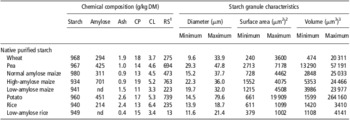
For each native starch, the RS fraction was obtained in vitro following the method proposed by Boisen and Fernàndez (Reference Boisen and Fernàndez1997), consisting of a two-step enzymatic hydrolysis-mimicking gastric (step 1) and small intestine (step 2) digestion of pigs. In short, about 2 g of samples were weighted in quadruplicate in colonical flasks. Step 1 involved an incubation in a buffer solution (pH = 2) containing fresh pepsin (4 ml, 25 mg/ml; Sigma P-7000; Sigma-Aldrich® Co.) under continuous magnetic stirring at 39°C for 2 h. This incubation was followed by a hydrolysis using pancreatin (4 ml, 100 mg/ml: Sigma P-1750; Sigma-Aldrich® Co.) in a buffer solution at pH 6.8 for 4 h (step 2). The starch residues, collected by filtration using a nylon cloth (42 μm), were washed with ethanol (2 × 20 ml) and acetone (2 × 20 ml) and dried overnight at 45°C. Considering the near absence of impurity of selected native starches (Table 1), the RS was calculated using the dry weight of the collected starch residue and expressed as g/kg dry matter (DM). The obtained RS from different incubations of same ingredient were pooled to obtain post-hydrolysis substrates for subsequent in vitro fermentation.
Chemical composition, resistant starch content and granule characteristics of native purified starches

CL = crude lipid; DM = dry matter; RS = resistant starch; nd = not detected.
1Starch not hydrolyzed after pepsin (2 h) and pancreatin (4 h) hydrolysis.
2Calculated as 4πr 2, where r is the granule radius.
3Calculated as 4/3πr 3.
In vitro large intestine fermentation
The fermentation of the resulting post-hydrolysis RS fraction was conducted in vitro according to the technique detailed by Jha et al. (Reference Jha, Bindelle, Rossnagel, Van Kessel and Laterne2011a). An anaerobic environment was maintained throughout the experiment by flushing with CO2 gas. Faeces were collected from the rectum of three growing pigs (35 to 46 kg body weight; fed with a standard commercial diet devoid of antibiotics) and immediately placed in airtight plastic syringes and in a water bath at 39°C. The faecal inoculum (obtained by pooling equal amounts (by wet weight) of fresh faeces from each animal) was mixed with 200 ml of a pre-warmed (to 39°C) CO2-saturated buffer solution (Menke and Steingass, Reference Menke and Steingass1988) by using a Stomacher Lab Blender 400 (Seward Medical, Norfolk, UK) and filtered through a 250 μm mesh screen (Bindelle et al., Reference Bindelle, Buldgen, Boudry and Leterme2007). Thereafter, an additional volume of buffer solution was added to reach the desired dilution of faeces in the buffer (0.05 g faeces/ml buffer) (Jha et al., Reference Jha, Bindelle, Rossnagel, Van Kessel and Laterne2011a). Then, ~200 mg each dry pooled RS residue was weighted in triplicate into a 125-ml glass serum bottle (Z114041; Sigma-Aldrich® Co.) and filled with 30 ml of the filtered buffer solution containing the faecal inoculum. Bottles were sealed with a rubber stopper and simultaneously placed for incubation in a pre-warmed shaking water bath (50-rpm) at 39°C. Three bottles without substrate were used as blanks. All manipulations and sample handlings were done under continuous CO2 flushing. Three incubation runs were carried out in 3 different days and bottles within runs were considered repetitions, whereas bottles between runs were considered as replicates. Aliquots (1.5 ml) were aseptically removed from each bottle with a 2-ml plastic injection syringe equipped with a catheter needle (SR-OX 1451 CA; Terumo Italia s.r.l., Rome, Italy) at 0, 4, 8, 24, 48 and 72 h after incubation for SCFA determination. About 2 min before each sampling, the shaking action of the water bath was stopped to prevent any undesirable substrate removal. At the end of the fermentation, following a thorough rinsing of the bottle, post-fermentative residues were collected by filtration with a porcelain filtration funnel lined with dried and pre-weighed filter papers (Whatman No. 54; Whatman Inc., Folrham Park, NJ, USA), and then filtrates were dried overnight at 100°C and used to calculate the in vitro RS degradation coefficient after 72-h fermentation (IVRSdc) as follows:
 $$ IVRSdc\,{\rm{ = }}\,{\rm{[(D}}{{{\rm{W}}}_{{\rm{sbf}}}}\,{\rm{ - }}\,{\rm{(D}}{{{\rm{W}}}_{{\rm{res}}}}\,{\rm{ - }}\,{\rm{D}}{{{\rm{W}}}_{{\rm{blk}}}}{\rm{))/D}}{{{\rm{W}}}_{{\rm{sbf}}}}{\rm{]}} $$
where DWsbf is the dry weight of the sample before fermentation (mg), DWres is the dry weight of the residue (mg) and DWblk is the average dried weight of blanks (mg). All samples were stored at −20°C until analysis.
Chemical analyses and calculations
Chemical analyses were performed in duplicate according to Association of Official Analytical Chemistry (AOAC) (2000) for DM, ash (g/kg DM), CP (g/kg DM) and crude lipid (CL, g/kg DM) (methods 930.15, 942.05, 976.05 and 954.02 without acid hydrolysis, respectively). Starch content (g/kg DM) was determined after enzymatic hydrolysis as detailed by Masoero et al. (Reference Masoero, Gallo, Zanfi, Giuberti and Spanghero2010), whereas amylose content (g/kg DM) was determined using a Megazyme amylose/amylopectin assay kit (K-AMYL 07/11; Megazyme Int., Wicklow, Ireland). Starch granule size was determined using a scanning electron microscope (Quanta Feg 250; Fei Company, Hillsboro, USA). In particular, each ingredient (i.e., native and post-hydrolysis starches) was thinly spread onto circular metal stubs with double-sided adhesive carbon tape and coated with 12 nm gold. For each sample, three images from separate areas were acquired and about 100 granules per image were randomly chosen and measured by ImageJ software (version 1.46r).
The SCFA content was analysed by gas chromatography (Varian 3350 system; Varian Inc., CA, USA) equipped with a flame ionization detector and a split injector. Analysis was performed with a silica capillary column (DB-5; Agilent Technologies, Cernusco s/N, Milan, Italy). The injection volume was 1 μl. The carrier gas was high-purity helium with a flow rate of 1.3 ml/min. The injector and detector temperatures were kept at 200°C and 220°C, respectively. The column oven temperature was programmed as follows: 60°C for 5 min, from 60°C to 160°C at 5°C/min and from 160°C to 190°C at 10°C/min for 7 min. Pivalic acid was used as internal standard. Individual SCFA concentration was calculated by subtracting the average concentration of corresponding SCFA in blanks at every measurement. Branched-chain fatty acid (BCFA) concentration was calculated as the sum of isobutyric and isovaleric acids, whereas SCFA concentration (SCFA, mmol/g DM incubated) was calculated as the sum of the individual production of each SCFA. The total energy from SCFA after 72 h of fermentation (TESCFA; kJ/g DM incubated) was calculated as the sum of energy equivalents from acetate, propionate and butyrate production as reported by Wang et al. (Reference Wang, Zhu, Li, Wang and Jensen2004).
Profiles of SCFA production (expressed as mmol/g DM incubated) were fitted to the monophasic model by Groot et al. (Reference Groot, Cone, Williams, Debersaques and Lantinga1996) as:
 $$ G\,{\rm{ = }}\,A{\rm{/(1}}\,{\rm{ + }}\,{{{\rm{(}}C{\rm{/}}t{\rm{)}}}^B} {\rm{)}} $$
where G is the total or individual (i.e., acetate, propionate and butyrate) SCFA production, A is the asymptotic SCFA production, B is the switching characteristics of the curve, C is the time at which half of the asymptote has been reached (T 1/2) and t is the time (h).
The maximum rate of SCFA production (R max) and the time at which it occurs (T max) were calculated according to the equations by Bauer et al. (Reference Bauer, Williams, Voigt, Mosenthin and Verstegen2001) as:
 $${{R}_{{\rm{max}}}}\,{\rm{ = }}\,{\rm{(}}A({{C}^B} {\rm{)}}B({{T}_{{\rm{max}}}}^{{{\rm{(}} - B - 1{\rm{)}}}} {\rm{))}}\,{\rm{/}}\,{{{\rm{(1}}\,{\rm{ + }}\,{\rm{(}}{{C}^B} {\rm{)(}}{{T}_{{\rm{max}}}}^{{( - B)}} {\rm{))}}}^{\rm{2}}} $$
 $${{T}_{{\rm{max}}}}\,{\rm{ = }}\,C({{((B\,{\rm{ - }}\,1)\,/\,(B\, + \,1))}^{(1/B)}} )$$
Statistical analysis
Data (i.e., total SCFA production, individual SCFA molar ratio, TESCFA, IVRSdc and fitted kinetic parameters) were subjected to ANOVA using the mixed procedure of SAS (2003) according to the model:
 $$ {{Y}_{ij}}\,{\rm{ = }}\,\mu \,{\rm{ + }}\,{\rm{block}}\,{\rm{ + }}\,{{\alpha }_i}\,{\rm{ + }}\,{{e}_{ij}} $$
where Yij is the dependent variable on the jth subject assigned to RS source i, μ is the overall mean, block is the random effect of day of incubation (n = 3), αi is the fixed effect of RS source (n = 7) and eij is the residual error. The minimum significant difference (MSD) was generated from Tukey's test and it was used as the basis of the multiple comparisons among means. The significant level was set at P < 0.05.
Results
Characteristics of native and hydrolyzed starches
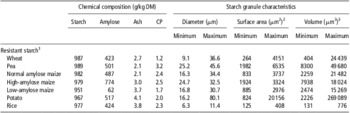
The chemical composition and the starch granule characteristics of native starches are presented in Table 1. A wide range in amylose content and in starch granule size was measured. On average, larger starch granule size in terms of diameter (from 14.5 to 79.6 μm), surface area (from 661 to 19 909 μm2) and volume (from 1599 to 264 160 μm3) was exhibited by PoS when compared with other native starches. The in vitro hydrolysis of native starches yielded different RS amounts, ranging from very high (⩾650 g/kg DM; PeS, PoS and HmS) to low (<50 g/kg DM; LRiS). On Table 2, the chemical composition and the starch granule characteristics are detailed for the post-hydrolysis RS fractions obtained after hydrolysis of native starches. Similar to native starch counterparts, starch was the major component of the resulting hydrolyzed fractions (ranging from 951 to 989 g/kg DM), which were characterized by a broad range of amylose content (ranging from 62 to 774 g/kg DM) and of starch granule sizes.
Chemical composition and starch granule characteristics of resulting post-hydrolysis ingredients

DM = dry matter.
1The resistant starch fractions were obtained for each native purified starch after a pre-incubation step consisting in pepsin (2 h) and pancreatin (4 h) hydrolysis. Parameters of interest for low-amylose rice starch are not reported as insufficient material was obtained after the pre-incubation steps.
2Calculated as 4πr 2, where r is the granule radius.
3Calculated as 4/3πr 3.
Profile of end-products after fermentation
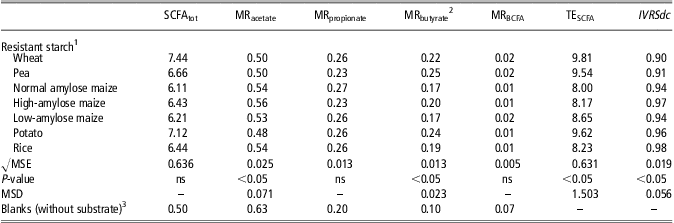
The SCFA production after 72 h of fermentation, along with TESCFA and IVRSdc values, is shown in Table 3. For LRiS, the in vitro fermentation was not performed because of insufficient substrate collected after the pre-incubation steps. The average total SCFA production was similar between ingredients, with values ranging from 6.11 to 7.44 mmol/g DM incubated for RS from NmS and WeS, respectively. In general, a SCFA production with high proportion of acetate and propionate, which together accounted for more than 0.70 of total SCFA production, was yielded by all ingredients. Both acetate and butyrate molar ratios in the SCFA profile differed between ingredients (MSD 0.071 and 0.023, respectively; P < 0.05). In particular, higher MR of butyrate was produced by RS from PoS and PeS (0.24 and 0.25, respectively), whereas lower MR (on average 0.17) was yielded by RS from NmS and LmS. Different (P < 0.05) TESCFA values were calculated, ranging from 8.00 to 9.81 kJ/g DM incubated. Finally, different (P < 0.05) IVRSdc were recorded, ranging from 0.90 to 0.98, for RS obtained from WeS and RiS, respectively.
Total SCFAtot (mmol/g DM incubated), MR of individual SCFA, total energy from SCFA (TESCFA; kJ/g DM incubated) and IVRSdc after 72 h fermentation of resistant starch fraction obtained from different native purified starches using pig faecal inoculum (n replicates = 3)
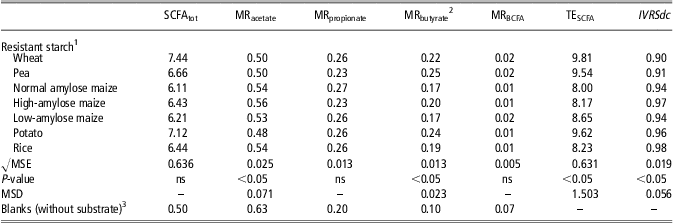
SCFA = short-chain fatty acid production; MR = molar ratio; IVRSdc = in vitro resistant starch degradation coefficient; BCFA = branched-chain fatty acids (sum of iso-butyric and iso-valeric acids); MSD = minimum significant difference.
1The resistant starch fractions used as substrate for the fermentation process were obtained for each native purified starch after a pre-incubation step consisting in pepsin (2 h) and pancreatin (4 h) hydrolysis before the fermentation process. Parameters of interest for resistant starch from low-amylose rice starch are not reported as insufficient material was obtained after the pre-incubation steps.
2Block effect P < 0.05.
3Values expressed as mmol/l.
Fermentation kinetics of RS
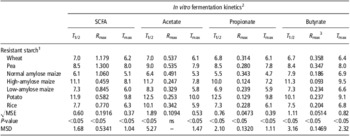
Within ingredients, the adopted monophasic model well fitted the observed data (Supplementary Figure S1). Differences in fermentation kinetic parameters for total and individual (i.e., acetate, propionate and butyrate) SCFA productions were recorded (P < 0.05; Table 4). Considering total SCFA production, T 1/2, R max and T max values differed (P < 0.05) between ingredients, with values ranging from 6.1 to 11.9 h, from 0.459 to 1.300 mmol/g DM incubated per hour and from 5.1 to 9.8 h, respectively (P < 0.05). Overall, a similar trend was observed for T 1/2, R max and T max values considering individual SCFA productions. In particular, T 1/2 ranged (P < 0.05) from 6.4 to 12.5 h, from 5.5 to 12.5 h and from 6.7 to 11.3 h for acetate, propionate and butyrate, respectively. Finally, considering R max, different values were obtained for propionate and butyrate productions (MSD 0.1320 and 0.1469, respectively; P < 0.05), whereas no difference was recorded for acetate.
Fitted kinetic parameters of SCFA, acetate, propionate and butyrate productions after fermentation of resistant starch fractions obtained from different native purified starches using pig faecal inoculum (n replicates = 3)

SCFA = short-chain fatty acid production; MSD = minimum significant difference; DM = dry matter.
1The resistant starch fractions used as substrate for the fermentation process were obtained for each native purified starch following a pre-incubation step consisting in pepsin (2 h) and pancreatin (4 h) hydrolysis before the fermentation process. Parameters of interest for resistant starch from low-amylose rice starch are not reported as insufficient material was obtained after the pre-incubation steps.
2T 1/2 = time to reach half of the maximum production (h); R max = maximum rate of production (mmol/g DM incubated per hour); T max = time of occurrence of R max (h).
3Block effect P < 0.05.
Discussion
The aim of this study was to determine how RS obtained from various native purified starches could influence both quantitative and qualitative productions of SCFA when fermented using pig faecal inoculum. In pigs, in vitro fermentations with faecal inoculum are frequently used to investigate how different sources of NDC can affect the fermentation in the large intestine (Wang et al., Reference Wang, Zhu, Li, Wang and Jensen2004; Williams et al., Reference Williams, Bosch, Boer, Verstegen and Tamminga2005). Generally, NDCs have a strong impact on fermentation kinetics and metabolite productions depending on the degree of polymerization, chemical composition and bond types (MacFarlane and MacFarlane, Reference MacFarlane and MacFarlane1993). Nevertheless, up to now, misleading results were reported about the possible influence of heterogeneous RS on total and individual concentrations of SCFA during fermentation, probably because of confounding effects of nutrients other than starch (i.e., fat, fibre and protein; Jha et al., Reference Jha, Bindelle, Rossnagel, Van Kessel and Laterne2011a) and to a restrictive characterization of substrates only by incubation with faecal inoculum (i.e., lack of an enzyme pre-treatment step before fermentation; Williams et al., Reference Williams, Bosch, Boer, Verstegen and Tamminga2005). In addition, Awati et al. (Reference Awati, Williams, Bosch, Li and Verstegen2006) argued that the study of metabolite profiles at the end of in vitro fermentation might not give a suitable comparison between different substrates that vary widely for the fermentation kinetics. In our opinion, even if the evaluation of SCFA profiles at the end of the fermentation process could be useful to compare different ingredients, it is not informative about specific dynamics (i.e., maximum rate and time at which it occurred) of total and individual SCFA productions.
Therefore, we addressed these issues using three different approaches. First, purified starches were selected to avoid possible confounding effects of starch-associated compounds. Second, native starches underwent an enzyme pre-treatment step to better simulate what is reaching the large intestine of the pig (Bindelle et al., Reference Bindelle, Buldgen, Boudry and Leterme2007). Third, each SCFA profile, resulting from RS fermentation, was characterized by six incubation times and up to 72 h of in vitro fermentation to better estimate kinetic parameters of the fermentation process.
Amount of RS in selected native starches
As expected, native starches were characterized by different RS contents. Our results indicated that LRiS could be considered as a negligible source of RS, being almost completely hydrolyzed during the pre-incubation step. As previously reported, differences in starch chemistry because of botanical origin can contribute to the relative resistance of starch towards being digested in the upper part of the gastrointestinal tract, thus resulting in different RS amount (Svihus et al., Reference Svihus, Uhlen and Harstad2005) potentially available for microbial fermentation. In particular, LRiS was characterized by a near absence of amylose and by small size of starch granules. Small intestinal starch degradability is inversely related to amylose content because of decreased enzyme accessibility (Svihus et al., Reference Svihus, Uhlen and Harstad2005). In addition, larger starch granules are characterized by a smaller surface area to volume ratio, and hence a lower surface potentially subjected to hydrolysis by enzymes (Tester et al., Reference Tester, Qi and Karkalas2006). In this work, the starch amount of native starches categorized as RS broadly reflects increasing granule size, being wheat < maize < pea < potato, which concurs with the results reported by Ring et al. (Reference Ring, Gee, Whittam, Orford and Johnson1988). The different RS content of native starches can be also related to the relative amount of crystalline material within starch granule and to the type of arrangement of the crystal structure (Blasek and Gilbert, Reference Blasek and Gilbert2010; Regmi et al., Reference Regmi, van Kempen, Matte and Zijlstra2011). Depending on the botanical origin, native starch granules can contain from 0.15 to 0.45 of crystalline regions offering higher resistance to enzymatic digestion compared with the amorphous regions (Tester et al., Reference Tester, Qi and Karkalas2006; Regmi et al., Reference Regmi, van Kempen, Matte and Zijlstra2011). In addition, starch granules exhibit three types of crystalline domains that resist hydrolysis by digestive enzymes to different degree (Tester et al., Reference Tester, Qi and Karkalas2006; Blasek and Gilbert, Reference Blasek and Gilbert2010). Comparative studies reported that cereal and low-amylose starches are in general characterized by the A-type power diffraction pattern, which has an open structure that renders starches highly digestible (Biliaderis, Reference Biliaderis1991). On the contrary, potato and high-amylose starches tend to exhibit the B-type crystallinity, which is more resistant to digestion by pancreatic amylase because of a close-packed structure. The C-type pattern found in legume starch, which is intermediate between types A and B, can make pea starch slightly resistant to enzyme action (Biliaderis, Reference Biliaderis1991).
SCFA production and related fermentation kinetics
It is generally thought that NDC that are not hydrolyzed by the small intestinal enzymes can be fermented by the colonic microbiota in the large intestine, thus providing the major source of SCFA (Wang et al., Reference Wang, Zhu, Li, Wang and Jensen2004). In pig nutrition, there is great interest in using dietary manipulation to optimize SCFA (and in particular butyrate) productions in the large intestine (Williams et al., Reference Williams, Verstegen and Tamminga2001). In addition, Williams et al. (Reference Williams, Bosch, Boer, Verstegen and Tamminga2005) argued that a further selection of fermentative ingredients for inclusion in pig diets should be according to the pattern of end-products, such as SCFA. For example, a high production of SCFA, especially butyrate, is generally considered favourable, whereas production of ammonia, suggesting an increase in protein fermentation, could have a negative effect on health (MacFarlane and MacFarlane, Reference MacFarlane and MacFarlane1993). A simple comparison between total production of SCFA, as an index of fermentation activity besides gas production, after in vitro fermentation of various NDC sources could be misleading, likely because of confounding effects related to differences in experimental conditions, procedural schemes, microbial population and length of incubation. However, data from the current work revealed that the in vitro fermentability potential (expressed as total SCFA) of different starchy ingredients are comparable to that obtained after fermentation of various NDC sources (i.e., homoglucans, mannans, fructans, polyuronides and complex heteroglycan) (Jonathan et al., Reference Jonathan, Van Den Borne, Van Wiechen, Souza de Silva, Schols and Gruppen2012).
In this context, starch was the main component of the resulting hydrolyzed fractions, with values >0.95, thus confirming the negligible presence of organic nutrients other than starch. As a consequence, we argue that the effects we observed during fermentation could be almost exclusively related to inherent RS characteristics. As hypothesized, differences in SCFA productions and kinetics were obtained. As the post-hydrolysis RS fractions were characterized by heterogeneous chemistry and structure, different fermentation kinetics may occur. Generally, formation of SCFA depends on several factors such as chemical composition, physical form and availability of specific substrate fermented (Brouns et al., Reference Brouns, Kettlizt and Arrigoni2002; MacFarlane and MacFarlane, Reference MacFarlane and MacFarlane2003), as well as on the microbial population during the fermentation process (Williams et al., Reference Williams, Verstegen and Tamminga2001). Wang et al. (Reference Wang, Brown, Khaled, Mahoney, Evans and Conway2002) reported different SCFA productions in mice from day 3 to day 8 of the experimental period after feeding diets formulated with different types of dietary starches, probably related to a variation in composition and population of indigenous colonic bacteria. In addition, structural changes occurring to RS during microbiota degradation may influence fermentation patterns, including SCFA composition (Jonathan et al., Reference Jonathan, Van Den Borne, Van Wiechen, Souza de Silva, Schols and Gruppen2012).
As expected, all RSs acted as butyrogenic sources (Brouns et al., Reference Brouns, Kettlizt and Arrigoni2002), providing a butyrate production about twofold higher than dietary fibre (Wang et al., Reference Wang, Zhu, Li, Wang and Jensen2004; Williams et al., Reference Williams, Bosch, Boer, Verstegen and Tamminga2005; Jonathan et al., Reference Jonathan, Van Den Borne, Van Wiechen, Souza de Silva, Schols and Gruppen2012). Butyrate is an important metabolite being the preferential fuel for colonocytes and has several physiological effects on cell metabolism, differentiation and proliferation (Martinez-Puig et al., Reference Martinez-Puig, Perez, Castillo, Andaluz, Anguita, Morales and Gasa2003). Notwithstanding, results from our study showed that molar ratios of butyrate released during in vitro fermentation were affected by the RS sources. This might be ascribed to the extent at which substrate is available to microbiota (Jha et al., Reference Jha, Bindelle, Rossnagel, Van Kessel and Laterne2011a), which, in turn, could enhance the proliferation of butyrate-producing bacteria (MacFarlane and MacFarlane, Reference MacFarlane and MacFarlane2003; Pieper et al., Reference Pieper, Jha, Rossnagel, Van Kessel, Souffrant and Leterme2008). Our results are also supported by findings of Martin et al. (Reference Martin, Dumon, Lecannu and Champ2000), where heterogeneous RS sources induced different appearance of butyrate in the portal blood of pigs during a 14 h test period.
According to previous findings, different amounts of total energy available from SCFA can be obtained when fermenting various sources of fibre and starch (Wang et al., Reference Wang, Zhu, Li, Wang and Jensen2004). The activity of the microbial community in the large intestine is related to the energy supply (Bach Knudsen et al., Reference Bach Knudsen, Jensen and Hansen1993). For instance, if energy becomes a limiting factor, C skeletons from deamination of amino acids are used as energy sources and NH3 is absorbed and disposed by the host as urea with energy costs, whereas in case of sufficient energy levels, NH3 is incorporated into microbial biomass (Bach Knudsen et al., Reference Bach Knudsen, Jensen and Hansen1993). However, it must be pointed out that in vitro fermentation methods probably underestimated the overall amount of energy available, as the contribution of animal endogenous components was not considered.
Different fermentation kinetic parameters were recorded between ingredients. As substrates must be depolymerized by bacterial hydrolytic enzymes before the fermentation process, the rate of substrate depolymerization strongly influenced the rate at which carbohydrates become available for bacteria (MacFarlane and MacFarlane, Reference MacFarlane and MacFarlane2003). In general, highly branched polymers (i.e., amylopectin) can provide a lot of cleaving sites for exo-enzymes, producing larger amounts of monomers and dimers that can be readily fermented by microbiota, whereas degradation of more linear polymers (i.e., amylose) yields large oligomers, which cannot be used directly by bacteria (Jonathan et al., Reference Jonathan, Van Den Borne, Van Wiechen, Souza de Silva, Schols and Gruppen2012). In addition, the different degree of penetration of bacteria into starch granules, which is related to granule dimension and surface area, is essential for some bacterial strains and may also interfere with the enzymatic microbial activity (Martinez-Puig et al., Reference Martinez-Puig, Perez, Castillo, Andaluz, Anguita, Morales and Gasa2003). According to Tester et al. (Reference Tester, Qi and Karkalas2006), the enzymatic hydrolysis of granular starch involves enzymes in solution acting on a solid substrate, and then the surface area accessible to enzymes may become an important kinetic parameter.
As discussed by Williams et al. (Reference Williams, Bosch, Boer, Verstegen and Tamminga2005), fermentation kinetics, combined with information about the transit time, can give an indication about where ingredients are fermented and could be used to select ingredients that rouse fermentation in specific places of the gastrointestinal tract of pigs. In particular, low T 1/2 values might indicate that SCFA production from NDC occurs throughout the large intestine starting from proximal segments (Jha et al., Reference Jha, Bindelle, Van Kessel and Laterne2011b). It may be of interest to select ingredients that can rouse fermentation of carbohydrates throughout the entire gastrointestinal tract, while minimizing protein fermentation, the latter linked to more BCFA and potentially toxic compounds productions (i.e., ammonia, indole compounds and phenols) and to growth of specific protein-fermenter pathogens (Williams et al., Reference Williams, Bosch, Boer, Verstegen and Tamminga2005). On the contrary, higher T 1/2 values may indicate fermentation mainly occurring in the distal part of the large intestine (Williams et al., Reference Williams, Bosch, Boer, Verstegen and Tamminga2005; Jha et al., Reference Jha, Bindelle, Van Kessel and Laterne2011b). When fermentable carbohydrate substrate shortage occurs in the more distal parts of the colon, the inclusion in pig diets of slowly fermentable RS, along with other NDC sources, might be desirable to provide further substrates generating SCFA (Regmi et al., Reference Regmi, van Kempen, Matte and Zijlstra2011), with possible reduction of protein fermentation and occurrence of related potentially harmful end-products (Jensen, Reference Jensen2001; Bach Knudsen et al., Reference Bach Knudsen, Hedemann and Lærke2012). In addition, Soral-Śmietana and Wronkowska (Reference Soral-Śmietana and Wronkowska2004) argued that RS fermented in the more distal parts of the colon could be more beneficial for a healthy colon, owing to a higher uptake of butyrate by the colonocytes.
Limitations of in vitro fermentation methods
Results presented in this study are based on an in vitro fermentation process that require further in vivo confirmation data for several reasons, principally related to the capacity of the in vitro model to mimic the digestive process in the pig's gastrointestinal tract. Moreover, the extent of fermentation and the SCFA productions are likely to be related to variation in the microbial population and to interactions between substrate, available microbiota and the in vitro model itself (Bindelle et al., Reference Bindelle, Buldgen, Boudry and Leterme2007), thus giving a complex process (Jha et al., Reference Jha, Bindelle, Rossnagel, Van Kessel and Laterne2011a) that requires further investigations. In addition, our results do not take into consideration the possible adaptation of pig microbial community during long-term consumption of different sources of RS.
Conclusions
This work has been a preliminary study to assess the pattern of SCFA production of various RSs fermented in vitro using a pig faecal inoculum. Our findings indicated that both quantitative and qualitative production of SCFA and related kinetic parameters were influenced by the fermentation of different types of RSs. However, our findings are based on an in vitro approach and thus require further in vivo validations.
Acknowledgements
This project was supported by the AGROSCENARI project ‘Scenari di adattamento dell'agricoltura italiana ai cambiamenti climatici’ of MIPAAF (Ministero delle politiche agricole alimentari e forestali – Italy).