Implications
The mycotoxin effect on animal performance is recognized. However, this effect may be modified by several factors, which are noticeable in the large variability observed in previous results. This study is innovative, because it seeks to understand and quantify the interactions among mycotoxins and other factors such as nutrition, sex or growth phase of the pigs. The meta-analysis used the complementarities among previous studies in order to highlight gaps in mycotoxicology, which is hardly studied in traditional experimental designs. Furthermore, it aimed to assist in understanding the mycotoxin effects that this approach can support in the determination of dynamic growth standards for challenged animals.
Introduction
Mycotoxins constitute a group of substances with diverse structures, produced by secondary metabolism by toxigenic fungi. It is estimated that 25% of the world's cereal production demonstrates contamination by mycotoxins (CAST, 2003). Apart from this high prevalence, these substances play an important role in a range of toxic mechanisms, which includes the compromising of several metabolic functions in both humans and domestic animals.
Mycotoxicoses are common and important in swine production, as pigs are considered to be very sensitive to mycotoxin effects. Mycotoxins can interfere in pig feed intake and growth (D'Mello et al., Reference D'Mello, Placinta and Macdonald1999; Dersjant-Li et al., Reference Dersjant-Li, Verstegen and Gerrits2003). However, the animal susceptibility is influenced by several factors, such as sex and age (Cote et al., Reference Cote, Beasley, Bratich, Swanson, Shivaprasad and Buck1985; Dortant et al., Reference Dortant, Peters-Volleberg, Van Loveren, Marquardt and Speijers2001). Furthermore, each mycotoxin has an action mechanism with different clinical manifestations, according to the ingested dose (Coulombe, Reference Coulombe1993; Hussein and Brasel, Reference Hussein and Brasel2001). In this context, the results observed in previous publications with pigs challenged by mycotoxins are usually variable and inconclusive in some aspects, such as the relationship of mycotoxins with nutritional components in diet.
An alternative to this problem is the meta-analytic approach, which allows integrating different variables and establishing systematic responses adjusted to the diversity of experimental publications. In addition, to help understand the mycotoxin effects, this approach can contribute to the determination of growth patterns for challenged animals. However, this study was carried out with the objective of investigating, through meta-analysis, the relationship of mycotoxins with organ weights and performance in challenged pigs according to nutrition, age and sex.
Material and methods
Indexed publications with in vivo experiment results on pigs challenged by mycotoxins were selected. Different online data sources (Google Scholar, HighWire, ScienceDirect Scopus, Scielo and PubMed) were searched with keywords in several languages (English, Portuguese, Spanish, French and Italian). The relevant studies, after being identified, were critically evaluated with regard to their relevance and quality in relation to the objectives of the meta-analysis. In this step, a set of information about each selected study was analyzed, including items related to the design, treatments, variables and data analysis. In addition, the selected trials were submitted to a checklist in order to evaluate their inclusion in this study. The main criteria for the publication selection were: (a) experimental intoxications with mycotoxins; (b) nursery, growth or finish phases; (c) performance response (feed intake and weight gain); and complementary results, such as organ weight. The selection was carried out independently by two evaluators based on the above criteria. Only data from studies published in indexed journals were selected, considering the acceptance for publication as a subjective criterion for their methodological quality. The results (positive or negative) were not taken as a criterion for inclusion of articles in the database. After the selection of the articles and the subsequent exploratory analysis, the information relative to the proposed theoretical model and other variables were tabulated, in order to permit a descriptive analysis on those studies included in the database. This information was selected from the sections of material and methods or results in the articles, and was tabulated using a database from an electronic data spreadsheet.
The methodology used for defining the dependent and independent variables, as well as for data encoding followed the proposals described in the literature (Sauvant et al., Reference Sauvant, Schmidely and Daudin2005; Lovatto et al., Reference Lovatto, Lehnen, Andretta, Carvalho and Hauschild2007). Some encoding were used with a qualitative grouping criteria, such as recourses for associating homogeneous groups in certain characteristics and including them in the analytical models as a variation source. In this particular study, the main encodings used were for the challenge (control or contaminated diets) and for the mycotoxin type being studied (control diet or contaminated with specific mycotoxins). Other encodings were used as moderating variables in the analysis with the purpose of considering the variability of the compiled studies (article, inter and intra effects). For encoding the article effect (or general effect), specific sequential numbers were used for each study inserted in the database. The inter encoding was formed by uniting the general encoding with sequential numbers in such a way so as to give a specific code for each different treatment within the database. The intra encoding, similar to previous procedure, was attributed to each group with repeated measurements (BW, age and mycotoxin concentration in diets).
The analyzed variables were the experimental characteristics (challenge period, type and concentration of mycotoxins in diets, animal age, BW and sex), diet composition, nutrient ingestion, performance (feed intake, weight gain and feed conversion ratio) and relative weight of the organs (liver, kidneys, lungs, heart, spleen and uterus). For better comparison of averages, the daily weight gain and the feed intake variables were corrected for the animal metabolic weight (adjusted variable = variable/kg of BW0.6). The exponent for the metabolic weight estimation was chosen based on a characteristic of the database, which was composed mainly of young animals (Brown and Mount, Reference Brown and Mount1982; Noblet et al. Reference Noblet, Karege, Dubois and Van Milgen1999).
The meta-analysis followed three sequence analysis: graphical (to control the database quality and observe the biological coherence of data); correlation (between the diverse variables, to identify the related factors); and variance–covariance (to compare the groups and obtain the prediction equations). The outlier observations were not removed from the database, as recommended by Sauvant et al. (Reference Sauvant, Schmidely, Daudin and St-Pierre2008).
For statistical analysis, the weighting scheme that was tested considered the number of repetitions in each measure. However, the use of weighting for sample size did not influence the determination coefficient in most analysis. Best determination coefficients were obtained with the use of encodings in the models. This is in accordance with the information provided by Sauvant et al. (Reference Sauvant, Schmidely, Daudin and St-Pierre2008) that the importance of weighing procedure decreases with the number of observations used in the analysis.
The encodings for general, intra or inter effects and for challenge were used in the models for variance analyses. Regression equations were obtained through variance–covariance analysis using the GLM procedure, considering in the model the effects of study (general encoding), sex and growth phase (the last factor was considered only in analysis of the data presented in Figure 1). The covariates used were those with the highest correlations with the variable being tested. The variance decomposition was used to observe the intensity of model variables on the response under analysis, and thus all of the comparisons reported here have been adjusted for the effect of the covariates. All the analytical studies were carried out using MINITAB 15 (2007) software.
Reduction in average daily weight gain, obtained through variance–covariance analysis, in pigs challenged by aflatoxins, fumonisins or deoxynivalenol relative to mycotoxin concentration in diets.

Characterization of the database
The database was composed from 85 articles (list available upon consultation with the authors), published between 1968 and 2010 (mode: 2002), and occupied 1012 lines and 62 columns in an electronic spreadsheet. The most frequently used periodicals were: Journal of Animal Science (25% of the articles), Archives of Animal Nutrition (5%), Journal of Veterinary Diagnostic Investigation (5%), Animal Feed Science and Technology (4%) and Food and Chemical Toxicology (4%). The greater part of the experiments was carried out in American (28% of the articles), French (23%), German (18%), Canadian (15%) and Brazilian institutions (10%).
The meta-analysis included a total of 13 196 pigs, with an average of 17 animals per treatment (mode: 12). The average initial age of the animals was 44 days (ranging from 21 to 160 days; mode: 28) and the average final age was 68 days (from 27 to 224 days; mode: 56). Piglets in the nursery were used in 64% of the studies. The growth phase was studied in 18%, the finishing phase in 3% and the whole period (growth and finish) in 15% of the articles.
Genetics were described in 64% of the articles (from this, 44% of the animals used were from known crossed origins; 32% used commercial genetics and 24% used pure bred animals). The largest number of studies (37%) used mixed sex groups, 34% used male pigs, 15% used females and 14% of the studies did not define the sex in the study.
The average area per animal was 1.56 m2, with four pigs per experimental group. The average duration of the experiments was from 26 days, and 168 days being the longest. The pigs were placed in pens (88%) or metabolic cages (5% of the papers), and 7% of the authors did not define the installation type used in the experiments.
The feed system was ad libitum in 81% of the studies; controlled or restricted feed system accounted for 5%; and for the remaining 14%, the authors did not define how the feed was given. Corn and soybean meal were the main ingredients in 43% of the diets. The average nutritional density was 3229 kcal/kg of metabolizable energy (ranging from 2961 to 3427 kcal/kg); 18.9% of CP (12% to 29.4%); and 0.32% of total methionine (0.29% to 0.40%). The average concentration of mycotoxins in the diets was 0.485 mg/kg for aflatoxins (0 to 4 mg/kg), 3.63 mg/kg for deoxynivalenol (0 to 72 mg/kg), 1.14 mg/kg for zearalenone (0 to 9 mg/kg) and 23.2 mg/kg for fumonisins (0 to 120 mg/kg).
Results and discussion
Mainly effects on the performance
The feed intake presented a negative correlation with the concentration of aflatoxins (−0.20; P < 0.01) and deoxynivalenol in diets (−0.22; P < 0.01). Despite the significance, the correlations were low, indicating that other factors, apart from the mycotoxin concentration, may have interfered in the feed consumption of challenged animals.
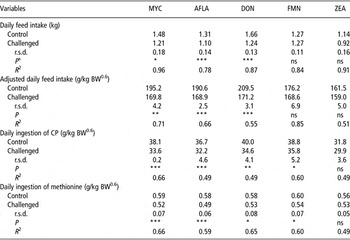
The mycotoxin presence in diets reduced the feed intake by 18% (P < 0.05; Table 1). The feed intake was 16% lower (P < 0.05) in animals that consumed diets containing aflatoxins and 26% lower (P < 0.05) in animals that received diets containing deoxynivalenol in comparison with control groups. The feed intake data adjusted for the animal metabolic weight was also lesser (P < 0.05) in groups fed diets contaminated with mycotoxins (−16%), aflatoxins (−11%) and deoxynivalenol (−18%). Fumonisins and zearalenone did not alter (P > 0.05) the pig feed intake.
Feed intake and nutrient ingestion, obtained through meta-analysis, for pigs challenged by MYC, AFLA, DON, FMN or ZEA

MYC = mycotoxins; AFLA = aflatoxins; DON = deoxynivalenol; FMN = fumonisins; ZEA = zearalenone; r.s.d. = residual standard deviation.
aSignificance level indicated by ns, P > 0.05, *P ⩽ 0.05, **P ⩽ 0.01, ***P ⩽ 0.001.
Mycotoxins reduced (P < 0.05) by 12% the CP intake and by 12% the methionine intake. The same variables were influenced (P < 0.05) in the groups challenged by aflatoxins, deoxynivalenol and fumonisins.
The dip that was observed in the feed intake variables could be attributed to specific action mechanisms of each toxin. Some substances, such as alimentary toxins, can also act as limiting factors in the diet selection, as animals may relate the consumption of contaminated feed with discomfort sensations (Hedman et al., Reference Hedman, Thuvander, Gadhasson, Reverter and Pettersson1997; Forbes, Reference Forbes2007). In naturally contaminated diets, a reduced consumption can also be related to organoleptic changes caused by fungal contaminants (Akande et al., Reference Akande, Abubakar, Adegbola and Bogoro2006). However, each mycotoxin has a diverse means through which it can reduce feed consumption and, in some cases, this mechanism is not completely clear.
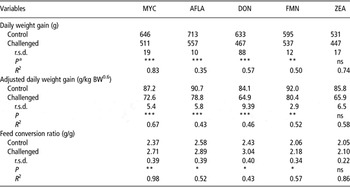
Pigs challenged by mycotoxins presented a feed conversion ratio 14% worse (P < 0.05) in relation to the animals in the control group. Deoxynivalenol increased (P < 0.05) the feed conversion by 25%. This variable was also influenced (P < 0.05) in animals that received diets containing aflatoxins (+12%) and fumonisins (+6%). Zearalenone did not influence (P > 0.05) the weight gain or the feed conversion in pigs, as had been observed in previous studies (Andretta et al., Reference Andretta, Lovatto, Hauschild, Dilkin, Garcia, Lanferdini, Cavazini and Mallmann2008).
Weight gain was 21% lower (P < 0.05) in pigs challenged by mycotoxins compared with the control group (Table 2). Aflatoxins, deoxynivalenol and fumonisins reduced (P < 0.05) weight gain by 22%, 26% and 10%, respectively. The weight gain adjusted for animal metabolic weight was 17% lower (P < 0.05) in pigs fed with diets containing mycotoxins, 13% lower in groups challenged by aflatoxins, 23% lower in groups fed deoxynivalenol and 13% lower in groups fed fumonisins.
Performance, obtained through meta-analysis, for pigs challenged by MYC, AFLA, DON, FMN or ZEA

MYC = mycotoxins; AFLA = aflatoxins; DON = deoxynivalenol; FMN = fumonisins; ZEA = zearalenone; r.s.d. = residual standard deviation.
aSignificance level indicated by ns, P > 0.05, *P ⩽ 0.05, **P ⩽ 0.01, ***P ⩽ 0.001.
The variance decomposition showed that 87% of variance in weight gain was due to the feed intake (P < 0.01) and only 4% was due to the presence of mycotoxins in diets (P < 0.01). The decrease in protein synthesis is the primary mechanism by which mycotoxins reduce weight gain in animals. This interference is observed in intoxications by aflatoxins and trichothecenes (Lindemann et al., Reference Lindemann, Blodgett, Kornegay and Schurig1993; Lin et al., Reference Lin, Liao, Liau, Lii and Sheen2006; Walle et al., Reference Walle, Sergent, Piront, Toussaint, Schneider and Larondelle2010). Pigs fed with diets containing aflatoxins presented reduction in the energy metabolism and in nitrogen retention (Hauschild et al., Reference Hauschild, Lovatto, Kunrath, Carvalho, Garcia and Mallmann2006). Direct upsets in the functioning of some organs, especially liver, and the partition of nutrients for activities besides body growth increases the animal demand for protein and energy (Hamilton, Reference Hamilton1977) and could also contribute to the deleterious effect on performance of challenged pigs.
In general, the reduction in the growth rate in challenged animals is explained by combined effects of reduction in feed consumption and in the efficiency of protein deposition. In our study, it was possible to observe that the greater part of variation in weight gain is explained by the variation in feed intake. Thus, an increase in nutritional density of diets could be studied as an alternative to reduce the mycotoxin effects in animal growth.
Interaction with dosage, age and sex
The mycotoxin concentration in the diets was one of the most explanatory variables for calculating the reduction in weight gain (Figure 1). For each additional 1 mg/kg of aflatoxin in the diets, there was a reduction of 3.9% in pig weight gain. Similarly, there was a reduction of 0.28% in the weight gain for each mg per kg of deoxynivalenol and 0.17% for each mg per kg of fumonisins in the diets.
The inclusion of age as a co-variable in the equations for estimating the reduction in weight gain on challenged animals (Table 3) improved the determination coefficient of models for all studied mycotoxins (on average of 27 perceptual points). The mycotoxin effect on pig weight gain does not appear to be constant in all growth phases. Therefore, the effect of mycotoxins on growth was greater in younger pigs.
Equations, obtained through variance–covariance analysis, to estimate the reduction (%) in average daily weight gain in pigs challenged by AFLA, DON or FMN

AFLA = aflatoxins; DON = deoxynivalenol; FMN = fumonisins.
It is likely that the sensitivity observed in young animals is associated with a reduced capacity or quantity of hepatic enzymes for detoxification. Some studies with rats suggest that young animals are deficient in key factors involved in hepatic biotransformation of aflatoxin B1 (Klein et al., Reference Klein, Van Vleet, Hall and Coulombe2002). Furthermore, the quantity of the aflatoxin–glutathione transferase conjugate is greater in adult animals, suggesting a greater capacity for detoxification within this category (Behroozikha et al., Reference Behroozikha, Saidee and Allameh1992). Therefore, young animals’ livers can be considered less efficient in the mycotoxin elimination metabolism, which determines an increase in the resistance with the maturity.
The mycotoxin effect on the performance of male pigs was greater than the effect on the females. The mycotoxin presence in diets reduced feed intake by 6% in females and by 10% in males. The reduction in weight gain was 15% in the female group and by 19% in the male group. Furthermore, the challenged females presented a feed conversion ratio 8% worse, whereas the feed conversion ratio for barrows was 10% worse, in relation to their respective control groups.
A similar relationship was observed in pigs challenged by aflatoxins to the feed intake (reduction of 24% in females and of 30% in barrows) and weight gain (reduction of 23% in females and 27% in barrows). The deoxynivalenol effect was even more pronounced in barrows compared with the effect on females for feed intake (reduction of 3% in females and 20% in barrows) and weight gain (reduction of 2% in females and by 34% in barrows).
The influence of sex on the sensitivity to mycotoxins had already been reported in rodents (Gurtoo and Motycka, Reference Gurtoo and Motycka1976; Castegnaro et al., Reference Castegnaro, Mohr, Pfohl-Leszkowicz, Estève, Steinmann, Tillmann, Michelon and Bartsch1998) and in birds (Bryden et al., Reference Bryden, Cumming and Lloyd1980). In challenged pigs, the clinical and immunological parameters can also be influenced by sex (Cote et al., Reference Cote, Beasley, Bratich, Swanson, Shivaprasad and Buck1985; Rotter et al., Reference Rotter, Thompson, Prelusky, Trenholm, Stewart, Miller and Savard1996; Marin et al., Reference Marin, Taranu, Pascale, Lionide, Burlacu, Bailly and Oswald2006). Some authors suggest that the greater susceptibility of males would be related to differences in the mycotoxin hepatic metabolism (Gurtoo and Motycka, Reference Gurtoo and Motycka1976; Castegnaro et al., Reference Castegnaro, Mohr, Pfohl-Leszkowicz, Estève, Steinmann, Tillmann, Michelon and Bartsch1998), although this hypothesis needs to be confirmed.
Nutritional interactions
Considering only the animals that consumed diets containing mycotoxins, there was a positive correlation between weight gain and daily ingestion of protein (0.27; P < 0.01) and methionine (0.68; P < 0.01). In addition, the ingestion of methionine presented a strong correlation with weight gain in animals challenged by aflatoxins (0.78; P < 0.01), deoxynivalenol (0.70; P = 0.04) and fumonisins (0.65; P < 0.01).
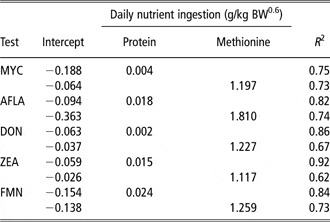
Adjusting the nutritional content in diets can influence the growth of challenged pigs. The equations for estimating the pig weight gain on the basis of ingestion of nutrients are presented in Table 4. In pigs challenged by mycotoxins, there was an increase of 1.2 g in the daily weight gain for each increase in one unit of ingested methionine (g of methionine/kg of animal metabolic weight). A similar relationship was observed for aflatoxins, where for each increase of one ingested unit of methionine, there was an increase of 1.8 g in the daily weight gain.
Equations, obtained through variance–covariance analysis, to estimate the daily weight gain (kg) of pigs fed with diets containing MYC relative to the ingestion of CP or total methionine

MYC = mycotoxins; AFLA = aflatoxins; DON = deoxynivalenol; FMN = fumonisins; ZEA = zearalenone.
Methionine is an amino acid with an important hepatic-protective role, as it has antioxidant and antitoxic properties. The relationship between the methionine levels and the performance of the challenged animals may involve an endogenous system that minimizes the effect of toxic products, through glutathione (Reed, Reference Reed1990). This way of detoxification assists in the elimination of the aflatoxin form activated by epoxidation. The metabolite is highly interactive and can be connected with macromolecules such as DNA, RNA and proteins (Lin et al., Reference Lin, Liao, Liau, Lii and Sheen2006). These links represent the primary biochemical lesion produced by aflatoxins and determine the reduction in protein biosynthesis and, consequently, in the animal growth. Conversely, aflatoxin–epoxide can also be connected with glutathione, constituting an important way of detoxification of this composite (Fatemi et al., Reference Fatemi, Allameh, Dadkhah, Forouzandeh, Kazemnejad and Sharifi2006). However, the level of glutathione in the cells is dependent on the availability of cysteine, an amino acid partially formed by methionine. Therefore, the increase in methionine intake can increase the hepatic glutathione content (Seligson and Rotruck, Reference Seligson and Rotruck1983) and, consequently, the excretion of metabolites and the detoxification (Coffey et al., Reference Coffey, Hagler and Cullen1989).
Organs
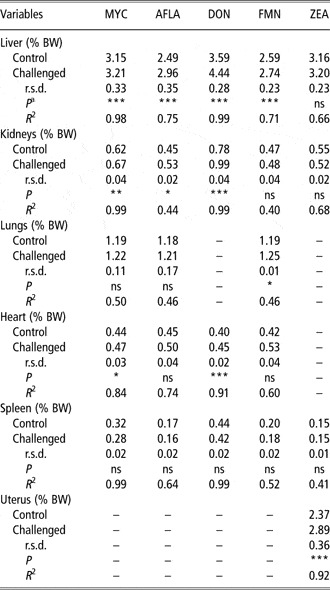
The mycotoxin presence in diets affects (P < 0.05) the relative weight of liver, kidneys and heart (Table 5). Aflatoxins increased (P < 0.05) the relative weight of liver by 19%, kidneys by 18% and heart by 11%, but did not influence (P > 0.05) the weight of lungs or spleen. Deoxynivalenol increased (P < 0.05) the relative weight of liver by 19%, kidneys by 21% and heart by 13%, without influencing (P > 0.05) the relative weight of spleen. Fumonisins did not influence the weight of kidneys and spleen, but it increased the relative weight of liver, heart and lungs. Zearalenone did not influence (P > 0.05) the relative weight of liver, kidneys and spleen, but it increased (P > 0.05) the relative weight of the uterus by 22%.
Relative organ weights, obtained through meta-analysis, for pigs challenged by MYC, AFLA, DON, FMN or ZEA

MYC = mycotoxins; AFLA = aflatoxins; DON = deoxynivalenol; FMN = fumonisins; ZEA = zearalenone; r.s.d. = residual standard deviation.
aSignificance level indicated by ns, P > 0.05, *P ⩽ 0.05, **P ⩽ 0.01, ***P ⩽ 0.001.
In general, the liver was the main target organ for mycotoxins. The correlation between the relative weight of liver is positive when subjected to a diet concentration of deoxynivalenol (0.48; P < 0.05) and aflatoxins (0.65; P < 0.01). For each 1 ppm of aflatoxins in diet, an increase of 0.29% is expected in the relative weight of the liver (−2.47 + 0.29 ppm; R 2: 0.79). Changes in the hepatic functions are observed in pigs fed with diets containing aflatoxins (Meissonnier et al., Reference Meissonnier, Laffitte, Loiseau, Benoit, Raymond, Pinton, Cossalter, Bertin, Oswald and Galtier2007), and the increase in the organ weight can be attributed to the fatty liver (Newberne and Butler, Reference Newberne and Butler1969).
Conclusions and perspectives
The meta-analysis performed in this study allowed us to address and systematically quantify the association of mycotoxins with productive alterations in pigs. Animals fed with diets containing mycotoxins presented a reduction in feed intake, weight gain, feed conversion ratio and final BW in relation to the control group. The mycotoxin ingestion interferes with the relative weights of liver, kidneys and heart. Deoxynivalenol and aflatoxins are the mycotoxins with the greater impact on feed intake and growth. In addition to assisting in understanding the mycotoxin effects, this approach can support in the determination of dynamic standards for the growth of the challenged animals. The results of this study indicate a possibility to explore the relationship of mycotoxins with several factors, such as the age and sex of the animals, mycotoxin type and concentration, as well as ingestion of protein or methionine.
Acknowledgments
To the National Council for Scientific Technology and Development (CNPq), to the Coordination for Improvement in Higher Education Personnel (Capes) and the Special Incentive Program for International Publications (PRPGP/UFSM).