Coal-series kaolin is a product associated with the formation of coal. It is usually greyish-brown in colour and is composed mainly of kaolinite (Xu et al., Reference Xu, Lao, Wu, Zhang, Xu and Li2015c; Yuan et al., Reference Yuan, Li, Han and Gao2018). With small amounts of impurities, coal-series kaolins have been developed and utilized as important industrial clays with a wide variety of applications in numerous industries, such as the paint, paper, rubber, plastics, ceramics and chemicals industries (Liu et al., Reference Liu, Lei, Lin, Xia, Pei and Li2018; Xie et al., Reference Xie, Niu, Miao, Gao, Cheng and Gao2019; Muschin et al., Reference Muschin, Zulchin and Jia2021). However, the presence of organic matter and coloured minerals in coal-series kaolins reduces the whiteness of the final products, thus decreasing their commercial value (Shelobolina et al., Reference Shelobolina, Pickering and Lovley2005; Huang et al., Reference Huang, Lei, Liu, Ji, Liu, Yin and Peng2015). To improve the whiteness of coal-series kaolin products, calcination associated with chlorination and some chemical whitening agents has been proposed (González & Ruiz, Reference González and Ruiz2006; Chen et al., Reference Chen, Zhou, Alshameri, Zhou, Ma and Sun2014). Calcination has a good whitening effect, is low cost and is relatively simple to apply. However, the temperature of the calcination whitening usually reaches 1000°C, causing sintering of the kaolin powder and leading to an increase in the particle size of the powder (Li et al., Reference Li, Lin, Li and Wu2009; Chen et al., Reference Chen, Zhou, Alshameri, Zhou, Ma and Sun2014; Hernández Chávez et al., Reference Hernández Chávez, Vargas Ramírez, Herrera González, García Serrano, Cruz Ramírez, Romero Serrano and Sánchez Alvarado2020). The sintering of calcined coal-series kaolin (CCSK) reduces its value for applications in the paper, paint and rubber industries, which require small powder particle sizes (Dong et al., Reference Dong, Xu, Lo and Sham2011; El-Sherbiny et al., Reference El-Sherbiny, Morsy, Hassan and Mohamed2015). Inhibiting the sintering of CCSK is a subject worthy of study.
The main techniques to inhibit particle sintering include particle-coating treatments and the use of additives. Coating particles with thermally stable materials and polymer surface layers prevents sintering during calcination (Okada et al., Reference Okada, Omori, Awata, Shirai, Matsumoto, Takeda and Furuzono2014; Namigata et al., Reference Namigata, Watanabe, Okubo and Nagao2020). Wang et al. (Reference Wang, Skreiberg and Becidan2014) reduced the sintering tendency of barley straw ash significantly via the addition of kaolin and zeolite. Furthermore, the addition of an inert matrix to the raw material may also prevent particle sintering (Mahalingam et al., Reference Mahalingam, Sudarsan, Munusamy, van Veggel, Wang, Steckl and Raudsepp2008). However, research focusing on the sintering of CCSK is scarce. The use of additives to inhibit the sintering of CCSK is an efficient and low-cost method compared to particle-coating treatments. Rashad et al. (Reference Rashad, Sabu, Logesh, Srishilan, Lodhe, Joy and Balasubramanian2020) reported that aluminium fluoride trihydrate (AlF3⋅3H2O) has a greater structural impact on metakaolin particles during calcination. Therefore, AlF3⋅3H2O was selected as the sintering inhibitor in this work.
In the paper industry, the oil-absorption value of kaolin is an important factor affecting the quality of coated paper. Kaolin fillers with high oil-absorption values improve the printability of coated paper (Bundy & Ishley, Reference Bundy and Ishley1991). BASF's Ansilex® 93 (calcined kaolin), produced using weathered kaolin from Georgia, USA, has an oil-absorption value of >90 g 100 g–1 (Hen et al., Reference Hen, Young, Gines and Mathur2000; Khokhani et al., Reference Khokhani, Yildirim, Berube, Mathur and Lake2019). However, increasing the oil-absorption value of CCSK remains challenging. The coal-series kaolins obtained from coal gangue are usually claystones of sedimentary origin (Ding et al., Reference Ding, Liu and Wang2009; Li & Wang, Reference Li and Wang2019). The kaolinite particles in coal gangue are bound tightly under compaction and cementation. The CCSKs obtained by crushing and calcining the coal gangue do not have the loose particle structure of weathered calcined kaolin, making it difficult to increase the oil-absorption value of CCSKs.
The purpose of this work is to study the sintering inhibition of CCSK powder by AlF3⋅3H2O and to compare the particle-size distribution, microstructure and crystal characteristics of CCSK before and after the addition of AlF3⋅3H2O. The effects of AlF3⋅3H2O addition and temperature on the morphology of calcined kaolin are studied and the oil-absorption properties of CCSK are also investigated.
Experimental
Materials and sample preparation
The CCSK powder was obtained from Shanxi JinKun Mineral Products Co. Ltd (China). The composition of the CCSK samples was determined using X-ray fluorescence (XRF) and the results are listed in Table 1. AlF3⋅3H2O powder was supplied by Aladdin Reagent Co. Ltd (China; 98%, CAS 15098-87-0).
Chemical composition of the coal-series kaolin sample (wt.%).

LOI = loss on ignition.
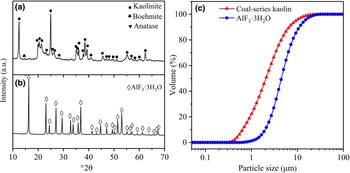
The X-ray diffraction (XRD) traces and cumulative particle-size distributions of the raw material powders are shown in Fig. 1. The major mineral of the CCSK sample is kaolinite, associated with minor anatase and boehmite impurities. The particle size of coal-series kaolin is in the range 0.30–27.84 μm, and the cumulative volume frequencies of D 10, D 50 and D 90 are 0.681, 2.195 and 7.012 μm, respectively. The particle size of AlF3⋅3H2O powder is in the range 0.55–35.58 μm, and the cumulative volume frequencies of D 10, D 50 and D 90 are 2.108, 4.747 and 11.66 μm, respectively.
XRD traces of (a) coal-series kaolin and (b) AlF3⋅3H2O and (c) cumulative particle-size distribution of raw powder materials.

The AlF3⋅3H2O was used as an additive to investigate its effects on the particle-size distribution, microstructure and crystal characteristics of the CCSK during the calcination process. The CCSK and AlF3⋅3H2O were mixed at various ratios and stirred with mechanical agitators to achieve thorough mixing. The various mixtures of CCSK and AlF3⋅3H2O were labelled KA0, KA2, KA4, KA6, KA8, KA10, KA12 and KA14, corresponding to 0, 2, 4, 6, 8, 10, 12 and 14 wt.% AlF3.3H2O, respectively. The mixtures were placed in an uncovered alumina crucible and heated to various target temperatures (800, 900 and 1000°C) at a heating rate of 7.5°C min–1 for 1 h and cooled in a muffle furnace. The sample ‘KAX’ heated at ‘Y°C’ is denoted hereafter as ‘KAX-Y’.
Sample characterization
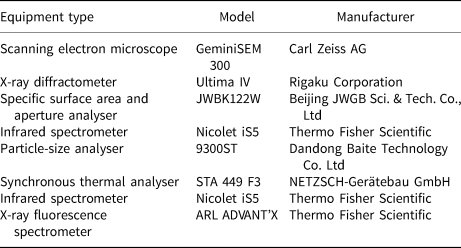
The chemical composition of the samples was determined using XRF (ARL ADVANT'X Intellipower 3600, USA). The particle-size distributions of sample powders were analyzed using a Mastersizer 3000 laser particle-size analyzer (wet, cycle injection mode and test time of 3 min). The powder XRD traces were recorded in the scanning range of 10–80°2θ using an Ultima IV diffractometer (Rigaku, Japan) operated at 40 kV and 40 mA using Cu-Kα radiation, with a scanning step of 0.01°2θ and a scanning rate of 5° min–1. Thermogravimetric analysis was performed using an STA 449 F3 simultaneous thermal analyzer (Netzsch, Germany) at 10 K min–1 and in an air atmosphere to collect thermogravimetric (TG), derivative thermogravimetric (DTG) and differential scanning calorimetry (DSC) data. The morphology of the samples was observed using scanning electron microscopy (SEM; ZEISS GeminiSEM 300). The N2 adsorption–desorption isotherms were collected at 77 K using a JWBK122W gas-adsorption device (JWGB Sci. & Tech., China). The specific surface areas were determined using the Brunauer–Emmett–Teller (BET) method and the mesopore-size distribution was obtained based on Barrett–Joyner–Halenda (BJH) analysis of the adsorption branches of the isotherms. Fourier-transform infrared (FTIR) spectra of the samples were obtained using a Nicolet iS5 device (Thermo Fisher Scientific, USA) with KBr discs over the 4000–400 cm–1 range. The oil-absorption values of the samples were determined using the Oil Absorption Test (ASTM D281-12, 2021). Detailed information on the instruments and equipment used is listed in Table 2.
The main equipment used in the experiment.

Results and discussion
Sintering inhibition of CCSK
During heating, kaolin minerals lose hydroxyls at 450–600°C, forming a disordered-phase, metakaolin (Liu et al., Reference Liu, Liu and Hu2015). Metakaolin transforms into a spinel phase at 980°C and mullite is generated as a by-product (Ghorbel et al., Reference Ghorbel, Fourati and Bouaziz2008; Zhou et al., Reference Zhou, Qiao and Yu2013). The kaolin densification proceeds via viscous flux sintering through the formation of an amorphous phase and via a diffusion mechanism at the grain boundaries. The alkali and/or iron contents influence the rate at which melting will occur through their fluxing action on silica and alumina (Hernández Chávez et al., Reference Hernández Chávez, Vargas Ramírez, Herrera González, García Serrano, Cruz Ramírez, Romero Serrano and Sánchez Alvarado2020). The presence of Fe, Na and K oxides in the kaolin decreases the formation temperature of the molten-phase liquid bridge (Li et al., Reference Li, Lin, Li and Wu2009). In addition, the formation of mullite and spinel phases occurs at the molten-phase liquid bridges as temperature increases. The appearance of liquid bridges in the molten phase and the recrystallization of metakaolin leads to the sintering of the calcined kaolin powder. Therefore, inhibiting the sintering of CCSK is the focus of this work, and the addition of AlF3⋅3H2O is proposed as a solution to this problem.
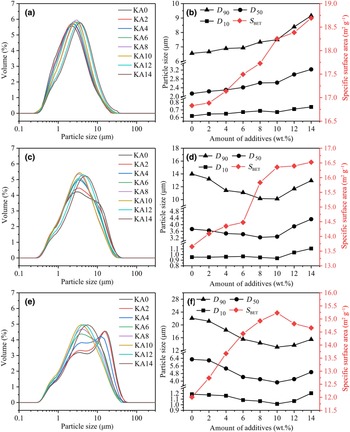
The particle-size distribution, D 10, D 50 and D 90 values and specific surface areas of CCSK at various temperatures are shown in Fig. 2. The particle-size distribution, particle-size indices and specific surface areas are important performance indicators of powder sintering. The D 10, D 50 and D 90 values of the samples calcined at 800°C increased significantly when the amount of AlF3⋅3H2O was increased from 0 to 14 wt.% (Fig. 2a,b). The reason for this is that the particle size of AlF3⋅3H2O is greater than that of KA0-800, and the addition of large particles to small particles increases the mean particle size of the powder. Moreover, the specific surface area increased gradually as the amount of AlF3⋅3H2O increased. These changes in particle size and specific surface area indicated that structural transformation had taken place inside the particles due to the reaction of SiO2 from metakaolin with AlF3 generated after pyrolysis of AlF3⋅3H2O to produce SiF4 gas at >600°C, thereby disrupting the structure of metakaolin (Abdel-Rehim, Reference Abdel-Rehim1999; Moyer & Hughes, Reference Moyer and Hughes2005; Rashad et al., Reference Rashad, Sabu, Logesh, Srishilan, Lodhe, Joy and Balasubramanian2020).
Particle-size distribution, D 10, D 50 and D 90 values and specific surface area (S BET) of samples at various temperatures: (a,b) 800°C, (c,d) 900°C, (e,f) 1000°C.

The D 10, D 50 and D 90 values of the samples calcined at 900°C decreased with increasing AlF3⋅3H2O content from 0 to 10 wt.% (Fig. 2c,d). This could be attributed to the reaction of SiO2 from metakaolin and AlF3 to produce SiF4 gas and topaz. The formed topaz crystals are unstable at >850°C and begin to decompose, releasing SiF4 gas and forming mullite crystals (Haught et al., Reference Haught, Talmy, Divecha and Karmarkar1991; Lee et al., Reference Lee, Souza, McConville, Tarvornpanich and Iqbal2008; Abdel-Rehim, Reference Abdel-Rehim2012). Both reactions moderated the formation of molten-phase liquid bridges between particles and inhibited the sintering of the raw powder material. When the AlF3⋅3H2O content exceeded 10 wt.%, the particle-size indices of the samples increased due to the sintering caused by the formation of a large amount of mullite at the liquid bridges of the molten phases between particles. In addition, the structure of metakaolin was broken and the particle size decreased, so the specific surface area of the sample increased rapidly when the content of AlF3⋅3H2O increased from 0 to 10 wt.%. The particle size of the sample increased with further increases of AlF3⋅3H2O content, but the specific surface area only increased slowly due to the disruption of the structure of metakaolin.
The sample calcined at 1000°C displays a similar trend to the sample calcined at 900°C in terms of the D 10, D 50 and D 90 values and specific surface area (Fig. 2e,f). The increase in temperature resulted in a greater variation in D 10, D 50 and D 90 values for the samples calcined at 1000°C. However, the increase in particle size and densification of the powder reduced the specific surface area with further increases in the AlF3⋅3H2O content. In summary, the sintering inhibition effect of AlF3⋅3H2O on CCSK was more obvious at 1000°C. When the AlF3⋅3H2O content was 10 wt.%, the D 10, D 50 and D 90 values and specific surface area of the sample reached their minimum and maximum values, respectively. Therefore, the following analysis will focus on the effect of AlF3⋅3H2O on CCSK at 1000°C.
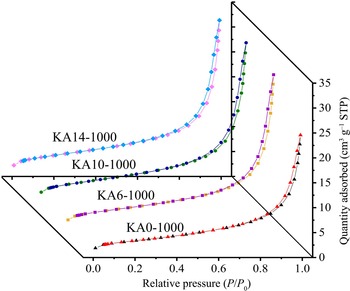
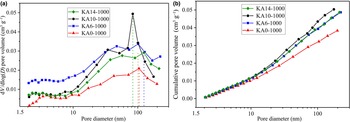
The N2 adsorption–desorption isotherms, pore-size distributions and cumulative pore volumes of four samples are shown in Fig. 3. The isotherms are classified as type II according to the International Union of Pure and Applied Chemistry (IUPAC), indicating macroporous materials. The hysteresis loops of the four samples are related to the capillary condensation of the slit-shaped mesopores in CCSK (Panda et al., Reference Panda, Mishra, Mishra and Singh2010; Kuroda et al., Reference Kuroda, Ito, Itabashi and Kuroda2011). The mode pore diameter of the samples is >50 nm, which is in accordance with that for macroporous materials (Fig. 4a,b). With the addition of increasing amounts of AlF3⋅3H2O, the mode pore size first decreased and then increased and the total pore volume increased and then decreased, which is consistent with the sintering law of the sample powders. The decrease in the mode pore size and the increase in the total pore volume are due to the formation of SiF4 gas, which slows down the sintering densification of the sample, and the formation of a small number of mullite whiskers, which also promotes the development of macropore structures. The increase in the mode pore size and the decrease in the total pore volume in the KA14-1000 sample are due to sintering caused by the growth and production of mullite crystals. The change in the trends of the mode pore size and total pore volume indicate the sintering-inhibitory effect of AlF3⋅3H2O on CCSK.
N2 adsorption–desorption isotherms of the samples. STP = standard temperature and pressure.

(a) Pore-size distributions and (b) cumulative pore volumes of the samples.

Sintering-inhibition mechanism of CCSK
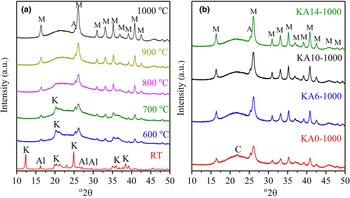
The XRD traces of samples containing 10 wt.% AlF3⋅3H2O calcined at various temperatures are shown in Fig. 5a. With increasing temperature, the intensity of the characteristic peak of the kaolinite in the samples decreased gradually until it disappeared due to the destruction of the crystalline structure caused by dehydroxylation (Yan et al., Reference Yan, Guo, Fang, Cui, Cheng and Li2017). The mullite peak appeared at 600°C and its intensity increased with increasing temperature. This could be due to the activation of metakaolin and AlF3 by fluoride ions, which resulted in their reaction, forming a small amount of mullite (Abdel-Rehim, Reference Abdel-Rehim1999; Bailey et al., Reference Bailey, Mukhopadhyay, Wander, Searle and Harrison2009). Previous studies have reported the existence of topaz along with minor mullite or sillimanite in the early stages (600–900°C) of sintering (Abdel-Rehim, Reference Abdel-Rehim2012; Xu et al., Reference Xu, Xi, Shui and Zhu2015a, Reference Xu, Xi, Zhu, Shui and Dai2015b). The presence of moisture and HF formed during the reaction can affect topaz nucleation (Rashad et al., Reference Rashad, Sabu, Logesh, Srishilan, Lodhe, Joy and Balasubramanian2020). However, the characteristic peaks of AlF3 and topaz were not observed in the sample after heating to 600°C, which may be due to their low crystal order.
XRD traces of the samples: (a) phase evolution in coal-series kaolin + 10 wt.% AlF3⋅3H2O at various temperatures and (b) calcination of samples with various additions at 1000°C. A = anatase; Al = AlF3⋅3H2O; C = cristobalite; K = kaolinite; M = mullite; RT = room temperature.

The XRD traces of samples calcined at 1000°C with various quantities of AlF3⋅3H2O are shown in Fig. 5b. In metakaolin, primary mullite begins to appear due to spinel decomposition at ~980°C and increases at greater temperatures, producing excess silica as a glassy phase or cristobalite in the matrix (Chen et al., Reference Chen, Lan and Tuan2000, Reference Chen, Wang and Hon2003; Xu et al., Reference Xu, Lao, Wu, Zhang, Xu and Li2015c). The characteristic peaks of cristobalite were observed in the XRD trace of sample KA0-1000. The Al provided by the addition of AlF3⋅3H2O participated in the reaction, forming mullite and excess silica and resulting in the disappearance of the cristobalite in the sample. The main crystalline phase of the sample calcined at 1000°C was mullite (Fig. 5b). Moreover, the characteristic peak intensity of mullite phase increased with increasing AlF3⋅3H2O content, indicating that the mullite content increased gradually. This confirms that the reduction of the D 10, D 50 and D 90 values is due to the substantial production of mullite.
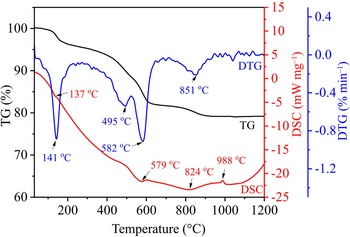
The results of the TG–DSC–DTG analyses of the CCSK containing 10 wt.% AlF3⋅3H2O are shown in Fig. 6. A major weight loss of 3.94% at 220°C in the mixture corresponds to the removal of molecular water from AlF3⋅3H2O and the moisture being adsorbed in the pores or on the surface of the sample (Xu et al., Reference Xu, Luo, Ji, Zhou and Gai2000). The endothermic peak corresponding to the removal of chemically bound water and the formation of AlF3 from AlF3⋅3H2O was observed at 137°C (corresponding to a DTG peak at 141°C). The small DTG peak at 495°C corresponds to further dehydration and the formation of Al2O3 and HF gas (Yang et al., Reference Yang, Shi, Liu and Mujumdar2007). The main mass loss (13.3%) between 300 and 650°C (corresponding to a DSC endothermic peak at 579°C and a DTG peak at 582°C) is attributed primarily to the formation of metakaolin via the dehydroxylation of kaolin. Compared to a previous report on pure kaolin (Zhou et al., Reference Zhou, Qiao and Yu2013), the formation of metakaolin was delayed in time because of the presence of AlF3 (Rehim, Reference Rehim1979). The DSC curve showed a weak and small endothermic peak at 824°C, corresponding to the release of SiF4 from topaz (Abdel-Rehim, Reference Abdel-Rehim2012). In addition, the TG curve exhibited a small weight loss of 2.26 wt.% at 700–950°C (corresponding to a DTG peak at 851°C) due to the high-temperature thermal decomposition of topaz releasing SiF4 gas. The DSC exothermic peak at 988°C is related to the recrystallization of the amorphous phase and the formation of mullite or a spinel phase.
TG–DSC–DTG curves of coal-series kaolin + 10 wt.% AlF3⋅3H2O.

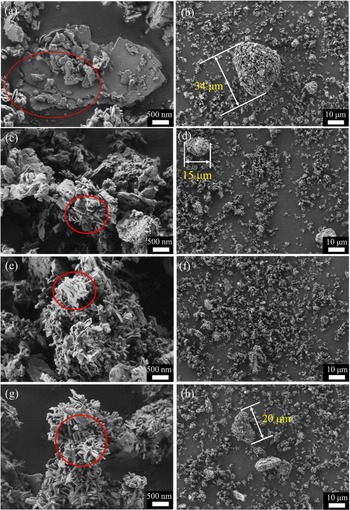
The SEM images of the samples calcined at 1000°C are shown in Fig. 7. Particles from sample KA0-1000 exhibited lamellar morphology (Fig. 7a,b). However, the structure of kaolin changed from lamellar to amorphous after heating and dehydroxylation, and the XRD data support this interpretation (Zhou et al., Reference Zhou, Qiao and Yu2013; Liu et al., Reference Liu, Lei, Lin, Li, Ye and Fan2017). Therefore, it can be inferred that although the structure of kaolin was still lamellar, it was actually in the process of transformation into an amorphous phase. The particle structure of sample KA0-1000 will be referred to as a ‘pseudo-lamellar structure’ hereafter. In addition, K2O and/or Na2O decreased the sintering temperature. When the AlF3⋅3H2O content increased to 6 wt.%, a small number of mullite whiskers appeared in the disrupted metakaolin sheets (Fig. 7c). The SEM image of sample KA6-1000 (Fig. 7d) shows agglomerated particles with small particle sizes, which is consistent with the results from the particle-size analysis.
SEM images of CCSK: (a,b) KA0-1000, (c,d) KA6-1000, (e,f) KA10-1000, (g,h) KA14-1000. The red circles highlight features of interest.

A large number of mullite whiskers (~200–400 nm long and 40–80 nm wide) and a small number of disrupted metakaolin sheets appeared on the particle surface in sample KA10-1000 (Fig. 7e). The formation of submicron mullite whiskers on the particle surface and the release of SiF4 gas disrupted the molten-phase liquid bridges between the particles in the sample, making it difficult for large agglomerated particles to emerge (Fig. 7f). When the AlF3⋅3H2O addition reached 14 wt.%, the particle surfaces were covered with mullite whiskers and trace amounts of disrupted metakaolin sheets (Fig. 7g,h). The interweaving of the mullite whiskers resulted in tight binding between small particles, leading to the increase in the particle size observed for sample KA14-1000.
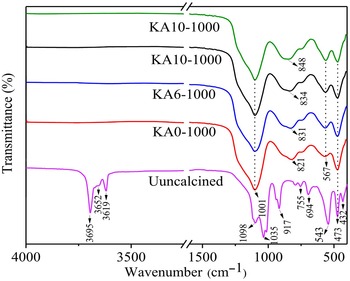
The FTIR spectra of the various samples are presented in Fig. 8. The characteristic bands at 3695, 3651 and 3620 cm–1 are attributed to O–H stretching in the CCSK structure (Gong et al., Reference Gong, Ruan, Zhang, Lai, Yu, Li and Dang2018; Zhang et al., Reference Zhang, Yan, Ouyang, Zhang, Yang and Chen2018). The bands at 1098, 1035 and 917 cm–1 correspond to the Si–O stretching vibration, the Si–O–Si symmetric stretching and the Al–OH bending vibration, respectively (Huang et al., Reference Huang, Li, Yin, Tian and Wu2019). The bands at 755 and 694 cm–1 correspond to the Al–OH vibration. The bands at 543, 473 and 432 cm–1 correspond to the Si–O–Al, Si–O–Si and Si–O deformations, respectively (Zhang et al., Reference Zhang, Xu, Seetharaman, Liu, Wang and Zhang2014). These bands are typical of kaolinite. When the temperature reached 1000°C, these bands decreased significantly or disappeared, suggesting that the kaolin had dehydroxylated and its structure had been destroyed.
FTIR spectra of uncalcined coal-series kaolin and calcined samples.

After calcination at 1000°C, the bands of 1098 and 1035 cm–1 merged into a single wide band at 1001 cm–1, attributed to Si–O stretching. The new band at 821 cm–1 observed after the disappearance of kaolinite is assigned to Al–O stretching of AlO units. In addition, the increase in the AlF3⋅3H2O content led to increased substitution of Al for Si, which shifted the band at 821 cm–1 (Si et al., Reference Si, Qiao and Yu2012). The increase in the mullite content of the calcined sample resulted in an increase in the band intensity of AlO6 in mullite at 567 cm–1 (Percival et al., Reference Percival, Duncan and Foster2006; Zhou et al., Reference Zhou, Qiao and Yu2013). Finally, the intensity of the Si–O–Si deformation band at 473 cm–1 was lessened due to the destruction of the kaolin structure.
By observing the phase evolution and crystal growth of CCSK under various conditions and with reference to the relevant literature, a possible reaction mechanism has been inferred. A rapid escape of water vapour occurred after the decomposition of AlF3⋅3H2O, starting at 108°C, to AlF3 (Xu et al., Reference Xu, Luo, Ji, Zhou and Gai2000; Stosiek et al., Reference Stosiek, Scholz, Eltanany, Bertram and Kemnitz2008), as per Equation 1:

The CCSK was transformed to metakaolin by releasing structural water at ~450°C, as per Equation 2:

Along with the removal of structural water from CCSK, the AlF3 underwent a hydrolysis reaction in the presence of water vapour, generating small quantities of Al2O3 and HF (Yang et al., Reference Yang, Shi, Liu and Mujumdar2007; Stosiek et al., Reference Stosiek, Scholz, Eltanany, Bertram and Kemnitz2008), as per Equation 3:

The surfaces of the metakaolin and AlF3 powder were activated significantly in the presence of HF, yielding mullite at ~600°C (Bailey et al., Reference Bailey, Mukhopadhyay, Wander, Searle and Harrison2009; Xu et al., Reference Xu, Xi, Zhu, Shui and Dai2015b), as per Equation 4:

However, the escaping of water vapour and HF activated only a fraction of AlF3. The remaining AlF3 was involved mainly in the formation of topaz crystals that began at ~600°C and occurred with intensity at between 770 and 800°C (Rashad et al., Reference Rashad, Sabu, Logesh, Srishilan, Lodhe, Joy and Balasubramanian2020), as per Equation 5:

The topaz crystals were unstable at >850°C, releasing fluorine upon heating at 850–900°C and forming mullite (Lee et al., Reference Lee, Souza, McConville, Tarvornpanich and Iqbal2008; Abdel-Rehim, Reference Abdel-Rehim2012), as per Equation 6:

In metakaolin, primary mullite started to appear due to spinel decomposition at ~980°C and increased at greater temperatures, forming excess silica as a glassy phase or cristobalite in the matrix, as per Equation 7:

In summary, CCSK with the addition of AlF3⋅3H2O generated great quantities of mullite and SiF4 gas after calcination. The formation of SiF4 moderated the formation of molten-phase liquid bridges between particles and inhibited sintering of the raw powder material. Table 3 presents the elemental mass changes of sample KA10-1000 before and after calcination, calculated from XRF data and considering conservation of Al. The amount of Si in the samples decreased after calcination, further suggesting that the release of SiF4 gas in the system was the main reason for the sintering inhibition of CCSK.
Changes in the mass of elements before and after calcination of sample KA10-1000 (10 g).

Oil-absorption properties
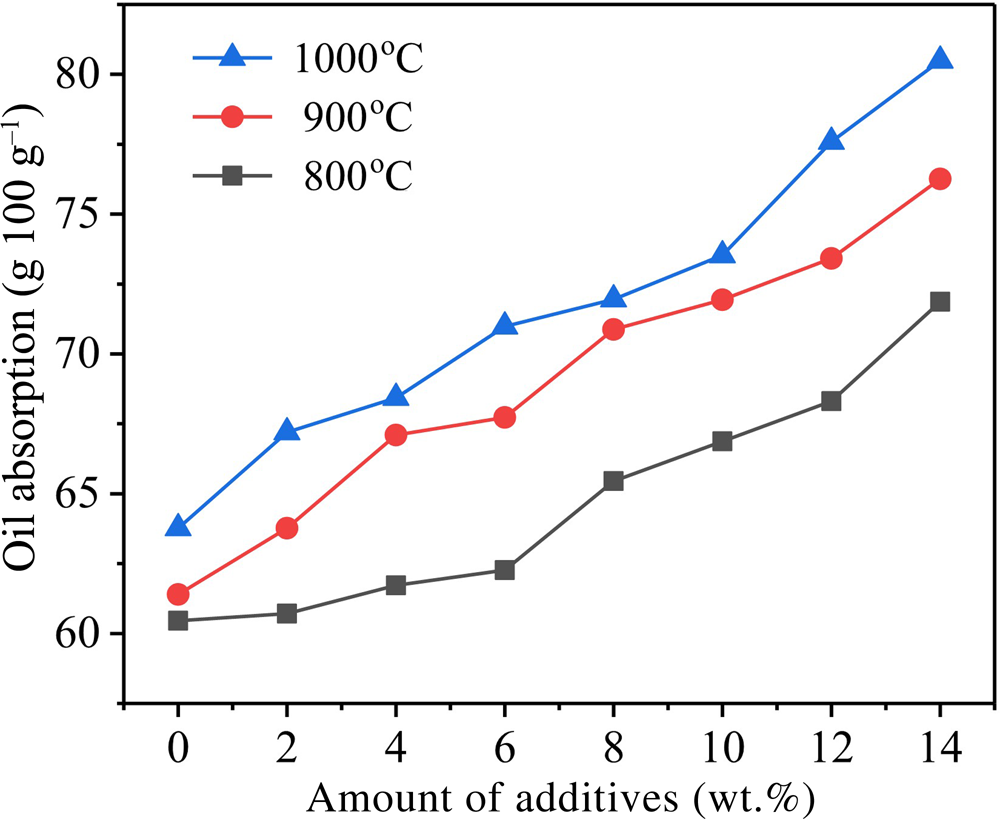
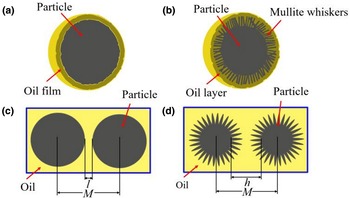
The oil-absorption values of CCSK with various quantities of added AlF3⋅3H2O are shown in Fig. 9. The oil-absorption value of CCSK increased with increasing addition of AlF3⋅3H2O at all temperatures, and the oil-absorption value of sample KA14-1000 reached 80.49 g 100 g–1. The oil-absorption models of ordinary particles and ‘hedgehog’ particles covered with mullite whiskers on their surface are presented in Fig. 10. The absorption of oil by ordinary particles depended mainly on the wetting effect of oil on the particle surface (Fig. 10a,b). The voids formed by the interweaving of mullite whiskers on the surface layers of hedgehog particles could adsorb greater amounts of oil, and the presence of mullite whiskers increased the thickness of the oil layer on the particle surface. Moreover, the thickness of the oil layer between the hedgehog particles was greater than that of ordinary particles at the same particle spacing (Fig. 10c,d), which resulted in the hedgehog particle powders having greater oil-absorption values. Increasing the AlF3⋅3H2O content transformed the CCSK particles into hedgehog particles with submicron mullite whiskers on their surfaces (Fig. 7), which increased the oil-adsorption capacity of CCSK. The presence of a large number of mullite whiskers on the particle surface rendered the oil-absorption value of sample KA14-1000 greater than those for all other samples.
Oil-absorption capacity of CCSK with various additions of AlF3⋅3H2O.

Schematic model describing oil absorption on particles: (a,c) ordinary particles; (b,d) hedgehog particles. M refers to particle spacing, whilst l and h refer to the thickness of the oil layer.

A finer and narrower particle-size distribution and an increase in specific surface area increased the oil-absorption value of the calcined kaolin (Hen et al., Reference Hen, Young, Gines and Mathur2000; Khokhani et al., Reference Khokhani, Yildirim, Berube, Mathur and Lake2019). When the addition of AlF3⋅3H2O exceeded 10 wt.%, the increase in particle size and decrease in specific surface area of the sample calcined at 1000°C did not decrease the oil-absorption value because the significant formation of mullite whiskers on the surfaces of the particles was the main driver underlying the increase in the oil-absorption capacity. Combined with the XRD results, we observe that temperature promoted the formation of mullite whiskers, so the oil-absorption capacity of samples with the same added quantity of AlF3⋅3H2O increased with temperature.
Conclusions
The sintering inhibition of CCSK by AlF3⋅3H2O was investigated systematically and the oil-absorption capacity of the prepared samples was studied. The main conclusions are as follows:
• The addition of AlF3⋅3H2O led to a decrease in the D 10, D 50 and D 90 values and an increase in the specific surface area of the CCSK, suggesting a good sintering-inhibition effect. For the samples calcined at 1000°C, 10 wt.% AlF3⋅3H2O produced the best sintering-inhibition effect on CCSK (smallest particle-size indices and greatest specific surface area and total pore volume).
• The release of SiF4 gas from the sample and the formation of mullite whiskers on the particle surface, caused by AlF3⋅3H2O, moderated the formation of molten-phase liquid bridges between particles and inhibited the sintering of the raw powder material. However, when AlF3⋅3H2O was added in excess, the interweaving of a large number of mullite whiskers led to tight binding between the small particles, resulting in increased particle size in the sample.
• The addition of AlF3⋅3H2O improved the oil-absorption capacity of CCSK. The generation of submicron mullite whiskers on the particle surface could improve the oil-absorption value of the sample significantly.
Acknowledgements
We thank the Advanced Inorganic Analysis Laboratory of Taiyuan University of Technology for providing raw materials, experimental equipment and technical guidance.
Financial support
This work is supported by the Science and Technology Major Project of Shanxi Province (20181101004) and Key R&D Project of Shanxi Province (201903D321064).