


Introduction
Insomnia and depression frequently occur together, with insomnia being a risk factor in the aetiology of depression. Specifically, sleep problems are a risk factor for first episodes of depression, new episodes of depression, and make depression more difficult to treat (Baglioni et al., Reference Baglioni, Battagliese, Feige, Spiegelhalder, Nissen and Voderholzer2011; Dombrovski et al., Reference Dombrovski, Cyranowski, Mulsant, Houck, Buysse and Andreescu2008; Reynolds et al., Reference Reynolds, Frank, Houck, Mazumdar, Dew and Cornes1997). Encouragingly, recent randomized controlled trials (RCTs) have demonstrated that by targeting insomnia through cognitive behavioural therapy for insomnia (CBT-I) both sleep problems and depressive symptomology can be reduced (e.g. Ashworth et al., Reference Ashworth, Sletten, Junge, Simpson, Clarke, Cunnington and Rajaratnam2015; Blom et al., Reference Blom, Jernelöv, Kraepelien, Bergdahl, Jungmarker and Ankartjärn2015; Lancee et al., Reference Lancee, van den Bout, van Straten and Spoormaker2012) and studies combining CBT-I with pharmacological treatments of depression show similar results (e.g. Manber et al., Reference Manber, Edinger, Gress, San Pedro-Salcedo, Kuo and Kalista2008, Reference Manber, Buysse, Edinger, Krystal, Luther and Wisniewski2016).
The current study regards secondary analyses of an RCT where the effects from group CBT-I (vs relaxation training as an active control) were tested on people with comorbid insomnia and depressive symptomatology (Norell-Clarke et al., Reference Norell-Clarke, Jansson-Fröjmark, Tillfors, Holländare and Engström2015). In the study, CBT-I was superior to the control condition regarding most sleep measures as well as functional ability after treatment. For depression outcomes, the results were mixed. CBT-I had significantly more who had remitted from major depressive disorder or demonstrated a clinical significant improvement in depressive severity compared to RT (68.8% vs 43.8%). There was, however, no significant difference between the treatment groups regarding depressive severity as measured by the BDI, but when we created more homogeneous groups in complementary analyses (separating clinical depression from subclinical depression) there were indications that the depressive severity had changed for those with subclinical depression. Together with the previously mentioned studies, this supports the idea that insomnia has a maintaining role in depression.
Two studies have investigated insomnia as a treatment mediator in a comorbid sample of people with insomnia and depression (Ashworth et al., Reference Ashworth, Sletten, Junge, Simpson, Clarke, Cunnington and Rajaratnam2015; Manber et al., Reference Manber, Buysse, Edinger, Krystal, Luther and Wisniewski2016). In the first study, decreased depression severity from baseline to follow-up was mediated by decreases in insomnia severity between baseline and follow-up (Ashworth et al., Reference Ashworth, Sletten, Junge, Simpson, Clarke, Cunnington and Rajaratnam2015). Also, decreased insomnia was mediated by decreases in depression, albeit with lower effect. However, due to a study design that lacked a mid-treatment measure and the use of overlapping change scores as mediators and outcomes variables, temporal conclusions cannot be drawn as to which (insomnia or depression) changed first and when changed occurred. In the second study, these limitations were covered for by continuous measures during a 16-week-long RCT. Changes in insomnia severity between baseline and 6 weeks of treatment mediated depression after treatment. No reciprocal effects were found. As this study investigated CBT-I in combination with pharmacotherapy for depression vs placebo therapy plus pharmacotherapy, it is unknown whether the mediating effect was for CBT-I alone or CBT-I combined with pharmacotherapy. Hence, whether or not insomnia severity mediates between CBT-I and depressive severity in patients with co-morbid insomnia and depression is still not fully answered.
The aim of the current study was to expand upon the findings from the two previous studies by using an RCT where CBT-I was compared with another non-pharmacological control treatment. More specifically, we wanted to examine if insomnia severity during treatment mediates between CBT-I and depression severity after treatment (post-treatment and follow-up, respectively) in patients with co-morbid insomnia and depressive symptomology. As there is support for a bidirectional relationship between insomnia and depression (e.g. Jansson-Fröjmark and Lindblom, Reference Jansson-Fröjmark and Lindblom2008), we also wanted to examine whether depressive severity mediated between CBT-I and insomnia.
Method
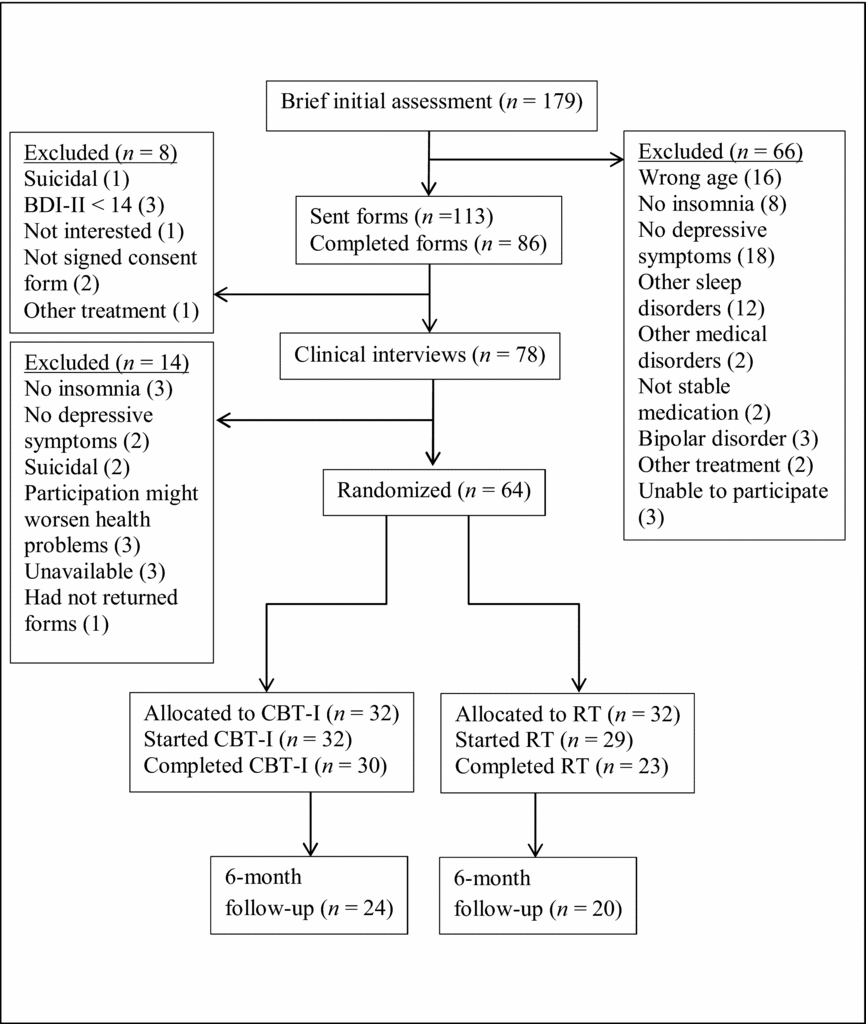
Sixty-four participants with insomnia and depressive symptomology were randomized to receive either four biweekly group sessions of CBT-I or relaxation training. A flowchart showing the recruitment process and treatment compliance is given in Fig. 1.
Flowchart of participants, from recruitment to follow-up. CBT-I, cognitive behaviour therapy for insomnia; RT, relaxation training. Reprinted from Norell Clarke et al., Group cognitive behavioural therapy for insomnia: effects on sleep and depressive symptomatology in a sample with comorbidity, Behaviour Research and Therapy, 74, 83. Copyright (2015), re-used with permission from Elsevier.
The inclusion criteria were as follows: age 18–75 years; insomnia diagnosis (after a structured clinical interview); BDI-II scores over 13; stable dose of medication for at least 3 months (if receiving pharmacological treatment for sleep or mood); and the ability to participate in group treatment during the study period. The exclusion criteria were: current or recent participation in psychological treatment for insomnia or depression; indications of untreated sleep disorders other than insomnia (after a structured clinical interview); current or prior manic or psychotic episodes or dysthymia; and strong indications of sleep disturbing medication use, sleep-disturbing medical issues, or problematic drug or alcohol use. Potential participants were recruited through advertisements in local newspapers, underwent two steps of structured clinical screening prior to treatment [the Structured Clinical Interview for DSM-IV axis I disorders and the Duke Structured Interview for Sleep Disorders (DSISD)], and filled in forms and sleep diaries before, during, after and at 6-month follow-up. An independent researcher block-randomized the participants into CBT-I or RT. The therapists had experience in the respective treatments they conducted and did so according to manuals (Edinger and Carney, Reference Edinger and Carney2008; and M. Jansson-Fröjmark, unpublished Relaxation Training Manual). An analysis of therapy recordings demonstrated that the treatment fidelity was good.
Our use of relaxation as an active control warrants clarification, as relaxation has been associated with improvements in both sleep and mood. However, systematic reviews of treatment effects have concluded that although relaxation is superior to no treatment regarding depression and superior to waitlist, no treatment and placebo regarding insomnia, the treatment effects are inferior to those from CBT (Jorm et al., Reference Jorm, Morgan and Hetrick2008; Morin et al., Reference Morin, Bootzin, Buysse, Edinger, Espie and Lichstein2006). Based on the above findings, we assumed that the effects from RT were similar to those from non-specific therapy factors such as attention and being presented with a plausible treatment rationale – factors we wanted to control for in the study.
The mid-treatment measure, which was used as a mediator, took place between sessions 2 and 3, after two sessions of behavioural interventions for insomnia had been administrated and before two sessions with cognitive interventions. More detailed information on recruitment, screening and the treatments is available in Norell-Clarke et al. (Reference Norell-Clarke, Jansson-Fröjmark, Tillfors, Holländare and Engström2015). The study protocol was approved by the Regional Ethics Vetting Board in Uppsala, Sweden. The clinical trial was registered at the Research and Development in Sweden in 2011 (FoU: http://www.fou.nu/is/sverige/document/84151). Written, informed consent was obtained from the participants.
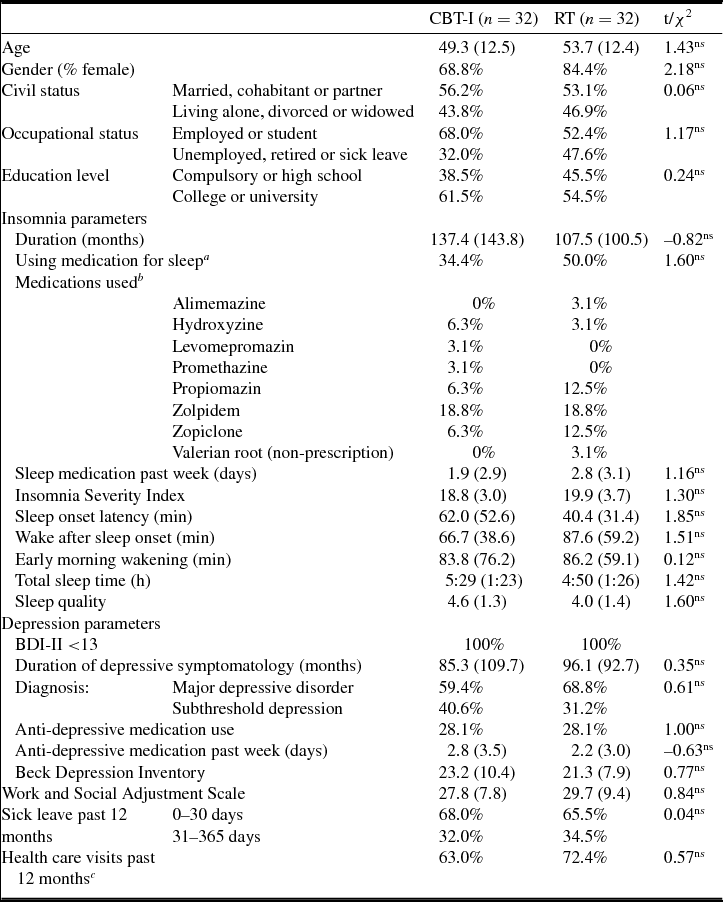
For demographic and clinical characteristics of participants, see Table 1. The mean age was 51.5 years (SD 12.6). Most participants were female (76.6%), born in Sweden (93.5%), had studied to university level (58.3%) and were in romantic relationships (74.6%). Approximately half were working or studying (55.6%). Retrospective data on symptomatology showed that the participants reported that they had suffered from insomnia and depressive symptoms for many years prior to the study (insomnia: 10.28 years; depressive symptoms: 7.53 years). Fewer than half used sleep medication (40.6%) and a minority had been prescribed anti-depressive medication (28.1%).
Study participants: demographic and clinical parameters at pre-treatment
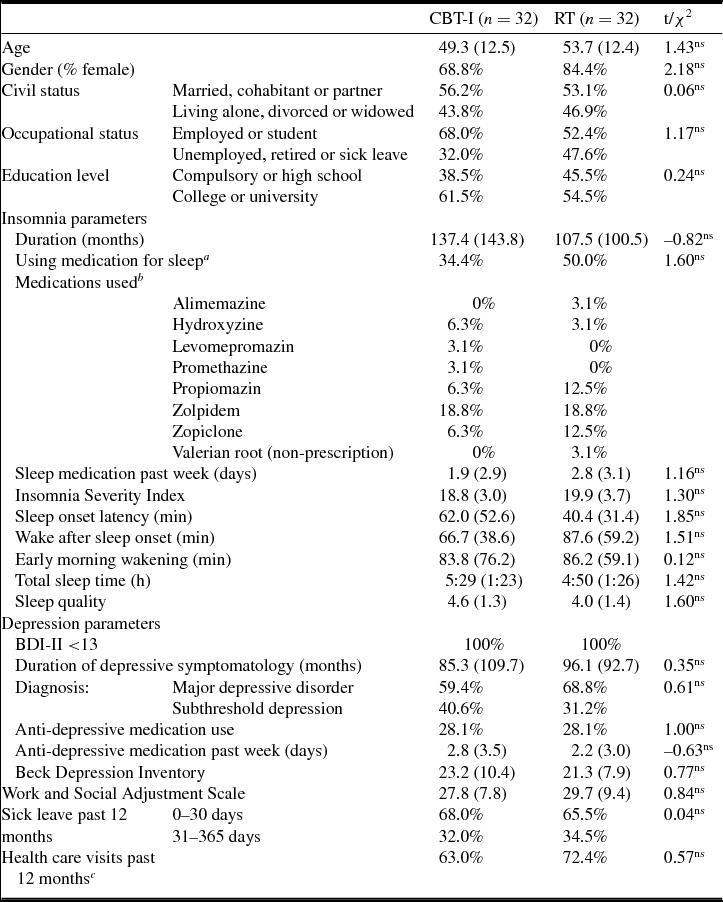
Reprinted from Norell Clarke et al., Group cognitive behavioural therapy for insomnia: effects on sleep and depressive symptomatology in a sample with comorbidity, Behaviour Research and Therapy, 74, 86. Copyright (2015), re-used with permission from Elsevier. All numbers are based on observed data. There were no significant differences (ns) between CBT-I and RT on any of the variables in the table. aParticipants stated medication had been used for sleep problems although some medications may be better known for other treatment effects. bSome had more than one medication prescribed for sleep. cVisits to physician, psychologist or hospital.
Depressive severity was measured with the Beck Depression Inventory-second edition (BDI-II; Beck et al., Reference Beck, Steer and Brown2005). All participants had reported >13 on the BDI-II pre-treatment (cut-off for ‘mild depression’) and 64.1% were diagnosed with major depressive disorder (MDD).
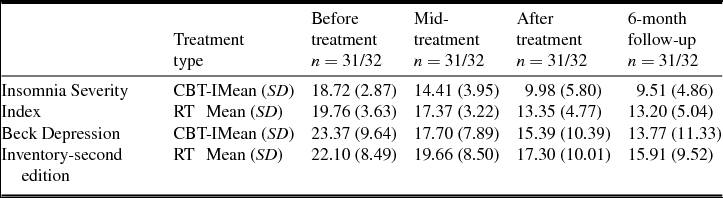
Insomnia severity was measured with the Insomnia Severity Index (ISI; Bastien et al., Reference Bastien, Vallières and Morin2001). All participants reported >10 on the ISI pre-treatment and 100% had been diagnosed with insomnia (see Table 2 for more data on ISI and BDI-II). The descriptive data in Table 2 give an overview of how depressive severity and insomnia severity changed over time for the respective treatments. For both groups, depressive severity and insomnia decreased over time. Previous mixed-models analyses demonstrated that CBT-I was associated with significantly greater changes in insomnia severity compared with RT, but that both groups had significant within-group changes regarding depressive severity (Norell-Clarke et al., Reference Norell-Clarke, Jansson-Fröjmark, Tillfors, Holländare and Engström2015).
Descriptive data, comparing CBT-I and RT regarding insomnia severity and depressive severity over four measurement times
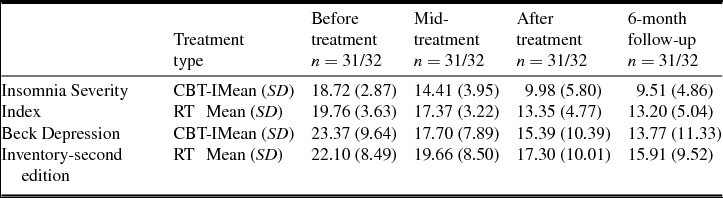
The data in this table are from the imputed dataset used in the current mediational analyses and thus deviates slightly from data previously presented in Norell-Clarke et al. (Reference Norell-Clarke, Jansson-Fröjmark, Tillfors, Holländare and Engström2015). SD, standard deviation.
Statistical analyses
Mediational analyses were conducted using the PROCESS computational tool (Hayes, Reference Hayes2013) added to SPSS version 20. ‘Model 4’ in PROCESS was chosen for all analyses. In this model, the indirect effect of X on Y through M = ab; the total indirect effect of X on Y through M = Σ(ab); and the direct effect of X on Y = c′. The statistical model is based on the following equations: M = i 1 + aX + e M and Y = i 2 + c′X + bM + e Y. In the equations, i 1 and i 2 represent regression intercepts, while e M and e Y represent errors in the estimation of Y and M. Furthermore, a, b and c′ represent the regression coefficients given to the antecedent variables in the model in the estimation of the consequents (Hayes, Reference Hayes2013). Bootstrap confidence intervals were chosen for inference testing of indirect effects (Hayes, Reference Hayes2013). Attrition was compensated for by multiple imputation through SPSS, generating five datasets. The pooled values were used in the analyses. Complementary analyses were conducted with observed data as well as without the BDI-II item regarding sleep disturbance. The results were almost identical (data not shown).
Mid-treatment insomnia severity and depressive severity were tested as mediators of insomnia severity and depressive severity, respectively: at post-treatment and 6-month follow-up. The mean values for the respective groups are given in Table 2. Treatment method (CBT-I vs RT) was the predictor in all mediational analyses. Basic models, consisting of predictor, mediator and outcome were tested first. Significant mediational models were followed by the testing of adjusted models that controlled for pre-treatment BDI-II and ISI as covariates.
The observant reader may remember from the Introduction that we did not find a significant difference between CBT-I and RT on depression severity (BDI-II) in the study's main findings (Norell-Clarke et al., Reference Norell-Clarke, Jansson-Fröjmark, Tillfors, Holländare and Engström2015). Thus, our approach that led to testing for mediational effects when the so-called path c was not significant, may seem inappropriate according to the traditional Baron and Kenny approach to mediation (Baron and Kenny, Reference Baron and Kenny1986). For a long time, consensus has been that mediational analyses only should be carried out if a significant relationship between X and Y was found. In more recent years, it has been argued that there are several statistical situations where an indirect effect between X and Y may exist despite an apparent lack of direct effect between the variables, which justifies mediational analyses in these cases also (Hayes, Reference Hayes2013; Zhao et al., Reference Zhao, Lynch and Chen2010). First, the Baron and Kenny approach (testing mediations by four consecutive steps and only if X→Y is significant) has been found have lower power in comparison with mediational tests that run simultaneous analyses of the paths in the mediational model (Fritz and MacKinnon, Reference Fritz and MacKinnon2007), such as the analyses conducted within PROCESS. Thus, rejecting mediational testing purely based on the results from the MANOVA previously reported (Norell-Clarke et al., Reference Norell-Clarke, Jansson-Fröjmark, Tillfors, Holländare and Engström2015). may be overly zealous. Second, the association between a hypothetical X and Y are probably explained by more than one mechanism: some may be positive (mediational), others negative (suppressive). When all effects are combined, as in path c analysis, the association between X and Y may be diluted and only observable in large samples. Our sample is small. Third, the association between X and Y may work differently for subsamples (such as people with high or low depressive severity), which could dilute a total effect in path c, despite the existence of mediational effects through paths a and b. In the main study, some differences between subsamples were found (Norell-Clarke et al., Reference Norell-Clarke, Jansson-Fröjmark, Tillfors, Holländare and Engström2015). Taken together, we found it justifiable to test BDI-II as a mediator.
Results
Tests of mid-treatment insomnia severity as a mediator between CBT-I and depressive severity
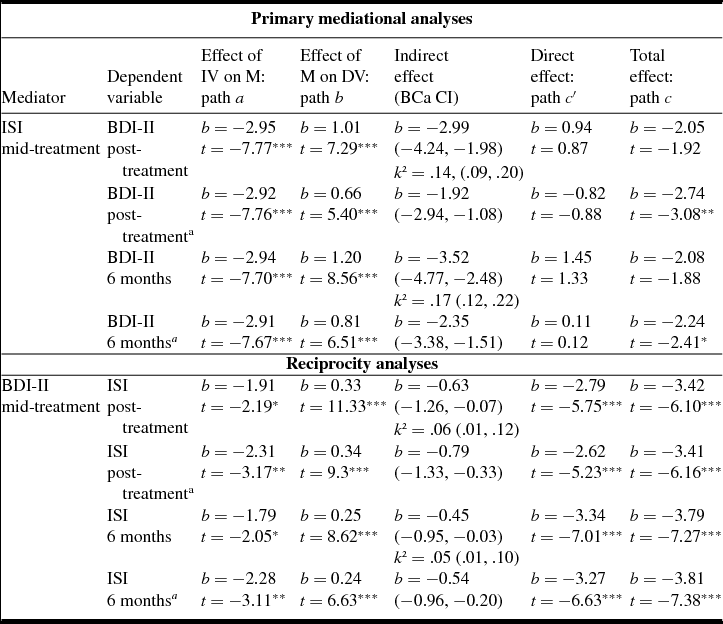
There was an indirect effect of CBT-I through insomnia severity (see Table 3) that explained 14% of the variance of post-treatment insomnia severity (k² = .14, BCa CI = −4.24, −1.98). When insomnia severity at baseline and depressive severity at baseline were added as covariates, the model remained significant. These results were maintained in models where depressive severity at the 6-month follow-up was used as the outcome.
Mediational analyses with insomnia severity and depressive severity
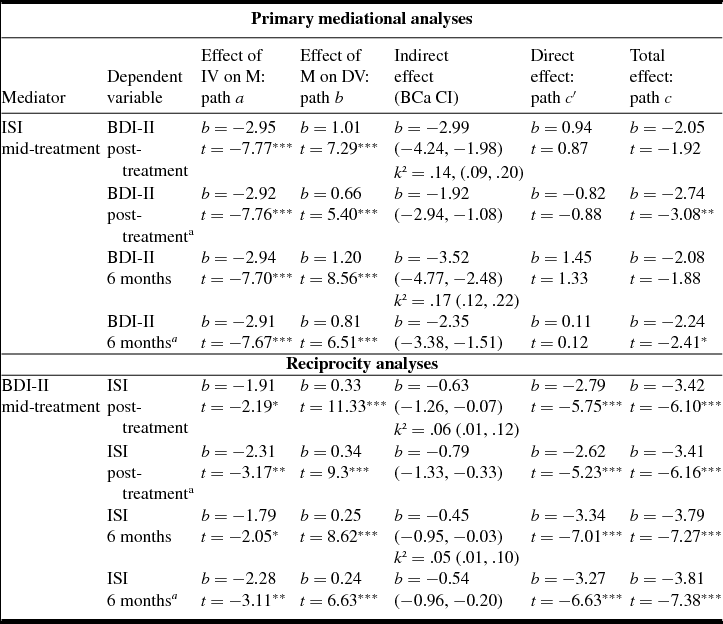
BCa CI, bias-corrected confidence interval; BDI-II, Beck Depression Inventory-second edition; DV, dependent variable; ISI, Insomnia Severity Index; IV, independent variable; k², effect size Preacher and Kelly Kappa-squared (if k² values are multiplied by 100, they can be interpreted as a percentage of explained variance; M, mediator. The independent variable (IV) was treatment group in all instances. aModels with pre-treatment BDI-II and ISI as covariates. *Significant at the .05 level; **significant at the .01 level; ***significant at the .001 level.
Tests of mid-treatment depressive severity as a mediator between CBT-I and insomnia severity
Complementary analyses were conducted to test for a reciprocal relationship between insomnia severity and depressive severity, using treatment as predictor, mid-treatment depressive severity as mediator, and insomnia severity at post-treatment as outcome. Depressive severity during treatment mediated insomnia severity after treatment and this effect explained 6% of the variance (k² = .06, BCa CI = −1.26, −0.07). This relationship remained significant when we used pre-treatment insomnia severity and depressive severity as covariates. These results were maintained in models where insomnia severity at the 6-month follow-up was used as the outcome. We therefore conclude that the relationship between insomnia severity and depressive severity is reciprocal, but it should be noted that the effect of depressive severity on insomnia severity is smaller.
Discussion
A reciprocal relationship was found between insomnia severity and depressive severity over the course of CBT-I, although insomnia severity had a stronger effect on depression than depressive severity on insomnia. The results are in line with previous studies (Manber et al., Reference Manber, Buysse, Edinger, Krystal, Luther and Wisniewski2016). This adds to the literature on comorbid insomnia and depression and further emphasizes the importance of making insomnia a treatment focus in its own right. A question that remains unanswered is how decreased insomnia has an effect on depression.
It has been suggested that the link between insomnia and depression goes via dysfunctional emotion regulation. People with insomnia experience more intense negative emotions and are more emotionally reactive (Baglioni et al., Reference Baglioni, Spiegelhalder, Lombardo and Riemann2010), thus decreased insomnia may lead to relatively weaker, more transient negative emotions, which in turn may be easier to regulate in a functional way. Also, reduced daytime tiredness, from improved sleep, may make it easier to initiate rewarding behaviours (also known as behavioural activation), which is associated with improvements in depressive symptoms (Martell et al., Reference Martell, Dimidjian and Herman-Dunn2013).
The finding that depressive symptoms only mediated insomnia severity to a small extent (during treatment for insomnia) is in line with previous studies that found this effect to be weaker than the effect of insomnia on depression (Ashworth et al., Reference Ashworth, Sletten, Junge, Simpson, Clarke, Cunnington and Rajaratnam2015; Manber et al., Reference Manber, Buysse, Edinger, Krystal, Luther and Wisniewski2016), and a study that demonstrated that CBT for insomnia had a greater impact on insomnia and equal effect on depression as CBT for depression (Blom et al., Reference Blom, Jernelöv, Kraepelien, Bergdahl, Jungmarker and Ankartjärn2015). Thus, if given the choice to only treat one condition with CBT, the research so far indicates that insomnia is a more effective treatment focus than depression.
When discussing the findings, it should be noted that the magnitudes of the mediational effects explain only a fraction of the variance in insomnia severity and depressive severity after CBT-I: 14 and 5%, respectively, in the basic models. The implications from this are twofold: further studies are warranted into (a) other potential mediators and (b) individual differences. Investigations into other potential mediators are needed to test to what extent other variables may explain the (unexplained) variance in post-treatment depression and insomnia. For example, studies that contrast different CBT-I techniques may shed light on whether certain interventions affect depression more than others. Some plausible mechanisms that would be interesting to test are if a more regular life schedule, as per stimulus control and sleep restriction may counter depressive inactivity and function as behavioural activation, and if cognitive techniques regarding worry may limit the depression-maintaining effects from depressive negatively toned thought activities. Also, studies that include both passive and active control conditions may allow for hypotheses testing therapeutic factors in general, such as attention, treatment rationale and expectancy, and group therapy factors such as coherence or social interactions. Regarding individual differences, cumulative data inevitably obscure individual differences in treatment responses. The indirect association between CBT-I and depressive severity through insomnia severity varied across the participants. For some, improved sleep may have been a salient ‘game changer’ for their depressive symptomatology, whereas there might be other mechanisms or factors that impact mood for others. For example, a previously well-functioning and industrious person may be able to use the increased energy from better sleep to resume healthy habits such as exercise, social interactions and other rewarding activities, which would further improve depressive severity. However, a lonely person with an inactive lifestyle is unlikely to suddenly approach situations that are outside the person's previous behavioural repertoire, even if they sleep better. Other specific interventions may be needed before there will be a noticeable effect on depression. Also, it is possible that physical health status, medications and symptom levels moderate treatment effects, amongst other pre-existing variables. We noted that those who dropped out from CBT-I and RT seemed to report more severe pre-treatment depression (Norell-Clarke et al., Reference Norell-Clarke, Jansson-Fröjmark, Tillfors, Holländare and Engström2015).
Strengths and limitations
The study design has some strengths and limitations that should be considered. The use of a plausible insomnia treatment as a control group controlled for common psychotherapy mechanisms such as attention, treatment rationale and expectancy effects. Four consecutive measurement times meant that temporal precedence of the mediators in relation to baseline and outcomes could be established, and allowed us to control for baseline values as well as testing for reciprocity between mediator and outcome. The limited sample size decreases power and hence lowers the statistical conclusion validity. The heterogeneous sample, including both people with MDD and people with sub-diagnosis depressive symptoms was probably the cause of the large standard deviations, which may have caused smaller effects in some instances. Our reliance of subjective measures of sleep means that we may have unintentionally included some people with untreated sleep disorders (e.g. apnoea), which in turn may have affected treatment outcomes. Although polysomnographic investigations are not the golden standard to diagnose insomnia, it should be noted that obstructive apnoea is common in people with comorbid insomnia and depression (e.g. Ong et al., Reference Ong, Gress, San Pedro-Salcedo and Manber2009), and that symptoms caused by apnoea are unlikely to remit after CBT-I. As the DSISD has been found to have acceptable validity and reliability in screening for sleep disorders (Edinger et al., Reference Edinger, Wyatt, Olsen, Stechuchak, Carney and Chiang2009), we conclude that it is unlikely that untreated sleep disorders would have had great impact on the treatment outcomes. Another limitation regards the clustered nature of the data, in that the ratings from the four to eight participants in every therapy group may not be independent from each other. While we did not find any support for therapist effects (Norell-Clarke et al., Reference Norell-Clarke, Jansson-Fröjmark, Tillfors, Holländare and Engström2015), specific therapy groups may have had their own dynamics that influenced each other's therapy progress or symptom reports. In order to facilitate successful therapies, all therapists discussed their therapies regularly with the first author and had the chance to bring up any problems or need for supervision. (For example, one group had some early issues with how a specific participant influenced sessions, which was successfully dealt with by the therapist.) According to our notes, nothing unsolvable surfaced during these discussions but there may have been processes that the therapists were unaware of. However, group dynamics can be a potential influence of treatment outcomes in any group treatment and it was one of the reasons why we offered the control condition as a group treatment also. To counter any dependency effects, an alternative statistical route would have been to use the mean values of every therapy group instead of the individual scores. This would require a much larger sample to attain sufficient power and was regrettably not possible within the current project.
To conclude, some of the effect of CBT-I on depressive symptoms in comorbid insomnia and depression seems to be explained via improved sleep. Investigations of insomnia severity together with other potential mediators such as various emotion regulation strategies, and behavioural activation in the same analysis, would add a more detailed picture.
Acknowledgments
The authors would like to express their gratitude to Iain Clarke for proof reading this manuscript.
Ethical statement: The authors have abided by the Ethical Principles of Psychologists and Code of Conduct as set out by the APA. The study protocol was approved by the Regional Ethics Vetting Board in Uppsala, Sweden (dnr: 2011/129).
Conflicts of interest: Annika Norell-Clarke, Maria Tillfors, Markus Jansson-Fröjmark, Fredrik Holländare and Ingemar Engström have no conflicts of interest with respect to this publication.
Financial support: The study was funded by Stiftelsen Professor Bror Gadelius Minnesfond (A.N.-C., M.J.-F., M.T., F.H. and I.E.); Psykiatrifonden (A.N.-C., M.J.-F., M.T., F.H. and I.E.); and the Research Committee of Region Örebro County, Sweden (A.N.-C.). The sponsors were not involved in any of the following: study design; the collection, analysis and interpretation of data; the writing of the report; or the decision to submit the article for publication.




Comments
No Comments have been published for this article.