Introduction
The notion of “density dependent natural selection” (MacArthur Reference MacArthur1962; MacArthur and Wilson Reference MacArthur and Wilson1967) states that genotypic fitness can vary as a function of population density-under a condition when carrying capacity acts as the agent controlling the action of natural selection. This is considered to be one of the important factors that affect the phenotypes related to the life history traits of organisms (Pianka Reference Pianka1970; Anderson Reference Anderson1971; Travis and Mueller Reference Travis and Mueller1989; Joshi and Mueller Reference Joshi and Mueller1996; Mueller Reference Mueller1997). Controlled laboratory experiments using the Drosophila Fallén (Diptera: Drosophilidae) model organism reared over many generations have shown that density-dependent selection leads to genetic divergence among populations for various life history traits (Mueller et al. Reference Mueller, Guo and Ayala1991; Joshi and Mueller Reference Joshi and Mueller1996; Roper et al. Reference Roper, Pignatelli and Partridge1996; Sokolowski et al. Reference Sokolowski, Pereira and Hughes1997). These laboratory experiments are useful for studying the implications of specific ecological factors, which can be manipulated at a given time and their influence on the genetic system could be ascertained over many generations (Travis and Mueller Reference Travis and Mueller1989; Joshi and Mueller Reference Joshi and Mueller1996; Mueller Reference Mueller1997). These studies included traits that are usually metric components of fitness, which exhibit extreme sensitivity to variation in experimental condition (Leroi et al. Reference Leroi, Bennett and Lenski1994). Empirical evidence suggests that increase in density-dependent competition for a limiting resource affects at least one of the traits representing juvenile mortality, delayed maturity, smaller adult size, and fecundity. The responses of the life history traits are also in general accord with predictions from life history theory of how individual genotype exhibits variable phenotypic expressions (otherwise known as phenotypic plasticity) under different environmental conditions of juvenile growth to maximise their fitness in adult (Stearns and Koella Reference Stearns and Koella1986; Berrigan and Koella Reference Berrigan and Koella1994). In doing so, optimisation of one trait that directly increases the fitness component of the population comes at the cost of another trait, or in other words, a trade-off in the life history traits has been evident as a key to survival strategy of population. One such systemic study on larval crowding behaviour of Drosophila melanogaster Meigen was conducted by Joshi and Mueller (Reference Joshi and Mueller1996), who observed a trade-off between larval food acquisition and use. This subsequently enabled them to designate the populations as r-selected and K-selected strains (Mueller et al. Reference Mueller, Graves and Rose1993), where r-selected strains use intrinsic growth rate (r) as survival strategy and K-selected strains depend on carrying capacity (K). Similarly, the study by Dey and Joshi (Reference Dey and Joshi2006) and Dey et al. (Reference Dey, Bose and Joshi2012) on larval crowding of Drosophila ananassae Doleschall has revealed populations selected for adaptation to larval crowding have higher K and lower r, and evolve greater stability than controls. Correlated responses to the selection pressure for faster development and reproduction is observed for D. melanogaster, implying a trade-off in size and fecundity with reference to the conditions experienced by the developing larva (Prasad et al. Reference Prasad, Shakarad, Anitha, Rajamani and Joshi2001). Similar observations are also made for D. ananassae and Drosophila nasuta nasuta Lamb (Nagarajan et al. Reference Nagarajan, Natarajan, Jayaram, Thammanna, Chari and Bose2016), where the competitive ability is increased without increase in the feeding rate. However, constraints arising out of the food availability can also bring similar effects in the phenotypes in principle with the norms of the genotype-environment interactions (Nunney Reference Nunney1983).
A feature common to almost all experiments that have been mentioned in previous section is manipulation of density of the experimental populations from low to high density of individuals under various treatments. However, the potential difficulties with the low density definition is that the count of low number of individuals was usually arbitrary in those experiments. Similarly, high-density values also varied by up to several orders of magnitude greater than so called low density (Reisen et al. Reference Reisen, Milby and Bock1984) and all these high-density conditions were referred as crowding. Assuming density being the number of individuals in unit space, the definition of crowding becomes qualitative and relative to the limited resource available with greater degree of aggregation of individuals. Thus within varying space with same number of individuals (keeping the density constant) the extent of crowding would vary. In the background of spatial distribution, the concept of crowding and the density are quite distinguishable. In so called high-density experiments, the effects on the life history traits are measured as an average of all the individuals or selected individuals, thereby undermining the effects on the single individual or on the sex of the individuals. For insects like Drosophila, the larval development is crucial in determining the adult features. Resources obtained in the course of larval feeding are assimilated for the somatic and reproductive development, which subsequently determines the fitness of the individuals. Manipulation of the rearing density enables assessment of the variations in the traits and offers a feasible way of commenting on the effects of the environmental conditions. Using low density of the developing larvae, the effects on the life history traits can be assessed at the level of sex and the individual concerned as experiments with so-called high density do not give opportunity to estimate the contribution of individual competitor in gradually and consistently increasing number in shaping survival strategy of the population. Here we report the result of the study with a minimalistic approach (Agnew et al. Reference Agnew, Haussy and Michalakis2000, Reference Agnew, Hide, Sidobre and Michalakis2002) in which larval densities were restricted to one to four larvae per replicate with an optimal amount of standard culture medium to generate acute competition for resource. This approach was originally proposed by Nicholson (Reference Nicholson1957), who simplified the potential confounding factors to its lower bounds by studying the effects of density-dependent competition in treatments containing one, two, or three individuals. Later, this experimental design was adopted by Agnew et al. (Reference Agnew, Haussy and Michalakis2000, Reference Agnew, Hide, Sidobre and Michalakis2002) for their study on the effect of density-dependent larval competition on life history traits of mosquitoes (Diptera: Culicidae). This approach carries some advantages. First, there was a control treatment where individual larvae developed in the absence of competition with other larvae. In addition, this design allowed comparison of the competitive interactions within and between sexes. We employed the above-mentioned experimental design to explore how precisely regulated larval density and sex influence a trade-off between life history traits and adult morphology as a survival strategy, for the first time in fruit fly D. melanogaster.
Materials and methods
Drosophila stock and culture conditions
We used the Oregon-R strain of D. melanogaster. The stock population of D. melanogaster used in the present experiment originated from the Drosophila laboratory of the Department of Zoology, University of Calcutta (Kolkata, India) in the 1980s. This stock is highly inbred and regarded as genetically homogeneous. Using eggs from this stock culture, new population was initiated and reared for 37 discrete generations (from September 2013 to December 2014) following standard protocol (Ashburner Reference Ashburner1989). The larvae emerging from the eggs of the P-generation were maintained in 30 different food vials at a density of 30 larvae per vial, each of which contained 3 mL of food. Upon emergence as adult and subsequent oviposition, the eggs were collected and separated from the population and placed in a new vial for the initiation of F1 generation. A cohort was maintained for each generation through selection and mixing of the eggs of the vials and picking up larvae emerging on the same day. Randomised selection of the eggs from the vials enabled retention of the heterogeneity of the initially separated populations in the vials. Any other eggs or larvae of the previous generations were not considered to maintain the generations as discrete from one another. On an average 12±1 days (egg – 1, instar I – 1, instar II – 1, instar III – 3, pupa – 4, adult oviposition – 2) was required for completion of the egg of one generation to first clutch of eggs of the next generation. Monitoring of the vials was continued at a particular time period within a day, for collection and synchronised hatching to facilitate the formation of a cohort for that generation. Adult flies were maintained in food vials measuring 30 mm in diameter and 105 mm in height and on standard yeast-agar-cornmeal culture medium (hot water 600 mL+agar 5 g+crude sugar 50 g+maize powder 50 g+yeast powder 15 g+1 g Nipagin dissolved in 95% ethanol+1 mL of propionic acid) under standard laboratory conditions at 24±1 °C temperature. Thus the eggs of the F38 generation were used in this experiment initiated in December 2014.
Experimental design
For the experiment, 10 pairs of newly hatched male and female of approximately same age (<12 hours difference in age) were chosen from the 37th generation mass culture vials and kept them for 24 hours in a fresh vial containing 3 mL of standard Drosophila culture medium as mentioned above. The eggs of 38th generation were isolated on the next morning and one, two, three, and four eggs were placed with a fine paint brush in small vials (diameter 12 mm, length 52 mm) containing 0.5 mL of standard Drosophila culture medium. A total of 20 replicate vials were used at each density; therefore, the experiment included 80 vials containing 200 larvae. Vials were maintained in a low-temperature incubator at 24±1 °C, 65–70% relative humidity and local photoperiod of 12:12 [light:dark] hours.
Morphological and life history parameters
The time point of hatching of eggs was recorded by careful observation in 10-minute regular time intervals under a stereoscopic microscope. Time needed to complete the pupation and adult emergence (the day of pupation and adult emergence) was noted as parameters of developmental time. As the eggs are hatched at any time within 24 hours following oviposition, we synchronised our record on adult emergence time and day of pupation initiating the time count from the time of hatching of the first instar. Immediately after emergence the adult flies were sexed and their body lengths were measured following the method by Santos et al. (Reference Santos, Fowler and Partridge1994). Each of them was then transferred to separate vial without food. They had only access to water from a soaked ball of cotton placed on the vial to prevent dehydration. Adults were thus starved to death and their day of death was noted to the closest 24 hours.
Following the death of adult fly, their wing length and aristae (branched sensory bristles extended from the third antennomere) length were measured. One wing was removed from each adult and the distance between the alula notch and the tip of the wing was measured using a dissecting microscope fitted with a graduated eyepiece. Aristae length was measured to the nearest 0.01 mm. Dead flies were dried in an 80 °C hot-air oven and their dry body weight was recorded to an accuracy of 0.01 mg.
Statistical analysis
Life history traits include age at pupation, which is the time span between hatching of first instar and onset of pupation; adult emergence time, which is the time span between hatching of first instar and imago emergence from puparium; and adult longevity in starvation, which is adult emergence from puparium until death (all in days). Adult longevity in starvation represents the time an individual survived on the reserves it accumulated during its larval life. Morphological traits include body length (in mm), dry body weight (in mg), arista length (in mm), and wing length (in mm). Age at pupation, wing length, arista length, and body length were analysed for those replicates where all individuals survived to their adulthood. This helped avoid chances of underestimating the effects of density on life history and morphological traits caused by larval mortality. Death of competing individuals reduced pressure on the surviving flies and this cannot be measured in present experimental set up. The chance of pseudoreplication of data has been minimised in cases where a replicate yielded data both for male and female by either ignoring data from one sex, or analysing both sexes separately. The selection of individuals under each density levels was made at random for each set thereby complying with the norms of replication (Hurlbert Reference Hurlbert1984). Similarly, if a replicate yielded data on more than one individual per sex, mean trait values were considered for statistical analyses. Hence, the degrees of freedom were determined on the number of replicate vials and not the number of individuals in the data set (Agnew et al. Reference Agnew, Haussy and Michalakis2000). A two-tailed log likelihood ratio G test was done to see the proportion of replicates in which all individuals survived to adulthood varied among density treatments.
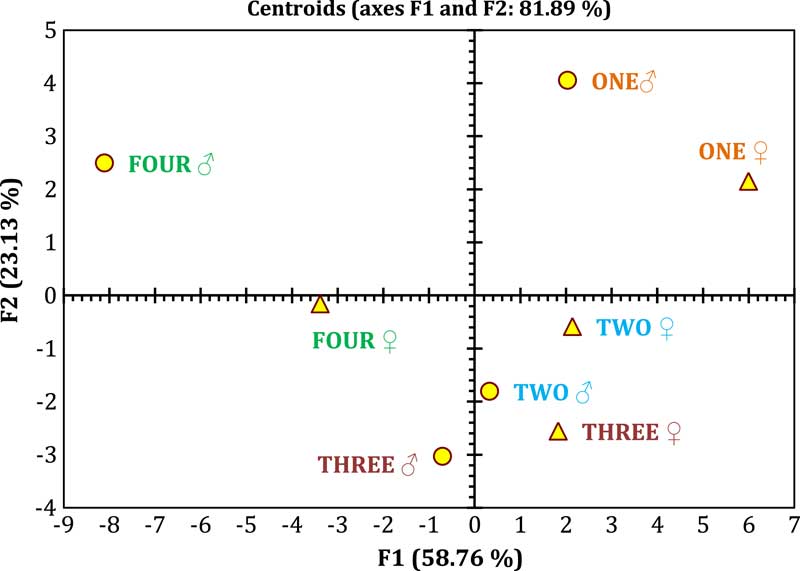
The data on the life history traits were used as the explanatory variables to distinguish D. melanogaster male and female emerging from the different density treatments, employing discriminant function analysis (Manly Reference Manly1994; Legendre and Legendre Reference Legendre and Legendre1998). As a part of the exploratory data analysis, the application of the multivariate analysis enabled portraying the differences in the individuals based on the life history traits and the density effects. This was followed by the application of a binomial generalised linear model with logit link on the data of the life history traits using the density and the sex as predictors. The data on the life history traits was assumed to follow binomial (n, p) distribution with n replicates for each combination of explanatory variables, while the probability parameter p was a linear combination of sex and density. A logit link was used and parameters were estimated through maximum likelihood using the software XLSTAT (Addinsoft XLSTAT software 2010, Paris, France). The logistic equation is provided in the form of: (y) Abundance=1/[1+exp {−(a+b 1×1+b 2×2)}], where ×1 and ×2 represents sex and density of D. melanogaster. The significance of the estimated parameters, i.e., sex and density, was judged through the χ2 value (Wald’s chi-square). A one-way ANOVA was carried out to explore the effects of larval density as a whole (sex ignored) on the selected life history and morphological traits.
To evaluate the effect of sex on change in traits of interest under competition, we measured the traits in sex-specific manner. Each sex was analysed separately by two-way ANOVA (Zar Reference Zar1999) taking larval density and sex as interacting factors. For both females and males, at densities of two, three, and four larvae per vial, we compared replicates to determine the effect of competition between same sex and opposite sex. In the case of females, we compared replicates where female competes with female and female competes with male. In case of males, we compared those replicates where male competes with male and male competes with female. Data from the density of one larva per vial were not included in these analyses because individuals did not compete with either the same or opposite sex larvae. The statistical analyses were carried out using XLSTAT and STATA (Statistical Software, College Station, Texas, United States of America).
Results
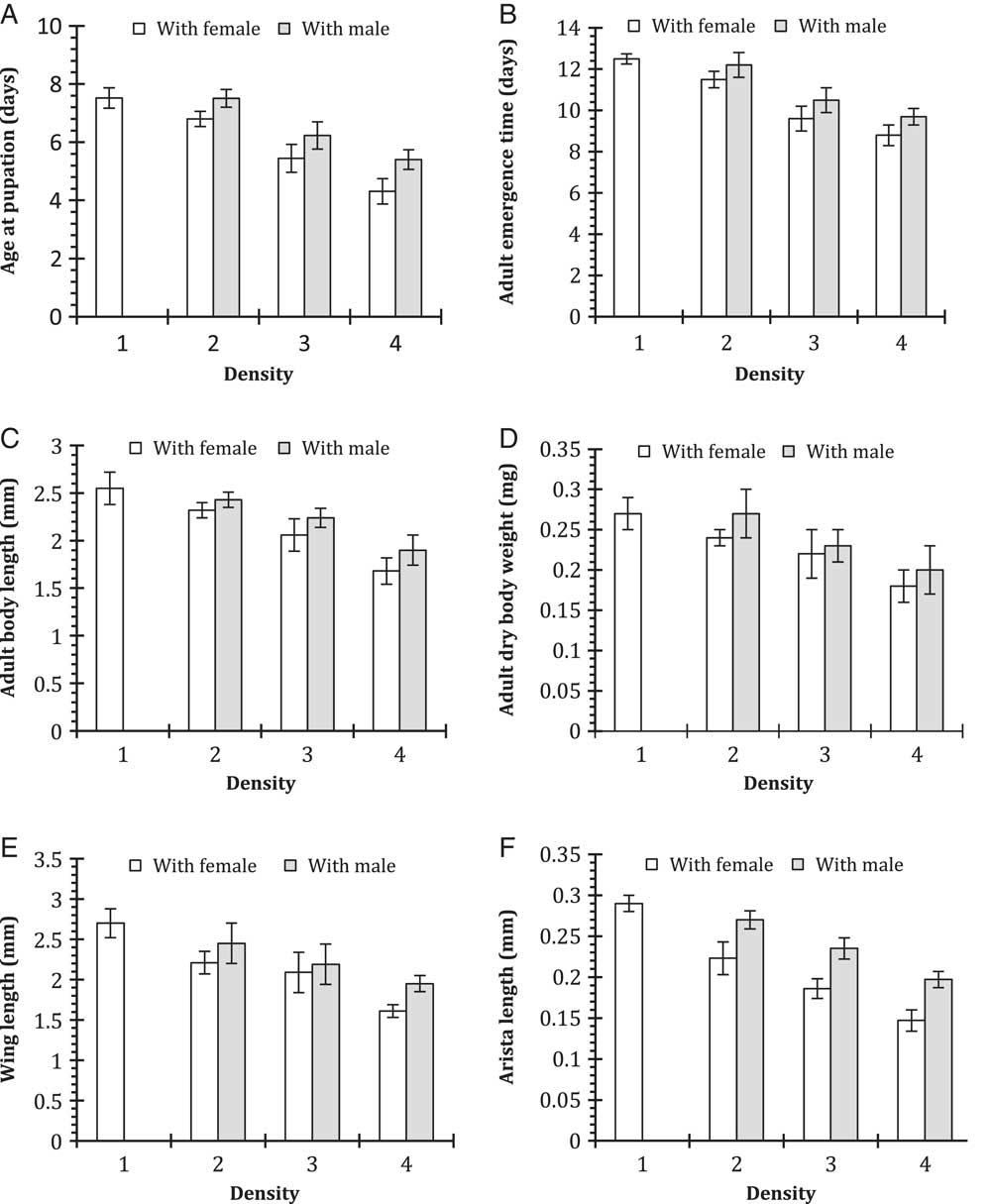
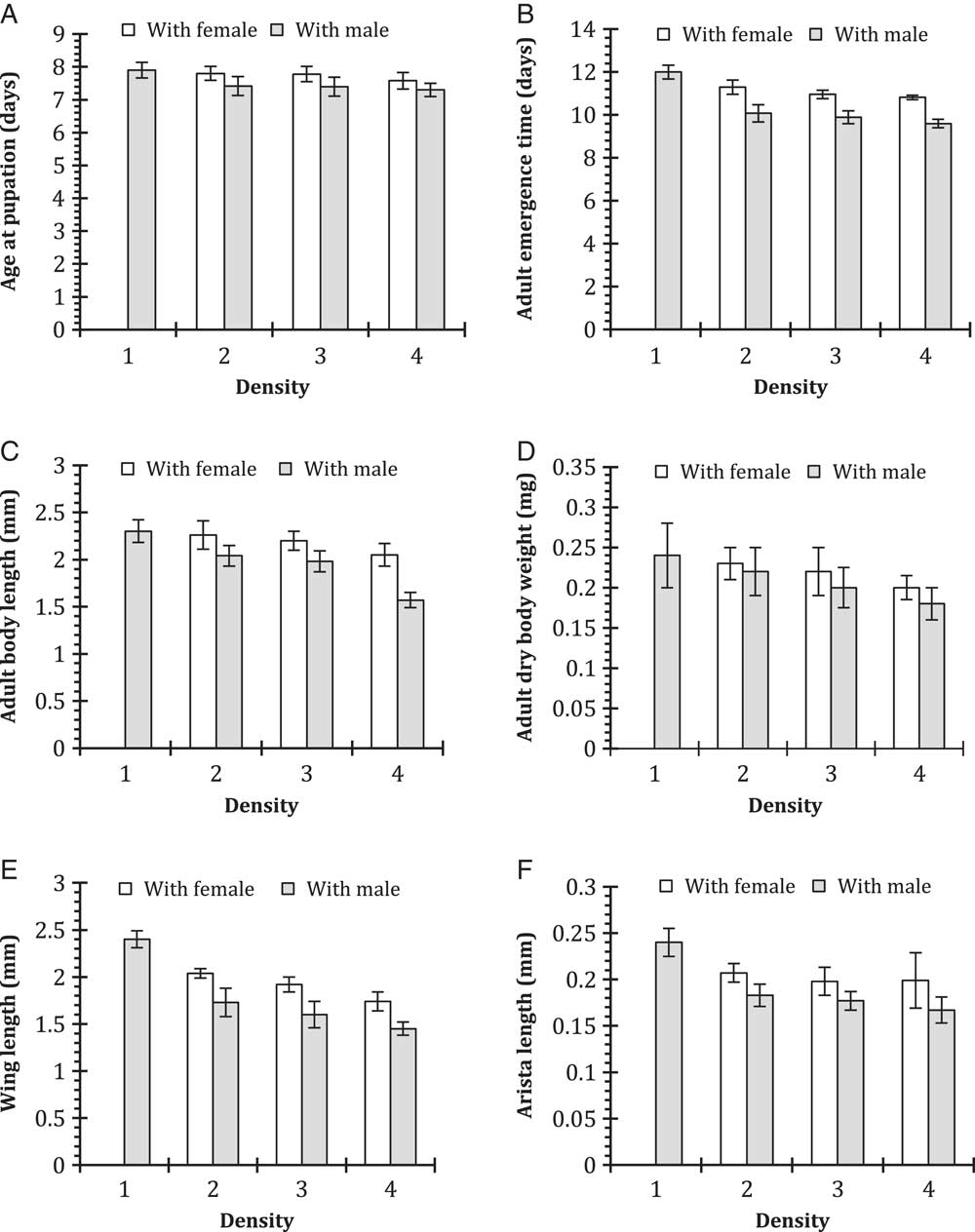
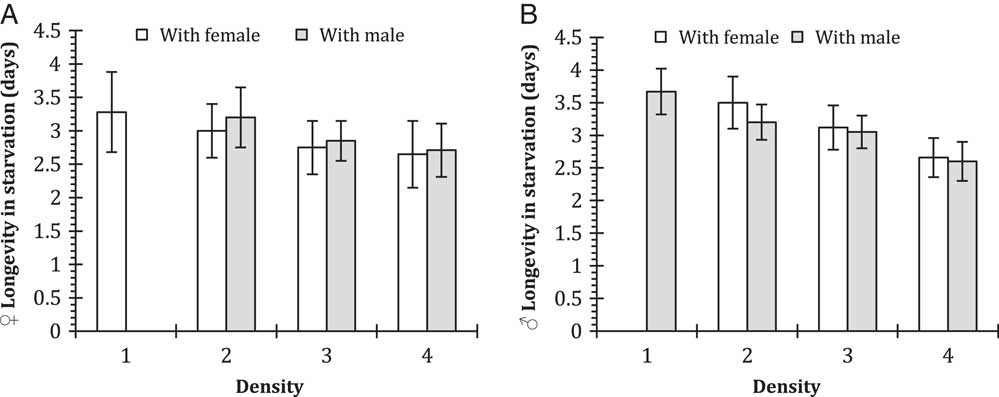
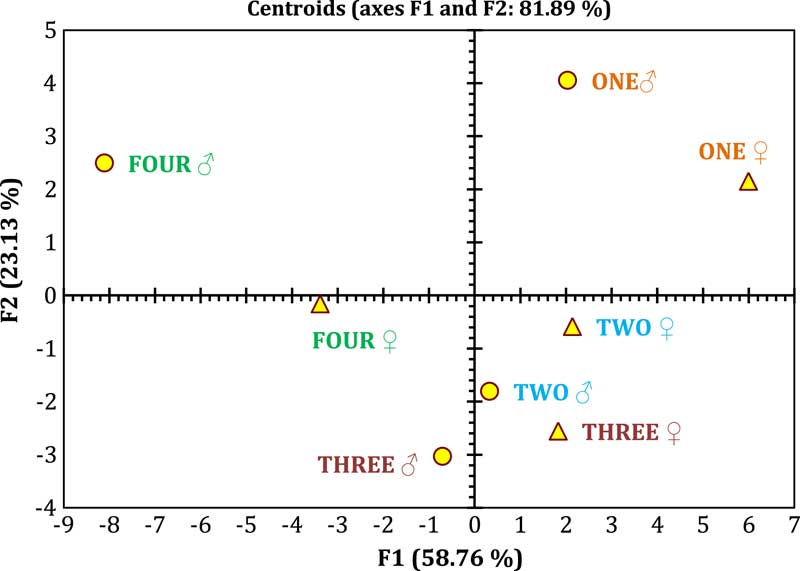
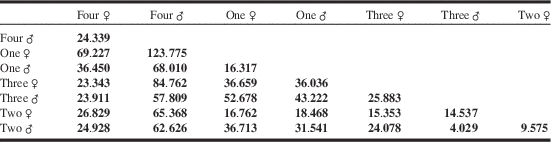
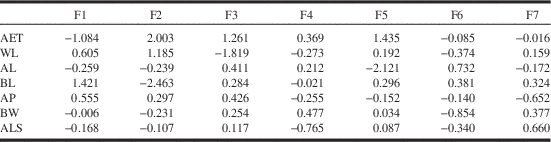
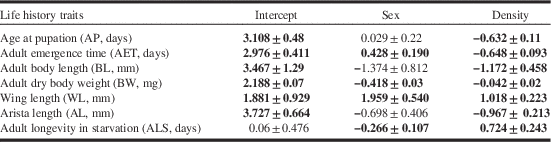
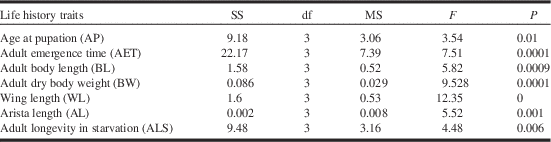
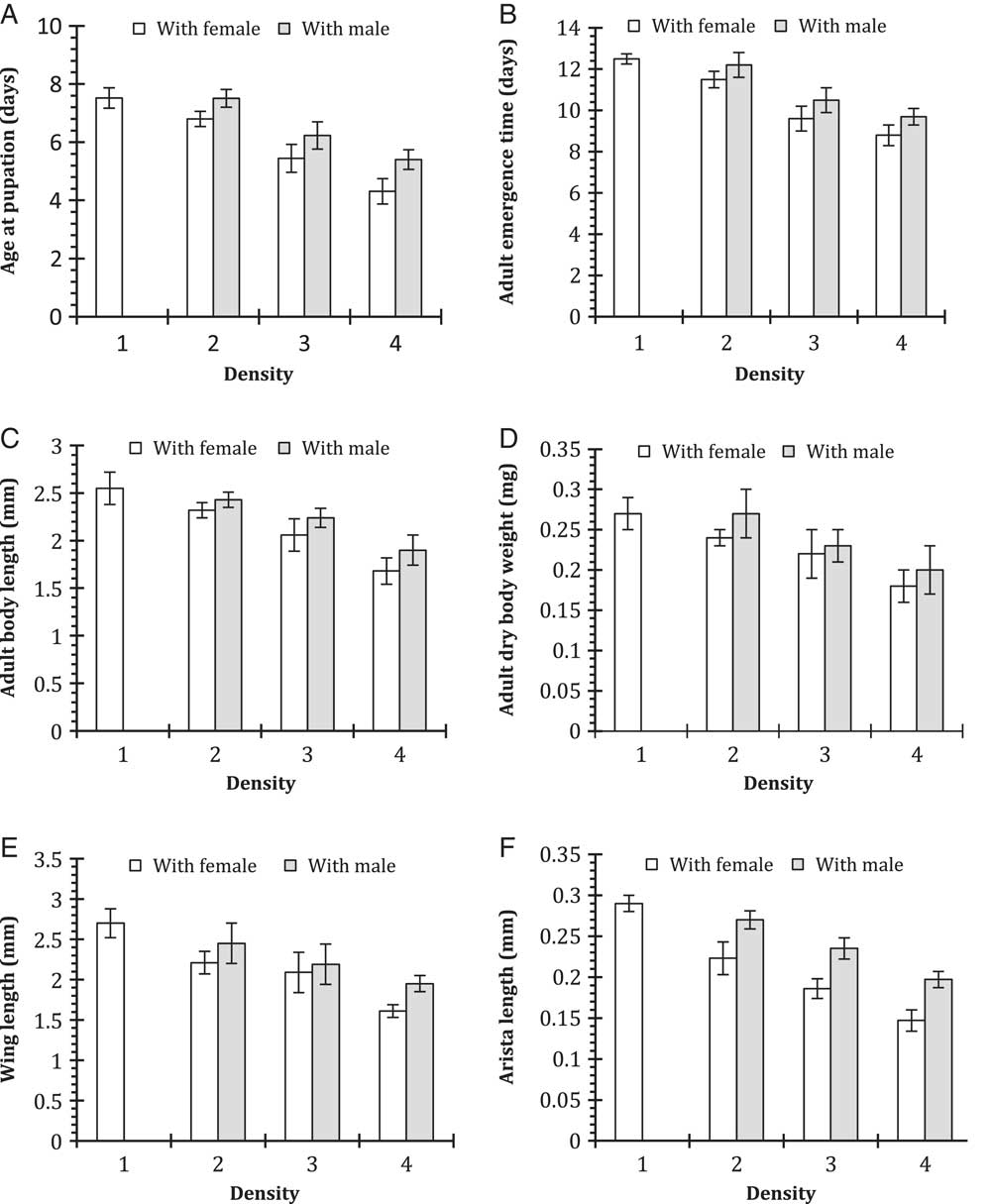
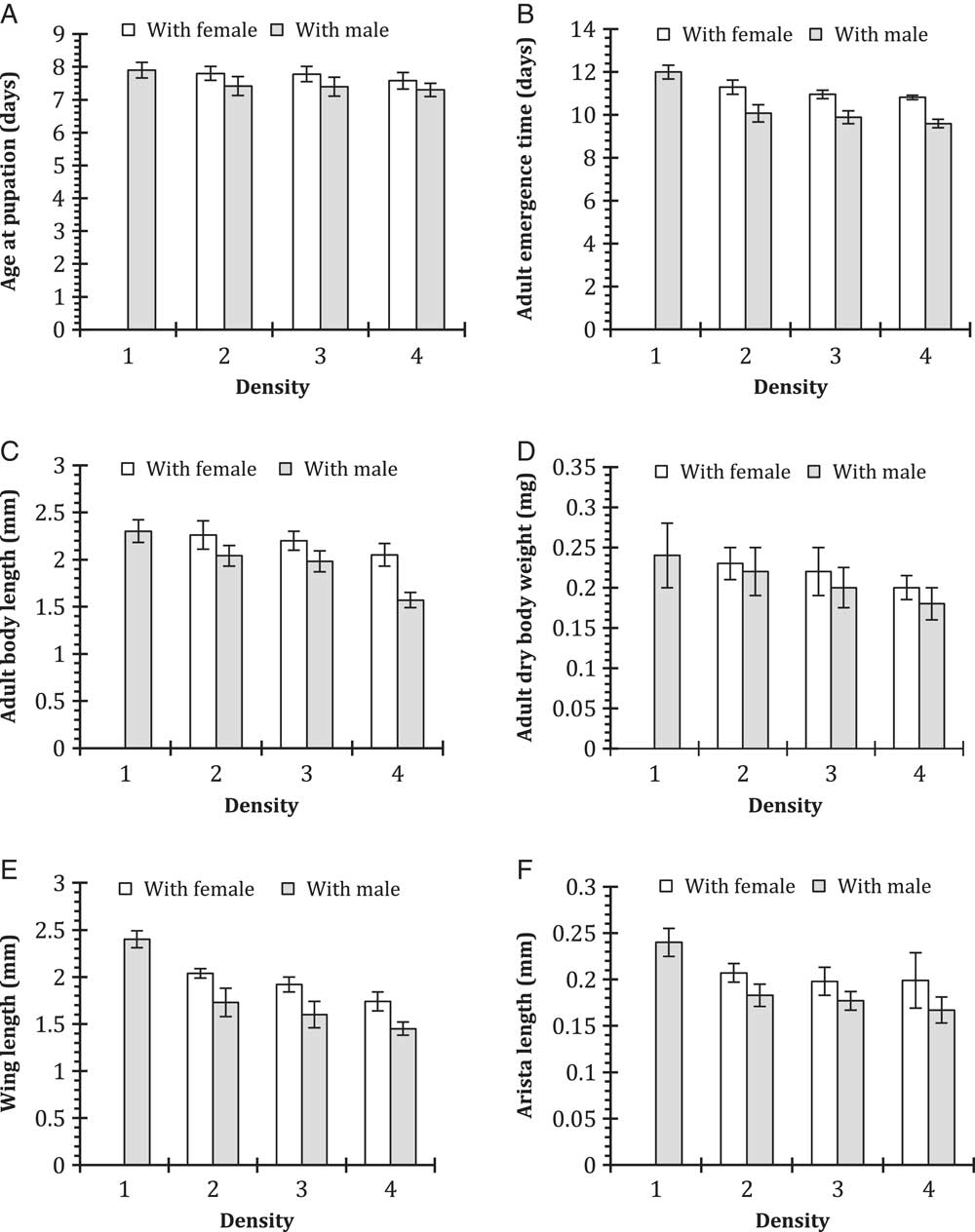
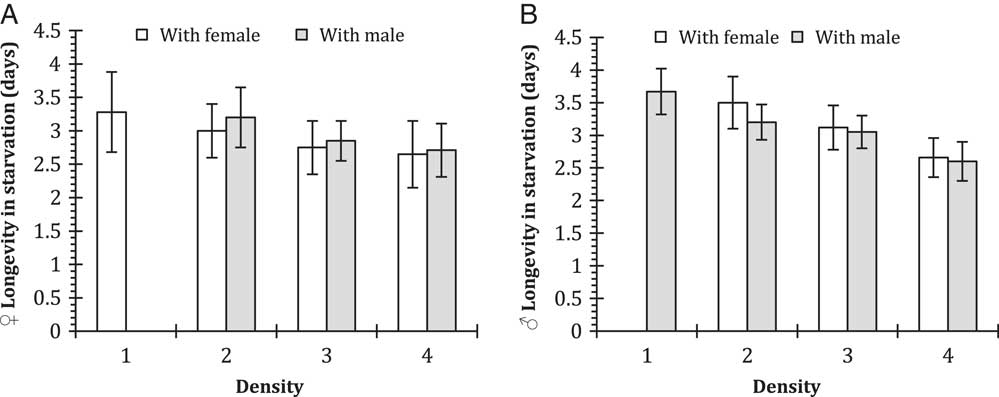
The proportion of replicates in which all the flies survived to their adulthood among the four density treatments did not vary significantly using the G test (χ2=12.42; df=3; P=0.233), though a gradual decrease in survival with increasing density was evident from 20/20 replicates in density one, 19/20 for density two (male–male: 6, male–female: 7, female–female: 6), 18/20 for density three (male–male–male: 5, female–male–male: 5, male–female–female: 6, female–female–female: 2), and 16/20 for density four (male–male–male–male: 3, female–female–male–male: 5, female–male–male–male: 3, male–female–female–female: 2, female–female–female–female: 3). Since each replicate was assigned with a particular sex, the sex bias on the overall number of individuals was not considered in the study, and hence for each density the number of replicate vials was the total number instead of the number of individuals arising out of that particular density. Discrimination of the individuals based on the sex of the adult could be achieved significantly through the life history traits considered in the study, i.e., age at pupation, adult emergence time, body length, dry body weight, aristae length, and wing length (Figs. 1–2). Adult longevity in starvation of both male and female is represented in Figure 3. The biplot shows (Fig. 4) the ordination of the individuals emerging from the density treatments and their cumulative differences (significant at P<0.05 level; Fisher’s distance) based on the life history traits. Among the factors extracted in the analysis, the first two factors used in ordination could explain more than 80% variations emerging from the sex and density treatments. Corresponding canonical correlations were more than 0.9 for the first two factors. The ordination of the individuals based on sex and density provides primary information about the prospective differences in the life history traits justifying the application of further confirmatory analysis (Tables 1–3). The results of the logistic regression indicated that the density and sex were significant contributors to the variations in the life history traits like adult emergence time and the adult wing length. However, for body length and the arista length no significant contribution was observed for the sex but the density remained a significant contributor for the observed variations in the data (Table 4). The logistic regression equations suggest that the density effect was prominent for all the life history traits though the differences in the two sexes were less prominent for body length and arista length, further substantiated through the results of the one-way ANOVA (Table 5). We found significant effects of density on all the selected traits from one-way ANOVA, which has done to explore the effect of larval density (sex ignored) on seven selected life history and morphological traits. A linear trend of decreased measure of wing length, arista length, body length and dry body weight with increasing density (Table 5) (Figs. 1–2) has been observed and this trend is statistically significant. For life history parameters, shortening of pupation time, adult emergence time and adult longevity in starvation with increasing density has been observed (P=0.01, 0.0001, and 0.006), which signifies faster growth rate and accumulation of fewer nutritional reserves during larval growth period under competition.
The trait values of female Drosophila melanogaster in competition with females and males. The x-axis represents the rearing density of the larvae, with the first non-shaded bar (density 1) representing no competition (control). The shaded bars represent the condition when the sex of the competitor was male, and the non-shaded bars represent the condition when the sex of the competitor was female. A: Variation in age at pupation of female under competition. B: Variation in adult emergence time of female under competition. C: Variation in adult body length of female under competition. D: Variation in adult dry body weight of female under competition. E: Variation in adult wing length of female under competition. F: Variation in adult arista length of female under competition.
The trait values of male Drosophila melanogaster in competition with females and males. The x-axis represents rearing density of the larvae, with the first shaded bar (density 1) representing no competition (control). The shaded bars represent the condition when the sex of the competitor was male, and the non-shaded bars represent the condition when the sex of the competitor was female. A: Variation in age at pupation of male under competition. B: Variation in adult emergence time of male under competition. C: Variation in adult body length of male under competition. D: Variation of adult dry body weight of male under competition. E: Variation of adult wing length of male under competition. F: Variation in adult arista length of male under competition.
Estimated adult longevity in starvation of female and male Drosophila melanogaster in competition with females and males. The x-axis represents rearing density of the larvae, with the first bar representing no competition (control). A: Variation in adult longevity in starvation of female under competition. B: Variation in adult longevity in starvation of male under competition.
The results of the discriminant function analysis carried out to portray the differences among the Drosophila melanogaster individuals reared under four densities. Life history traits were used as the explanatory variables for the observed differences among the individuals. The Wilk’s λ value was 0.001; F(49,339)=23.52; P<0.0001. The values in bold indicate significance at P<0.05. AP, age at pupation; AET, adult emergence time; WL, wing length; AL, arista length; BL, body length of adults; BW, dry body weight of adults; ALS, adult longevity in starvation.
Eigen values of the extracted factors of the discriminant function analysis using life history traits as explanatory variables.

The Fisher’s distance among the response variables of the discriminant function analysis.

Note: Values in bold indicate significance at P<0.05.
The standardised discriminant function coefficients of the discriminant function analysis.

AET, adult emergence time; WL, wing length; AL, arista length; BL, body length of adults; AP, age at pupation; BW, dry body weight of adults; ALS, adult longevity in starvation.
The parameters sex (x 1) and density (x 2) for the observed variations in the life history traits of Drosophila melanogaster in compliance with the equation: life history trait (y)=1/[1+exp (−(a+b 1×1–b 2×2))].

Notes: The values in bold indicate significance at P<0.05 level based on Wald’s chi-square following the logistic regression model.
AP, age at pupation; AET, adult emergence time; WL, wing length; AL, arista length; BL, body length of adults; BW, dry body weight of adults; ALS, adult longevity in starvation.
Effects of larval density on selected life history and morphological traits of Drosophila melanogaster using a one-way analysis of variance (sex ignored), error df=76.

AP, age at pupation; AET, adult emergence time; WL, wing length; AL, arista length; BL, body length of adults; BW, dry body weight of adults; ALS, adult longevity in starvation); SS, sum of squares; MS, mean square.
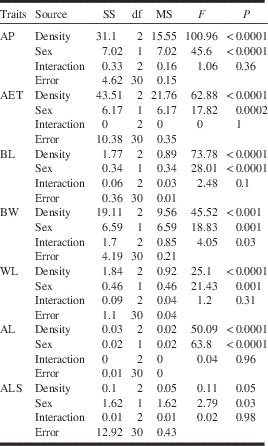
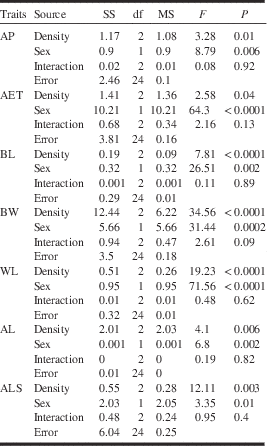
From the two-way ANOVA, which is done to explore the effect of larval density and sex on seven selected life history and morphological traits, we found significant effect of sex-specific larval competition on those selected traits (Figs.1–3). Table 6 represents effects on female traits under competition with male and female and Table 7 represents effects on male traits. We found shorter period of pupation onset and adult emergence time, i.e., faster growth rate in both sexes. Similarly, shortening of wing length, arista length, body length, and dry body weight is also observed in both the sexes. But the effect is more intense in female sex than its male counterpart. There is 34.9% reduction in mean body length of females in the replicates of four flies in comparison to control under competition with another female; in contrast, the reduction in body length is 25.5% among females when in competition with male flies in the replicates of four. Similarly, reduction in arista length at highest density treatment is 50.2% with female competitors and 32.8% with male competitors. For mean wing length the estimates are 40% reduction with female competitors in contrast to nearly 27.9% with male competitors. There is 45.4% reduction in mean dry body weight of adult female under competition with female competitor in contrast to 36.1% reduction when female competes with the opposite sex.
Effect of sex-specific larval competition on selected life history and morphological traits of female Drosophila melanogaster analysed using a two-way analysis of variance.

AP, age at pupation; AET, adult emergence time; WL, wing length; AL, arista length; BL, body length of adults; BW, dry body weight of adults; ALS, adult longevity in starvation; SS, sum of squares; MS, mean square.
Effect of sex-specific larval competition on selected life history and morphological traits of ♂ Drosophila melanogaster analysed using a two-way analysis of variance.

AP, age at pupation; AET, adult emergence time; WL, wing length; AL, arista length; BL, body length of adults; BW, dry body weight of adults; ALS, adult longevity in starvation; SS, sum of squares; MS, mean square.
Estimates for effects on male morphology yield nearly 32% reduction in mean body length when competed with male and 11.5% when competed with female. Arista length of male exhibits 32.8% and 21.4% reduction under male and female competitors, respectively. Similar estimates for male wing length yield 39.2% and 27% reduction under male and female competitors respectively. For dry body weight there is 40% reduction in mean weight with female competitors in contrast to 22.1% reduction with male competitors. These data suggest the competitive effect is more intense between the competitors of same sex than in opposite sexes.
Discussion
Our study was an attempt to analyse the density and sex-dependent larval competition on the selected life history and morphological traits in D. melanogaster under precisely regulated competitive ambience with minimalistic approach. The results reveal a trade-off between larval density and various morphological traits, which could be interpreted as survival strategies (Santos et al. Reference Santos, Borash, Joshi, Bounlutay and Mueller1997). Body size is considered to be positively correlated with adult fitness component (Santos et al. Reference Santos, Fowler and Partridge1992; Partridge and Fowler Reference Partridge and Fowler1993) and this strategy allows the species to gain a demographic advantage, i.e., earlier emergence or shorter developmental time under competitive environment (Lewontin Reference Lewontin1965), trading off with smaller adult somatic structures. If smaller body size equals reduced fitness then this comes at a significant cost of developing earlier particularly in the female sex. The interesting question is then whether the advantages of early development outweigh the costs of smaller body size. If the answer is yes, then this would suggest that the response is adaptive and has been selected for.
This strategy is particularly important for Drosophila, because larvae may grow in suboptimal local densities when resources are limited (Atkinson Reference Atkinson1979; Grimaldi and Jaenike Reference Grimaldi and Jaenike1984; Berrigan and Koella Reference Berrigan and Koella1994; Joshi and Mueller Reference Joshi and Mueller1996; Santos et al. Reference Santos, Borash, Joshi, Bounlutay and Mueller1997). Our data reveal an association of shorter adult body size and gradual decrease in developmental time with increasing density, an effect of competitive interactions among individuals due to food resources (Stearns and Koella Reference Stearns and Koella1986; Agnew et al. Reference Agnew, Hide, Sidobre and Michalakis2002). It may be a casual association or may have some relation that is not discernible from the result of present experimental protocol. Comparing our results with the findings of Bierbaum et al. (Reference Bierbaum, Mueller and Ayala1989), we could say accumulation of ammonia as excreta in culture condition and the drying of food before the larvae start growing may force the larvae to pupate earlier rather than lingering in the putrid food, as they do in the standard crowded-culture condition. Support to this possibility is available from similar studies on D. melanogaster (Shakarad et al. Reference Shakarad, Prasad, Gokhale, Gadagkar, Rajamani and Joshi2005) and D. ananassae (Yadav and Singh Reference Yadav and Singh2007).
The relationship between developmental time and adult body size becomes more intriguing considering the apparently conflicting notions. It is generally believed that body size of Drosophila may represent an evolutionary compromise between the conflicting effects of genetic variation in larva and adult performance, because larger body size increases fitness of adult, but also increases the larval critical size and developmental time (Shakarad et al. Reference Shakarad, Prasad, Gokhale, Gadagkar, Rajamani and Joshi2005), which results in a decrease in larval survival in a crowded environment (Wilkinson Reference Wilkinson1987; Partridge and Fowler Reference Partridge and Fowler1993). In contrast, Santos et al. (Reference Santos, Borash, Joshi, Bounlutay and Mueller1997) observed a faster growth rate in an environment with abundant food for populations that have evolved in a crowded environment compared with the populations that have evolved in an uncrowded condition. Though we did not study the evolutionary change through generations, our result reveals plasticity in developmental time as a means of survival under critical condition (i.e., shortage of food) within a single generation. The results of the present study are in parity with the findings of the earlier studies, where experimental manipulation of the food (Nunney Reference Nunney1983) and competitors (Prasad et al. Reference Prasad, Shakarad, Anitha, Rajamani and Joshi2001; Nagarajan et al. Reference Nagarajan, Natarajan, Jayaram, Thammanna, Chari and Bose2016) induced variations in the life history and morphological traits of Drosophila. In the present instance the density was the source of variation, instead of the food amount, yet the effects remained comparable with distinct variations in the life history traits. Thus changes in the environmental quality either through the changes in the food amount or the relative density (Nicholson Reference Nicholson1957) of the developing larvae affects the life history traits of the individuals considerably in a single generation. The resultant effect on the fitness would therefore vary considering the linearity of the body size with fecundity, as has been evident in case of the congeneric D. ananassae (Sisodia and Singh Reference Sisodia and Singh2002, Reference Sisodia and Singh2009).
The competitive effect of male on female and vice versa could be deduced through the assessment on the life history and morphological traits. For all the four morphological traits, body length, dry body weight, wing length, and arista length, there is more reduction in size in the female sex than in its male counterpart (Figs. 1–2), when compared with respective controls (rearing density of 1). The mean length of female body has reduced by 34.9% and 25.5% in competition with female and male respectively in contrast to reduction in male by 32% and 11.5% under competition with male and female. Estimates for other traits also exhibit similar trend (Figs. 1–2). We also found a significant effect of sex and density on adult longevity in starvation (Fig. 3), which suggests that the use of stored food in adults is dependent on both density and sex. This result is supported by pattern of change in dry weight, which exhibits a reduction with density and variation with sex. In true sense the longevity and dry weight are related traits and reciprocally justify the present results. Another interesting finding of the present work is the evidence for stronger effects on morphological traits in the competitive events between the same sex than between the opposite sex. This is true for both female (Fig. 1) and male (Fig. 2). While sufficient explanation could not be given from the observed data, still the differential competitive outcomes may be attributed to the differences in the reproductive strategies of males and females.
The implications of the present finding can be related to the competition based selection in Drosophila (de Jong Reference de Jong1976; Moya et al. Reference Moya, Gonzalez-Candelas and Meusua1988; Mueller Reference Mueller1988). Earlier studies on evolution of the larval traits of Drosophila adapted to low and high crowding conditions show correlated responses to selection for faster development and early reproduction (Nicholson Reference Nicholson1957; Manly Reference Manly1994; Shakarad et al. Reference Shakarad, Prasad, Gokhale, Gadagkar, Rajamani and Joshi2005; Dey and Joshi Reference Dey and Joshi2006). As shown in the present instance, the developmental pattern at the individual level changes with the rearing density and the sex of the competing individuals. Eventually a shift in the fitness of the individuals may occur depending on the sex of the competing individuals. If there is asymmetry in the fitness values of the males owing to the density and sex of the competing individuals, the consequences will be realised at the population level, where the variations at the phenotype will be observed even though the genotypes may remain similar. The variations in the life history traits due to the density and sex-dependent competition may facilitate maintenance of the population heterogeneity even if the genotypic homogeneity is present. Further studies are needed to prove whether natural selection favours the variation that has emerged within population owing to competition for resources. While the crowding effects (Santos et al. Reference Santos, Fowler and Partridge1992; Legendre and Legendre Reference Legendre and Legendre1998; Dey and Joshi Reference Dey and Joshi2006) are considerably different from the density effects observed in the present study, the effective changes in the life history and the morphological traits are in parity with the earlier findings (Zar Reference Zar1999; Agnew et al. Reference Agnew, Hide, Sidobre and Michalakis2002).
In summary, our findings help to understand the effects of density and larval sex on the adaptive attributes of Drosophila as a part of their survival strategy. Considering all the traits of Drosophila under genetic control, our result facilitates understanding how environmental factors interact with genetic systems to induce phenotypic plasticity that may be an adaptive strategy for a species for ensuring survival. Our study reveals the effects of individual competitors among small numbers of juveniles to shape the survival potential of adults.
Acknowledgements
The authors thank the two anonymous reviewers and Dr. Justin Schmidt for their help with earlier versions of this manuscript. The authors are grateful to the head of the Department of Zoology, University of Calcutta, Kolkata, India, for the facilities needed to carry out this research, including Department of Science and Technology, Government of India, FIST, PURSE and UGC-UPE Phase II support.