Introduction
When people talk, whether in face-to-face interaction or when no one is watching them, they often gesture, or move their hands spontaneously, in ways that complement their speech (Kendon, Reference Kendon1992; McNeill, Reference McNeill1992, Reference McNeill2005). For monolinguals, co-speech gestures serve a variety of functions, including aiding speakers in formulating the message they wish to convey (Kita, Reference Kita and McNeill2000), aiding speakers in accessing words (Krauss, Chen & Chawla, Reference Krauss, Chen, Chawla and Zanna1996), and aiding speakers’ access to memories (Stevanoni & Salmon, Reference Stevanoni and Salmon2005). Some studies have shown that bilinguals gesture more than monolinguals (Nicoladis, Pika & Marentette, Reference Nicoladis, Mayberry and Genesee2009; Pika, Nicoladis & Marentette, Reference Pika, Nicoladis and Marentette2006). Given that bilinguals have greater difficulty with lexical access than do monolinguals (Gollan & Acenas, Reference Gollan and Acenas2004), bilinguals might use a lot of gestures in order to help with accessing words and/or formulating their message. The purpose of the present study is to test whether gestures aid bilinguals’ information-packaging for speaking more than monolinguals’. If this hypothesis were true, we predicted that bilinguals’ stories would suffer more from gesture restriction than would monolinguals’. Furthermore, since accessing language should be more difficult in bilinguals’ non-dominant language, gesture restriction should particularly affect production of this language. In order to understand the rationale behind these predictions, we first review the functions of gestures in speech production and then bilinguals’ use of gestures.
Functions of gestures in speech production
People's co-speech gestures serve a myriad of social and cognitive functions, including making the message clearer and/or more engaging to the listener (Beattie & Shovelton, Reference Beattie and Shovelton1999), helping the speaker conceptualize the message they wish to convey (Iverson & Goldin-Meadow, Reference Iverson and Goldin-Meadow1997; Kita, Reference Kita and McNeill2000; Kita & Davies, Reference Kita and Davies2009), and aiding lexical access (Krauss et al., Reference Krauss, Chen, Chawla and Zanna1996). We focus first on the cognitive functions, because our main interest in this study is in bilinguals, who have been shown to differ from monolinguals in information conceptualization (Grosjean, Reference Grosjean and Nicol2001) and in lexical access (Gollan & Acenas, Reference Gollan and Acenas2004).
Some researchers have pointed out that gestures play a role during the conceptualizing stage of speech production, thence easing the process by which the speakers conceptually package the information they want to convey (Kita, Reference Kita and McNeill2000), particularly spatial information (Alibali, Reference Alibali2005; Kita & Davies, Reference Kita and Davies2009). One possible mechanism for the facilitation effect of gestures is through working memory. Gestures may help speakers retain information in visuo-spatial working memory by activating images (Wesp, Hesse, Keutmann & Wheaton, Reference Wesp, Hesse, Keutmann and Wheaton2001), thereby lightening the burden on the verbal working memory (Goldin-Meadow, Nusbaum, Kelly & Wagner, Reference Goldin-Meadow, Nusbaum, Kelly and Wagner2001; Smithson & Nicoladis, Reference Smithson and Nicoladis2013). Another possible (and perfectly complementary) mechanism is through simulation of the action a speaker is talking about (Hostetter & Alibali, Reference Hostetter and Alibali2008). Other researchers have argued that gestures might be involved later in the process of speaking, during the formulating stage of speech production by helping the speakers access or retrieve the right item from their mental lexicon (Krauss et al., Reference Krauss, Chen, Chawla and Zanna1996; Rauscher, Krauss & Chen, Reference Rauscher, Krauss and Chen1996). In the context of everyday discourse, it is not always possible to distinguish whether gestures function to assist conceptualization, or to enable lexical access, or both (Kita, Reference Kita and McNeill2000). The design of the present study was predicated on the assumption that gestures might aid speakers in the process of constructing language for production, without specifying when exactly this assistance might be provided (e.g., at the stage of conceptualization or at the stage of lexical access).
Not all kinds of gestures are thought to help speakers access language for production. Researchers have noted that iconic or representational gestures may be particularly strongly linked with language access (Hostetter, Alibali & Kita, Reference Hostetter, Alibali and Kita2007; Kita & Davies, Reference Kita and Davies2009). Iconic gestures refer to gestures that resemble the referent (McNeill, Reference McNeill1992), such as miming the action of throwing a ball while talking about throwing a ball. Representational gestures refer more broadly to gestures that represent the referent (Alibali, Reference Alibali2005), so, in addition to iconic gestures, these could also include gestures that are metaphoric (e.g., using an index finger to mimic the hand of a clock going around to indicate that the duration of time seemed long) and abstract pointing (e.g., pointing to one side to indicate a non-present person). Iconic or representational gestures can activate the visuo-spatial properties of referents and so may be particularly important in constructing spatial concepts and activating spatial words (Alibali, Reference Alibali2005). Non-iconic gestures can include points and beats (i.e., repetitive hand movements, often used for emphasis) and may be linked to discourse functions such as cohesion (Kendon, Reference Kendon1992; McNeill, Reference McNeill1992).
A social factor that could be related to the functions of gesture is the relative frequency of gesture use across languages and associated cultures. Some languages and/or cultures might be associated with normative high gesture frequency use. For instance, some studies have reported Italian as a high gesture frequency language (Barzini, Reference Barzini1964; Kendon, Reference Kendon1992, Reference Kendon1995, Reference Kendon2004). So (Reference So2010) argued that Chinese is a relative low gesture frequency culture compared to American English. Some of the research on this question has been qualitative rather than quantitative. So, while it is clear that Italians use a greater number of conventional gestures (i.e., gesture types) than American English speakers (Iverson, Capirci, Volterra & Goldin-Meadow, Reference Iverson, Capirci, Volterra and Goldin-Meadow2008), few studies have directly compared the quantity of gesture tokens used by speakers of different languages (see So, Reference So2010). One recent study showed that there were cross-cultural differences in gesture frequency, with Spanish and French speakers gesturing more than Hindi and Chinese speakers (Nicoladis, Nagpal & Marentette, Reference Nicoladis, Nagpal and Marentette2011). However, the gesture frequency corresponded with story length; that is, the Spanish and French speakers told longer stories than did the Hindi and Chinese speakers. Story length is strongly linked to use of visuo-spatial imagery, as is gesture use. So, the researchers could not conclude whether the differences in gesture frequency were due to cross-cultural differences in normative gesture frequency or cross-cultural differences in normative storytelling style (i.e., greater or lesser use of visuo-spatial imagery).
In sum, gestures, particularly iconic or representational gestures, can aid speakers in constructing language for production. It is unclear whether there are cross-cultural or cross-linguistic differences in normative gesture frequency.
Gesture use in bilinguals
Bilinguals have greater difficulty with lexical access than do monolinguals (Gollan & Acenas, Reference Gollan and Acenas2004) and greater difficulty with lexical access in their non-dominant language than their dominant language (Kroll, Michael, Tokowicz & Dufour, Reference Kroll, Michael, Tokowicz and Dufour2002). If gestures play a crucial role in accessing language for production, then bilinguals should gesture more than monolinguals and more in their non-dominant language than their dominant language.
Some studies have shown that bilinguals do, in fact, produce more gestures when they speak than do monolinguals in the context of storytelling tasks. For instance, Nicoladis et al. (Reference Nicoladis, Pika and Marentette2009) found that French–English bilingual preschoolers produced more iconic gestures than their English and French counterparts when retelling a story. Nicoladis and O’Carroll (Reference Nicoladis and O’Carroll2012) reported the same pattern of results with bilingual adults: French–English bilingual adults gestured more than either French or English monolinguals. Moreover, Pika et al. (Reference Pika, Nicoladis and Marentette2006) reported a similar finding in a study comparing French–English and English–Spanish bilingual adults with English monolinguals. Both bilingual groups used more iconic gestures than their monolingual counterparts. Note that, in that study, there was no comparison group of French or Spanish monolinguals.
Still other studies have shown that, when comparing the two languages of the bilinguals with two groups of each corresponding language, bilinguals tend to gesture more than monolinguals in only one language. In a study comparing Chinese–English bilinguals with English monolinguals and Chinese monolinguals, So (Reference So2010) showed that, in the Mandarin-speaking condition, the number of representational gestures was higher in the bilingual group than in the Chinese monolingual group, but approximately the same when compared to the English monolinguals in the English-speaking condition. The author attributed this pattern of results to the bilinguals gesturing in accordance with cultural norms for the two languages, with English being a higher gesture frequency language than Chinese. In another study with Chinese–English bilinguals, the bilinguals gestured more than did English monolinguals but at the same rate as Chinese monolinguals (Nicoladis, Pika, Yin & Marentette, Reference Nicoladis, Pika, Yin and Marentette2007). The authors attributed their results to the intermediate English proficiency of the bilinguals, arguing that the bilinguals were showing lexical access difficulties only in English.
Regarding the level of proficiency in each language, if gesture use is related to compensation for weak(er) proficiency in one language, then bilinguals should generally use more gestures in their non-dominant language. Indeed, some studies have found that bilinguals speaking a variety of different languages tend to gesture more in their non-dominant language, particularly with non-iconic gestures (Gullberg, Reference Gullberg1999; Marcos, Reference Marcos1979; Nagpal, Nicoladis & Marentette, Reference Nagpal, Nicoladis and Marentette2011; Nicoladis et al., Reference Nicoladis, Pika, Yin and Marentette2007; Sherman & Nicoladis, Reference Sherman and Nicoladis2004). Given the strong link between iconic or representational gesture use and accessing language/concepts in monolinguals (e.g., Kita & Davies, Reference Kita and Davies2009), the high use of non-iconic gestures in an apparently compensatory way is surprising. Furthermore, other studies have shown that bilinguals use more gestures, particularly iconic or representational gestures, in their dominant language (Gullberg, Reference Gullberg1999; Laurent, Nicoladis & Marentette, Reference Laurent, Nicoladis and Marentette2010; Nicoladis, Reference Nicoladis2002; Nicoladis, Mayberry & Genesee, Reference Nicoladis, Mayberry and Genesee1999). These results, again, are difficult to reconcile with the results from monolinguals, since iconic gestures do not seem to play a compensatory role with language access difficulties.
In part because of the surprising results related to proficiency with bilinguals, some researchers have also raised the possibility that cross-cultural or cross-linguistic differences in normative gesture frequency could play a role in bilinguals’ gesture use. For example, Pika et al. (Reference Pika, Nicoladis and Marentette2006) argued that the higher gesture rates observed in English–Spanish and French–English bilinguals compared to English monolinguals were possibly due to the fact that both Spanish and French are high gesture frequency languages. If this were the case, then cultural or linguistic norms must be linked to bilingualism in some way, since Nicoladis and O’Carroll (Reference Nicoladis and O’Carroll2012) showed that monolingual French speakers gesture at a similar rate to monolingual English speakers. In other words, speaking either French or Spanish as one of their languages would then lead to bilinguals using many gestures in both of their languages.
In sum, previous studies have shown that bilinguals sometimes gesture more than monolinguals. They tend to use more non-iconic gestures and fewer iconic gestures in their non-dominant language than their dominant language. Researchers have also raised the possibility that cross-linguistic or cross-cultural norms might affect bilinguals’ gesture frequency, although research results do not provide unambiguous support for this possibility. It is possible that there are interactions between bilingualism and cross-linguistic/cultural norms in gesture frequency.
This study
Some previous studies have shown that bilinguals gesture more than do monolinguals. This difference could be related to bilinguals’ greater difficulty in accessing language for production. The primary goal of this research was to test this explanation by restricting participants’ gestures while telling a story. If bilinguals gesture more to help with language access, then they should gesture more than the monolinguals in the gesture-allowed condition and, in the gesture-restricted condition, their stories should be shorter, they should use fewer word types and show more evidence of hesitation. A secondary purpose was to test whether gesture restriction affects bilinguals’ level of proficiency. We were interested in investigating whether gesture restriction exerts a greater influence on bilinguals’ weaker and non-dominant language than does their dominant and stronger language on the same dependent measures. Because of inconsistent findings on linguistic dominance, one might think that being unable to move our hands might interfere with the process of producing speech, all the more in a weaker language.
It is also possible that the high gesture frequency reported among bilinguals is not related to language access at all, but rather to cultural norms in gesture frequency. If so, then we might observe that the bilinguals use more gestures when speaking French than when speaking English, as French is known to be a more relative high gesture frequency language than English. Besides, it is possible that gesture restriction affects the bilinguals more in French than in English.
Note that these two possibilities are not mutually exclusive: it is possible that bilingualism interacts with normative gesture frequency associated with a language or a culture.
Method
Participants
A sample of 33 French–English bilingual and 15 English monolingual adults participated in this study. All of them lived in Edmonton, Alberta, an English-speaking area in Western Canada with an active French-speaking community. They were recruited by word-of-mouth and they were all students or staff members at the University of Alberta. All but two of the bilinguals reported having English (N = 14), French (N = 12) or both languages (N = 5) as mother tongue (the remaining two reported having German and Arabic; as they did not differ noticeably from the other bilinguals, we included them in the present sample). For those who were not exposed to the two languages from birth, they reported having been exposed to the second language from childhood through daycare, school or neighbourhood contacts (N = 20). Only four participants (one with French and three with English as the second language) out of the 33 had an onset of exposure of their second language during their teenage years (their results tend to be on average for all the dependent variables). All the bilinguals were judged by the experimenters who collected the data to be advanced, near-native or native speakers of both languages on the basis of their speech prior to and during the experimental tasks, and of an evaluation of their level of fluency in French and English. The monolingual group was composed of native speakers of English. All of them reported being unable to speak a second language, though some had some passive knowledge of another language acquired in high school. Note that there are no second-language requirements in Albertan schools or universities (although some individual university programs have second-language requirements), so most self-reported monolinguals were likely to be quite monolingual.
The average age of the participants in the monolingual group was 21.4 years (SD = 3.7) and 24.8 years (SD = 10.9) in the bilingual group. Even if the bilingual group was slightly older, there was no significant age difference between the two groups (p > .11). Among the 15 monolinguals, there were 9 females and 6 males; among the bilinguals, 23 females and 10 males.
Material
A narrative task was used to examine speech production and gesture use. Two short segments of Pink Panther cartoons (in total approximately seven minutes long) were chosen. In the first episode, titled In the Pink of the Night, the Pink Panther tries to get rid of an annoying cuckoo. In the second segment, Jet Pink, the Pink Panther, who wants to become a famous pilot, tries to fly a jet plane. The video does not contain any spoken words.
Procedure
The participants were asked to watch the two short clips and then to recount what happened in the video to a native speaker of the relevant language. The retellings were done in two conditions, once with the hands free (gesture-allowed condition) and once with the hands still (gesture-restricted condition). In the gesture-restricted condition, participants were sitting on their hands. The two conditions were counterbalanced across participants. We favored a within-subject design in order to check for any individual variability in gesture and speech production. Likewise, we conducted an independent t-test to control for a possible condition effect. There was no significant effect of the two conditions on the length and the elaborateness of their retellings (in English: ps > .227; in French: ps > .102). Moreover, the bilinguals were asked to retell the two clips twice, once in French and once in English, to a different experimenter in order for them to be in as monolingual a mode as possible (Grosjean, Reference Grosjean and Nicol2001) in two different sessions within approximately ten days. The order of the language of testing was also counterbalanced to avoid any language effect in the bilingual group. We also tested for this potential effect with independent t-tests and we found no effect of the languages on the same variables (in French, ps > .102; in English, ps > .227).
Transcription and speech coding
All the interviews were transcribed in standard French or English orthography by a native speaker of each language.
To analyse participants’ narratives, we used three linguistic variables: the length of the stories through the total number of words (word tokens), the elaborateness of the stories by counting the total number of different words (word types), and the total number of scenes. Counting the number of word tokens (rather than morphemes) has yielded comparable story lengths in French and in English in previous studies (Nicoladis et al., Reference Nicoladis, Pika and Marentette2009). All false starts and self-repetitions were discounted from the total number of words. Following Nicoladis et al. (Reference Nicoladis, Pika, Yin and Marentette2007), the number of scenes was calculated after having divided one portion of story into events that could be approximately described in one single clause (e.g., the Pink Panther throws flowers into water from bridge). We chose to focus on a portion of the story that most speakers told in detail, the second half of the first story. There were a total of 40 different scenes that could have been included in a narrative, although speakers typically included fewer than half that number. We also used a number of interjections, that is a number of meaningless words such as uhm, uh, etc. that are not relevant to the message, used in the retellings as a dependent variable to test for any effect of hesitation specifically in the gesture-restricted condition and to see whether gesture restriction might decrease their speech fluency.
Linguistic dominance
Since the bilinguals were not all dominant in their first language and some of them considered both languages to be their mother tongues, we decided to use the bilinguals’ language samples to operationalize linguistic dominance. Following previous studies using a somewhat similar methodology (Genesee, Nicoladis & Paradis, Reference Genesee, Nicoladis and Paradis1995; Nicoladis et al., Reference Nicoladis, Pika and Marentette2009), we used the number of word types in each language to classify participants into dominance groups. Bilingual participants were classified as English- or French-dominants depending on the language in which they used the greater number of word types overall in the two conditions. In total, there were 19 English-dominants and 14 French-dominants. The smallest difference in the number of word types was about 20 and there were four participants whose number of word types differed by 200 or more. Amongst the English-dominants, 12 have English as a first language, and amongst the French-dominants, 10 have French as a first language. Note that the bilinguals’ proficiency was relatively high in both languages as judged by themselves and by the experimenters.
Gesture coding
All the gestures the participants produced to tell the stories were coded. Gestures were thus classified as follows: iconic, deictic, conventional and beat gestures (McNeill, Reference McNeill1992). Iconic gestures are gestures that resemble the referent by the shape or the movement of the hand, for example moving the index and middle fingers like a scissors in a circular shape indicating that the Pink Panther is cutting a hole in the bird house. Deictic gestures are pointing gestures to a static location in gesture space, for example pointing to the right side to indicate the location of the airplane. Conventional gestures are gestures that are shared and recognizable within a linguistic or cultural community, such as holding up a thumb to indicate “okay”. Beat gestures are repetitive movements with no representational content; they often serve to emphasize a specific point that the speaker is making. Some gestures were coded as ‘unknown’ as they do not fit in one of these four categories. These ‘unknown’ gestures were discarded from the analysis since only a few of them were produced (there was no significant difference in the rate of unknown gestures in French and English, p = .475). Moreover, as it is known that few conventional, deictic and beat gestures are used in storytelling situations, these three categories were collapsed as non-iconic gestures (Pika et al., Reference Pika, Nicoladis and Marentette2006).
For each participant, we calculated not only the number of gestures but also the gesture rate, that is the number of gestures per word token multiplied by 100 because previous studies (Sherman & Nicoladis, Reference Sherman and Nicoladis2004) have shown that the number of gestures is correlated with the length of the story they tell.
Results
Gesture use
We first tested whether gesture use varied amongst monolinguals and bilinguals in the gesture-allowed conditions. Table 1 summarizes the mean rates of iconic and non-iconic gestures in both languages by both groups. When speaking in English, even if the bilingual group produced more iconic gestures than their monolingual counterparts, iconic and non-iconic gesture rates did not differ across language groups on a one-way ANOVA with group (English monolinguals and French–English bilinguals) as between-subject independent variable and rate of gestures (iconic and non-iconic) as dependent variables (ps > .231). Moreover, the rates of iconic and non-iconic gestures were also compared in both bilinguals’ languages with paired samples t-tests with language as within-subject independent variable. The analysis revealed that the rate of iconic gestures was significantly higher in French than in English (t(32) = 3.45, p = .002): bilinguals produced significantly more iconic gestures when speaking in French than when speaking in English.
Average rates (with SDs in parentheses) of iconic and non-iconic gestures for each linguistic group and in each language.

Speech production by Gesture condition
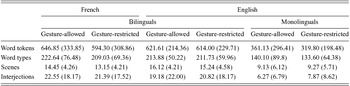
The number of word types, word tokens, scenes and interjections were calculated for each speaker in each language and in each condition (i.e., gesture-allowed vs. gesture-restricted). Table 2 summarizes the means and standard deviations for each dependent variable. To test the effect of the two conditions on these linguistic variables, paired samples t-tests were performed with gesture condition (gesture-allowed and gesture-restricted conditions) as a within-subject independent variable and number of word types, word tokens, scenes and interjections as dependent variables. For the bilingual group, the same pattern of results for the three first variables by language was found. In French, there were significant differences for the number of word tokens (t(32) = 3.22, p = .003), word types (t(32) = 3.41, p = .002) and scenes (t(32) = 3.42, p = .002) between the two conditions. However, these differences did not reach significance in English (ps > .162). In other words, in the French modality, when bilinguals could use their hands, they used more word tokens, word types and scenes than when they could not. Nonetheless, when speaking in English, the bilinguals did not differ in terms of the number of word types, word tokens and scenes they used in the two conditions. For the monolinguals, the analysis revealed no effect of the two conditions on the number of word types, word tokens and scenes used by the participants: their retellings did not differ across the two conditions. The number of interjections did not differ significantly between conditions for any group: both groups used as many interjections in the gesture-allowed condition as in the gesture-restricted condition.
Mean numbers (with SDs in parentheses) of linguistic dependent variables in both conditions (“gesture-allowed” vs. “gesture-restricted”) by linguistic groups and languages.

Speech production by linguistic dominance
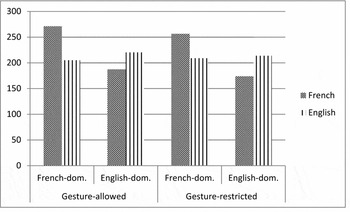
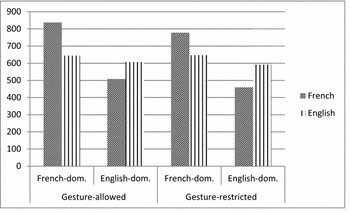
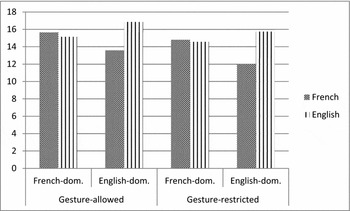
If gestures aid in language access or construction, we predicted that gesture restriction would have particularly strong effects on bilinguals’ non-dominant language. To test this prediction, we next analyzed the number of word types, word tokens and scenes depending on linguistic dominance, gesture conditions and languages to figure out whether there was a difference in speech in the bilinguals’ stronger and weaker languages in the two conditions. As noted earlier, amongst bilinguals, there were 19 English-dominants and 14 French-dominants. A 2 × 2 × 2 (Linguistic dominance × Gesture condition × Language) ANOVA, with the first factor as a between-subject variable and the two last factors as within-subject variables, was applied. Figures 1, 2 and 3 summarize the mean numbers of word types, word tokens and scenes by language, gesture condition and linguistic dominance. Significant main effects of the gesture condition on each dependent variable were found with bilingual participants telling longer and more elaborate stories in the gesture-allowed condition than in the gesture-restricted condition (word types: F(1,31) = 4.93, p = .034; word tokens: F(1,31) = 4.80, p = .036; number of scenes: F(1,31) = 11.20, p = .002). A main effect of Language on the number of scenes and a main effect of Linguistic dominance on the number of word tokens were also found (respectively: F(1,31) = 5.91, p = .021 and F(1,31) = 5.23, p = .029). In other words, bilinguals included more scenes when speaking in English compared to French and the French-dominants showed a larger number of word tokens in their stories than the English-dominants. There were significant interactions between Linguistic dominance and Language for each variable as well (word types: F(1,31) = 49.45, p = .000; word tokens: F(1,31) = 16.99, p = .000; number of scenes: F(1,31) = 8.89, p = .006).
Mean number of word types by gesture condition, linguistic dominance and language.

Mean number of word tokens by gesture condition, linguistic dominance and language.

Mean number of scenes by gesture condition, linguistic dominance and language.

Gesture production by linguistic dominance
We finally looked at how gestures were used by the bilinguals depending on linguistic dominance to establish whether there were differences between the English- and the French-dominant groups in terms of gesture use. Independent t-tests with linguistic dominance as a between-subject variable were performed on gesture rates (see Table 3) in the conditions in which gestures were allowed. For both types of gestures and in both languages, we found no significant difference between the two linguistic groups (in English for the iconic: t(31) = –1.01, p = .323, for the non-iconic: t(31) = –0.17, p = .863; in French for the iconic: t(31) = .36, p = .721, for the non-iconic: t(31) = –.74, p = .466). These results mean that the English-dominants used, on average, as many gestures as the French-dominants when retelling the stories.
Average rates (SDs) of iconic and non-iconic gestures by language and linguistic dominance.

Discussion
If bilinguals gesture more to aid in lexical access, they should: (i) gesture more than monolinguals, (ii) show a greater effect of gesture restriction in their retellings than monolinguals, (iii) show a greater effect of gesture restriction in their non-dominant language, and (iv) gesture more in their non-dominant language than their dominant language. The results of the present study showed only partial support for these predictions.
The French–English bilinguals in this study did use more iconic gestures in English than monolinguals, but this difference was not statistically significant (see Pika et al., Reference Pika, Nicoladis and Marentette2006). In contrast, the bilinguals used a significantly higher rate of gestures in French than in English. As the bilinguals used both languages on a regular basis and the language measures (e.g., word tokens, types, interjections) were similar in the two languages, this language difference is unlikely to result from the bilinguals being, as a group, less proficient in French than in English. While we do not have a French monolingual comparison group in the present study, previous studies have shown no differences between French and English monolinguals’ rates of gesturing (Nicoladis et al., Reference Nicoladis, Pika and Marentette2009; Nicoladis & O’Carroll, Reference Nicoladis and O’Carroll2012). Assuming that the high rate of gestures in French among the bilinguals is higher than that of French monolinguals, these results would be consistent with gestures aiding message construction and/or language access only in French.
A further test of the possibility that bilinguals were using gestures to aid in lexical access comes from looking at the effects of gesture restriction. We predicted that bilinguals might show more specific deficits than monolinguals when restricted from gesturing. The results showed that, in English, neither the bilinguals’ nor the monolinguals’ stories differed in length, variety of word choices, or interjections in the gesture-allowed vs. the gesture-restricted condition. In contrast, the data revealed that gesture restriction leads to the production of shorter and less elaborate narratives in the French of the bilinguals. In other words, these results support the role of gestures as a lexical access aid in bilinguals, only in French.
We next focused on linguistic dominance by examining the role of gesture restriction. If gestures help with linguistic retrieval, we foresaw that the impact of the restricted condition might be greater in the bilinguals’ non-dominant language than in their dominant language. In fact, we found support for this assumption, but the effect was only for one linguistic variable – the number of word tokens – and once again, it is exclusively when speaking in French. Put differently, these findings suggest that French–English bilinguals who are dominant in French retold longer stories than the English-dominants. Consequently, one might ask if the impact of gesture restriction on linguistic dominance seems to be language-specific. Secondly, we checked for the effects of linguistic dominance on gesture use. Bilinguals tended to gesture at a similar rate in their non-dominant language and in their dominant language.
In sum, we have shown some evidence that is consistent with bilinguals using gestures to aid in linguistic access, but only in French, and particularly among French-dominant bilinguals. As we noted above, the bilinguals were highly proficient in both languages so we think that the differences in French and English are unlikely to be linked with differences in French and English proficiency in our participants. In other words, the bilinguals were, as a group, quite fluent in both French and English, so there is no reason to think that they had greater difficulty accessing words in French than in English. We caution that we used both self-report and analyses of language use to operationalize monolingualism, bilingualism, and dominance in the present study. Future research that uses systematic measures of proficiency and/or that tests bilinguals living in a French-dominant part of the world would be necessary to rule out the possibility that bilinguals gesture to aid lexical retrieval in a weak language. An alternative and entirely logical possibility is that people use gestures as an aid to lexical access in French but not in English. This possibility seems unlikely since the data contributing to the Lexical Retrieval Hypothesis came from English speakers (Rauscher et al., Reference Rauscher, Krauss and Chen1996).
We argue that our results suggest that, even when bilinguals use a higher rate of gestures than monolinguals (Nicoladis et al., Reference Nicoladis, Pika, Yin and Marentette2007; Nicoladis et al., Reference Nicoladis, Pika and Marentette2009), this difference may have little to nothing to do with gestures aiding language access or message construction (see also Nagpal et al., Reference Nagpal, Nicoladis and Marentette2011). Instead, French–English bilinguals may gesture more in French because of a cultural norm to use gestures frequently. There have been anecdotal descriptions of French as a high gesture frequency language (though some have made this claim of Romance languages more generally) (Efron, Reference Efron1941; Kendon, Reference Kendon1995; Pika et al., Reference Pika, Nicoladis and Marentette2006; Smithson, Nicoladis & Marentette, Reference Smithson, Nicoladis and Marentette2011). While the research to date has shown no difference between French and English monolinguals in gesture frequency (Nicoladis et al., Reference Nicoladis, Pika and Marentette2009; Nicoladis & O’Carroll, Reference Nicoladis and O’Carroll2012), both of these studies did show a non-significant tendency for the bilinguals to gesture more in French than in English. Future research could test whether there is something about bilingualism in interaction with speaking French (or another relative high gesture frequency language) that leads to a high gesture rate.
At the moment, we can offer no complete explanation as to why there might be an interaction between bilingualism and speaking French that would be linked to gesture use. Part of the explanation could lie in storytelling style, since culture differences in storytelling style (i.e., gesture use and story length) have been observed, with French speakers telling longer stories with more gestures than Hindi or Chinese speakers (Nicoladis et al., Reference Nicoladis, Nagpal and Marentette2011). Dart (Reference Dart1992) reported that a French–English bilingual child used a more vivid and elaborate storytelling style in French than in English. She argued that French stories are typically told in a more imagistic style than English stories. Gesture use is highly linked to images: according to Hostetter and Skirving (Reference Hostetter and Skirving2011), speakers that have seen images corresponding to events gesture more than those that have not seen. If so, then the French storytelling style might be more strongly linked with gesture use (through vivid images) than the English storytelling style. If so, bilingual speakers of French may adopt a storytelling style that is particularly conducive to high gesture use in French. In support of this interpretation, recall that the bilinguals tended to tell longer stories than the monolinguals (see Table 2), even though this difference was not significant. We caution that the cultural differences in French and English storytelling style have not yet been confirmed either in adults or in Canadian French. Until that research is done, our interpretation remains speculative.
To summarize, the findings of this study suggest that, at least for advanced or native bilingual speakers, gesture use might not function primarily to facilitate the process of accessing the right item from their mental lexicon or constructing a message. We found that the bilinguals did not gesture significantly more than the monolinguals in English but did gesture more in French than in English. We argue that how French–English bilinguals are affected by gesture restriction in each language might depend on combined effects of cultural and linguistic patterns of storytelling and speaking two languages. Future research might link gesture use with the associated cultural characteristics in bilingual communities to confirm this interpretation.