1. Introduction
Motion is a crucial element in human consciousness, and in most languages motion verbs play a fundamental role just as motion is a constituent part of the lexical content of many other verbs. A lexical analysis of motion verbs is therefore an appropriate starting point for an investigation of verb lexicalization in the various languages and language families and groups (cf. Herslund, Reference Herslund1997, p. 16). Leonard Talmy’s work on motion verb typology – especially Talmy (Reference Talmy and Shopen1985, Reference Talmy2000) – remains a cornerstone for research on motion verb lexicalization, and the Talmyan framework has also greatly inspired a Danish research group, TYPOlex, in its taxonomic distinction between the so-called endocentric and exocentric languages. The former are languages whose verbs (seen as the ‘centre’ of the proposition) are characteristic of a high lexical and therefore informative weight (‘endocentric’ = inside the centre), and the latter are languages whose nouns carry a high lexical and informative weight (‘exocentric’ = outside the centre). This paper presents some of the most important results of the Danish scholars’ comparative work on Germanic and Romance languages as well as some specifications and additions to Talmy’s Cognitive Semantics.
The paper is structured as follows: After a quick review of Talmy’s lexicalization patterns for motion verbs, I introduce a theoretical supplement and refinement of the cognitive distinction between the semantic components manner and path. I then present TYPOlex’s generalizations of verb (and, briefly, noun) lexicalization in Romance and Germanic languages with the main focus on Italian, French, English, and Danish, after which the component ground is examined more closely with special reference to productive parasynthetic derivation in the Romance languages. Before the concluding remarks, I give a brief overview of parasynthetic Romance derivation based on the component figure.
2. Talmy (briefly) revisited
It is well known that Talmy (1985, pp. 62–76; 2000, pp. 25–67) operates with a Motion-sentence pattern consisting of a basic Motion event, which contains the four semantic components, figure, ground, path, and motion, and possibly a Co-Event, which conveys the manner or the cause of the motion. This pattern gives rise to “three typologically principal lexicalization types” (Talmy, Reference Talmy2000, p. 27) for motion verbs across the languages:
A. motion + manner/cause, found for instance in the Germanic languages;
B. motion + path, found for instance in the Romance languages;
C. motion + figure, found especially in some North American Indian languages.
Talmy considers the verb root alone, and languages that tend to lexicalize the basic motion event in the verb itself, such as the Romance languages, are termed verb-framed languages, whereas languages that generally need a satellite to express path, such as, e.g., the Germanic languages, cf. run out, walk back, fly up, are named satellite-framed (Talmy, Reference Talmy2000, p. 222).
Regarding the three principal lexicalization types, Talmy adds (2000, p. 27): “In most cases, a language uses only one of these types for the verb in its most characteristic expression of Motion.” I shall return to this claim and to the fact that for instance Romance motion verbs may be either unaccusative telic verbs expressing path, cf. the examples in (1), or unergative atelic verbs expressing manner, cf. the examples in (2):
(1) Italian: andare, venire, arrivare, entrare, uscire, partire …
French: aller, venir, arriver, entrer, sortir, partir …
‘go/move, come, arrive, enter, exit, leave’
(2) Italian: camminare, nuotare, rollare, danzare …
French: marcher, nager, rouler, danser … Footnote 1
‘walk, swim, roll, dance’
According to Talmy (2000, p. 60), the three patterns are also “apparently the main ones found across languages”, leaving the semantic component ground generally unlexicalized:
It can be seen that one Motion-event component, the Ground, does not by itself conflate with the motion verb to form any language’s core system for expressing Motion. Conflations of this sort may not even form any minor systems. (Talmy, Reference Talmy2000, p. 60)Footnote 2
Rare cases such as the English emplane (to board or put on board an aeroplane) and deplane (to disembark from an aeroplane) are called ‘sporadic instances’ of ground conflations, which “can provide an idea of what a larger system might be like” (Talmy, Reference Talmy2000, p. 61). However, according to Talmy, “such [larger] systems are not to be found” (p. 61).
Talmy was not the first scholar to distinguish between the way an object moves or is moved and the fact that it moves or is moved from one location to another. In his important work on structural syntax, Tesnière (1982 [1959], pp. 307–310)Footnote 3 distinguished between mouvement and déplacement, and characterized German as a language whose verbs express ‘mouvement’ – defined as “la «nature» ou le «caractère» de l’action” – in contrast to French verbs that express ‘déplacement’ (p. 309).
What is new in Talmy’s framework is his overall cognitive approach. His distinction between motion with and without the component path is summarized in the terms translational motion (or translocation) vs. self-contained motion, of which the latter “generally consists of oscillation, rotation, dilation (expansion or contraction), wiggle, local wander, or rest” (Talmy, Reference Talmy2000, pp. 35–36, cf. also pp. 25–26).Footnote 4 However, a cognitive treatment of these terms and the related real-life situations is not developed any further in his framework. In fact, according to Smith (esp. 2005a, 2005b), and in spite of the very numerous contributions to motion event research, even with a specific cognitive approach, Talmy’s cognitive categories manner and path still need further elaboration and refinement. The following sections represent a modest (and, due to space limitations, brief) attempt of such further analysis and are largely based on Smith’s (Reference Smith2005a, Reference Smith2005b) proposal for a synthesis between Talmy’s original analyses, the verb typology of Durst-Andersen (e.g., 1992, 2000), and insights from non-linguistic research into motion perception. The idea is taken further for a somewhat different theoretical purpose in Durst-Andersen, Smith, and Thomsen (Reference Durst-Andersen, Smith, Thomsen, Paradis, Hudson and Magnusson2013).
3. Looking more closely into manner and path
3.1. the non-linguistic cognitive literature
In non-linguistic cognitive research, e.g., Borst and Egelhaaf (Reference Borst and Egelhaaf1989) and Borst (Reference Borst2000), visual motion detection is seen as a delay-and-compare mechanism, i.e., a comparison of successive images with conflicting visual information;Footnote 5 see also Dellen and Wessel (Reference Dellen, Wessel and Squire2009). In the same vein, Dodge and Lakoff (Reference Dodge, Lakoff and Hampe2005) quote neuroscientific research revealing that the same brain structures are used when imagining or talking about an action and when actually executing the same action (pp. 73–74). These scholars also talk about the probability that processing path and manner of a movement may involve different parts of the brain:
[A]s we’ve shown in this paper, these path- and manner-related schemas may each be computed by the neural circuitry of different functional brain networks. Consequently, ‘manner-predominant’ and ‘path-predominant’ languages may differ not only in their utilization of the ‘basic image schema inventory’, but also in the terms of their underlying neural substrates. (Dodge & Lakoff, Reference Dodge, Lakoff and Hampe2005, p. 83)
Blaser and Sperling (Reference Blaser and Sperling2007) distinguish between perceptual (or visual) and conceptual motion. Perceptual motion is a direct “first-order” observable movement, “a mechanism that yields a conscious sensation of motion” (p. 627). Conceptual motion implies a different kind of processing, called a “cognitive simulation” (p. 627). Such processing is of a much more abstract nature and “has little restriction on the visual tokens that may be displaced” (p. 627). In a psychophysical experiment, the authors contrast luminance-based perceptual motion (a displaced pattern of luminance over time) with semantic-based conceptual motion (a shifting pattern of words and non-words). Based on the processing time of the observers, the authors conclude that whereas perceptual motion has “access to special-purpose motion mechanisms of the visual system” (p. 627), conceptual motion “would seem to be distinctly second-class” (p. 627) and dependent on the aforementioned cognitive simulation of perceptual motion.
3.2. durst-andersen and smith
Within the linguistic cognitive research, Durst-Andersen (1992, pp. 53–63, 2000, pp. 59–66) takes his starting point in “the perceptual notion of picture” (2000, p. 59) and argues that humans generally distinguish between two kinds of real-world phenomena or situations, both of which can be described in terms of the relationship between figure and ground:
a. States, which are perceived as a stable figure on a stable ground, providing a stable picture; ‘states’ are referred to by state verbs such as be, have, sit, lie, stand, etc.
b. Activities, which are perceived either as an unstable figure on a stable ground or as a stable figure on an unstable ground, providing an unstable picture; ‘activities’ are referred to by activity verbs such as carry, drive, walk, swim, crawl, etc.
Only these two (atelic) situation types can be perceived via direct observation, but in addition hereto, real-world experience has taught us that some activities can result in certain states, and some states can be the result of certain activities. This provides us with a third (telic) situation type:
c. Actions, which are mental constructs combining a particular activity with a particular state. When an ‘activity’ is conceived as part of an ‘action’, it is classified as a process, and the ‘state’ is classified as an event. Footnote 6Action verbs are verbs such as give, sell, buy, leave, kill, etc.
Smith (e.g., 2005a, 2005b, 2009) uses the observations of Durst-Andersen and Blaser and Sterling mentioned above to distinguish between simple and complex situations. ‘Simple situations’ include Figure, Ground and “simple Motion or Locatedness”, termed activities and states, respectively. ‘Complex situations’ consist of “observed or expected interdependencies between simple ones” (2005a, §2.2) and are labelled actions or relocations. These are mental constructs that relate ‘activities’ and ‘states’ to each other “not on a first-order perceptual level, but on a higher-order conceptual level” (§2.2.).
4. The research group TYPOlex and the endo-/exocentric typology
There are very clear similarities between the above-mentioned approaches and results and those of the Danish research project group TYPOlex (of which Smith is a member). The group is based at the Copenhagen Business School and was initiated in 1997 with the aim of studying typological differences in lexicon and text structure between Germanic and Romance languages.Footnote 7 The overall starting point of the TYPOlex project is the well-established fact that languages subdivide the world in different ways according to their lexicalization patterns (e.g., Herslund & Baron, Reference Herslund, Baron and Baron2003; Hjelmslev, 1993 [1943], p. 50; Humboldt, 1997 [1822]; Sapir, 1964 [1929]; Whorf, 1956 [1940]), and essentially differ in “what they must convey and not in what they may convey”, as Jakobson (1959, p. 236) so aptly puts it. In their efforts to work out a general typological description of lexicalization patterns in different language families and groups, these researchers were particularly inspired by Talmy’s framework regarding motion verb lexicalization and by elements of Pustejovsky’s (e.g., 1995, pp. 76–104) qualia structure regarding noun lexicalization.
Comparing the Germanic and the Romance languages, the TYPOlex scholars were able to ascertain an overall difference in what they label as concreteness vs. abstractness in the lexicalization of verbs and nouns. By ‘concreteness’, the group refers to the denotation of an exterior, visible aspect or ‘picture’ in a lexical item, and by ‘abstractness’ to the lack of such a ‘picture’ and to a more conceptual notion of an ‘idea’ expressed by the lexeme.
4.1. Germanic and Romance lexicalization of verbs
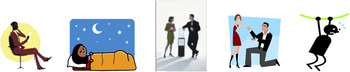
Regarding verb lexicalization, the distinction between a ‘picture’ and an ‘idea’ is a consistent extension of Talmy’s manner vs. path distinction. On the one hand, motion verbs containing the manner component denote a visibly specifiable activity that can be represented as a picture, as is seen in Figure 1.
Representations of motion expressed by manner verbs.

On the other hand, path verbs convey an abstract idea of a movement from one location to another. Here, information is given about the relation between the figure that moves and the point of departure, traversal, or arrival, of the motion.Footnote 8 The way or manner in which the movement takes place is not rendered explicit but is so to say cognitively assumed or “simulated”, as Blaser and Sperling (2007, p. 627) put it, cf. section 3.1.
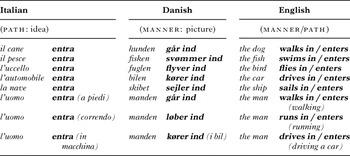
Blaser and Sperling’s description of ‘conceptual motion’ as a “cognitive simulation [which] has little restriction on the visual tokens that may be displaced” can be applied to the selectional restrictions of the Romance motion verbs in comparison with the Germanic ones. For instance, the Italian verb entrare ‘enter’ may select any kind of subject that can move or be moved, whereas Danish verbs denoting a movement-into-something are much more particular in their selection of the subject, as shown in Table 1.
Equivalent lexicalization of motion-into-something in Italian, Danish, and English

Unlike the Italian verb entrare, but like the English manner verbs (the first ones mentioned in the right-hand column of Table 1), all the Danish verbs require a subject that is congruous with the denoted manner. Thus, there is a strict correspondence, or congruence, between the manner component and the figure. Entities, animate as well as inanimate, must have specific physical features to be able to perform or undergo particular movements (as well as other actions or activities, as we shall see below). Thus, in such cases, the figure component could be defined as a resulting and secondary consequence rather than a direct and primary lexicalization such as the one found in English verbs like rain and spit (cf. Talmy, Reference Talmy2000, pp. 57–58).Footnote 9 Other cases of primary figure lexicalization are verbs such as (non-metaphorical) flow, stream, gush, spout, etc., which indicate that the entities involved are fluid.
As seen in the last three examples of Table 1, an Italian sentence may indicate the manner in an independent, typically adverbial constituent, often a prepositional group or a gerund, as in the cases cited here. Generally, however, such specification is only added if deemed particularly necessary, and it may be established elsewhere in the co- or context. On the other hand, the Danish and the English manner verbs cannot avoid expressing this specification, cf. the quote of Jakobson above.Footnote 10
The right-hand column of Table 1 shows the ‘double set’ of English verbs denoting motion-into-something: one equivalent to the Danish verbs lexicalizing the manner component and one equivalent to the Italian lexicalization of path, ‘inherited’ from Latin and French. Such examples of mixed Germanic–Romance heritage have prompted scholars such as, e.g., Roberts (1939, p. 23) to define English as “the standard example of a hybrid language”.
4.2. what kind of manner?
Even with the specifications cited above, it may be argued that the component manner could cover more semantic grounds than those described by Talmy’s ‘self-contained motion’, and that manner verbs could be divided into different subtypes, as suggested, e.g., by Alonge (Reference Alonge and Agostiniani1997) and Korzen (Reference Korzen and Cresti2008). Where Talmy’s ‘self-contained motion’, as well as most of the verbs mentioned in the preceding subsection denote manner in terms of what could be defined as the ‘form’ of the movement (as depicted in Figure 1), a verb like sail listed in Table 1 denotes manner in terms of means of transportation. Such verbs, denoting the ‘means of motion’, are – just like the ‘form manner verbs’ mentioned in the preceding subsection – very common in the Germanic languages, especially in English, cf., e.g.:
(3) travel, drive, motor, fly, ski, skate, parachute, (bi)cycle, ride, sail/boat, bus, canoe, balloon, sleigh …
Of the verbs mentioned in (3), travel can be considered as a hyperonym merely indicating that a means of transportation has been used but not which sort.Footnote 11 Of these verbs, only travel, fly, skate, drive, (bi)cycle, ride, sail/boat have equivalent (non-phrasal) verbs in Danish:
(4) rejse, flyve, skøjte, køre, cykle, ride, sejle Footnote 12
Like the ‘form manner verbs’, verbs denoting manner in the sense of ‘means of motion’ are (more or less felicitously) depictable; see Figure 2.
Representations of ‘means of motion verbs’.

It is characteristic that such verbs are very rare in the Romance languages:
(5) Italian: viaggiare ‘travel’, pedalare ‘bicycle’, sciare ‘ski’, pattinare ‘skate’, paracadutarsi ‘parachute’
French: voyager ‘travel’, patiner ‘skate’, se parachuter ‘parachute’
Yet another kind of manner is lexicalized in some motion verbs across the languages, such as the following Italian and English cases:
(6) accasciarsi/stramazzare ‘collapse, fall heavily’, fuggire/scappare ‘flee, escape’, sgattaiolare ‘sneak out’
Here, manner is not seen as form or means, but rather as the intensity of the movement, in accasciarsi/stramazzare describable with the adverb pesantemente ‘heavily’, in fuggire/scappare with the adverb velocemente ‘quickly’, and in sgattaiolare with the adverbs velocemente and/or silenziosamente ‘silently’. In these cases, and unlike verbs denoting form or means, the particular manner component is not representable as a picture, and, like the verbs cited in (1), the verbs in (6) are all unaccusative and telic.Footnote 13
Thus, whereas the verbs in (3) and (4), illustrated in Figure 2, are very similar to other manner verbs, both syntactically and in their frequency in the two language families, the verbs in (6) should be analyzed as path verbs with an additional semantic component of intensity – and fuggire, scappare ‘flee, escape’ also with a component of purpose, i.e., ‘to get away (typically) from a dangerous situation’.
4.3. extensions of the motion verb lexicalization pattern
The distinction between concrete and relatively precise ‘picture verbs’, applicable to a limited number of entity categories and typical of the Germanic languages, and abstract and more generic ‘idea verbs’, applicable to a much larger number of categories and typical of the Romance languages, is not limited to motion verbs but can be extended to many other verb groups (albeit, obviously, not without exceptions). In this section, I cite a few Italian–Danish examples; many more French–Danish examples can be found in Herslund (1997, pp. 18–30).
In parallel to motion verbs we find – also in Talmy’s framework – position verbs, and similarly to the Italian motion verb andare, which just means ‘to move’, the Italian verb stare ‘to be’ can correspond to all five Danish/English position verbs, sidde ‘sit’, ligge ‘lie’, stå ‘stand’, knæle ‘kneel’, and hænge ‘hang’. Again, it is characteristic that the states denoted by these five verbs can all be represented as pictures, unlike stare; see Figure 3. As in the last three cases of Table 1, a specification may be added to the Italian verb: stare seduto ‘be sitting/seated’, stare sdraiato ‘lying down’, stare in piedi ‘on foot’, stare in ginocchio ‘on knee’, stare appeso ‘hanging’, but, as before, this will only happen if strictly necessary.Footnote 14
Representations of position expressed by manner verbs.

Also in other cases, Danish usually specifies the position of an entity. Table 2 shows how either the position or the shape of the object is decisive for the choice between the abovementioned position verbs in Danish. In all cases, the Italian verb, ‘V’, can be essere, stare, or trovarsi ‘be (located)’.Footnote 15
Examples of position verbs in Italian and Danish
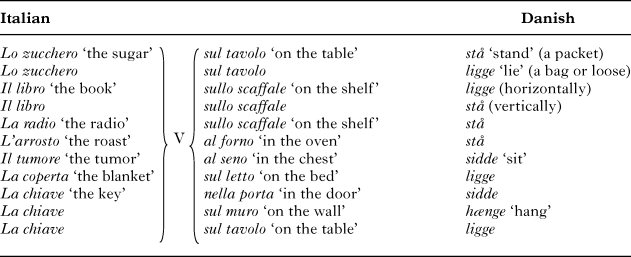
The difference between abstract and generic Italian verbs and concrete and precise Danish verbs is found in many other cases. Table 3 shows how the Italian verb ‘of destruction’ rompere, which, in most of its usages, according to Lo Zingarelli 2010 , has the synonyms spezzare and spaccare, corresponds to no less than fifteen different Danish verbs: brække, knække, bryde, gennembryde, afbryde, flække, knalde, knuse, mase, baldre, smadre, ødelægge, kløve, hugge, and brænde depending on the manner of the action and the figure of the object destroyed.Footnote 16 The Italian examples in Table 3 all come from Lo Zingarelli 2010.Footnote 17
Italian and Danish ‘verbs of destruction’

Table 4 cites some Italian and Danish (transitive and intransitive) kitchen verbs. Again, the Italian verbs are more abstract and denote what are, from the perspective of Danish, different types of activities. On the other hand, the Danish verbs are more precise. The more precise Italian verbs in parentheses at the bottom of the left-hand column exist but generally belong to a special linguistic register and/or to special text genres such as cookbooks.
Italian and Danish kitchen verbs

And while we are in the kitchen region: if food (or something else) is evaluated positively, in Italian the praise would sound: è buono, che buono, che bello. But in Danish, it is generally necessary to specify the manner in which it is ‘good’; see Table 5.
Italian and Danish evaluation expressions

In all the cases cited in this section, the Italian verbs (and, in Table 5, adjectives) are more abstract and generic and may apply to many more action or activity types. On the other hand, the Danish verbs are more precise and concrete; unlike the Italian verbs, they express the manner of the verb situation and – as a consequence – often also the kind or figure of the object that is involved in it.
4.4. Germanic and Romance lexicalization of nouns
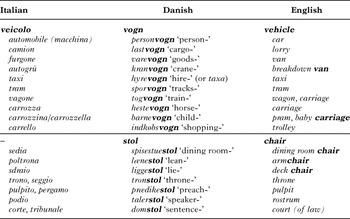
Extending the distinction between precise and concrete lexemes (which can denote relatively few instances) and generic and abstract lexemes (which can denote a larger number of instances) to nouns, we find exactly the opposite picture in the Germanic and Romance lexicalization patterns. Compared with Romance lexicalization of nouns, Germanic primary lexicalization (i.e., of basic lexemes, not compounds or derivatives) occurs at a hyperonymic level covering more entity categories, i.e., having a larger extension. To achieve the same precise denotation (i.e., larger intension and smaller extension) of a Romance primary lexicalization, a Germanic language will typically create a N+N compound, as is seen in Table 6.
Two examples of nominal lexicalization in Italian, Danish, and English

The basic Danish lexeme vogn can be used for all the mentioned subtypes and stol for the first four instances of ‘chairs’. In these cases, the specifying modifier (the first part of the compound) will only be added where necessary for the interpretation of the noun, which – as with the Romance verbs – may rely on other elements in the co- or context. On the other hand, the Italian lexemes in the left-hand column cannot avoid expressing this specification. As Table 6 shows, Italian does not have a hyperonym equivalent to stol. Footnote 19
Again, English appears as a mix of the Germanic system with N+N compounds (e.g., breakdown van, baby carriage, deck chair) and the Romance system with primary lexicalization at a hyponymic level (e.g., throne, pulpit, court).
The (primary) Germanic and Romance lexicalization of artefacts can be seen in the light of the four semantic components, or ‘explanatory categories’ (Müller, Reference Müller, Korzen and D’Achille2005, p. 65), that Pustejovsky (1995, pp. 76–104) includes in his ‘qualia structure’ of lexical items, viz. the constitutive, formal, telic, and agentivequalia. In Danish, it is the function of the object (corresponding to the telic quale) that is the dominant and distinctive feature of the basic lexemes, the feature which all subtypes have in common and which distinguishes them from other categories and subtypes; in Table 6, a vehicle used for transportation and a piece of furniture used to sit or stand on. In Italian, the lexicalization is based on external, visible aspects of the object (corresponding to the constitutive and formalqualia), and each subtype is morphemically unique. For more Italian and Danish examples, see, e.g., Korzen (Reference Korzen, Korzen and Marello2000, Reference Korzen and D’Achille2005b); for more French and Danish examples, see Herslund and Baron (Reference Herslund, Baron and Baron2003) and Herslund (1997, pp. 30–43); for Spanish examples, see Müller (Reference Müller, Korzen and D’Achille2005).Footnote 20
4.5. the complete picture: endocentric and exocentric languages
Combining the above-mentioned tendencies for verb and noun lexicalization in Germanic and Romance languages, we obtain an interesting set of patterns. Typical Germanic lexicalization produces concrete and precise verbs, based on the external picture of the verb situation – including the figure of the entity involved – and abstract nouns based on the function of the artefact, i.e., on the idea of what purpose the object can serve. On the other hand, Romance lexicalization tends to produce abstract verbs, based on a generalized and/or conceptualized idea of the verb situation, and precise nouns based on the external aspects, the picture, of the object. This can be illustrated as in Table 7.
Typical lexicalization patterns of Germanic and Romance verbs and nouns

The more precise lexical content (i.e., larger intension) entailing a more limited extension of applicable instances thus lies in the Germanic verbs and in the Romance nouns, and, as stated in the ‘Introduction’, the conception of the verb as constituting the ‘centre’ of the proposition and the noun(s) as placed outside this centre has prompted the TYPOlex group to use the terms endocentric (i.e., Germanic) vs. exocentric (i.e., Romance) languages. In ‘endocentric languages’ the informative weight is concentrated in the verb, which also selects the (abstract) nominal arguments linked to it. In ‘exocentric languages’ the informative weight lies in the nouns, whereas the verbs that link the nouns together are relatively abstract and generic and do not put as heavy selectional restrictions on the arguments.Footnote 21
4.6. motion verbs differing from these patterns
The lexicalization patterns shown in Table 7 describe important tendencies, but not, however, rules without exceptions. Although Talmy has a point in stating (with respect to the lexicalization of motion) that a language uses only one lexicalization type for the verb “in its most characteristic expression of Motion” (cf. Section 2), endocentric path verbs and exocentric manner verbs, i.e., exceptions to the rules mentioned, are not difficult to find. As already stated, English may be defined as a ‘hybrid language’ on this account, but also Danish, a more ‘genuinely endocentric’ language, has path verbs, albeit fewer; cf. Table 8 (which does not pretend to be complete).
Endocentric path verbs

Most of the English verbs are inherited from Latin and French; exceptions are go, come, fall, and rise. In some cases, e.g., come, pass, disappear, the path component is or can be deictic; cf. footnote 8.
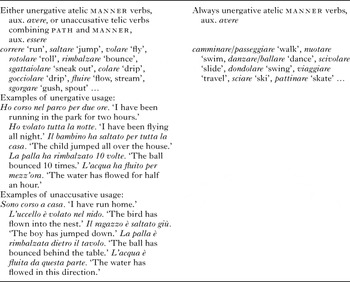
French manner verbs are quite frequent and common, even if path verbs are more so, both in types and in tokens (Herslund & Baron, Reference Herslund, Baron and Baron2003; Schøsler, Reference Schøsler and Birkelund2010).Footnote 22 Most French path verbs are unaccusative, telic, and select the auxiliary verb être ‘be’, whereas the manner verbs are unergative, atelic, and use the auxiliary avoir ‘have’; cf. Table 9.
French motion verbsFootnote 26

Nevertheless, there are differences also within the Romance languages. If the pattern illustrated in Table 9 could be defined as ‘typically’ Romance, the Italian situation is somewhat more complex. Again, path verbs are more common both in types and tokens, see Table 11 in Section 4.7, but regarding manner verbs, we find two groups: one is similar to the French manner verbs: unergative, atelic, selecting auxiliary avere ‘have’; see the right-hand column of Table 10 (which, like Tables 8 and 9, does not pretend to be complete). Another group consists of verbs that occur either with that same meaning and combination (i.e., unergative, atelic, expressing solely manner and selecting avere), or with an unaccusative, telic meaning, combining path and manner end selecting the auxiliary essere ‘be’ (see the left-hand column of Table 10). In this, the latter group is very similar to the equivalent Danish verbs (Herslund & Baron, Reference Herslund, Baron and Baron2003; Korzen, Reference Korzen, Bache, Holsting and Kjær Nissen2012).Footnote 25
Italian motion verbs with the manner component

Italian motion verbs, types and tokens in Lessico di frequenza dell’italiano parlato

Like the manner verbs listed in Table 1, the verbs in Table 10 select specific subjects, and in cases like colare, gocciolare ‘drip’, fluire ‘flow, stream’, and sgorgare ‘gush, spout’ we should probably talk about a primary lexicalization of figure and not ‘only’ congruence. In non-metaphorical usages, the entities involved must be fluid. In the other cases, it would be more precise to say that the figure must be congruous with the denoted manner.
In their unaccusative, telic usages, these verbs thus follow a fourth lexicalization type, a type D, in addition to the three mentioned by Talmy (cf. Section 2):
D. motion + path + manner (+ figure)
where the component figure is ‘primarily’ lexicalized only in colare, gocciolare, fluire, sgorgare.
Referring to “a minor system” in Atsugewi, Talmy (2000, p. 63) mentions the rare case of verbs “expressing the ‘MOVE’ notion in isolation”. However, it should be noted that the two Italian verbs girare, circolare may occur with the sole meaning of muoversi ‘move’, in cases such as:
(7) Ho girato tutta Roma per trovarlo.
‘I have been all over Rome to find it’.
Circolare, circolare! [said, e.g., by a traffic policeman]
‘Keep moving! Clear the street!’
In such cases, these verbs do not convey a path meaning of ‘circulate, move around in circles’.Footnote 27
4.7. conclusion: Italian and French as exocentric languages
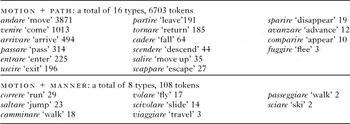
Even if Italian does have a consistent number of both path and manner verbs, it is interesting to examine the differences in frequency. A count of all motion verbs in the spoken language corpus LIP: Lessico di frequenza dell’italiano parlato (De Mauro, Mancini, Vedovelli, & Voghera, Reference De Mauro, Mancini, Vedovelli and Voghera1993), consisting of 490,000 words, gave the results shown in Table 11.
Considering that three of the cited manner verbs, correre, saltare, volare, can also express path (cf. Table 10), it seems more than fair to conclude that Italian – like French (cf. Section 4.6) – should be regarded as an exocentric language with a quite dominant occurrence of the abstract path component in motion verbs. However, more concrete and precise manner verbs are by no means excluded.
Further corroboration of this claim is found in a study carried out by the IMAGACT project (cf. Moneglia & Panunzi, Reference Moneglia, Panunzi, Cresti and Korzen2010, and footnote 16), which compared the frequency of verbs with and without the component manner, in their terminology verbi di attività and verbi generali respectively, in a corpus of spoken Italian of about 1.3 million words. The scholars found that the ‘general’ verbs, those without the manner component, were about twice as frequent regarding types and almost three times as frequent regarding tokens.
5. The component ground
As anticipated in Section 2, the component ground is by and large absent in Talmy’s lexicalization patterns for motion verbs. In addition to the two English verbs emplane, deplane, Talmy (2000, pp. 62, 154) briefly mentions the verbs shelve, box, berth as “a minor system of agentive verbs in English”. Larger systems such as, e.g.:
(8) enhouse/dehouse/circumhouse ‘move with respect to a house’,
enliquid/deliquid/transliquid ‘move with respect to liquid’ (cited as fictitious cases by Talmy, Reference Talmy2000, p. 61)
“are not to be found” (p. 61). Talmy suggests his own explanation for the lack of such systems across the languages: “The reason for such a prohibition seems straightforward for any system that would undertake to make relatively fine semantic distinctions: it would require an enormous lexicon” (p. 62).Footnote 28
Herslund (1997, p. 18) suggests that the component ground could be considered as lexicalized in Danish verbs such as soppe ‘paddle’ and as a distinctive feature in cases such as flyde ‘float in water’ vs. svæve ‘float in the air’ and svømme ‘swim’ vs. flyve ‘fly’, but admits that this component is not dominant in the lexicalization patterns of motion verbs. Baron (2007, pp. 109–110; 2009, pp. 235–236) argues that ground is in fact lexicalized in several Danish motion verbs such as, e.g., sejle ‘sail’, but not in exocentric (Romance) verb roots that can be used in equivalent co-texts (cf. Table 1).
However, the assumption of the component ground as rare in exocentric motion verbs is only correct if confined strictly to primary lexicalization. Cases equivalent to the ‘fictitious’ Talmy examples in (8) are not only frequent, they form an entirely productive derivation pattern, i.e., a secondary lexicalization system in the Romance languages, and have done so since the earliest written testimony.
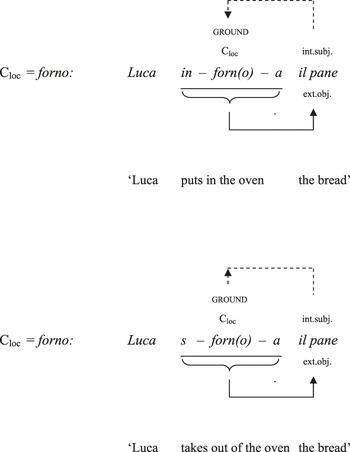
The derived verbs are formed by means of parasynthesis with a nominal stem denoting the ground with respect to which the motion occurs. The derivatives consist of a discontinuous verb morpheme acting as “host predicate” (Herslund, Reference Herslund2005, p. 93), in Italian consisting of a prefix, either a-/in- (when the ground is the point of arrival) or de-/dis-/s- (when the ground is the point of departure), and the suffix -are (in rare cases -ire).Footnote 29Figure 4 shows the derivatives infornare/sfornare ‘put in the oven’ / ‘take out of the oven’, with the external object (ext.obj.) il pane ‘the bread’, where the solid arrow illustrates the connection between the derived parasynthetic verb and its (external) object. The host predicates in…are / s…are host the ground stem forno ‘oven’, and the external object can at the same time be seen as the internal subject (int.subj.) of the host predicate, which has the location complement (Cloc) ground as its second argument, illustrated by the dotted arrow which also indicates the direction of the motion with respect to the location complement, i.e., the ground.
Italian parasynthetic structures with ground = forno ‘oven’ as stem and point of arrival and departure, respectively.

The parasynthetic structures have features in common with causative structures: the external subject Luca causes the external object, il pane ‘the bread’, to move with respect to the groundil forno ‘the oven’. Therefore, the component path is lexicalized in the parasynthetic verb as well as ground (in non-metaphorical senses; cf. below and Table 12).
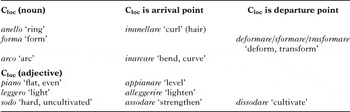
Italian parasynthetic ground verbs with a metaphorical meaning

In the ‘Appendix’, I list a number of Italian examples, more precisely 174 derivatives of 115 stems, and the equivalent French examples, and the lists are by no means complete. In many cases, the same stem is the basis of one derivative denoting motion with the ground as arrival point and another with the ground as departure point, but it is interesting to see that the first type is the most frequent one. The same is true of French – although, as a whole, these parasynthetic structures seem more frequent in Italian than in French (and probably Spanish; see Korzen, Reference Korzen, Bache, Holsting and Kjær Nissen2012), and the fairly frequent lack of equivalent French derivatives seems to indicate language-specific derivation patterns. According to Lo Zingarelli 2010, the vast majority of the Italian cases are known as early as in the fourteenth and fifteenth centuries, i.e., in the very earliest written Italian texts. An exception is the verb allunare ‘land on the moon’, with the stem luna ‘moon’, dating back to 1961.
Numerous parasynthetic derivatives denote motion in a metaphorical sense, viz. a change in physical or mental form or position, and in such cases the ‘ground’ stem can be both nominal and adjectival, as can be seen in Table 12, which cites just a few cases. Many more can be found in Korzen (Reference Korzen and Cresti2008). Also metaphorically, most verbs denote the ground (Cloc) as their ‘arrival point’.
Many of the Italian derivatives are highly frequent; for instance infornare and sfornare, limited to Italian web pages and to the infinitive verb form alone, yielded 709,000 and 863,000 Google hits, respectively.Footnote 30 Other derivatives are more rare and/or archaic, in some cases limited to specialized text genres or metaphorical usages.
6. Parasynthetic verbs lexicalizing the component figure
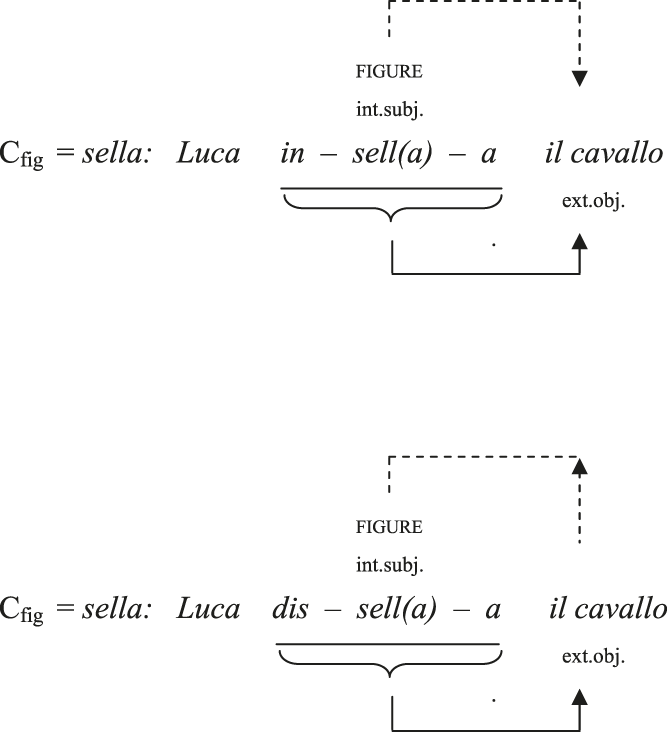
Another quite substantial group of parasynthetic verbs have stem nouns that denote the figure that moves. For instance, from the nominal stem sella ‘saddle’, two verbs are derived: insellare ‘saddle (a horse)’ and dissellare ‘unsaddle (a horse)’. The affixes are the same as those of the parasynthetic ground verbs, and the only difference is that in these cases it is the denotatum of the stem, the figure, that moves – as internal subject of the host predicate – in relation to the external object (see Figure 5).
Italian parasynthetic structures with figure as stem and moving object.
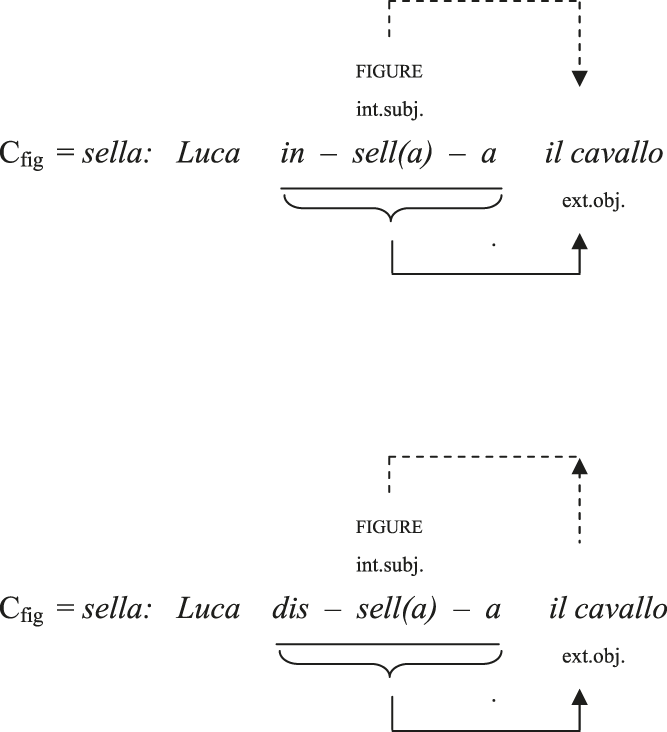
In such cases, it is normal (perhaps most evidently when the external object is the arrival point of the motion, as in insellare) that the figure assumes the semantic role of instrument.
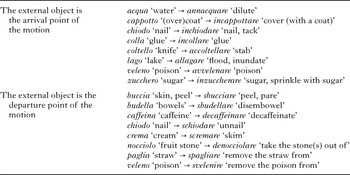
As with the parasynthetic ground derivatives, many figure nouns function as stems for two parasynthetic derivatives, one denoting motion with the external object as arrival point and another with the external object as departure point (see Table 13). Due to space limitations, I confine myself to a few other cases in this context; a list 100 examples of such derivatives can be found in Korzen (Reference Korzen and Cresti2008).
Italian parasynthetic figure verbs

7. Conclusions
Talmy’s motion verb typology, supplemented with some cognitive elaboration and refinement, has served as a solid basis for an investigation of the general lexicalization patterns for Germanic and Romance verbs. The Danish TYPOlex project has revealed clear tendencies of a more concrete and precise lexical content in Germanic verbs, explained by the frequent lexicalization of the semantic component manner. Often, this component renders the verb content depictable as a picture and implies relatively heavy selectional restrictions on the arguments of the verb. In other words, Germanic verbs have a larger lexical intension and a smaller extralinguistic extension. On the other hand, Romance verbs are generally more abstract and generic, expressing an abstract idea of a generalized action or situation, which typically covers more types of instances. The most frequent Romance motion verbs express the component path, but the motion itself is reduced to what could be defined as a ‘cognitive simulation’.
The reverse phenomenon is found in the nouns. Here, the Romance languages are more precise and concrete in that they tend to lexicalize the configuration of artefacts,Footnote 31 i.e., a lexicalization that depends on the externally visible picture of the object, whereas Germanic lexicalization depends more abstractly on the function of the object, i.e., on the idea of the purpose that the object can serve.
This paper has also exposed a perfectly productive Romance derivation pattern in which parasynthetic motion verbs are derived from stems that denote either the ground with respect to which a motion occurs or the figure that moves. With reference to such secondary lexicalization patterns, it must be concluded that these two components very much conflate with Romance motion verbs to form specialized systems for expressing motion.
The component ground can be seen as a sort of ‘specialized path component’. Therefore, it is not surprising that we find this lexicalization pattern in the Romance languages and not in the Germanic ones. In English and Danish, we are forced to use more lengthy constructions such as put [something] in the oven for the very precise Italian verb infornare [qualcosa].Footnote 32
Also, regarding the figure component in parasynthetic derivatives, we could say that the Romance languages have ways of ‘making up’ for the more abstract and generic verb content. A verb such as, e.g., accoltellare ‘stab’ conveys a more precise semantic content than both the English stab and the equivalent Danish stikke, i.e., “to pierce or injure with a sharp pointed instrument” (Collins English Dictionary), namely “to pierce or injure with the instrument un coltello ‘a knife’”.
All in all, there are many good grounds for including both ground and figure in the (secondary) lexicalization patterns of the Romance languages.
Appendix
Italian and French parasynthetic verbs that lexicalize groundin concrete motion, subdivided according to the type of ground
In some cases, the French examples do not correspond etymologically to the Italian but are placed where they are semantically closest to these.