





Extended Abstract
Project description and rationale
The concept of protopia, coined by Kevin Kelly, was introduced as an alternative to utopian and dystopian thinking, framing progress as incremental improvement rather than an idealized end state (Kelly Reference Kelly2016). In The Inevitable, Kelly describes protopia as a condition of continual becoming – futures that are “better today than yesterday” – emerging largely through cumulative technological development.
More recent reinterpretations, including those advanced by Monika Bielskyte and the Protopian Futures collective, have expanded protopia beyond technological emergence toward pluralistic, ethical and culturally grounded imaginaries (Bielskyte Reference Bielskyte2021). This work productively recenters values, inclusion and alternative worldviews, while often operating upstream of technical specification, leaving open questions about how such imaginaries interface with concrete scientific research trajectories, deployment constraints and governance mechanisms.
This conception of protopia diverges from dominant climate fiction, which tends to oscillate between dystopian collapse and pastoral utopias. Protopian narratives instead explore plausible, situated futures in which technologies, often climate technologies, are negotiated, governed and lived with at civic scales.
Together, these framings reveal a gap between technological emergence and cultural aspiration – particularly salient in climate and biotechnology futures, where public agency and governance are central. We introduce Civic Protopia to name this missing layer.
Civic Protopia defines a mode of future-making in which incremental technological progress is deliberately shaped through civic participation, governance and cultural meaning-making. Unlike techno-optimistic protopia, which assumes progress will emerge from acceleration, or culturally expansive protopian frameworks that decenter technical pathways, Civic Protopia insists that “better” must be actively authored through participatory governance, shared narratives and engagement with real scientific trajectories.
Drawing from the lineage of civic media, which treats media as participatory infrastructure for public engagement rather than passive consumption (Zuckerman Reference Zuckerman2014), Civic Protopia positions speculative, data-informed media as a civic interface for collective sensemaking around emerging science and technology. In this framing, speculative media does not merely represent futures; it participates in shaping how scientific research moves toward public understanding, governance and adoption.
Outcomes and future perspectives
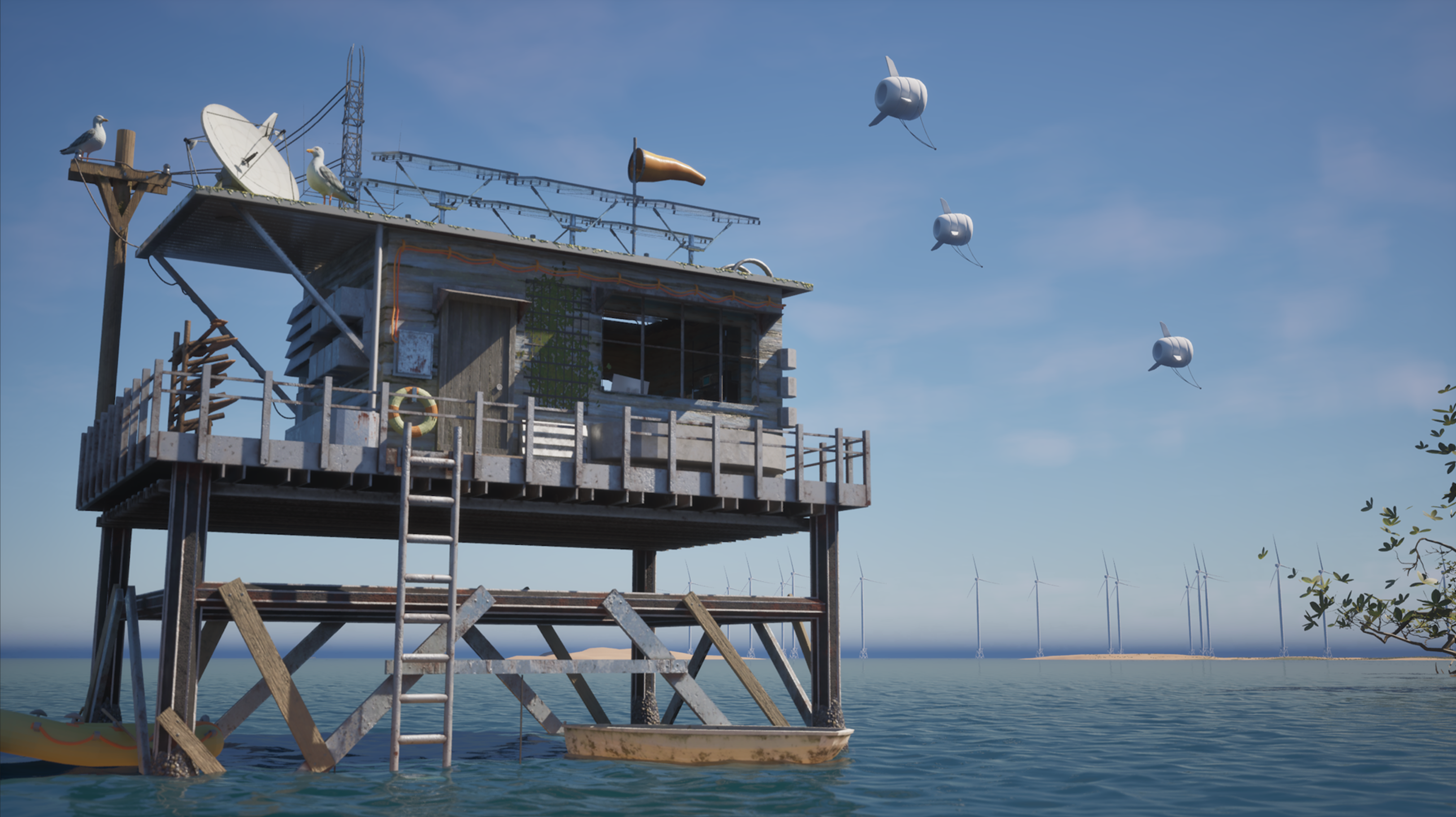
We situate this framework through TIDELANDS, a game and immersive film exploring life in coastal communities adapting to long-term sea-level rise in 2100 (Figure 1). Built as a 1:1 recreation of Potter Pond, Rhode Island, using NOAA projections and ArcGIS data in Unreal Engine, the project integrates environmental datasets and climate modeling to create a civic-scale future environment where players encounter questions of adaptation, stewardship and community technology as part of everyday life.
The floating home of the character is known as the “Hacker.” The structure demonstrates architectural adaptation to life on water, integrating pragmatic technologies without embracing either a high-tech or anti-technology ethos.

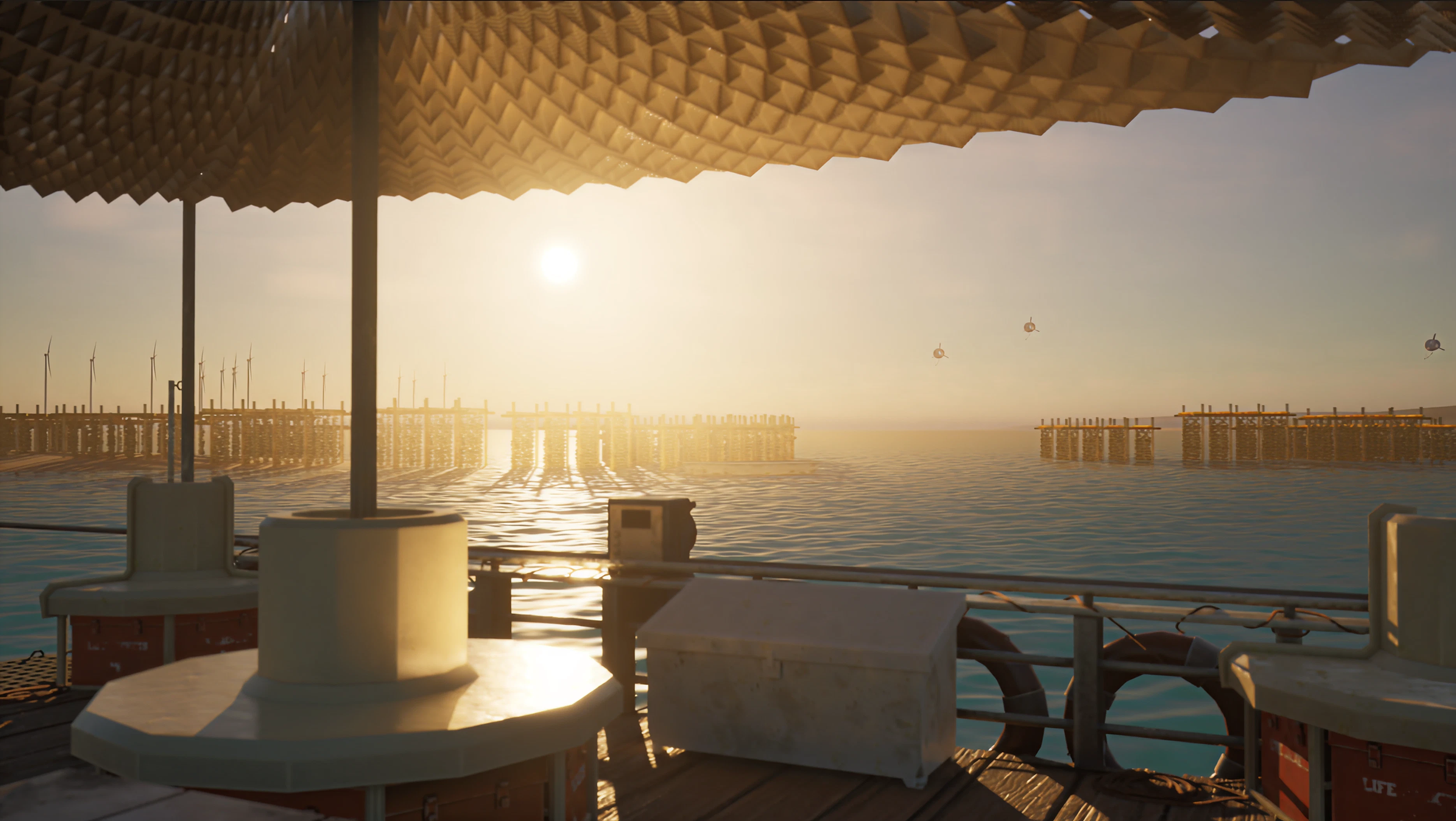
Developed with the University of Rhode Island’s DWELL Lab (led by Madison Jones) and fisherman and food sovereignty activist Jason Jarvis, Tidelands constructs a sandbox world that extends present-day experiments – aquaculture farming, cooperative fisheries, renewable energy systems and new forms of environmental sensing – into a tangible future landscape (Figure 2). Rather than presenting a singular solution or idealized outcome, the project foregrounds incremental, contested futures shaped through collective choice and negotiation.
A cable car transportation system connects the mainland to the Tidelands. During this journey, players observe community-built infrastructure, including oyster farms that extend along the coastline.

Creative science reflection
For us, creative science is about creating spaces where scientific inquiry and creative imagination can meet. Many of the climatic challenges we face today sit across cultural, technical and ecological systems. We believe it is essential to build places where knowledge can move between disciplines and where artists, designers and scientists can learn from one another. In our work across technical research, art, design and storytelling, these exchanges are incredibly generative, often opening new ways of seeing problems and new pathways for action.
Data availability statement
No new data were created or analyzed in this study. Data sharing is not applicable to this article.
Acknowledgments
A special thanks to NEW INC, the Simons Foundation, our dedicated mentor AX Mina, our track mentor Elizabth Henaff, support from the EY Intelligent Realities Lab and the Macdowell Fellowship, and our project advisors: Madison Jones, Jason Jarvis, Rusty Ippolito, Valerie Ippolito, Marina Psaros and Tory Stephens.
Author contributions
All authors made substantial contributions to the conception, development and writing of this work in accordance with the Cambridge University Press authorship guidelines. The authors collaboratively contributed to the research design, theoretical framing, analysis and interpretation of the work. All authors participated in drafting and critically revising the manuscript for important intellectual content, approved the final version for publication and agreed to be accountable for all aspects of the work, including ensuring the accuracy and integrity of the research.
Financial support
This work was supported by the Anonymous Was a Woman Environmental Art Grant (2025) and the RISCA Make Art Grant (2025).
Competing interests
The authors have no conflicts of interest to declare for this publication.
Ethical Statement
This research did not involve human participants, animal subjects or identifiable personal data requiring institutional ethical review or approval. No experiments involving human or animal subjects were conducted as part of this work.

 Open access

