Introduction
Several species of Ocimum L. are called Tulsi or basil, and they have antioxidant, anti-inflammatory, antimicrobial, antidiabetic, anxiolytic, hepatoprotective, antitumor, gastroprotective, hyperlipidemic and antiplasmodic properties (Chattopadhyay, Reference Chattopadhyay1994; Lahon and Das, Reference Lahon and Das2011; Manaharan et al., Reference Manaharan, Thirugnanasampandan, Jayakumar, Ramya, Ramnath and Kanthimathi2014; Saharkhiz et al., Reference Saharkhiz, Kamyab and Kazerani2014; Parasuraman et al., Reference Parasuraman, Balamurugan, Christapher, Petchi, Yeng, Sujithra and Vijaya2015; Srivastava et al., Reference Srivastava, Adholeya, Conlan and Cahill2016). There are more than 150 species in the genus Ocimum, and each species has a unique chemical composition and medicinal properties, which remain unexplored entirely. Ocimum gratissimum L., commonly known as clove basil, is also an important species in this genus with a high therapeutic value. It is a perennial shrub that grows 1–3 m of height, and it is distributed in tropical and subtropical areas, especially India and Africa. Due to its widespread use in India, it has got about 85 vernacular names in India with Ram Tulasi or its phonetic variants being common in Hindi, Kannada, Malayalam, Marathi, Sanskrit and Telugu (http://medicinalplants.in/).
O. gratissimum contains several phytochemicals such as eugenol, tannins, flavonoids, terpenoids, saponins, glycosides and reducing sugars (Ighodaro et al., Reference Ighodaro, Agunbiade and Akintobi2010; Singh et al., Reference Singh, Jayaramaiah, Agawane, Vannuruswamy, Korwar, Anand, Dhaygude, Shaikh, Joshi, Boppana and Kulkarni2016; Olamilosoye et al., Reference Olamilosoye, Akomolafe, Akinsomisoye, Adefisayo and Alabi2018; Airaodion et al., Reference Airaodion, Ibrahim, Ogbuagu, Ogbuagu, Awosanya, Akinmolayan, Njoku, Obajimi, Adeniji and Adekale2019). Eugenol from O. gratissimum is an FDA-approved non-toxic inhibitor of advanced glycation end products (AGEs) used in the management of diabetes (Singh et al., Reference Singh, Jayaramaiah, Agawane, Vannuruswamy, Korwar, Anand, Dhaygude, Shaikh, Joshi, Boppana and Kulkarni2016). The essential oils from the leaves of O. gratissimum are used as a larvicidal agent against A. albopictus mosquitoes (Sumitha and Thoppil, Reference Sumitha K and Thoppil2016). Phenolic compounds such as caffeic acid and its derivatives caftaric acid, chicoric acid and rosmarinic acid and the flavonoid compound, vicenin-2, from this species showed enhanced glucose-stimulated insulin secretion (GSIS) in the pancreatic islets isolated from mice (Casanova et al., Reference Casanova, Gu, Costa and Jeppesen2017). The essential oil derived from O. gratissimum altered the permeability of the cell membrane and showed antimicrobial activity against gastroenteritis pathogens such as Staphylococcus aureus, Escherichia coli, Salmonella typhimurium and Shigella flexneri (Chimnoi et al., Reference Chimnoi, Reuk-ngam, Chuysinuan, Khlaychan, Khunnawutmanotham, Chokchaichamnankit, Thamniyom, Klayraung, Mahidol and Techasakul2018).
The lack of sufficient genomic and transcriptomic data from Ocimum species is limiting the molecular studies on critical metabolic pathways in this group of medicinal plants. Partial genome sequences from short-read paired-end sequencing are available for O. tenuiflorum L. (syn. O. sanctum L.) and O. tenuiflorum subtype Krishna Tulsi (Rastogi et al., Reference Rastogi, Meena, Bhattacharya, Ghosh, Shukla, Sangwan, Lal, Gupta, Lavania, Gupta and Nagegowda2014, Reference Rastogi, Kalra, Gupta, Khan, Lal, Tripathi, Parameswaran, Gopalakrishnan, Ramaswamy and Shasany2015; Upadhyay et al., Reference Upadhyay, Chacko, Gandhimathi, Ghosh, Harini, Joseph, Joshi, Karpe, Kaushik, Kuravadi and Lingu2015). Leaf transcriptomes are available for O. tenuiflorum subtypes Krishna and Rama Tulsi, O. basilicum L. and O. americanum L. (Rastogi et al., Reference Rastogi, Meena, Bhattacharya, Ghosh, Shukla, Sangwan, Lal, Gupta, Lavania, Gupta and Nagegowda2014, Reference Rastogi, Kalra, Gupta, Khan, Lal, Tripathi, Parameswaran, Gopalakrishnan, Ramaswamy and Shasany2015; Upadhyay et al., Reference Upadhyay, Chacko, Gandhimathi, Ghosh, Harini, Joseph, Joshi, Karpe, Kaushik, Kuravadi and Lingu2015; Zhan et al., Reference Zhan, Yang, Wang, Zhu and Lang2016). Apart from these reports, differential gene expression profiling was carried out for the O. basilicum cv. ‘Red Rubin’ with purple leaves and O. basilicum cv. ‘Tigullio’ with green leaves (Torre et al., Reference Torre, Tattini, Brunetti, Guidi, Gori, Marzano, Landi and Sebastiani2016). However, there were not many molecular studies carried out in O. gratissimum. There were only 116 nucleotide sequences from O. gratissimum present in the GenBank database of NCBI as of July 2020. In this study, we report the whole transcriptome of the leaves of O. gratissimum based on RNA-seq data, and a detailed analysis of the genes, which are involved in phenylpropanoid and caffeine metabolism.
Material and methods
Sample collection and RNA isolation
Seedlings of O. gratissimum were collected from Nanmangalam, Medavakkam, Chennai, Tamil Nadu. The seedlings were transplanted in pots and grown in a greenhouse. The plants were taxonomically identified by a botanist (Prof. P. Jayaraman, Plant Anatomy Research Center, Chennai, Tamil Nadu). Young leaves from one healthy and mature plant at the flowering stage were used for RNA isolation using RNAiso Plus reagent (TaKaRa, Japan). DNA contamination was removed by DNase I treatment (Qiagen, GmbH, Germany) and RNA purification by using RNeasy Min Elute Clean-up Kit (Qiagen, GmbH, Germany). RNA quality and quantity were estimated by using agarose gel electrophoresis, spectrophotometer, Qubit3.0 fluorimeter (Invitrogen, California, USA) and Bioanalyzer 2100 (Agilent Technologies, California, USA).
RNA-Seq library preparation and sequencing
Library preparation was performed by using TrueSeq mRNA v2 Kit (Illumina, USA). Briefly, mRNA purification was done from total RNA by using oligo-dT attached magnetic beads, and the fragmentation of purified mRNA was done by mechanical shearing. After fragmentation, cDNA synthesis was done in the presence of reverse transcriptase and random primers. Double-stranded cDNAs were end-repaired and adenylated at the 3′end by using end-repair mix and A-Tailing mix, respectively (Illumina, USA). Then, adapters were ligated to the fragment and amplified by PCR. Finally, the library was validated by bioanalyzer 2100 (Agilent Technologies, Santa Clara, California, USA). The RNA-Seq library was quantified and subjected to paired-end sequencing in Nexseq500 (Ilumina, USA).
De novo transcriptome assembly and clustering
The paired-end sequencing image files in the bcl format were converted to FASTQ reads using bcl2fastq tool (Illumina, USA). The quality of raw reads was examined using the bioinformatics tool FastQCv0.11.8 (Andrews, Reference Andrews2010). Low quality reads with a Phred quality score <30, and the adapter sequences were removed by using Sickle (https://github.com/najoshi/sickle) and Cutadapt tool version 1.15 (Martin, Reference Martin2011). We used Velvet-v1.2.10 (Zerbino and Birney, Reference Zerbino and Birney2008), SOAPdenovo2 (Luo et al., Reference Luo, Liu, Xie, Li, Huang, Yuan, He, Chen, Pan, Liu and Tang2012) and Trinity-v2.6.6 (Grabherr et al., Reference Grabherr, Haas, Yassour, Levin, Thompson, Amit, Adiconis, Fan, Raychowdhury, Zeng, Chen, Mauceli, Hacohen, Gnirke, Rhind, di Palma, Bruce, Friedman and R2013) for transcriptome assembly. Trinity gave the best assembly as reported before (Zhao et al., Reference Zhao, Wang, Kong, Luo, Li and Hao2011), which was used to construct unique transcripts and further analysis. Non-redundancy of the assembled data was achieved using CD-HIT version 4.7 (Fu et al., Reference Fu, Niu, Zhu, Wu and Li2012).
Assessment of gene completeness
Gene completeness analysis was done using the bioinformatics tool TRAPID (http://bioinformatics.psb.ugent.be/webtools/trapid) to obtain the total number of full length, quasi length and partial coding unigenes. This analysis was performed by comparing the assembled transcripts against PLAZA4 green plants clade database (Van et al., Reference Van Bel, Diels, Vancaester, Kreft, Botzki, Van de Peer, Coppens and Vandepoele2018) with an E-value of < IE −5.
Functional annotation and classification
For functional annotation of unigenes, assembled sequences of O. gratissimum were searched against the non-redundant protein database at the National Center for Biotechnology Information (NCBI) (ftp://ftp.ncbi.nlm.nih.gov/blast/db/) using stand-alone BLAST+ package and BLASTX algorithm with threshold E value < IE– 5 for the homology search. Further BLASTX result was imported to the Blast2GO software for Gene Ontology (GO) analysis and enrichment of assembled unigenes. Functional classification and pathway prediction of the transcripts was carried out using KEGG Automated Annotation Server (KAAS) with default parameters.
Phylogenetic analysis
A few transcripts from the chloroplast genome were selected and assembled with the transcripts from 13 other species representing the Lamiaceae family. Nicotiana tabacum L. (Solanaceae) and Arabidopsis thaliana L. (Brassicaceae) were used as outgroups. Alignment was carried out using Clustal W (Thompson et al., Reference Thompson, Gibson and Higgins2003) and a neighbour-joining tree with 1000 bootstrap replicates was constructed using MEGAX (Kumar et al., Reference Kumar, Stecher, Li, Knyaz and Tamura2018).
Transcript quantification
Quantification of the assembled transcripts and determination of isoform abundance were carried out by using RNA-Seq by expectation maximization (RSEM) tool (Li and Dewey Reference Li and Dewey2011), and the transcripts per kilobase million (TPM) and fragments per kilobase million (FPKM) were calculated.
Prediction of transcription factors
The transcripts, which code for the transcription factors (TFs) belonging to different families, were predicted using the plant TF database (http://planttfdb.cbi.pku.edu.cn/prediction.php).
Identification of simple sequence repeats
Simple sequence repeats (SSRs) or the microsatellites among the assembled transcripts of O. gratissimum were identified using the MicroSAtellite (MISA) tool and misa.pl script (Beier et al., Reference Beier, Thiel, Münch, Scholz and Mascher2017). The search criteria were adjusted for the identification of perfect di, tri, tetra, penta and hexa nucleotide motifs with minimum 6, 5, 5, 5 and 5 repeats, respectively. Primers were designed for 30 SSR loci using Primer3 software (https://primer3plus.com/cgi-bin/dev/primer3plus.cgi).
Results
RNA sequencing and de novo transcriptome assembly
The total RNA extracted from the leaves of O. gratissimum and purified after DNase treatment showed intact ribosomal RNA bands without any DNA contamination in agarose gel electrophoresis, A260/A280 ratio of 2.05 and RNA integrity number (RIN) of 7.30, which indicated its suitability for RNA-Seq library preparation. Sequencing of the RNA-Seq library generated 134.258 million raw reads (10.124 Gb). Since the reference genome sequence was not available for O. gratissimum, we performed de novo transcriptome assembly. After removing the adapter sequence and filtering out low-quality reads, 99.22 million reads (6.67 Gb bases) with a mean Phred score of 35.08 were obtained. These high-quality reads were assembled into 143,744 transcripts. Clustering removed 22,093 redundant transcripts and yielded 121,651 unique transcripts with an average length of 505 bases and an N50 length of 580 bases. Detail of the paired-end sequencing data generated and the assembly statistics are provided in Table 1. Assessment of gene completeness revealed that the unique transcripts included 4742 full-length, 25,644 quasi full-length and 42,415 partial coding unigenes. About 40% of the transcripts did not show significant similarity with any transcripts in the PLAZA 4.0 green plants clade database.
Summary of paired-end sequencing and de novo assembly of the leaf transcriptome of O. gratissimum

Annotation of the transcripts
The transcripts that showed similarity with already reported genes were annotated for their putative biological functions based on a similarity search against the non-redundant database at NCBI. Out of the 121,651 unique assembled transcripts, 75,509 (62%) and 11,106 (9.1%) transcripts matched with existing gene models and uncharacterized proteins, respectively. The remaining 35,036 transcripts (28.8%) showed no significant similarity with any sequences in the database. These sequences may represent the sequences, which are unique to O. gratissimum. When the assembled transcripts were compared with the plant non-redundant protein databases from NCBI, as shown in Fig. 1, a large number of O. gratissimum transcripts matched with Sesamum indicum (40%) and Erythranthe guttata (14.9%).
Top hit species distribution of the transcripts of the O. gratissimum leaf transcriptome based on BLASTX search against plant non-redundant database.

Phylogenetic analysis
The neighbour-joining tree depicting the phylogenetic relationships among O. gratissimum and 13 other species from the Lamiaceae family is shown in online Supplementary Fig. S1.
Functional classification of the annotated transcripts
The assembled transcripts were functionally classified to be involved in the biological process, cellular component and metabolic function, and then assigned into several subcategories within each major component. The detailed functional classification of the transcripts under major categories and subcategories therein are shown in online Supplementary Fig. S2. The biological process category with 88,082 transcripts contained 2988 subcategories, and the oxidation-reduction process had the highest number of transcripts (3549 transcripts), followed by protein phosphorylation (2787 transcripts), regulation of transcription (2081 transcripts) and others. In the case of the cellular component category, 60,069 transcripts were grouped into 704 subcategories, with the highest number of transcripts being related to the integral component of the membrane (14,576 transcripts). Under the metabolic function category with 89,514 transcripts, 2154 subcategories were present in which the highest number of transcripts were related to ATP binding (8375 transcripts) followed by metal ion binding (3407 transcripts), RNA binding (2177 transcripts) and others. The expression levels of the de novo assembled transcripts from O. gratissimum leaves were estimated based on FPKM and TPM values. Among the top ten most abundant transcripts, three were coding for metallothionein proteins (online Supplementary Table S1).
Transcripts involved in biochemical pathways
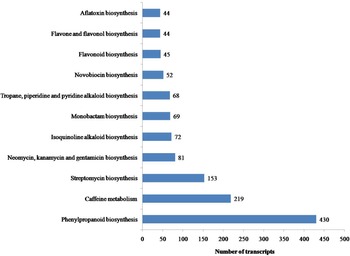
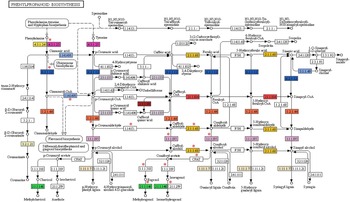
We annotated 32,697 transcripts of O. gratissimum with enzyme commission (EC) numbers. These transcripts were mapped onto 149 pathways, which predominantly included the biochemical pathways of metabolism. Among the transcripts involved in metabolism, a large number of transcripts were mapped to purine and thiamine metabolism, which accounted for more than 50% of the transcripts (online Supplementary Fig. S3). Carbohydrate metabolism, nucleotide metabolism and metabolism of cofactors and vitamins accounted for more than 50% of the transcripts that were mapped under metabolism. It also included 1410 transcripts that were mapped onto 23 pathways for other secondary metabolites (online Supplementary Fig. S4). In O. gratissimum, among the transcripts which are involved in the biosynthesis of secondary metabolites, the highest number of transcripts was involved in phenylpropanoid biosynthesis, followed by caffeine metabolism (Fig. 2). The phenylpropanoid biosynthetic pathway begins with the formation of cinnamic acid from phenylalanine catalysed by phenylalanine ammonia-lyase (PAL). Cinnamic acid is then converted into cinnamoyl-CoA, p-coumaryl-CoA, p-coumaryl quinic acid, caffeoylquinic acid, caffeoyl-CoA, feruloyl-CoA and sinapoyl-CoA, which lead to the synthesis of flavonoids, lignins, eugenol and other phenolic compounds. In the present study, KEGG analysis of leaf transcriptome of O. gratissimum revealed the presence of 430 transcripts coding for 14 enzymes involved in the biosynthesis of different compounds of the phenylpropanoid pathway (Fig. 3). Caffeine biosynthesis begins with the conversion of xanthosine to 7-methylxanthosine by xanthosine methyltransferase. Subsequently, 7-methylxanthosine is converted to 7-methylxanthine, paraxanthine and caffeine by the sequential actions of N-methyl nucleosidase and caffeine synthase. In the present study, the leaf transcriptome of O. gratissimum contained 219 transcripts coding for four enzymes, which are involved in caffeine metabolism (online Supplementary Fig. S5).
The number of transcripts of the O. gratissimum leaf transcriptome, which code for the enzymes of different pathways of secondary metabolites.

Phenylpropanoid biosynthesis pathway showing different enzymes for which transcripts were identified from the O. gratissimum leaf transcriptome (each colour represents one Enzyme Code). The KEGG pathway map was adapted from http://www.kegg.jp/kegg/kegg1.html. Asterisk (*) indicate enzymes involved in the biosynthesis of eugenol.

Transcripts coding for TFs and SSRs
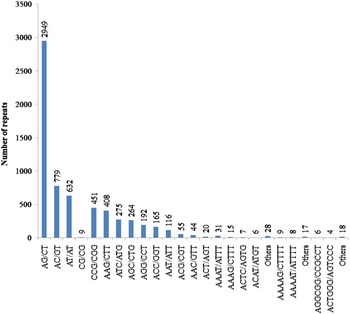
TFs are classified into different families according to the features of DNA binding domains. In this study, 930 transcripts coding for TFs belonging to 59 families were identified. The most abundant TFs belonged to the myeloblastosis (MYB) MYB TF family. The details of the transcripts coding for different TFs are presented in online Supplementary Fig. S6. We identified 6508 SSRs in which about 98% of them were di-nucleotide (67.1%) and tri-nucleotide repeats (30.6%). The details of the repeat number under different repeat/motif length and their frequency are given in Table 2. Among the di-nucleotide repeats, the AG/CT repeats were found to be the most abundant (67.4%) followed by AC/GT (17.8%), AT/AT (14.4%) and CG/CG (0.2%). In the case of the tri-nucleotide repeats, CGG/CCG was found to be most abundant. Primers designed for the amplification of 30 SSR loci with tri-nucleotide repeats are given in online Supplementary Table S2. The details of different types of repeats length and their frequency are given in Fig. 4.
Number of different types of simple sequence repeats (SSRs) identified from the O. gratissimum leaf transcriptome.

Number of different kinds of simple sequence repeats (SSRs) identified from the leaf transcriptome of O. gratissimum

Discussion
Genome sequences are not available for many of the medicinal plants bestowed with therapeutic compounds that are useful in traditional as well as modern medicine. Although the cost of DNA sequencing has come down drastically, de novo assembly of chromosome-level genomes in the absence of physical maps is a challenge. Moreover, the accumulation of therapeutic compounds in medicinal plants depends on expression than the mere presence of unique genes. Therefore, the characterization of expressed genes from whole transcriptome analysis will be highly useful to understand the functional genes involved in the biosynthesis of therapeutic compounds. Clove basil (O. gratissimum) or Ram Tulasi is a commonly used medicinal plant, and its leaves are used as a single drug and as a component in herbal formulations. In this study, we report the leaf transcriptome of O. gratissimum assembled from Illumina's paired-end RNA-Seq data. Most of the assembled transcripts from O. gratissimum showed the highest nucleotide identity with S. indicum and E. guttata. This result is in concordance with the phylogenetic relationships among these species as per the latest Angiosperm Phylogeny Group (APG) IV classification (Chase et al., Reference Chase, Christenhusz, Fay, Byng, Judd, Soltis, Mabberley, Sennikov, Soltis, Stevens, Briggs, Brockington, Chautems, Clark John, Conran, Haston, Möller, Moore, Olmstead, Perret, Skog, Smith, Tank, Vorontsova and Weber2016). While O. gratissimum belongs to Lamiaceae, S. indicum and E. guttata belong to Pedaliaceae and Phrymaceae, respectively. However, all of them are taxonomically related as they belong to the same order, Lamiales.
The number of genes involved in the synthesis of secondary metabolites is variable among different species. Even at the variety level, a significant difference in the number of such transcripts was observed between two varieties of O. basilicum (Torre et al., Reference Torre, Tattini, Brunetti, Guidi, Gori, Marzano, Landi and Sebastiani2016). In this study, we identified 1410 transcripts from the leaf transcriptome of O. gratissimum that are functional in 23 pathways of secondary metabolite biosynthesis. In a similar study, although relatively a comparable amount of RNA-Seq data were analysed, the number of transcripts related to secondary metabolite biosynthesis identified was only 501 and 952 from O. tenuiflorum (syn. O. sanctum) and O. basilicum, respectively (Rastogi et al., Reference Rastogi, Meena, Bhattacharya, Ghosh, Shukla, Sangwan, Lal, Gupta, Lavania, Gupta and Nagegowda2014). Among the O. gratissimum transcripts mapped to the secondary metabolite biosynthesis in this study, those coding for the enzymes of phenylpropanoid biosynthesis and caffeine metabolism were abundant than the others. We also found a significant number of the MYB TFs, which are the key regulator of the phenylpropanoid metabolism in plants (Ma and Constabel, Reference Ma and Constabel2019). MYB TFs are also involved in the regulation of tolerance to biotic and abiotic stress tolerance (Lippold et al., Reference Lippold, Sanchez, Musialak, Schlereth, Scheible, Hincha and Udvardi2009; Du et al., Reference Du, Zhao, Wang, Gao, Wang, Liu, Chen, Chen, Zhou, Xu and Ma2018).
Phenylpropanoids are a diverse group of compounds derived from phenylalanine, and are involved in plant defence, structural support and tolerance against biotic and abiotic stresses (Vogt, Reference Vogt2010). Eugenol is a phenylpropanoid compound with several therapeutic properties (Fujisawa and Murakami, Reference Fujisawa and Murakami2016; Barboza et al., Reference Barboza, da Silva Maia Bezerra Filho and Silva2018), and it is the primary ingredient in the essential oil of Ocimum species. We identified 101 transcripts, which code for seven enzymes that are involved in eugenol biosynthesis in O. gratissimum. Among the 101 transcripts, 64 were unique transcripts and 37 were truncated forms of the unique transcripts. The number of unique transcripts is reasonable considering that six out of the seven enzymes of the eugenol biosynthesis pathway are encoded by multigene families. Only eugenol O-methyltransferase is encoded by a single gene family. Interestingly, this gene is represented by a single transcript in this study also. Regarding caffeine metabolism, the leaf transcriptome of O. gratissimum contained 219 transcripts coding for four enzymes involved in caffeine metabolism. These enzymes are involved in either caffeine catabolism or diverting the precursors of caffeine to the synthesis of other metabolites. For example, urate hydroxylase is involved in the catabolism of caffeine to allantoin. Arylamine N-acetyltransferase converts paraxanthine, a precursor of caffeine, to 5-acetylamino-6-formylamino-3-methyl uracil. None of the transcripts related to caffeine metabolism identified from O. gratissimum is involved in caffeine synthesis, which supports the caffeine-free nature of the Ocimum species (Pattanayak et al., Reference Pattanayak, Behera, Das and Panda2010).
Some heavy metals are essential micronutrients (Co, Fe, Mn, Mo, Ni, Zn, Cu), but others are nonessential and toxic (Pb, Cd, As, Cr, Hg). Ocimum species were reported to accumulate some of the toxic heavy metals. While O. basilicum was reported to be a hyperaccumulator of Cd, Cr and Pb (Chand et al., Reference Chand, Singh, Singh and Patra2015; Dinu et al., Reference Dinu, Vasile, Buleandra, Popa, Gheorghe and Ungureanu2020), O. gratissimum was found to accumulate Cd (Chaiyarat and Suebsima, Reference Chaiyarat, Suebsima, Putwattana, Kruatrachue and Pokethitiyook2011). Though the accumulation of toxic heavy metals is helpful in bioremediation, it is a matter of concern when the accumulating plants are used for medicinal purposes. Metallothioneins (MTs) are cysteine-rich proteins, which bind with heavy metals and help in their accumulation in plants (Hamer, Reference Hamer1986). Our quantitative analysis showed that the transcripts coding for metallothionein proteins are abundant in the leaf transcriptome of O. gratissimum. This is the first report on the abundant expression of MT genes in Ocimum, which shall be useful for a detailed study on heavy metal accumulation in this important group of medicinal plants.
We also identified transcripts belonging to 59 TF families and 6508 SSR markers from the leaf transcriptome of O. gratissimum. The TFs are diverse and actively regulate all the vital functions of the plants, including germination, growth and reproduction. They are also involved in the synthesis of bioactive compounds, especially in the regulation of secondary metabolism. Therefore, identification of the genes coding for the TF is useful for understanding the regulatory mechanism of secondary metabolites. Though SSR markers are available for O. tenuiflorum and O. basilicum (Rastogi et al., Reference Rastogi, Meena, Bhattacharya, Ghosh, Shukla, Sangwan, Lal, Gupta, Lavania, Gupta and Nagegowda2014, Reference Rastogi, Kalra, Gupta, Khan, Lal, Tripathi, Parameswaran, Gopalakrishnan, Ramaswamy and Shasany2015), this is the first time a large number of SSR markers were identified for O. gratissimum. These SSRs shall be useful as DNA markers for comparative genomics, molecular breeding, genetic diversity assessment and gene mapping (Pyne et al., Reference Pyne, Honig, Vaiciunas, Wyenandt and Simon2018). The leaf transcriptome reported here will serve as a foundation for further molecular studies in O. gratissimum and related species. We also designed primers for 30 SSR loci to be useful for this purpose.
Supplementary material
The supplementary material for this article can be found at https://doi.org/10.1017/S1479262121000563
Acknowledgements
This study was financially supported by SRM-DBT Partnership Platform for Contemporary Research Services and Skill Development in Advanced Life Sciences Technologies (Order No. BT/PR12987/INF/22/205/2015).
Author contributions
MP and PN contributed to the study conception and design. Material preparation, data collection and analysis were performed by Tanuja, NRP and RK. The manuscript was written by MP and Tanuja. All authors read and approved the final manuscript.
Availability of data
The data were submitted to NCBI with Biosample Accession Number SAMN15582955.