The paradoxical effect of authoritarian elections has preoccupied the literature on authoritarian institutions for more than a decade. Why do elections sometimes stabilize authoritarian regimes (Greene Reference Greene2007; Magaloni Reference Magaloni2006) while, at other times or in other places, authoritarian elections spur regime breakdown and perhaps even democratization (Brownlee Reference Brownlee2009; Lindberg Reference Lindberg2006; Miller Reference Miller2013; Schedler Reference Schedler2013)? Scholars have recently shown that while elections are threatening to autocrats in the short run, once the regime has survived the immediate post-electoral period, elections contribute to upholding the regime in the longer term (Knutsen, Nygård and Wig Reference Knutsen, Nygård and Wig2017). The question, however, remains why some autocrats survive the immediate threat of elections and move on to reap the long-term benefits whereas others succumb during or after elections. Along the same lines, scholars have also found that democratizing outcomes are more likely where elections are already semi-competitive (Brownlee Reference Brownlee2009; Donno Reference Donno2013; Howard and Roessler Reference Howard and Roessler2006). But why are some authoritarian elections competitive while other rulers remain hegemonic – that is, win elections with astounding majorities?
In this article, I argue that the state's capacity to control its territory enables incumbents to heighten their margins of victory. Supermajority victories have been shown to be a central mechanism through which elections stabilize rather than undermine authoritarian rule (Greene Reference Greene2007; Magaloni Reference Magaloni2006; Simpser Reference Simpser2013), for instance by reducing the risk of elite defections (Reuter and Gandhi Reference Reuter and Gandhi2011). Previously, state capacity has been linked to electoral victories in autocracies through the stocks of performance legitimacy that an effective state apparatus can generate (Flores and Nooruddin Reference Flores and Nooruddin2016). Instead, I argue and show that state territorial control is linked to large victories through the subtle manipulation of elections. The autocrat does not manipulate elections singlehandedly but is dependent on a multitude of local agents (Rundlett and Svolik Reference Rundlett and Svolik2016). The state's infrastructure allows an autocrat to provide local agents with the tools and incentives to subtly manipulate elections without incurring the legitimacy costs that follow from harsher and more visible types of manipulation.Footnote 1 Thus subtle electoral manipulation (that is, manipulation with low legitimacy costs) not only increases the margins of victory; it also substitutes for more visible and costly forms of fraud that risk turning elites and the masses against the regime. Territorial control, in other words, allows autocrats to choose wisely from ‘the menu of manipulation’ (Asunka et al. Reference Asunka2017; Schedler Reference Schedler2002).
I first present a theoretical argument of how state capacity, understood as control over territory, can increase an autocrat's ability to use subtle manipulation, and reduce the use of more visible and costly manipulation. These tactics increase the margins of victory. Secondly, in cross-national analyses, I demonstrate that high levels of state-territorial control in authoritarian elections are linked to higher levels of subtle manipulation, and higher margins of victory. I also show that the subtle manipulation strategies in themselves increase the likelihood that incumbents will win large victories. At the same time, the state's ability to control its territory reduces the use of more visible and costlier strategies such as violence. Finally, I discuss how these results affect our knowledge of state capacity, authoritarian elections, manipulation and legitimacy.
The state, territorial control and electoral manipulation
Building on existing work on autocrats’ use of the state (for example, Slater Reference Slater2010; Slater and Fenner Reference Slater and Fenner2011; Way Reference Way2015), recent research has shown that state capacity and control over the economy help autocrats avoid breakdown in the context of authoritarian elections (Levitsky and Way Reference Levitsky and Way2010; Seeberg Reference Seeberg2018; van Ham and Seim Reference van Ham and Seim2018). However, the precise mechanisms through which state capacity alters the dynamics of authoritarian elections and regime stability have not yet been systematically theorized and tested on a cross-national basis. How can the state apparatus affect the long-term effects of elections?
State Capacity and Territorial Control
I argue that the state's capacity to control its territory is central to electoral control in autocracies, and thereby to large-majority victories. State territorial control is one aspect of state capacity, where state capacity is defined as a state's ‘capacities to penetrate society, regulate social relations, extract resources, and appropriate or use resources in determined ways’ (Migdal Reference Migdal1988, 4). High-capacity states are able to exert the will of the rulers across the territory, thus linking state capacity to territorial control (see also Fearon and Laitin Reference Fearon and Laitin2003, 80). Importantly, this notion of state capacity, including territorial control, should not be equated with the rule of law or the professionalism of the bureaucracy in a Weberian sense (see also Hanson Reference Hanson2018; Soifer and vom Hau Reference Soifer and vom Hau2008). Autocrats often control the state bureaucracy precisely because appointments are political – not meritocratic – and bureaucrats depend on leaders to hold onto their position (Gehlbach and Simpser Reference Gehlbach and Simpser2015) and livelihood.
Territorial control may hinge on the administrative, extractive and coercive powers of the state as it depends on the bureaucracy – including tax collection efforts – extending across the territory as well as police and armed forces upholding the monopoly on violence. State territorial control is low in countries where the presence of the state apparatus is limited in general. But territorial control also drops where parts of the territory are outside the reach of the state, even if state capacity is reasonably high in certain regions or in the capital. A case in point is Russia in the late 1990s, where there was non-compliance with the orders of the central state in many regions (Stoner-Weiss Reference Stoner-Weiss2006). Thus, cases of low territorial control include (but are not limited to) so-called failed states.
A ruler may also secure territorial control through a strong party organization or paramilitary forces, and such non-state agents also manipulate elections. However, local party activists are most commonly known to engage in costly types of fraud such as vote buying (Stokes et al. Reference Stokes2013) and violence (Asunka et al. Reference Asunka2017). Thus a strong party organization is an alternative – and less common – route to territorial control, but the associated electoral strategies are likely to be different, and the effects of territorial control independent of state capacity are not theorized in this article. My argument instead theorizes one way in which the state affects electoral dynamics in autocracies.
The argument
My argument takes its starting point in the claim that large victories are key to stability in electoral autocracies. Large victories in terms of votes signal regime invincibility and deter internal elites and opposition candidates from challenging the regime. Large majorities of parliamentary seats allow a ruler to dominate politics, alter the rules of the game and secure further supermajority victories in the future (Schedler Reference Schedler2013). Holding multiparty elections, however, is a gamble, as they may also allow the opposition to gain ground. I argue that the state's capacity to control its territory is central to electoral control in autocracies, and thereby to large-majority victories:
Hypothesis 1 The state's capacity to control its territory increases the likelihood that the incumbent will gain a large majority of votes and seats in authoritarian multiparty elections.
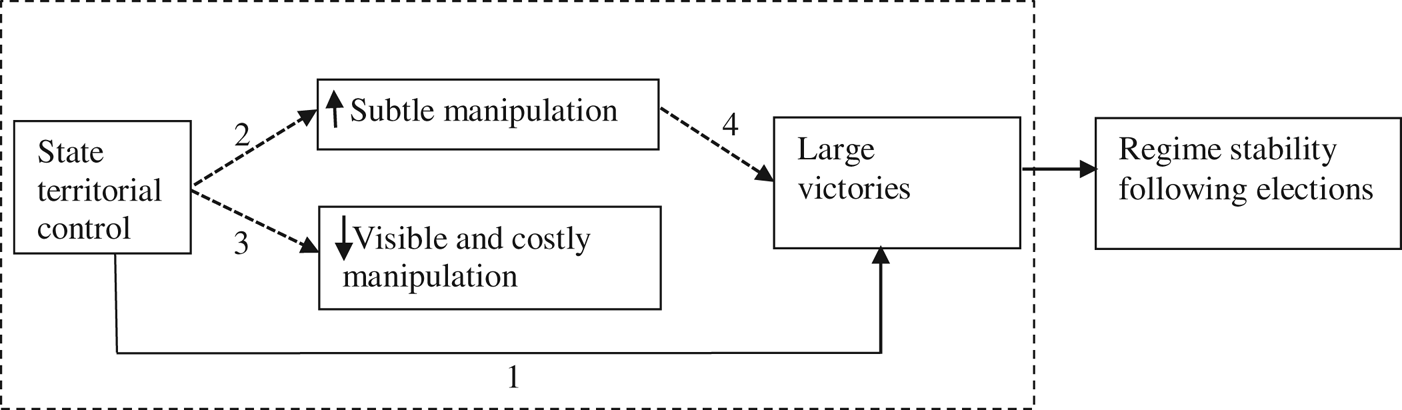
Hypothesis 1 presents the main effect theorized in the article. The mechanisms are spelled out below, and the full argument is illustrated in Figure 1.
Argument
Note: Full arrow is main effect. Dotted arrows are mechanisms. Dotted box indicates argument tested in the article.

How does the state's capacity to control its territory increase the chances of a large-majority victory? One way in which state capacity is assumed to affect authoritarian vote margins is by enhancing performance legitimacy. Flores and Nooruddin argue that when the state commands a large fiscal space, rulers are more likely to secure the votes necessary to win elections (2016). However, if autocrats could rely on performance alone to secure large victories, democratization ought not be a frightening prospect (Flores and Nooruddin Reference Flores and Nooruddin2016; Slater and Wong Reference Slater and Wong2013). Nonetheless, even high-performance autocracies with strong states routinely manipulate elections to avoid democratization. As autocrats do not know the extent of their popularity, they will often turn to manipulation as insurance against a potential loss, even where they could have won elections without it (Rundlett and Svolik Reference Rundlett and Svolik2016).
An example is Singapore, where rulers supplement performance legitimacy with various forms of electoral manipulation: the media is tightly controlled, gerrymandering of districts and ethnic quotas have benefited the ruling party, and state resources have been used to secure votes, as housing upgrades have been reserved for districts that supported the ruling People's Action Party (Chin Reference Chin2007; Li and Elklit Reference Li and Elklit1999; Ong and Tim Reference Ong and Tim2014).
As in Singapore, I argue that autocrats supplement performance with electoral manipulation. But they prefer specific forms of fraud. The literature distinguishes between two types of costs related to electoral manipulation: implementation costs (organizational and financial) and legitimacy costs (Birch Reference Birch2011; van Ham and Lindberg, Reference van Ham and Lindberg2015). State territorial control enables manipulation strategies with high organizational costs because it equips rulers with an expansive network of state agents. Local actors ranging from bureaucrats and police forces over tax inspectors and poll workers to fire fighters carry out manipulation across the territory and are offered rewards or threatened with punishments accordingly (for instance in the form of job opportunities, promotions and pay rises) (Rundlett and Svolik Reference Rundlett and Svolik2016).
However, not all of these organizationally demanding strategies are equally attractive. Autocrats will attempt to avoid manipulation strategies with high legitimacy costs. Legitimacy costs are incurred when fraud is detected and frowned upon either domestically or internationally, potentially sparking protests, endangering diplomatic and trade relations, and jeopardizing regime stability (Birch Reference Birch2011; Norris, Frank and Martínez Reference Norris, Frank and Martínez2015; van Ham and Lindberg Reference van Ham and Lindberg2015). Thus the legitimacy costs of a manipulation strategy are high if it is visible (detectable) and it is considered a harsh form of manipulation (with the potential to cause domestic and international outrage) (Birch Reference Birch2011; van Ham and Lindberg Reference van Ham and Lindberg2015). In autocratic elections, both the national and international community know that some breaches of electoral integrity are to be expected. Thus, the more coercive manipulation strategies typically constitute clearer breaches with democratic norms and provoke stronger reactions both domestically and abroad.
In the following, I distinguish between subtle manipulation strategies, which have low legitimacy costs (either because they are less visible or because they make limited use of coercion), and visible and costly strategies (those with high legitimacy costs). I argue that state territorial control allows rulers to carry out manipulation strategies that are organizationally costly. But rulers will prefer subtle strategies to visible and costly ones. The territorial control of high-capacity rulers allows them to choose widely and wisely from the ‘menu of manipulation’ (Schedler Reference Schedler2002). As state territorial control increases, the use of subtle manipulation strategies will increase, and the use of visible and costly manipulation will decrease.
The following section explicates how local agents manipulate elections across the territory, thus tying state territorial control to margins of victory. I then turn to a more visible and costly tactic that high-control leaders are expected to avoid as they prefer subtle strategies. The theory focuses on manipulation strategies that rely on the state's capacity to control its territory. It does not predict the use of tactics that are carried out from the capital without the need for territorial control such as systemic manipulation of election laws or gerrymandering of election districts.
This article theorizes four ways in which the state's capacity to control its territory allows rulers to subtly manipulate elections without incurring the legitimacy costs associated with visible and more coercive tactics. First, using state control over the media to block information about opposition candidates and spread negative propaganda about the opposition is a common tactic on the national level, but high-capacity regimes are also more likely to control and be able to exploit the media throughout the territory (Birch Reference Birch2011, 93). Local civil servants or police officers on the ground can prevent journalists from investigating and reporting on elections, close down local radio stations that are often the primary means of information in rural areas during elections, or spread anti-opposition propaganda and slander in local communities. In Zimbabwe, it is not only the national media that suffers from state interference. Local police also target community radio stations and conduct raids and confiscations to interfere with broadcasting (Reporters without Borders 2014). Media manipulation attempts to alter voters’ preference formation rather than physically prevent them from casting their vote, and is thus a less visible and coercive form of election manipulation (Birch Reference Birch2011, 31–34, 89–90, Schedler Reference Schedler2002, 39–40).
Secondly, another form of preference manipulation is discreet obstruction of the opposition's campaign. Territorial control, for instance through a large bureaucracy, makes it easier to obstruct opposition campaigns without the use of repression, using tax inspectors, fire fighters, or local police to close down opposition facilities and rallies (Birch Reference Birch2011, 92–93; Schedler Reference Schedler2013). In Malaysian elections in the 1980s and 1990s, opposition parties were often denied police licenses for major rallies, and ruling party appointees at the municipal level prevented the opposition from booking community halls for meetings (Hilley Reference Hilley2001, 86; US Department of State 1990, 957). Community council members who did not support the ruling Barisan Nasional's tactics were threatened with removal (Crouch Reference Crouch1996, 62). Such tactics prevent the opposition from reaching voters in an attempt to affect voter preferences before elections take place.
Thirdly, high-control states may also use local agents to stuff ballot boxes and manipulate vote counting. State control over territory allows rulers to appoint compliant agents as polling station personnel. Where poll workers are loyal to the regime, they may stuff ballot boxes with false votes either during the vote or after polling stations have closed, vote on behalf of dead or absent voters, and conduct false tallying of votes at the polling station before the results are aggregated and announced. This strategy does not visibly prevent voters from expressing their preference on election day; nor does it rely on coercion. Instead, it more discreetly manipulates the aggregation of voters’ preferences and is thus not as costly as, for instance, election violence (Schedler, Reference Schedler2002).
Fourthly, high-control states may also be more likely to prevent irregularities from being discovered and made public. Rulers who have control over their territory can use local agents to restrict the work of domestic election observers and opposition party agents whose reports could be used by the opposition to stage domestic protests and secure international attention.Footnote 2 Doing so, rulers rely not only on laws restricting the freedom of domestic observers but also on local officials and security officers denying information to observers and obstructing observers’ access to oversee electoral preparations and the voting procedure throughout the territory. Again, as local actors avoid obstructing voters from casting their ballot and stay clear of outright violence, the legitimacy costs of this strategy are limited in comparison to election violence.
Hypothesis 2 The state's capacity to control its territory increases the frequency of subtle manipulation in authoritarian multiparty elections, including control of the media, obstruction of the opposition's campaign, ballot stuffing and false counting of votes, and restrictions on domestic election observers.
By enabling subtle manipulation strategies (Figure 1, Arrow 2), state territorial control contributes to authoritarian rulers’ ability to win large victories (Figure 1, Arrow 4). Hypothesis 2 represents the mechanism through which the state's capacity to control its territory affects election outcomes. However, a second dynamic (Figure 1, Arrow 3) is also at play.
Controlling the territory through an effective state apparatus makes an autocrat better able to use any form of manipulation, ranging from the subtle forms listed above to more coercive and visible forms of manipulation. But it does not make her more likely to do so. Autocrats with state control over territory have a choice of what forms of manipulation to use and should thus be less likely to use types of manipulation that carry higher legitimacy costs. I therefore expect high-control autocrats to refrain from using visible and costly manipulation even though their control over territory enables them to carry out these tactics.
The violent oppression of opposition candidates and voters is a form of harsh manipulation that is common across autocracies but avoided by rulers who have other options. Although election violence may prevent opposition candidates from running and voters from supporting the opposition, it is a visible and coercive strategy that can compel elites to defect and the opposition to mobilize, and which can catch the eye of the international community (Haber Reference Haber, Weingast and Wittman2006, 699; Kelley Reference Kelley2009). In the Philippines, President Marcos relied on a number of tactics, including violence, to win the 1986 election. On election day, four domestic election observers and nearly a hundred other civilians died while an opposition politician was assassinated in the electoral aftermath (US Department of State 1986, 795; Villegas Reference Villegas1987, 195). In spite of the initial victory, the Marcos regime was unable to hold on to power. Violence against voters and the opposition sparked massive public protests and central military officers defected. Marcos gave up power and sought asylum in the United States.
I expect high-capacity autocrats to refrain from using election violence as it carries high legitimacy costs. In other words, state territorial control does not generate higher levels of manipulation as such, but increases the use of subtle manipulation and limits the need for costlier manipulation:
Hypothesis 3 The state's capacity to control its territory decreases the frequency of visible and costly manipulation such as election violence against voters and the opposition.
In the following, I assess the theory that autocrats are more likely to win large victories when state control over territory is high in part because this enables them to manipulate elections. Furthermore, I examine whether the manipulation used in high-capacity regimes is of a more subtle nature, whereas rulers avoid or limit visible and costly manipulation.
Method and data
The dataset used covers authoritarian country-years with at least one multiparty election from 1946 to 2017 (the unit of analysis is country-election years).Footnote 3 The NELDA data (Hyde and Marinov Reference Hyde and Marinov2012) is used to identify direct, national elections between 1945 and 2012Footnote 4 and the V-Dem dataset (Coppedge et al. Reference Coppedge2018a) is used after that. Authoritarian elections take place in a country where the leader did not acquire power through a reasonably competitive election or, alternatively, a democratically elected government circumvented electoral competition or the military wielded substantial power (Geddes, Wright and Frantz Reference Geddes, Wright and Frantz2014).Footnote 5 The selection of regimes thus corresponds roughly to a minimalist understanding of democracy (Schumpeter Reference Schumpeter1974[1942], 269). Finally, multiparty authoritarian elections are those in which parties outside the ruling front exist and are represented in the legislature (data from Cheibub, Gandhi and Vreeland Reference Cheibub, Gandhi and Vreeland2010), indicating that even though the winner of the election is known a priori, opposition candidates run and win votes.Footnote 6 Appendix Table N displays the sample of authoritarian multiparty election years (521 election years across 100 countries).
To capture the explanatory variable, the state's capacity to control its territory, I use an indicator from V-Dem that captures the percentage of the territory over which ‘the state [has] effective control’ and where ‘in a contest of wills it can assert its control over political forces that reject its authority’ (Coppedge et al. Reference Coppedge2018b, 169). Examples of high-control states are Rwanda and Belarus in recent years and South Korea in the 1970s. Low-control states include Myanmar in 1960 and the Democratic Republic of the Congo in recent years. I use a three-year running average of the state's control over the territory, as some of the manipulative tactics may be employed not only during the election campaign but also in previous years. As described below, I also control for ongoing civil wars to ensure that the state's capacity to control its territory does not simply capture whether a civil war is raging in the territory. As the sample only consists of election years and autocratic leaders often refrain from holding elections during civil wars (of the 521 country years with elections, thirty-two had an ongoing civil war), the Pearson's correlation between civil war and territorial control is limited (–0.38), indicating that the indicator captures state control independent of civil wars.
Apart from being available for the entire post-war period, the chosen proxy has two primary advantages over measures of other aspects of state capacity. First, unlike most measures (for example, Hanson and Sigman Reference Hanson and Sigman2013; World Governance Indicators, World Bank 2014), it does not capture more democratic aspects of state capacity, such as the rule of law or the professionalism of the bureaucracy, which would have effects on electoral manipulation other than those theorized here. Secondly, unlike tax extraction rates, the state's control over territory is unlikely to vary significantly with ideological preferences. States that have the ability to tax may choose not to use it (for ideological reasons or because they have sufficient resources available, for example, through natural resource wealth), but states that have the ability to control the territory are extremely unlikely to refrain from doing so.
Throughout the analyses, I use a variety of dependent variables. To explore the main effect of state control on large victories, I analyze the likelihood that the largest party will gain at least 60 per cent of votes/seats in the first round of elections to the lower (or only) chamber of parliament (vote and seat shares from V-Dem).Footnote 7 Theoretically, the victory needs to be large enough to signal invincibility (the opposition is nowhere close to winning), and ideally, the rulers attain enough seats to make constitutional changes. As rules differ across countries, I run robustness checks using a range of alternative thresholds as well as the raw vote and seat shares.Footnote 8
To assess whether the state's capacity to control its territory increases the frequency of subtle electoral manipulation, I look at allegations of media bias in elections (NELDA), an indicator of whether opposition candidates were prevented from running (NELDA), whether domestic monitors operate freely (V-Dem), and a measure of the absence of other voting irregularities such as ballot stuffing, misreporting of votes and the false collation of votes (V-Dem). To capture the frequency of visible and costly manipulation, I use NELDA's variable on whether violence against civilians occurred during the elections. I also run robustness tests using an alternative measure of pre-election violence from the Quality of Elections Data (QED, Kelley Reference Kelley2012). Appendix Table A lists the indicators used to gauge subtle and costly manipulation tactics, respectively.
The main contending explanation linking state capacity to large victories in authoritarian regimes is performance legitimacy. To ensure that state capacity affects margins of victory and manipulation strategies independently of levels of performance legitimacy, all models include a control for Economic Growth (Bolt and Luiten van Zanden Reference Bolt and Luiten van Zanden2014, data extracted from V-Dem). I also control for GDP per Capita (log) (Bolt and Luiten van Zanden Reference Bolt and Luiten van Zanden2014, data extracted from V-Dem) and Income from Oil and Gas (Ross and Mahdavi Reference Ross and Mahdavi2015)Footnote 9 as these factors could correlate with state control over territory, the will and ability to use manipulation and margins of victory. I control for the Age of the Current Authoritarian Regime (cubed, from Geddes, Wright and Frantz)Footnote 10 as autocrats’ levels of state capacity, tendency to manipulate elections and margins of victory could vary with the age of the regime. All analyses also include a control for Party Regimes (from Geddes, Wright and Frantz) that may be better able to manipulate elections through the party apparatus and to generate supermajority victories.Footnote 11
In some models, I control for Majoritarian Electoral Systems that may correlate with both state capacity and large victories (data from V-Dem). To ensure that large victories are not driven by quotas that are abused by the ruling party, I control for Reserved Seats for Women in robustness checks (data from V-Dem). I also control for ongoing Civil Wars in certain models (data from Haber and Menaldo Reference Haber and Menaldo2011) to ensure that the links between state control and large victories, and state control and election violence, are not driven by regimes in which a civil war has limited the government's control over territory and at the same time reduced vote margins or increased levels of violence. Finally, I control for First Multiparty Elections, as rulers may have more discretion over whether to hold elections when there is no tradition of multiparty elections, and the choice to hold elections may correlate with levels of state capacity in this particular instance. Descriptive statistics of all main indicators are presented in Appendix Table B.
All models are random effects OLS or logistic regression models with robust standard errors clustered at the country level. I also run country fixed effects models to estimate the effect of changes within countries over time, but these models reduce the sample as some countries are only represented in the sample once or twice (Chile, Poland, Liberia, Uganda, Iraq, etc.). For those that appear regularly (Mexico, Malaysia), the measure of state capacity often exhibits very little variation over time.
Main effect: the state's capacity to control its territory and large-majority victories
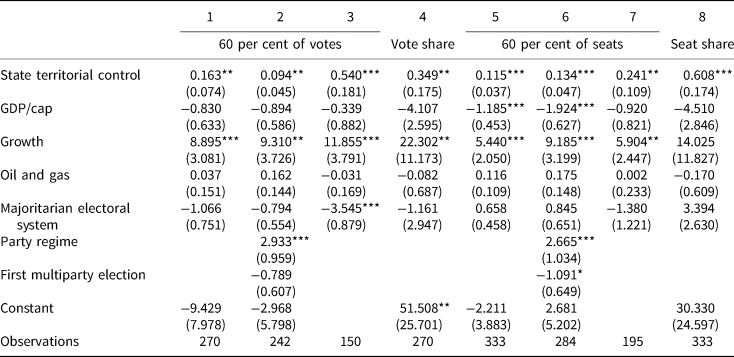
I first test Hypothesis 1, which predicts that the state's capacity to control its territory makes autocrats more likely to win large-majority victories. This corresponds to a test of the main effect illustrated in Figure 1. Table 1, Models 1 and 5 show that if we look at the effect of the average level of state control over the past three years, state capacity significantly increases the likelihood that the largest party wins at least 60 per cent of votes and seats in parliamentary elections. The finding is in accordance with Hypothesis 1. Although growth, a proxy for performance legitimacy, has a significant positive effect on the likelihood of large victories, state control also has a substantial independent effect. In correspondence with this finding, Models 4 and 8 reveal that territorial control is not only associated with an increased likelihood of large-majority victories; it also increases vote and seat shares in general.
The state's capacity to control its territory and large majority electoral victories

Note: Models 1–3 and 5–7 are logistic regression models. Models 4 and 8 are OLS. All models with robust standard errors clustered on country. Models 3 and 7 are country fixed effects models. Regime age (cubed) included but not shown (see Appendix Table C). *p < 0.10, **p < 0.05, ***p < 0.01
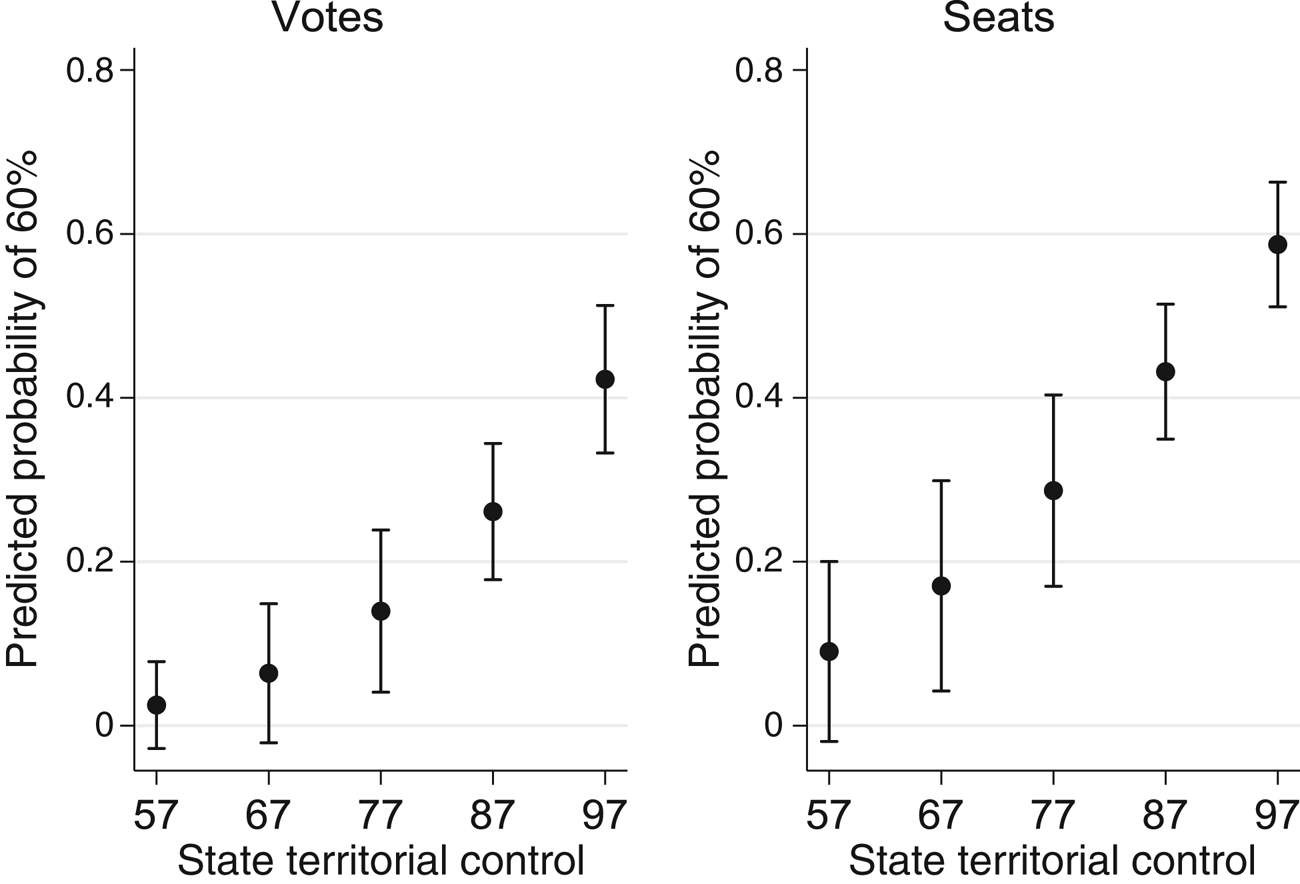
The substantial effects are illustrated in Figure 2, and the predicted probabilities, calculated with covariates held at their observed values (Hanmer and Kalkan Reference Hanmer and Kalkan2013), are reported with confidence intervals in Appendix Table D1. In an authoritarian regime in which the state effectively controls 57 per cent of the territory (the minimum in the sample), the predicted probability of the largest party winning at least 60 per cent of votes in parliamentary elections is 2.5 per cent. In a regime where the state controls all of the territory, the probability of at least a 60 per cent majority of votes is 47.5 per cent. This difference is statistically significant (p < 0.01, Appendix Table D1). Correspondingly, the predicted probability of winning 60 per cent of seats in parliament changes from 9 to 63 per cent as the state apparatus’ control over the territory increases from the minimum to the maximum (p < 0.01, Table D1).
Predicted probabilities of large victories across levels of state territorial control
Note: based on Table 1, Models 1 and 5. Covariates held at their observed values.

Models 2 and 6 introduce controls for party regimes and first multiparty elections. A majoritarian electoral system does not lead to high-margin victories in terms of votes or seats. However, party regimes are significantly more likely to win a large majority of votes and seats than other types of autocracies that rely less on a central party. Furthermore, first multiparty elections are negatively associated with large victories in terms of seats, which underscores the idea that the capacity to win sound electoral victories is built up over time.
In spite of these significant effects of party regimes and first multiparty elections, the effect of state control over territory remains significant and substantial.Footnote 12 The effect of state control on large victories is not driven by strong states being more likely to have majoritarian systems that generate higher margins of victory or by party regimes being better able to control the territory and win elections. The control for multiparty elections ensures that results are not driven by dictators who control strong states and decide to implement elections only when they know they can win them. The fixed effects models (3 and 7) show that increased state capacity within countries over time heightens the likelihood of large victories.
The effect of state territorial control remains substantially and statistically significant across six additional sets of robustness checks. First, the effect of the state's capacity to control territory on its ability to generate supermajority victories is independent of whether the regime is facing a civil war, which could be theorized to affect levels of territorial control and margins of victory (Appendix Table E1). Secondly, the results are also robust to controlling for and excluding the small number of cases in which variation in the seat share was limited, for instance because of seats reserved for the ruling party or a cap on the number of seats allowed for any one party (Appendix Table E1). Thirdly, the relationship between territorial control and victories is not driven by strong states’ ability to abuse quotas: the effects remain when controlling for parliamentary seats reserved for women (Appendix Table E1).
Importantly, there are a few cases in the sample in which the largest party in elections is not the ruling party as the incumbents lost and the authoritarian regime broke down following elections. In a fourth robustness test, the effect of territorial control on large victories remains when controlling for (and when excluding) elections in which the opposition won and the vote and seat share of the largest party refers to an opposition party or coalition (Appendix Table E2). Fifthly, excluding monarchies – in which it is sometimes not the largest party but independents who support the ruler (the monarch) – does not change the results (Appendix Table E2). Finally, the results remain the same when running the analyses with varying thresholds on the dependent variable, ranging from 55 to 65 per cent of votes and seats (selected results in Appendix Table F).
Mechanisms: the state's capacity to control its territory and electoral manipulation
Autocrats who control the territory through the state apparatus are significantly and substantially more likely to gain a large-majority victory. This result could stem from the fact that high-capacity regimes perform better and thereby secure more votes. However, the fact that the effect of state capacity is robust to controls for economic growth, GDP per capita, and income from oil and gas supports the idea that it is not only performance legitimacy that drives the results. I thus proceed to investigate whether high-capacity autocrats are in fact more likely to use subtle manipulation strategies than low-capacity autocrats (Hypothesis 2 and Arrow 2 in Figure 1). The results are presented in Tables 3 and 4.
Models 1–3 (Table 2) test the first argument in Hypothesis 2: Are high-capacity regimes more likely to use the media to their own advantage? The positive and significant coefficients in Models 1–3 show that as territorial control increases, media bias becomes more likely. The predicted probabilities are reported in Table D1: Where state control is at its minimum, the likelihood of the media being biased to the advantage of the incumbent during an authoritarian election campaign is 23 per cent. When control increases to its maximum, the likelihood of media bias during elections increases to 49 per cent and the difference is statistically significant (p < 0.1). The results are robust to controlling for party regimes and first multiparty elections as well as fixed effects models. Furthermore, using an alternative proxy for media manipulation – whether the opposition has free access to the media during election campaigns – also supports Hypothesis 2 (Appendix Table I).
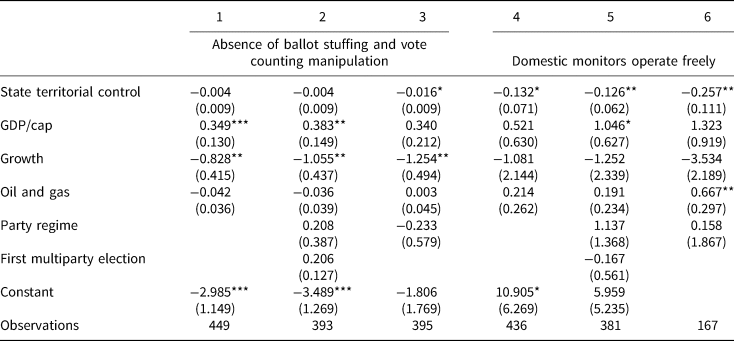
The state's capacity to control its territory and subtle manipulation

Note: logistic regression models with robust standard errors clustered on country. Models 3 and 6 are fixed effects models. Regime age cubed included but not shown (see Appendix Table G). *p < 0.10, **p < 0.05, ***p < 0.01
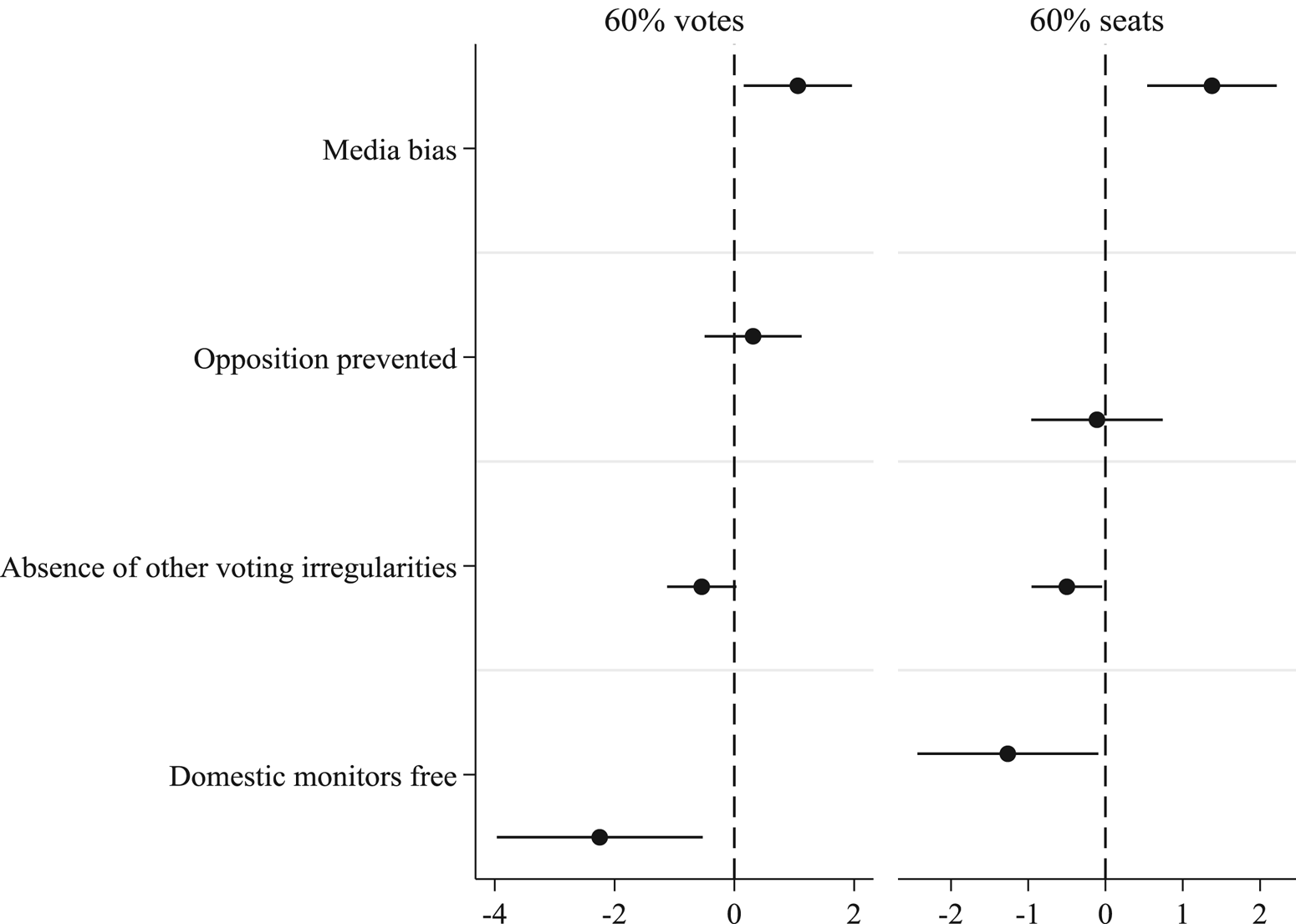
Figure 3 introduces the test of the second part of the mechanism, stating that media manipulation also increases the likelihood of the incumbent winning large electoral victories. The top panel shows the logistic regression coefficients for media bias on the likelihood of at least a 60 per cent majority of votes and seats. The effects are positive and significant and robust to various controls. If the media is biased, the likelihood that the incumbent will win at least 60 per cent of votes increases from 30 to 43 per cent; this difference is statistically significant (p < 0.1, Appendix Table D2). These findings support the idea that subtle manipulation is an important mechanism through which state control contributes to large victories and, in turn, potentially regime stability.
Subtle manipulation and large victories
Note: regression coefficients for the effect of the four subtle manipulation strategies on the likelihood of the incumbent winning 60 per cent of votes and 60 per cent of seats. 90 per cent confidence intervals. Controlled for GDP/capita, growth, income from oil and gas, majoritarian electoral system and regime age (cubed). Results remain with additional controls (not reported). Based on Appendix Table J.

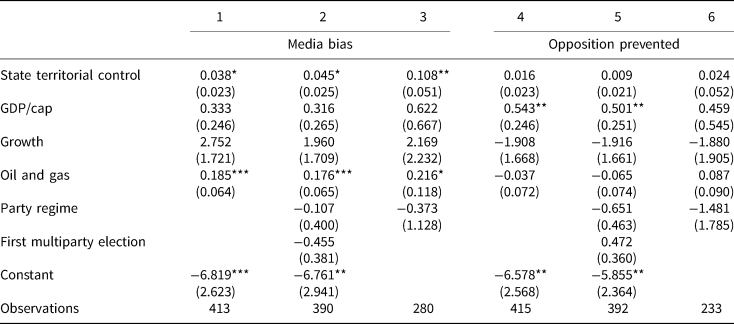
The second argument of Hypothesis 2 is tested in Table 2, Models 4–6. Here, the results do not corroborate the hypothesis. Although high state control correlates positively with opposition figures being prevented from running, the effect is not statistically significant. Furthermore, the bottom panel in Figure 3 shows that preventing the opposition from running has no significant effect on large victories. It therefore seems that the positive effect of state control on electoral victories in authoritarian regimes works through other subtle manipulation tactics. However, the null finding on this part of the hypothesis may also be caused by the available measure. Theoretically, the idea is that the opposition is inhibited from campaigning across the territory without the use of coercion. The measure, however, captures whether opposition figures are prevented from running – a maneuver that is often carried out from the capital and does not necessarily depend on territorial control. Unfortunately, there are no available measures capturing only subtle obstacles to the opposition's campaign, such as restricting access to venues or inhibiting daily work by pestering local party headquarters. Were such measures available, the effect of state control on opposition campaigns may have been clearer.
Table 3, Models 1–3, tests the third argument of Hypothesis 2. The measure captures the absence of voting and counting irregularities such as ballot stuffing and the false collation of votes. The negative correlation between state territorial control and the absence of such irregularities demonstrates the expected effect: as state territorial control increases, ballot stuffing and false vote counting are more common. However, the relationship is only statistically significant when analyzing differences in state territorial control within countries over time (Model 3). This part of the hypothesis does not find support in the random effects models. The mixed results on the effect of state control on irregularities such as ballot stuffing could imply that ballot stuffing is not as preferable to high-capacity autocrats as, for instance, media manipulation. However, the results may also reflect the fact that the measure includes not only ballot stuffing and manipulation of vote counting but also other voting irregularities, some of which may be less clearly preferable to leaders with high degrees of territorial control.
The state's capacity to control its territory and subtle manipulation, continued

Note: Models 1–3 are OLS and Models 4–6 are logistic regression models. All models with robust standard errors clustered on country. Models 3 and 6 are fixed effects models. Regime age (cubed) included but not shown (see Appendix Table H). *p < 0.10, **p < 0.05, ***p < 0.01
Looking at the other part of the mechanisms – the effect of subtle manipulation on large victories (Figure 3) – ballot stuffing and false vote counts increase the likelihood that incumbents will win large victories, as argued in Hypothesis 2 (the effect is negative because the measure captures the absence of irregularities) (p < 0.1). Going from no irregularities (max) to widespread irregularities increases the likelihood of a large majority of votes by 30 percentage points (p < 0.1, Appendix Table D2).
The final argument of Hypothesis 2 is tested in Table 3, Models 4–6: the greater the state's control over territory, the less likely it is that independent, domestic monitors are allowed to operate freely. The effect is statistically significant and confirms the expectation that one way in which autocrats use state control over territory during elections is to restrict the independent monitors who could potentially reveal fraud. The chances of domestic monitors operating freely drops from 93 to 69 per cent as state control increases from its minimum to its maximum level (p < 0.01, Appendix Table D1). These results are robust to controlling for economic factors, regime age, party regimes, and first multiparty elections and to estimating fixed effects models.
Furthermore, in correspondence with the second part of the mechanism (Arrow 4, Figure 1), the final panel of Figure 3 shows that if domestic monitors were allowed to operate freely, this would decrease the likelihood of a large victory, both in terms of votes and seats. The predicted probabilities in Table D2 show that restricting the maneuvering room of monitors increases the likelihood of a large majority of votes by 24 percentage points (p < 0.05).
The results reveal that high-capacity autocrats do indeed manipulate elections. In support of Hypothesis 2, the state's capacity to control its territory increases the use of three of the four hypothesized subtle manipulation strategies. Regimes with a high degree of state control over the territory are significantly and substantially more likely to bias the media and put obstacles in the way of independent, domestic election monitors. The effect of high state territorial control on the use of ballot stuffing and false vote counting is less clear, as the results are only statistically significant in some models. All three strategies were also shown to increase the likelihood of large victories in terms of both votes and seats. Only obstruction of the opposition's ability to campaign could not be shown to increase with state territorial control. However, this finding may reflect the fact that the measure captures the exclusion of opposition figures rather than obstructing their campaigns, as theorized in Hypothesis 2. Overall, the findings support the notion that state capacity increases a ruler's ability to win elections by enabling certain strategies of electoral manipulation.Footnote 13
According to theoretical expectations, there are also forms of manipulation that the state's capacity to control its territory should reduce, simply because they are not attractive strategies when other methods are available. Hypothesis 3 holds that simultaneously with increasing subtle manipulation, high-capacity rulers can afford to restrict their use of harsh or costly manipulation to avoid backlash. The mechanism is illustrated as Arrow 3 in Figure 1 and tested in Table 4.
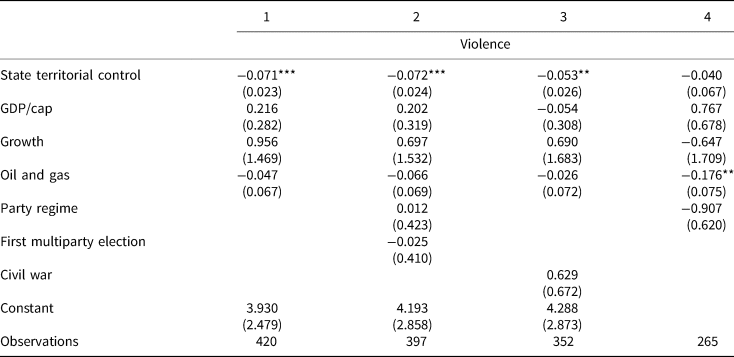
The state's capacity to control its territory and visible and costly manipulation

Note: logistic regression models with robust standard errors clustered on country. Model 4 includes country fixed effects. Regime age (cubed) included but not shown (see Table L, Appendix). *p < 0.10, **p < 0.05, ***p < 0.01.
The coefficient in Model 1 shows that where the state exercises greater territorial control, election violence is also less likely to occur. It may be that high-capacity regimes refrain from the more costly strategy of election violence simply because they have alternatives. When state capacity increases from its minimum to its maximum, the predicted probability of election violence drops from 74 per cent to 20 per cent (p < 0.01, Appendix Table D1).
The results are robust to controls for party regimes and first multiparty elections (Model 2) but not to fixed effects (Model 4). However, the fixed effects models also reduce the sample to only 265 observations, which may explain the drop in statistical significance in the model. Importantly, the results remain substantial and statistically significant when controlling for civil wars in Model 3, indicating that the finding is not driven by regimes with low degrees of state territorial control being more likely to experience civil war and thus to see higher levels of violence both within and outside of election years.
Furthermore, the results remain robust when using an alternative measure of election violence. The NELDA measure captures violence surrounding elections and could in theory include cases where the government did not use violence to manipulate or pressure voters and the opposition into compliance before elections but instead only applied violence after the elections, for instance in response to protests. However, relying on a measure of pre-election violence from the QED available from 1978 to 2004 reveals an identical effect (Kelley Reference Kelley2012). Even though the sample is halved, state territorial control significantly (p < 0.01) decreases the likelihood of pre-election violence on a scale from 0 (no problems) to 3 (major problems) (see Appendix Table M). Again, the results remain when controlling for ongoing civil wars. These results demonstrate that the findings are not driven by incidents of post-election violence and lend support to Hypothesis 3: the state's capacity to control its territory decreases the likelihood of using harsh and costly measures of electoral manipulation. Even though regimes with high levels of territorial control have the capacity to violently repress opposition and voters across the territory, they do so to a lesser extent.
The findings reveal that there is a non-trivial and clear relationship between state capacity (conceptualized as control over territory), manipulation and electoral victories in authoritarian regimes. High-capacity regimes are more likely to win elections with large-majority victories and are more likely to use certain subtle measures of electoral manipulation (measures that in turn correlate with high margins of victory). However, in line with expectations, they are less likely to use visible and more coercive manipulation methods, such as violence, to generate these high margins of victory.
Conclusion
The literature has found autocracies with high levels of state capacity to be more robust to holding elections than low-capacity regimes (Levitsky and Way Reference Levitsky and Way2010; Seeberg Reference Seeberg2018; van Ham and Seim Reference van Ham and Seim2018). This finding may help explain why some autocrats survive the short-term risks of an electoral contest (Knutsen, Nygård and Wig Reference Knutsen, Nygård and Wig2017) – and perhaps even use elections to their advantage – while others face regime breakdown following elections. But how do electoral autocrats use state capacity to stabilize their regimes?
To benefit from holding elections, autocrats depend not only on winning but on winning big. Supermajority victories signal invincibility, discourage elites from defecting, and citizens and the opposition from mobilizing against the regime, and allow the ruling party that dominates parliament even greater powers over electoral laws. In this article, I first show that autocrats with high levels of state control over territory are substantially and significantly more likely to win a large majority of votes and seats in parliament than are low-control autocrats. Thus, supermajority victories are a central mechanism through which state capacity turns elections into a stabilizing tool rather than a force for change in authoritarian regimes.
This finding indicates that the state's capacity to control its territory may help explain other important findings in the literature. For instance, researchers have shown that democratizing outcomes are more likely in competitive than in hegemonic regimes (Brownlee Reference Brownlee2009; Donno Reference Donno2013; Howard and Roessler Reference Howard and Roessler2006). My findings suggest that state control over territory may explain why some regimes stay hegemonic (that is, continually win large majorities) and refrain from democratizing, while others turn competitive and eventually democratic. Thus in order to understand authoritarian regime dynamics, research needs to move beyond categorizing regime types to look at how various capacities of the autocrat, including state control, shape regime type, stability and other important traits.
Furthermore, the argument that the state's reach affects regime dynamics reflects a finding in the literature on internal armed conflict (see, for instance, Fearon and Laitin Reference Fearon and Laitin2003). I show that the reach of the state matters not only in situations of combat but also during more mundane events such as election campaigns. Furthermore, electoral authoritarian regimes – or ‘hybrid’ regimes – may have high levels of state territorial control and are thus not necessarily unstable (Hegre et al. Reference Hegre2001) as they may use such capacities to win elections without relying on outright repression.
Secondly, I argue that although performance legitimacy may form part of the explanation for a large-majority victory – high-capacity states perform better and are therefore able to win votes (Flores and Nooruddin Reference Flores and Nooruddin2016) – it is not the only explanation. Autocrats with high levels of state control over territory are also better able to subtly manipulate elections to their advantage. However, in line with theoretical expectations, high-control autocrats prefer specific forms of manipulation. Autocrats ruling strong states are less likely to use visible and more coercive manipulation, such as election violence, but they are more likely to manipulate the media, prevent domestic election monitors from operating freely, and to stuff ballots and manipulate the counting of votes – strategies that, in turn, correlate with large-majority victories in elections. The findings correspond to previous research highlighting that not all forms of manipulation go together; constrained by factors such as regime type and state capacity, leaders choose the least costly manipulation tactics available to them (van Ham and Lindberg Reference van Ham and Lindberg2015).
This is the first cross-national study of the mechanisms through which state capacity affects authoritarian electoral dynamics. The findings deepen our understanding of how state capacity contributes to authoritarian stability through elections. Furthermore, the argument corresponds well with case studies of electoral autocracies. The trends of autocrats using not only performance legitimacy but also subtle electoral manipulation – documented in case studies of Mexico, Malaysia and Zimbabwe (for example, Magaloni Reference Magaloni2006; Seeberg Reference Seeberg2014; Seeberg Reference Seeberg2018) – are apparently present in electoral autocracies around the world.
However, in spite of impressive ongoing data collection efforts, cross-national measures of electoral manipulation are not sufficiently detailed to capture all the forms of subtle manipulation theorized here. Thus, contrary to expectations, I do not find that high-control autocrats are more likely to discreetly obstruct the opposition's campaign activities across the territory. It is unclear whether the lack of support for this part of the hypothesis stems from the measure capturing the prevention of opposition figures from the ballot rather than manipulation of the campaign. Thus, more research is needed to analyze the relationship between state strength and opposition activities.
Unfortunately, the findings confirm a worrying trend that has been mentioned in the literature. Although state capacity may indeed be necessary in processes of democratization, it can be counterproductive in the hands of autocrats (Slater and Fenner Reference Slater and Fenner2011; van Ham and Seim Reference van Ham and Seim2018). State capacity helps autocrats dominate elections and thereby splinter any hopes of ‘democratization by elections’. Although it is plausible that autocrats who can win elections based on legitimacy alone would be willing to embark on a process of democratization (Flores and Nooruddin Reference Flores and Nooruddin2016), most high-capacity autocrats use the state to subtly manipulate elections and ensure their continued rule. Building strong and efficient states does not guarantee a smooth road to democracy. Rather, an autocrat's ability to control the state apparatus should be curbed if electoral manipulation is to be avoided.
Supplementary material
Data replication sets are available in Harvard Dataverse at: https://doi.org/10.7910/DVN/CTKZIG and and online appendices at: https://doi.org/10.1017/S0007123419000450.
Acknowledgements
I would like to thank Jørgen Elklit, Hanne Fjelde, Patrick Kuhn, Jørgen Møller, Svend-Erik Skaaning, Jakob Tolstrup, Inken von Borzyskowski, Michael Wahman, participants at the CODE workshop on Challenges to Democratization (Aarhus, 2018), participants at the V-Dem Annual Conference (Gothenburg, 2018) and participants at the EPSA Annual Conference (Belfast, 2019) as well as the anonymous reviewers for extensive comments and constructive criticism of various versions of the manuscript. The project has benefited from financial support from Innovationsfonden (4110-00002B).