

History of Present Illness
A 25-year-old gravida 2 para 0 patient presents for pregnancy care and is diagnosed with an early intrauterine gestation. In the patient’s prior pregnancy, she had first-trimester bleeding, and a related ultrasound showed an 8-week nonviable intrauterine pregnancy in the right horn of a bicornuate uterus. She subsequently underwent a suction dilation and curettage performed under ultrasound guidance. Given this history, the patient is very anxious about her current pregnancy. She reports mild nausea and otherwise feels well. Her last menstrual period was 7 weeks ago. Her medical and surgical history are both noncontributory.
Physical Examination
General appearance: Well-appearing, well-developed female in no apparent distress
Vital signs:
Temperature: 36.6°C
Pulse: 91 beats per minute
Blood pressure: 128/78 mmHg
Respiratory rate: 16 breaths per minute
BMI: 28 kg/m2
Abdomen: Soft, non-distended, non-tender
Pelvic: External genitalia are normal. Vaginal epithelium is normal without lesions or discharge. The cervix is normal in appearance without lesions or discharge. Bimanual examination is normal, and the uterus is 7-week size
Laboratory studies:
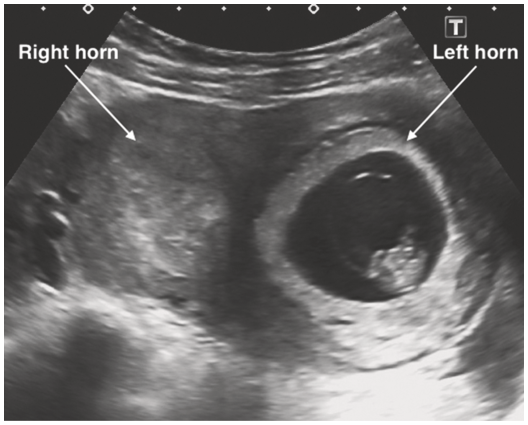
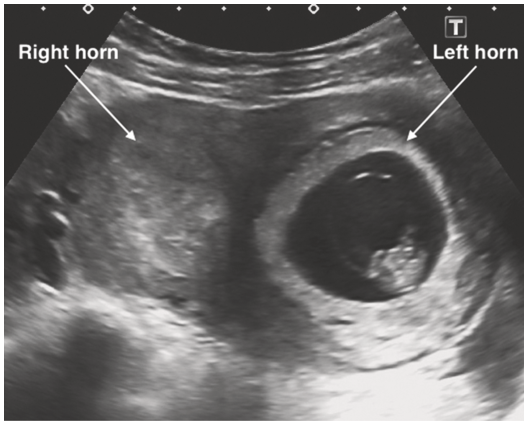
Ultrasound: Single, viable intrauterine pregnancy measuring 7 2/7 weeks in the left uterine horn with fetal cardiac activity. Normal cervix, and right uterine horn with moderate endometrial thickening (Figure 10.1)
Ultrasound of early gestation in left horn of bicornuate uterus.
How Would You Manage This Patient?
This patient was reassured that most patients with a bicornuate uterus achieve a normal pregnancy outcome with a term delivery and vaginal birth. The patient was also counseled about pregnancy complications that occur in patients with congenital uterine abnormalities including the increased risk of first-trimester pregnancy loss, preterm birth, and fetal malpresentation. Counseling emphasized that there are no proven interventions to decrease these risks. Provision of early anticipatory guidance was undertaken to alert the patient of symptoms associated with pregnancy loss and preterm birth and to help guide the patient’s expectations for future delivery planning should malpresentation occur. The patient had a follow-up ultrasound in the third trimester given the association between congenital uterine anomalies and poor fetal growth, but it showed normal growth. The pregnancy progressed to term and the fetus was confirmed to be in cephalic presentation. She had a SVD of a healthy neonate.
Uterine Anomalies in Pregnancy
Congenital anomalies of the female reproductive tract are the result of deviations from normal embryologic development [Reference Cunningham, Leveno and Dashe1]. As with most organ systems, embryologic development of genitourinary structures begins early in the embryonic period. The upper urinary system derives from the mesonephric ducts that develop into the kidney and ureter. The urogenital sinus develops into the bladder, urethra, and the distal vagina. The paramesonephric or Müllerian ducts develop into the upper vagina, cervix, uterus, and fallopian tubes [Reference Cunningham, Leveno and Dashe1]. Failure of any of these embryologic developmental steps can result in congenital anomalies of the genitourinary tract. While diverse in their clinical presentation and associated medical complications, all congenital genitourinary tract abnormalities can impact reproductive health and pregnancy [Reference Cunningham, Leveno and Dashe1,Reference Akhtar, Saravelos, Li and Jayaprakasan2].
Congenital uterine anomalies result from a few specific failures in embryologic development of the Müllerian ducts.
1. Failure of Müllerian duct formation: If bilateral, failed formation results in Müllerian agenesis and pregnancy would not be possible. However, unilateral failure of Müllerian duct formation results in a unicornuate uterus where pregnancy is possible.
2. Complete failure of Müllerian duct fusion: Complete failed fusion results in a uterus didelphys. Although there are variations on the classic presentation, typically patients with uterus didelphys will have two uteri, two cervices and a septum in the upper vagina (which may obstruct outflow from one cavity, resulting in an earlier diagnosis).
3. Partial or incomplete Müllerian duct fusion: Partial or incomplete fusion results in a bicornuate uterus. In this circumstance, a patient will typically have one cervix that splits in the lower to mid uterus into a bivalued uterine cavity.
4. Failure of the midline septum to resorb: Failure to resorb results in a septate uterus [Reference Cunningham, Leveno and Dashe1].
Specificity of diagnosis is imperative for appropriate counseling and management of uterine anomalies in pregnancy. In 2021, the American Society for Reproductive Medicine (ASRM) published a new and robust classification system that maintains the simplicity of prior classification systems while also integrating the more nuanced complexities of diagnosis to make the tool more comprehensive and more widely applicable [Reference Pfeifer, Attaran and Goldstein3]. The classification is most easily accessed via a web-based tool that allows users to not only classify the abnormality, but also appreciate variations in presentation, symptoms, and examination. It also provides guidance regarding appropriate imaging techniques [4].
The incidence of Müllerian anomalies in the general population is 0.4–10% but is markedly higher in patients with infertility (8%) and recurrent pregnancy loss (24.5%) [Reference Cunningham, Leveno and Dashe1,Reference Chan, Jayaprakasan and Zamora5]. In patients with these diagnoses, thoughtful consideration of the uterine morphology is necessary to rule out a uterine anomaly. Uterine anomalies may first come to clinical attention during routine first-trimester sonography, and therefore, decisions for further diagnostic testing may be limited by intrauterine gestation [Reference Cunningham, Leveno and Dashe1,Reference Akhtar, Saravelos, Li and Jayaprakasan2]. Several imaging modalities can be considered for diagnosis including 2D and 3D sonography, hysterosalpingogram, MRI, laparoscopy, and hysteroscopy. Balancing risk, cost, and accuracy of diagnosis the best initial test is 3D sonography, which has a diagnostic accuracy of 97% [Reference Cunningham, Leveno and Dashe1,Reference Akhtar, Saravelos, Li and Jayaprakasan2,Reference Dietrich, Millar and Quint6]. If after 3D sonography the diagnosis is in doubt, MRI is highly sensitive and specific [Reference Akhtar, Saravelos, Li and Jayaprakasan2].
The relationship between the embryologic development of the mesonephric and paramesonephric ducts leads to a common association between congenital anomalies of the vagina, cervix, and uterus and anomalies of the renal system. Around 50% of people with congenital reproductive tract anomalies will have a concomitant renal or ureteral anomaly, with unilateral renal agenesis being the most common [Reference Cunningham, Leveno and Dashe1]. Evaluation of the renal system is essential at the time of diagnosis of a congenital uterine anomaly and ultrasound, MRI, or IV pyelography can all be considered for renal evaluation [Reference Cunningham, Leveno and Dashe1].
While most patients achieve a normal pregnancy outcome, congenital uterine anomalies have been linked to several pregnancy complications including early pregnancy loss, malpresentation, preterm birth, and poor fetal growth [Reference Cunningham, Leveno and Dashe1,Reference Akhtar, Saravelos, Li and Jayaprakasan2]. The anatomic variations in congenital uterine anomalies have varying reproductive consequences. Patients with septate uteri have the highest incidence of reproductive complications with a near threefold increased risk of infertility, an over twofold increased risk of first-trimester pregnancy loss and preterm birth, and a sixfold increased risk of malpresentation [Reference Chan, Jayaprakasan and Tan7]. While not associated with infertility, patients with a bicornuate or unicornuate uterus have a 3.5-fold increased risk of first-trimester pregnancy loss, a 2.5-fold increased risk of preterm birth and an over fivefold increased risk of fetal malpresentation [Reference Chan, Jayaprakasan and Tan7]. Patients with a uterus didelphys have a 3.5-fold increased risk of preterm labor and an almost fourfold increased risk of fetal malpresentation [Reference Chan, Jayaprakasan and Tan7]. Poor fetal growth in patients with congenital uterine anomalies is thought to be due to comparatively poor placental prefusion resulting from reduced uterine blood flow related to the anatomic defect [Reference Dietrich, Millar and Quint6]. In one study, birth weight less than the 10th percentile was noted in 3.8% of patients with a normal uterus, 50% of patients with uterus didelphys, 28.3% of patients with a bicornuate uterus, and 18.8% of patients with a unicornuate uterus [Reference Hua, Odibo and Longman8].
Despite the association of congenital uterine anomalies with pregnancy complications, interventions to offset these risks are relatively limited. In patients with a uterine septum and infertility or recurrent pregnancy loss, hysteroscopic excision of the septum can be considered and is associated with improved pregnancy retention rates [Reference Akhtar, Saravelos, Li and Jayaprakasan2]. Surgical interventions for bicornuate or didelphic uteri, like metroplasty, are not recommended and have not been proven to improve reproductive outcomes [Reference Akhtar, Saravelos, Li and Jayaprakasan2]. Aside from hysteroscopic septum excision, there are no proven interventions or treatments for first-trimester loss, preterm birth, or fetal malpresentation associated with uterine anomalies [Reference Cunningham, Leveno and Dashe1,Reference Akhtar, Saravelos, Li and Jayaprakasan2,Reference Dietrich, Millar and Quint6]. Counseling patients regarding these risks early in pregnancy is essential for shared decision-making. Providing anticipatory guidance regarding preterm labor symptoms and the potential impact of a diagnosis of uterine anomaly on delivery planning (both as it related to malpresentation and preterm birth risk) is essential for setting patient expectations. Given the association between congenital uterine anomalies and poor fetal growth, it is reasonable to consider a third-trimester growth scan in pregnant patients with these conditions.
Vaginal delivery is generally achievable in patients with congenital uterine anomalies except in the case of fetal malpresentation [Reference Cunningham, Leveno and Dashe1,Reference Akhtar, Saravelos, Li and Jayaprakasan2]. If malpresentation exists, a trial of external cephalic version is reasonable [Reference Cunningham, Leveno and Dashe1]. Due to malpresentation, risk of cesarean section in this population is higher than in patients with a normal uterus. Research on trial of labor after cesarean section (TOLAC) in this patient population is limited with mixed results, and therefore shared decision-making must be carefully undertaken in patients who desire TOLAC with a congenital uterine abnormality [Reference Cunningham, Leveno and Dashe1]. In the event that a uterine anomaly is diagnosed at the time of cesarean section, intraoperative survey and operative documentation should carefully outline the nature of the abnormality [Reference Cunningham, Leveno and Dashe1].
Key Teaching Points
Congenital uterine anomalies are the result of deviations in embryologic development and can be associated with concomitant renal abnormalities.
As reproductive outcomes differ with the various Müllerian abnormalities, specific diagnosis is imperative to drive counseling. The American Society for Reproductive Medicine has a robust classification system and web-based application to aid in classification.
Normal pregnancy and birth outcomes are common in patients with congenital uterine anomalies.
Pregnancy-associated complications in patients with congenital uterine anomalies include increased risk of first-trimester pregnancy loss, preterm birth, fetal malpresentation, and poor fetal growth. The degree of risk varies based on the type of uterine anomaly.
Vaginal birth should be attempted in patients with congenital uterine anomalies unless there is fetal malpresentation or other maternal or fetal indication for cesarean section.