The factors leading to change in the organizational structure of government are important to analyze, because government agencies influence whether and how policies are turned into outcomes that matter in the political process.Footnote 1 The survival and termination of government agencies has long been of interest to researchers,Footnote 2 although systematic mapping of agencies, policies and programs over time is fairly new.Footnote 3 Work that systematically assesses influences on organizational survival is scarcer still.Footnote 4 To date, the most substantial, systematic work on agency survival is Lewis’s research on the termination of federal agencies within the US separation of powers system. Lewis found strong evidence that federal agencies face a higher risk of termination when political change leads to a unified government (when the president and the majority in both houses of Congress are of the same party) that is distinct from the coalition of actors establishing these agencies,Footnote 5 which fits with the literature on differences in party positions and party effects on government policies.Footnote 6 Structures to insulate agencies from direct political control and, more specifically, direct presidential control, reduce this effect and consequently create a credible commitment between the coalition of actors establishing such an agency and the supporters of that coalition.Footnote 7
Among advanced democracies, the United States is an outlier. Most other countries in this group have parliamentary systems, in which it is very difficult for any incumbent coalition to credibly pre-commit the governmental apparatus to a course of action that cannot be completely overturned at the next election.Footnote 8 Since the executive in a parliamentary system can undertake many organizational changes without the need for legislation or other approvals, we expect very different forces to determine the survival of government agencies in parliamentary as opposed to separation-of-powers systems. In a parliamentary system, the main changes in the executive consist of changes to the party in power, the prime minister and individual departmental ministers. Ministers have long been a subject of research, but recent work has for the first time systematically mapped out the pattern of ministerial survival and the role of the prime minister in hiring and firing ministers.Footnote 9 Changes in party control of government and prime ministerial changes have recently been linked to periods of relatively high change in the policy agenda, defined as the list of policy issues prioritized by the government.Footnote 10 However, the effects of executive change on agency survival have not previously been assessed.
The next section of this article sets out the theoretical argument about how the incentives for elected governments in parliamentary systems affect the survival of government agencies. Our theory sits within the broader literature about party governments, prime ministers and departmental ministers; departmental ministers are central to our analysis, because the government agencies we examine fall under their responsibility. The following section describes our new dataset of UK ‘executive agencies’ from 1989–2012. The start of this period marked the beginning of implementation of this new organizational form in the UK. Executive agencies are organizations under the direct supervision of ministers who set performance targets for each agency each year, and who have the power to set up or abolish them without requiring legislation. Our time period allows us to examine the relationship between the survival of all the bodies of this type set up over the period and change in the political executive. The period covers changes in power from Conservative to Labour in 1997 and from Labour to the Conservatives and Liberal Democrats in 2010, changes in departmental ministers and four changes of prime minister. The findings are of broad relevance because close variants of this type of organization now exist not only in Britain but in several other parliamentary systems, notably in Austria, Australia, Belgium, Canada, Denmark, Estonia, Germany, Hungary, Ireland, Italy, the Netherlands, Norway and Sweden.Footnote 11
The subsequent section reports our findings that ministerial change drives agency terminations, and that this form of political change trumps agency performance because poor performance against targets does not appear to raise the risk to survival. The final section draws conclusions about the importance of these ministerial changes, which contributes to a growing literature that uses quantitative data to analyze the key role of these actors in government,Footnote 12 and develops implications for theories of executive politics and priorities for future research.
Changes in the Executive and the Survival of Government Agencies
The structure of government agencies matters, because agencies institutionalize approaches to public policy by putting distinct activities under the control of managerial leadership that is specific to each agency. Agency structures affect the economy, efficiency and effectiveness of government action, and embody sets of relationships between the agency and actors across the government system and beyond. Thus the principal actors within the political executives of parliamentary systems have a strong interest in the organization of government agencies. These actors also have a position in the government system that enables them to make changes to agency structures. Parties in government require organizations to implement their policies and deliver their programs to voters.Footnote 13 Governing parties tend to have fairly stable core tenets on a range of policy issues and represent broad, enduring interests among segments of the electorate. Parties in government have a direct interest in closing agencies they feel do not promote their agenda, which breaks up those management structures and sends a signal about government priorities. In the US context, Lewis notes that ‘administrative agencies never escape the politics that created them’;Footnote 14 their survival is endangered by political changes that bring different priorities to the fore. Research has examined political changes in parliamentary systems as part of work on government duration.Footnote 15 A lack of congruence between a party that is currently in government and the party that established a government agency implies a greater risk that these agencies will be terminated, as they were established to implement the policies of another party. Even if there is some uncertainty about the effects of change on implementation outcomes, there is clear evidence that governments of different parties seek to change the policy agenda, highlighting their own lists of subjects or problems as priorities at the expense of previous priorities, although there are also changes within the period of a party’s control.Footnote 16 Therefore, we expect that agencies established by a party other than the one in government in any given year will be more likely to be terminated.
Prime ministers act as party leaders or leaders of the bloc that controls the legislature, and focus on areas that will help their party retain power and maintain sufficient support within the party or coalition. The importance of the prime minister means the post has received considerable scholarly attention in its own right.Footnote 17 Prime ministers seek to maintain sufficient support within a party to continue in their post and, related to this, seek to raise their party’s chances of winning the next election. Prime ministers can change either at election times or between elections, due to shifts in the balance of power within their parties, or because of pre-arranged deals between factions within their party, as in the transition from Tony Blair to Gordon Brown in the United Kingdom in 2007. These shifts, in turn, are likely to be accompanied by shifts in policy emphasis that have been found in changes in the UK policy agenda following changes in prime minister.Footnote 18 A change in prime minister and change in policy agenda may require different organizations to further these different goals and to show a different direction in policy. Therefore we expect that agencies established by a prime minister other than the one in power in any given year will be more likely to be terminated.
Within a government, departmental ministers have responsibility for major portfolios of activity and are in the top echelon of government, alongside their leader, the prime minister. They seek to demonstrate their abilities to those in control of the opportunities for their advancement, notably the leader. Ministers are increasingly the subject of systematic quantitative analysis of their careers and actions.Footnote 19 Within this literature, the core tenets of our approach are consistent with Berlinski, Dewan and Dowding’s novel principal-agent model of a prime minister’s hiring and firing of ministers, although we do not seek to model this aspect of the political system. In their model, ministers seek mainly to avoid removal and advance their ministerial careers. Within each minister’s portfolio, a range of agencies is charged with implementing the details of government policy for the policy area. Ministers can reorganize their portfolio of agencies by terminating some. Newly appointed ministers, including those following on from a previous post-holder who was removed for failing to follow the policy favored by the prime minister, might be expected to reorganize the agencies under his or her control.Footnote 20 Unlike many other activities that ministers could engage in, these changes are very much under their control; thus they serve the valuable function of indicating a minister’s policy priorities or capacity to do his or her job. Even if a minister’s termination of agencies does not fulfill all of his or her goals, making changes to organizations in their portfolios is perceived as a step in their career. From the perspective of an individual politician, what a ministry can do for his or her career is often as important as what he or she can do for the ministry.
Ministers often change within a government’s term, and ministerial turnover is high. In the UK, the mean duration in office for the most senior cabinet ministers is 28.7 months.Footnote 21 Organizational terminations of agencies are useful for ministers, because these changes occur in a timespan of several months, but within this mean length of ministerial tenure. Yet if a minister establishes an agency and then terminates it, this would be unlikely to promote the policy priorities that led him or her to set it up in the first place and would likely raise questions, including from the prime minister, about that minister’s judgement and capacity. It would be unlikely to send a positive signal about the minister’s ability to deal with more challenging and prestigious portfolios. Based on these considerations, we expect agencies that were established by a different minister than the one overseeing them in any given year to be more likely to be terminated.
In summary, for an agency in any given year, party congruence means that the governing party that established the agency is still in power; prime ministerial congruence means that the prime minister who established the agency is still in power; and ministerial congruence means that the departmental minister who established the agency is still overseeing it. An incongruent state along any dimension implies a more dangerous environment for an executive agency.
In addition to periods of congruence or incongruence, our theory focuses on the influence of periods immediately following a change in the executive. Changes in party control of government, prime minister and overseeing minister are likely to increase attention from all actors on organizations’ potential termination in the period just after the succession. By contrast, incongruence may persist well beyond the period just after a change, for example if a new governing party, prime minister or minister is in that office for several years. The importance of party change has been established by research on policy agenda announcements in the UK using analysis of the Queen’s Speech, which sets out the government’s policy priorities each year. For the period 1940–2005, large policy changes are more likely after a general election if a new party is elected.Footnote 22 While these years make up just 9 per cent of all Queen’s Speech years, they account for 22 per cent of all large policy changes.
However, John and Jennings note that policy agenda changes also occur at other points in time. New prime ministers and departmental ministers can also use reorganizations to control agencies and signal new policy priorities. Prime ministers and departmental ministers are aware of the time limits on their tenure, and the period immediately after a new politician takes over is a key time when changes to organizational structure are likely. This mechanism is paralleled by that operating in the United States, where new presidents need to ‘hit the ground running’ and are more likely to reorganize early in their period of office, which increases the risk to agencies at this time.Footnote 23 Therefore, we expect that executive agencies will be more likely to be terminated in the year following a change in the governing party, prime minister or their overseeing departmental minister.
A number of confounding factors relevant to these expectations have to be taken into account when explaining the survival of agencies. An often-discussed factor is the age of the organization. A long line of work has identified a ‘liability of newness’, in which many factors work in the same direction to place new organizations at greater risk than older ones.Footnote 24 This argument is consistent with the idea that bureaucracies forge their identity. That is, by building a reputation for efficiency, expertise and uniqueness of service, organizations can enhance their durability.Footnote 25 There is also a counterargument in the literature, however. Public organizations can fall out of step with changing technologies and broader environments, which increases the risk they face as they age.Footnote 26 There is little empirical evidence of a clear relationship between an agency’s age and the risk it faces at a particular age.Footnote 27 Organizations do not age in a way that is found in biological processes, however tempting particular analogies with the human life course may be. Instead, age is often a proxy for a set of factors influencing survival that we incorporate directly into our survival models.
Change in an organization’s managerial leadership potentially raises the risks for that organization because it causes disruption, even if the change might have brought benefits eventually.Footnote 28 This disruption ensues regardless of whether the previous manager left voluntarily or was forced out. The discontinuity of leadership could make an organization more vulnerable to reorganization by the overseeing minister. We therefore include a dummy variable for whether an agency’s chief executive (agency head) changed during a financial year.
It has long been suggested that an organization’s performance – as judged by its key stakeholders – is important for its continued existence. Such a relationship is well established for firms in the private sector, where success can be assessed by profitability.Footnote 29 Performance tends to have more dimensions in the public sector, and the benefits and costs of activities are more contested. Yet one school of thought suggests that government agencies that fail to deliver results for their stakeholders will lose support and are in greater danger of termination.Footnote 30 Governing parties, as the key stakeholders, are expected to be more likely to terminate poorly performing agencies than ones they perceive to be performing well. Politicians concerned about re-election are likely to have an interest in agencies that deliver their policy goals effectively. Extremes of performance have previously been found to have political consequences, especially very poor performance,Footnote 31 which suggests that government agency performance will most clearly affect their survival when it is relatively high or low. We use data about agency performance against targets set and monitored by the responsible departmental minister, who is the predominant stakeholder for the agency, to assess performance each year.
We extend the analysis of performance beyond performance targets to consider other factors that might not be picked up by targets. We use media attention to agencies, defined as the number of newspaper stories about each agency each year, as a proxy for this performance context. Media coverage is a valuable proxy, because previous research has established that there is a substantial negativity bias in press reporting of public service performance, such that attention predominantly reflects perceived problems with the agency.Footnote 32 We also interact this variable with ministerial change and performance target achievement to see if these variables are more influential in a context of heightened interest in the agency.
The political institutional context of agencies has been recognized as an influence on their survival. For the United States, Lewis found that the existence of institutions that protect an agency from political interference (such as having statutory status and being excluded from executive budgetary review processes) reduces the risk of their termination. However, subsequent work on American New Deal agencies suggests that initial institutional protection may not always last.Footnote 33 In parliamentary systems, many government agencies share a common institutional structure. These executive agencies report directly to ministers, not the legislature, and have relatively little autonomy from executive politicians in a system in which overall autonomy for any public organization is limited. Here, theories of independence for credibility or blame shifting are of less relevance. The observation about the US federal government that ‘presidents increasingly are faced with an accumulation of agencies over which they have little control’Footnote 34 does not generally hold for executive politicians in parliamentary systems. In parliamentary systems, theoretical arguments about how one branch of government insulates agencies from interference by another are much less relevant, as powers are fused.Footnote 35
Executive politicians have less potential to shift blame, and are centrally concerned with the performance of the agencies they set up (and can abolish). While agency heads are held to account for operational performance by their supervising ministries, the ministers themselves are ultimately responsible for the agencies delivering their policies. A partial exception from ministers’ dominance over their agencies is where an agency draws on streams of funding separate from budgetary appropriations, normally by directly charging users for their services. These agencies are able to use this autonomy as a buffer to reduce resource-based pressures for termination. We include a dummy variable for agencies that have formal financial autonomy to raise part of their budget through by charging users. Another factor related to an agency’s capacity to defend itself is size; it has been suggested that larger agencies are partially insulated from termination because they have larger constituencies with which to protect themselves.Footnote 36 We therefore also include a control variable for staff size.
Agencies’ functions may also influence their survival, bringing with them differences in the organizational environment.Footnote 37 We control for types of function, noting whether an agency is primarily oriented toward regulatory, research or service outputs. The latter category is further split into agencies predominantly serving clients outside and inside government. Agencies’ chances of survival are also likely to be affected by the overall munificence of the fiscal environment.Footnote 38 We therefore control for central government public spending in our analysis.
Data and Methods
We test our propositions about the survival of government agencies by examining all executive agencies reporting directly to the UK central government, beginning with the first agencies of this type created in financial year 1988–89 and covering all such agencies directed by the central government up to and including financial year 2011–12. The bodies were set up following the recommendations of a report by the Prime Minister’s Efficiency Unit called the ‘Next Steps’ for improving management in government, a term by which the reform to create executive agencies became known in the UK and internationally. We focus on these bodies because they were a new organizational form created to carry out the executive functions of government; they constituted a break with the earlier form of organization, in which the executive functions were predominantly bundled up within departments rather than being handled by distinct organizations. While some individual elements of the executive agency organizational model were used prior to 1989 (for example, organizational mission statements and objectives), after this date, for the first time, the full model of organization was systematically implemented across the UK central government.
Executive agencies all share a defining governance structure comprised of a chief executive (agency head) with a senior management team, a framework document overseen by the parent department setting out the agency’s mission and objectives, and a regime of performance targets linked to the objectives. The chief executive is accountable for the agency and has considerable management freedom to deliver the agency’s objectives within the prescribed accountability to ministers. Agency heads are held to account for operational performance by their supervising departmental minister, who also approves the agency framework document and performance targets. The minister is part of the government and is ultimately democratically responsible for the agency to the legislature and broader communities. Ministers have the power to both create and abolish executive agencies without requiring legislation to change the organizational form. As such, they provide a good test of our hypotheses concerning changes in the political executive leading to a higher risk of abolition. The types of bodies we examine contrast with independent regulatory agencies, which have become increasingly common in many OECD countries, where they are given formal protection against termination by political executives in order to increase their policy credibility.Footnote 39
Studying terminations of public organizations requires a clear definition of when the lifespan of an organization ends. KaufmanFootnote 40 developed a concept of organizational survival based on an organization’s ability to maintain a boundary between itself and its environment. This concept has proved difficult to apply systematically, however, because organizational boundaries are difficult to measure. Many studies have relied instead on official lists of organizations that are not grounded in analytical concepts of survival, as is discussed in recent reviews of this literature.Footnote 41 We define the termination of a government agency as occurring when its governance structure (of defined roles for managers formally leading an organization and associated accountability mechanisms) has been ended. For UK executive agencies, we take the ending of a Framework Document to mark the end of the agency. We do not count a change of name only; a termination entails the ending of the agency governance structure.
Our analysis covers executive agencies for UK-wide functions from 1989–2012. Country-specific agencies for the devolved parts of the UK that report to the administrations of Wales, Scotland or Northern Ireland are not included. Throughout the period, these bodies reported to their corresponding territorial departments or their formally devolved administrations since 1999.
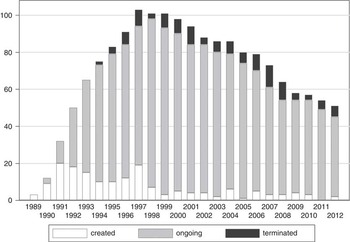
We assess the hypothesized relationships between political congruence, agency performance and the termination of agencies using survival analysis. This method attempts to avoid some of the problems identified with earlier studies of organizational longevity. Kaufman found that many agencies in the United States were highly durable by comparing them at the start and end of a period, ignoring agencies that came and went in the meantime – which inflated his estimate of durability. By contrast, Lewis included all the agencies created and abolished between the two snapshots used by Kaufman, resulting in much higher estimates of agency termination.Footnote 42 We follow Lewis by including all agencies that existed from 1989–2012 in our dataset. Figure 1 provides an overview of the total number of UK agencies in each year since this type of organization was introduced in financial year 1988–89. In the figure, the total number is also broken down into agency creations, agencies that live on in a year, and those that are in their final year (that is, the year in which they were terminated).
Number of agencies created, ongoing and terminated in each financial year

We analyze agency survival using discrete time models with financial years as the unit of time. This approach matches performance information, collected annually (for each financial year),Footnote 43 with survival periods. In our analysis, the dependent variable is whether agencies are terminated in a financial year (termination is coded 1; agencies that continue are coded 0); 80 per cent of all agencies terminated were formally shut down in the last two months of the financial year. We use logit to estimate our models. Under the following conditions, logit is a useful estimator for discrete time survival models such as ours:Footnote 44 (1) the data are structured such that each row in the dataset contains either one year at risk for an agency or the year in which it is terminated; (2) there are no observations that do not cover either an agency-year at risk or an agency in the year of its termination and (3) the baseline hazard is modeled in some form. We fulfill all of these conditions. In particular, we model the baseline hazard fully non-parametrically by including one dummy for each agency age in our dataset.
Our key explanatory variables include congruence at three levels: the party, the prime minister leading the party and the departmental minister overseeing an agency. Party Congruence is measured as congruence of the party administration setting up the agency with the party in control of government at a particular point in time, following the approach used by LewisFootnote 45 in the United States to examine political influence. We code Party Congruence as 1 for a given agency and financial year if the party that established the agency is in control of government in that financial year, and 0 if it is not. For the current coalition government,Footnote 46 we code Party Congruence as 1 if the agency was established by a Conservative government and the minister in control of the department supervising the agency is also Conservative, or if the agency was established by the current coalition. Otherwise, this variable is coded 0 for the present coalition government. Prime Ministerial Congruence is measured as whether the prime minister under whose rule an executive agency was established is still in power in a given financial year. Finally, Ministerial Congruence is measured as whether the minister who established an executive agency is still in office in a given financial year. In these data, no minister returned to an executive agency they established. Consequently, any ministerial succession implies ministerial incongruence; so, for all agencies, ministerial incongruence begins at the first ministerial succession in an agency’s lifespan and continues until its termination or the end of the dataset. Prime ministerial and ministerial congruence imply party congruence,Footnote 47 but ministerial congruence does not imply prime ministerial congruence. A number of ministers stayed on during the transitions from Margaret Thatcher’s government to John Major’s, and from Tony Blair’s government to Gordon Brown’s.Footnote 48
In addition to these three different types of congruence, we separately assess the effects of party, prime ministerial and ministerial successions by including separate indicators for these events. For prime ministers, successions occur in our study period in the financial years ending in 1991 (John Major), 1998 (Tony Blair), 2008 (Gordon Brown) and 2011 (David Cameron). In each of these financial years, the new party, prime minister and minister variables are coded 1 when new and 0 in any other financial year.
A further dummy variable captures the presence of a succession in the agency’s head (chief executive) to assess increased risk during the disruption following this discontinuity of leadership. We operationalize media attention for each agency by first counting the number of stories included in the Nexis UK newspaper database that referred to the agency within a financial year. We then obtain the over-time mean and standard deviation of the number of media stories for each agency over its lifespan within our dataset. Finally, for each observation (agency-financial year), we calculate a z-score of the number of media stories. This score indicates the number of media stories away from the mean, measured in units of the standard deviation of media stories for the agency. This measure shows whether media attention in the year is atypical. We include this variable separately as well as interacted with ministerial change and the proportion of performance targets met.
Agency performance is measured as the achievement of key targets set by ministers. The targets are discussed annually by the agency and the supervising ministerial department, and are formally signed off on by ministers; each agency is required to report publicly on them each year. While the targets have changed from time to time, the percentage of targets met provides a useful annual measure of performance against dimensions that are agreed as important with the supervising minister.Footnote 49 We incorporate performance in two different ways. First, we directly include the percentage of targets met. Secondly, we generate dummy variables for high and low performance on this metric relative to all agencies in the same financial year. High performance is defined here as a target achievement percentage more than one standard deviation above the within-financial year mean of all agencies, while low performance is defined as a target achievement percentage more than one standard deviation below the within-financial year mean of all agencies. For both operationalizations, we also include interaction terms between target achievement and media attention using the media stories z-score introduced above.
Considering the proportion of targets met provides a way to compare performance across a set of agencies handling different activities. This is similar to using the US federal government’s (now discontinued) Program Assessment Rating Tool (PART) scores as performance indicators.Footnote 50 There is no evidence in the UK that the agencies’ performance targets suffer from the apparent partisan bias that has been noted about the PART scores, and they are less vulnerable because they serve a different purpose: they are mainly a tool of ministers’ direct control over their agencies. At the same time, the targets do share some aspects of PART, such as extensive reliance on documented evidence.Footnote 51
We characterize agencies by function and institutional features. All executive agencies we examine were newly established as separate management structures beginning in 1988. However, most of the functions of these agencies were already being carried out by the UK central government (either directly or by organizations with their own distinct governance structures) prior to their creation. We include a dummy variable for executive agencies that are successors to such distinct organizations. In the base category are organizations that were units or sections within government departments; that were created from a split, merger or replacement of an existing executive agency; and agencies that did not exist in any form prior to being set up as an executive agency.
We group agencies by their primary function, using three dummy variables, into those primarily producing for external customers (for example, public or private sector organizations), engaging in regulation or conducting research. Agencies primarily producing for internal customers (that is, government departments) form the base category. As noted above, function has been highlighted in previous work as potentially associated with survival.
As further controls, we operationalize agency size with the number of full-time equivalent permanent staff members. We include the overall amount of central government spendingFootnote 52 to assess the importance of the fiscal context. We capture financial autonomy using an indicator for trading fund status. Agencies with this status have standing authority to use their receipts to fund expenditure, with receipts coming from charging users of the services directly rather than relying solely on government appropriations. They can also establish reserves from their surpluses. This degree of financial independence is likely to make these agencies more immune to termination in challenging circumstances, for instance by permitting them the opportunity to dip into reserves, alter their pricing structures or identify new sources of income.
For all time-varying explanatory variables we use a one-year lag to allow sufficient time for them to affect the risk of termination. The timing of our modeling strategy is shown for a two-year example period in the online appendix. Our one-year time lag for the variables we evaluate hypotheses about (and for all other independent variables) reflects the process of organizational closure, because it takes several months to arrange from the initial decision. New ministers, prime ministers or parties in control of government operate in this timeframe, but it does not take as long to close executive agencies as it would if legislation were required.
It is very difficult to terminate an agency midway through a financial year, because budgets have been set and eight out of ten terminations occur in the last two months of the financial year. Furthermore, if we did not lag our independent variables by a year, we would be at risk of our dependent variable, Termination, occurring before some of the other events that serve as our predictor variables (for example an agency closing in October 1997 and a ministerial change occurring in November 1997).
The data used for the analysis stem from a dataset covering all agencies created since the inception of the ‘Next Steps’ program – which saw the first executive agencies established in 1988–89 – until 2011–12. The sources are official reports for the performance data, and official statistics for government expenditure and staffing numbers. Data on agency function and trading fund status are taken from agency reviews,Footnote 53 Cabinet Office sources and agencies’ own annual reports. Start and end dates of agencies and details of terminations are taken from official sources including agencies’ annual reports.Footnote 54 The ministerial change data incorporate information from online sources and an existing dataset of post-war ministerial turnover.Footnote 55 Chief executive succession dates were gathered from agency annual reports. Data on the number of media stories for each agency each year were collected by searching the online media stories database Nexis.Footnote 56
Findings
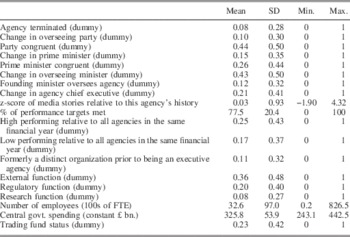
When reporting our models (in Tables 2 and 3), we compare the odds of continuation versus discontinuation of an agency, with continuation as the base category. All the models contain 1,291 observations on the 153 executive agencies that existed during the period of our analysis. Each observation denotes a financial year or ‘spell’ of each agency in the dataset (see Table 1 for summary statistics of all variables in these models).
Summary Statistics

Note: summary statistics are provided for the estimation sample of 1,291 observations on 153 agencies. All time-varying right-hand side variables are lagged by one year. For the dummy variables, the mean is the proportion of the included category in the data.
The pattern of terminations shows that government agencies are very far from immortal, extending findings from the US separation of powers system to this parliamentary context.Footnote 57 In the period 1989–2012, the first agency termination occurred in financial year 1993–94. In our estimation sample, 109 agencies were terminated during the study period. The mean lifespan of an agency was 8.8 years and the median was seven, with the longest continuing for twenty-four years (and still going) and the shortest three years. While agencies themselves are not immortal, their functions come close. Of the agency terminations in our data, there are only two cases in which an agency’s functions were terminated completely.
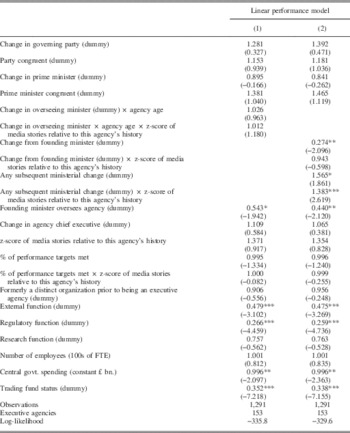
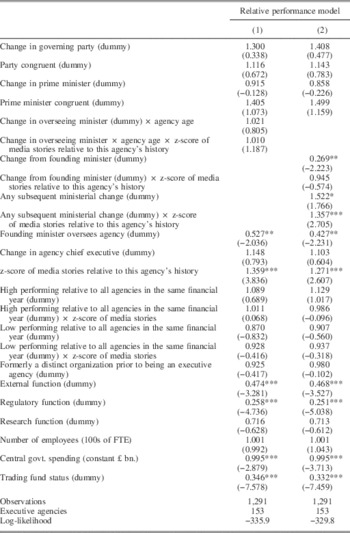
To test our hypotheses, we estimate two sets of discrete-time survival models, with a logit link function. We make no assumptions about the baseline hazard – it is modeled non-parametrically by including a dummy variable for each of the ages of executive agencies included in our analysis. Table 2 shows two models with performance operationalized linearly, as a percentage of targets achieved. Table 3 shows an alternative specification with performance operationalized discretely, with dummies for high and low performance relative to all agencies within a financial year. All other variables are the same as in Table 2.
Discrete-time Analysis of Executive Agency Survival with Performance against Targets as a Percentage

Note: these discrete-time survival models are estimated by logistic regression. All time-varying right-hand side variables are lagged by one year. The figures provided are odds ratios; odds ratios greater than one indicate an increased risk of agency termination, and odds ratios less than one a reduced risk. The figures in parentheses are z-statistics, adjusted for clustering for each set that is dependent on each other in terms of their termination. That is, there are sixteen clusters. The baseline hazard is fully non-parametric: we include a dummy variable for each agency age existing in these data with variation in terms of agency survival (we include dummies for eighteen ages). These dummy variables are not listed here. *Significant at 10%; **significant at 5%; ***significant at 1%.
Discrete-time Analysis of Executive Agency Survival with Performance against Targets Relative to all other Agencies in the Same Financial Year

Note: these discrete time-survival models are estimated by logistic regression. All time-varying right-hand side variables are lagged by one year. The figures provided are odds ratios; odds ratios greater than one indicate an increased risk of agency termination, and odds ratios less than one a reduced risk. The figures in parentheses are z-statistics, adjusted for clustering for each set that is dependent on each other in terms of their termination. That is, there are sixteen clusters. The baseline hazard is fully non-parametric: we include a dummy variable for each agency age existing in these data with variation in terms of agency survival (we include dummies for eighteen ages). These dummy variables are not listed here. *Significant at 10%; **significant at 5%; ***significant at 1%.
We examined whether hazards are proportional. This assumption is violated for ministerial change, and we addressed this non-proportionality in two ways. The first approach was to multiply ministerial change by agency age (see the first numerical columns of Tables 2 and 3). The second approach was to break up the ministerial succession indicator into two dummy variables: change from the minister who established the agency to another overseeing minister, and any subsequent changes in overseeing ministers. This distinction is of theoretical interest, as the first minister to take over responsibility for a new agency is, in most cases, overseeing a fledgling organization. The mean ministerial tenure of 28.7 months, including those creating agencies, results in new ministers taking on agencies that are only a year or two old at the time of this first ministerial succession. This timespan is too short to show sufficient outputs for a decision about its merits to be made, and abolishing an agency that had just been set up would likely raise questions about ministerial competence rather than demonstrate competence.
We address issues of potential left or right censoring in our analysis. Left-censored spells would be cases in which an agency existed before it entered our dataset and experienced a termination. Strictly speaking there are no such cases, since there were no executive agencies prior to the start of our data (financial year 1988–89). Yet some executive agencies had predecessor organizations within the central government although their formal creation marks their entry into our dataset. Our analysis therefore includes a dummy variable for agencies that previously were organized as separate bodies outside of a department (but within the central government) and as such had some management freedoms before being restructured as an agency, although they did not have the full package of governance arrangements that define executive agencies.Footnote 58
As is common in large parts of the literature using survival analysis, and all analyses of the survival of government agencies, we assume that the process leading to the right-censoring point (in our case, the end of our data collection) is independent of the processes determining the length of time an agency survives. If this assumption is correct, right censoring (that is, ending data collection at a particular point in time) does not make our estimator inconsistent. This approach is reasonable because the data period encompasses the important types of events that theory suggests might potentially affect the survival of agencies. We have no reason to believe that there are types of events or changes to the agency landscape that occur after 2012 that are likely to affect agency survival in ways that are different to those that occur within our time period. Two factors that arguably affect context – the current period of spending austerity and the Conservative/Liberal Democrat coalition – date from 2010 and are included in our analysis. There are also other periods of tight spending associated with fiscal squeeze in our dataset, for example in the early 1990s. We address the dependence of some of the terminations in our estimation sample. There are sixteen instances in which two or more agencies have linked deaths because they are merged into a new or different entity. We address this non-independence by clustering our standard errors on the sets of linked agencies. All of our models incorporate this adjustment.
We report the results of our statistical models in Tables 2 and 3. The odds of termination are calculated by dividing instances of the agency being terminated by instances of the agency continuing its existence for another financial year (see Tables 2 and 3). Odds ratios are the odds of termination for a level of an independent variable divided by the odds for the event of termination at a one-unit lower level of the same independent variable. They are obtained by taking the exponential of the estimated logit model coefficients. An odds ratio smaller than one indicates that a one-unit increase in a variable is associated with reducing the odds of termination by that multiple, whereas an odds ratio greater than one indicates that a variable is associated with increased odds of termination by that multiple. For our dummy variables of change in the political executive, the odds ratio shows the factor of increase or decrease in the odds for the change compared to the reference category of no change in that variable.
Our hypotheses concern political executive congruence and transitions. There is no evidence that party congruence or changes in political party control are associated with agency termination, nor do we find a systematic relationship between prime ministerial congruence or succession and agency termination. Looking at ministers, however, we find a pattern in accordance with the expectations of our theory. Being overseen by the minister who established an agency is associated with substantially lower odds of termination in all our models, with a minimum estimate of 46 per cent lower and a maximum of 57 per cent lower odds.
We also report the relationships using predicted probabilities of termination. While the predicted probability of termination remains low in all cases, ministerial variables are associated with sizeable and statistically significant percentage changes in the probabilities. The presence of the agency’s founding minister lowers the probability of termination. Using the example of Model 2 calculated at mean values, being overseen by the founding minister is associated with a four percentage point lower predicted probability of termination of 0.05 (plus or minus just under 0.02 in a 95 per cent confidence interval) rather than 0.09 (plus or minus 0.02 in a 95 per cent confidence interval). These findings suggest that ministers do not change their priorities during their tenure so drastically that they abolish agencies they had personally set up. This is consistent with wanting to appear competent, especially in the context of the short length of most ministers’ tenure as discussed previously, in which such an immediate volte face might suggest a lack of command of the ministerial brief.
We analyze the relationship between agency termination and ministerial succession for different forms of succession. We find that it is not the change from the founding minister that increases risk, but rather the changes from the second minister in an agency’s lifespan onwards that raises the odds of agency termination. Tables 2 and 3 report that the first ministerial change in an agency’s lifespan is associated with a reduced risk of termination, whereas subsequent ministerial changes are associated with an increased risk of termination. This finding is in accordance with ministers terminating agencies to reflect new policy goals or to signal their competence, their high standards for government activity and their motivation. The initial phase of an agency’s existence, before it has had time to be fully established, is too short for ministers to decide to terminate it. No agencies were abolished within two years of being set up, and only one was terminated within three years; the rest survived to four years or longer. In terms of changes of minister, 77 per cent of first ministerial changes (110 out of 142) occurred in this initial phase within three years of an agency being set up. By contrast, subsequent replacement ministers occurred just 5 per cent of the time (twenty-one out of 414 replacements of subsequent ministers) in the first three years of an agency being established.
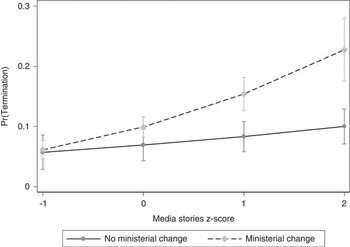
The increased odds of termination following a subsequent ministerial change are evident where an agency is featured in a large number of media stories relative to its historical level of media attention. The predicted probabilities of termination following a subsequent ministerial change for different levels of the variable media stories z-score are shown in Figure 2. A plausible interpretation of this finding is that, given the negativity bias of the British media, agencies that become the focus of the media (with z-scores above 0) are not performing well in the eyes of ministers, even though they may achieve a high percentage of their performance targets. In such a case, incoming ministers can be expected to weigh an agency’s perception in the media when deciding its fate.
Predicted probability of agency termination according to the presence or absence of ministerial change at different levels of media stories (with 95 per cent confidence intervals)

Agency performance against targets does not affect the odds of termination. This finding contrasts with other contexts in which formally assessed performance measures have been found to have an effect on public management, notably in US school districtsFootnote 59 and English local government,Footnote 60 where poor performance is associated with shortened tenure for those responsible for these bodies. However, our findings relate to organizational survival rather than the tenure of individual chief executives or management teams, and suggest that underperforming agencies can survive while failing to hit their performance targets. In contrast to executive agencies, local government performance measures were more widely reported in the press and known among important segments of the electorate. Executive agency performance targets may not capture scandals and other unexpected negative outcomes from agencies that might lead ministers to act against them, and are better reflected in our media attention variable. Ministers tolerate the continuation of agencies that meet a relatively low proportion of their performance targets compared to other agencies,Footnote 61 although it is an open question whether performance against targets influences agency chief executives’ tenures.
Some examples illustrate the phenomenon of ministers gaining control of departments and terminating agencies that had passed through their initial phase of being set up. In all these examples, the agencies were performing well against their targets. The Central Science Laboratory was terminated after sixteen years of operation in financial year 2008–09, following the appointment of Hilary Benn as Secretary of State for the Environment in 2007–08. The Laboratory met 90 per cent of its targets in its final year of operation, but the termination reflected the new minister’s priorities; Benn announced that the change would ‘strengthen DEFRA’s ground-breaking food, farming and environmental research programme’.Footnote 62 Similarly, Liam Fox was appointed Secretary of State for Defence in financial year 2010–11. Three Ministry of Defence executive agencies under his oversight were terminated in the following financial year: the People, Pay and Pensions Agency (five years old at termination), the Defence Vetting Agency (fourteen years old at termination) and the Service Personnel and Veterans Agency (four years old at termination). These agencies had each met over 90 per cent of their targets in the two years prior to their abolition, with the exception of one agency for one year. However, the new minister had a new assessment of the potential for better performance, and justified the terminations in order to ‘provide high quality professional services more efficiently and with fewer civil servants’.Footnote 63
Agencies primarily serving external customers and those with regulatory functions have lower odds of termination than those providing internal services to government departments (our base category). It is possible that having external constituencies makes it harder for agencies to be abolished; such constituencies may have their own reasons for maintaining agencies and blocking their reorganization. For example, the Vehicle Certification Agency works closely with the car industry on vehicle standards. In the case of regulatory agencies, regulatory functions are usually specified in legislation. Since regulatory functions may be more difficult to transfer to replacement organizations than the function of providing services within government, regulatory agency terminations are less likely even if they lack formal protection from termination by ministers, as would be the case for independent regulatory bodies.
Central government spending in real terms is negatively associated with the risk of executive agency termination, though the substantive magnitude of this relationship is small. Agencies that are trading funds, raising part or all of their finance through user fees and other charges instead of depending on appropriations, are at a reduced risk of termination through reorganization compared to other agencies. Substantively, having trading fund status reduces the predicted probability of termination, calculated at the mean, by four percentage points from 0.09 (plus or minus 2 per cent in a 95 per cent confidence interval) to 0.05 (plus or minus just under 2 per cent in a 95 per cent confidence interval).
Conclusion
Departmental ministers are key actors in determining the survival of government agencies in the UK parliamentary system. In the absence of electorally visible performance criteria for ministers and the agencies they oversee, and given their short tenure in particular posts, ministers abolish agencies in order to signal their policy intent and control of the organizational structure of government. These findings lend support to research on policy agendas in the UK and other countries, which has found changes in attention to policy programs following changes in party government and prime ministers.Footnote 64 It extends the insight about the consequences of changes in executive politicians to changes in the organization of government agencies, and points to the importance of changes in individual departmental ministers in this process. In so doing, it also supports research that emphasizes the importance of these ministers as key actors in parliamentary systems.Footnote 65
We find that politics, here in the form of ministerial succession, trumps performance in determining agency survival. This finding extends the generality of the primacy of politics over program performance that has been found in other contexts, notably in the determination of US appropriations to federal programs.Footnote 66 Agency performance does not seem important for agency survival in the eyes of UK ministers, which is a potentially surprising result given their interest in meeting targets in order to avoid being blamed for low-performing agencies. We suggest that their incentives are to announce new initiatives and avoid negative media attention, reflected in terminating agencies, rather than planning to raise long-term performance. The idea of ministerial hyperactivism is a common view of UK central government, but it has not been widely studied with systematic empirical evidence. Our findings provide support for this thesis.
The high level of organizational instability in the system creates disruption costs as agencies are terminatedFootnote 67 that are not demonstrably balanced by improved performance. Using the central government’s own measures, we assessed whether new agencies performed better than those they replaced either as a consequence of a merger or an outright replacement. We compared all pairs of predecessor and successor agencies in our data on the proportion of targets met, subtracting the former from the latter to create a measure of difference in target achievement. The mean was −1.8 (median −1.6), indicating slightly higher performance by the predecessor agencies (although not statistically significantly different: a Wilcoxon signed-rank test failed to reject the null hypothesis of no difference (p=0.42)). These findings raise serious policy questions about this form of government reorganization, which appears to have neither performance causes nor performance consequences on government accountability mechanisms.
The agency characteristics that we find to be associated with survival – function of the organization and financial autonomy – indicate that ministerial politics does not explain the whole picture. Institutional design has previously been noted as an important influence on survival in other contexts.Footnote 68 Executive agencies in the UK share a lack of legal protection from termination, but our research design allows us to address an important aspect of institutional design by examining funding as a variable that influences de facto protection from political stakeholders. We find that autonomy to raise revenue gives an agency some protection against termination. Other jurisdictions vary from the UK in terms of legal and broader constitutional structures that introduce more actors who could act as veto playersFootnote 69 and potentially block agency terminations. For example, Sweden has a parliamentary system in which many agencies have legal protection that insulates them from ministers.Footnote 70 This cross-national variability could be used in comparative research to further analyze the effect of institutional factors that our findings suggest are likely to be important influences on agency survival. Future research could also further develop the analysis of agency leadership effects on survival. While we include change in agency leadership in our analysis and do not find an effect, avenues for future research include the effects of the personal characteristics and management strategies of agency chief executives on overseeing ministers’ desires to terminate the bodies they lead.