“Gentile sinners,” William Cooper proclaimed on Sunday, August 28, 1796, “you are at this day highly honoured with the presence of a noble nation. Behold the ancient Israel of God; and, conscious of your own inferiority, reverence them as your superiors.” Despite being a Congregational minister, Cooper's imagined audience extended well beyond his fellow Christians. In the preface to the printed version of his sermon, Cooper explained that, “having frequently observed that some Jews attended my preaching, I was led to reflect on the present state of that dear neglected people.” The ensuing “pity” Cooper felt drove him to craft a special address to “God's Ancient Israel the Jews,” with particular emphasis on the key modifier “ancient.” Ultimately, the sermon was Cooper's attempt to persuade his Jewish participants of the historicity of the Christian faith and plead with his fellow Protestants to give this ancient people their due respect. Although delivered in England, Cooper's sermon made such an impression on Americans that it was printed and distributed for the next two years in Philadelphia, Portsmouth, Boston, Concord, Hopkinton, Windsor, Danbury, and Ballston, illuminating the still-deep connection between the two nations’ religious and print cultures.Footnote 1
Cooper's positive outlook on the Jews, however, began to fade as the sermon progressed. After challenging Christians to show better regard for their forebears, Cooper went on to bring the scripturalized weight of history down upon ancient Israel. Cooper began by arguing that, as had been foretold in places like Genesis 49, their ancient sovereignty was stripped from them and that for “Eighteen hundred years, nearly, hath Jerusalem been destroyed.” Nor was Genesis the only place where such destruction had been prophesied. Cooper drew the congregation's attention to Daniel 9:26: “The people of the prince that shall come, shall destroy the city.” “Now you all know the city of Jerusalem is here meant,” he continued, “But who are the people of the prince that shall come? Are they not the Romans? Did they not destroy your city, and desolate your nation?” Indeed, the Romans had destroyed Jerusalem. In 70 a.d., Titus, the son of the soon to be emperor Titus Flavius Vespasianus, or Vespasian, besieged the city, set fire to the temple, and razed Jerusalem's walls to the ground. “Thousands, yea, tens of thousands of your countrymen,” Cooper concluded, “perished in that bloody war; the country was made a desolation, and so it remains to this day,” thus fulfilling the words of the prophets. Yet the war with Rome that had cost the Jews their independence, their religion, and countless “countrymen,” was not a story to be found in Daniel nor in any other book of the Christian Old Testament. In fact, it was not to be found in the Bible at all. Rather, as Cooper pointed out, this was history “according to Josephus.”Footnote 2
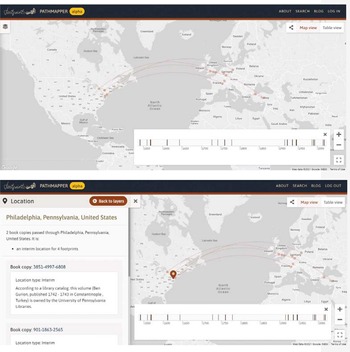
Titus Flavius Josephus was a Jewish rebel turned Roman beneficiary turned Jewish historian in the first century a.d. He was born Joseph son of Matthias in Jerusalem in “Year 3797 of the World's Creation,” according to the Jewish calendar, which corresponds to year 37 a.d. Although he had been born and raised “in the best Judean tradition,” a proud descendant of Jewish priests, he was to live out his life in Rome where his name would formally be changed to better reflect his Roman benefactor. For the next three decades in Rome, Josephus “devoted himself to history and apologetics” of both his home nation and of himself. Josephus's works had enormous impact over a long span of time. Against Apion, Josephus's Life, Jewish Antiquities, and his first and most popular work, The Jewish War, would be translated and passed down by Christians from late antiquity, through the middle ages, to William Cooper in the eighteenth century, and even now, into the present. For early Puritans, “Josephus was the only reading, aside from the holy Bible, authorized on the Lord's day,” and by the end of the twentieth century, Josephus's works, as translated by William Whiston, had been reprinted in America roughly 217 times since its first appearance in 1737—an astonishing “rate of about one every 1.25 years” (Fig. 1).Footnote 3
These maps showing the movement of printed versions of Josephus over the past four hundred years were generated using the Footprints project, which grew out of the Center for Jewish History. The Footprints project itself emphasizes books, specifically Jewish books, as objects whose history “continues long after composition as it is bought, sold, shared, read, confiscated, or even discarded.” By mapping the movement of Josephus's works across space and time, historians achieve a more robust picture of “the social and cultural dynamics at work in producing, disseminating, and reading Hebrew and other ‘Jewish’ books.” Footprints: Jewish Books Through Time and Place, ed. Michelle Chesner et al., entered by Kristofer Stinson. https://footprints.ctl.columbia.edu/pathmapper/.

But why? Why should Josephus be handed down across time and space until he reached William Cooper and the Americans of the eighteenth century? Why, among all the classical stories that Americans held dear, was Josephus the most consequential? Answering these questions has been difficult because few historians have examined the reception of Josephus among Protestant Christians in America. By surveying the prefaces to his printed works in America from colonization to the mid-nineteenth century, it becomes clear that Josephus mattered to Americans as they stood torn between the tales of two cities, or two models from the ancient past: Rome and Jerusalem. In their reading, he gave them the needed space to be both. Using Josephus, Americans attempted to hold together the tensions in their national identity and ancient imagination. If it was Josephus who chronicled for contemporaries of the eighteenth and nineteenth centuries the destruction of the old Jerusalem by the Romans, it was also Josephus who made possible the construction of what was, indeed, a new Jerusalem in a new world.Footnote 4
Americans of the eighteenth and nineteenth centuries felt a strong connection with ancient civilizations. This was especially true, scholars have argued, for classical civilizations such as Rome. From the virtue of its citizens, to the benevolence of its senate, to the glory of its republic, Rome was enshrined as the highest political goal. According to Gordon Wood, when time came to christen the American republic amid a “monarchy-dominated culture,” “there was one republican model that did seem worth emulating—one republic that had achieved in glory and fame all that any people anywhere could ever hope for. And that republic was ancient Rome.” Spurred by a distinctive approach to history, the classical past came to shape “the cyclical narrative arc of the present time, suggesting to moderns the path of vice as well as the road to virtue.” Taken as a whole, these histories composed a “culture of classicism,” as Caroline Winterer has put it, that helped to make sense of their present moment. Even those scholars such as Bernard Bailyn, who would disagree that these classical models were “determinative” of American thought, admit how deeply the stories had sunk into the surrounding culture. Importantly, as Bailyn points out, the American idealization of Rome was inherently selective as it held up the Roman republic specifically while demonizing the later empire. “What gripped their minds,” Bailyn wrote, “what they knew in detail, and what formed their view of the whole of the ancient world was the political history of Rome from the conquests in the east and the civil wars in the early first century b.c. to the establishment of the empire on the ruins of the republic at the end of the second century a.d.” But until that tragic fall, the republic of Rome, it seemed, was worthy of every emulation.Footnote 5
On the other hand, and at the same time, early Americans imbibed the history of Jerusalem and Israel. Scholars of Puritanism since Perry Miller have pointed to the importance of these stories in forming much of the culture of early America. Even now scholars repeatedly point out how many early Americans considered themselves to be that “city upon a hill,” the “new Israel,” the “new Jerusalem,” an “American Zion.” Largely interchangeable, these titles reflected a profound exceptionalism in which first the Puritans and then, after 1776, citizens of the United States considered themselves God's chosen people. Eric Nelson has argued that early modern encounters with Jewish sources had a profound impact on the development of Western political thought as a whole as individuals delved into the history of the republica Hebraeorum to better understand how to perfect their own republics. In many respects Josephus stood at the center of this story of the Hebrew republic. His works enabled Hebraists and political thinkers to embark on a deep analysis of the republic they so yearned to imitate. Nelson posits that many of these individuals “regarded the Hebrew republic” as outlined by Josephus “as an authoritative expression of God's constitutional preferences.” “They labored with the help of their rabbinic authorities,” Josephus chief among them, “to interpret his design and attempted in their own societies to replicate it as closely as possible.” Indeed, it was Josephus who first introduced the very idea of “theocracy” into the political lexicon of the Western world. Similarly, Eran Shalev has delved into the ways in which the model of Israel was taken from that other all-important ancient history, the biblical Old Testament, to become a tool of “American self-fashioning” and a “constructive mode of political expression.”Footnote 6
A quick glance over both of these images reveals a tension that has not yet been addressed. Ideally, America and the United States was to be both a new Rome and a new Jerusalem. Yet, as William Cooper and his congregants and readers well knew, those images did not always go together. In fact, if the events of 70 a.d. were taken seriously, something about them might actually be antithetical. The central question became how early Americans would respond to two competing stories pulling them in opposite directions. Potentially, they might have realized that they would eventually have to choose between them. However, when it comes to the reception of Josephus, Americans seemed to prefer him for the ambiguity and versatility he allowed. Josephus, in other words, became a bridge between the two stories—a tale that allowed Americans to have their cake and eat it, too.
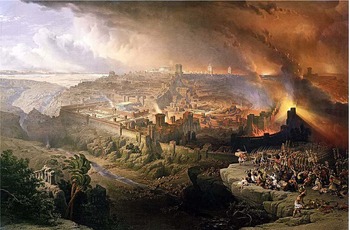
This ambiguity, however, came from and with real consequences. American Protestants were not the first to wrestle with this dual identity. From the early days of the church in Palestine to the rise of imperial Christendom in early modern Spain, Josephus had done much to not only inform readers about the legacy and downfall of God's peculiar people but to shape their relationships with Jews and their God to often devastating effect. Martin Goodman suggests that it was the destruction of the Jewish temple in 70 a.d., the historical event to which Josephus was inextricably bound as a historian, that marked the origins of antisemitism (Fig. 2). Rome's “living legacy” in Europe and beyond, Goodman argues, was “the institution and ideology of the Church.” Yet from the first century, the Church had struggled with its own ambiguous identity as it stood poised between two cultures. On the one hand, there was no denying that early Christians had arisen from the local Jewish faith in the Roman colony of Judea. However, these same early Christians felt compelled to follow in the footsteps of their Lord to seek and save the lost, who, in the imperial context, were the very Romans who would go on to decimate their place of origin. Thus, “if Christians were to defend their own good name and seek converts in a Roman world in which, after 70, the name of the Jews excited opprobrium, it was easier to join in the attack and agree with the pagans that the defeat of the Jews and the destruction of the Temple were to be celebrated as the will of God.” Goodman rightly points out that “anti-Judaism based on such religious convictions does not necessarily lead to antisemitism,” but it was no coincidence that the emerging stance of early Christianity that sought to distinguish itself from Judaism echoed the “terminology [that] was being used in the centre of imperial power at Rome.”Footnote 7
David Roberts, The Siege and Destruction of Jerusalem by the Romans under the Command of Titus, oil on canvass, 1850.

These tensions were passed on to the church of later ages as future congregants and rulers sought to come to terms with Jews and the God they had once served within the walls of the Temple Mount. So it was that Jewish history, and the Jewish historian, came to the European imperial courts of the sixteenth and seventeenth centuries where it served largely the same purposes as it had for centuries. Within the halls and marketplaces of contemporary kingdoms and empires that aspired to be Rome reincarnate, Josephus was employed to better grapple with God's relationship to earthly powers and with the Jewish people.
This lingering question about God's relationship to earthly polities harbored repercussions for the people European Christians believed had executed their deity, Jesus Christ, the very son of God. As with the story of the Hebrew republic in the early modern world, Josephus was central in the popular understanding of Jews themselves. On March 27, 1492, Alfonso de Palencia published his Spanish translations of the Jewish War and Against Apion. Although Palencia had completed his work the previous year, publication had been intentionally delayed. Only days later, on March 31, 1492, “the Edict expelling the Jews from the Kingdoms of Castile and Aragon was issued in the Alhambra, the Nasrid palace of Granada now converted to Royal Christian abode. At a time when the leaders of Church and State were uprooting the Jewish people from one of their ancestral homes,” Julian Weiss argues, “Iberia's intelligentsia were attempting to make sense of their Jewish past and its legacy.” Yet it is not only Palencia's timing that deserves attention. His choice of texts further illustrates that reception, both past and present, is marred by deep complexities and ambiguities. Palencia's volume simultaneously “puts the case for and against the Jews.” Rather than tackling the complete works of Josephus, Palencia chose the two texts that best represented the spectrum of his thought, an approach that would be typical of the many English translations to come. “In the Jewish War,” Weiss points out, “Josephus was the Jews’ most incisive critic; in Against Apion, he was their most ardent and eloquent defender.” Yet it was “precisely because of these ambiguities that Josephus mattered in late fifteenth-century Spain” and, later on, to those in the English-speaking world.Footnote 8
The first English translation of Josephus appeared in 1602, amid the Old World's increased colonization of the New World. The translation was the work of Thomas Lodge and was based on the Latin text along with the French translation. Lodge's translation would spend the next several decades being fine-tuned until the release of the “revised and amended” edition in 1676. The motives that compelled both the first English translation and the many to come were similar to those at work in Spain and the early Church. As Lodge and his revisors noted in their prefaces, the divine abandonment and destruction of Jerusalem, God's chosen city on earth, not only held repercussions for states and empires under the same God but still possessed immediate relevance for the English treatment of Jews. “It may be boldly affirmed,” the revised edition of Lodge asserted, “that never was seen a greater example” of God's wrath “than the ruine of that ungrateful Nation, of that proud City, and of that venerable Temple.” What was more, the sole reason God had sided with the Romans was to punish the Jews for the high crime of deicide. “The blood of his Son shed,” this edition continued, “the most horrified of all crimes, was the only cause of the ruine of that unhappy City.” It was ultimately “the heavy hand of God upon that wretched people” that stirred up the civil atrocities that marked their fall from grace, wherein “the cruelty of those unnatural Jews, who more like Devils than Man, destroyed by the Sword and Famine, of which they were the Authors, 1100000 persons.”Footnote 9
The second English translation was commissioned and undertaken by Roger L'Estrange in 1692. Although it would eventually be outdone by William Whiston in the 1730s, L'Estrange's translation would circulate in the American market even into the nineteenth century. The first appearance of L'Estrange's translation of Josephus in British North America in 1719 nearly coincided with that of the works of Josephus ben Gorion, a medieval Jewish paraphrase of Josephus's Jewish War. These works represented the first books of Jewish authorship to be published and printed, respectively, in British America.
Ironically, they did more to assert the historical case against Jews than to cultivate any sense of cultural appreciation. Many Christians in America took their cue from Josephus to disparage both Jews and Judaism, deploying the text to create an anti-Christian “other” that Protestants used to define themselves against. In other words, these stories “projected” a “Judaism” that was mythic but became real in their telling and circulation. The 1719 edition of L'Estrange's translation, which was reprinted in Boston, began its preface with the observation “that the Jews were a great and warlike Nation can be doubted by none that believe the Sacred Records.” Yet such greatness, it seemed, was ephemeral. For after the Jews “with wicked Hands had crucified and slain the Lord of Glory, and so had brought wrath upon themselves unto the uttermost, never was their [sic] any People that receiv'd so fatal and total a Destruction, as they did.” What was more, the preface argued that “the Guilt whereof (tho’ they refuse to own it) pursues them to this very Day, so that (tho’ they were once the peculiar People of God) they are, now a curse and an Execration in all the Kingdoms of the World.” The preface closed with a dedication to the city of London and the great empire it represented: “God grant that our Nation may avoid their Sins, that so we also may avoid their Judgements. And therefore Let Jewry Britain's Warner be, Let Jebus [or Jerusalem] London teach. That we God's Wrath may fear and see, Whilst Jews to Britains preach.” And even as this volume was utilizing Josephus to legitimate Jews’ “otherness” within an English, Protestant society, the larger ramifications for their Christian audience was enough to give the author pause. As the ancient history of the Jews appeared to illustrate, the title of “the peculiar People of God,” be they Jews or Christians, was far from fixed. English Christians in Europe and America would have to remain vigilant lest their own sins force them into the very subservient role they had assigned to God's ancient people.Footnote 10
Yet what were the sins that Jerusalem could warn “Britains,” or Americans, of? In many respects, the lessons to be gleaned from Josephus were contingent on the social context in which the volume was republished. The 1722 edition of Josephus ben Gorion, reprinted in Boston by John Allen, for instance, portrayed Josephus and the destruction of Jerusalem as a call to avoid civil dissension while cultivating imperial unity and stability. The book's dedication warned that “the same Crimes and Crying Sins, which reigned in Jerusalem before her last and utter destruction, were very rife then in London; which were, the spirit of Sedition, instable stubborn rebellious Hearts, their murmurings at Government, an Itch after Innovations.” And, although it skirted “High Prophaneness,” the author could not help but suggest that the “muthering [of] CHARELS the First” resembled the execution of Christ. It may be said of London, the author concluded, “to be led all along by a true Jewish Spirit.” If England and the colonies were to avoid divine wrath and the imperial devastation that accompanied it, they would have to avoid the religious and political characteristics that led to both. For this edition of Josephus, that meant maintaining the proper deference to both crown, or the English monarchy, and altar, or God's ultimate sovereignty that he exercised through the king. Doing so was the only way to mitigate the civil strife that plagued Jerusalem on the eve of its destruction. In this respect, Israel served more as an “antimodel” to learn from rather than as a model to build on.Footnote 11
As the 1719 edition made clear, Josephus's history was to be applied on a more intimate level than cities and empires. Mainly, it was to shape the interactions of citizens. The discussion of the Jewish plight from 70 a.d. down to the most recent edition of Josephus drove many Protestant readers to call for conversion. As James Howel put it in his dedication to the 1722 reprint, “[I]f there were no other motive for the Jews conversion, the length of those heavy Judgments, under which they groan to this day, were enough to do it.” And if the Jews’ perpetual sufferings were not enough to convince them to convert, “the punctual accomplishment of our Saviour's predictions, were sufficient to convince any rational creature. For not long after, their Land became a stage of blood, and all kind of barbarisms. Their so renowned City, their Temple and Sanctum Sanctorum, so fam'd all the Earth over, was made level to the ground.” Ultimately, Howel suggested, it was their continued stubbornness and refusal to repent that resulted in the continuation of suffering—a suffering that was even beginning to affect their physical nature, most notably in how they smelled. “I wish that England may not be troubled with that scent again,” he wrote. Despite his deeply rooted prejudice, Howel never portrayed their predicament as singular. Other nations and groups were susceptible to the same fate. Josephus was “very worthy of [the reader's] perusal,” Howel argued, that he “may serve for caution to all People not to provoke the most High Majesty of Heaven by such kind of sedition and prophanness.” “For if the natural Branches” of Judaism “were not spared,” Howel wondered how “the Wild-Olive” of Christianity could “think to escape the Fire of his Displeasure.” Indeed, his closing remarks undermined the very religious confidence he had exerted sentences prior. “So with my hearty Prayers to Heaven for the Prosperity and Welfare of this glorious City,” Howel concluded, “and that she may take fair Warning by these Judgments, I rest.”Footnote 12
National retribution, Jewish citizens, the fate of Protestant Christendom, conversion—the themes that pervaded these early editions of Josephus in British America represent the lingering issues readers grappled with in the colonies and, eventually, in the United States. Two additional themes merit attention insofar as they reappeared in conversations surrounding Josephus and the destruction of Jerusalem. First, Josephus was a crucial text for both the English and Americans as Protestant Christians. As the subtitle to the 1722 edition put it, his “History begins where the Holy Scriptures do end.” Josephus served as a bridge between sacred and secular time, connecting the history of the Bible with the history of the world beyond the sacred text. In doing so, Josephus grounded the predictions of Christ in the revered tradition of Greco-Roman historiography. Although many Protestants in American continued to insist on hard borders to their canon, Josephus was a constant reminder that biblical prophecies were fulfilled outside of the Bible. The scriptures may have ended, as the subtitle implied, but history continued on.Footnote 13
Second, and interrelated with the first, Protestants in both England and America remained deeply torn, as the early church was, about their sentimental ties to Rome and Israel. How were Americans, who would come to portray themselves as both a New Rome and a New Israel, to handle the fact that the two, in the first century at least, had been mutually exclusive images? Josephus himself embodied this internal tension. Whereas the 1719 edition was confident that Josephus's ambiguous identity leant him weight as a historian, later authors were not so sure. The historical event of Jerusalem's destruction highlighted the rifts in readers’ cultural allegiances. Yet when it came time to choose a side, the prefaces to Josephus often favored Rome, not Israel. From this standpoint, Rome appeared to be God's unwilling instrument that nevertheless handled the decimation of Judea with honor and restraint. Perpetuating Josephus's history allowed Americans to continue to cling intellectually to Rome, which Josephus largely absolved of any blame in the destruction of Jerusalem. In a way, the Romans made possible their historical claims to exceptionalism. Since the first Jerusalem was no more, Americans were free to establish themselves as a “New,” “Second Jerusalem” that was, ironically, antithetical to Judaism. In a somewhat curious twist for early Americans, rather than critiquing the violence and destruction of empire against a colony, readers sided with imperial Rome against colonial Jerusalem.
Josephus continued to capture and mold Americans’ imaginations in the years before the Revolution. In 1737, amid the fires of religious revival, William Whiston published his translation of Josephus that quickly garnered universal acclaim and was “deemed to be the definitive, superior English translation and without errors.” Whiston added eight dissertations to his translation, which served as his own “passionate defense of Christianity” while perpetuating “the same strong anti-Jewish sentiments” of the earlier Lodge translation. Meanwhile, the 1740s saw an increase in the number of sermons in the northeastern colonies that solidified the link between Christianity, America, and Jerusalem. These sermons often intersected with Josephus on various levels. Most obviously, they would use his history as the gospel truth that would be proclaimed to their congregations from the pulpit. Ministers would rely on Josephus as a proof of prophecy, as proof that God had abandoned the Jews to wrath, and to underscore the availability of the title of Jerusalem. Yet even when ministers did not explicitly cite Josephus, they continued to find themselves in his orbit. On the one hand, Josephus continued to provide the backstory to their sermons even when he went unnamed in that many still related the tale of the destruction of Jerusalem, the historical event whose only ancient account came from Josephus. On the other hand, by perpetuating the idea that Protestant America was in fact a new Jerusalem, ministers continued to foster a communal image that merged with Josephus as new generations of translators and editors echoed these claims in the prefaces to his work. In short, these sermons provided the main articulation of what was meant by “Jerusalem” and the ways in which it was both similar and distinct from the ancient Jewish nation.Footnote 14
In 1742 Isaac Stiles delivered his sermon on “A Prospect of the City of Jerusalem” in Hartford, Connecticut, in which he equated the church with the holy city of old. “That the Church is fitly styl'd Jerusalem,” Stiles observed, “in that . . . Jerusalem (which was built up as a City that is Compact together) was a lively Emblem or Picture of the Church's Unity and Peace.” The Church's beauty was equivalent to that of Jerusalem, which once was “beautiful for Situation and for its goodly Buildings; particularly the Temple, which was the most magnifical, curious and splendid Edifice that ever human Art contriv'd, hands erected or mortal Eyes beheld.” And like Jerusalem, the colonies were utterly dependent on divine favor to bolster their political stability. “Civil Government is of divine Original,” Stiles argued, “those that have the most could have none at all, except it were given them from above, by him who Rules in the Kingdoms of men, and giveth it to whomsoever he will.” As Hull Abbot put it four years later, it was the ultimate “Duty of God's People to pray for the Peace of Jerusalem,” by which Abbot meant the rule of God through an English, Protestant establishment.Footnote 15
This perspective that viewed the Church, specifically the Protestant church, as the new Jerusalem not only gained traction over the generations but helped structure the Church's expectations within a diverse, imperial world—a world often marked by competition and war. In 1749, William Balch was compelled to place particular emphasis on the desire for the “peace” of Jerusalem, by which he meant “a State of Freedom from War.” Yet the ideal for peace that Balch implored his flock to strive for extended far beyond the church's walls. Jerusalem, for Balch, was not simply the religious aspects of the church, but the political facets of the colony and empire in which the church found itself. For ancient Jerusalem “was also the Seat of Empire & Government; and the People repaired thither, as well for the Administration of Justice, and Protection in their civil Rights, as for the public Exercise of their Religion. . . . So that by the Peace of Jerusalem,” he concluded, “we may well enough understand both the religious and civil Prosperity of the whole Kingdom, of which Jerusalem was at that Time the Metropolis.” For Balch, the pivotal takeaway for his listeners was that “they shall prosper that love thee; i.e. that love Jerusalem, that love their Country, and seek its Welfare.” By extending the confines of the new Jerusalem, Balch was continuing a process that had begun with the Puritans a century prior that sought to link the religious destiny of Christianity to the political life of their polity. The resilience of this association came “not from a desire to emulate or remain within the past, but from the applicability of the concept to a uniquely sanctioned future,” John Davis explains. “A protean concept at best, ‘Jerusalem’—or the ‘New Jerusalem’—stood variously for the historical Israelite capital and its people, the thriving, righteous nation envisioned by American colonists, and the true Protestant church rooted in and predicted by scripture.” The image of a new “Jerusalem” that was to thrive in the American context was expansive even as it was restricted to Protestant Americans.Footnote 16
By 1772, this potent blend of history, religion, and nationalism began to take on a militaristic edge. Nathaniel Robbins, pastor at the local church in Milton, concurred with Balch and Stiles that “by Jerusalem in our day, we are to understand the Christian church.” He clarified, however, that it did not mean all of Christianity. Rather, they were to understand it to be “the whole protestant Christian church, considering them as a body, or a nation, or a community, as they are distinguished from heathens” in both “their civil and religious capacities.” What was unique about Robbins was his willingness to address the question that many of these sermons simply assumed the answer to: what had happened to the first Jerusalem? The result was that the alternatives to peace were particularly felt in his sermon just as conflict with the imperial government in London was escalating. Robbins reiterated “that Jerusalem's peace certainly intends peace in the most common acceptation of the word, i.e. in opposition to wars.” Yet, “as Jerusalem of old was sorely chastened, and once laid waste by enemies; so the Christian protestant church has been also sorely chastened by men her enemies; and they are not all destroyed: We may not therefore conclude, that we shall never again be engaged in war.” Interestingly, this call for militant preparation caused Robbins to shift his reflection from Jerusalem to Rome, further illustrating the potential complexity of Americans’ cultural identities. “And we find it observed of the old Romans,” he continued, “that as a martial spirit,” the same spirt that laid waste to the first Jerusalem, “decayed among them, in proportion luxury prevailed . . . so by degrees ended in the ruin of their country.” So the call, which Robbins issued before “the ancient and honorable artillery company Boston,” was to stand ready, for God needed them lest the new Jerusalem follow in the decimated footsteps of the old.Footnote 17
With the increasing certainty that Protestant America was taking on the role and destiny of Jerusalem, a new wave of interest in Josephus washed over the American book market just as the Revolution began. Beginning in 1771, proposals were issued by one John McGibbons to print what would become the first American edition of the works of Flavius Josephus based on the translation of Roger L'Estrange. McGibbons explained in his advertisement that “a number of Gentlemen have encouraged me to undertake the re-publishing the Works of this elegant Writer, and profound Historian.” As such, he hoped his proposal would be “kindly received by the Public, and meet with due Encouragement and Favor. I need not expatiate on the Character of this Classic writer,” McGibbons wrote, “as his Reputation is universally known among all Gentlemen conversant in the Literary World, and greatly approved of by all who have had the perusing of his Works.” His proposal must have been met with at least adequate favor, for after two years of collecting subscriptions, in May of 1774, on the cusp of the ratification of the Intolerable Acts and the convening of a “Continental Congress,” an American Josephus appeared. The announcement alluded to a wide range of readers, referencing subscribers in Maryland, Virginia, Pennsylvania, and New Jersey. “There is no antient history extant,” an advertisement in Philadelphia ran, “that relates any matter with so much particularity of circumstances, as Josephus does that of the Jewish Wars, especially the siege and destruction of Jerusalem; and that the providence of God may appear the more remarkable in this history, which is the only punctual one that hath been preserved down to us, of this great action.” The paper concluded that “it will be worth our observation to consider, how remarkably this person [Josephus] was preserved for the writing of his history.” So critical was Josephus that McGibbons went on to claim that readers “rely more upon the Veracity of his Writings, than all the Greek and Latin Historians put together.” Perhaps the most illustrative aspect of the importance many Americans accredited to him, however, was the timing of this publication. The American edition of Josephus appeared three years before the American edition of the Bible itself.Footnote 18
Yet the presence of the first American edition, as important as it was, did not halt the publication and printing of the various other iterations of Josephus to come. In the 1780s, the more exciting portions of Josephus, revolving mainly around the fall of Jerusalem, were translated into poetic verse or condensed into abridgments in an effort to make him more accessible. Then, in 1789, George Maynard published his own translation to which he added ten dissertations and his “Continuation of the History of the Jews, from Josephus down to the present Time.” Taking on the “anti-Jewish” tone that had pervaded earlier editions, Maynard saw the hand of God at work in the destruction of Jerusalem. For regardless of how adept Josephus was as a political negotiator and Jewish military commander, Maynard argued in his prefatory “address to the reader” that the Romans “were sent as the tremendous scourge of Providence to an abandoned ungrateful people: they [the Romans] fought under the banner of an avenging God, and literally fulfilled Our Savior's prophecy, when they planted the Roman eagle in the heart of Judaea; ‘Wheresoever the carcass is, there will the Eagles be gathered together.’—Luke xvii.37.” Indeed, Maynard made much of Josephus's acquaintance “with the sacred books of the Prophets,” which enabled him to speak hard truths to Israel, primarily “that God had forsaken them, and gone over to the Romans.” Yet in their obstinance, which Maynard traced as an inheritable trait down through the centuries, they rebelled against Rome. In doing so, Maynard suggested that “they fought not only against an incensed enemy, but against the decrees of God.”Footnote 19
As in Howel's dedication to the 1722 edition, Maynard had little but pity and contempt for the state of the Jews since the destruction of Jerusalem. Additionally, he saw the Jewish plight as a reflection on the perpetual competition between Protestantism and Catholicism, a competition that was deeply felt in the American, Protestant republic. “The Jewish writers divide the west between two sovereigns,” Maynard observed, “or rather between two prevailing religions, the Protestants and the Roman Catholics.” What puzzled Maynard was how the Jews decided to throw in their lot with Catholicism. “They highly praise the popes,” he wrote, “for popish Rome (say they) has always protected them, since its general, Titus, took Jerusalem.” Yet it seemed obvious to Maynard and anyone that was acquainted with Josephus that Titus “was not general of papist but of heathen Rome.” This misconception, according to Maynard, obscured the Jews’ approach to both Catholicism and Protestantism. “Their writers complain often of the Protestants, as not having sufficient humanity. However, they find not among them the barbarous court of inquisition.” He found that the Jews “live peaceably in many cities where the reformation is established.” Ultimately, Maynard posited that the inescapable trait that had been “the grand source of all the calamities that have befallen the Jews” was unbelief. It was unbelief that had cost them their temple and nation and it was unbelief that kept them from unifying with modern communities in Christian fellowship. For Maynard, there was a universal lesson to be learned here. “The History of the Jews,” he concluded, “afford a most important lesson to those who call themselves Christians, and a tremendous example to those who are too wise, or rather too wicked, to submit to the Divine will, as revealed in the Sacred Oracles.”Footnote 20
Josephus not only served as justification for political and cultural exclusion but became a key means for possible religious inclusion. As a tool for conversion, Josephus was deployed to show that Jews were both religiously and historically in the wrong and that God had not only been with the Romans in the first century but was now with Protestants in America in the eighteenth and nineteenth. The turn of the nineteenth century brought a new wave of religious awakenings to the United States and England and, thus, a renewed emphasis on the unbelievers in their midst, real and imagined. The desire to bring about general revival was seen in the print culture and organizational societies that directed themselves explicitly at Jews. Tellingly, much of their efforts were founded upon, and directed by, Josephus. The fulfilment of prophecy, it turned out, could be a powerful tool for conversion. “It has been observed,” an 1801 periodical began, “that prophecies are permanent miracles, whose authority is sufficiently confirmed by their completion, and are, therefore, solid proofs of the supernatural origin of the religion, whose truth they are intended to testify.” In this case, it was the destruction of Jerusalem that served to testify to the supernatural origins of Protestant Christianity. The author continued by pointing out that from “an early period was this dreadful catastrophe foretold. Upwards of fifteen hundred years before it happened Moses, in the most striking manner, predicted it.” Yet it was not simply the testimony of Moses that gave rhetorical weight to this event. It was Moses paired with Josephus. “Between his prophetical description in the twenty-eighth chapter of Deuteronomy, and the historical relation of Flavius Josephus,” the author marveled that “there is such a surprising agreement in all the material circumstances, that no man, friend of Christianity or foe, can candidly compare the one with the other, without astonishment.”Footnote 21
George Holford could also not help but be amazed at the Jews’ refusal to convert before the prophetic weight of Josephus. The title of his book stated his position perfectly: “The Destruction of Jerusalem, an Absolute and Irresistible Proof of the Divine Origin of Christianity: Including a Narrative of the Calamities which befell the Jews, so far as they tend to verify our Lord's predication relative to that event.” Throughout Holford's retelling of events, he not only relied heavily on the works of Josephus, citing him as much as, if not more than, the Bible, but followed in the footsteps of previous editions that defended the character of Titus and the Roman Empire. Tracing many of the same parallels between biblical prophecy and Josephus's account of the sacking of Jerusalem, Holford drew his work to a close with the applications his readers should walk away with. “To the Jew we would say—Suspend, if it be practicable, the prejudices which you inherit from your forefathers, whilst you ponder, for one hour, the important and interesting subject of these pages.” “Is it possible,” he asked, “that you can attentively reflect upon the destruction of ‘the beloved city,’ the dispersion of your nation into all countries . . . and not trace therein the condign and predicted punishment of their original rejection, and continued contempt of that very Messiah whose character your own scriptures so faithfully pourtray?” Holford's call for Jews to convert was also an opportunity to ensure that his fellow Protestants were walking in the paths of righteousness. The catastrophic loss that had been so faithfully recorded by Josephus “is pregnant with the most important instruction to the whole world. From amidst the ruins of Jerusalem,” Holford concluded, “a voice may be heard calling loudly and incessantly in the ears of all nations, and saying, ‘Beware that ye depart not from the living God!’”Footnote 22
The ends to which Josephus was applied in early America align with the overarching relationship modern historians have traced between Protestants and Jews. For Susanna Linsley, their relationship cut both ways and was symbolic of the larger tensions surrounding the nature of religious liberty and religious pluralism in the early republic. She argues that “Christians and Jews alike envisioned a tolerant society as one built on underlying commonalities, not as one that supported pluralism as a positive social good. . . . As often as not, a tolerant society came to mean a world that rejected pluralism, not one that legitimized it.” Indeed, societies such as the American Society for Meliorating the Condition of the Jews perpetuated the approach of Maynard and Holford as it strove for assimilation over toleration. “In its most generous moments,” Linsely posits, “the Society gestured that it would respect and embrace religious pluralism not by supporting the right of multiple groups to worship openly and equally, but rather by inviting into their fold those who Christians had once dispossessed.” And for the most part, Protestant and Jewish interactions remained at this more intimate, rather than societal, level. “So while religious conflict between Judaism and Christianity was everywhere present,” Lincoln Mullen writes, “it was a conflict that took place primarily in social and cultural terms, and at most in the level of everyday law, and not at the highest reaches of society's power to define and exclude.” The fate of the Jews, it seemed, was no longer to be decided by armies and siege engines but by the successful mobilization of a rival religious culture—one that wrapped itself in the historical and prophetic garb of Josephus.Footnote 23
The desire to bring about conversion through historical revelation only heightened as the century went on. In 1812, Hannah Adams published her monumental The history of the Jews from the destruction of Jerusalem to the present time in order to better educate her fellow believers on the people they were to proselytize. While the advertisements for both the American and British editions lauded her grounding in the prophecies of the Old and New Testaments, it was Josephus that overwhelmingly directed the first part of Adams's work. Indeed, her second chapter, which covered the fall of Jerusalem, was itself a paraphrase of the Jewish War. Although Adams was captivated by the history, it took on a whole new interest when “connected with religion.” According to her reading of Josephus, the “dispersion of the Jewish people, and the ruin of their temple, form a part of the gospel system, by means of which, a knowledge of the true God was no longer to be confined to one nation only, or his worship attached to one particular place.” Josephus himself had become part of this “gospel system,” playing the role of a “Fifth Evangelist.” Adams concluded that, however unintentionally, Josephus has “given us a striking demonstration of the truth of the Christian religion, by exhibiting, in the most lively manner, how the prophecies of our blessed Lord, concerning the destruction of Jerusalem, were literally fulfilled in their fullest extent.” Similarly, in a sermon delivered in 1816, Thaddeus Harris pleaded with his flock in Boston to “Pray for the Jews!” for their dismal condition “reaches back to the remotest antiquity.” For both Adams and Harris, the fulfilment of Christ's prophecy in the destruction of Jerusalem was the ultimate testimony of the truth of Christianity, and thus solid ground on which Jews, as both a small but growing population and as an abstract “other,” could repent and convert. Yet the even larger message, by this point, was clear. If Protestants were to successfully understand and engage the plight of the Jews, they must start with Josephus. In turning to him, they underscored the importance of his history, and ancient history in general, to the unfolding of what would become a second “Great Awakening.”Footnote 24
At the same time that this revived emphasis on conversion swept over the early republic, another string of sermons emerged to reaffirm the place of American Protestantism as Jerusalem redeemed and reincarnated. After providing his congregation with a general survey of the war between Jerusalem and Rome that Josephus narrated, Dan Huntington, a pastor in Middletown, Connecticut, reassured them that they need not concern themselves with the particulars of this ancient city. “What it was,” he explained in 1814, “is but of little importance to us, since it has lain, now, for many centuries, in ruins, excepting that it was a lively emblem of the Spiritual Jerusalem.” While the physical Jerusalem may have been destroyed, the spiritual essence had settled upon the early church. “Accordingly, when speaking of the Church of God, how often do the sacred writers call it by the names Jerusalem,” with a promise that those “who have at heart the great interests of the Redeemer's kingdom” would prosper. This prosperity stemmed from the fact that, while some aspects of God's covenant may have been “peculiar” to ancient Israel, Huntington believed that God ultimately dealt with collective bodies, ancient or modern, in similar fashion. “Individuals will exist, and be judged, and be recompensed, in a future state,” he went on to say, “but collective bodies, having no future existence, will therefore, be recompensed in this world.” America, as the newest collective body on the cosmic stage, thus had a list of stipulations to meet in order to live into the prosperity held out by divine Providence. America must ensure “pure religion” and a “careful attention to the soul.” But above all, Huntington argued, “there must be a love for Jerusalem; and sincere attachment to her interests, interwoven in its very contexture.” And “to love Jerusalem,” Joseph Field reiterated two years later, “is to have a sincere affection for that church which God hath purchased with his own blood; to desire its increase and furtherance; its purity in doctrine and worship; that its ground may be firmly maintained against every hostile invasion.” Since the old Jerusalem was gone, Huntington and Field felt confident of tying the image of the new one to the fate of the American church.Footnote 25
As had been the case in the mid-eighteenth century, the equation of the United States with Jerusalem in the nineteenth century rested on a pervasive historical tradition and culture—one that constructed its cosmologies by interweaving the Bible with other ancient texts to glimpse the larger forces at work behind empires and societies. The beating heart of this popular historical culture was the firm belief in the veracity and applicability of ancient texts. Americans were sure that they could trust Josephus and his interpretation of the central event for many Christians and Jews in the first century. Individuals from Nathaniel Robbins to John McGibbons to Hannah Adams approached Josephus in the certainty that his narrative held direct ramifications for Americans. Ultimately, they provided the historical grounds on which Protestants in America could lay claim to the title of a “New Jerusalem” or a “New Israel” while simultaneously dismantling the validity of Judaism and its place in the United States. For those claims were upheld by the historical assumptions that God had abandoned the first Jerusalem to its fate at the hands of Titus, and that God had abandoned it for Christianity—assumptions that were rooted in, and unique to, Titus Flavius Josephus. As such, the developing notions of American exceptionalism, along with the equally pervasive notions of American Protestantism, were contingent on a particular relationship with ancient history, a relationship that, unbeknownst to many Americans at the turn of the nineteenth century, was about to change.Footnote 26
The rise of higher criticism directly challenged the relationship Americans had with their ancient stories. In contrast to the trust readers took with them to Josephus, the critical posture highlighted all that made Josephus and his narratives untrustworthy—his bias and exaggeration that skewed key aspects of his history. The questions that constituted the emerging criticism eroded the applicability of antiquity along with the utility of ancient histories in popular culture by suggesting that the ancient world itself was wholly other. The past's innate isolation from the present ultimately meant that its content need not, and perhaps should not, inform the development of the novos ordo seclorum. Yet it was not just the historicity of the Bible that became all important during the debates that came out of the rise of higher criticism but the historicity of all ancient texts that had been connected to the Bible's authority. And perhaps more than any other classical text, it was the works of Josephus that had the most to lose should the historicity and applicability of the Bible falter.Footnote 27
This changing posture toward Josephus the historian held deep ramifications for the Protestants of the new United States. As his reputation was immersed in a state of flux, so too were the cultural projects that his works had been the foundation for. If The Jewish War had given Protestant Americans an excuse to exclude Jews from the image of their ideal community, and had provided the seemingly sound historical foundation for their exceptional place as the new Israel, what would it mean for its trustworthiness to be thrown into question? Would the great edifice that was built upon Josephus remain? Or would it be called into question as well? In the afterlife of Josephus, one glimpses some of the main reasons the era of criticism proved so destabilizing to many Americans.
The beginning of a new era came in 1858, with the simultaneous publication of a new edition of Josephus that confronted the potential problem of historicism and a report of a journey into the Holy Land. Robert Traill's The Jewish War of Flavius Josephus was inspired by, and became a defense of, Josephus's connection to Scripture. The American publishers noted that, while Traill had initially been discouraged by the size of the task he had taken on, “the sense he entertained of the high value of these writings, as related to sacred history, carried him forward with an impulse which—to a mind like his—no motives but such as took their rise in religious feeling could give.” For both Traill and his American publishers, Josephus's value came in his relevance. “In a word,” the publishers concluded, “it is the History of the Jewish War, as narrated by Josephus, which, more than any other ancient book—not included in the canon of Scripture—connects the long past with the present, and both with the future.”Footnote 28
Yet already Traill had witnessed the fracturing of this connection. He had undertaken this momentous task as a means of rescuing Josephus, along with the Bible, by connecting it to the supposedly secure foundation of contemporary travelers and archaeologists. “Now it is true that the historical reputation of Josephus,” Traill observed, “is at this moment coming . . . within reach of a species of confirmation which is equally circumstantial, novel, and conclusive. Modern Travel . . . while it is bringing Palestine, almost foot by foot, under our eye, is undesignedly, but effectively, opening before Josephus a new era of historic authority.” Traill hoped that this new era would prove that Americans’ trust in Josephus was warranted, and thus would rescue his work from the rising criticism. He feared that, should the critics prove correct and the need arose to disassociate the Bible from classical works, Josephus would not survive. “For although it be true,” he concluded, “that the Bible may be read and interpreted apart from any aid that can be furnished by Josephus—important as that aid is—it is not true that he, if dissociated from the Inspired Writings, or if perused merely as a Greek classic, could hold his place on the high ground he has always occupied.”Footnote 29
In the long run, Traill's hope that archaeology would simply bolster traditional historical culture proved to be a chimera. Starting in the 1840s, whispers began to accumulate that the famed location of Masada, the place of the Jews’ last stand against the Romans after the fall of Jerusalem, had been discovered. As one periodical put it, “[F]rom a very early period there gathered around the scene of the memorable exploit we have just been contemplating an impenetrable mist. Not once, so far as we can learn, during the lapse of seventeen centuries and a half, was the cloud lifted from the brow of this hill of sacrifice.” But thankfully, “like so many other celebrated localities, it was reserved for the exploring spirit of the present century to discover and identify it.” The periodical was a delayed report on one expedition in particular, carried out in 1842, in which “Messrs. Wolcott and Tipping, the former an American missionary, and the latter and English artist,” scaled the “stupendous rock” in question to ascertain the validity of the site. Their exploration was part of a new surge of travels to Palestine that would revolutionize the way Americans approached their ancient, sacred texts. While not quite fully embracing the spirit of criticism, the increased interaction between ancient space and sacred text created tensions that caused many American Protestants to reimagine their relationship with antiquity. The irony behind this revolution was what drove these explorers to the Holy Land in the first place. Wolcott and Tipping were there “taking sketches in Palestine for the illustration of a new edition of Josephus.”Footnote 30
Josephus and his history of the decimation of the first Jerusalem was the backstory that bolstered the developing American culture. As a foundation, Josephus breathed life and legitimacy into what was becoming American Protestantism and American exceptionalism. The legacy of Josephus in America is a reminder that much of the formation of the American Protestant church and political imagination was done through histories. As powerful stories of where peoples had come from, historical narratives molded the visions and expectations of American Protestants in profound and lasting ways. And for nigh on two centuries, no other historical narrative, save the Bible, was as powerful as the ones that came from Josephus. This power was rooted in the reality of the past that flowed not only from Americans’ affinity for Josephus, but from their trust in his historical accuracy and, above all, their trust in his interpretation of events—an interpretation that blamed the ancient Jews, honored the ancient Romans, and made way for the ancient Christians. And while the ambiguities around Josephus push our understanding of what it meant for Americans to be called a new “Rome,” they do even more to challenge our conceptions of what it meant when they called themselves a “Jerusalem” or a “Israel.” The reception of Josephus reveals early Americans’ interest in how the two ancient images Americans most idealized clashed in the first century, how the shockwaves from that clash reverberated across centuries and empires, and how those waves resonated most deeply with the peoples of another colony along the coast of another ocean.Footnote 31
As many Protestants in America began to reimagine their relationship to the ancient past by the end of the nineteenth century, it caused them to reassess, and rearticulate, the divine sense of destiny that had traditionally been rooted in bygone ages as articulated by ancient authors. And although Josephus himself remained important to some, he was no longer mobilized on a mass scale as he had been in early America. While he had always served Protestant Christian ends in America, Josephus's relegation to an exclusively Christian text was more pronounced by the 1870s and 1880s, largely as a result of the intellectual divide that had grown between the proponents of higher criticism and a more traditional, Protestant culture. The changing conceptions of historical time, the rising Jewish population in America that confronted Protestants more often with the “Jew next door” even as those Jews began to reclaim or disown their own history, and the developing uncertainty of how far one could trust his works all served to shroud Josephus the historian even while his history remained critical for many preachers and authors.Footnote 32
The loss of the historical narrative lurking behind the exceptionalism of America as the new Jerusalem can be seen down through the end of the twentieth century. From Reinhold Niebuhr to Ronald Reagan, conceptions of America as the second “city upon a hill” not only reflected the larger disjunction between antiquity and modernity but asserted a more open and accommodating picture of what it meant to be a new Israel. Rather than being linked explicitly with Protestant Christianity, this picture of a new Jerusalem focused on the American nation and a specific political system, one that incorporated the myriad of religious traditions to be found in the United States. The new Jerusalem, in a sense, became a political, rather than a spiritual or even religious, creation. To be sure, this was not a picture that Americans of the eighteenth and nineteenth century would recognize. This transformation in the image of the new Jerusalem was due not only to the criticism around Josephus but to a transformation in the printing of his work itself. Beginning in the late nineteenth century, the majority of the works of Josephus were no longer printed with the prefaces that had defined many of the early editions. Readers were now left to interpret largely for themselves the significance of his work and its applicability to their own lives. As such, his work shed many of the explicit ties to the darker narratives that had woven themselves into the fabric of the history of western Christianity. Gone was the exclusivity that proclaimed Protestant Christianity, as practiced in America, as the only “true religion.” Gone was the antisemitic push for Jews to abandon their faith as God had abandoned them in ages past. Yet gone too was the memory that these themes had so shaped American Protestantism and American exceptionalism.Footnote 33